
Swarm ACC and GPSR summary Christian Siemes Swarm

- Slides: 14
Swarm ACC and GPSR summary Christian Siemes Swarm Data Quality Workshop 02. 12. 2014, Potsdam, Germany ESA UNCLASSIFIED – For Official Use
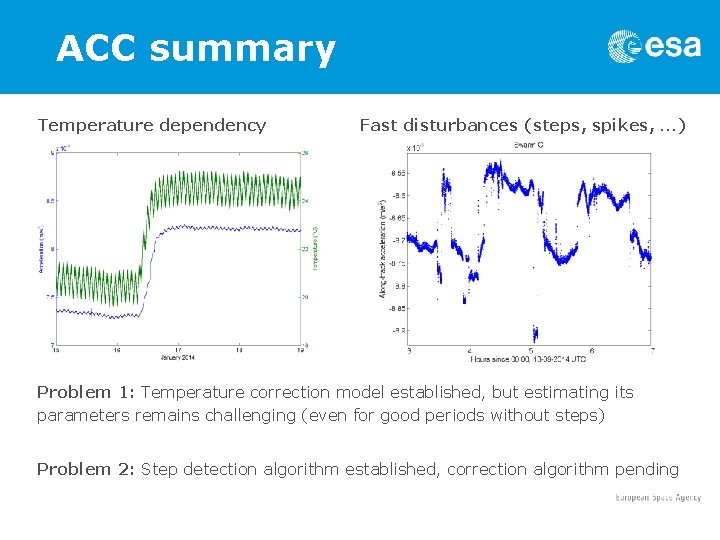
ACC summary Temperature dependency Fast disturbances (steps, spikes, …) Problem 1: Temperature correction model established, but estimating its parameters remains challenging (even for good periods without steps) Problem 2: Step detection algorithm established, correction algorithm pending
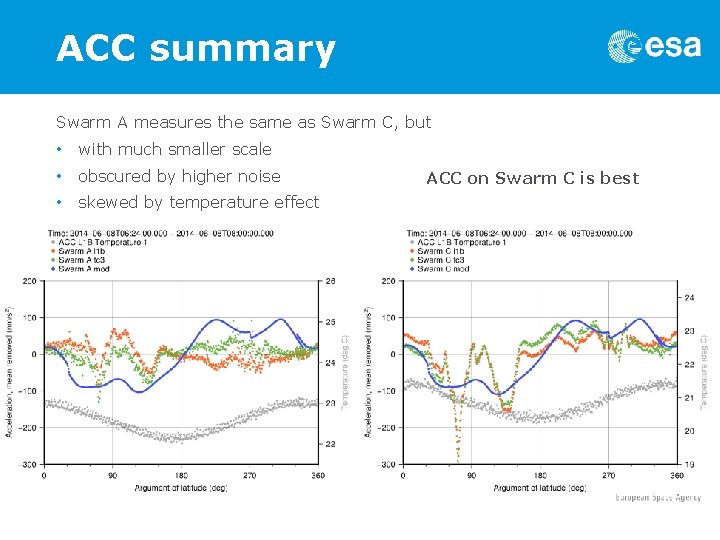
ACC summary Swarm A measures the same as Swarm C, but • with much smaller scale • obscured by higher noise • skewed by temperature effect ACC on Swarm C is best
ACC summary Way forward Processing • Use POD-derived accelerations in estimation of temperature correction Caveat: No possibility to validate temperature correction • Occurrence of spikes and steps in Swarm C seems to vary over time Investigate why good periods are good • For L 2 density product, focus on Swarm C ACC data Spacecraft • • Optimization of the ACC thermal environment Scale factor calibration by ACT activations (under discussion) Release L 1 b and/or L 2 data to cal/val users with flaws (discussion needed, user demand)
GPSR summary ESA UNCLASSIFIED – For Official Use
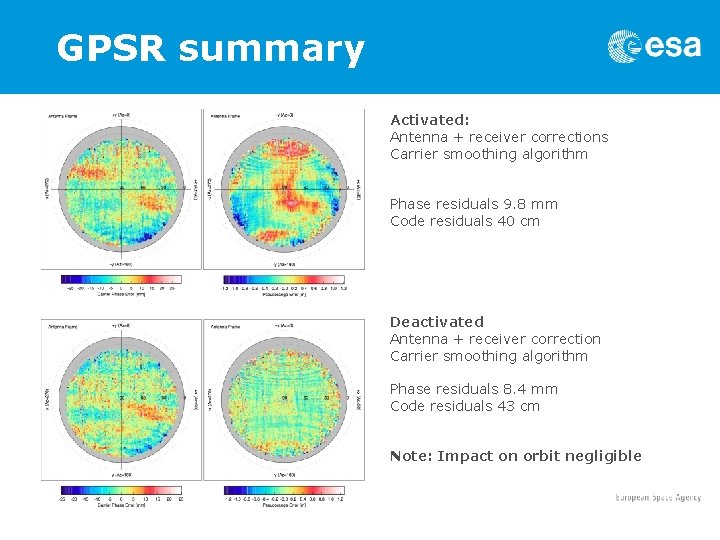
GPSR summary Activated: Antenna + receiver corrections Carrier smoothing algorithm Phase residuals 9. 8 mm Code residuals 40 cm Deactivated Antenna + receiver correction Carrier smoothing algorithm Phase residuals 8. 4 mm Code residuals 43 cm Note: Impact on orbit negligible
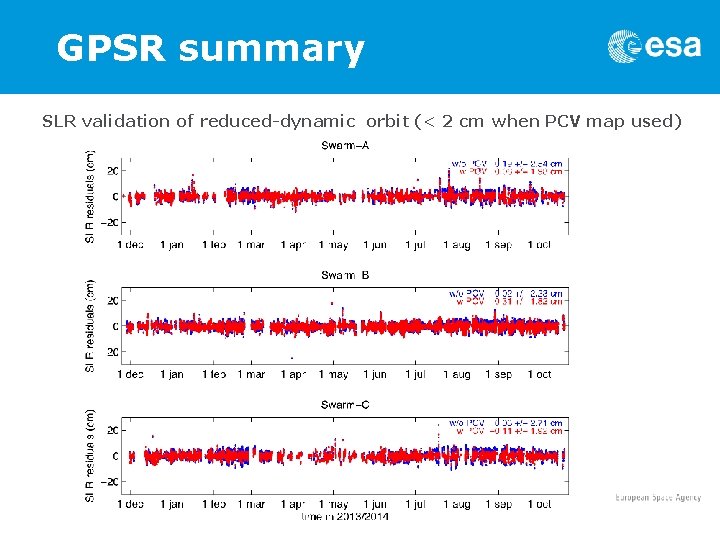
GPSR summary SLR validation of reduced-dynamic orbit (< 2 cm when PCV map used)
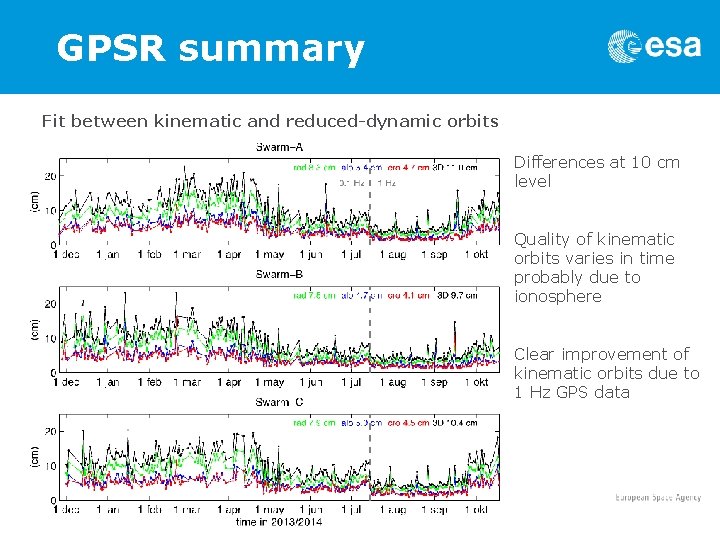
GPSR summary Fit between kinematic and reduced-dynamic orbits Differences at 10 cm level Quality of kinematic orbits varies in time probably due to ionosphere Clear improvement of kinematic orbits due to 1 Hz GPS data
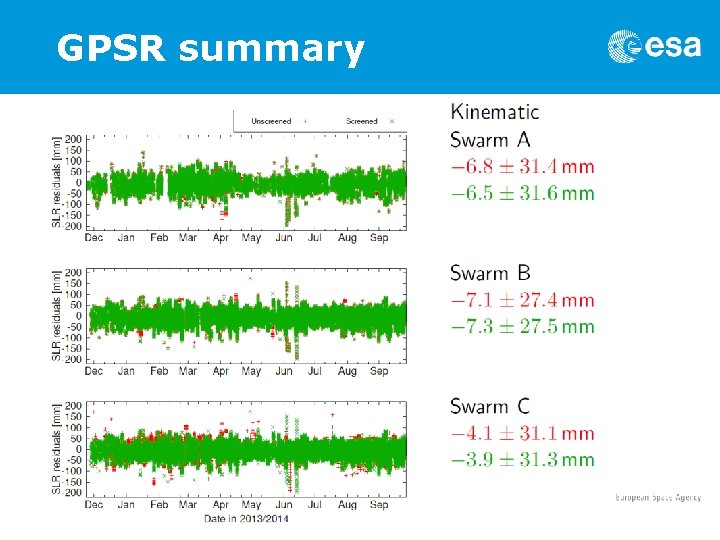
GPSR summary
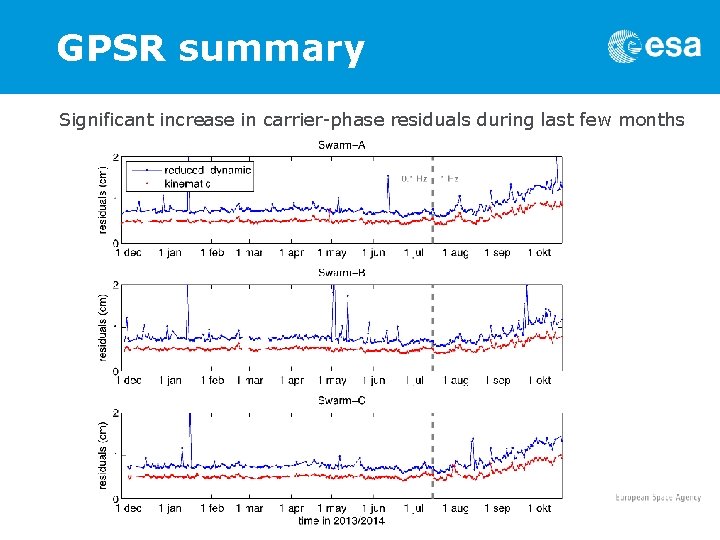
GPSR summary Significant increase in carrier-phase residuals during last few months
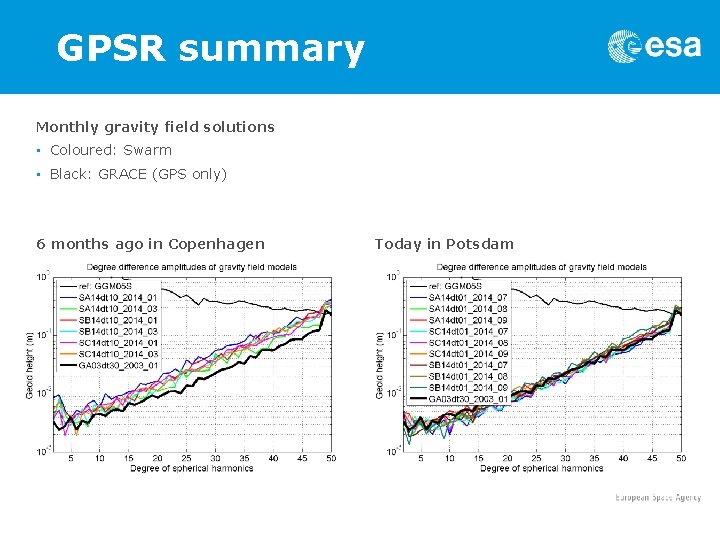
GPSR summary Monthly gravity field solutions • Coloured: Swarm • Black: GRACE (GPS only) 6 months ago in Copenhagen Today in Potsdam
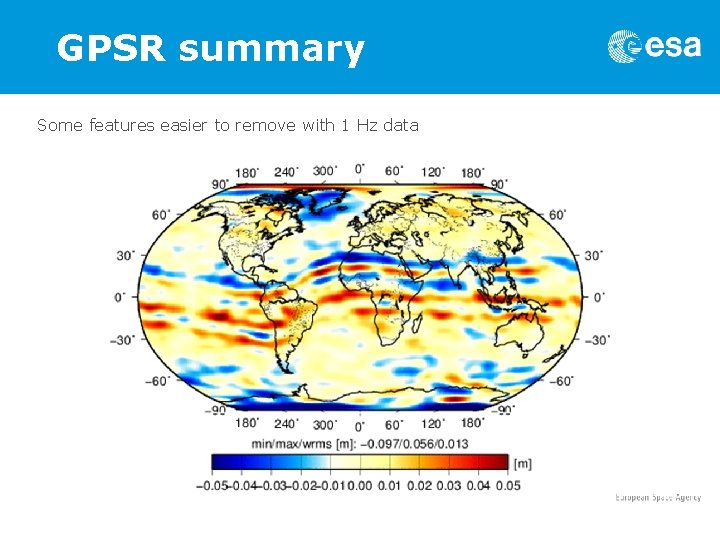
GPSR summary Some features easier to remove with 1 Hz data
GPSR summary • Swarm reduced-dynamic orbits are of good quality (SLR fit < 2 cm) • Quality of Swarm kinematic orbits is worse, especially close to geomagnetic poles and equator (3 D fit of ~10 cm with reduced-dynamic orbits) • Quality of Swarm kinematic orbits improves with 1 Hz GPS data • Large increase in GPS phase residuals during last few months probably related to ionospheric activity • Data screening of GPS data based on high ionospheric variability has only marginal effect on the orbit • Gravity field models benefited from better processing and receiver settings
GPSR summary Way forward Further optimization of receiver (under discussion) • • • Prevent Loss. Of. Sync events Continuous time information, in particular for ASM • Reduce the number of GPS SVs required to invoke the Kalman filter based PVT calculation from 3 to 1 • Activate the fast re‐acquisition of the L 1 carrier Orbit improvement • Increase the carrier loop bandwidth for the L 2 carrier tracking loop • Link between tracking loop bandwidth and antenna Fo. V Complexity of changes and system impact under investigation • Which changes can be implemented with/without interruption of nominal operations? (GPSR AOCS) Further improvement of processing