
SWANA Saskatchewan Landfill Capital and Operational Costs By
SWANA - Saskatchewan Landfill Capital and Operational Costs By Steve Johnson M. Eng. , P. Eng. November 2015
Introduction • Saskatchewan Tipping Fee Ranges • Landfill Siting and Design Assumptions • Range of Operational Costs Assumptions – audience participation • Tipping Fee Calculation Development • Solid Waste Management Plan • Questions SWANA November 2015 Page 2
Saskatchewan Tipping Fee Ranges • Poll of room for tipping fees • From Internet search larger municipal landfills, with scales, charge $60 to $90 per tonne • Smaller municipal landfills, without a scale, charge by the load so can not compare to cost per tonne SWANA November 2015 Page 3
Fictional Landfill – Siting and Design Assumptions • One quarter section appropriately sited and designed • the following design criteria have been used to develop the airspace: – 25% (4 horizontal to 1 vertical) grade on waste side slopes, to a height of approximately 15 m; – 5% minimum grade on top of the landfill; – 1, 825, 000 m 3 of airspace (1, 369, 000 tonnes) • Landfill Design Infrastructure – – – 1. 0 m compacted clay liner (least cost option) a tireshred leachate collection system (least cost option) Stormwater pond Leachate pond Scale house and maintenance building Front end transfer area and recycle area • Miscellaneous – Contingency, legal appeals, regulatory applications, land purchase, power and utilities, engineering Notes: 1) that capping not included in with Capital estimate 2) New and expanding landfill should develop a landfill Master Plan to outline the staged development of the landfill for regulatory and budgeting purposes. SWANA November 2015 Page 4
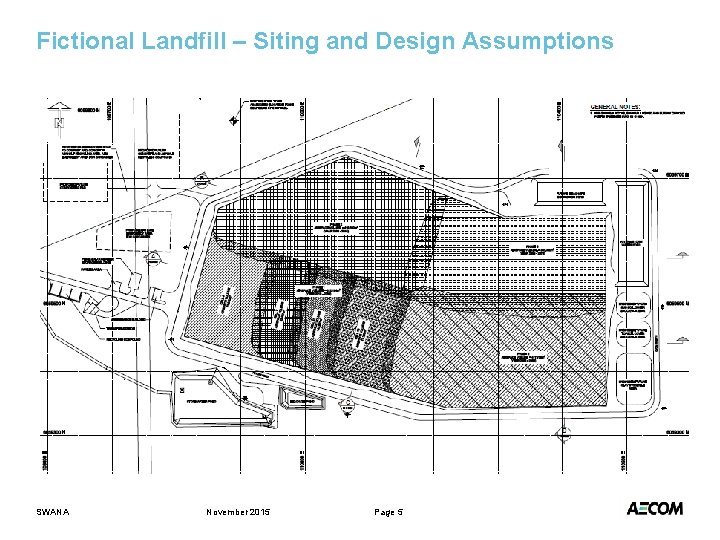
Fictional Landfill – Siting and Design Assumptions SWANA November 2015 Page 5
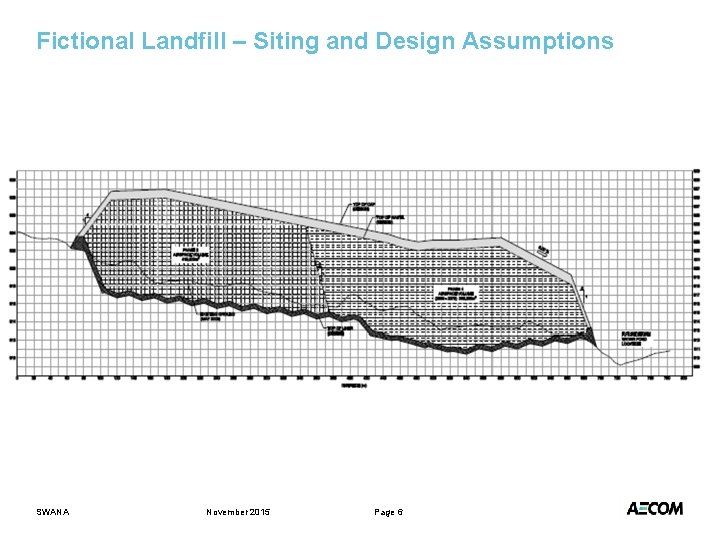
Fictional Landfill – Siting and Design Assumptions SWANA November 2015 Page 6
Fictional Landfill – Capital Costs Assumptions • Estimate all landfill capital costs in 2015 dollars. • Developed for low and high range for costs Capital Costs SWANA November 2015 Page 7
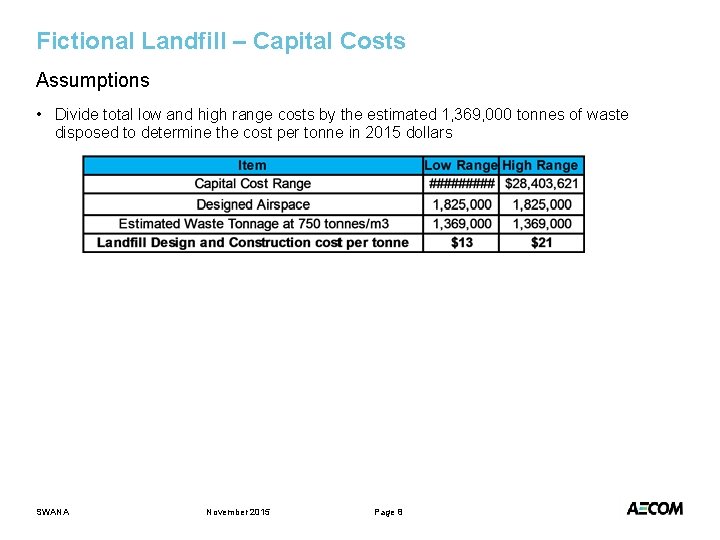
Fictional Landfill – Capital Costs Assumptions • Divide total low and high range costs by the estimated 1, 369, 000 tonnes of waste disposed to determine the cost per tonne in 2015 dollars SWANA November 2015 Page 8
Fictional Landfill – Operational Costs Assumptions • Three case scenario`s for landfills taking 5, 000 tonnes per year, 10, 000 tonnes per year, and 20, 000 tonnes per year • Equipment – varied capital depreciation expense on hours and capital cost – Compactor – Dozer – Wheel loader • Personnel – varied hours and vested hourly rates – – Equipment operator Scale operator Manager Laborer • Operations costs – – – SWANA Soil moving (cover) Leachate disposal/treatment (assumed annual leachate generation and disposal cost range) Environmental monitoring Closure costs (capping) Post-closure costs (25 years of environmental monitoring) Steve Johnsons - spreaksheet - SWANA 2015 - Regional System Landfill Capital and Operational Costs. xls November 2015 Page 9
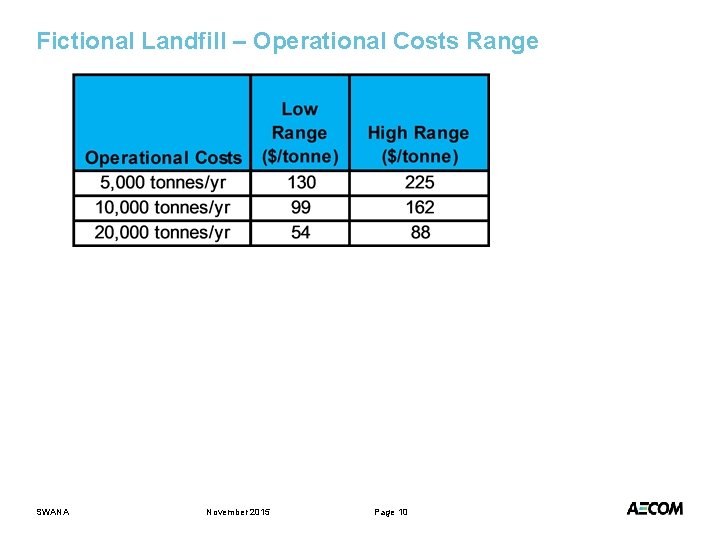
Fictional Landfill – Operational Costs Range SWANA November 2015 Page 10
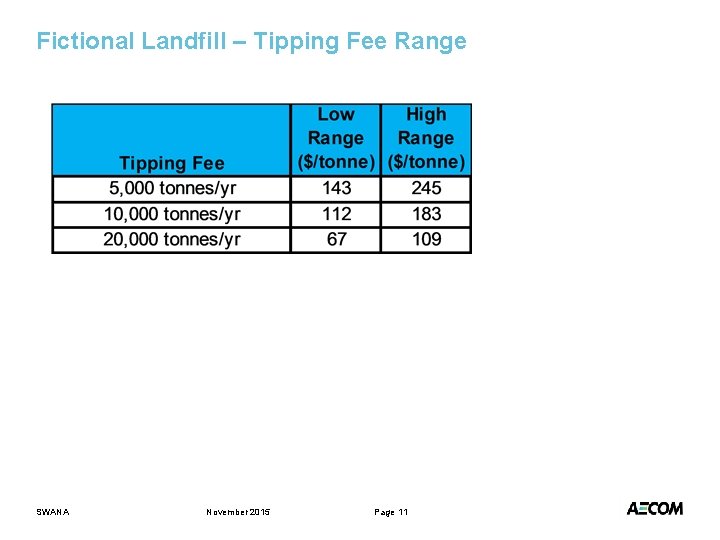
Fictional Landfill – Tipping Fee Range SWANA November 2015 Page 11
Setting the Stage – Solid Waste Management Plan • Other regulatory jurisdictions have implemented solid waste management plans for waste disposal and diversion programs. • A solid waste management plan, where several municipalities can form an ‘organization’ to manage their waste more effectively. Factors to consider area: – – – – transportation corridors Existing waste infrastructure (airspace, capacity, age, maintenance, etc. ) Geology Population Politics Regulatory Public • Regulatory and public impetus to increase diversion, find alternative ways to manage waste, resistance to siting new landfills, more stringent landfill design and operations requirements, reduce tax or waste management fee, market value for recyclables, etc. SWANA November 2015 Page 12
Jurisdictions that have SWMPs • British Columbia – Environmental Waste Management Act required SWMP – Guide to the Preparation of Regional Solid Waste Management Plans by Regional Districts • Ontario – Legislation requiring recycling and diversion – Has a 2007 Policy Statement on Waste Management Planning: Best Practices for Waste Managers to plan for waste management needs over the next 20 to 25 years and obtain 60% diversion – Funding available to develop plan ($15 K) – Is not mandatory • Nova Scotia – – – SWANA Provincial Act requires SWMP (2007 Act – 300 kg/capita/yr disposal target) Developed provincial material bans Set up a resource recovery fund Established EPR programs (e-waste, tires, beverage containers, lead acid batteries, paints/solvents) Required municipalities to develop SWMP and provided financial assistance November 2015 Page 13
SWMP Components • Inventory and description of all solid waste handling facilities and future needs • Estimate of long range needs for a minimum of 20 years • Program for the development of solid waste facilities • Considerations for land use planning • Financial plan for the next 6 years for the facilities • Financial assessment for the capital and operational expenditures for the next six years • Program for surveillance and control • Comprehensive waste reduction and recycling strategy • Inventory and assessment of waste collection needs for the next six years. SWANA November 2015 Page 14
SWMP – Potential Results • Increased diversion from landfill and WTE to meet provincial diversion targets • Operational efficiency • Better use of solid waste resources and infrastructure • Possible reduction in capital or operational costs SWANA November 2015 Page 15
Questions SWANA November 2015 Page 16

Thank You.
- Slides: 17