
SVT Calibration and STI tracking status An update

SVT Calibration and STI tracking status An update of work since the SVT review and the STAR upgrades meeting STAR Collaboration Meeting Rene Bellwied – Wayne State University July 2004
An update of work since the SVT review and the STAR upgrades meeting STAR Collaboration Meeting Rene Bellwied – Wayne State University July 2004
SVT Calibration and STI tracking status An update of work since the SVT review and the STAR upgrades meeting STAR Collaboration Meeting Rene Bellwied – Wayne State University July 2004
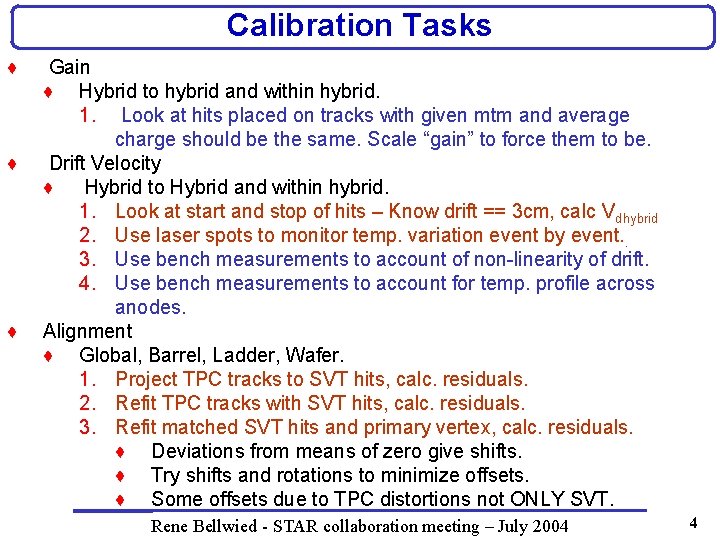
Calibration Tasks ♦ ♦ ♦ Gain ♦ Hybrid to hybrid and within hybrid. 1. Look at hits placed on tracks with given mtm and average charge should be the same. Scale “gain” to force them to be. Drift Velocity ♦ Hybrid to Hybrid and within hybrid. 1. Look at start and stop of hits – Know drift == 3 cm, calc Vdhybrid 2. Use laser spots to monitor temp. variation event by event. . 3. Use bench measurements to account of non-linearity of drift. 4. Use bench measurements to account for temp. profile across anodes. Alignment ♦ Global, Barrel, Ladder, Wafer. 1. Project TPC tracks to SVT hits, calc. residuals. 2. Refit TPC tracks with SVT hits, calc. residuals. 3. Refit matched SVT hits and primary vertex, calc. residuals. ♦ Deviations from means of zero give shifts. ♦ Try shifts and rotations to minimize offsets. ♦ Some offsets due to TPC distortions not ONLY SVT. Rene Bellwied - STAR collaboration meeting – July 2004 4
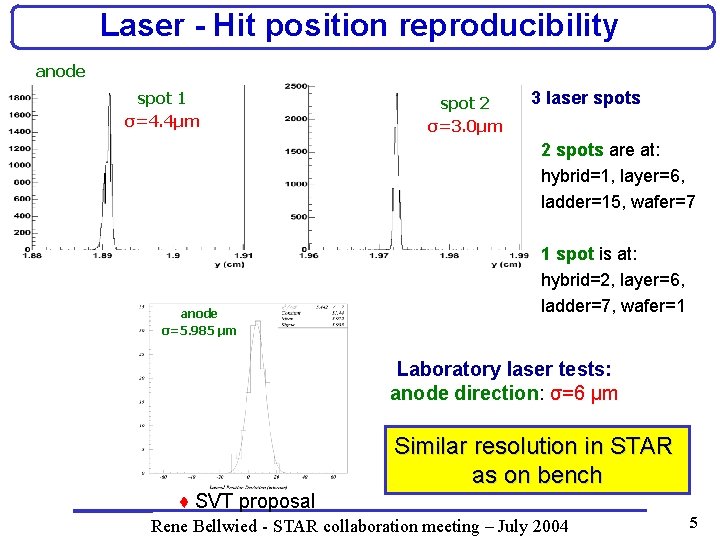
Laser - Hit position reproducibility anode spot 1 σ=4. 4μm spot 2 σ=3. 0μm 3 laser spots 2 spots are at: hybrid=1, layer=6, ladder=15, wafer=7 anode σ=5. 985 μm 1 spot is at: hybrid=2, layer=6, ladder=7, wafer=1 Laboratory laser tests: anode direction: σ=6 μm Similar resolution in STAR as on bench ♦ SVT proposal Rene Bellwied - STAR collaboration meeting – July 2004 5
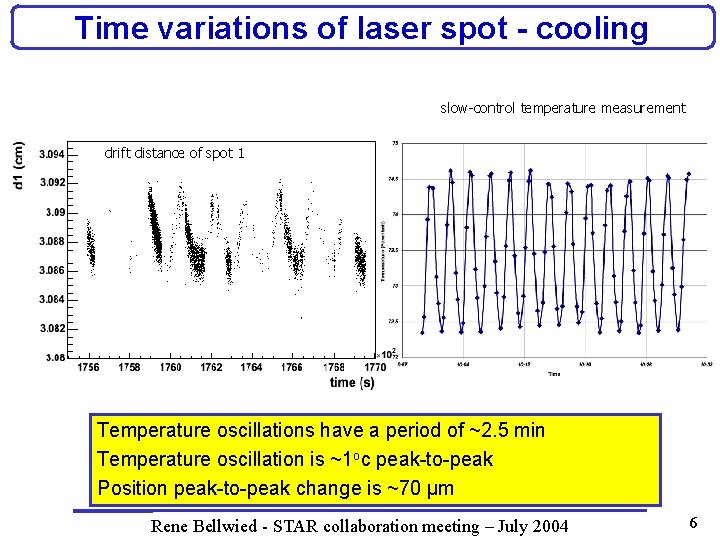
Time variations of laser spot - cooling slow-control temperature measurement drift distance of spot 1 Temperature oscillations have a period of ~2. 5 min Temperature oscillation is ~1 oc peak-to-peak Position peak-to-peak change is ~70 μm Rene Bellwied - STAR collaboration meeting – July 2004 6
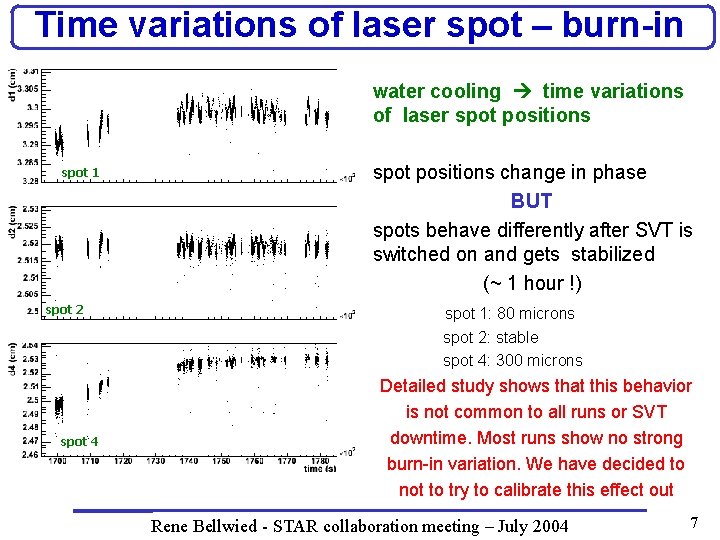
Time variations of laser spot – burn-in water cooling time variations of laser spot positions spot 1 spot 2 spot 4 spot positions change in phase BUT spots behave differently after SVT is switched on and gets stabilized (~ 1 hour !) spot 1: 80 microns spot 2: stable spot 4: 300 microns Detailed study shows that this behavior is not common to all runs or SVT downtime. Most runs show no strong burn-in variation. We have decided to not to try to calibrate this effect out Rene Bellwied - STAR collaboration meeting – July 2004 7
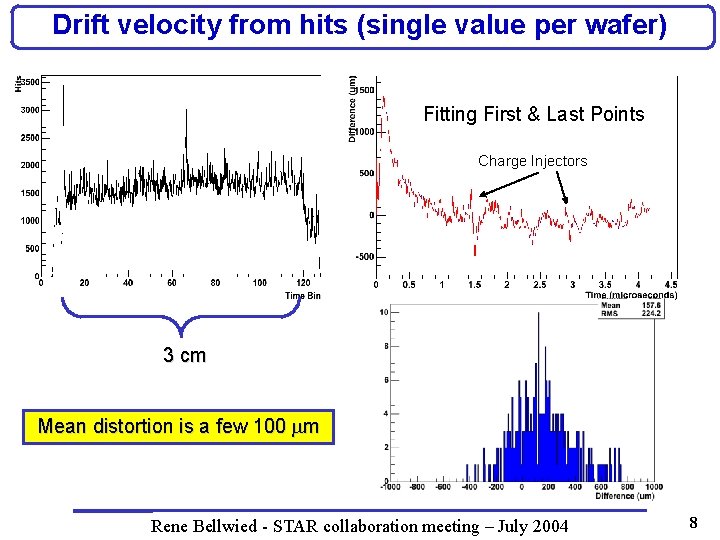
Drift velocity from hits (single value per wafer) Fitting First & Last Points Charge Injectors 3 cm Mean distortion is a few 100 mm Rene Bellwied - STAR collaboration meeting – July 2004 8
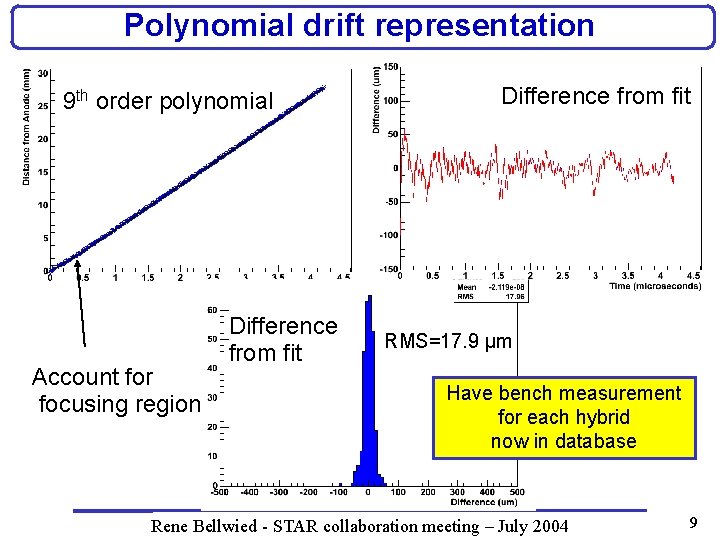
Polynomial drift representation 9 th order polynomial Account for focusing region Difference from fit RMS=17. 9 µm Have bench measurement for each hybrid now in database Rene Bellwied - STAR collaboration meeting – July 2004 9
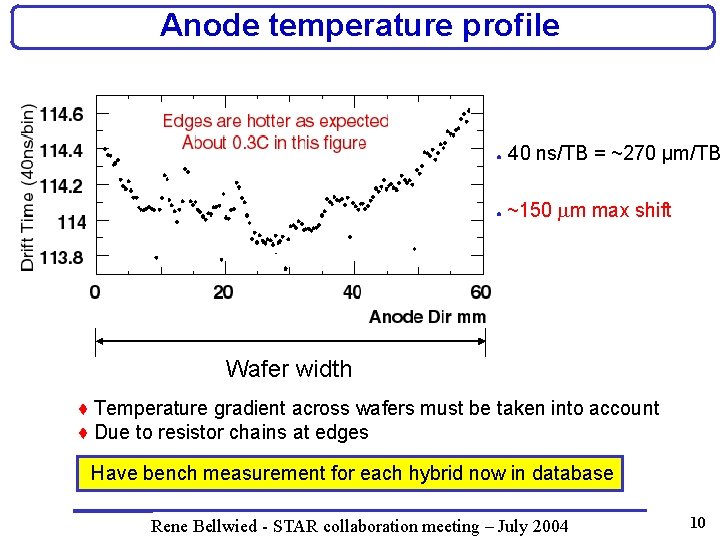
Anode temperature profile ● 40 ns/TB = ~270 µm/TB ● ~150 mm max shift Wafer width ♦ Temperature gradient across wafers must be taken into account ♦ Due to resistor chains at edges Have bench measurement for each hybrid now in database Rene Bellwied - STAR collaboration meeting – July 2004 10

Alignment We seek for 6 parameters that must be adjusted in order to have the SVT aligned to the TPC: u x shift u y shift u z shift u xy rotation u xz rotation u yz rotation Have to calculate for each wafer – 216 in total The Question ♦ How to disentangle and extract them without ambiguity from the data? ♦ Many approaches are possible. We are using two of them. . . Rene Bellwied - STAR collaboration meeting – July 2004 11
The two approaches First approach: u Calculate the “residuals” between the projections of TPC tracks and the closest SVT hit in a particular wafer. u Advantage: l u can be done immediately TPC calibration is OK (not final), even without B=0 data. Disadvantage: l l highly dependent on TPC calibration. the width of these “residuals” distributions and therefore the precision of the procedure is determined by the projection resolution. Second approach: u Use only SVT hits in order to perform a self-alignment of the detector. u Advantage: a better precision can be achieved. l does not depend on TPC calibration. l u Disadvantage: it is harder to disentangle the various degrees of freedom of the detector (need to use primary vertex as an external reference). l depends on B=0 data (can take longer to get started). l Rene Bellwied - STAR collaboration meeting – July 2004 12
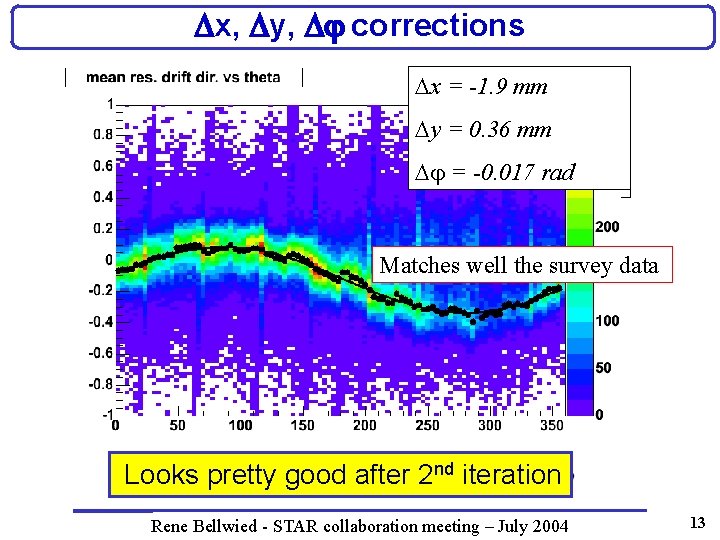
Dx, Dy, Dj corrections -1. 9 mm mm x x==-0. 25 0. 36 mm mm y y==0. 10 ==-0. 0018 -0. 017 rad Matches well the survey data Looks pretty good after 2 nd iteration Rene Bellwied - STAR collaboration meeting – July 2004 13
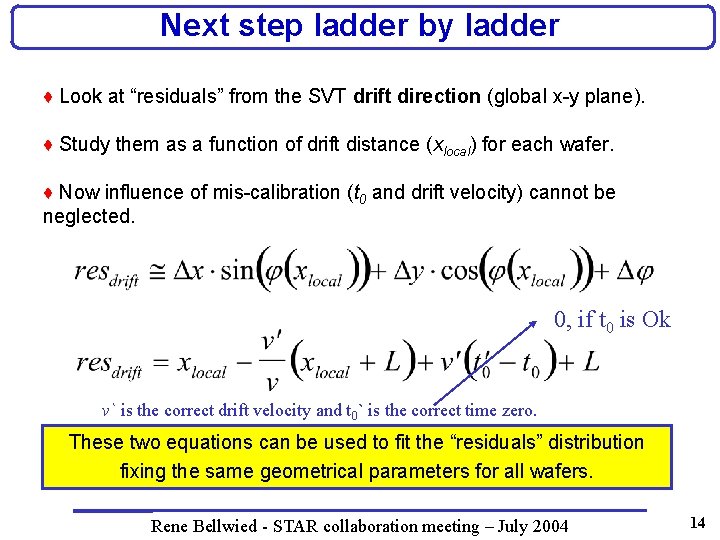
Next step ladder by ladder ♦ Look at “residuals” from the SVT drift direction (global x-y plane). ♦ Study them as a function of drift distance (xlocal) for each wafer. ♦ Now influence of mis-calibration (t 0 and drift velocity) cannot be neglected. 0, if t 0 is Ok v` is the correct drift velocity and t 0` is the correct time zero. These two equations can be used to fit the “residuals” distribution fixing the same geometrical parameters for all wafers. Rene Bellwied - STAR collaboration meeting – July 2004 14
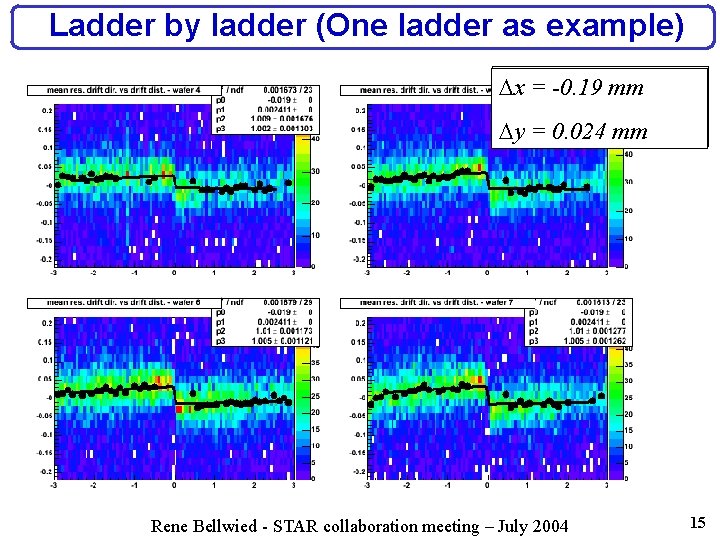
Ladder by ladder (One ladder as example) -0. 81 mm x = -0. 19 0. 56 mm y = 0. 024 mm Rene Bellwied - STAR collaboration meeting – July 2004 15
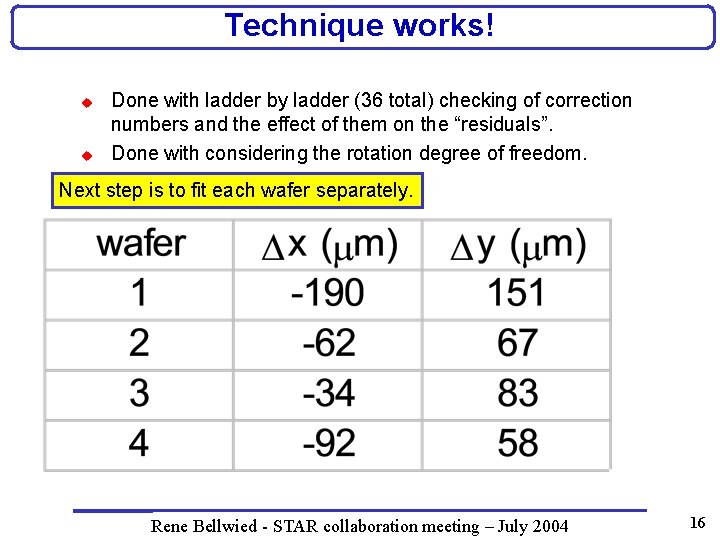
Technique works! u u Done with ladder by ladder (36 total) checking of correction numbers and the effect of them on the “residuals”. Done with considering the rotation degree of freedom. Next step is to fit each wafer separately. Rene Bellwied - STAR collaboration meeting – July 2004 16
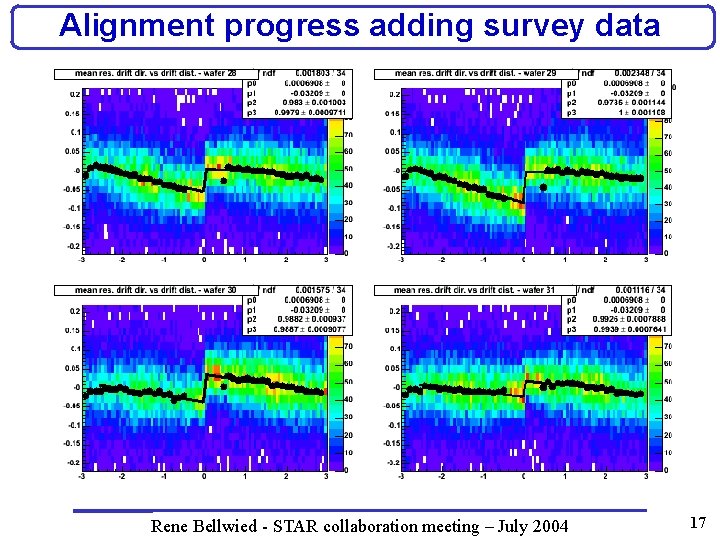
Alignment progress adding survey data Rene Bellwied - STAR collaboration meeting – July 2004 17
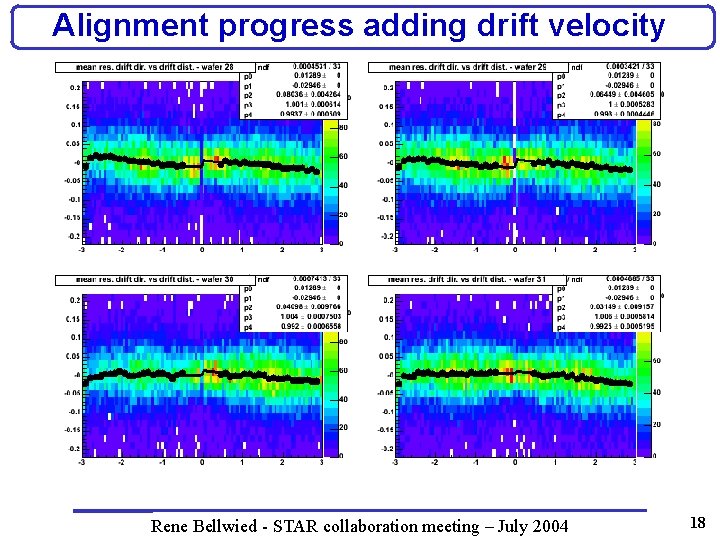
Alignment progress adding drift velocity Rene Bellwied - STAR collaboration meeting – July 2004 18
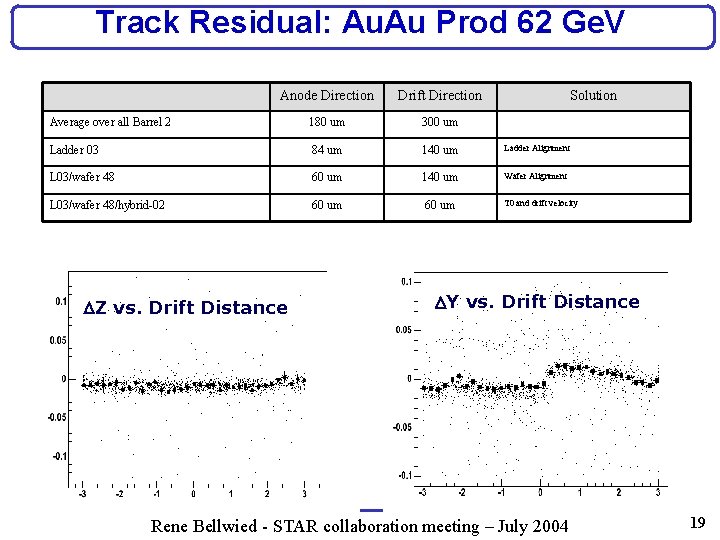
Track Residual: Au. Au Prod 62 Ge. V Anode Direction Drift Direction Average over all Barrel 2 180 um 300 um Ladder 03 84 um 140 um Ladder Alignment L 03/wafer 48 60 um 140 um Wafer Alignment L 03/wafer 48/hybrid-02 60 um DZ vs. Drift Distance Solution T 0 and drift velocity DY vs. Drift Distance Rene Bellwied - STAR collaboration meeting – July 2004 19
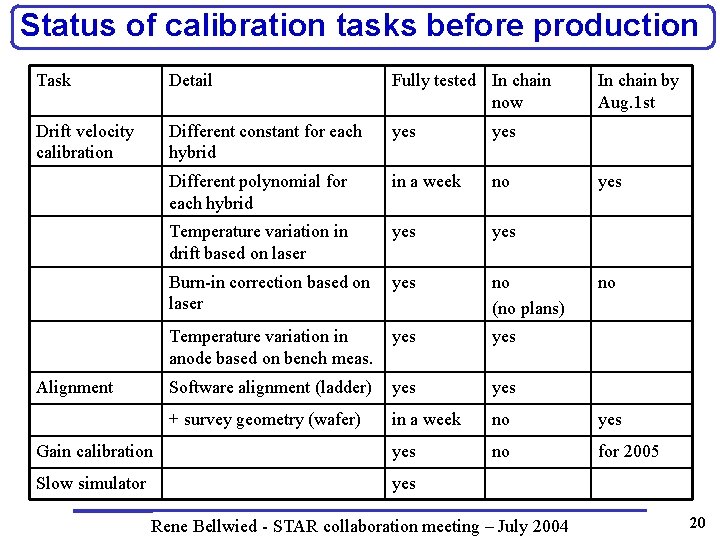
Status of calibration tasks before production Task Detail Fully tested In chain now Drift velocity calibration Different constant for each hybrid yes Different polynomial for each hybrid in a week no Temperature variation in drift based on laser yes Burn-in correction based on laser yes no (no plans) Temperature variation in anode based on bench meas. yes Software alignment (ladder) yes + survey geometry (wafer) in a week no yes Gain calibration yes no for 2005 Slow simulator yes Alignment Rene Bellwied - STAR collaboration meeting – July 2004 In chain by Aug. 1 st yes no 20
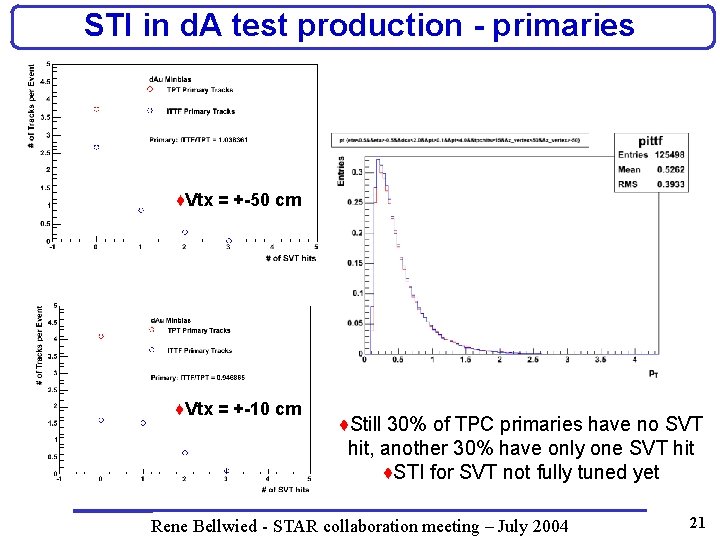
STI in d. A test production - primaries ♦Vtx = +-50 cm ♦Vtx = +-10 cm ♦Still 30% of TPC primaries have no SVT hit, another 30% have only one SVT hit ♦STI for SVT not fully tuned yet Rene Bellwied - STAR collaboration meeting – July 2004 21
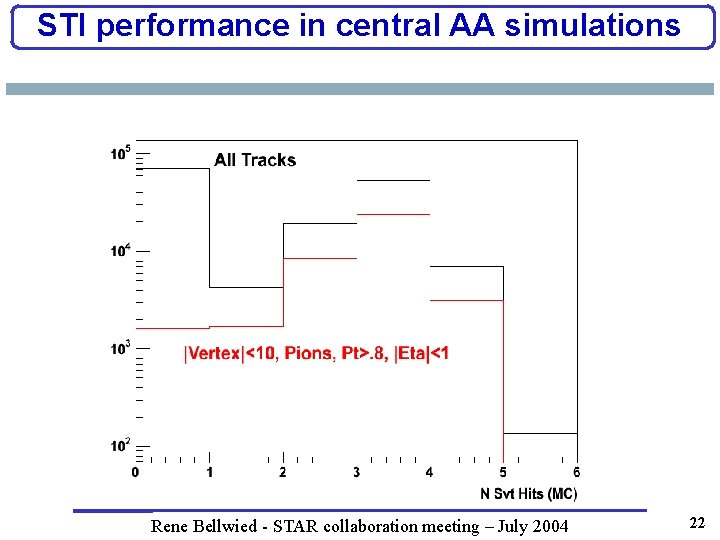
STI performance in central AA simulations Rene Bellwied - STAR collaboration meeting – July 2004 22
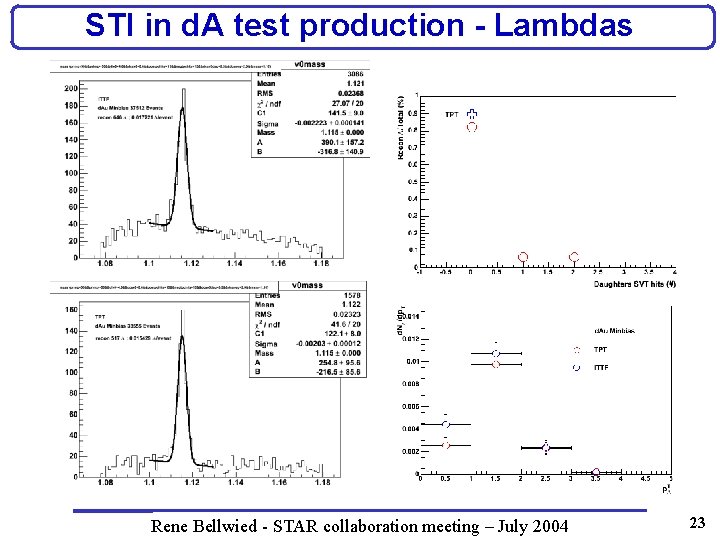
STI in d. A test production - Lambdas Rene Bellwied - STAR collaboration meeting – July 2004 23
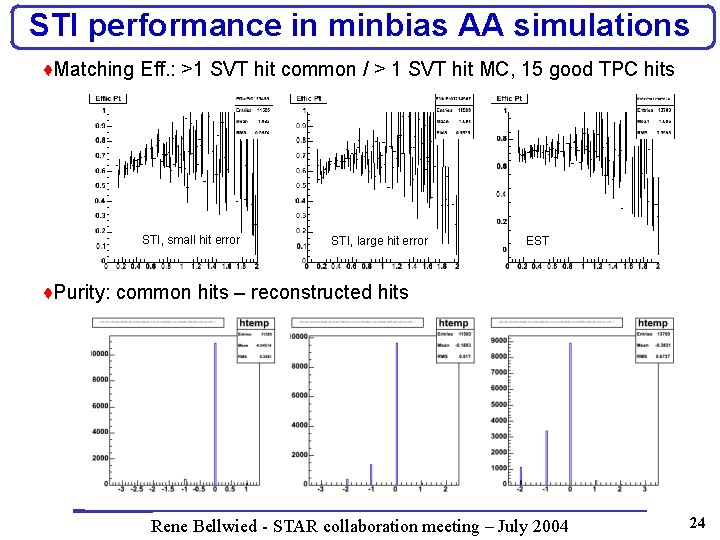
STI performance in minbias AA simulations ♦Matching Eff. : >1 SVT hit common / > 1 SVT hit MC, 15 good TPC hits STI, small hit error STI, large hit error EST ♦Purity: common hits – reconstructed hits Rene Bellwied - STAR collaboration meeting – July 2004 24
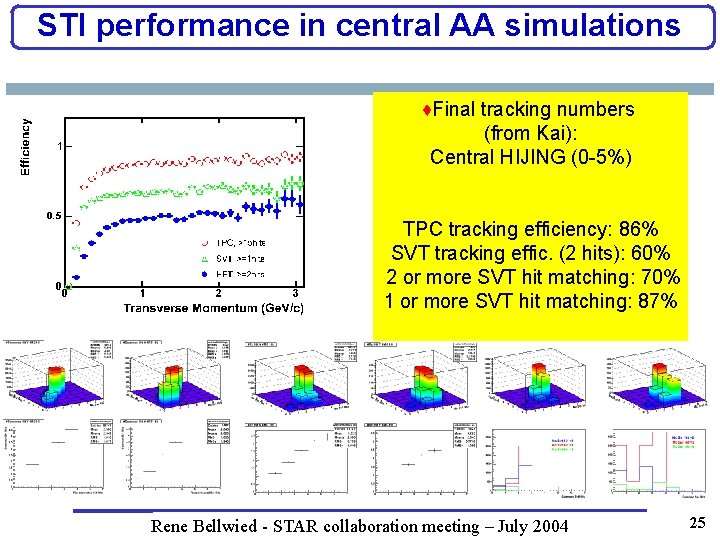
STI performance in central AA simulations ♦Final tracking numbers (from Kai): Central HIJING (0 -5%) TPC tracking efficiency: 86% SVT tracking effic. (2 hits): 60% 2 or more SVT hit matching: 70% 1 or more SVT hit matching: 87% ♦Purity: Com. vs. RC ♦Efficiency: RC vs. MC ♦Efficiency: SVT hits vs MC Rene Bellwied - STAR collaboration meeting – July 2004 25
STI performance summary 1. ) The number of SVT hits assigned to the TPC track is low in central AA simulations, and to some extent in the d. A production. Need to find the reason. (geometry problem ? ) 2. ) The purity of SVT hits assigned to the TPC tracks is very high. 3. ) minbias AA simulations show that the STI performance is presently comparable to EST in terms of momentum resolution and efficiency and superior to EST in terms of purity when small hit errors for the SVT are used in the STI tracking. 4. ) we will continue to tune the STI-SVT tracking parameters until the production starts. Present level of performance is sufficient when compared to EST. Rene Bellwied - STAR collaboration meeting – July 2004 26
Are we ready to go ? 1. ) we need about 2 -3 more weeks to finish all necessary calibration and alignment steps. 2. ) we will use that time also to continue further tuning of the SVT tracking parameters in STI. We expect to be ready by August 1 st. Rene Bellwied - STAR collaboration meeting – July 2004 27
- Slides: 27