
SVMC Emergency Department Handoff Reinforcement Using SBAR Casey
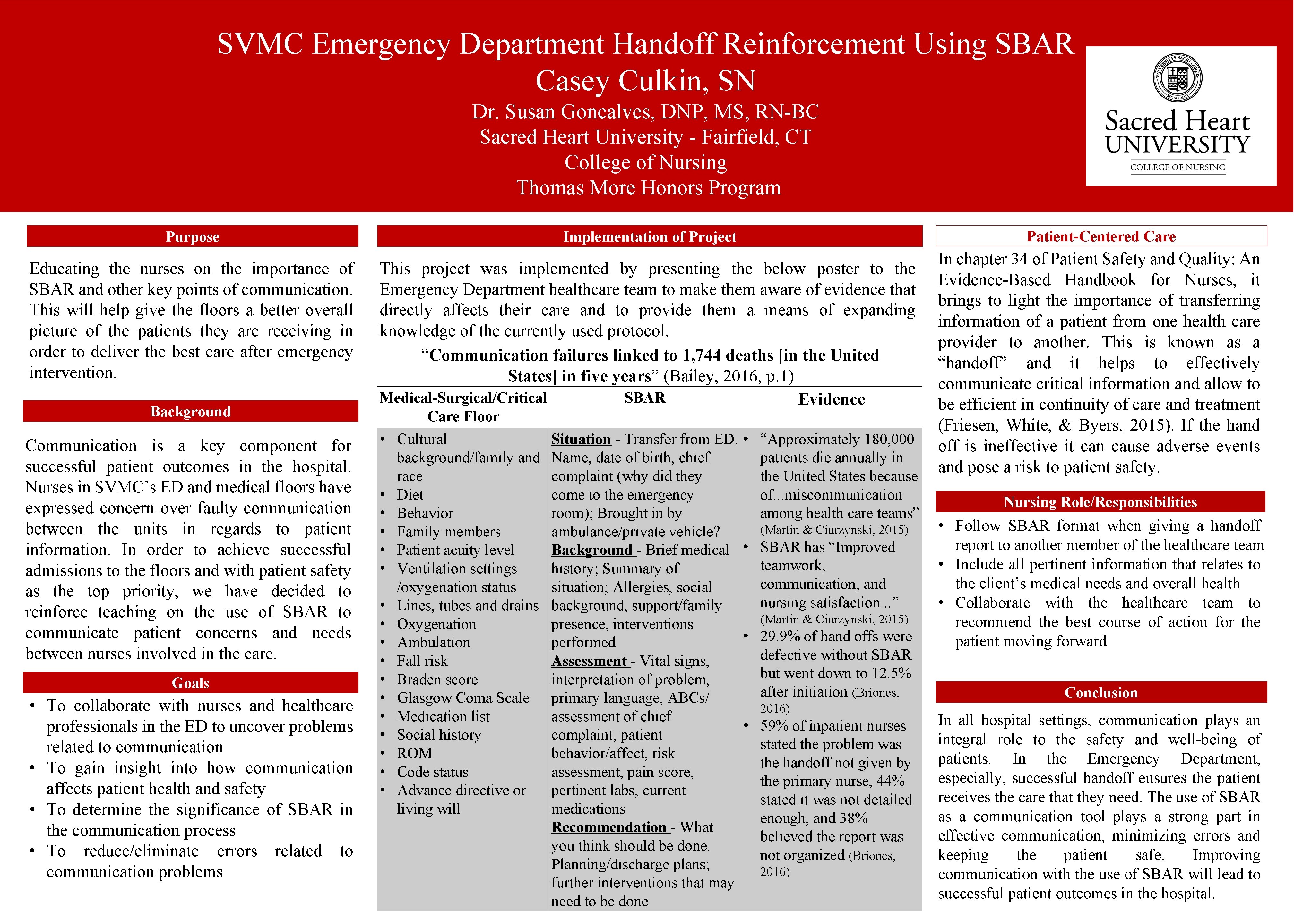
SVMC Emergency Department Handoff Reinforcement Using SBAR Casey Culkin, SN Dr. Susan Goncalves, DNP, MS, RN-BC Sacred Heart University - Fairfield, CT College of Nursing Thomas More Honors Program Purpose Educating the nurses on the importance of SBAR and other key points of communication. This will help give the floors a better overall picture of the patients they are receiving in order to deliver the best care after emergency intervention. Background Communication is a key component for successful patient outcomes in the hospital. Nurses in SVMC’s ED and medical floors have expressed concern over faulty communication between the units in regards to patient information. In order to achieve successful admissions to the floors and with patient safety as the top priority, we have decided to reinforce teaching on the use of SBAR to communicate patient concerns and needs between nurses involved in the care. Goals • To collaborate with nurses and healthcare professionals in the ED to uncover problems related to communication • To gain insight into how communication affects patient health and safety • To determine the significance of SBAR in the communication process • To reduce/eliminate errors related to communication problems Patient-Centered Care Implementation of Project This project was implemented by presenting the below poster to the Emergency Department healthcare team to make them aware of evidence that directly affects their care and to provide them a means of expanding knowledge of the currently used protocol. “Communication failures linked to 1, 744 deaths [in the United States] in five years” (Bailey, 2016, p. 1) Medical-Surgical/Critical SBAR Evidence • • • • • Care Floor Cultural background/family and race Diet Behavior Family members Patient acuity level Ventilation settings /oxygenation status Lines, tubes and drains Oxygenation Ambulation Fall risk Braden score Glasgow Coma Scale Medication list Social history ROM Code status Advance directive or living will Situation - Transfer from ED. Name, date of birth, chief complaint (why did they come to the emergency room); Brought in by ambulance/private vehicle? Background - Brief medical history; Summary of situation; Allergies, social background, support/family presence, interventions performed Assessment - Vital signs, interpretation of problem, primary language, ABCs/ assessment of chief complaint, patient behavior/affect, risk assessment, pain score, pertinent labs, current medications Recommendation - What you think should be done. Planning/discharge plans; further interventions that may need to be done • “Approximately 180, 000 patients die annually in the United States because of. . . miscommunication among health care teams” (Martin & Ciurzynski, 2015) • SBAR has “Improved teamwork, communication, and nursing satisfaction. . . ” (Martin & Ciurzynski, 2015) • 29. 9% of hand offs were defective without SBAR but went down to 12. 5% after initiation (Briones, 2016) • 59% of inpatient nurses stated the problem was the handoff not given by the primary nurse, 44% stated it was not detailed enough, and 38% believed the report was not organized (Briones, 2016) In chapter 34 of Patient Safety and Quality: An Evidence-Based Handbook for Nurses, it brings to light the importance of transferring information of a patient from one health care provider to another. This is known as a “handoff” and it helps to effectively communicate critical information and allow to be efficient in continuity of care and treatment (Friesen, White, & Byers, 2015). If the hand off is ineffective it can cause adverse events and pose a risk to patient safety. Nursing Role/Responsibilities • Follow SBAR format when giving a handoff report to another member of the healthcare team • Include all pertinent information that relates to the client’s medical needs and overall health • Collaborate with the healthcare team to recommend the best course of action for the patient moving forward Conclusion In all hospital settings, communication plays an integral role to the safety and well-being of patients. In the Emergency Department, especially, successful handoff ensures the patient receives the care that they need. The use of SBAR as a communication tool plays a strong part in effective communication, minimizing errors and keeping the patient safe. Improving communication with the use of SBAR will lead to successful patient outcomes in the hospital.
- Slides: 1