
SUTURE MATERIALS AND RECENT WOUND CLOSURE TECHNIQUES Department








- Slides: 34
SUTURE MATERIALS AND RECENT WOUND CLOSURE TECHNIQUES Department of Oral and Maxillofacial Surgery Dentistry Explorer
CONTENTS • • Introduction to suture materials Goals Principles of suture selection Classification of suture Suture needles Wound closure techniques References Dentistry Explorer
INTRODUCTION • Suture is a stitch/series of Stitches made to secure apposition of the edges of a surgical/traumatic wound • Any surgical procedure involves the creation of a wound and subsequent closure by repositioning or reapproximating and securing the surgical flaps by suturing to allow optimum healing Dentistry Explorer
GOALS • Provide an adequate tension of wound closure without dead space but loose enough to obviate tissue ischemia and necrosis • Maintain hemostasis • Permit primary intention healing Dentistry Explorer
• Provide support for tissue margins until they have healed and the support is no longer needed • Reduce postoperative pain • Prevent bone exposure resulting in delayed healing and unnecessary resorption Dentistry Explorer
PRINCIPLES OF SUTURE SELECTION • Healing characteristics of the tissues, which are to be approximated • Thickness of the tissues to be sutured • Physical and biological properties of the suture materials Dentistry Explorer
• Condition of the wound to be closed • Probable post-operative course of the patient • Interaction between the suture material and tissues Dentistry Explorer
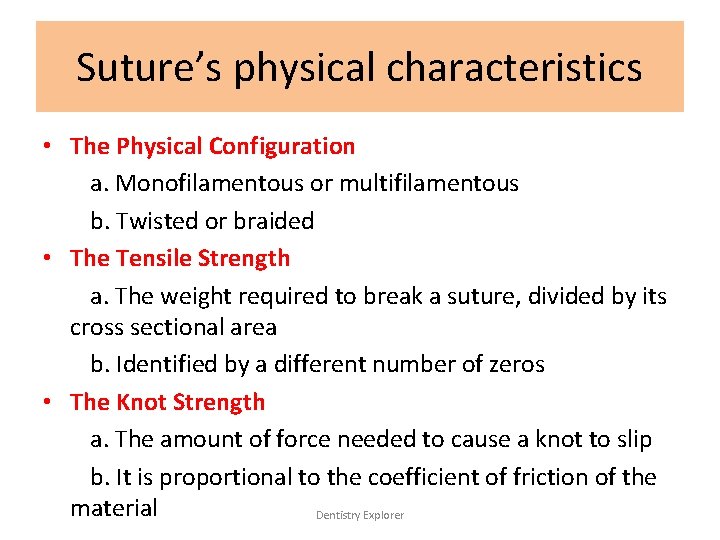
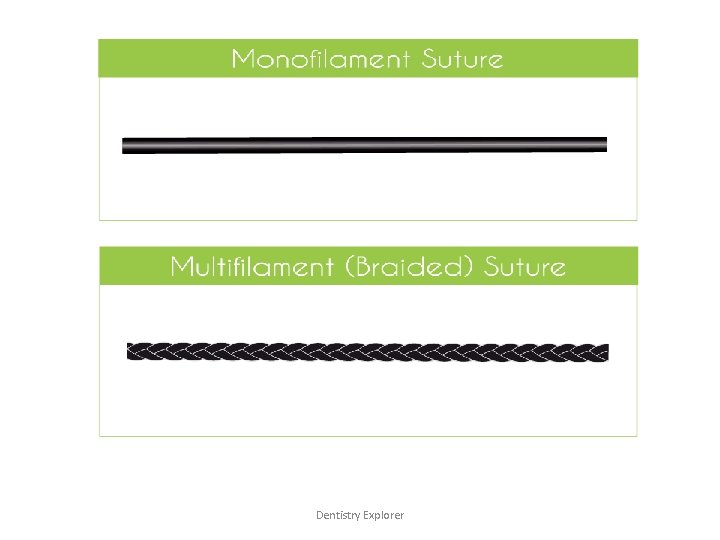
Suture’s physical characteristics • The Physical Configuration a. Monofilamentous or multifilamentous b. Twisted or braided • The Tensile Strength a. The weight required to break a suture, divided by its cross sectional area b. Identified by a different number of zeros • The Knot Strength a. The amount of force needed to cause a knot to slip b. It is proportional to the coefficient of friction of the material Dentistry Explorer
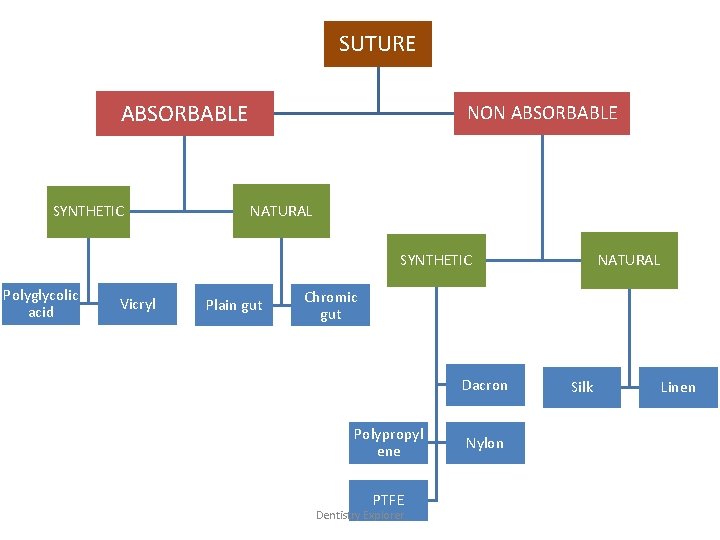
SUTURE ABSORBABLE SYNTHETIC NON ABSORBABLE NATURAL SYNTHETIC Polyglycolic acid Vicryl Plain gut Chromic gut Dacron Polypropyl ene PTFE Dentistry Explorer Nylon Silk Linen
Dentistry Explorer
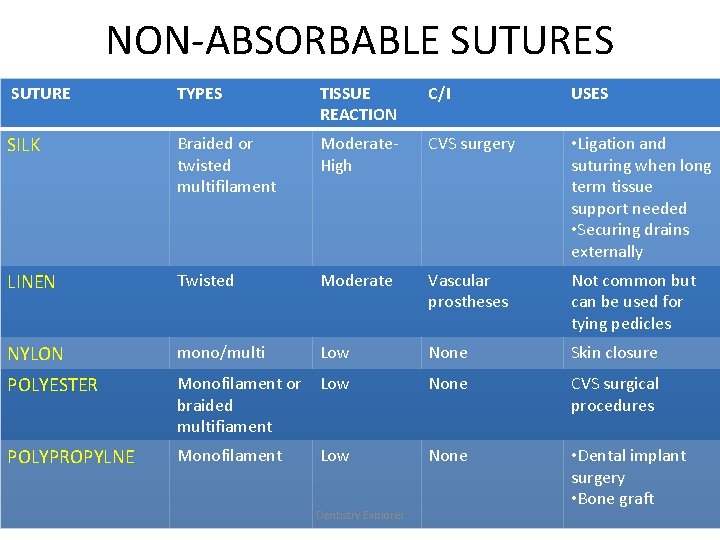
NON-ABSORBABLE SUTURES SUTURE TYPES TISSUE REACTION C/I USES SILK Braided or twisted multifilament Moderate. High CVS surgery • Ligation and suturing when long term tissue support needed • Securing drains externally LINEN Twisted Moderate Vascular prostheses Not common but can be used for tying pedicles NYLON mono/multi Low None Skin closure POLYESTER Monofilament or Low braided multifiament None CVS surgical procedures POLYPROPYLNE Monofilament None • Dental implant surgery • Bone graft Low Dentistry Explorer
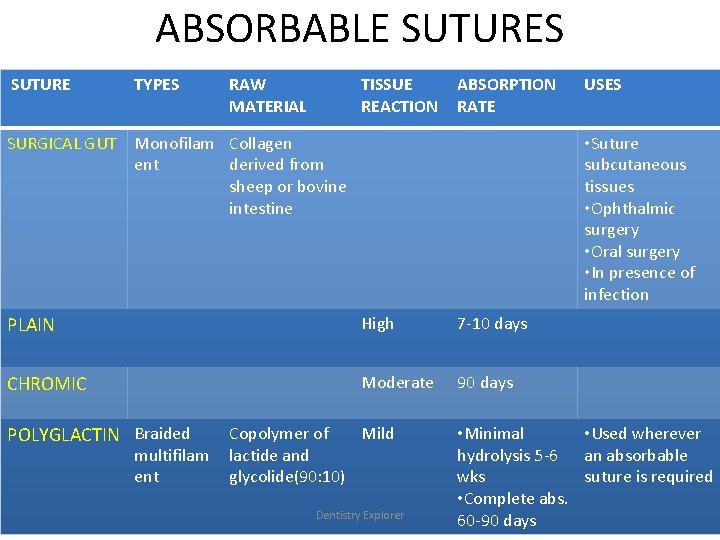
ABSORBABLE SUTURES SUTURE TYPES RAW MATERIAL TISSUE REACTION SURGICAL GUT Monofilam Collagen ent derived from sheep or bovine intestine ABSORPTION RATE • Suture subcutaneous tissues • Ophthalmic surgery • Oral surgery • In presence of infection PLAIN High 7 -10 days CHROMIC Moderate 90 days POLYGLACTIN Braided multifilam ent USES Copolymer of Mild lactide and glycolide(90: 10) Dentistry Explorer • Minimal • Used wherever hydrolysis 5 -6 an absorbable wks suture is required • Complete abs. 60 -90 days
Dentistry Explorer
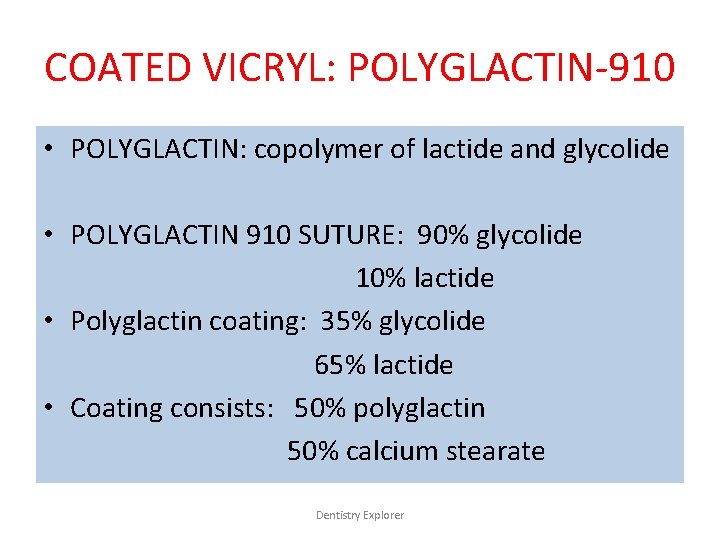
COATED VICRYL: POLYGLACTIN-910 • POLYGLACTIN: copolymer of lactide and glycolide • POLYGLACTIN 910 SUTURE: 90% glycolide 10% lactide • Polyglactin coating: 35% glycolide 65% lactide • Coating consists: 50% polyglactin 50% calcium stearate Dentistry Explorer
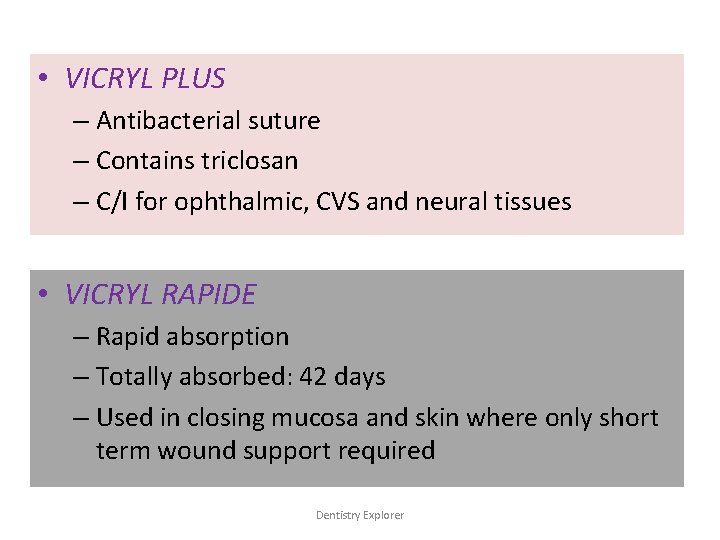
• VICRYL PLUS – Antibacterial suture – Contains triclosan – C/I for ophthalmic, CVS and neural tissues • VICRYL RAPIDE – Rapid absorption – Totally absorbed: 42 days – Used in closing mucosa and skin where only short term wound support required Dentistry Explorer
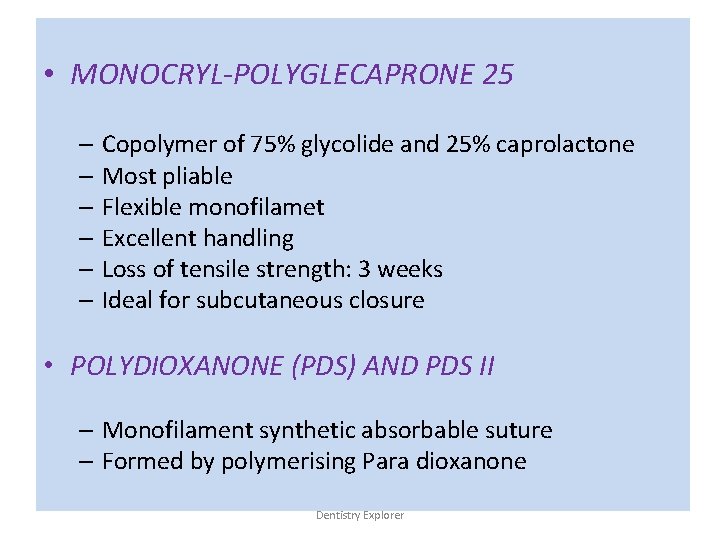
• MONOCRYL-POLYGLECAPRONE 25 – Copolymer of 75% glycolide and 25% caprolactone – Most pliable – Flexible monofilamet – Excellent handling – Loss of tensile strength: 3 weeks – Ideal for subcutaneous closure • POLYDIOXANONE (PDS) AND PDS II – Monofilament synthetic absorbable suture – Formed by polymerising Para dioxanone Dentistry Explorer
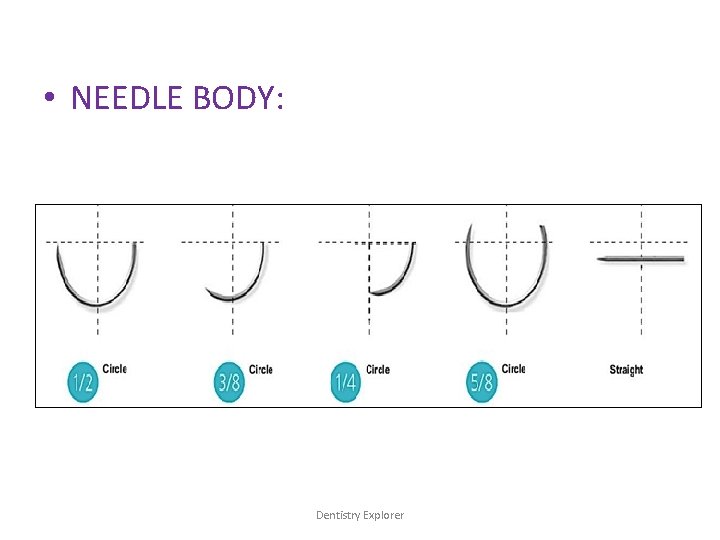
SUTURE NEEDLES • Surgical needles are designed to lead suture material through tissue with minimal injury Dentistry Explorer
• NEEDLE BODY: Dentistry Explorer
• NEEDLE TIP: Dentistry Explorer
WOUND CLOSURE TECHNIQUES • Suture • Non suture alternatives ü Staples ü Tape closure ü Wound adhesives Dentistry Explorer
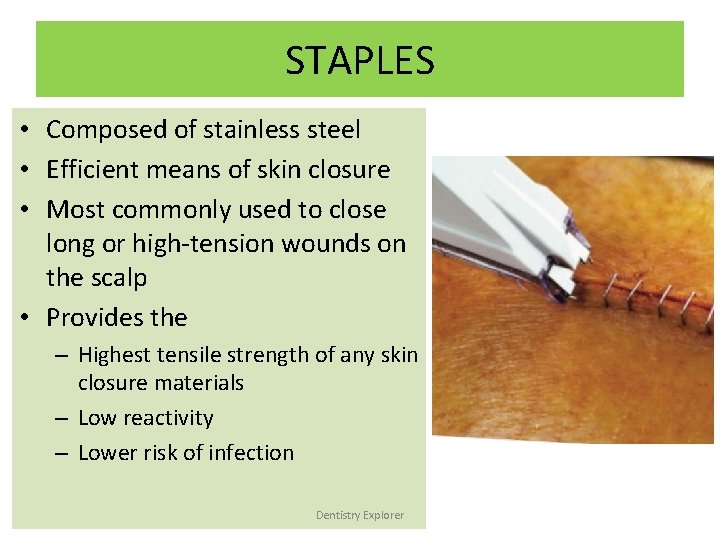
STAPLES • Composed of stainless steel • Efficient means of skin closure • Most commonly used to close long or high-tension wounds on the scalp • Provides the – Highest tensile strength of any skin closure materials – Low reactivity – Lower risk of infection Dentistry Explorer
• Placement of staples – faster than observed in sutures – factoring in time – Cost efficient • With the stapler centered over the wound, press it gently but firmly against the wound and depress the trigger • If no pressure is applied it ends up with partially applied “floating staples” Dentistry Explorer
Dentistry Explorer
Dentistry Explorer
SURGICAL STRIPS • Placed across the wound are most commonly used to support the standard sutured wounds or to repair lacerations • Can also be used in place of sutures for epidermal closure in low-tension wounds, after the placement of buried sutures Dentistry Explorer
• To increase the length of time of the strips to stay in a place, a liquid adhesive, such as Mastisol can be placed on the dry skin surrounding the surgical line before the placement of the strips • Can last 1 to 2 weeks Dentistry Explorer
WOUND ADHESIVE • Tissue adhesive is typically used in place of epidermal sutures, once buried intradermal sutures are in place. • It is applied to a clean, dry surgical site by brushing or dropping the liquid directly onto the wound. • It is extremely important that wound edges be in direct apposition before application of the adhesive, so that the liquid does not seep between the edges of the defect and inhibit good wound healing Dentistry Explorer
CYANOACRYLATE • Formed by the reversible condensation of formaldehyde with a cyanoacrylate ester • Maintained in a liquid state by an acidic stabilizer (inhibits the molecule from cross linking) • Biodegradable Dentistry Explorer
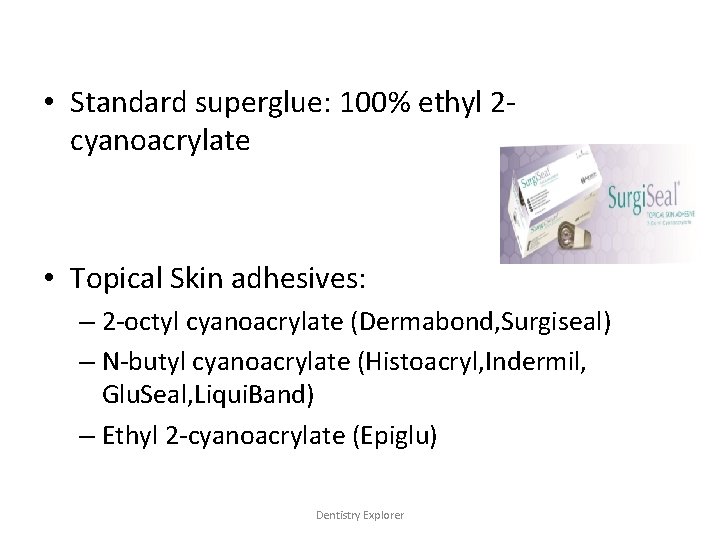
• Standard superglue: 100% ethyl 2 cyanoacrylate • Topical Skin adhesives: – 2 -octyl cyanoacrylate (Dermabond, Surgiseal) – N-butyl cyanoacrylate (Histoacryl, Indermil, Glu. Seal, Liqui. Band) – Ethyl 2 -cyanoacrylate (Epiglu) Dentistry Explorer
Advantages • Faster application • Innate hemostatic properties • Low allergic potential • Does not require a secondary bandage or water avoidance after surgery • Alleviates the need for suture removal Dentistry Explorer
Disadvantages • Used on perfectly approximated wounds • Postoperative bleeding may cause epithelial wound edge separation Dentistry Explorer
Wound Aftercare For Tissue Adhesives • Do Not Use Ointments • Avoid Trauma • Sloughs on own Dentistry Explorer
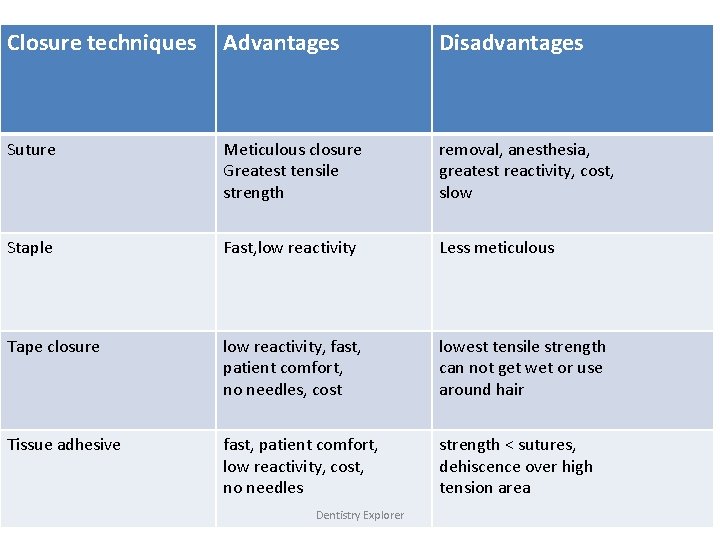
Closure techniques Advantages Disadvantages Suture Meticulous closure Greatest tensile strength removal, anesthesia, greatest reactivity, cost, slow Staple Fast, low reactivity Less meticulous Tape closure low reactivity, fast, patient comfort, no needles, cost lowest tensile strength can not get wet or use around hair Tissue adhesive fast, patient comfort, low reactivity, cost, no needles strength < sutures, dehiscence over high tension area Dentistry Explorer
REFERENCES • Oral and maxillofacial surgery- Daniel M. Laskin • Oral and maxillofacial surgery Neelima Anil Malik 4 th edition • Dental Suturing Materials and Techniques Hassan H Kosha Head of the Dental Department, Ministry of Interior Security Forces Medical Services, Saudi Arabia • Suture materials- Current and emerging trends Christopher Dennis, Swaminathan Sethu, Sunita Nayak, Loganathan Mohan, Yosry (Yos) Morsi, Geetha Manivasagam Dentistry Explorer