
Sutton Barto Chapter 4 Dynamic Programming Policy Improvement
Sutton & Barto, Chapter 4 Dynamic Programming
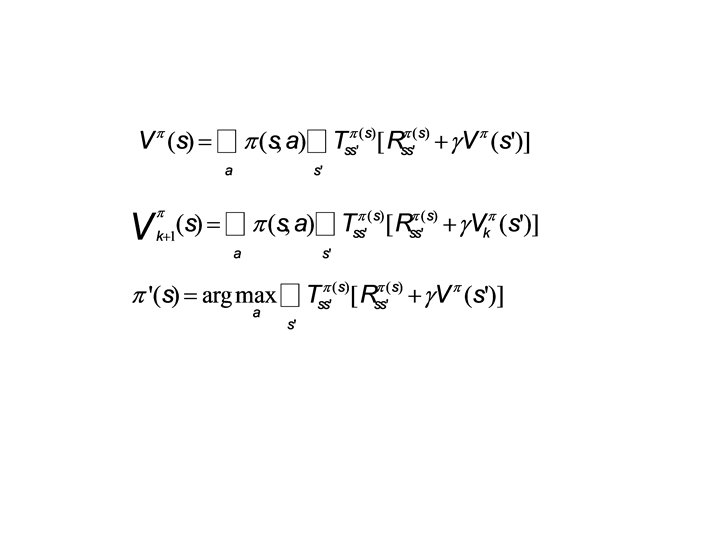
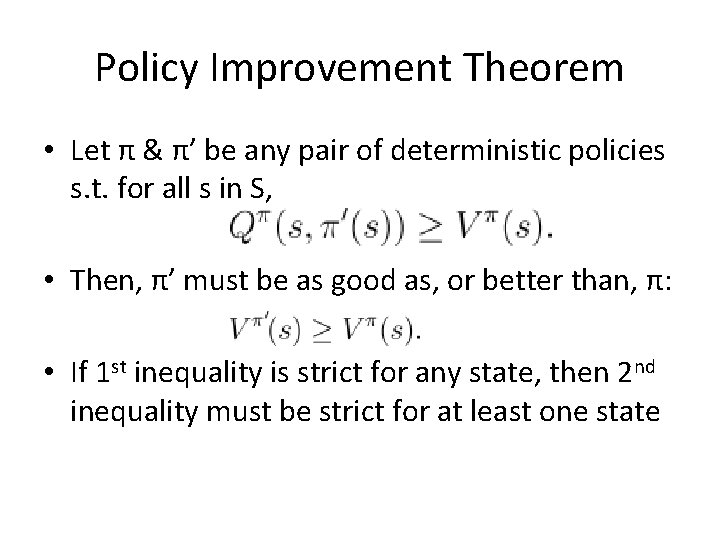
Policy Improvement Theorem • Let π & π’ be any pair of deterministic policies s. t. for all s in S, • Then, π’ must be as good as, or better than, π: • If 1 st inequality is strict for any state, then 2 nd inequality must be strict for at least one state
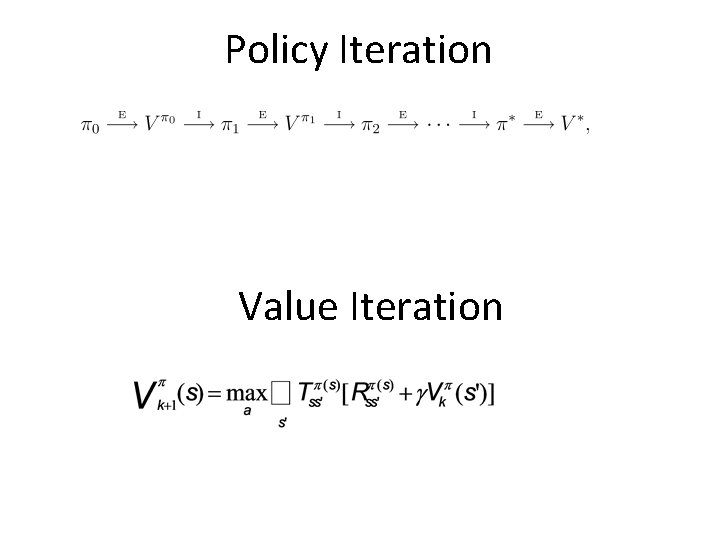
Policy Iteration Value Iteration
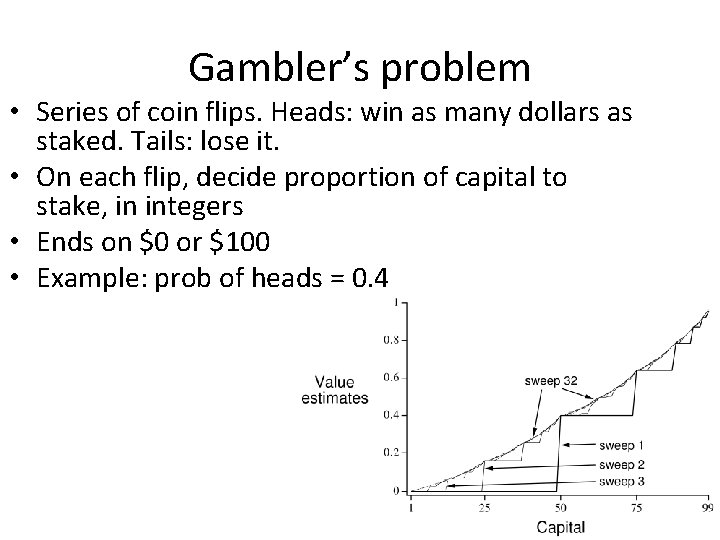
Gambler’s problem • Series of coin flips. Heads: win as many dollars as staked. Tails: lose it. • On each flip, decide proportion of capital to stake, in integers • Ends on $0 or $100 • Example: prob of heads = 0. 4
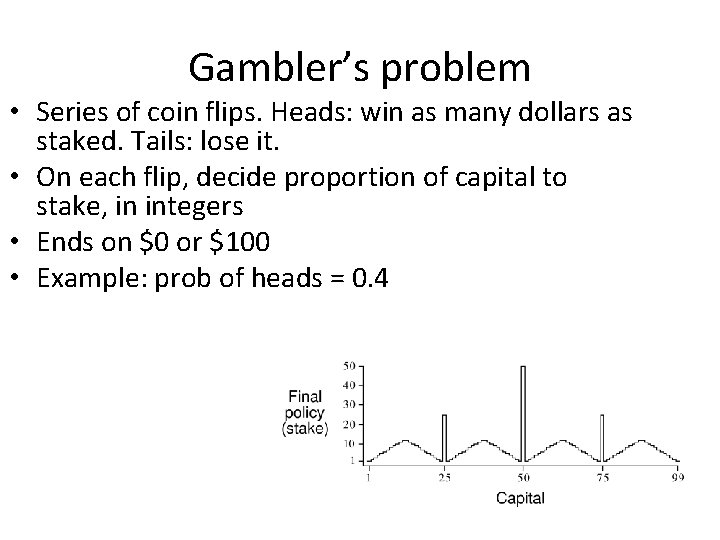
Gambler’s problem • Series of coin flips. Heads: win as many dollars as staked. Tails: lose it. • On each flip, decide proportion of capital to stake, in integers • Ends on $0 or $100 • Example: prob of heads = 0. 4
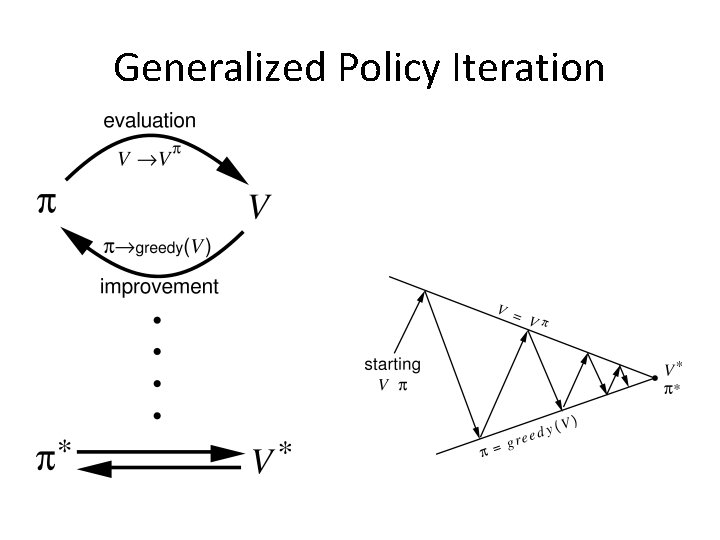
Generalized Policy Iteration
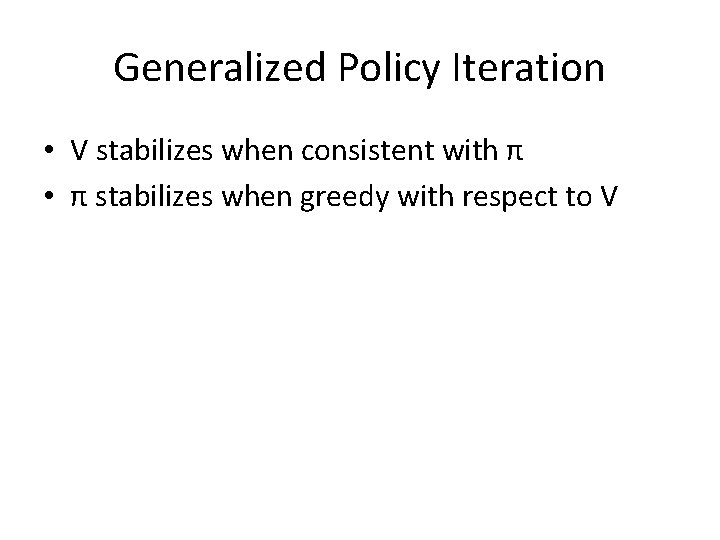
Generalized Policy Iteration • V stabilizes when consistent with π • π stabilizes when greedy with respect to V
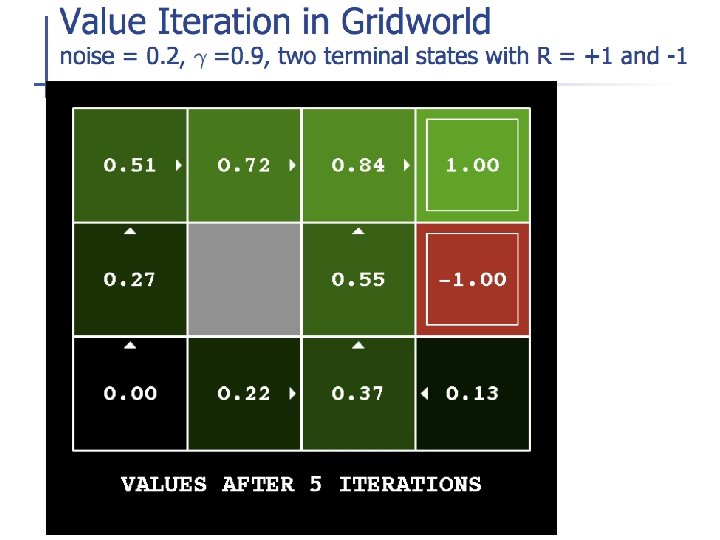
Asynchronous DP • Can backup states in any order • But must continue to back up all values, eventually • Where should we focus our attention?
Asynchronous DP • Can backup states in any order • But must continue to back up all values, eventually • Where should we focus our attention? • Changes to V • Changes to Q • Changes to π
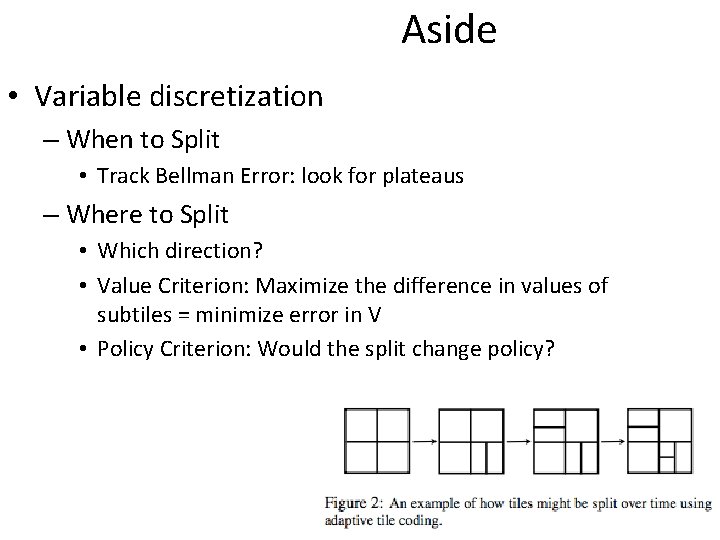
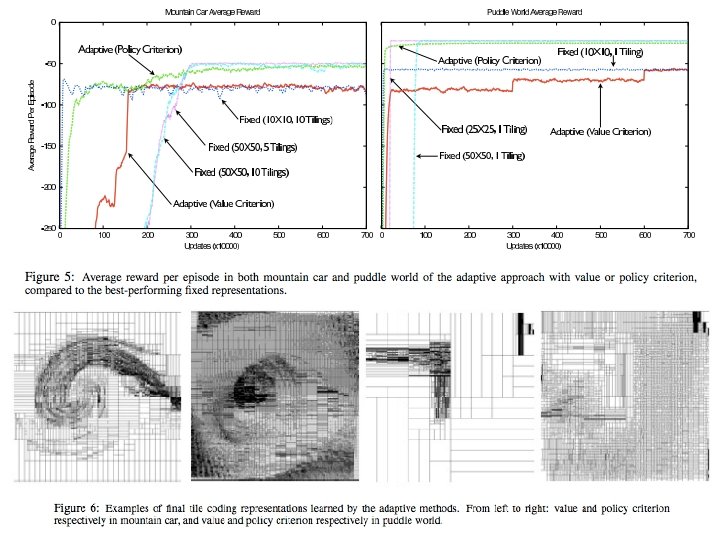
Aside • Variable discretization – When to Split • Track Bellman Error: look for plateaus – Where to Split • Which direction? • Value Criterion: Maximize the difference in values of subtiles = minimize error in V • Policy Criterion: Would the split change policy?
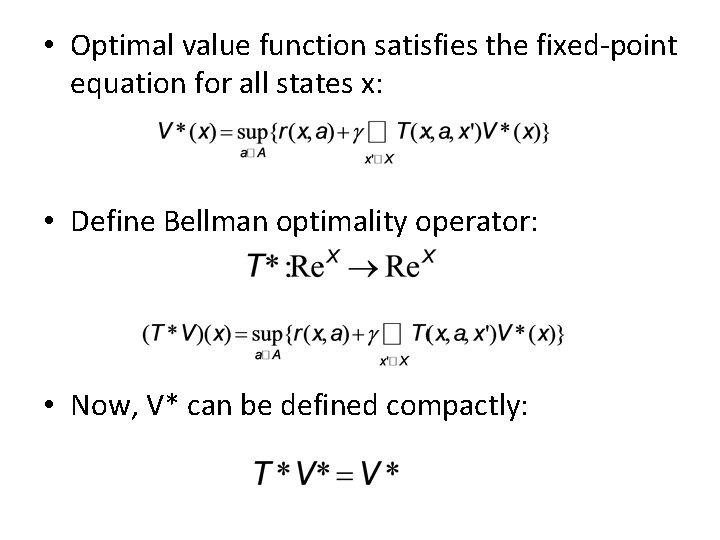
• Optimal value function satisfies the fixed-point equation for all states x: • Define Bellman optimality operator: • Now, V* can be defined compactly:
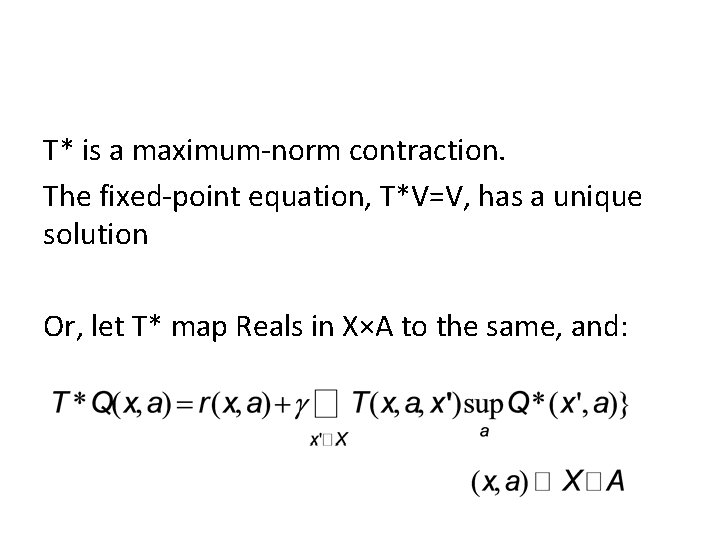
T* is a maximum-norm contraction. The fixed-point equation, T*V=V, has a unique solution Or, let T* map Reals in X×A to the same, and:
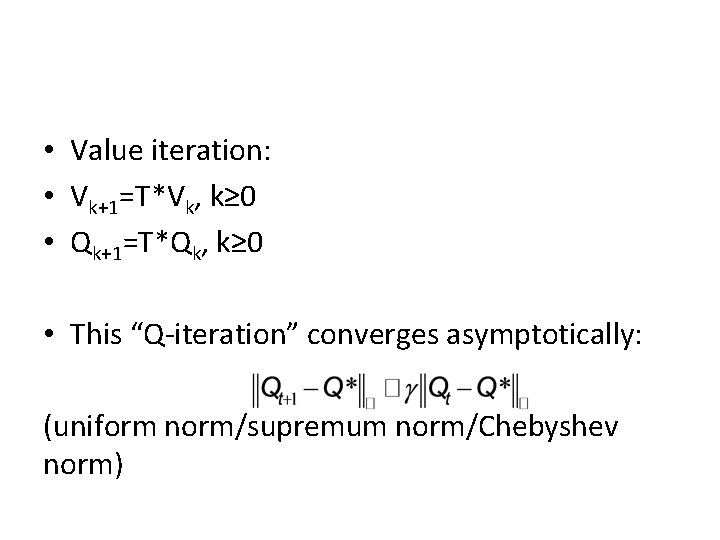
• Value iteration: • Vk+1=T*Vk, k≥ 0 • Qk+1=T*Qk, k≥ 0 • This “Q-iteration” converges asymptotically: (uniform norm/supremum norm/Chebyshev norm)
• Also, for Q-iteration, we can bound the suboptimality for a set number of iterations based on the discount factor and maximum possible reward
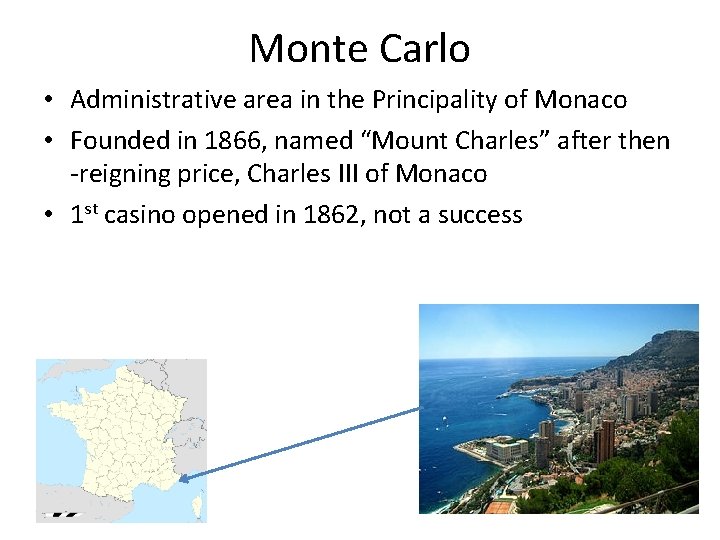
Monte Carlo • Administrative area in the Principality of Monaco • Founded in 1866, named “Mount Charles” after then -reigning price, Charles III of Monaco • 1 st casino opened in 1862, not a success
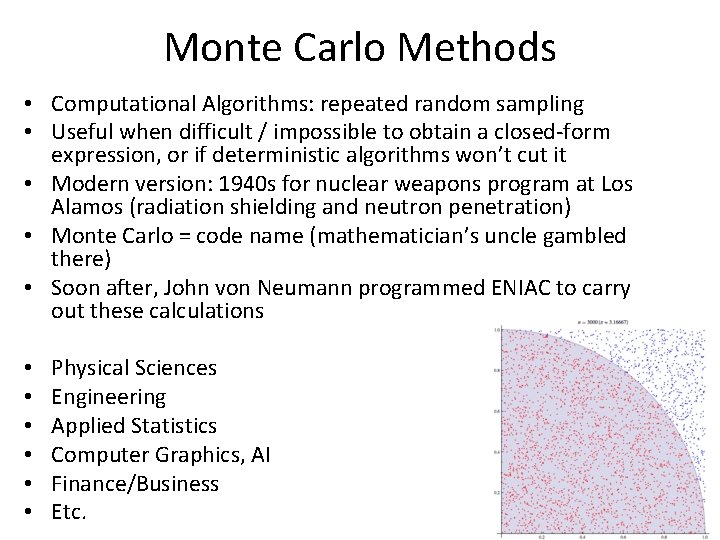
Monte Carlo Methods • Computational Algorithms: repeated random sampling • Useful when difficult / impossible to obtain a closed-form expression, or if deterministic algorithms won’t cut it • Modern version: 1940 s for nuclear weapons program at Los Alamos (radiation shielding and neutron penetration) • Monte Carlo = code name (mathematician’s uncle gambled there) • Soon after, John von Neumann programmed ENIAC to carry out these calculations • • • Physical Sciences Engineering Applied Statistics Computer Graphics, AI Finance/Business Etc.
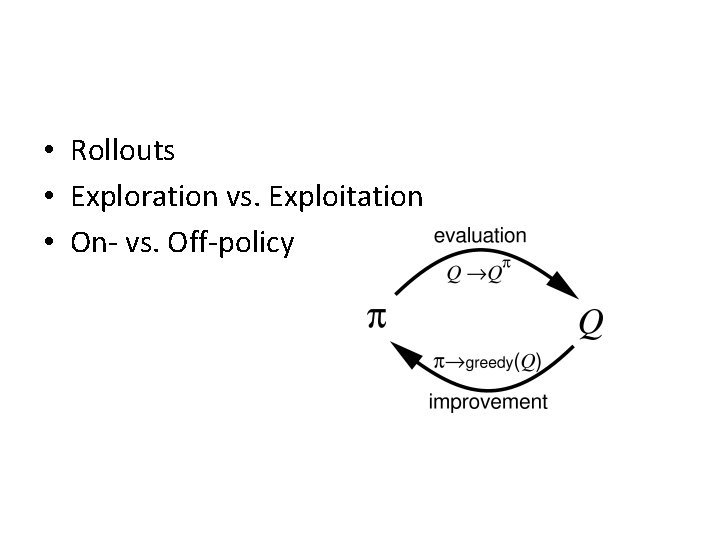
• Rollouts • Exploration vs. Exploitation • On- vs. Off-policy
- Slides: 20