
Sustaining Open Defecation Free Communities MISSION VISION OBJECTIVES
Sustaining Open Defecation Free Communities
MISSION VISION OBJECTIVES MISSION End open defecation across the villages VISION maintain cleanliness by providing equitable access to safe sanitation, promoting improved hygiene practices and judiciously managing the solid and liquid resources OBJECTIVES By October 2018, ensure universal access to safe sanitation and eliminate open defecation across villages By October 2019, sustain ODF status in all villages and improve hygiene
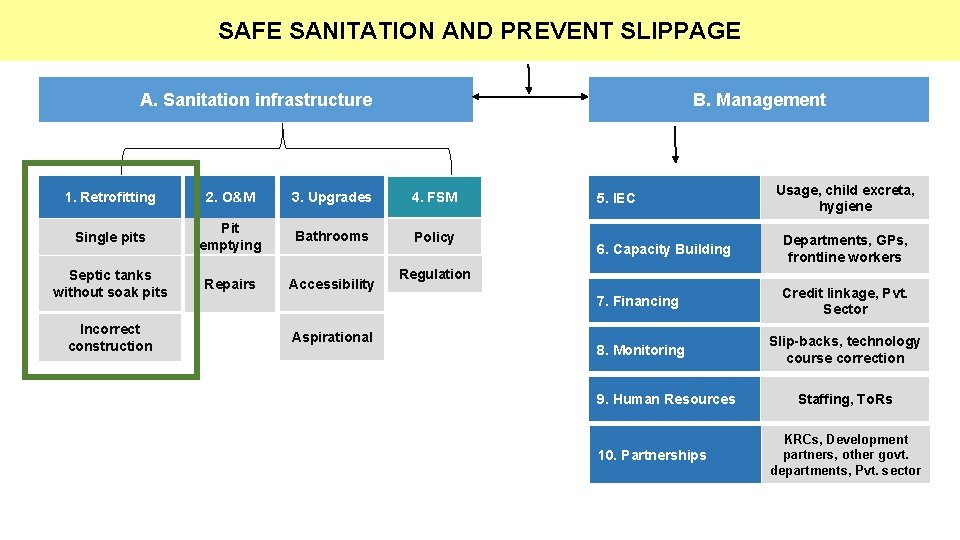
SAFE SANITATION AND PREVENT SLIPPAGE B. Management A. Sanitation infrastructure 1. Retrofitting 2. O&M 3. Upgrades 4. FSM Single pits Pit emptying Bathrooms Policy Septic tanks without soak pits Repairs Accessibility Incorrect construction Aspirational 5. IEC Usage, child excreta, hygiene 6. Capacity Building Departments, GPs, frontline workers 7. Financing Credit linkage, Pvt. Sector 8. Monitoring Slip-backs, technology course correction Regulation 9. Human Resources 10. Partnerships Staffing, To. Rs KRCs, Development partners, other govt. departments, Pvt. sector

CONSTRUCTION COVERAGE ODF STATUS OF ODF DISTRICTS 20 Declared 51 15 Total Verified 1860073 STATUS OF ODF VILLAGES STATUS OF ODF GPs 22895 26495 10846 Declared 13247 5780 Total Verified 51080 Total Declared 2429314 Verified COVERAGE CONSTRUCTION 1180677 100 85. 95 90 1016755 100 77. 91 80 70 60 304844 49. 24 50 40 29. 08 36. 07 30 20 October 2014 April 2015 - April 2016 - April 2017 - April 2018 -March 2015 March 2016 March 2017 March 2018 March 2019 10 2/10/2014 2/10/2015 2/10/2016 2/10/2017 31/3/2018 2/10/2018
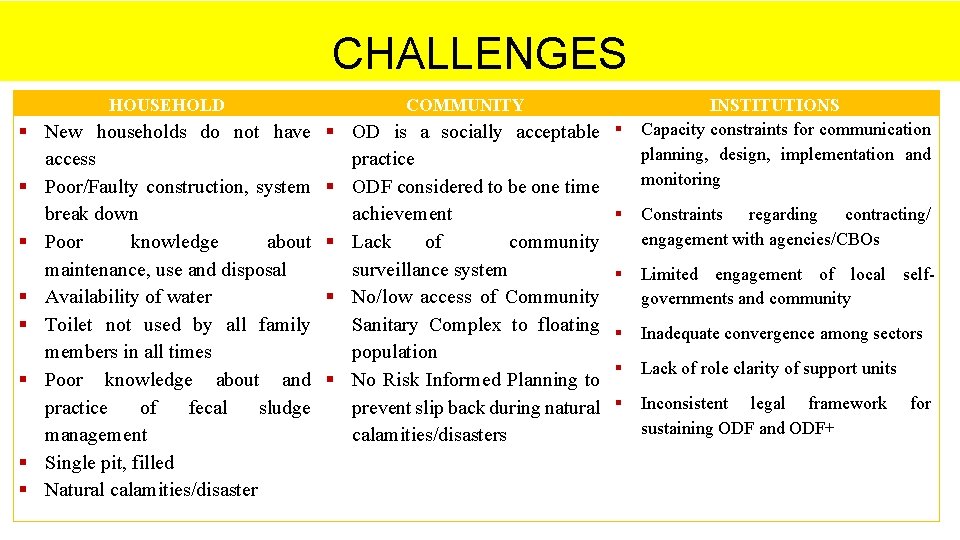
CHALLENGES HOUSEHOLD COMMUNITY New households do not have access Poor/Faulty construction, system break down Poor knowledge about maintenance, use and disposal Availability of water Toilet not used by all family members in all times Poor knowledge about and practice of fecal sludge management Single pit, filled Natural calamities/disaster OD is a socially acceptable practice ODF considered to be one time achievement Lack of community surveillance system No/low access of Community Sanitary Complex to floating population No Risk Informed Planning to prevent slip back during natural calamities/disasters INSTITUTIONS Capacity constraints for communication planning, design, implementation and monitoring Constraints regarding contracting/ engagement with agencies/CBOs Limited engagement of local selfgovernments and community Inadequate convergence among sectors Lack of role clarity of support units Inconsistent legal framework sustaining ODF and ODF+ for
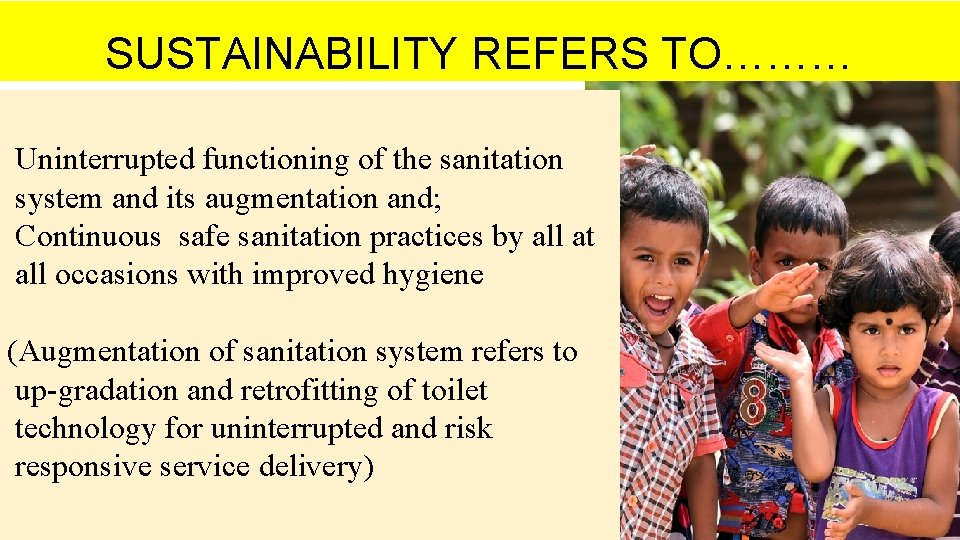
SUSTAINABILITY REFERS TO……… Uninterrupted functioning of the sanitation system and its augmentation and; Continuous safe sanitation practices by all at all occasions with improved hygiene (Augmentation of sanitation system refers to up-gradation and retrofitting of toilet technology for uninterrupted and risk responsive service delivery)
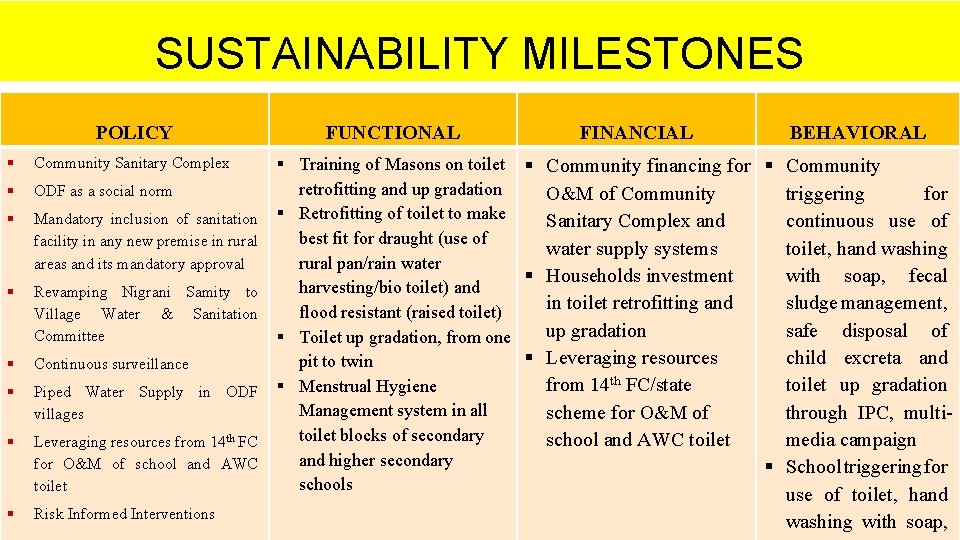
SUSTAINABILITY MILESTONES POLICY Community Sanitary Complex ODF as a social norm Mandatory inclusion of sanitation facility in any new premise in rural areas and its mandatory approval Revamping Nigrani Samity to Village Water & Sanitation Committee Continuous surveillance Piped Water Supply in ODF villages Leveraging resources from 14 th FC for O&M of school and AWC toilet Risk Informed Interventions FUNCTIONAL Training of Masons on toilet retrofitting and up gradation Retrofitting of toilet to make best fit for draught (use of rural pan/rain water harvesting/bio toilet) and flood resistant (raised toilet) Toilet up gradation, from one pit to twin Menstrual Hygiene Management system in all toilet blocks of secondary and higher secondary schools FINANCIAL BEHAVIORAL Community financing for Community O&M of Community triggering for Sanitary Complex and continuous use of water supply systems toilet, hand washing Households investment with soap, fecal in toilet retrofitting and sludge management, up gradation safe disposal of Leveraging resources child excreta and from 14 th FC/state toilet up gradation scheme for O&M of through IPC, multischool and AWC toilet media campaign School triggering for use of toilet, hand washing with soap,
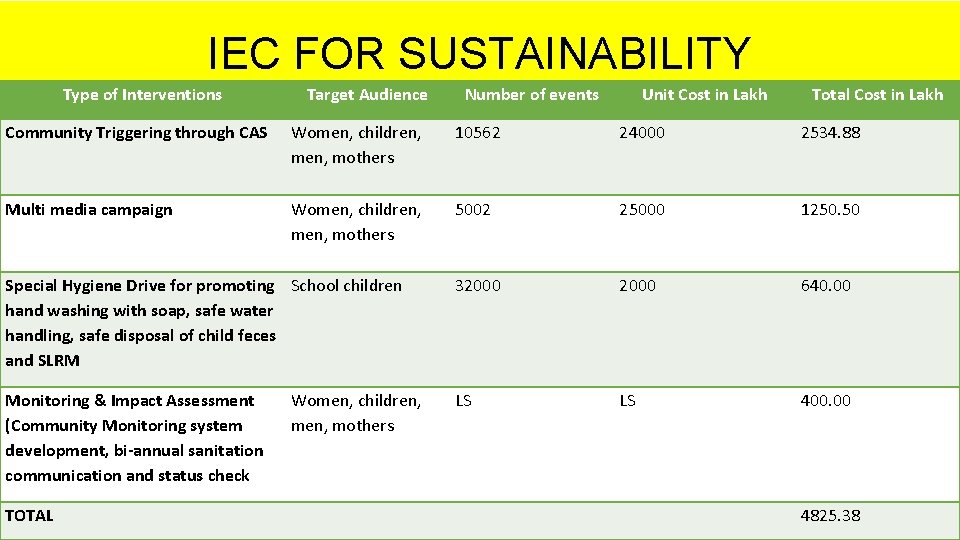
IEC FOR SUSTAINABILITY Type of Interventions Target Audience Number of events Unit Cost in Lakh Total Cost in Lakh Community Triggering through CAS Women, children, men, mothers 10562 24000 2534. 88 Multi media campaign Women, children, men, mothers 5002 25000 1250. 50 Special Hygiene Drive for promoting School children hand washing with soap, safe water handling, safe disposal of child feces and SLRM 32000 640. 00 Monitoring & Impact Assessment (Community Monitoring system development, bi-annual sanitation communication and status check Women, children, men, mothers LS LS 400. 00 TOTAL 4825. 38
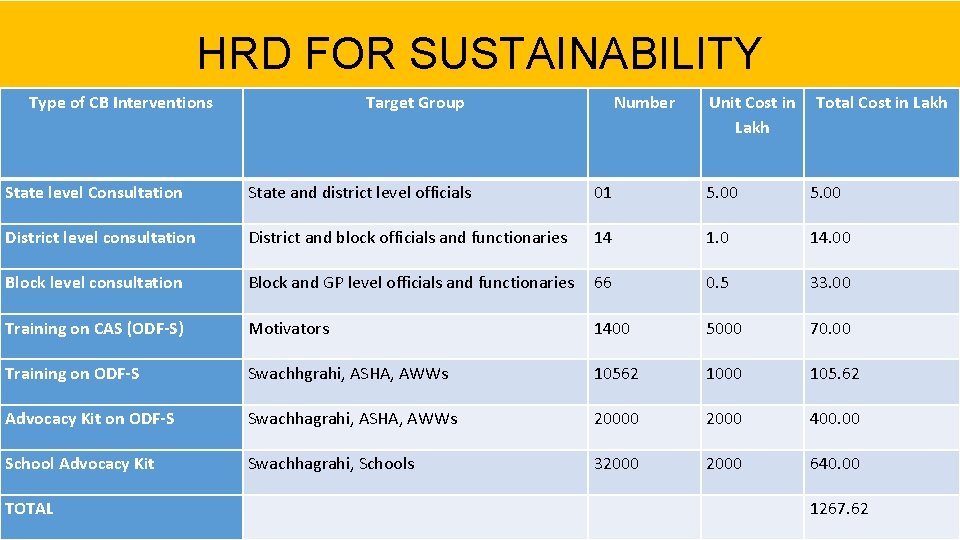
HRD FOR SUSTAINABILITY Type of CB Interventions Target Group Number Unit Cost in Lakh Total Cost in Lakh State level Consultation State and district level officials 01 5. 00 District level consultation District and block officials and functionaries 14 1. 0 14. 00 Block level consultation Block and GP level officials and functionaries 66 0. 5 33. 00 Training on CAS (ODF-S) Motivators 1400 5000 70. 00 Training on ODF-S Swachhgrahi, ASHA, AWWs 10562 1000 105. 62 Advocacy Kit on ODF-S Swachhagrahi, ASHA, AWWs 20000 2000 400. 00 School Advocacy Kit Swachhagrahi, Schools 32000 640. 00 TOTAL 1267. 62
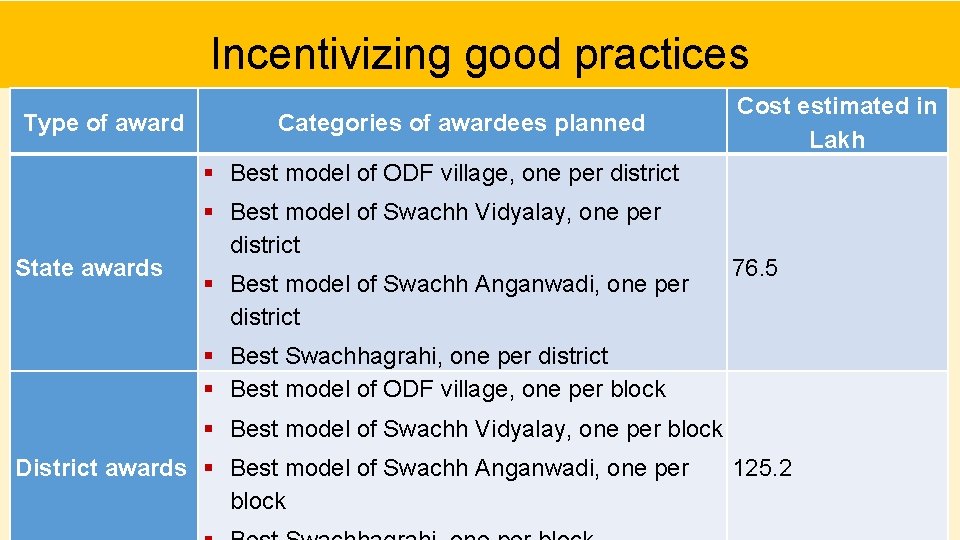
Incentivizing good practices Type of award Categories of awardees planned Cost estimated in Lakh Best model of ODF village, one per district State awards Best model of Swachh Vidyalay, one per district Best model of Swachh Anganwadi, one per district 76. 5 Best Swachhagrahi, one per district Best model of ODF village, one per block Best model of Swachh Vidyalay, one per block District awards Best model of Swachh Anganwadi, one per block 125. 2
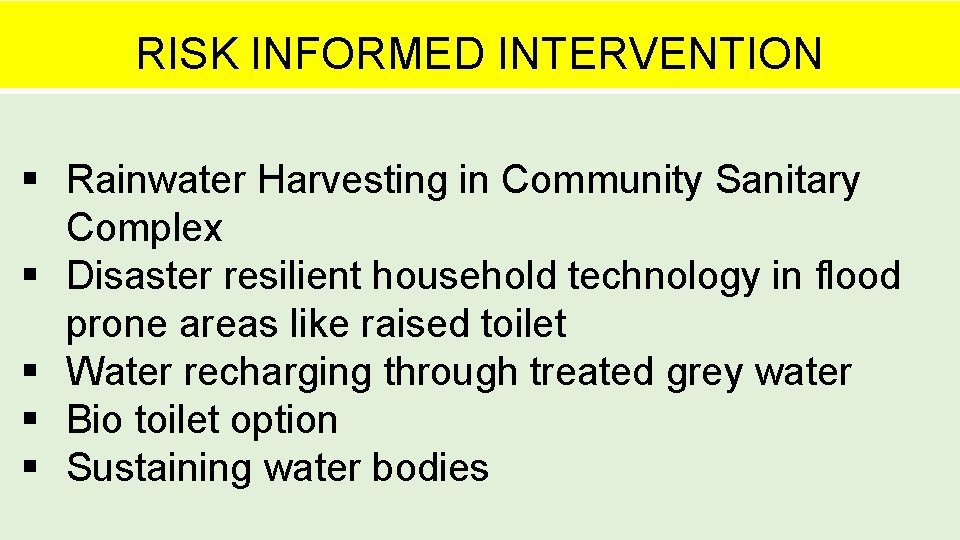
RISK INFORMED INTERVENTION Rainwater Harvesting in Community Sanitary Complex Disaster resilient household technology in flood prone areas like raised toilet Water recharging through treated grey water Bio toilet option Sustaining water bodies
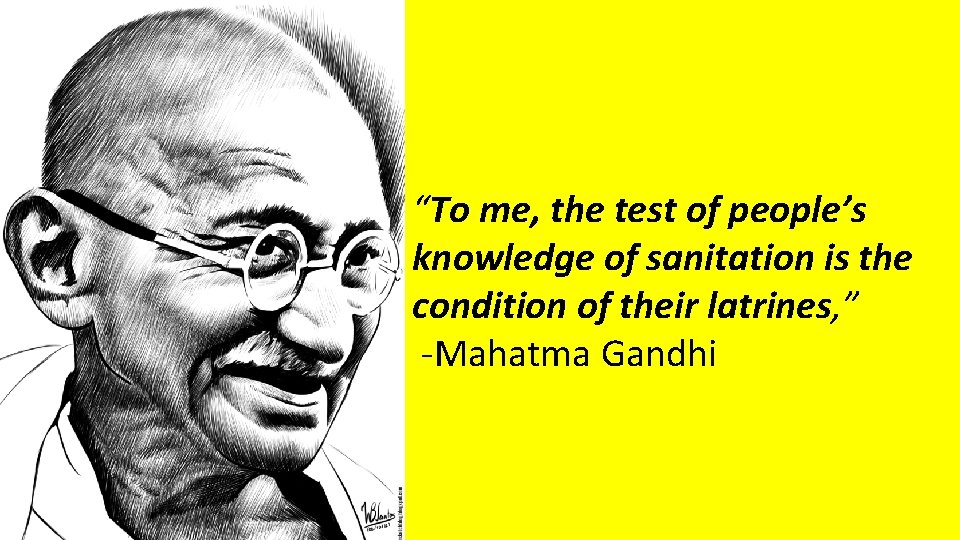
“To me, the test of people’s knowledge of sanitation is the condition of their latrines, ” -Mahatma Gandhi
- Slides: 12