
Sustainable wealth creation based on disruptive systemic and
Sustainable wealth creation based on disruptive, systemic and circular innovation, for emerging countries Carlos Scheel, Ph. D Tecnológico de Monterrey, EGADE Business School June, 2018
Some problems of LATAM • Incontrollable debt of the countries • Growing economic-social gap • Concentration of wealth on a few • Increasing the base of the pyramid • Geopolitical conflicts (internal and external the region) • Poor Rule of Law and high corruption • Incrementing a misleading populism and nationalism • Depredation of natural resources by extractive economies
However, the real problem of contemporary economic growth is NON ASSOCIATION OF THE KEY PLAYERS OF GROWTH: • Linear Economic view • Restrictive Ecological rules • Non rational Natural resources depletion • Social point of view • Human point of view
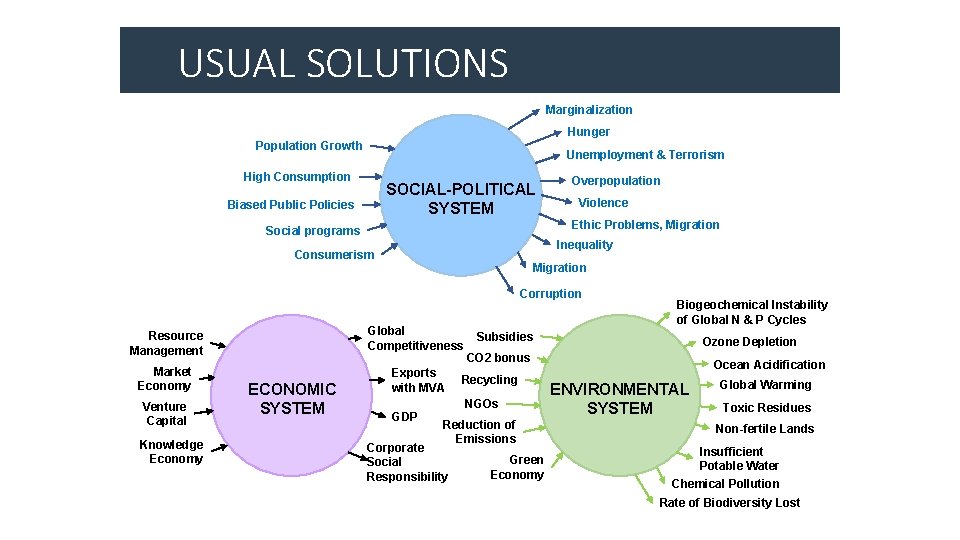
USUAL SOLUTIONS Marginalization Hunger Population Growth Unemployment & Terrorism High Consumption SOCIAL-POLITICAL SYSTEM Biased Public Policies Overpopulation Violence Ethic Problems, Migration Social programs Inequality Consumerism Migration Corruption Resource Management Global Competitiveness Market Economy Exports with MVA Venture Capital Knowledge Economy ECONOMIC SYSTEM Subsidies Recycling Reduction of Emissions Corporate Social Responsibility Ozone Depletion CO 2 bonus NGOs GDP Biogeochemical Instability of Global N & P Cycles Green Economy Ocean Acidification ENVIRONMENTAL SYSTEM Global Warming Toxic Residues Non-fertile Lands Insufficient Potable Water Chemical Pollution Rate of Biodiversity Lost
WE ARE TOO MANY AND POORLY MANAGED… • Too many people, …. cars, CO 2 …. • Too many PET bottles, plastic, …. biodegradable is a contradiction • Mono-crops damage the biodiversity • Great energy expense in maintaining Internet • Too many cows. • Irrational extraction of natural resources…. • Corruption and no-transparency • Poor Rule of Law, trust, tolerance, …. . • Excessive consumism and programmed obsolescence • Crisis of values… unconsciousness. . ©C. SCHEEL 2017 5
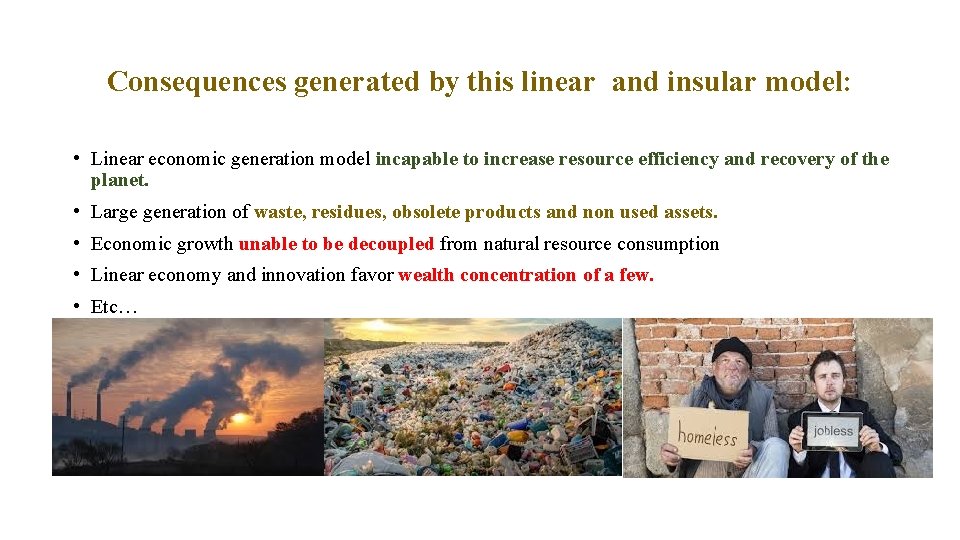
Consequences generated by this linear and insular model: • Linear economic generation model incapable to increase resource efficiency and recovery of the planet. • Large generation of waste, residues, obsolete products and non used assets. • Economic growth unable to be decoupled from natural resource consumption • Linear economy and innovation favor wealth concentration of a few. • Etc…
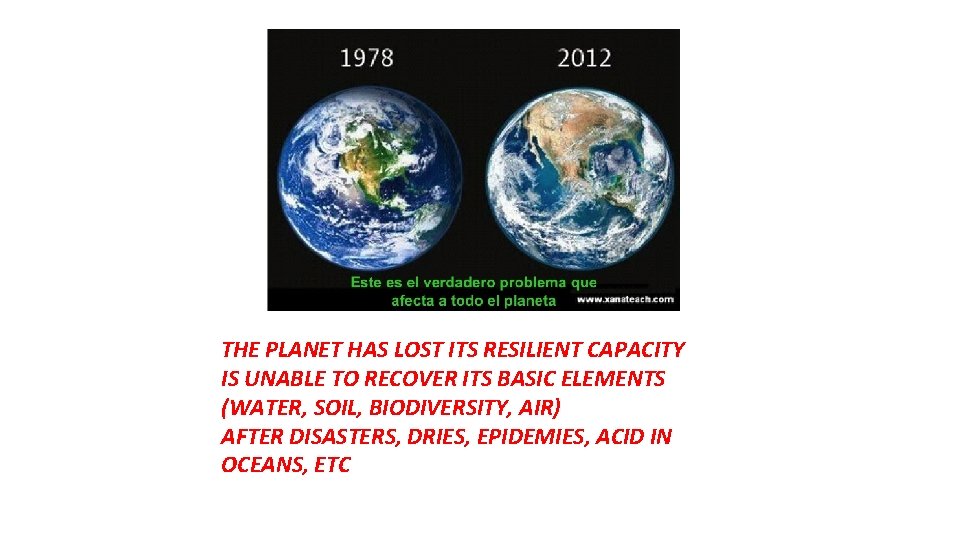
THE PLANET HAS LOST ITS RESILIENT CAPACITY IS UNABLE TO RECOVER ITS BASIC ELEMENTS (WATER, SOIL, BIODIVERSITY, AIR) AFTER DISASTERS, DRIES, EPIDEMIES, ACID IN OCEANS, ETC
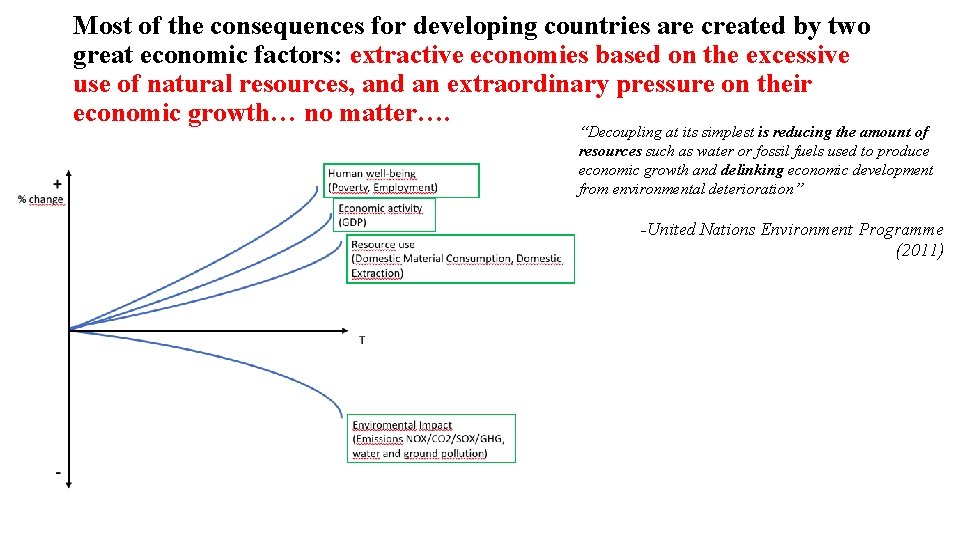
Most of the consequences for developing countries are created by two great economic factors: extractive economies based on the excessive use of natural resources, and an extraordinary pressure on their economic growth… no matter…. “Decoupling at its simplest is reducing the amount of resources such as water or fossil fuels used to produce economic growth and delinking economic development from environmental deterioration” -United Nations Environment Programme (2011)
PROPOSED MODEL AND IMPLEMENTATION PLAN
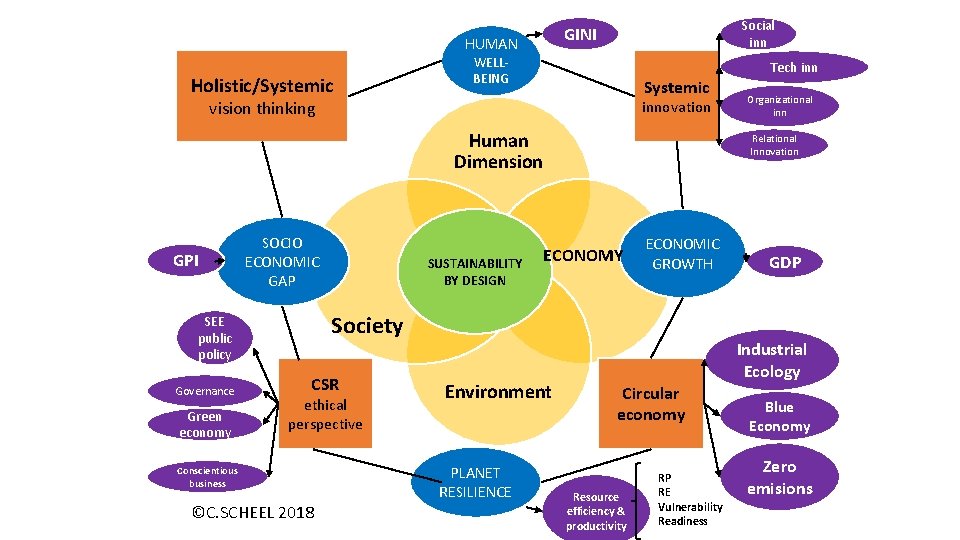
HUMAN Holistic/Systemic Social inn GINI WELLBEING Tech inn Systemic vision thinking innovation Human Dimension GPI SOCIO ECONOMIC GAP Green economy Relational Innovation ECONOMY ECONOMIC GROWTH Society SEE public policy Governance SUSTAINABILITY BY DESIGN CSR ethical perspective Conscientious business ©C. SCHEEL 2018 Environment PLANET RESILIENCE Organizational inn GDP Industrial Ecology Circular economy Resource efficiency & productivity RP RE Vulnerability Readiness Blue Economy Zero emisions
• We present the SWIT framework, its benefits and threats, and the Di. SC Innovation Platform, that has been designed to train entrepreneurs, businessmen, consultants, policy makers and academic instructors, for the creation of a critical mass of practitioners and thinkers focused on the achievement of sustainable wealth for firms and regions, based on a circular sharing value ecosystem, for developing countries.
The SWIT framework has been developed around three levels of economic and environmental activities § A Product-residues value chain level, where the circularization of linear product chains occur, based on a zero-value residue (o-emissions) industrial ecology system (ZRIES) approach, § A cluster level, through the assembling of a regional circular value ecosystem (CVES) designed to articulate the synergies of a cluster of multiple ZRIES businesses within a region, with a common goal to create selfsustainable benefits for all inhabitants of a regional community; § A Regional level, where a network of sharing value systems (SVS) is capable of providing the enabling conditions to articulate: resources, technologies, policies, infrastructure, resource allocation (holistic) management, synergies and inclusive governance; with all stakeholders of impact on the social, the environmental and the economic activities of a region. © C. SCHEEL 2018 12
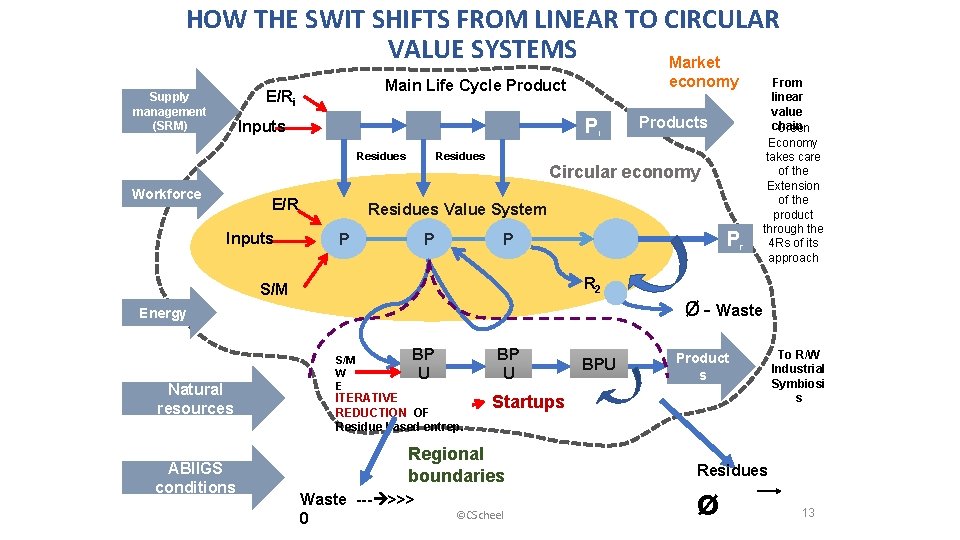
HOW THE SWIT SHIFTS FROM LINEAR TO CIRCULAR VALUE SYSTEMS Market E/Ri Supply management (SRM) Pi Inputs Residues Workforce E/R Inputs economy Main Life Cycle Product Residues Circular economy Residues Value System P P Pr P R 2 S/M Energy Natural resources ABIIGS conditions Products S/M W E BP U ITERATIVE REDUCTION OF Residue based entrep. ø - Waste Product s Startups Regional boundaries Waste --- >>> 0 BPU From linear value chain Green Economy takes care of the Extension of the product through the 4 Rs of its approach ©CScheel To R/W Industrial Symbiosi s Residues ø 13
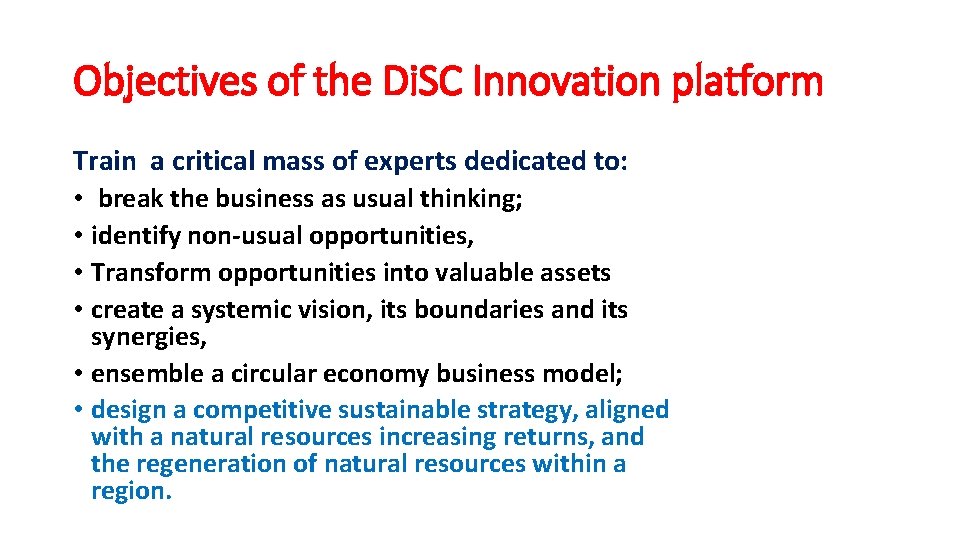
Objectives of the Di. SC Innovation platform Train a critical mass of experts dedicated to: • break the business as usual thinking; • identify non-usual opportunities, • Transform opportunities into valuable assets • create a systemic vision, its boundaries and its synergies, • ensemble a circular economy business model; • design a competitive sustainable strategy, aligned with a natural resources increasing returns, and the regeneration of natural resources within a region.
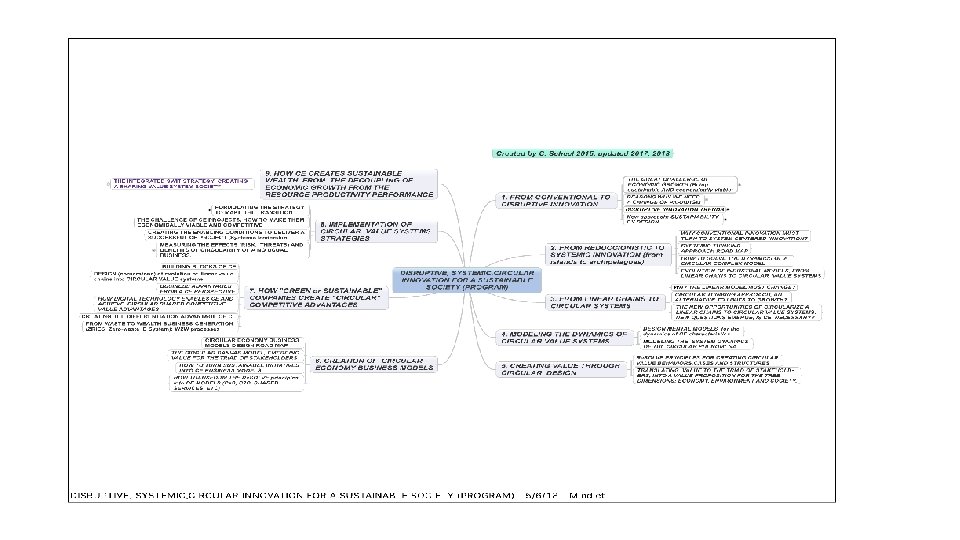
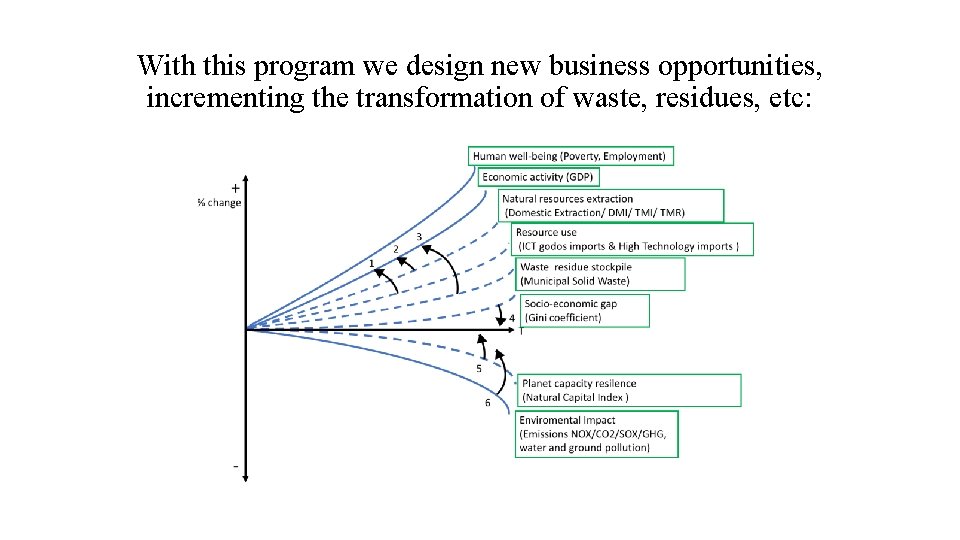
With this program we design new business opportunities, incrementing the transformation of waste, residues, etc:
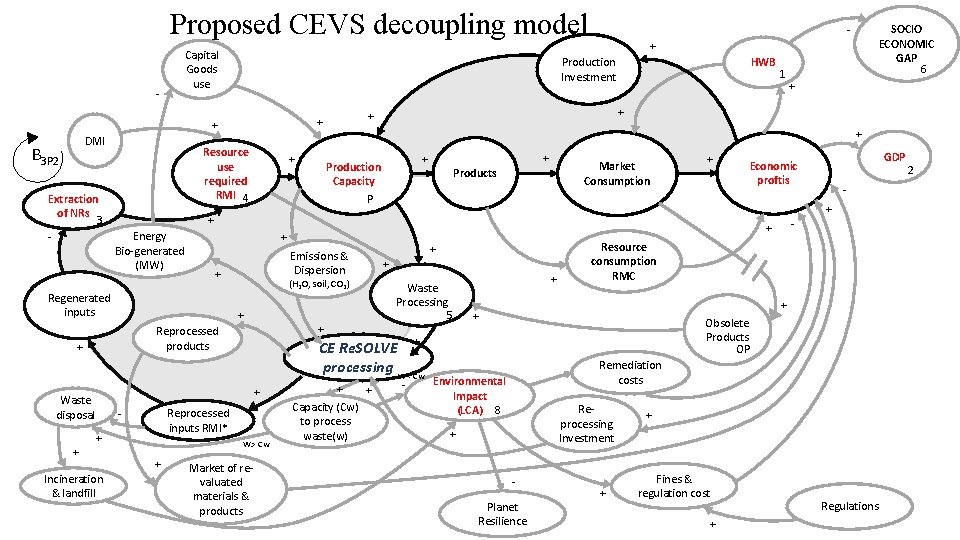
Proposed CEVS decoupling model Capital Goods use - DMI B 3 P 2 Extraction of NRs 3 - Energy Bio-generated (MW) Market Consumption Products + (H 2 O, soil, CO 2) + + W> Cw + + Waste Processing 5 Market of revaluated materials & products + + Capacity (Cw) to process waste(w) + - GDP - + Resource consumption RMC + + Obsolete Products OP + CE Re. SOLVE processing W< Cw Reprocessed inputs RMI* - + + Economic proftis + Emissions & Dispersion Reprocessed products Incineration & landfill + + Production Capacity P + + 1 + + + HWB + + + Resource use required RMI 4 Regenerated inputs Waste disposal + Production Investment + SOCIO ECONOMIC GAP 6 - Remediation costs Environmental Impact (LCA) 8 Reprocessing Investment + Planet Resilience + + Fines & regulation cost + Regulations 2
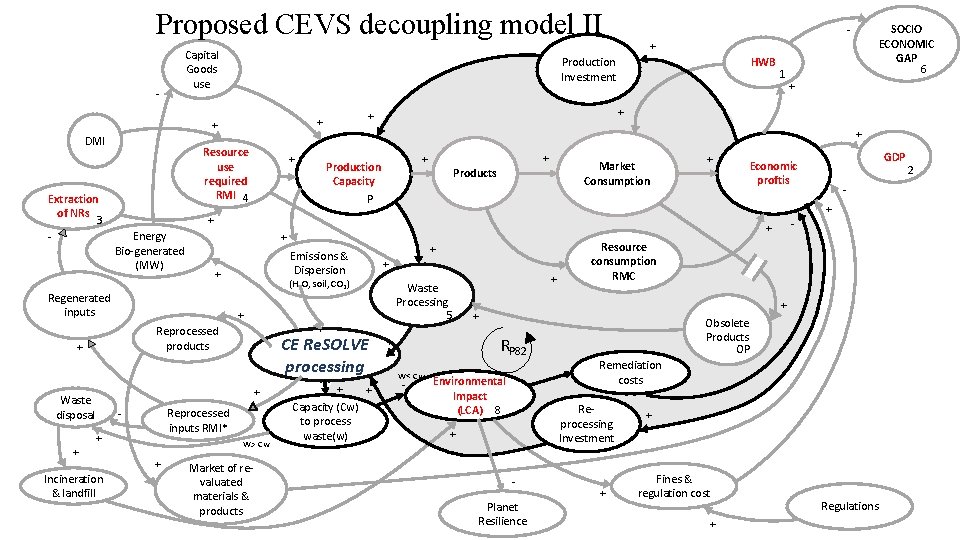
Proposed CEVS decoupling model II Capital Goods use - DMI Extraction of NRs 3 - Energy Bio-generated (MW) Market Consumption Products + + CE Re. SOLVE processing + Reprocessed inputs RMI* + W> Cw + + + (H 2 O, soil, CO 2) + Market of revaluated materials & products + + + Capacity (Cw) to process waste(w) Waste Processing 5 + - W< Cw - + Resource consumption RMC + + RP 82 + GDP Economic proftis + Emissions & Dispersion Reprocessed products Incineration & landfill + + Production Capacity P + + 1 + + + HWB + + + Resource use required RMI 4 Regenerated inputs Waste disposal + Production Investment + SOCIO ECONOMIC GAP 6 - Environmental Impact (LCA) 8 Obsolete Products OP Remediation costs Reprocessing Investment + Planet Resilience + + Fines & regulation cost + Regulations 2
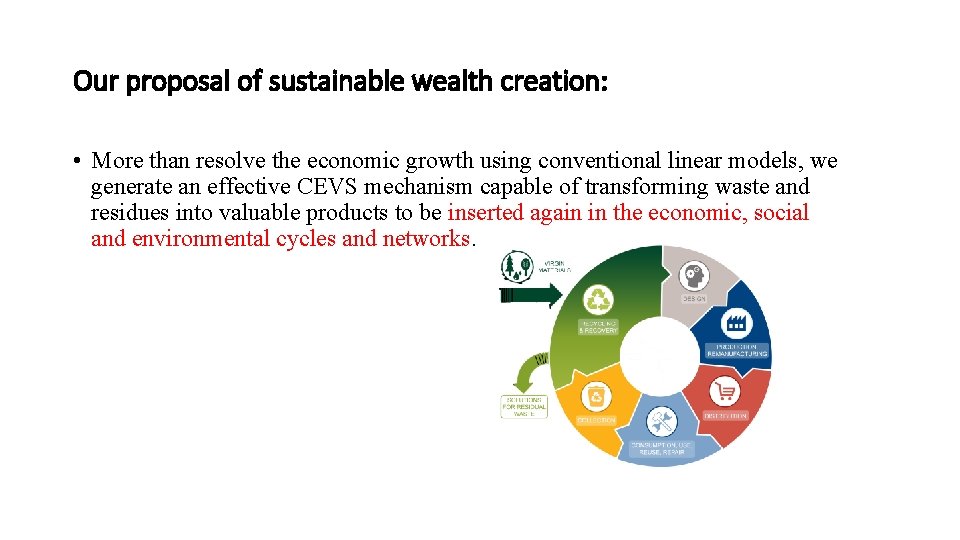
Our proposal of sustainable wealth creation: • More than resolve the economic growth using conventional linear models, we generate an effective CEVS mechanism capable of transforming waste and residues into valuable products to be inserted again in the economic, social and environmental cycles and networks.
Does this solve the COUPLING and EXTRACTIVE problem? • Circular economy can be inserted into the linear production chain, creating a circular value system (CVS) dynamics, which reduces the Total Material Requirement (TMR), and at the same time transforming the impact generated by residues and waste, into aggregated economic increasing returns, through the implementation of new non-usual businesses, increasing economic growth as well as the natural resource productivity and efficiency, allowing environmental recovering and social inclusion and in consequence generating new ventures, in benefit to all.
Conclusions and cases: 1. The linear model is incapable to solve the conventional decoupling 2. A circular economy model provides a more viable mechanism to create sustainable wealth. 3. A disruptive innovation approach must be delivered 4. Create economic incremental returns reducing the natural damage is the purpose of the application of Di. SC innovation platform to the SWIT Framework. 5. the need of an executive think tank prepared to design non usual businesses and regions is a must for developing countries.
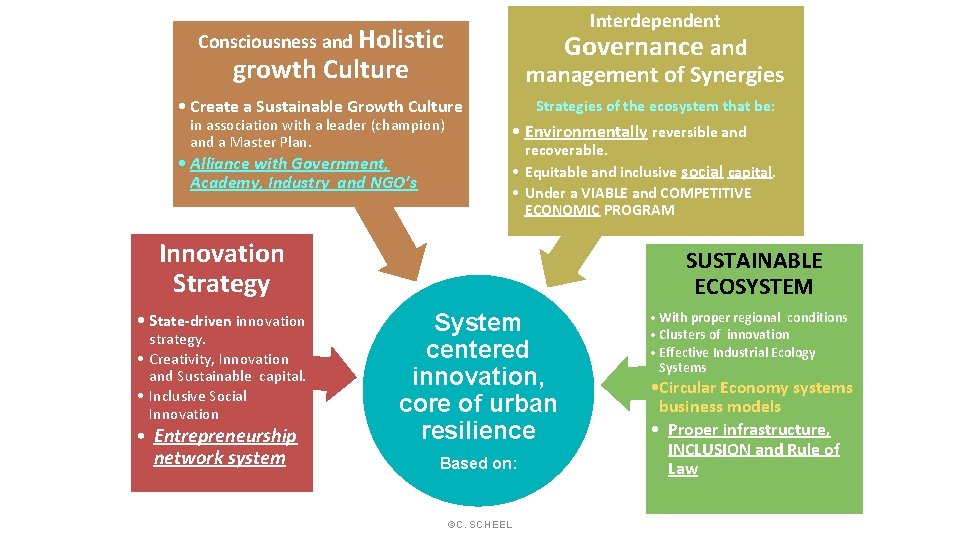
Interdependent Consciousness and Holistic Governance and growth Culture management of Synergies • Create a Sustainable Growth Culture Strategies of the ecosystem that be: in association with a leader (champion) and a Master Plan. • Alliance with Government, Academy, Industry and NGO’s • Environmentally reversible and recoverable. • Equitable and inclusive social capital. • Under a VIABLE and COMPETITIVE ECONOMIC PROGRAM Innovation Strategy • State-driven innovation strategy. • Creativity, Innovation and Sustainable capital. • Inclusive Social Innovation • Entrepreneurship network system SUSTAINABLE ECOSYSTEM System centered innovation, core of urban resilience Based on: ©C. SCHEEL • With proper regional conditions • Clusters of innovation • Effective Industrial Ecology Systems • Circular Economy systems business models • Proper infrastructure, INCLUSION and Rule of Law
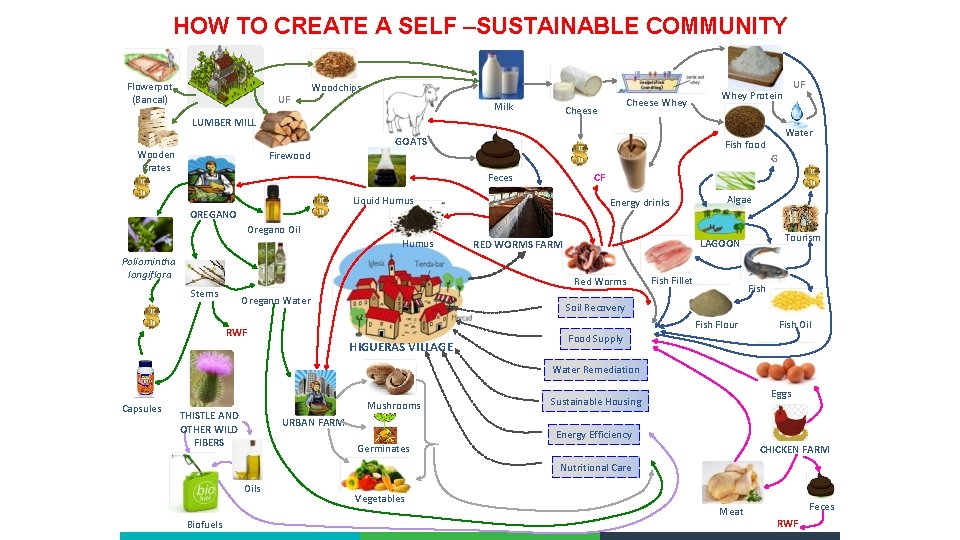
HOW TO CREATE A SELF –SUSTAINABLE COMMUNITY Flowerpot (Bancal) UF Woodchips Milk Cheese Whey Cheese LUMBER MILL GOATS Wooden Crates G Feces CF Liquid Humus Energy drinks OREGANO Algae Oregano Oil Humus Poliomintha longiflora Oregano Water Fish Fillet Fish Soil Recovery Fish Flour RWF Tourism LAGOON RED WORMS FARM Red Worms Stems Water Fish food Firewood UF Whey Protein HIGUERAS VILLAGE Fish Oil Food Supply Water Remediation Capsules Mushrooms THISTLE AND OTHER WILD FIBERS URBAN FARM Eggs Sustainable Housing Energy Efficiency Germinates CHICKEN FARM Nutritional Care Oils Biofuels Vegetables Meat Feces RWF
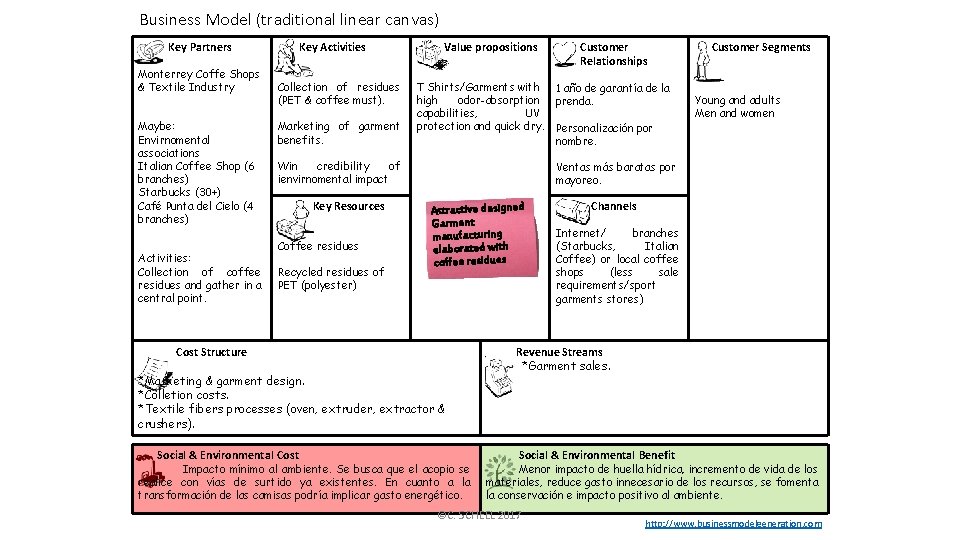
Business Model (traditional linear canvas) Key Partners Monterrey Coffe Shops & Textile Industry Maybe: Envirnomental associations Italian Coffee Shop (6 branches) Starbucks (30+) Café Punta del Cielo (4 branches) Activities: Collection of coffee residues and gather in a central point. Key Activities Collection of residues (PET & coffee must). Marketing of garment benefits. Value propositions T Shirts/Garments with high odor-absorption capabilities, UV protection and quick dry. Win credibility of ienvirnomental impact Key Resources Coffee residues Recycled residues of PET (polyester) 1 año de garantía de la prenda. Personalización por nombre. Customer Segments Young and adults Men and women Ventas más baratas por mayoreo. Attractive designed Garment manufacturing elaborated with coffee residues Cost Structure *Marketing & garment design. *Colletion costs. *Textile fibers processes (oven, extruder, extractor & crushers). Social & Environmental Cost Customer Relationships Impacto mínimo al ambiente. Se busca que el acopio se realice con vías de surtido ya existentes. En cuanto a la transformación de las camisas podría implicar gasto energético. Channels Internet/ branches (Starbucks, Italian Coffee) or local coffee shops (less sale requirements/sport garments stores) Revenue Streams *Garment sales. Social & Environmental Benefit Menor impacto de huella hídrica, incremento de vida de los materiales, reduce gasto innecesario de los recursos, se fomenta la conservación e impacto positivo al ambiente. ©C. SCHEEL 2017 http: //www. businessmodelgeneration. com
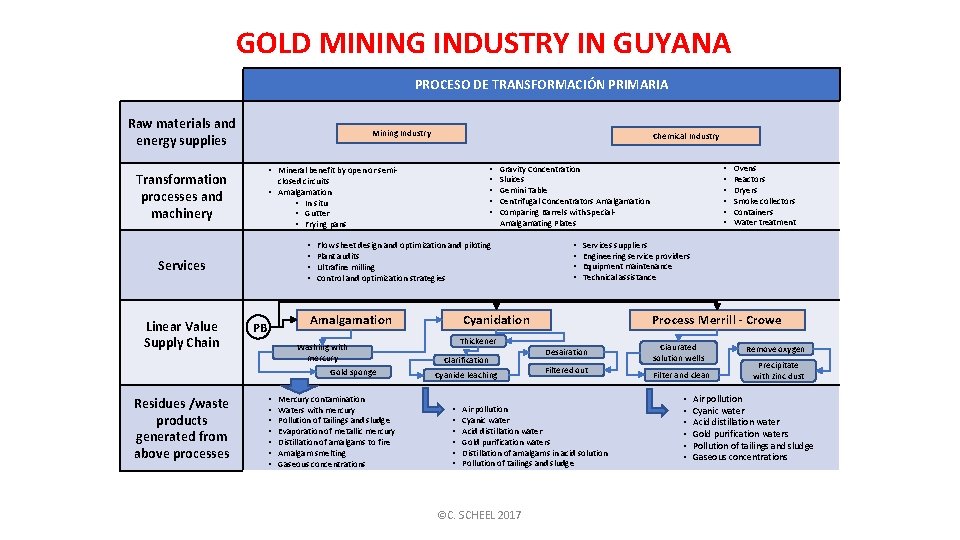
GOLD MINING INDUSTRY IN GUYANA PROCESO DE TRANSFORMACIÓN PRIMARIA Raw materials and energy supplies Mining Industry closed circuits • Amalgamation • In situ • Gutter • Frying pans • • Services Washing with mercury • • Mercury contamination Waters with mercury Pollution of tailings and sludge Evaporation of metallic mercury Distillation of amalgams to fire Amalgam smelting Gaseous concentrations • • Process Merrill - Crowe Thickener Clarification Cyanide leaching • • • Desairation Filtered out Air pollution Cyanic water Acid distillation water Gold purification waters Distillation of amalgams in acid solution Pollution of tailings and sludge ©C. SCHEEL 2017 Ovens Reactors Dryers Smoke collectors Containers Water treatment Services suppliers Engineering service providers Equipment maintenance Technical assistance Cyanidation Amalgamation PB • • • Gravity Concentration Sluices Gemini Table Centrifugal Concentrators Amalgamation Comparing Barrels with Special. Amalgamating Plates Flow sheet design and optimization and piloting Plant audits Ultrafine milling Control and optimization strategies Gold sponge Residues /waste products generated from above processes • • • Mineral benefit by open or semi- Transformation processes and machinery Linear Value Supply Chain Chemical Industry Ciaurated solution wells Filter and clean • • • Remove oxygen Precipitate with zinc dust Air pollution Cyanic water Acid distillation water Gold purification waters Pollution of tailings and sludge Gaseous concentrations
THANKS Carlos Scheel-Mayenberger, Ph. D Director, Research line: Sustainable Wealth creation based on Innovation and Technology: SWIT Professor Emeritus, EGADE, Tecnológico de Monterrey. Mexico Visit: www. swit. mx cscheel@itesm. mx © C. SCHEEL 2018 26
- Slides: 26