
SUSTAINABLE WATER MANAGEMENT How do we get there
SUSTAINABLE WATER MANAGEMENT: How do we get there? AWRA Summer Specialty Conference July 2014 Gary Bardini, P. E. Deputy Director California Dept of Water Resources
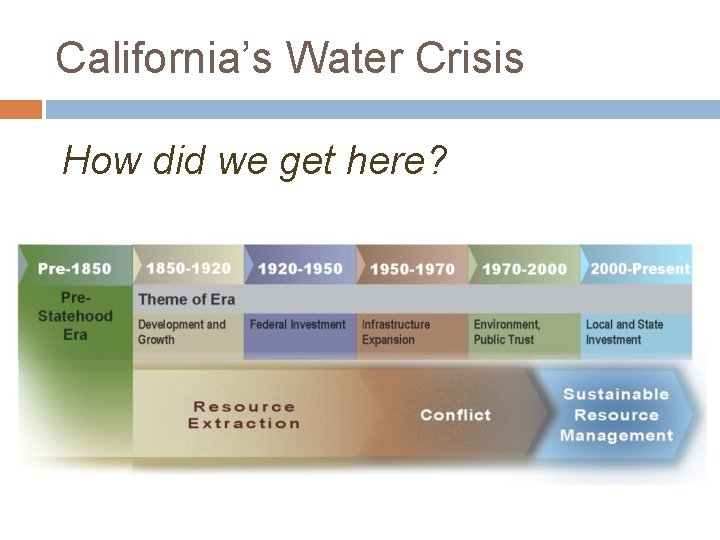
California’s Water Crisis How did we get here?
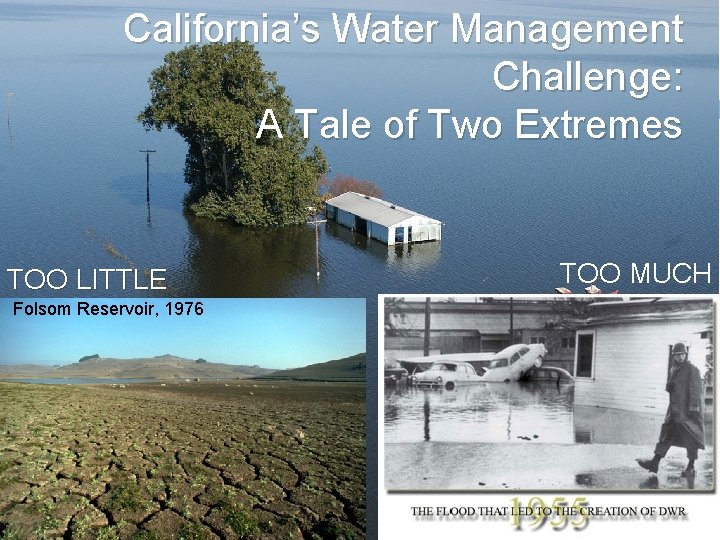
California’s Water Management Challenge: A Tale of Two Extremes TOO LITTLE Folsom Reservoir, 1976 TOO MUCH
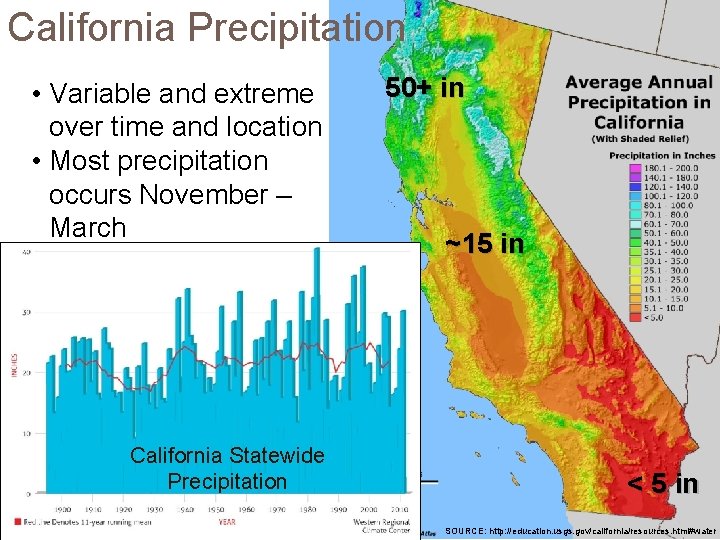
California Precipitation • Variable and extreme over time and location • Most precipitation occurs November – March California Statewide Precipitation 50+ in ~15 in < 5 in SOURCE: http: //education. usgs. gov/california/resources. html#water
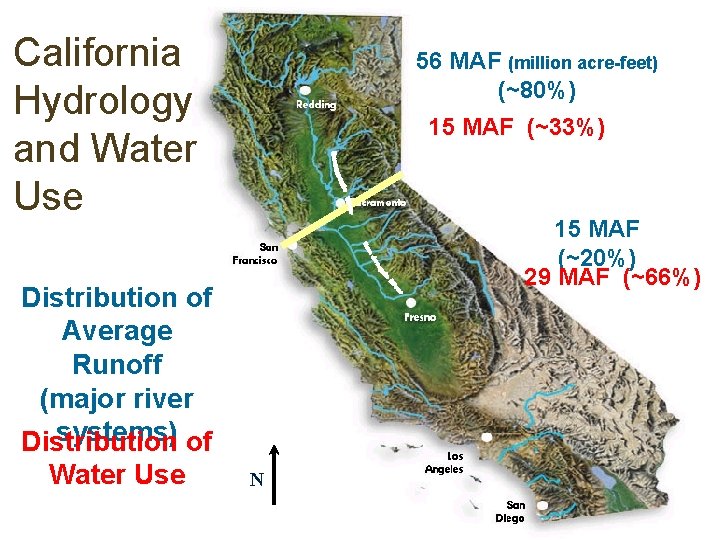
Average 56 MAF (million acre-feet) Annual (~80%) 15 MAF (~33%) Runoff California Hydrology and Water Use ~71 15 MAF/Year (~20%) 29 MAF (~66%) Distribution of Average Runoff (major river systems) of Distribution Water Use n N 5
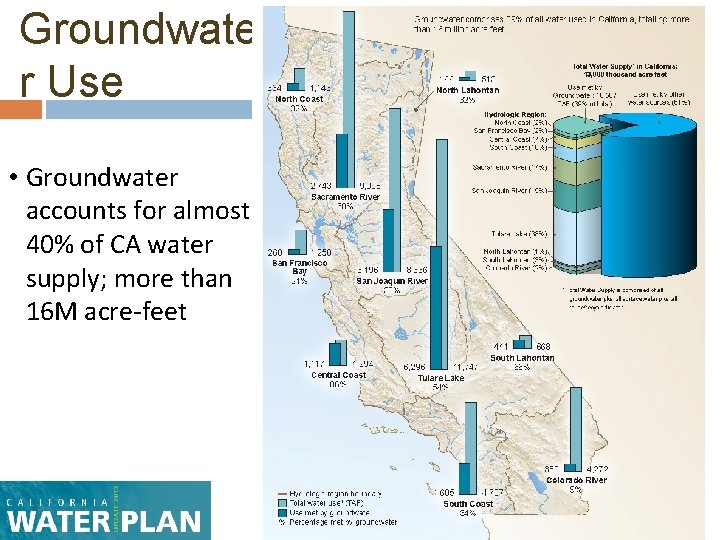
Groundwate r Use • Groundwater accounts for almost 40% of CA water supply; more than 16 M acre-feet
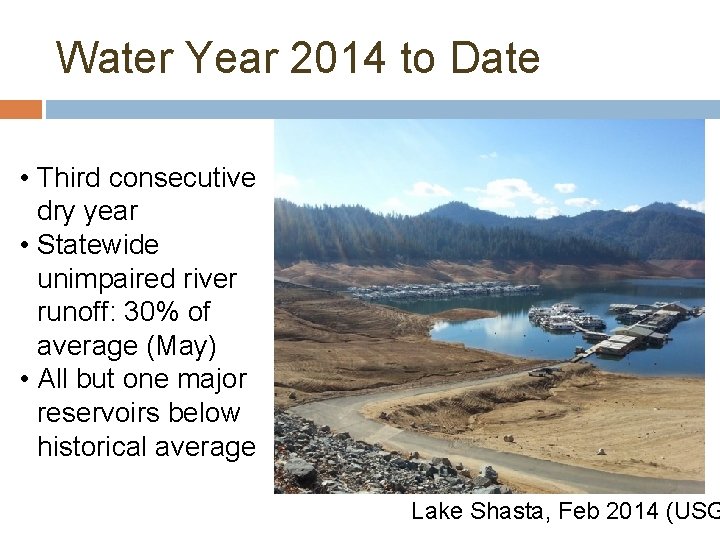
Water Year 2014 to Date • Third consecutive dry year • Statewide unimpaired river runoff: 30% of average (May) • All but one major reservoirs below historical average Lake Shasta, Feb 2014 (USG
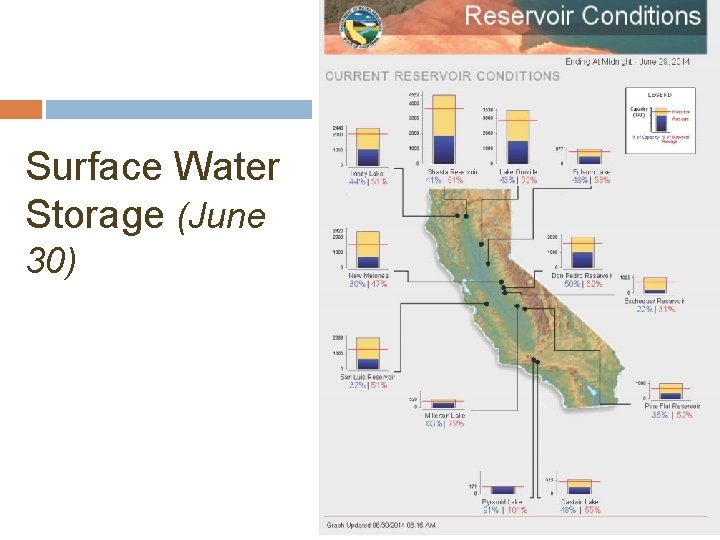
Surface Water Storage (June 30)
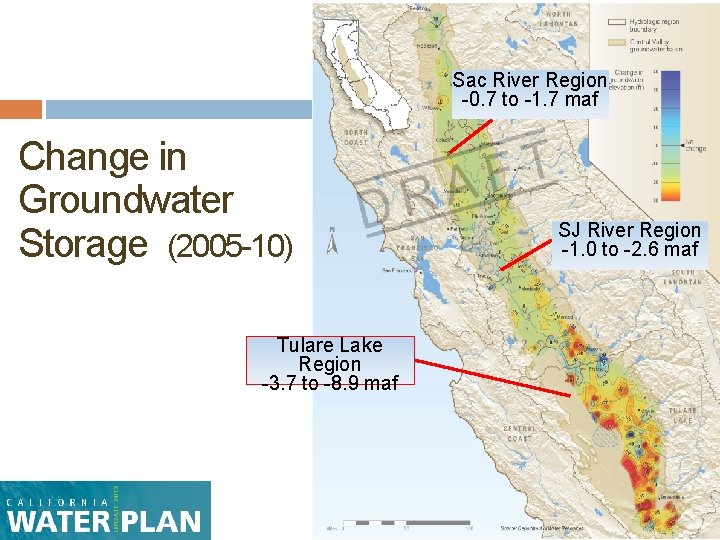
Sac River Region -0. 7 to -1. 7 maf Change in Groundwater Storage (2005 -10) Tulare Lake Region -3. 7 to -8. 9 maf SJ River Region -1. 0 to -2. 6 maf
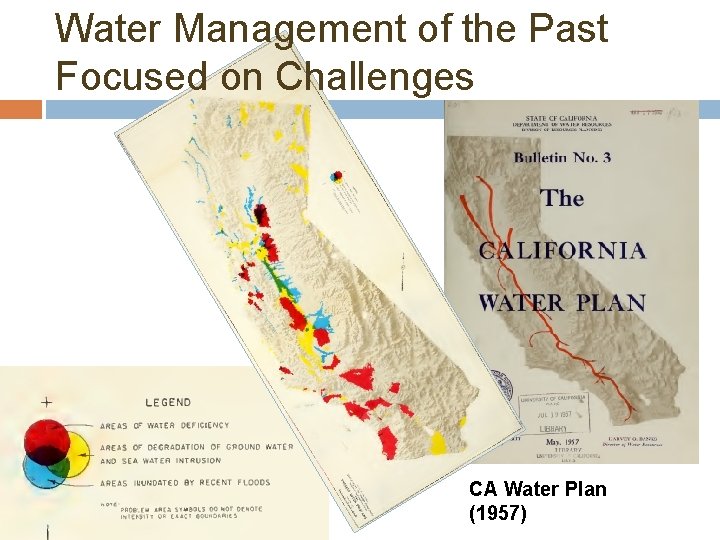
Water Management of the Past Focused on Challenges 10 CA Water Plan (1957)
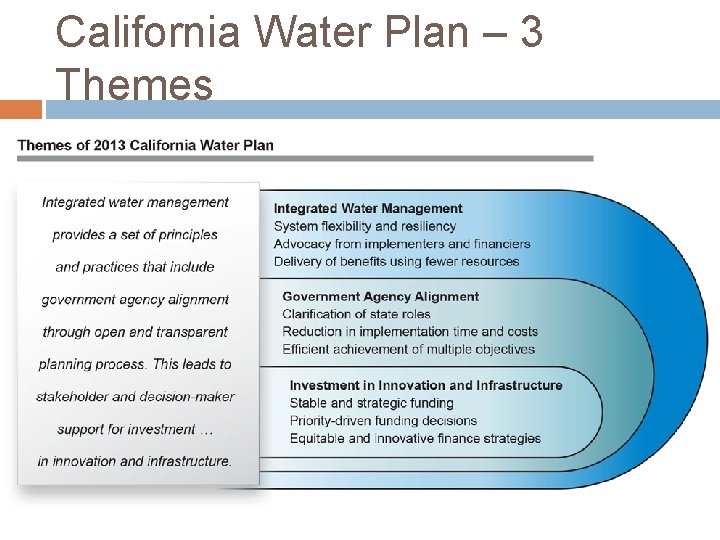
California Water Plan – 3 Themes
Integrated Water Management is Part of the Solution Integrated Water Resources Management Definition (Global) A process which promotes the coordinated development and management of water, land related resources, in order to maximize the resultant economic and social welfare in an equitable manner without compromising the sustainability of vital ecosystems - Global Water Partnership (GWP)
Integrated Water Management is Part of the Solution Integrated Water Management Definition (California) Comprehensive and collaborative approach for managing water to concurrently achieve social, environmental, and economic objectives. In the California Water Plan, these objectives are focused toward improving public safety, fostering environmental stewardship, and supporting economic stability. IWM delivers higher value for investments by considering all interests, providing multiple benefits, and working across jurisdictional boundaries at the appropriate geographic scale. – CA DWR, Calif Water Plan Update 2013
Defining “Sustainable Water Management” Recent CA Legislative Proposals for Groundwater: Senate Bill 1168 Management of a groundwater basin to provide for multiple long-term benefits without resulting in or aggravating conditions that cause significant economic, social, or environmental impacts such as long-term overdraft, land subsidence, ecosystem degradation, depletions from surface water bodies, and water quality degradation, in order to protect the resource for present and future generations. Assembly Bill 1739 Management and use of groundwater in a manner that can be maintained during the planning and implementation horizon without causing unreasonable adverse environmental, economic, or social consequences through the development, implementation, and updating of plans and programs based on the best available science, monitoring, forecasting, and use of technological resources, as determined by a groundwater sustainability agency.
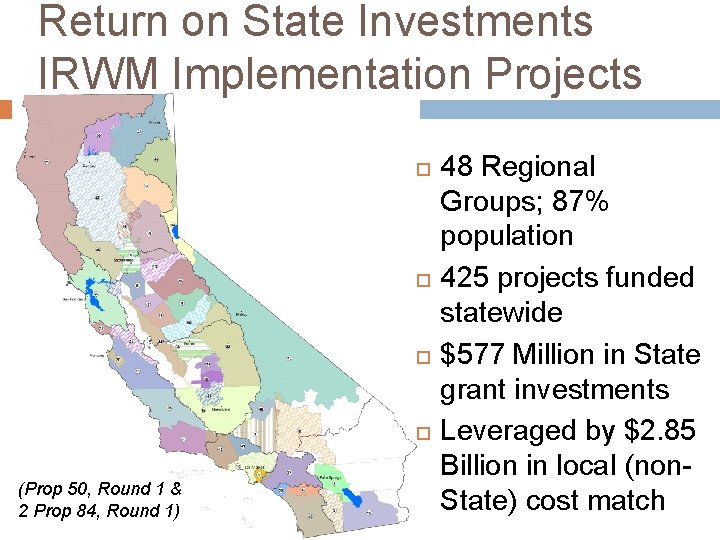
Return on State Investments IRWM Implementation Projects (Prop 50, Round 1 & 2 Prop 84, Round 1) 48 Regional Groups; 87% population 425 projects funded statewide $577 Million in State grant investments Leveraged by $2. 85 Billion in local (non. State) cost match
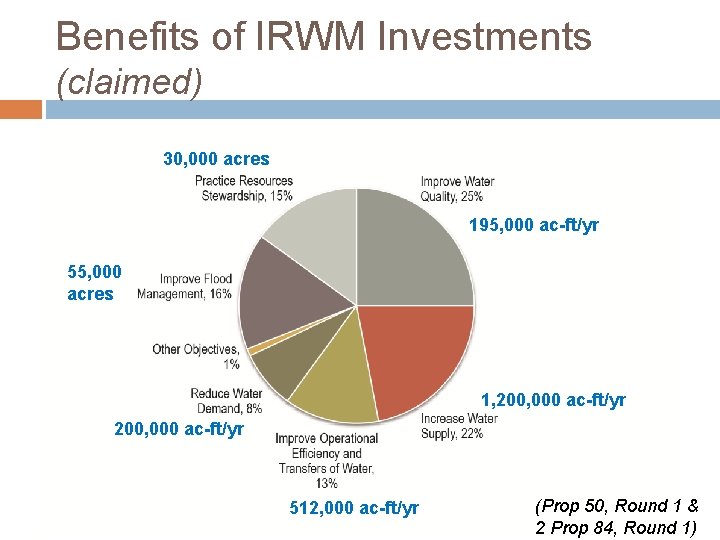
Benefits of IRWM Investments (claimed) 30, 000 acres 195, 000 ac-ft/yr 55, 000 acres 1, 200, 000 ac-ft/yr 512, 000 ac-ft/yr (Prop 50, Round 1 & 2 Prop 84, Round 1)
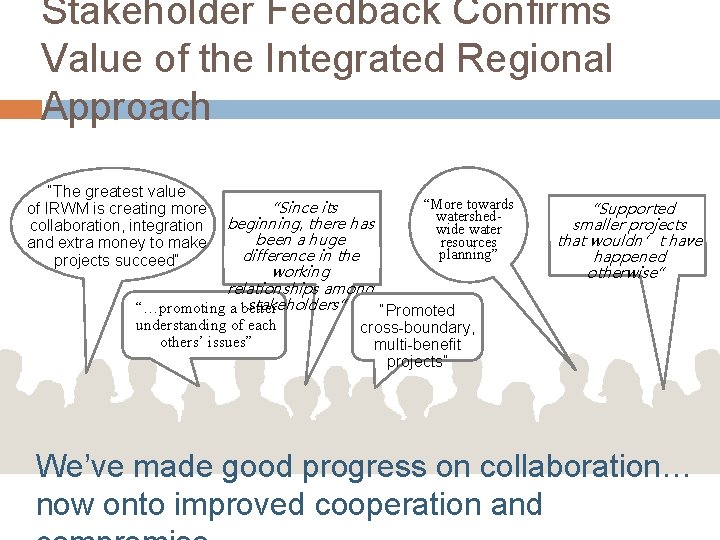
Stakeholder Feedback Confirms Value of the Integrated Regional Approach “The greatest value of IRWM is creating more collaboration, integration and extra money to make projects succeed” “More towards “Since its watershedbeginning, there has wide water been a huge resources planning” difference in the working relationships among stakeholders” “…promoting a better “Promoted understanding of each cross-boundary, others’ issues” multi-benefit projects” “Supported smaller projects that wouldn’t have happened otherwise” We’ve made good progress on collaboration… now onto improved cooperation and
What’s Needed to Move to Sustainable Water Management? What Water Leaders are saying: q Establish Stable Financing q Improve Alignment at all Levels of Government q Improve Investment in Science q Measure and Track Progress Towards System 18
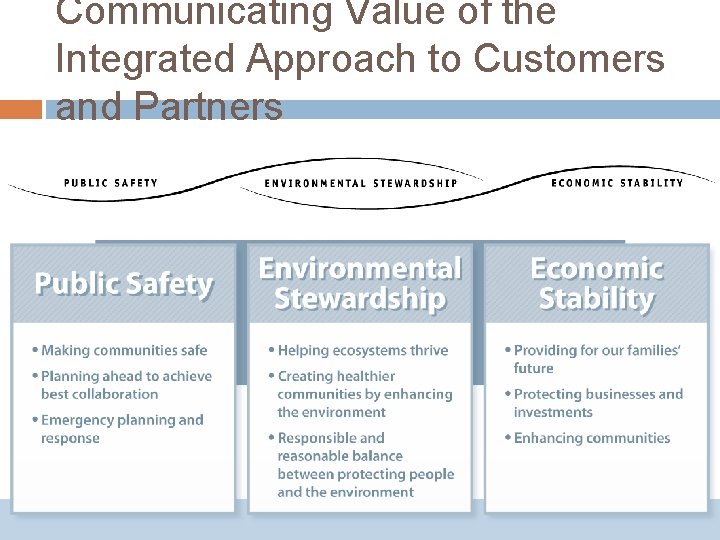
Communicating Value of the Integrated Approach to Customers and Partners
Bureau of Reclamation Application of IWRM Principles in Reclamation Planning
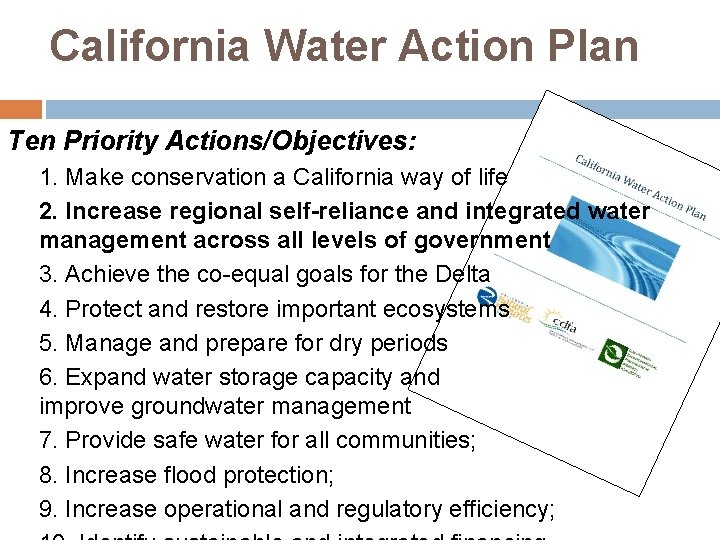
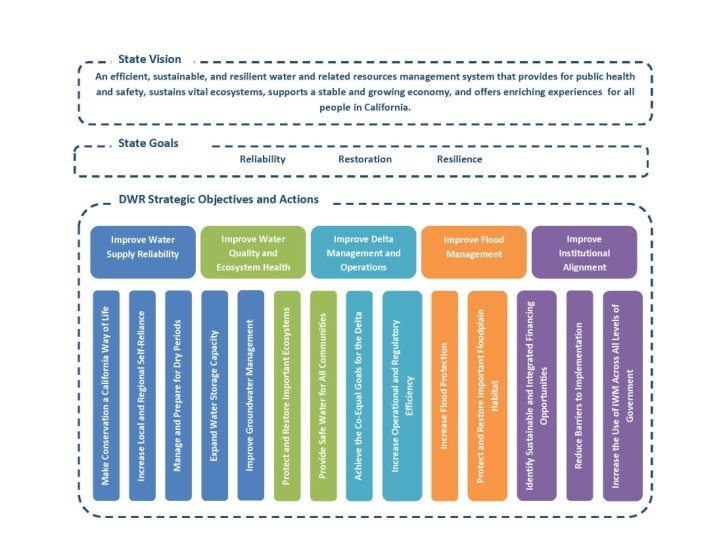
California Water Action Plan Ten Priority Actions/Objectives: 1. Make conservation a California way of life 2. Increase regional self-reliance and integrated water management across all levels of government 3. Achieve the co-equal goals for the Delta 4. Protect and restore important ecosystems 5. Manage and prepare for dry periods 6. Expand water storage capacity and improve groundwater management 7. Provide safe water for all communities; 8. Increase flood protection; 9. Increase operational and regulatory efficiency;
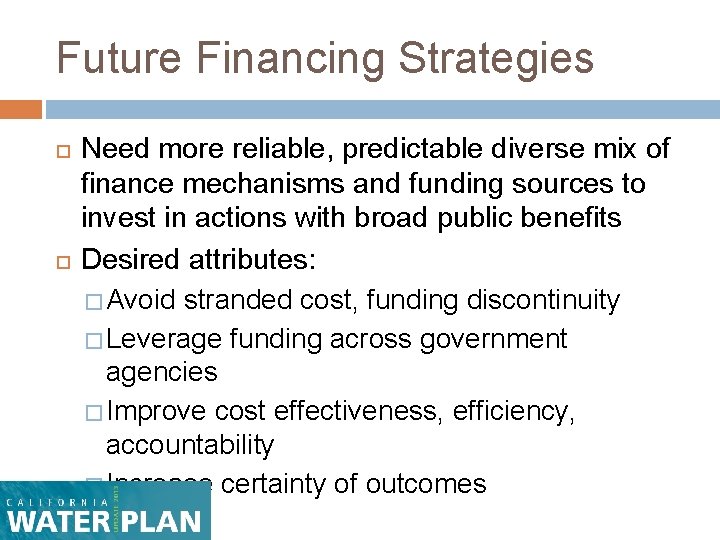
Future Financing Strategies Need more reliable, predictable diverse mix of finance mechanisms and funding sources to invest in actions with broad public benefits Desired attributes: � Avoid stranded cost, funding discontinuity � Leverage funding across government agencies � Improve cost effectiveness, efficiency, accountability � Increase certainty of outcomes
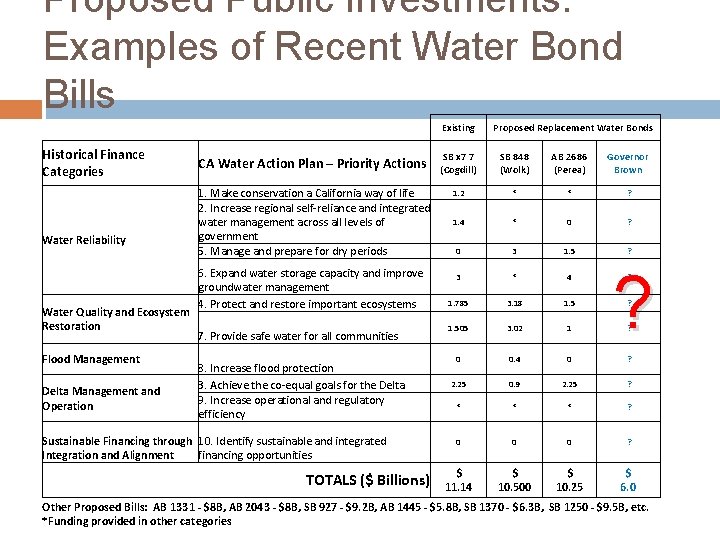
Proposed Public Investments: Examples of Recent Water Bond Bills Existing Historical Finance Categories Water Reliability Water Quality and Ecosystem Restoration Flood Management Delta Management and Operation CA Water Action Plan – Priority Actions SB x 7 7 (Cogdill) 1. Make conservation a California way of life 2. Increase regional self-reliance and integrated water management across all levels of government 5. Manage and prepare for dry periods 1. 2 6. Expand water storage capacity and improve groundwater management 4. Protect and restore important ecosystems 7. Provide safe water for all communities 8. Increase flood protection 3. Achieve the co-equal goals for the Delta 9. Increase operational and regulatory efficiency Sustainable Financing through 10. Identify sustainable and integrated Integration and Alignment financing opportunities TOTALS ($ Billions) Proposed Replacement Water Bonds SB 848 (Wolk) AB 2686 (Perea) Governor Brown * * ? 1. 4 * 0 ? 0 3 1. 5 ? 3 * 4 1. 785 3. 18 1. 505 3. 02 1 0 0. 4 0 ? 2. 25 0. 9 2. 25 ? * * * ? 0 0 0 ? $ $ 11. 14 10. 500 10. 25 ? ? $ 6. 0 Other Proposed Bills: AB 1331 - $8 B, AB 2043 - $8 B, SB 927 - $9. 2 B, AB 1445 - $5. 8 B, SB 1370 - $6. 3 B, SB 1250 - $9. 5 B, etc. *Funding provided in other categories
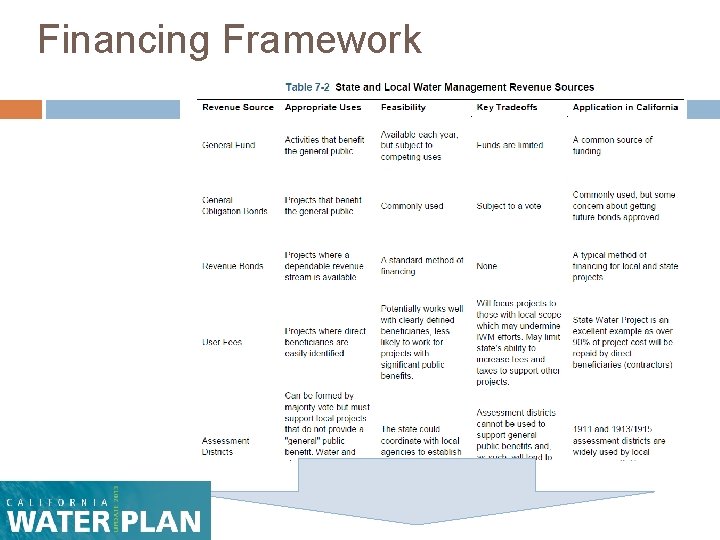
Financing Framework
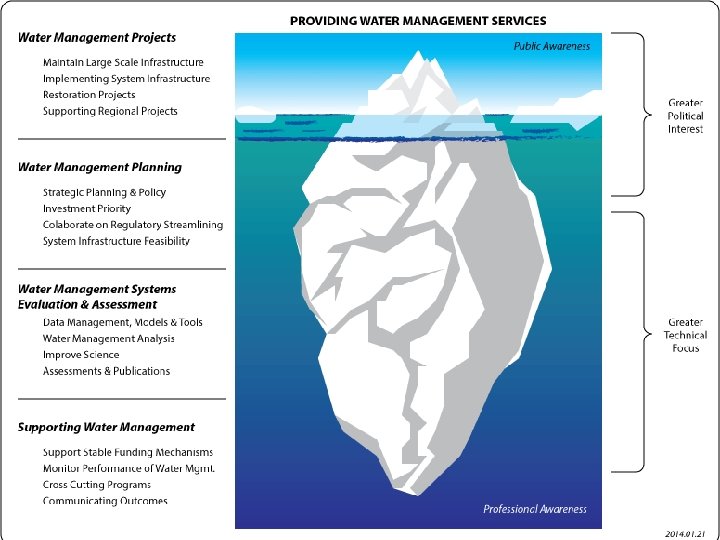
Iceberg
Gary Bardini Deputy Director Integrated Water Management California Department of Water Resources For more information: (916) 591 -1324 carmel. brown@water. ca. go v http: //www. water. ca. gov
Extra slides
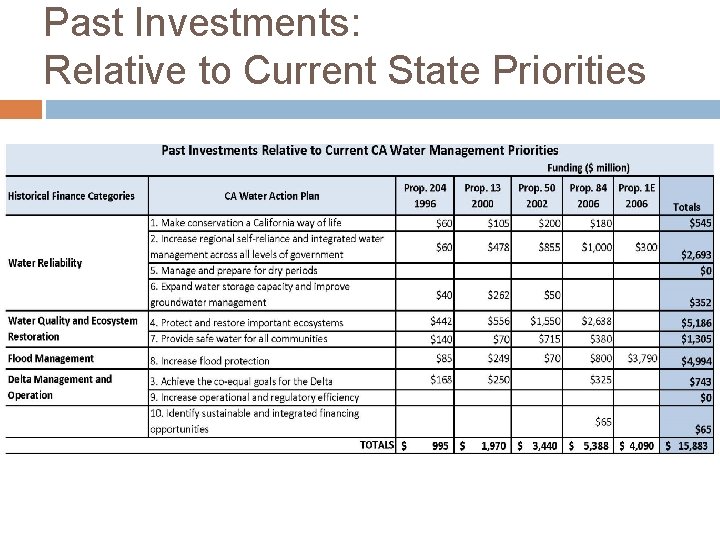
Past Investments: Relative to Current State Priorities
- Slides: 29