
Sustainable Urban Traffic Management using Advanced Technologies Yashar
Sustainable Urban Traffic Management using Advanced Technologies Yashar Zeinali Farid, Farnoush Khalighi Eleni Christofa, Ph. D Civil and Environmental Engineering University of Massachusetts Amherst T 3 e Webinar, ITS PCB Program The Volpe National Transportation Systems Center May 26, 2016
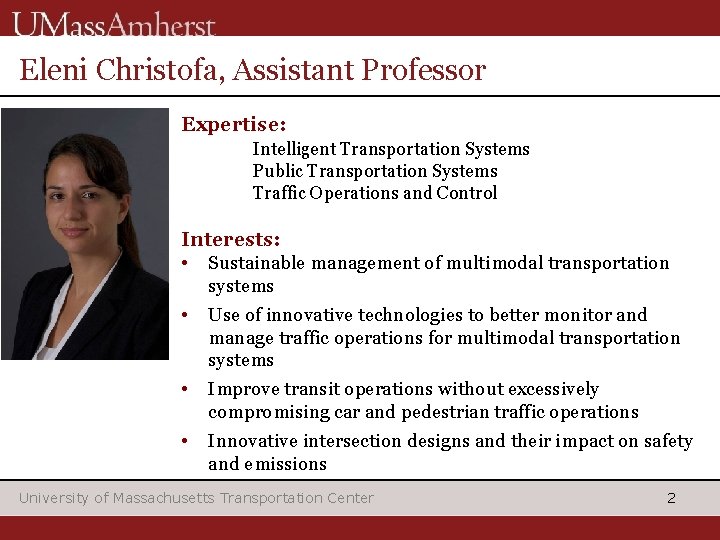
Eleni Christofa, Assistant Professor Expertise: Intelligent Transportation Systems Public Transportation Systems Traffic Operations and Control Interests: • Sustainable management of multimodal transportation systems • Use of innovative technologies to better monitor and manage traffic operations for multimodal transportation systems • Improve transit operations without excessively compromising car and pedestrian traffic operations • Innovative intersection designs and their impact on safety and emissions University of Massachusetts Transportation Center 2
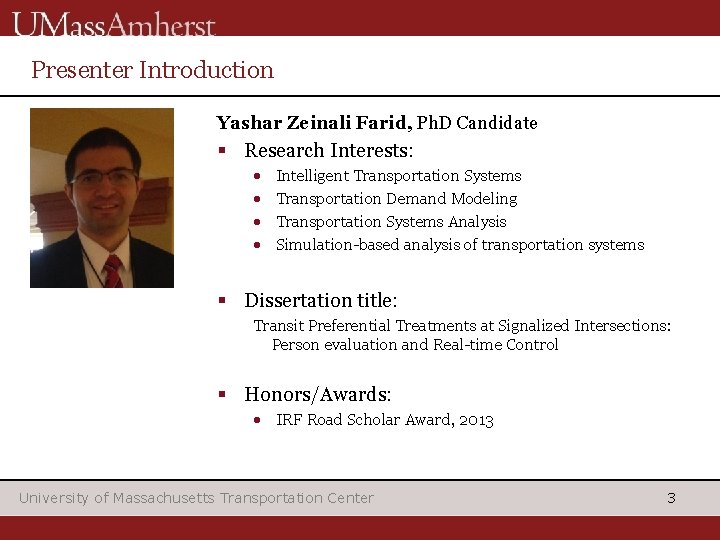
Presenter Introduction Yashar Zeinali Farid, Ph. D Candidate § Research Interests: • • Intelligent Transportation Systems Transportation Demand Modeling Transportation Systems Analysis Simulation-based analysis of transportation systems § Dissertation title: Transit Preferential Treatments at Signalized Intersections: Person evaluation and Real-time Control § Honors/Awards: • IRF Road Scholar Award, 2013 University of Massachusetts Transportation Center 3
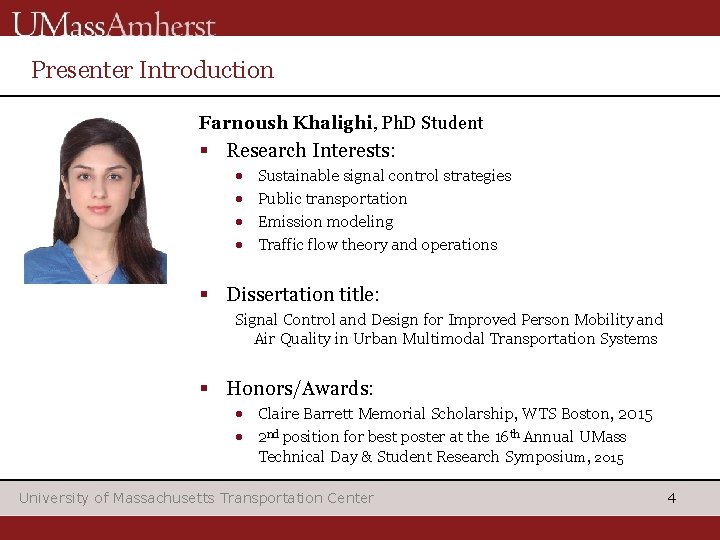
Presenter Introduction Farnoush Khalighi, Ph. D Student § Research Interests: • • Sustainable signal control strategies Public transportation Emission modeling Traffic flow theory and operations § Dissertation title: Signal Control and Design for Improved Person Mobility and Air Quality in Urban Multimodal Transportation Systems § Honors/Awards: • Claire Barrett Memorial Scholarship, WTS Boston, 2015 • 2 nd position for best poster at the 16 th Annual UMass Technical Day & Student Research Symposium, 2015 University of Massachusetts Transportation Center 4
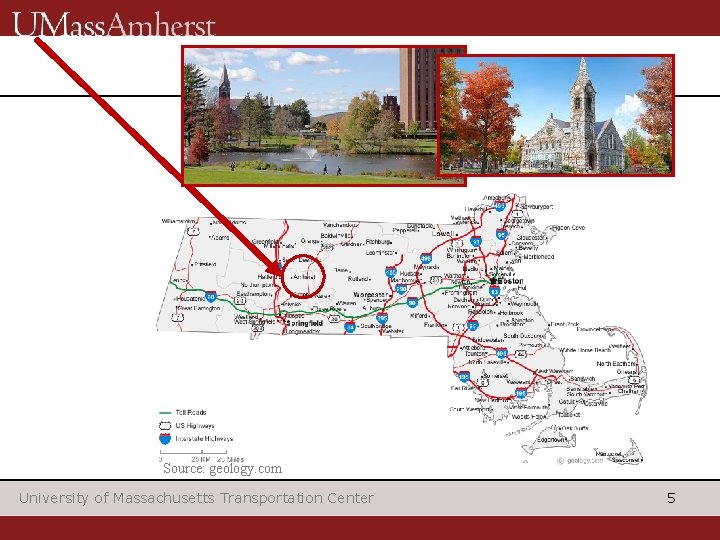
Source: geology. com University of Massachusetts Transportation Center 5
University of Massachusetts Transportation Center, UMTC § The Center includes: • • Regional Traveler Information Center (RTIC) Local Technical Assistance Program (LTAP) Transportation Training Institute (TTI) Cooperative Research Program UMass Traffic Research Safety Program (UMass. Safe) Aviation Center University Transportation Centers (UTC) • New England UTC (Region I) • Safety Research Using Simulation (SAFERSIM) • Tier I Crash-Imminent Safety UTC University of Massachusetts Transportation Center 6
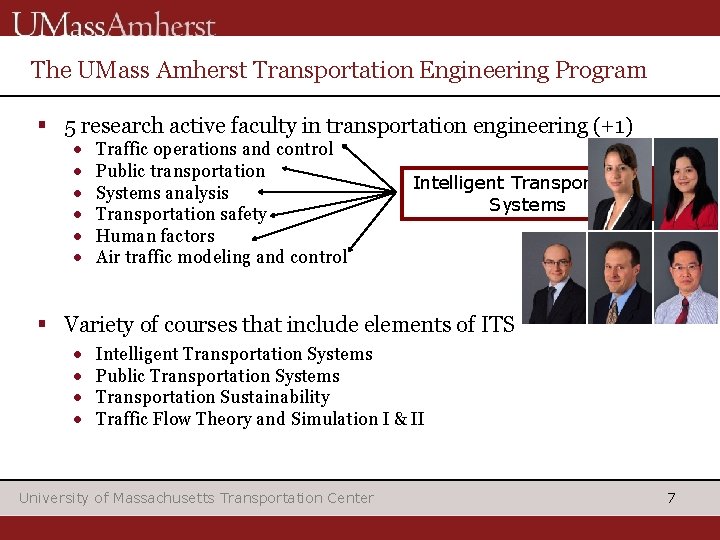
The UMass Amherst Transportation Engineering Program § 5 research active faculty in transportation engineering (+1) • • • Traffic operations and control Public transportation Systems analysis Transportation safety Human factors Air traffic modeling and control Intelligent Transportation Systems § Variety of courses that include elements of ITS • • Intelligent Transportation Systems Public Transportation Systems Transportation Sustainability Traffic Flow Theory and Simulation I & II University of Massachusetts Transportation Center 7
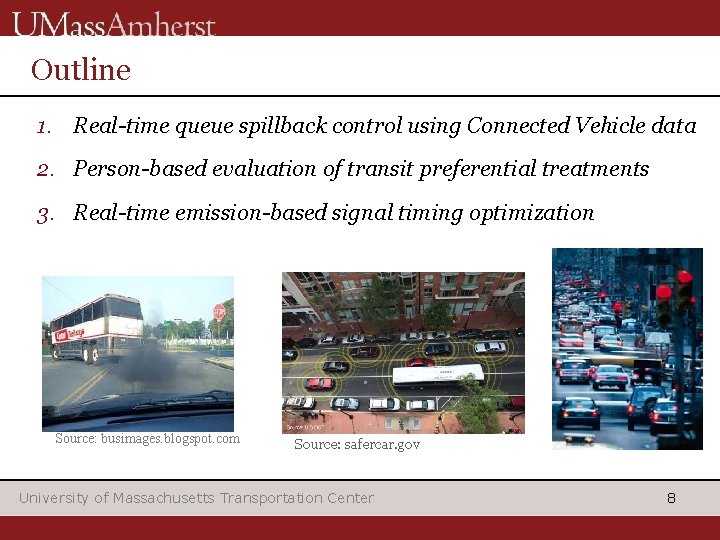
Outline 1. Real-time queue spillback control using Connected Vehicle data 2. Person-based evaluation of transit preferential treatments 3. Real-time emission-based signal timing optimization Source: busimages. blogspot. com Source: safercar. gov University of Massachusetts Transportation Center 8
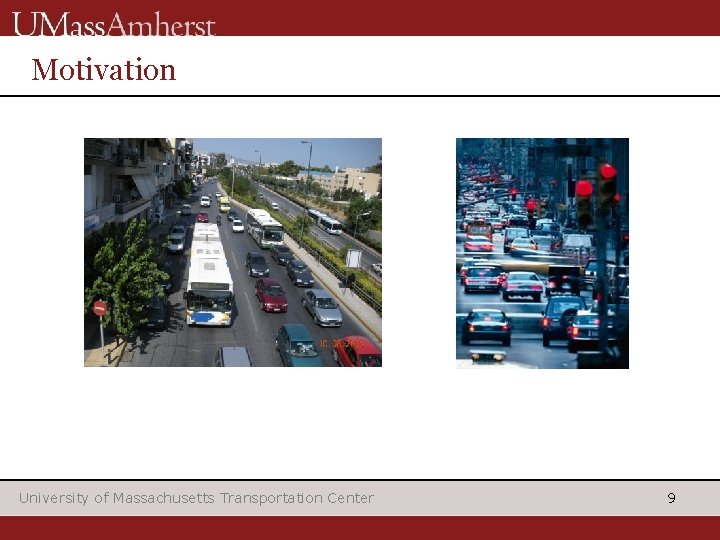
Motivation University of Massachusetts Transportation Center 9
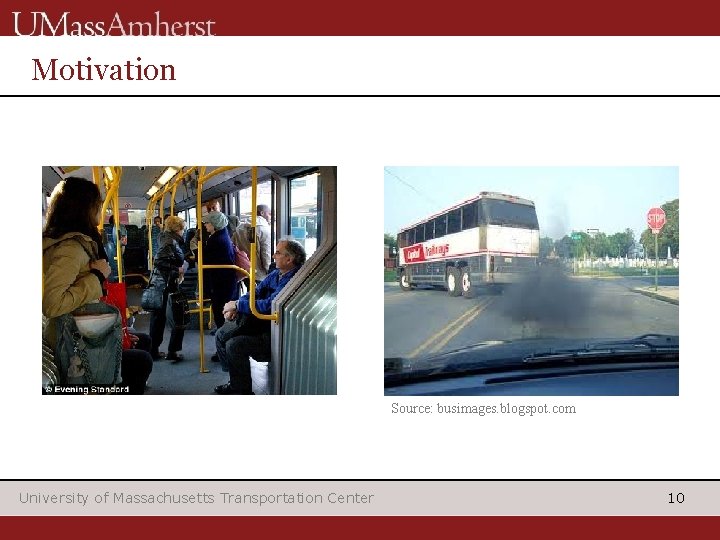
Motivation Source: busimages. blogspot. com University of Massachusetts Transportation Center 10
1. Arterial Queue Spillback Detection and Signal Control Based on Connected Vehicle Technology Christofa, E. , Argote, J. , and Skabardonis, A. 2013. Arterial Queue Spillback Detection and Signal Control based on Connected Vehicle Technology. Transportation Research Record: Journal of the Transportation Research Board, 2356: 61– 70. University of Massachusetts Transportation Center 11
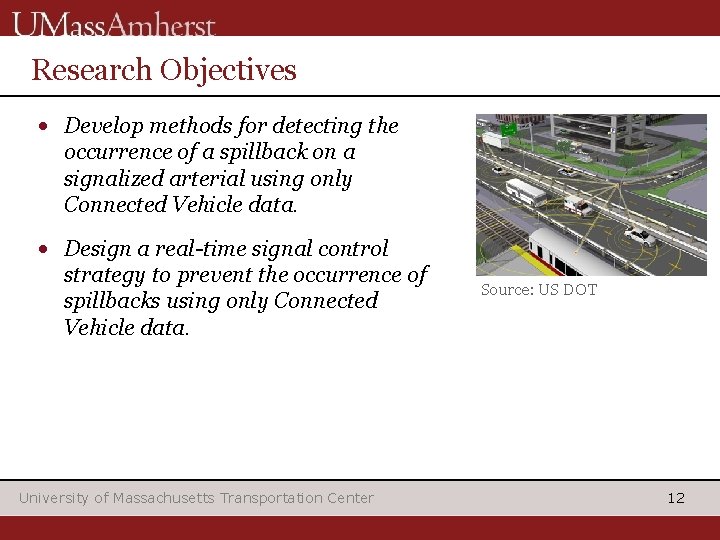
Research Objectives • Develop methods for detecting the occurrence of a spillback on a signalized arterial using only Connected Vehicle data. • Design a real-time signal control strategy to prevent the occurrence of spillbacks using only Connected Vehicle data. University of Massachusetts Transportation Center Source: US DOT 12
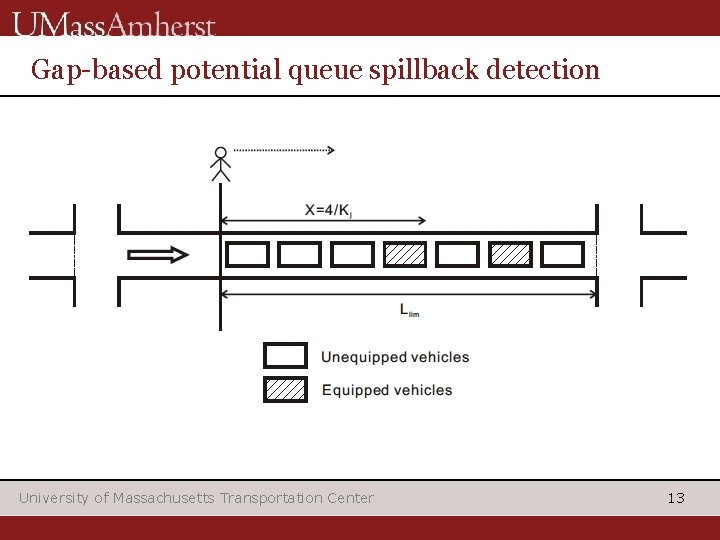
Gap-based potential queue spillback detection University of Massachusetts Transportation Center 13
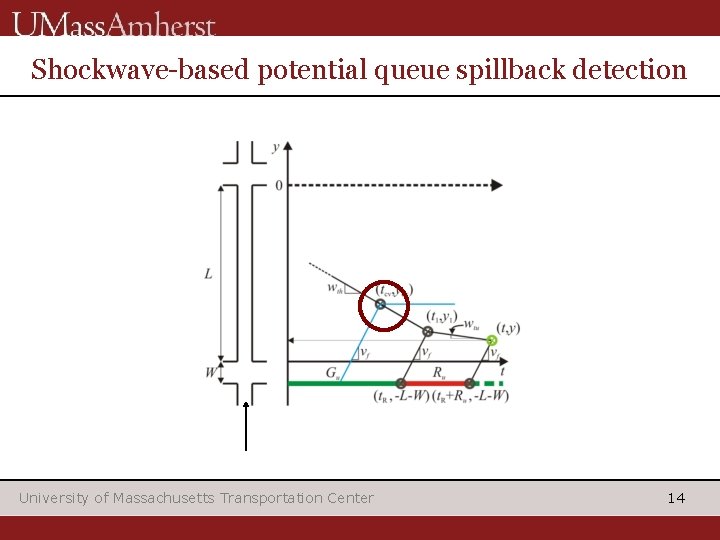
Shockwave-based potential queue spillback detection University of Massachusetts Transportation Center 14
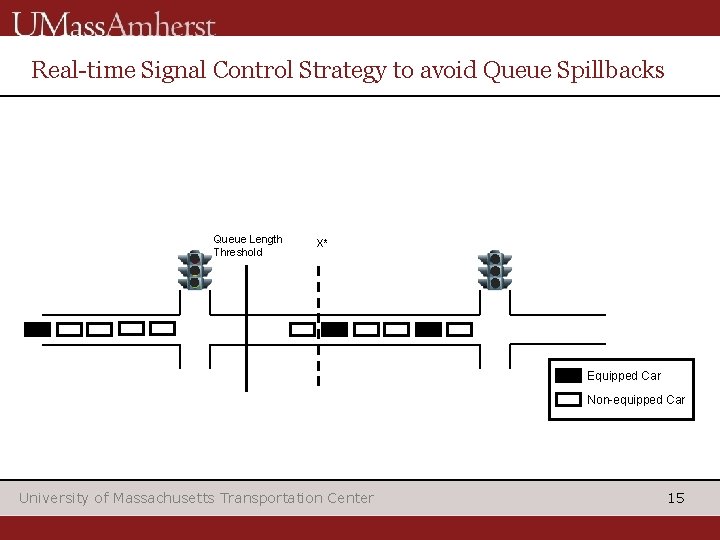
Real-time Signal Control Strategy to avoid Queue Spillbacks Queue Length Threshold X* Equipped Car Non-equipped Car University of Massachusetts Transportation Center 15
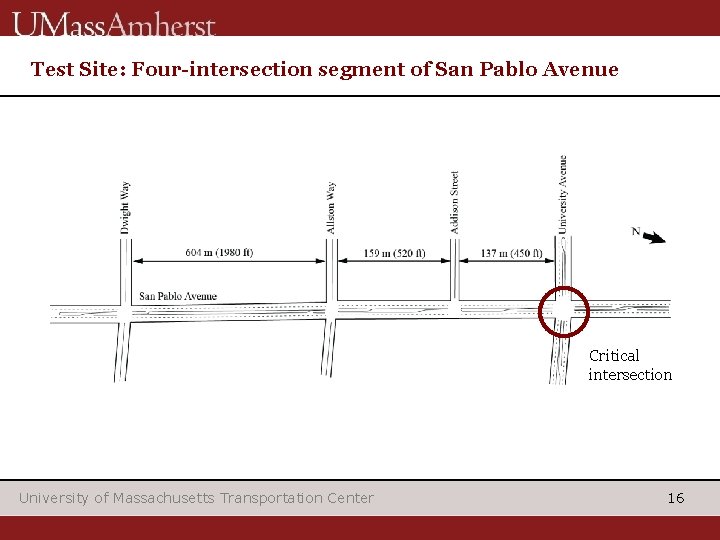
Test Site: Four-intersection segment of San Pablo Avenue Critical intersection University of Massachusetts Transportation Center 16
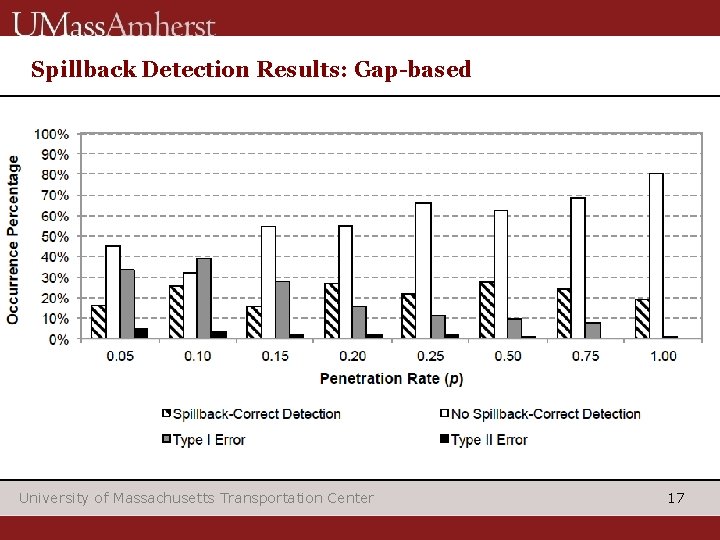
Spillback Detection Results: Gap-based Critical intersection University of Massachusetts Transportation Center 17
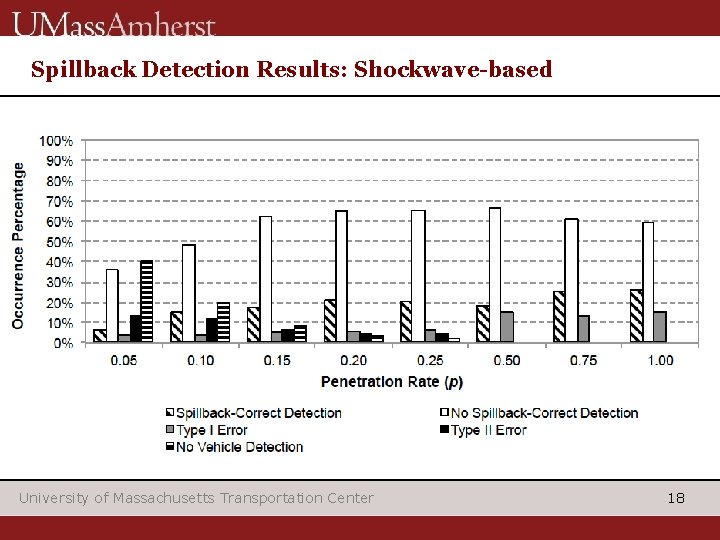
Spillback Detection Results: Shockwave-based University of Massachusetts Transportation Center 18
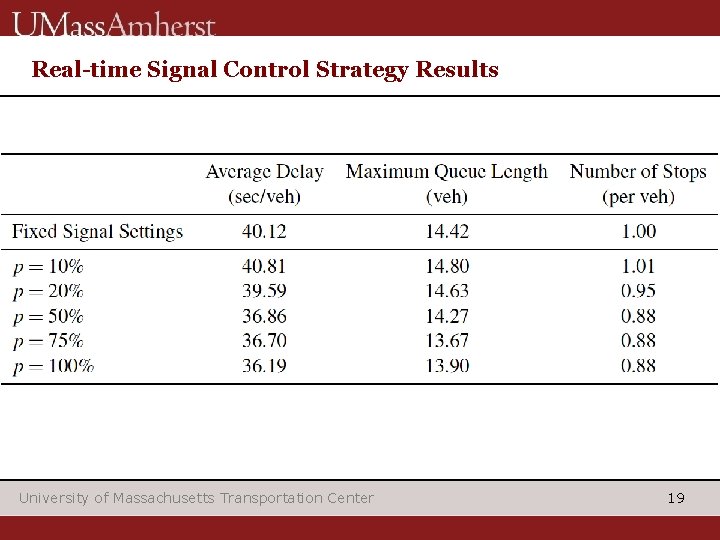
Real-time Signal Control Strategy Results University of Massachusetts Transportation Center 19
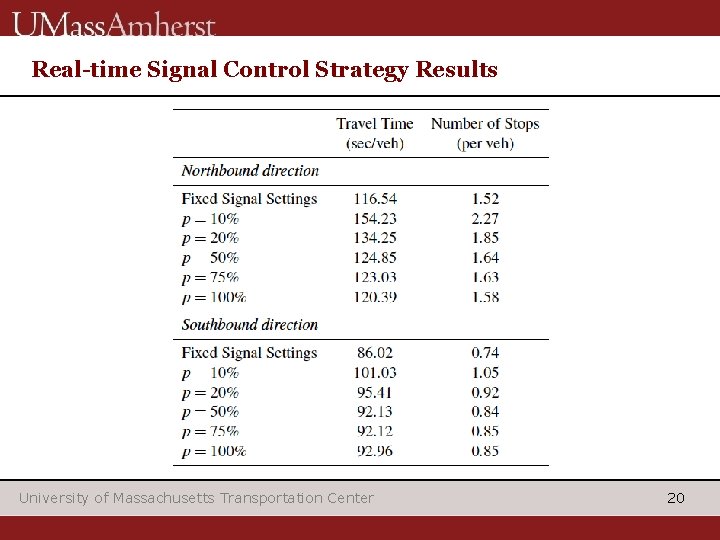
Real-time Signal Control Strategy Results University of Massachusetts Transportation Center 20
Findings • Both methods result to correct detection of the spillback in more than 80% of the cycles for CV penetration rates higher than 20%. • The shockwave-based detection method is more effective for CV penetration rates as low as 10 -20%. • For high CV penetration rates the signal control strategy can effectively reduce the maximum queue length at the critical link and therefore, result in avoidance of queue spillbacks and a reduction in the delay for the cross-street traffic. • For low CV penetration rates the signal control strategy may be triggered inconsistently and result to worse performance for the critical link and the whole arterial. University of Massachusetts Transportation Center 21
- Slides: 21