
SUSTAINABLE URBAN MOBILITY PLAN TRAINING WORKSHOP Module 5
SUSTAINABLE URBAN MOBILITY PLAN TRAINING WORKSHOP Module 5 – Identifying & Testing Measures, SUMP Strategy Development
Sustainable Urban Mobility Plans: Selection of Measures & Projects • Distinguish between measures and projects! • Defining optimum set of solutions for SUMP objectives: – Solutions considered for each objective – Measures/projects tested using the analysis tools as appropriate. • Different categories of measures including: – Infrastructure: requires capital investment in physical works – Operational measures: describe actions to improve operation of transport (eg. travel information, ticketing, traffic management or other intelligent transport systems) – Organisational measures: involve changes to the structures that oversee the implementation of transport solutions, implemented at institutional level or within specific authorities/agencies. JASPERS EU Sustainable Urban Mobility Plan (SUMP) Training
Sustainable Urban Mobility Plans: Selection of Measures & Projects • Each measure needs to be specified in detail, often by defining one or more projects. In doing this, cities need to consider: – where the measure should operate? – when it should operate? – who will use it? – how intensively it should be used? JASPERS EU Sustainable Urban Mobility Plan (SUMP) Training
Sustainable Urban Mobility Plans: Selection of Measures & Projects • Information required on each measure: – Describe the measure in detail: Location, technology, scope, objective addressed and expected impact – Any experience of implementing this measure: This can be used as the basis for inclusion – Project Implementability: Is it possible to implement this project in the study area - are there any risks that will need to be overcome. Does it need other, supporting measures to succeed JASPERS EU Sustainable Urban Mobility Plan (SUMP) Training
Sustainable Urban Mobility Plans: Selection of Measures & Projects • Aiming for most cost effective set of SUMP solutions to meet objectives: – Start with long-list of measures: screen measures to remove those measures that do not support the objectives – Identify individual measures that address numerous objectives: likely to be most cost efficient solutions for SUMP – Consider all possible interventions and not exclude low cost solutions JASPERS EU Sustainable Urban Mobility Plan (SUMP) Training
Sustainable Urban Mobility Plans: Selection of Measures & Projects Establishing a realistic set of measures for the SUMP: • Measures should clearly link to outcome of the analysis work and established SUMP objectives: • Include measures from previous considerations: projects under implementation do not need further assessment (Business-as-Usual. Scenario). • Measures reviewed and filtered according to how they meet the objectives – Ones that poorly support or conflict with Objectives can be omitted from subsequent consideration • Any further work required to develop measure concepts should be identified (e. g. additional feasibility studies). JASPERS EU Sustainable Urban Mobility Plan (SUMP) Training
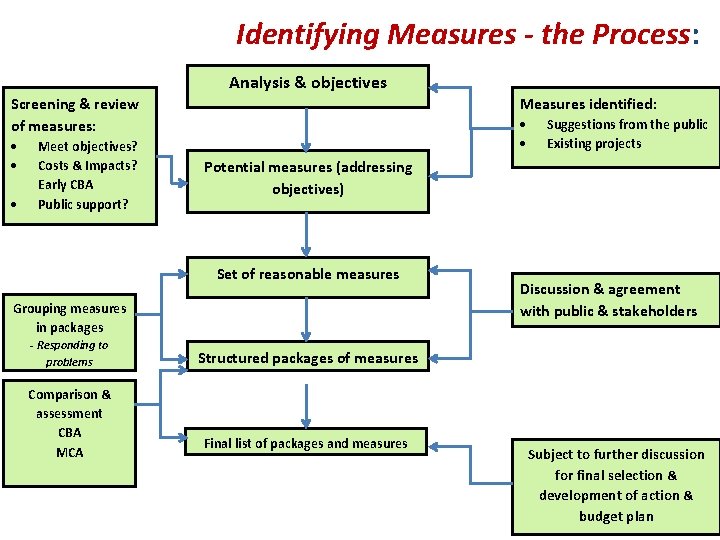
Identifying Measures - the Process: Analysis & objectives Measures identified: Screening & review of measures: Meet objectives? Costs & Impacts? Early CBA Public support? Potential measures (addressing objectives) Set of reasonable measures Grouping measures in packages - Responding to problems Comparison & assessment CBA MCA Suggestions from the public Existing projects Discussion & agreement with public & stakeholders Structured packages of measures Final list of packages and measures Subject to further discussion for final selection & development of action & budget plan

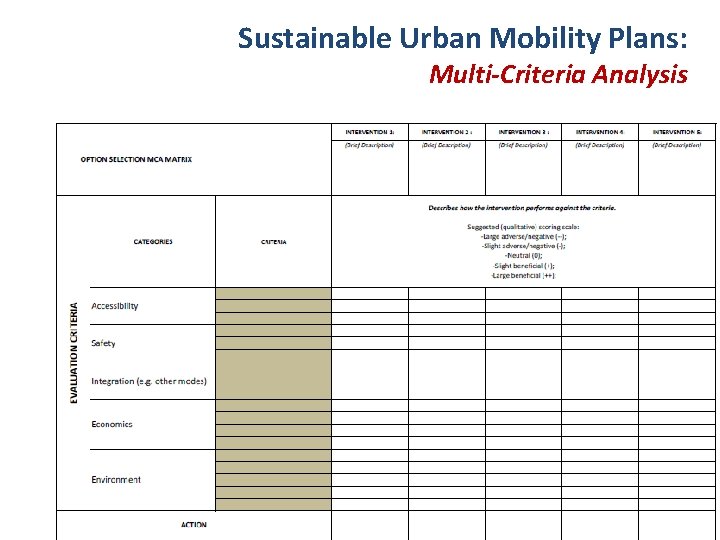
Sustainable Urban Mobility Plans: Selection of Measures & Projects • Range of tools available to help the filtering/screening process: – Use of Cost-Benefit Analysis (CBA) to assess overall value for money of different interventions • For well-developed projects or those with feasibility studies undertaken. – Use of Multi-Criteria Analysis (MCA) to provide a mix of assessment criteria on projects: • Mix of qualitative, quantitative or monetised criteria to evaluate project suitability • UK – Web. TAG includes MCA assessment through use of Appraisal Summary Tables (AST) JASPERS EU Sustainable Urban Mobility Plan (SUMP) Training
Sustainable Urban Mobility Plans: Multi-Criteria Analysis
Sustainable Urban Mobility Plans: Screening Outcomes • Range of different outcomes: – Scheme rejected: Shows poor case for the project/measure – Scheme accepted: Some of which will be considered a high priority with a strong case for early implementation – Scheme accepted: Other schemes accepted but with a lower priority – there is a clear case but not for immediate implementation – Scheme accepted: However the case may be conditional ie. The measure may be dependent on other issues/measures (eg. Quality Corridor) • Consider ‘state of readiness’ and deliverability too JASPERS EU Sustainable Urban Mobility Plan (SUMP) Training
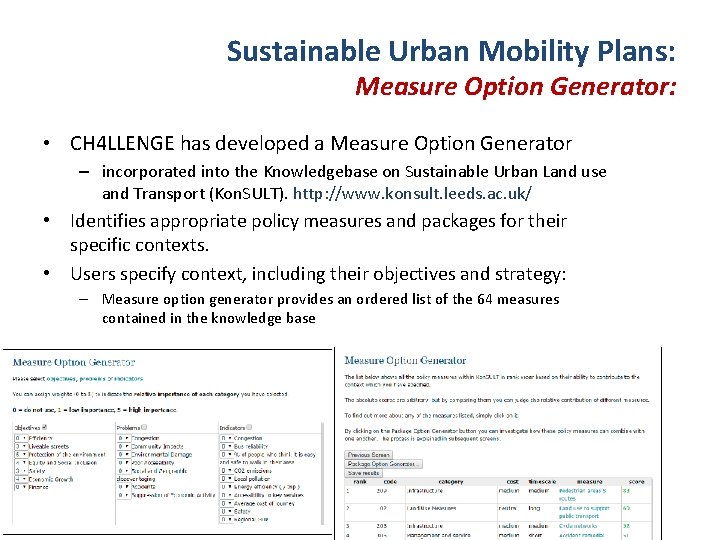
Sustainable Urban Mobility Plans: Measure Option Generator: • CH 4 LLENGE has developed a Measure Option Generator – incorporated into the Knowledgebase on Sustainable Urban Land use and Transport (Kon. SULT). http: //www. konsult. leeds. ac. uk/ • Identifies appropriate policy measures and packages for their specific contexts. • Users specify context, including their objectives and strategy: – Measure option generator provides an ordered list of the 64 measures contained in the knowledge base
Sustainable Urban Mobility Plans: SUMP Packages of Measures/Projects • Following problem identification possible to identify measures – option generation • Consider how to establish the most appropriate ‘package’ of measures • Long list of measures assessed for appropriateness = shortlist of promising measures: – Screening process • Selection and prioritisation of measures – option appraisal: – Informed by Multi-Criteria Analysis – Informed by stakeholder engagement – Scenario techniques based on modelling JASPERS EU Sustainable Urban Mobility Plan (SUMP) Training
Sustainable Urban Mobility Plans: SUMP Packages of Measures/Projects • Isolated measures likely to have only limited impact: – Packages of measures can make use of synergies and reinforce each other – Analysis of measures & options helps inform meaningful combined packages of measures – Packages finally selected should aim for integration of transport modes (inter-modality), with land-use planning and other sectoral planning activities (e. g. environmental, health or economic measures). JASPERS EU Sustainable Urban Mobility Plan (SUMP) Training
Sustainable Urban Mobility Plans: SUMP Packages of Measures/Projects • Each SUMP objective to have groups of measures developed that respond to identified problems: – Outcome is comprehensive, balanced set of measures – Qualitative assessment of groups of measures against alternatives to establish preferred set • Final result is list of potential groups of measures which significantly support SUMP objectives: – Focus on effective and efficient solutions and now considered for inclusion in the SUMP. – Ready to move forward to testing and developing SUMP strategy JASPERS EU Sustainable Urban Mobility Plan (SUMP) Training
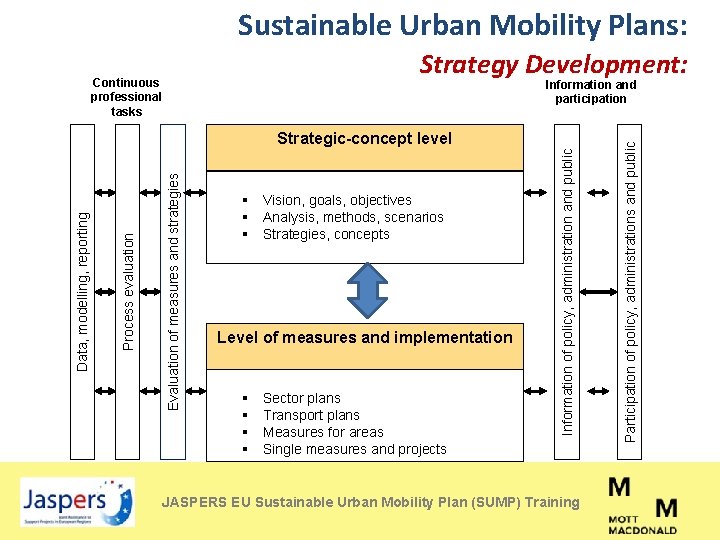
Sustainable Urban Mobility Plans: Strategy Development: Continuous professional tasks § Vision, goals, objectives § Analysis, methods, scenarios § Strategies, concepts Level of measures and implementation § § Sector plans Transport plans Measures for areas Single measures and projects Information of policy, administration and public Evaluation of measures and strategies Process evaluation Data, modelling, reporting Strategic-concept level JASPERS EU Sustainable Urban Mobility Plan (SUMP) Training Participation of policy, administrations and public Information and participation
Sustainable Urban Mobility Plans: Strategy Development: • Set of preferred groups of measures combined into a “do-allscenario”: – Measures are tested using SUMP Transport Model – Assessment against indicative value of the selected group of KPIs for the whole set of preferred Groups of measures. – Where KPIs do not reach the established Target values: • SUMP Targets should be reviewed • Different measures / options might be included • Preliminary assessment of alternative groups of measures repeated JASPERS EU Sustainable Urban Mobility Plan (SUMP) Training
Sustainable Urban Mobility Plans: Strategy Development: • Strategic Environmental Assessment (SEA) process: – Proposed SUMP measures / ‘packages’ assessed in terms of anticipated impacts: • including secondary effects, synergistic, cumulative, short-term, medium and long-term, permanent and temporary, positive and negative. – According to the outcome of the assessment, adjustments, mitigation measures and monitoring plan should be proposed. – Results of ongoing consultation process included in process JASPERS EU Sustainable Urban Mobility Plan (SUMP) Training
Sustainable Urban Mobility Plans: SUMP Scenarios • Important to have up-to-date information on policy options, transport impacts or outcomes of transport activities: – Include ‘business-as-usual’ forecast scenario • Optimising land use and transport systems to deliver future vision: – urban growth scenarios developed in combination with strategic level transport networks – SUMP/MCA models used to assess impact of these • Lack of alternative scenarios often occurs in SUMP process: – Traditional approaches often ignored complete set of transport policy interventions – Analysing wide range of potential future situations is beneficial – Arriving at a preferred pattern of land use and transport system through transparent evaluation process JASPERS EU Sustainable Urban Mobility Plan (SUMP) Training
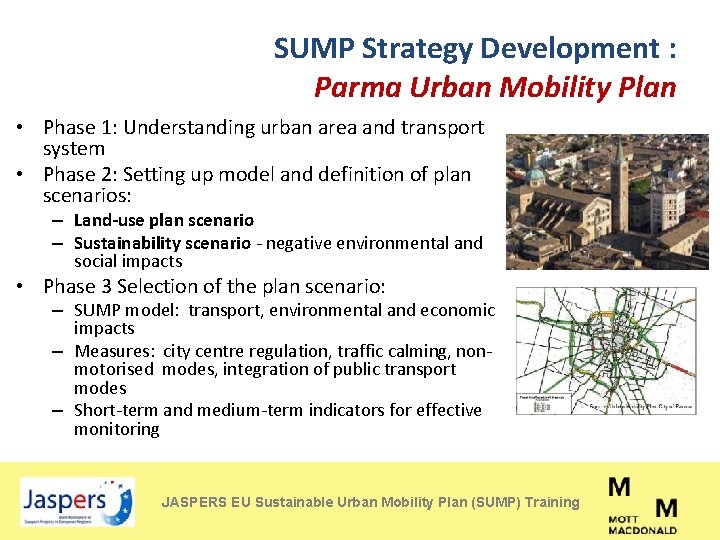
SUMP Strategy Development : Parma Urban Mobility Plan • Phase 1: Understanding urban area and transport system • Phase 2: Setting up model and definition of plan scenarios: – Land-use plan scenario – Sustainability scenario - negative environmental and social impacts • Phase 3 Selection of the plan scenario: – SUMP model: transport, environmental and economic impacts – Measures: city centre regulation, traffic calming, nonmotorised modes, integration of public transport modes – Short-term and medium-term indicators for effective monitoring JASPERS EU Sustainable Urban Mobility Plan (SUMP) Training
SUMP Strategy Development : Milan Urban Mobility Plan • SUMP developed through a participation process to identify agreed strategies and actions • Deep analysis of the current situation and trends • Four mobility strategies identified: – Shared mobility governance with co-ordinated strategies and tools (balanced approach) – Urban accessibility using PT; – Urban space as common goal; – Passenger & freight mobility demand management • Projections to 2024 of main transport variables to evaluate SUMP against reference case scenario JASPERS EU Sustainable Urban Mobility Plan (SUMP) Training
SUMP Strategy Development : Opava Urban Mobility Plan • Plan contains long-term vision meet the mobility needs of citizens and businesses in a sustainable way to 2020. • Three scenarios proposed: – Optimistic: Reduction in car use by 20% – Medium: Car-use is 33% – Low: 40% car-use • Based on its available finances, City chose the medium scenario: – Developed package of 19 logical measures or activities – Safe cycling; safe streets and crossings; parking regulation; the promotion of public transport; and Mobility Management. JASPERS EU Sustainable Urban Mobility Plan (SUMP) Training
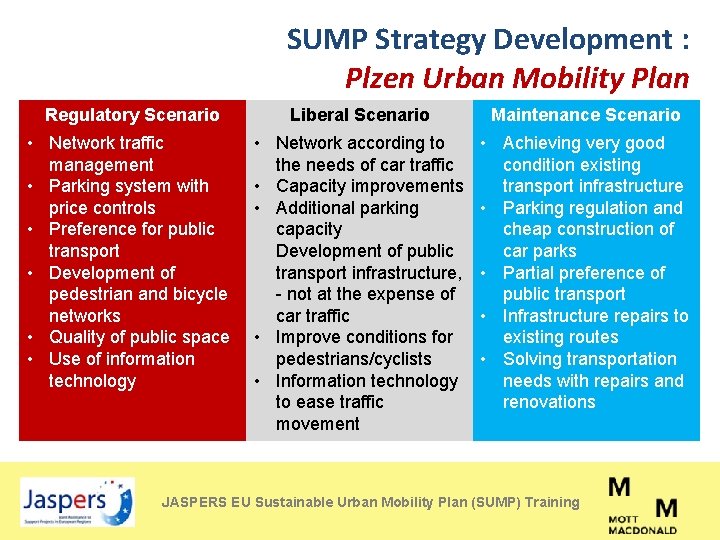
SUMP Strategy Development : Plzen Urban Mobility Plan Regulatory Scenario Liberal Scenario Maintenance Scenario • Network traffic management • Parking system with price controls • Preference for public transport • Development of pedestrian and bicycle networks • Quality of public space • Use of information technology • Network according to the needs of car traffic • Capacity improvements • Additional parking capacity Development of public transport infrastructure, - not at the expense of car traffic • Improve conditions for pedestrians/cyclists • Information technology to ease traffic movement • Achieving very good condition existing transport infrastructure • Parking regulation and cheap construction of car parks • Partial preference of public transport • Infrastructure repairs to existing routes • Solving transportation needs with repairs and renovations JASPERS EU Sustainable Urban Mobility Plan (SUMP) Training
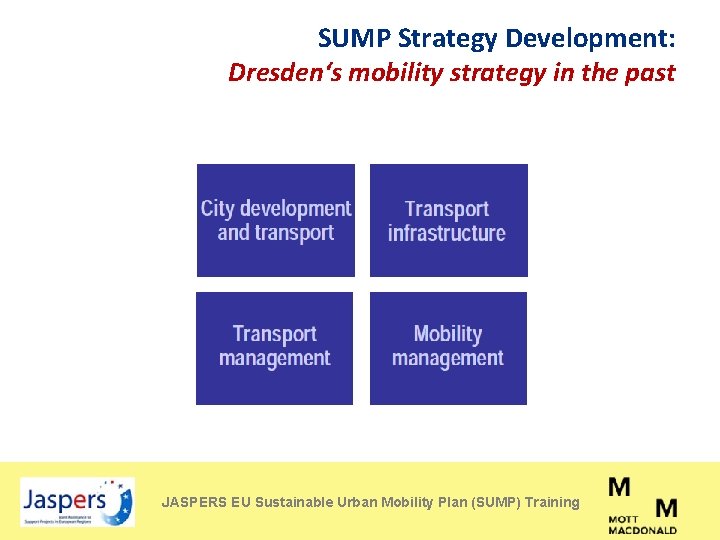
SUMP Strategy Development: Dresden‘s mobility strategy in the past JASPERS EU Sustainable Urban Mobility Plan (SUMP) Training
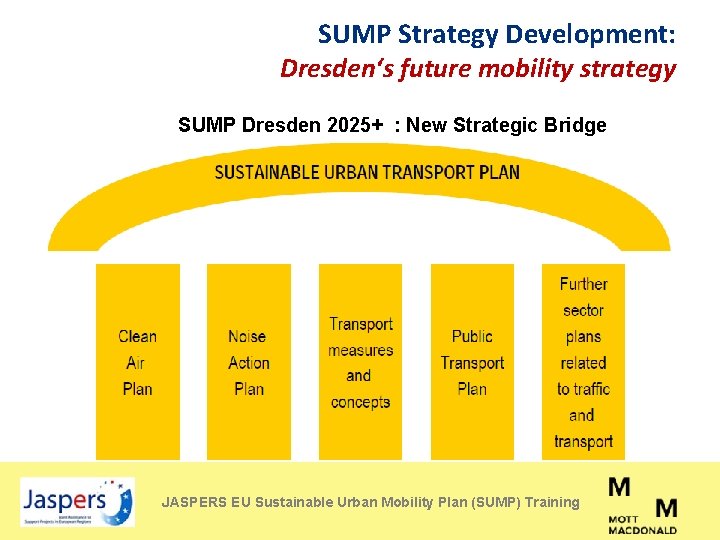
SUMP Strategy Development: Dresden‘s future mobility strategy SUMP Dresden 2025+ : New Strategic Bridge JASPERS EU Sustainable Urban Mobility Plan (SUMP) Training
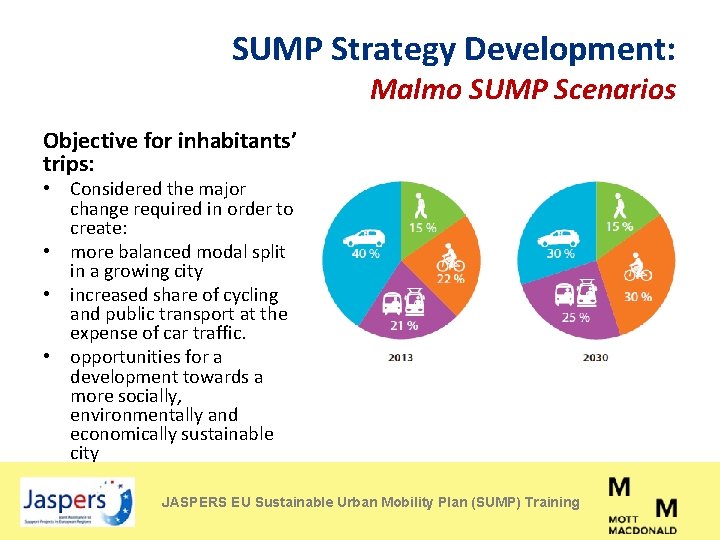
SUMP Strategy Development: Malmo SUMP Scenarios Objective for inhabitants’ trips: • Considered the major change required in order to create: • more balanced modal split in a growing city • increased share of cycling and public transport at the expense of car traffic. • opportunities for a development towards a more socially, environmentally and economically sustainable city JASPERS EU Sustainable Urban Mobility Plan (SUMP) Training
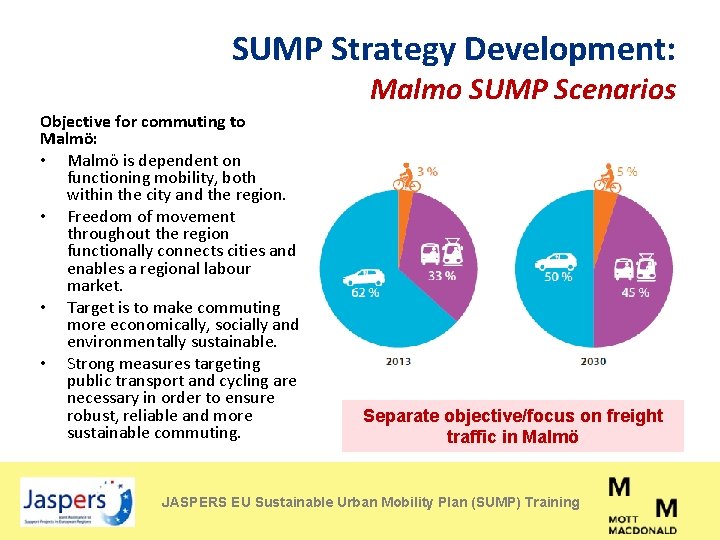
SUMP Strategy Development: Malmo SUMP Scenarios Objective for commuting to Malmö: • Malmö is dependent on functioning mobility, both within the city and the region. • Freedom of movement throughout the region functionally connects cities and enables a regional labour market. • Target is to make commuting more economically, socially and environmentally sustainable. • Strong measures targeting public transport and cycling are necessary in order to ensure robust, reliable and more sustainable commuting. Separate objective/focus on freight traffic in Malmö JASPERS EU Sustainable Urban Mobility Plan (SUMP) Training
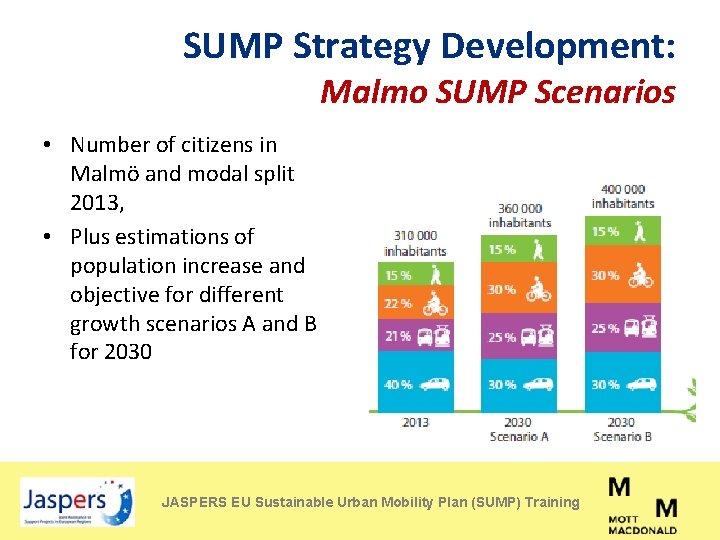
SUMP Strategy Development: Malmo SUMP Scenarios • Number of citizens in Malmö and modal split 2013, • Plus estimations of population increase and objective for different growth scenarios A and B for 2030 JASPERS EU Sustainable Urban Mobility Plan (SUMP) Training
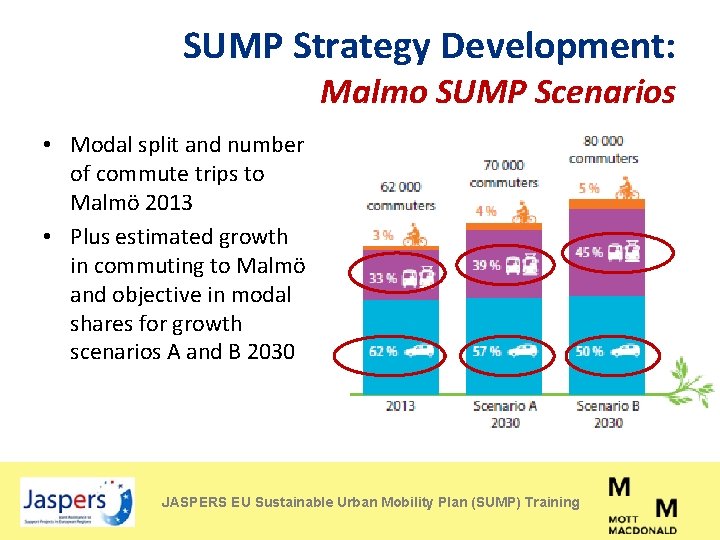
SUMP Strategy Development: Malmo SUMP Scenarios • Modal split and number of commute trips to Malmö 2013 • Plus estimated growth in commuting to Malmö and objective in modal shares for growth scenarios A and B 2030 JASPERS EU Sustainable Urban Mobility Plan (SUMP) Training
- Slides: 28