
Sustainable urban development in cohesion policy programmes 2014
Sustainable urban development in cohesion policy programmes 2014 -2020 A brief overview Márton MATKÓ European Commission DG Regional and Urban Policy Brussels 18 February 2016
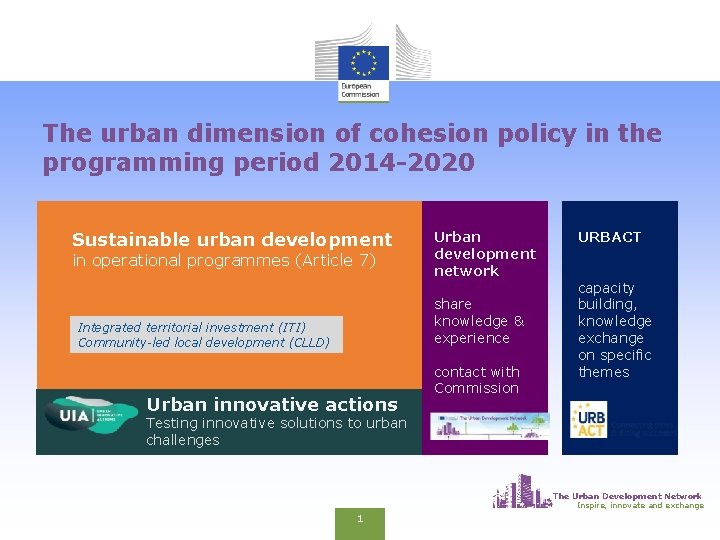
The urban dimension of cohesion policy in the programming period 2014 -2020 Sustainable urban development in operational programmes (Article 7) Urban development network share knowledge & experience Integrated territorial investment (ITI) Community-led local development (CLLD) Urban innovative actions contact with Commission URBACT capacity building, knowledge exchange on specific themes Testing innovative solutions to urban challenges The Urban Development Network Inspire, innovate and exchange 1

The urban dimension of cohesion policy in the programming period 2014 -2020 Sustainable urban development in operational programmes (Article 7) Urban development network share knowledge & experience Integrated territorial investment (ITI) Community-led local development (CLLD) Urban innovative actions contact with Commission URBACT capacity building, knowledge exchange on specific themes Testing innovative solutions to urban challenges The Urban Development Network Inspire, innovate and exchange 2
Cornerstones of the SUD framework (Article 7 ERDF) What are the common rules? Integrated approach, long term planning horizon, multi-level governance Urban areas develop and implement integrated, sustainable urban development strategies cutting through sectorial, territorial and governance boundaries. Empowerment Urban areas will select the projects (drawing up and applying selection criteria) taking responsibility in the implementation of the OP. The MA must designate them as IB by way of written arrangements on the delegated tasks. Funding At least 5% of the national ERDF allocation must be programmed for SUD using: • A specific priority axis of an OP dedicated to SUD • A specific operational programme dedicated to SUD • Integrated territorial investment (ITI) tool: using a part of the allocation of one or more priority axes of one or more OP for SUD The Urban Development Network Inspire, innovate and exchange 3
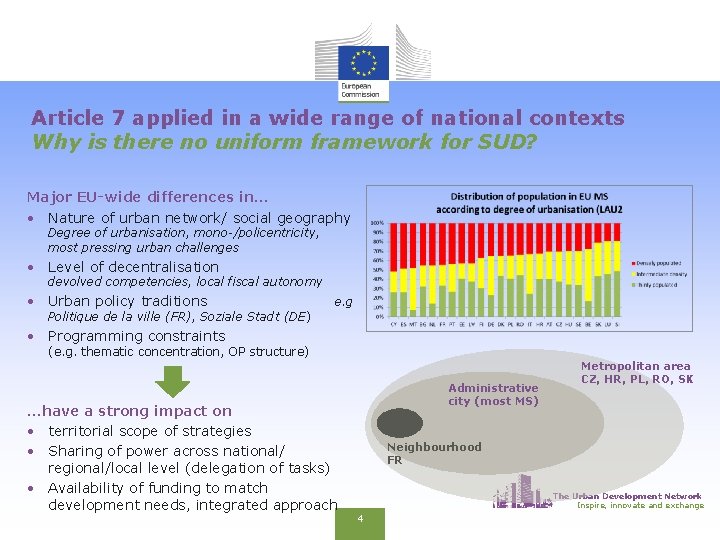
Article 7 applied in a wide range of national contexts Why is there no uniform framework for SUD? Major EU-wide differences in… • Nature of urban network/ social geography Degree of urbanisation, mono-/policentricity, most pressing urban challenges • Level of decentralisation devolved competencies, local fiscal autonomy • Urban policy traditions e. g Politique de la ville (FR), Soziale Stadt (DE) • Programming constraints (e. g. thematic concentration, OP structure) …have a strong impact on • territorial scope of strategies • Sharing of power across national/ regional/local level (delegation of tasks) • Availability of funding to match development needs, integrated approach Administrative city (most MS) Metropolitan area CZ, HR, PL, RO, SK Neighbourhood FR The Urban Development Network Inspire, innovate and exchange 4
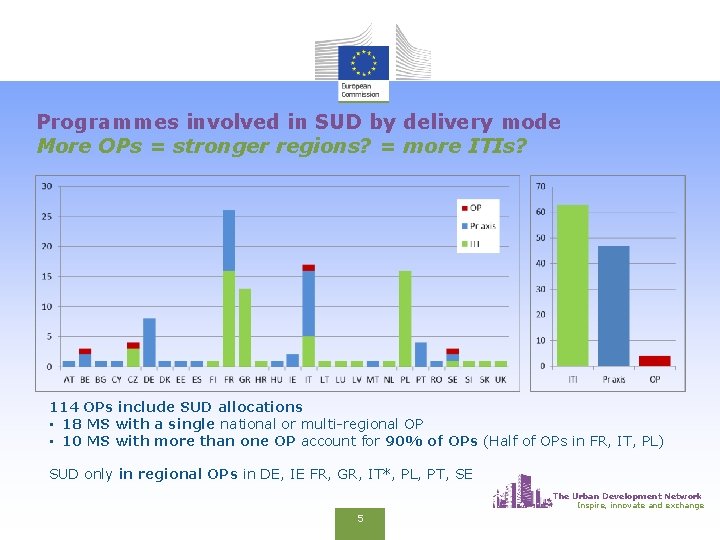
Programmes involved in SUD by delivery mode More OPs = stronger regions? = more ITIs? 114 OPs include SUD allocations • 18 MS with a single national or multi-regional OP • 10 MS with more than one OP account for 90% of OPs (Half of OPs in FR, IT, PL) SUD only in regional OPs in DE, IE FR, GR, IT*, PL, PT, SE The Urban Development Network Inspire, innovate and exchange 5
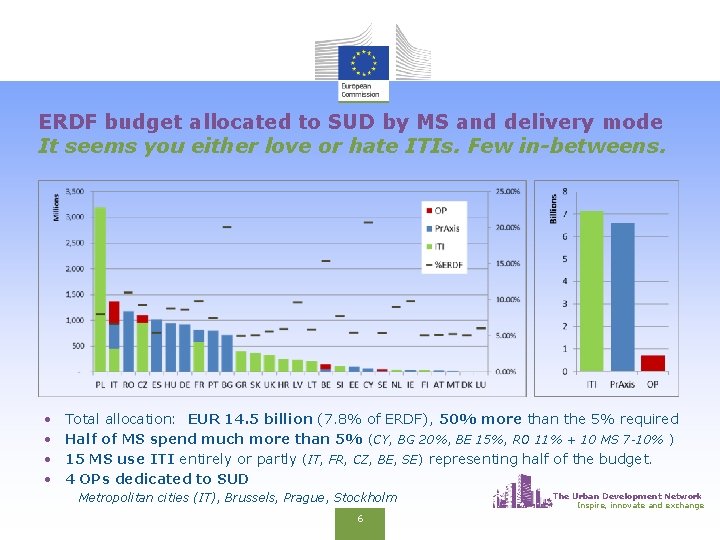
ERDF budget allocated to SUD by MS and delivery mode It seems you either love or hate ITIs. Few in-betweens. • • Total allocation: EUR 14. 5 billion (7. 8% of ERDF), 50% more than the 5% required Half of MS spend much more than 5% (CY, BG 20%, BE 15%, RO 11% + 10 MS 7 -10% ) 15 MS use ITI entirely or partly (IT, FR, CZ, BE, SE) representing half of the budget. 4 OPs dedicated to SUD Metropolitan cities (IT), Brussels, Prague, Stockholm 6 The Urban Development Network Inspire, innovate and exchange
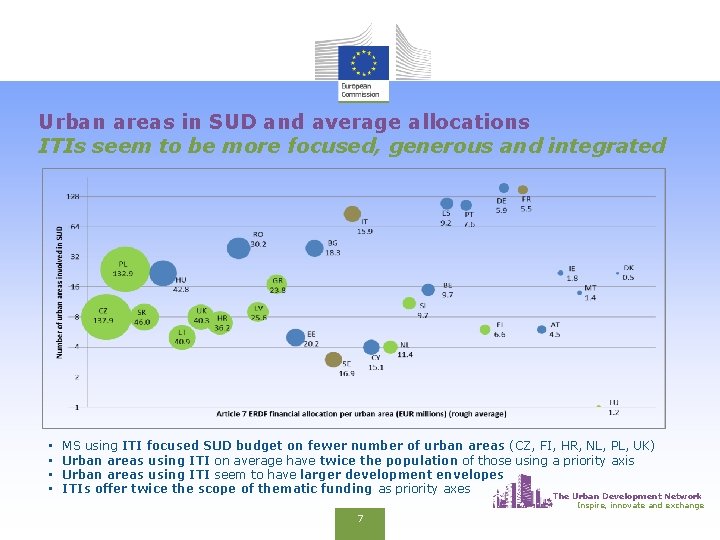
Urban areas in SUD and average allocations ITIs seem to be more focused, generous and integrated • • MS using ITI focused SUD budget on fewer number of urban areas (CZ, FI, HR, NL, PL, UK) Urban areas using ITI on average have twice the population of those using a priority axis Urban areas using ITI seem to have larger development envelopes ITIs offer twice the scope of thematic funding as priority axes The Urban Development Network Inspire, innovate and exchange 7
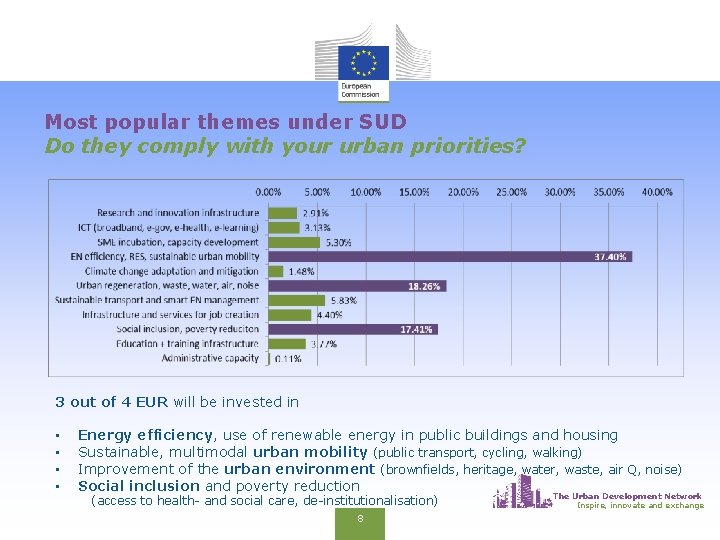
Most popular themes under SUD Do they comply with your urban priorities? 3 out of 4 EUR will be invested in • • Energy efficiency, use of renewable energy in public buildings and housing Sustainable, multimodal urban mobility (public transport, cycling, walking) Improvement of the urban environment (brownfields, heritage, water, waste, air Q, noise) Social inclusion and poverty reduction (access to health- and social care, de-institutionalisation) 8 The Urban Development Network Inspire, innovate and exchange
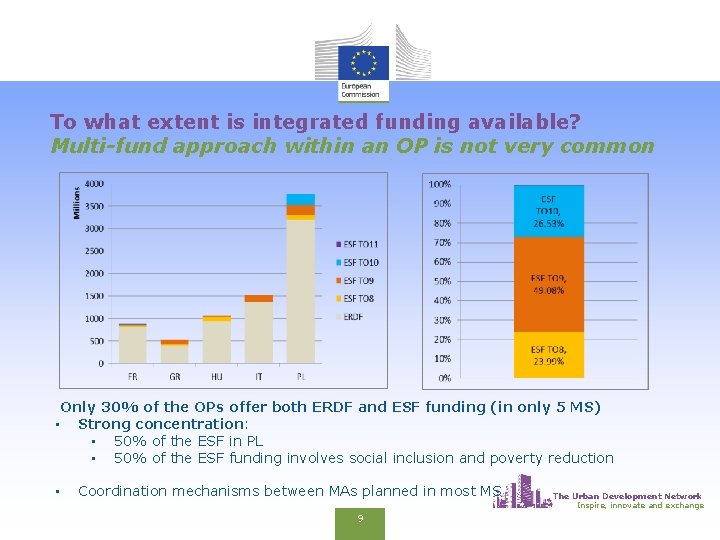
To what extent is integrated funding available? Multi-fund approach within an OP is not very common Only 30% of the OPs offer both ERDF and ESF funding (in only 5 MS) • Strong concentration: • 50% of the ESF in PL • 50% of the ESF funding involves social inclusion and poverty reduction • Coordination mechanisms between MAs planned in most MS 9 The Urban Development Network Inspire, innovate and exchange
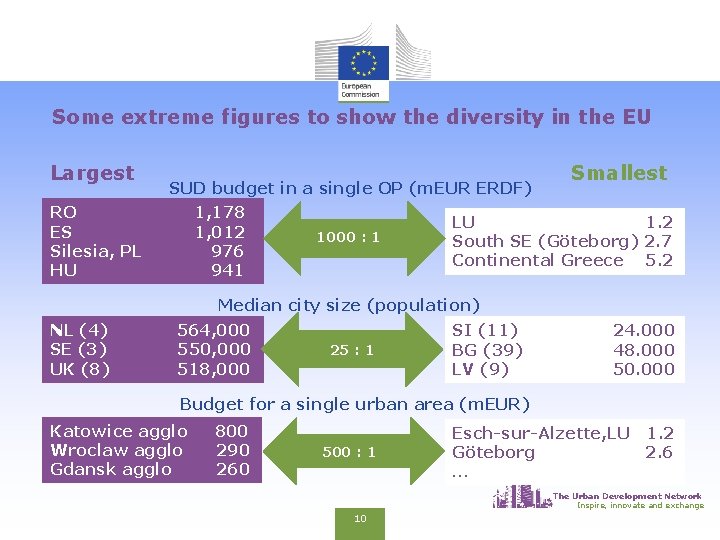
Some extreme figures to show the diversity in the EU Largest SUD budget in a single OP (m. EUR ERDF) RO ES Silesia, PL HU 1, 178 1, 012 976 941 1000 : 1 Smallest LU 1. 2 South SE (Göteborg) 2. 7 Continental Greece 5. 2 Median city size (population) NL (4) SE (3) UK (8) 564, 000 550, 000 518, 000 25 : 1 SI (11) BG (39) LV (9) 24. 000 48. 000 50. 000 Budget for a single urban area (m. EUR) Katowice agglo Wroclaw agglo Gdansk agglo 800 290 260 500 : 1 Esch-sur-Alzette, LU 1. 2 Göteborg 2. 6 … The Urban Development Network Inspire, innovate and exchange 10
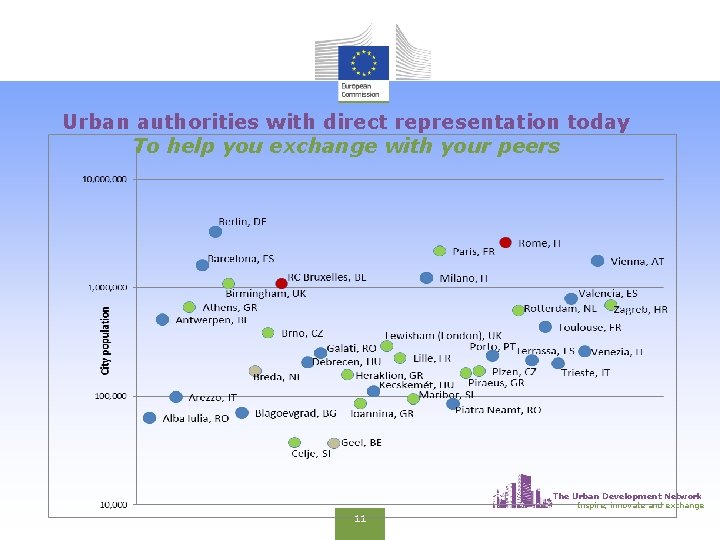
Urban authorities with direct representation today To help you exchange with your peers The Urban Development Network Inspire, innovate and exchange 11
- Slides: 12