
Sustainable urban Development and climate change indicators Ramon
Sustainable urban Development and climate change indicators Ramon Paul M. Falcon Social Development Staff National Economic and Development Authority 1

Outline • Philippine Development Plan (PDP) 2017 -2022 and Ambisyon Natin 2040 • National Spatial Strategy (NSS) • National Framework Strategy on Climate Change 2010 -2022 • National Urban Development and Housing Framework (NUDHF) • Philippine Sustainable Development Goals • Low Emission Strategies in the PDP • SDGs – PDP Results Matrix Indicators
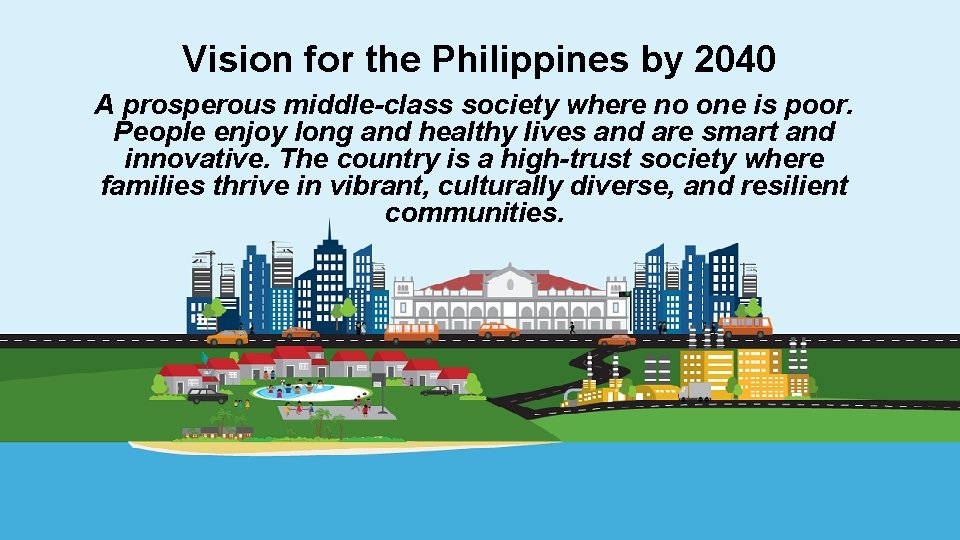
Vision for the Philippines by 2040 A prosperous middle-class society where no one is poor. People enjoy long and healthy lives and are smart and innovative. The country is a high-trust society where families thrive in vibrant, culturally diverse, and resilient communities.
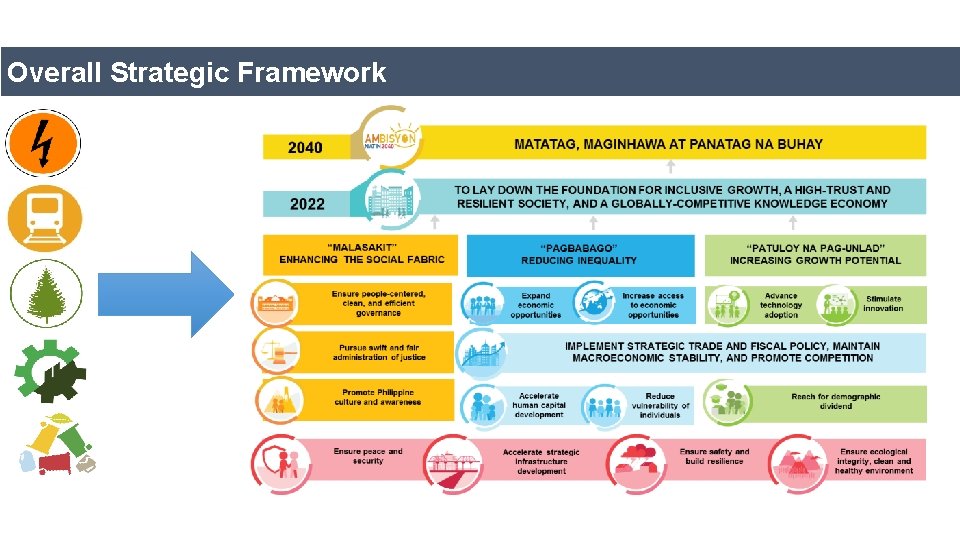
PDP 2017 -2022 Framework 4
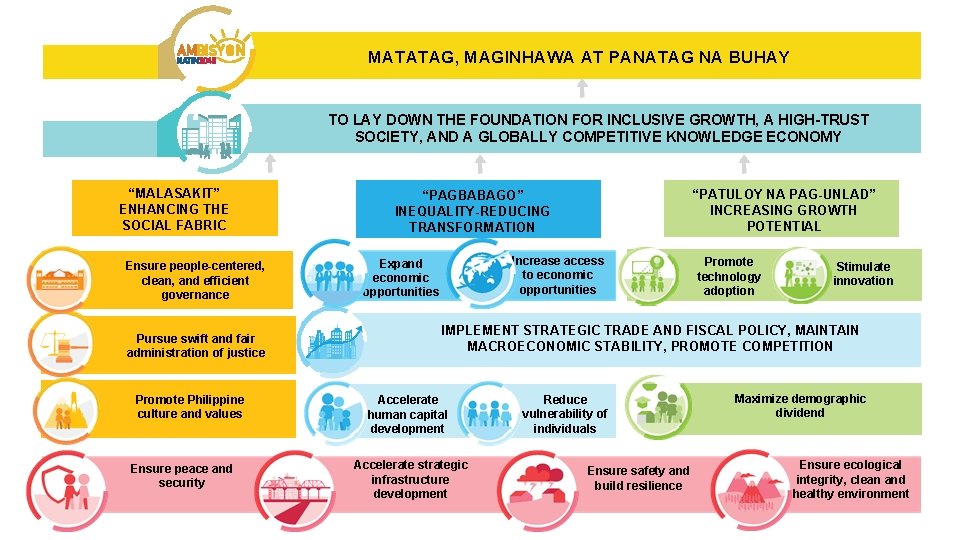
MATATAG, MAGINHAWA AT PANATAG NA BUHAY TO LAY DOWN THE FOUNDATION FOR INCLUSIVE GROWTH, A HIGH-TRUST SOCIETY, AND A GLOBALLY COMPETITIVE KNOWLEDGE ECONOMY “MALASAKIT” ENHANCING THE SOCIAL FABRIC Ensure people-centered, clean, and efficient governance Pursue swift and fair administration of justice Promote Philippine culture and values Ensure peace and security “PATULOY NA PAG-UNLAD” INCREASING GROWTH POTENTIAL “PAGBABAGO” INEQUALITY-REDUCING TRANSFORMATION Increase access to economic opportunities Expand economic opportunities Promote technology adoption Stimulate innovation IMPLEMENT STRATEGIC TRADE AND FISCAL POLICY, MAINTAIN MACROECONOMIC STABILITY, PROMOTE COMPETITION Accelerate human capital development Accelerate strategic infrastructure development Reduce vulnerability of individuals Ensure safety and build resilience Maximize demographic dividend Ensure ecological integrity, clean and healthy environment
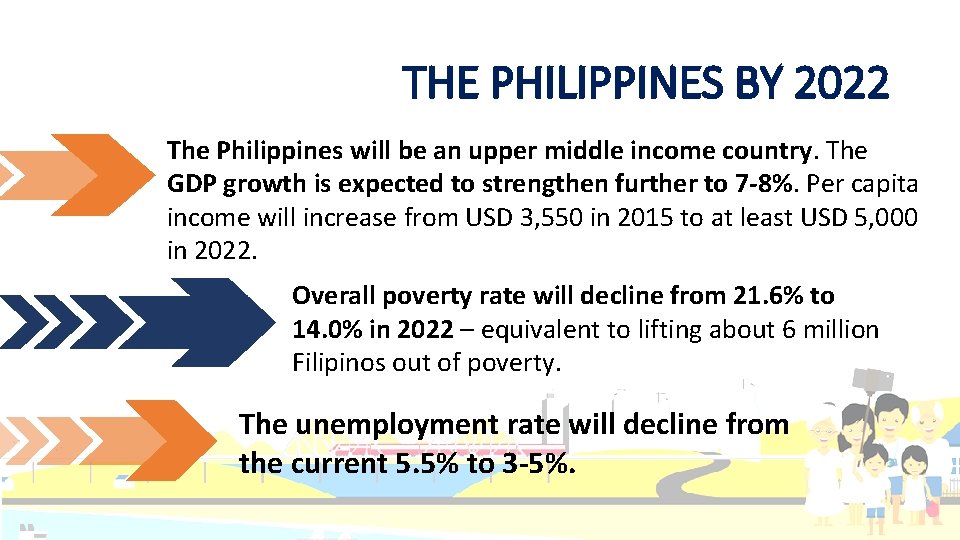
THE PHILIPPINES BY 2022 The Philippines will be an upper middle income country. The GDP growth is expected to strengthen further to 7 -8%. Per capita income will increase from USD 3, 550 in 2015 to at least USD 5, 000 in 2022. Overall poverty rate will decline from 21. 6% to 14. 0% in 2022 – equivalent to lifting about 6 million Filipinos out of poverty. The unemployment rate will decline from the current 5. 5% to 3 -5%.
National Spatial Strategy (NSS) Sets the direction of future growth recognizing population, geography and the role of cities as engines of economic growth, with infrastructure providing efficient connectivity between and among urban and rural communities 7
PDP 2017 -2022 Chapter 12: Building Safe and Secure Communities 8
Strategies • Develop integrated neighborhoods and sustainable communities particularly for low-income households • Intensify implementation of alternatives and innovative solutions to address housing needs • Strengthen decentralization of housing and urban development interventions • Adopt viable land acquisition approaches and fast-track the inventory of lands for socialized housing 9
Strategies • Mainstream program convergence budgeting in housing and resettlement, and innovative housing finance modalities • Strengthen partnerships with stakeholders • Adopt a community-driven development approach • Strengthen housing as a platform to reduce poverty and improve social outcomes 10
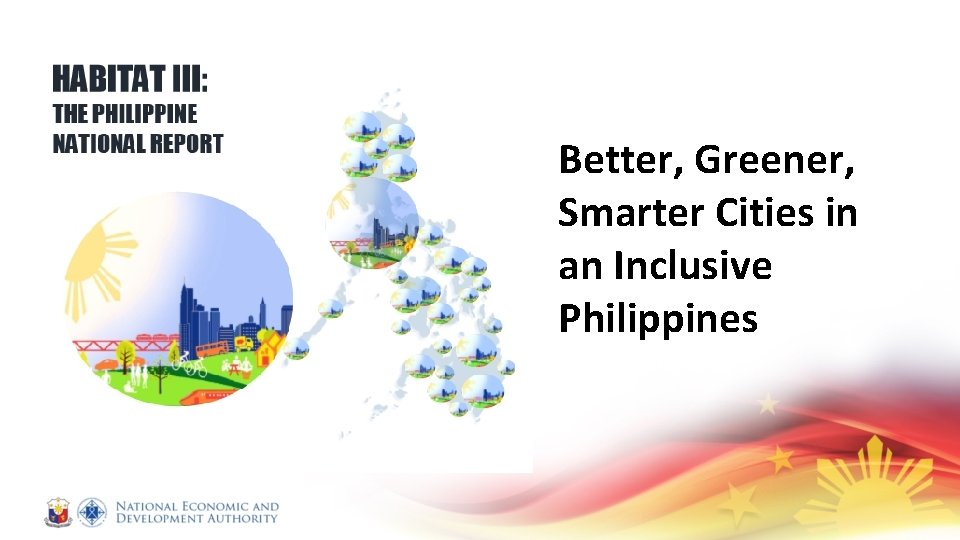
Better, Greener, Smarter Cities in an Inclusive Philippines
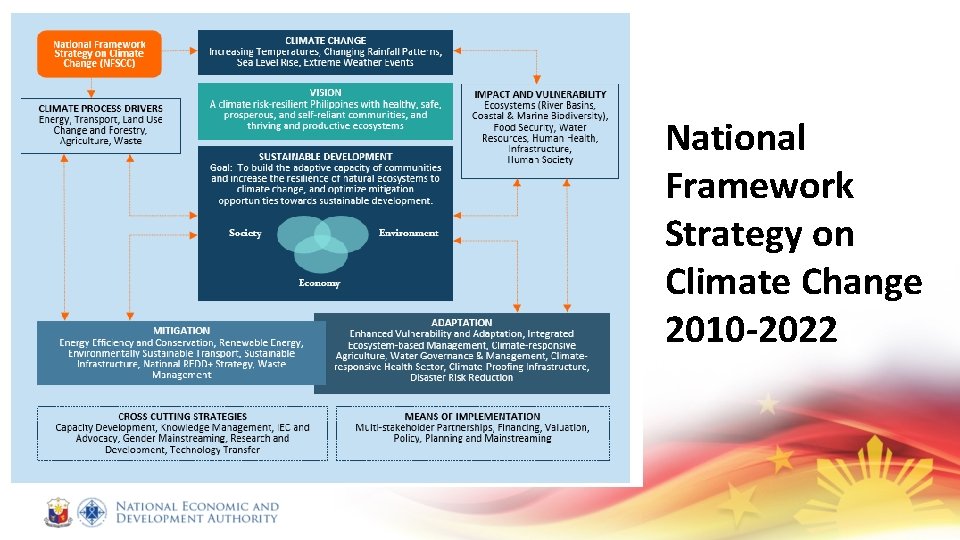
National Framework Strategy on Climate Change 2010 -2022
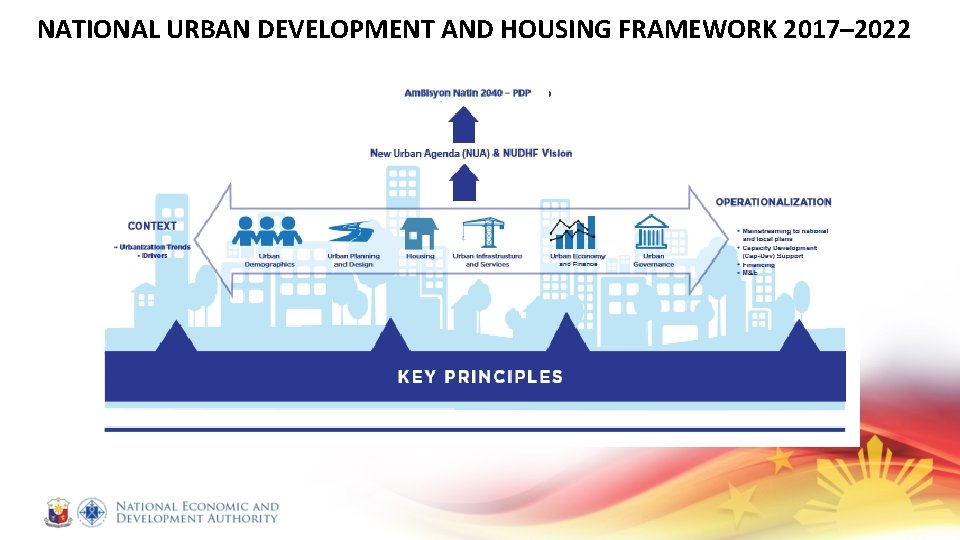
NATIONAL URBAN DEVELOPMENT AND HOUSING FRAMEWORK 2017– 2022
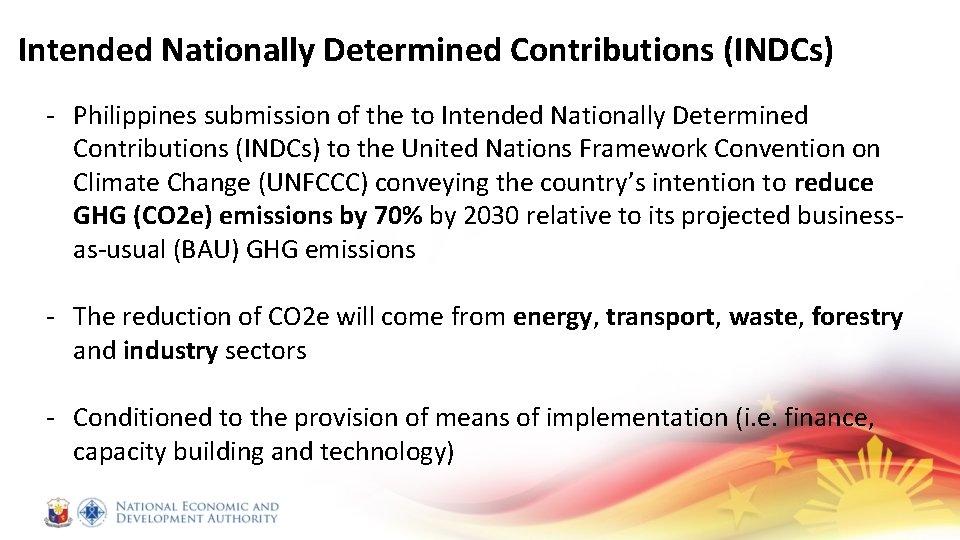
Intended Nationally Determined Contributions (INDCs) - Philippines submission of the to Intended Nationally Determined Contributions (INDCs) to the United Nations Framework Convention on Climate Change (UNFCCC) conveying the country’s intention to reduce GHG (CO 2 e) emissions by 70% by 2030 relative to its projected businessas-usual (BAU) GHG emissions - The reduction of CO 2 e will come from energy, transport, waste, forestry and industry sectors - Conditioned to the provision of means of implementation (i. e. finance, capacity building and technology)
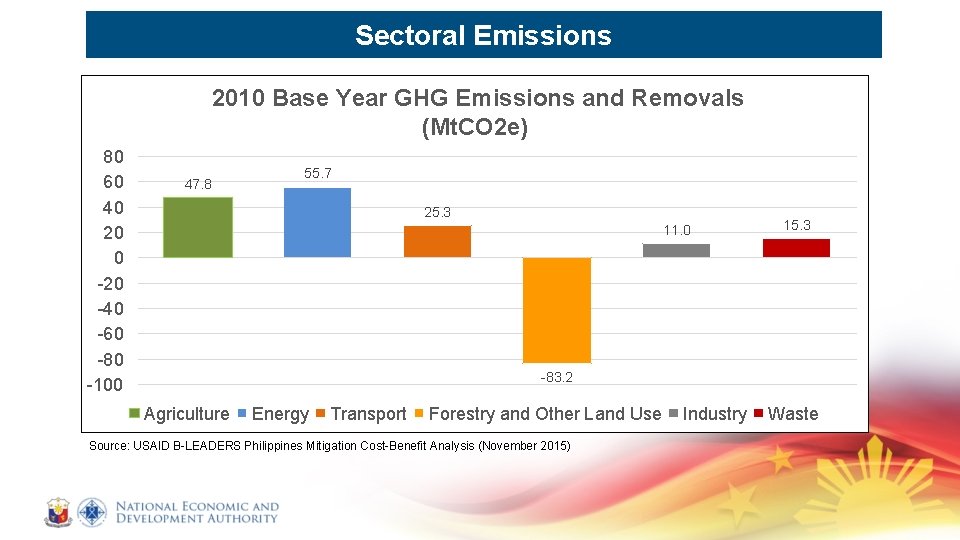
Sectoral Emissions 2010 Base Year GHG Emissions and Removals (Mt. CO 2 e) 80 60 40 20 0 -20 -40 -60 -80 -100 47. 8 55. 7 25. 3 11. 0 15. 3 -83. 2 Agriculture Energy Transport Forestry and Other Land Use Source: USAID B-LEADERS Philippines Mitigation Cost-Benefit Analysis (November 2015) Industry Waste
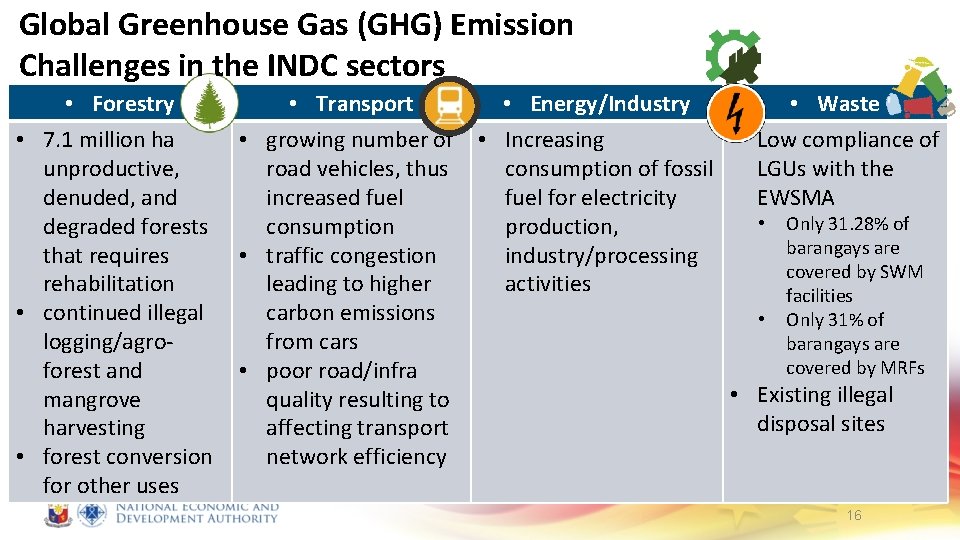
Global Greenhouse Gas (GHG) Emission Challenges in the INDC sectors • Forestry • 7. 1 million ha unproductive, denuded, and degraded forests that requires rehabilitation • continued illegal logging/agroforest and mangrove harvesting • forest conversion for other uses • Transport • growing number of road vehicles, thus increased fuel consumption • traffic congestion leading to higher carbon emissions from cars • poor road/infra quality resulting to affecting transport network efficiency • Energy/Industry • Waste • Increasing • Low compliance of consumption of fossil LGUs with the fuel for electricity EWSMA • Only 31. 28% of production, barangays are industry/processing covered by SWM activities facilities • Only 31% of barangays are covered by MRFs • Existing illegal disposal sites 16
Low Emission Strategies in the PDP 2017 -2022
Overall Strategic Framework 20
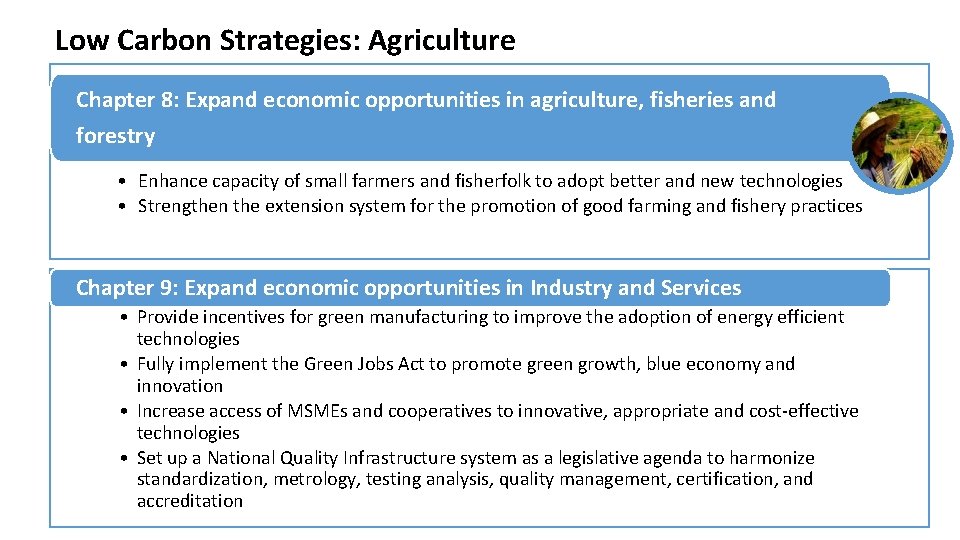
Low Carbon Strategies: Agriculture Chapter 8: Expand economic opportunities in agriculture, fisheries and forestry • Enhance capacity of small farmers and fisherfolk to adopt better and new technologies • Strengthen the extension system for the promotion of good farming and fishery practices Chapter 9: Expand economic opportunities in Industry and Services • Provide incentives for green manufacturing to improve the adoption of energy efficient technologies • Fully implement the Green Jobs Act to promote green growth, blue economy and innovation • Increase access of MSMEs and cooperatives to innovative, appropriate and cost-effective technologies • Set up a National Quality Infrastructure system as a legislative agenda to harmonize standardization, metrology, testing analysis, quality management, certification, and accreditation
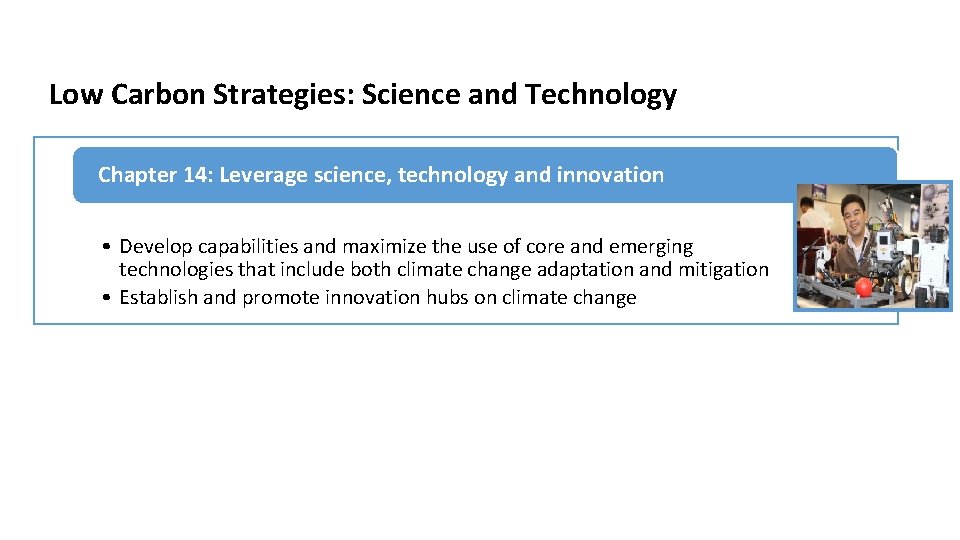
Low Carbon Strategies: Science and Technology Chapter 14: Leverage science, technology and innovation • Develop capabilities and maximize the use of core and emerging technologies that include both climate change adaptation and mitigation • Establish and promote innovation hubs on climate change
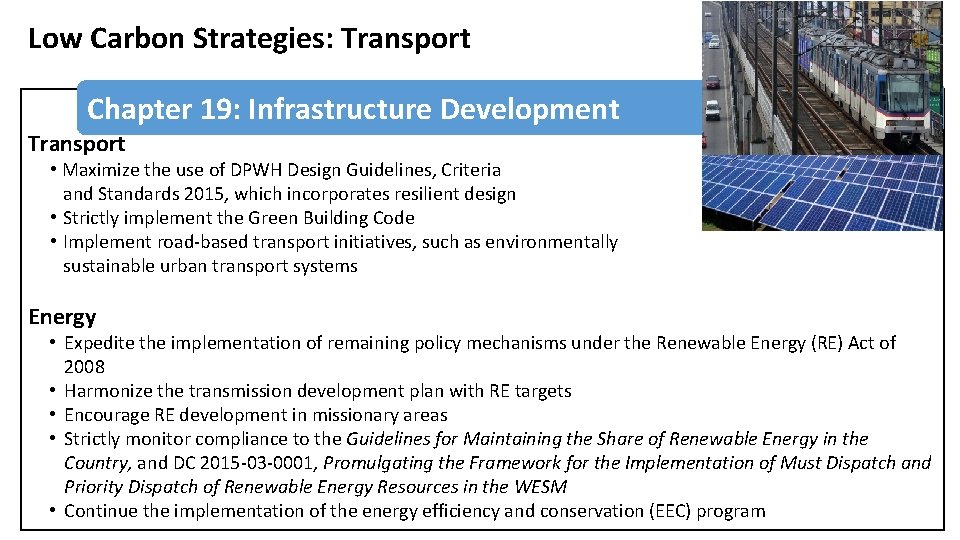
Low Carbon Strategies: Transport Chapter 19: Infrastructure Development Transport • Maximize the use of DPWH Design Guidelines, Criteria and Standards 2015, which incorporates resilient design • Strictly implement the Green Building Code • Implement road-based transport initiatives, such as environmentally sustainable urban transport systems Energy • Expedite the implementation of remaining policy mechanisms under the Renewable Energy (RE) Act of 2008 • Harmonize the transmission development plan with RE targets • Encourage RE development in missionary areas • Strictly monitor compliance to the Guidelines for Maintaining the Share of Renewable Energy in the Country, and DC 2015 -03 -0001, Promulgating the Framework for the Implementation of Must Dispatch and Priority Dispatch of Renewable Energy Resources in the WESM • Continue the implementation of the energy efficiency and conservation (EEC) program
Low Carbon Strategies: ENR Chapter 20: Ecological Integrity Ensured and Socio-economic Conditions of Resource-based Communities Improved Through Sustainable Integrated Area Development • Sustain the rehabilitation of degraded forestlands including reforestation efforts • Identify technological and research priorities and capacity needs for low carbon development • Promote environmentally-sustainable transport • Promote climate-smart structures and designs • Develop database to measure emission reduction per sector • Promote sustainable consumption and production
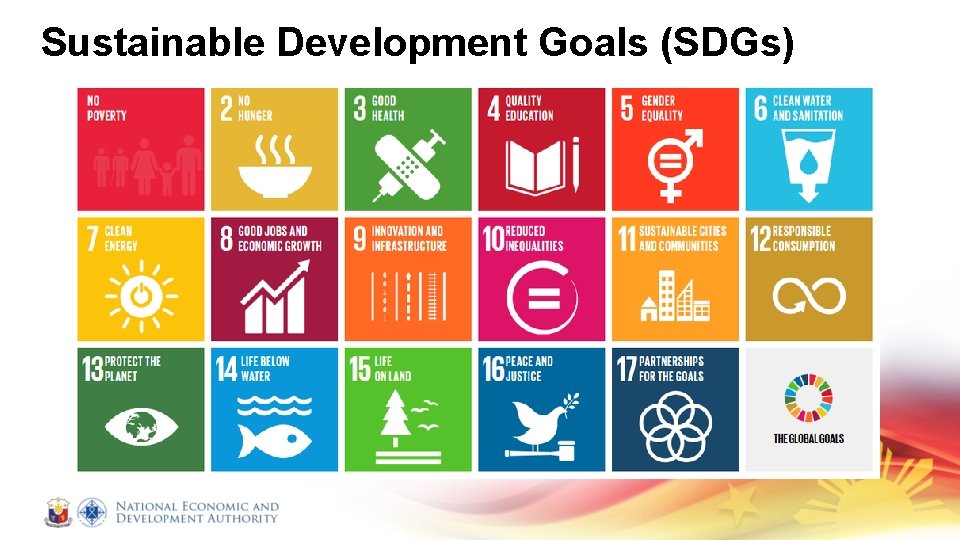
Sustainable Development Goals (SDGs)
The Philippine Development Plan and the 2030 Agenda
Philippine Sustainable Development Goals 25
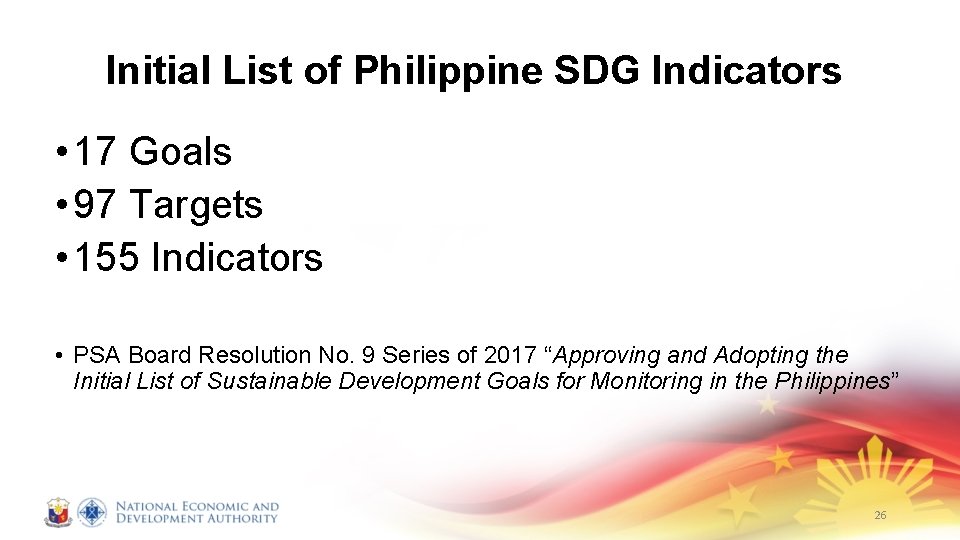
Initial List of Philippine SDG Indicators • 17 Goals • 97 Targets • 155 Indicators • PSA Board Resolution No. 9 Series of 2017 “Approving and Adopting the Initial List of Sustainable Development Goals for Monitoring in the Philippines” 26
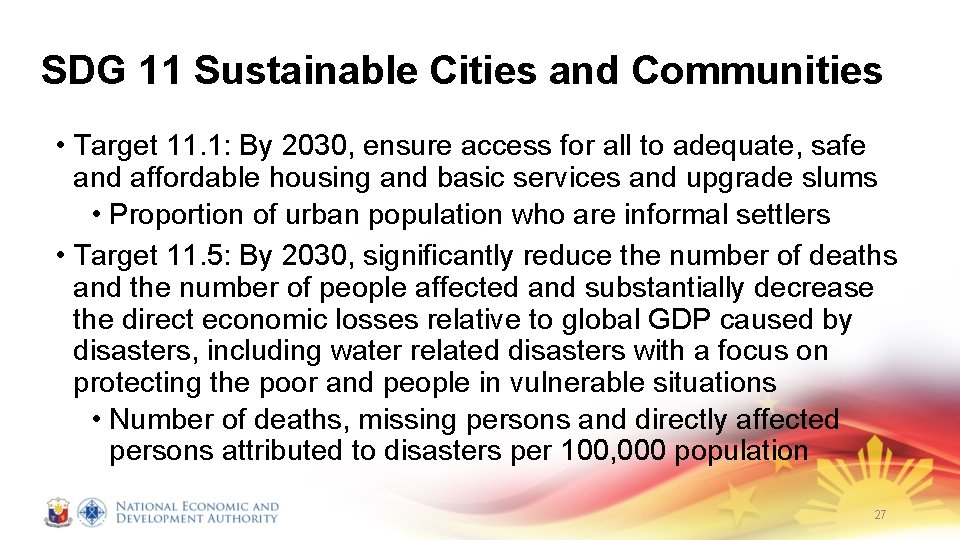
SDG 11 Sustainable Cities and Communities • Target 11. 1: By 2030, ensure access for all to adequate, safe and affordable housing and basic services and upgrade slums • Proportion of urban population who are informal settlers • Target 11. 5: By 2030, significantly reduce the number of deaths and the number of people affected and substantially decrease the direct economic losses relative to global GDP caused by disasters, including water related disasters with a focus on protecting the poor and people in vulnerable situations • Number of deaths, missing persons and directly affected persons attributed to disasters per 100, 000 population 27
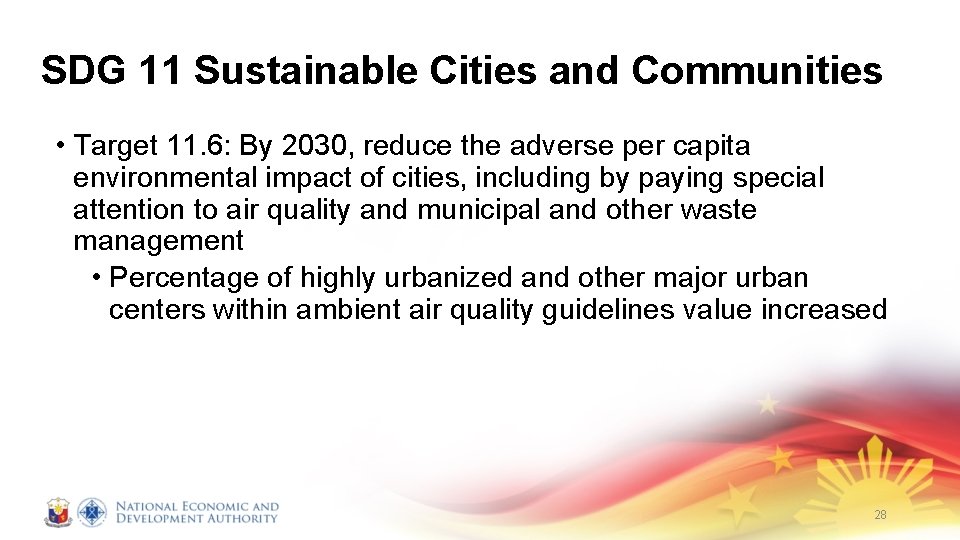
SDG 11 Sustainable Cities and Communities • Target 11. 6: By 2030, reduce the adverse per capita environmental impact of cities, including by paying special attention to air quality and municipal and other waste management • Percentage of highly urbanized and other major urban centers within ambient air quality guidelines value increased 28
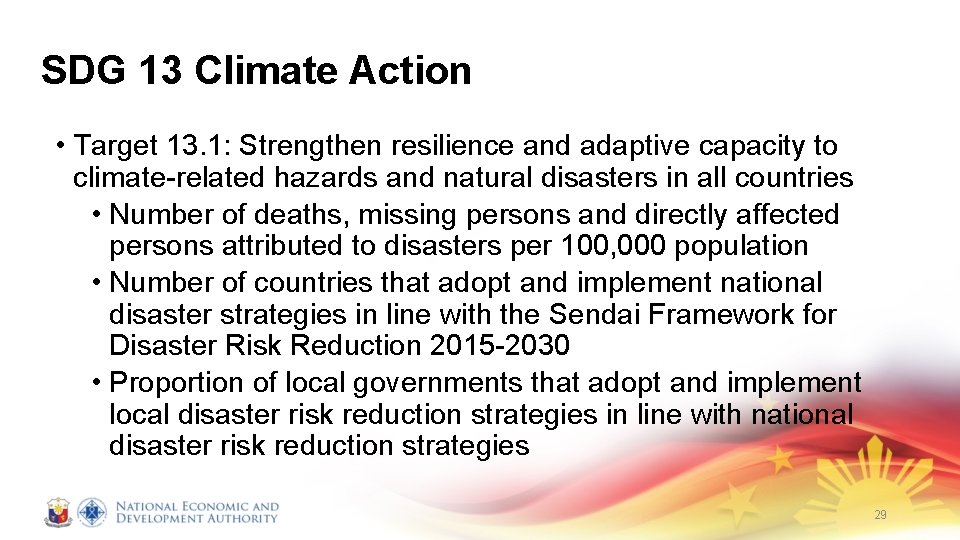
SDG 13 Climate Action • Target 13. 1: Strengthen resilience and adaptive capacity to climate-related hazards and natural disasters in all countries • Number of deaths, missing persons and directly affected persons attributed to disasters per 100, 000 population • Number of countries that adopt and implement national disaster strategies in line with the Sendai Framework for Disaster Risk Reduction 2015 -2030 • Proportion of local governments that adopt and implement local disaster risk reduction strategies in line with national disaster risk reduction strategies 29
SDG 13 Climate Action • Target 13. 2: Integrate climate change measures into national policies, strategies and planning • Number of countries that have communicated the establishment or operationalization of an integrated policy/strategy/plan which increases their ability to adapt to the adverse impacts of climate change, and foster climate resilience and low greenhouse gas emissions development in a manner that does not threaten food production (including a national adaptation plan, nationally determined contribution, national communication, biennial update report or other) 30
Sustainable Development Goals (SDGs) and Philippine Development Plan – Results Matrix (PDP-RM) Indicators 31

SDG Indicators and PDP-RM Indicators Sustainable Development Goal (SDG) Goal 7. Ensure access to affordable, reliable, sustainable and modern energy for all Goal 9. Build resilient infrastructure, promote inclusive and sustainable industrialization and foster innovation Targets Philippine Development Plan – Results Matrix (PDP-RM) Indicators 7. 2 By 2030, increase substantially the share Chapter 19: Accelerating Infrastructure of renewable energy in the global energy mix Development Renewable Energy Capacity Increased, MW 7. 3 By 2030, double the global rate of improvement in energy efficiency Chapter 19: Accelerating Infrastructure Development Energy intensity (primary energy) reduced, in tons of oil equivalent per million peso (TOE/Ph. P million) 9. 1 Develop quality, reliable, sustainable and resilient infrastructure, including regional and trans-border infrastructure, to support economic development and human wellbeing, with a focus on affordable and equitable access for all Chapter 19: Accelerating Infrastructure Development Passenger and freight volumes, by mode of transport 32

SDG Indicators and PDP-RM Indicators Sustainable Development Goal (SDG) Targets Philippine Development Plan – Results Matrix (PDP-RM) Indicators Goal 9. Build resilient infrastructure, promote inclusive and sustainable industrialization and foster innovation 9. 1 Develop quality, reliable, sustainable and resilient infrastructure, including regional and trans-border infrastructure, to support economic development and human wellbeing, with a focus on affordable and equitable access for all Chapter 10: Accelerating Human Capital Development Government expenditure for higher education research, development, and innovation as a percentage of GDP increased (%) 9. 5 Enhance scientific research, upgrade the technological capabilities of industrial sectors in all countries, in particular developing countries, including, by 2030, encouraging innovation and substantially increasing the number of research and development workers per 1 million people and public and private research and development spending Chapter 14: Vigorously Advancing Science, Technology, and Innovation Research and development expenditure as a proportion of GDP 33

SDG Indicators and PDP-RM Indicators Sustainable Development Goal (SDG) Targets Goal 11. Make cities and 11. 1. 1: Proportion of urban human settlements population who are informal settlers inclusive, safe, resilient and sustainable 11. 6: By 2030, reduce the adverse per capita environmental impact of cities, including by paying special attention to air quality and municipal and other waste management Philippine Development Plan – Results Matrix (PDP-RM) Indicators Chapter 12: Build Safe and Secure Communities Proportion of urban population living in informal settlements decreased Chapter 20: Ensuring Ecological Integrity, Clean and Healthy Environment Percentage of highly urbanized and other major urban centers within ambient air quality guidelines value increased 34

SDG Indicators and PDP-RM Indicators Sustainable Development Goal (SDG) Targets Philippine Development Plan – Results Matrix (PDP-RM) Indicators Goal 15. Protect, restore and promote sustainable use of terrestrial ecosystems, sustainably manage forests, combat desertification, and halt and reverse land degradation and halt biodiversity loss 15. 1: By 2020, ensure the conservation, restoration and sustainable use of terrestrial and inland freshwater ecosystems and their services, in particular forests, wetlands, mountains and drylands, in line with obligations under international agreements Chapter 20: Ensuring Ecological Integrity, Clean and Healthy Environment Forest area as a proportion of total land area 35
Sustainable urban Development and climate change indicators Ramon Paul M. Falcon Social Development Staff National Economic and Development Authority 36
- Slides: 36