
Sustainable Sustain ability the ability to sustain last

Sustainable Sustain- ability = the ability to sustain (last) One definition of sustainability is… To live in a way that meets the needs of today, without risking the ability of our children to meet their needs. To determine if an action is sustainable you can… consider the 3 Es: social equity, environmental, and economic impacts.
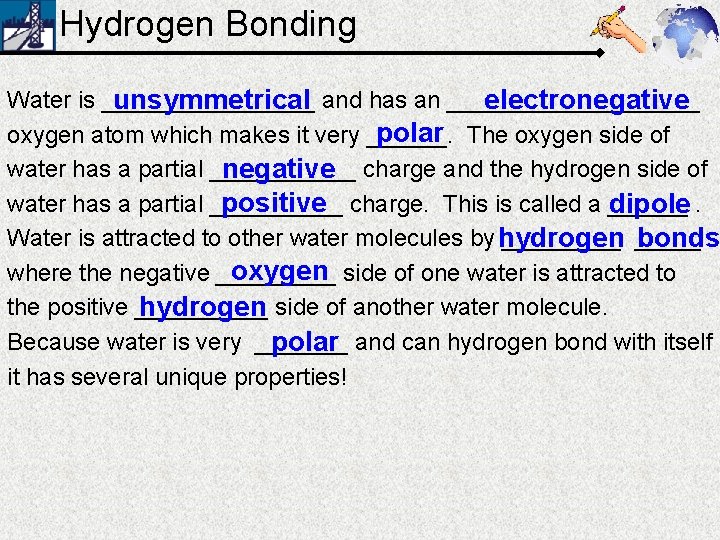
Hydrogen Bonding Water is ________ unsymmetrical and has an __________ electronegative polar The oxygen side of oxygen atom which makes it very ______. water has a partial ______ negative charge and the hydrogen side of water has a partial _____ positive charge. This is called a ______ dipole. Water is attracted to other water molecules by hydrogen _____ bonds oxygen side of one water is attracted to where the negative _____ the positive _____ hydrogen side of another water molecule. Because water is very _______ polar and can hydrogen bond with itself it has several unique properties!
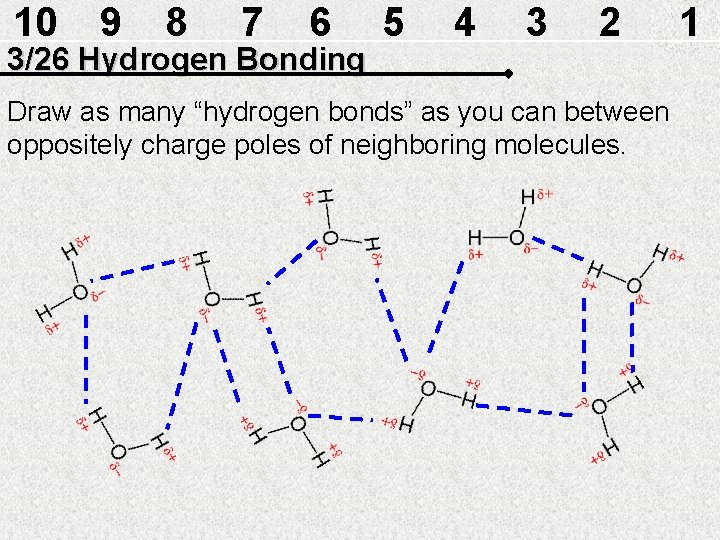
10 9 8 7 6 3/26 Hydrogen Bonding 5 4 3 2 Draw as many “hydrogen bonds” as you can between oppositely charge poles of neighboring molecules. 1
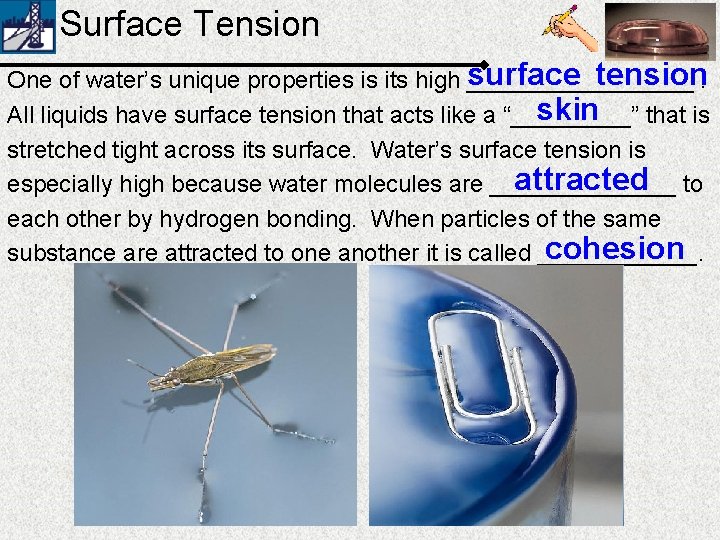
Surface Tension tension. One of water’s unique properties is its high surface _________ skin that is All liquids have surface tension that acts like a “_____” stretched tight across its surface. Water’s surface tension is attracted to especially high because water molecules are _______ each other by hydrogen bonding. When particles of the same cohesion substance are attracted to one another it is called ______.
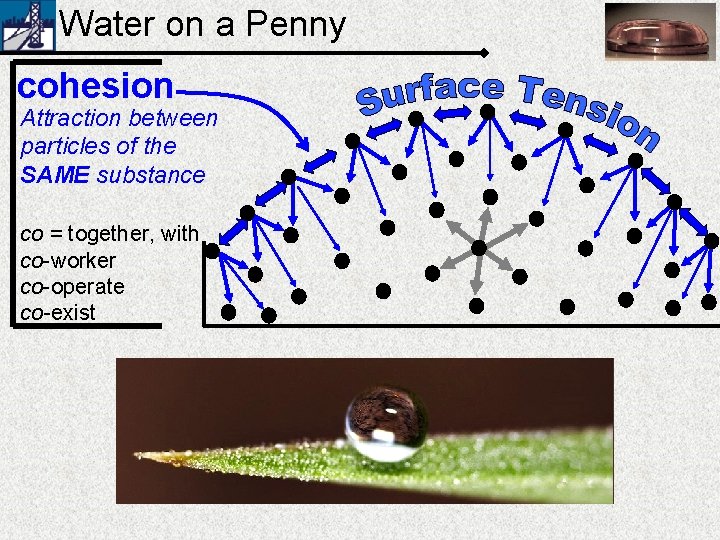
Water on a Penny cohesion Attraction between particles of the SAME substance co = together, with co-worker co-operate co-exist
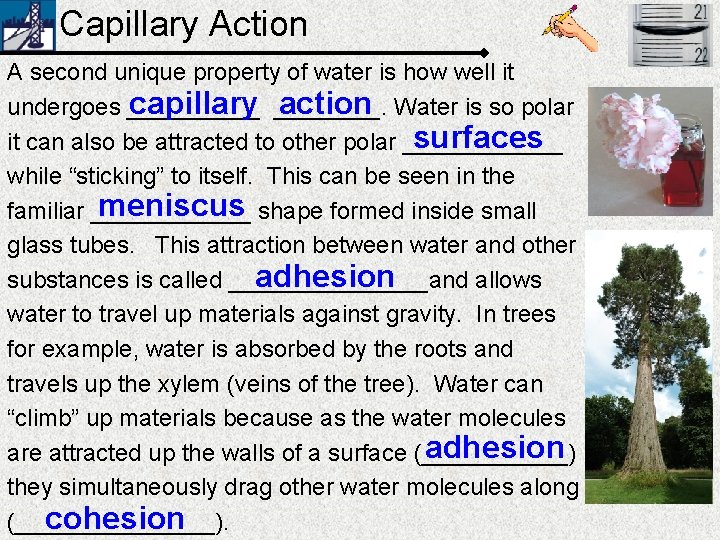
Capillary Action A second unique property of water is how well it capillary ____. action Water is so polar undergoes _____ surfaces it can also be attracted to other polar ______ while “sticking” to itself. This can be seen in the meniscus shape formed inside small familiar ______ glass tubes. This attraction between water and other adhesion substances is called ________and allows water to travel up materials against gravity. In trees for example, water is absorbed by the roots and travels up the xylem (veins of the tree). Water can “climb” up materials because as the water molecules adhesion are attracted up the walls of a surface (______) they simultaneously drag other water molecules along cohesion (________).
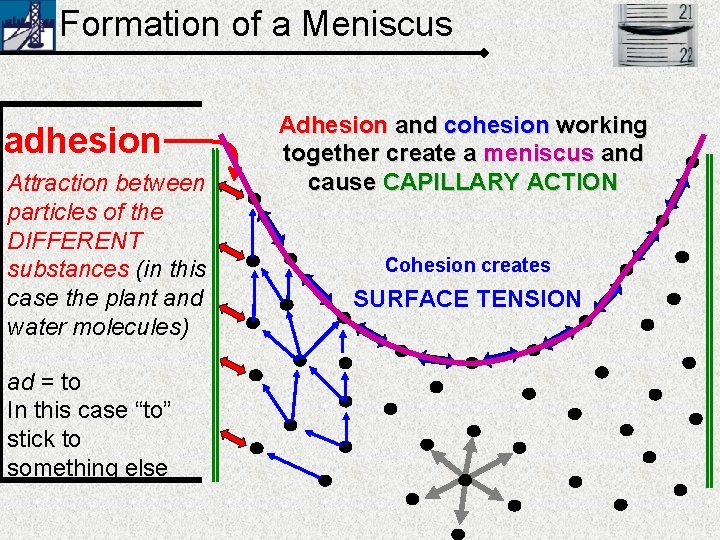
Formation of a Meniscus adhesion Attraction between particles of the DIFFERENT substances (in this case the plant and water molecules) ad = to In this case “to” stick to something else Adhesion and cohesion working together create a meniscus and cause CAPILLARY ACTION Cohesion creates SURFACE TENSION
Solubility Another unique property of water is that it is very good at dissolving many substances and therefore called the _____ Universal _____. Solvent When an ionic solid like salt [Na. Cl] or polar liquid like methanol [CH 3 OH] is mixed into dissolves. Once it dissolves the water it _______. solute and the water is substance is called the _____ solvent called the ______. Therefore, we would say that soluble compounds like salt and methanol are _______ in water.
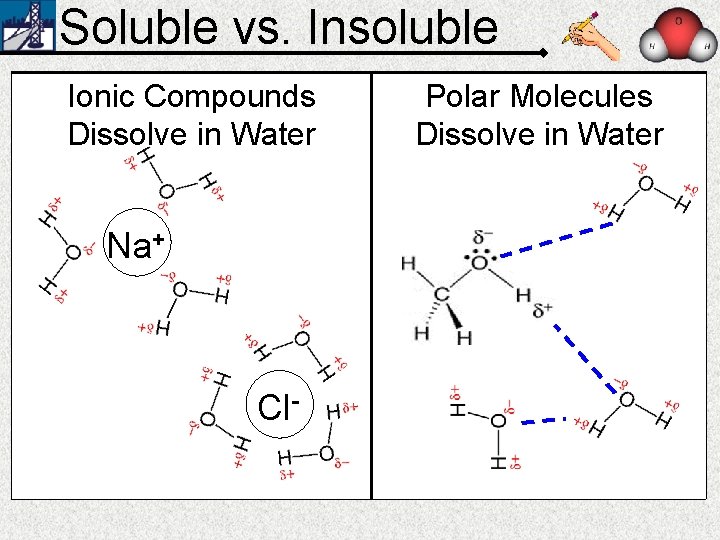
Soluble vs. Insoluble Ionic Compounds Dissolve in Water Na+ Cl- Polar Molecules Dissolve in Water
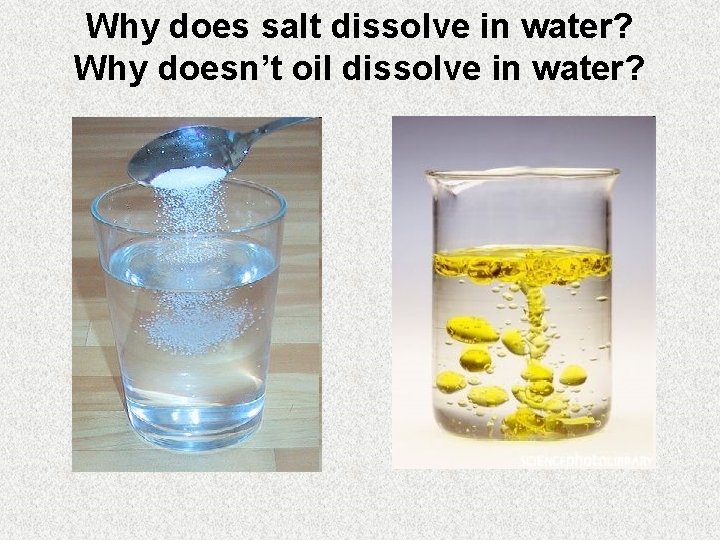
Why does salt dissolve in water? Why doesn’t oil dissolve in water?
Solubility oil are not water ______ Non-polar compounds, like ______, soluble because hydrogen bonding between water is stronger than any attraction between the non-polar solute and the polar water solvent. Water is so polar that it can actually induce (force) oil molecules to have a temporary ______, dipole but this will not happen because water molecules would rather stick with other water molecules. The attraction of polar solvents to themselves prevents non-polar molecules from ever dissolving into polar solvents. This is summarized in the chemistry rule Like Dissolves Like “_________________”.
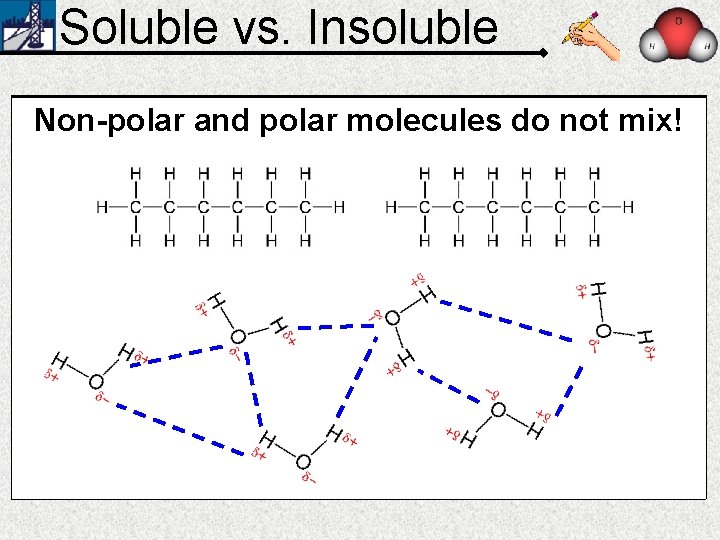
Soluble vs. Insoluble Non-polar and polar molecules do not mix!
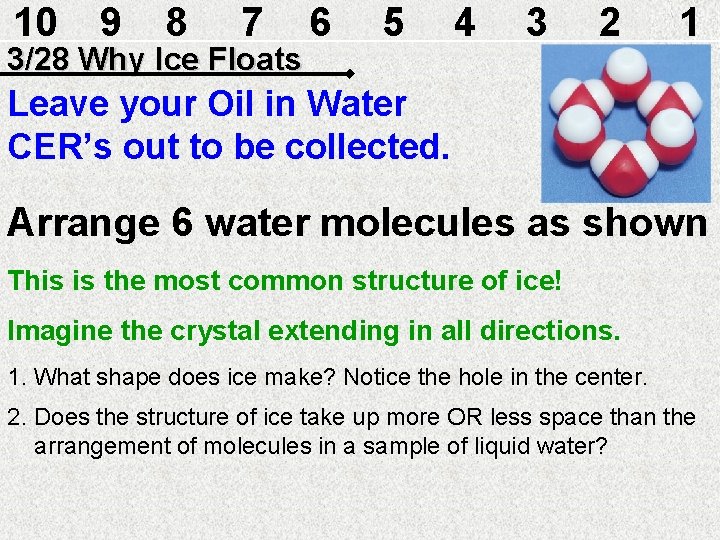
10 9 8 7 3/28 Why Ice Floats 6 5 4 3 2 1 Leave your Oil in Water CER’s out to be collected. Arrange 6 water molecules as shown This is the most common structure of ice! Imagine the crystal extending in all directions. 1. What shape does ice make? Notice the hole in the center. 2. Does the structure of ice take up more OR less space than the arrangement of molecules in a sample of liquid water?
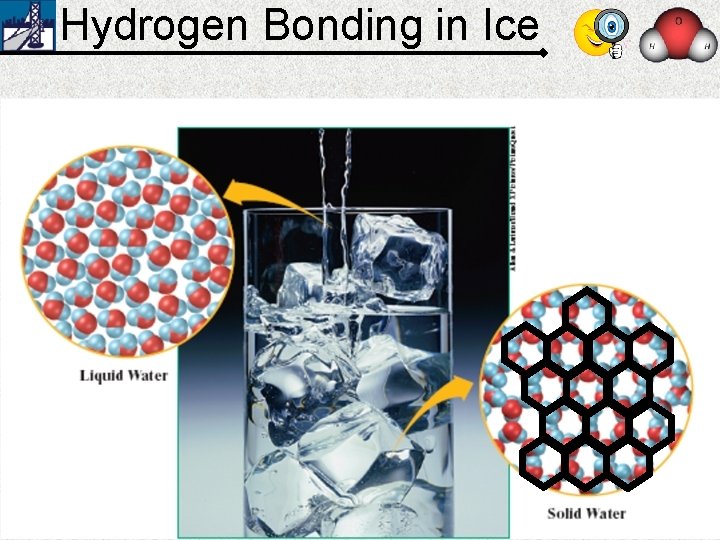
Hydrogen Bonding in Ice
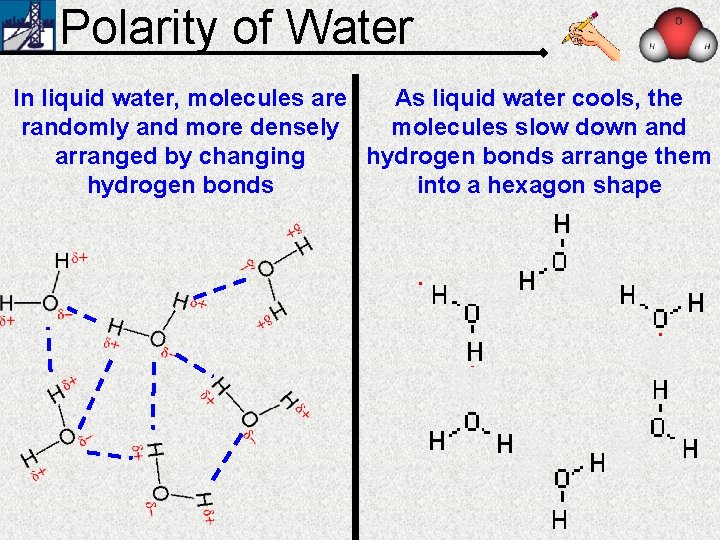
Polarity of Water In liquid water, molecules are As liquid water cools, the randomly and more densely molecules slow down and arranged by changing hydrogen bonds arrange them hydrogen bonds into a hexagon shape
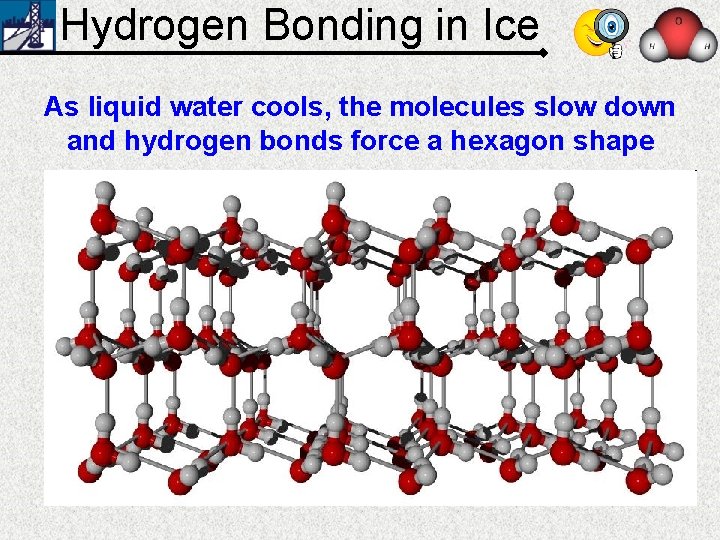
Hydrogen Bonding in Ice As liquid water cools, the molecules slow down and hydrogen bonds force a hexagon shape
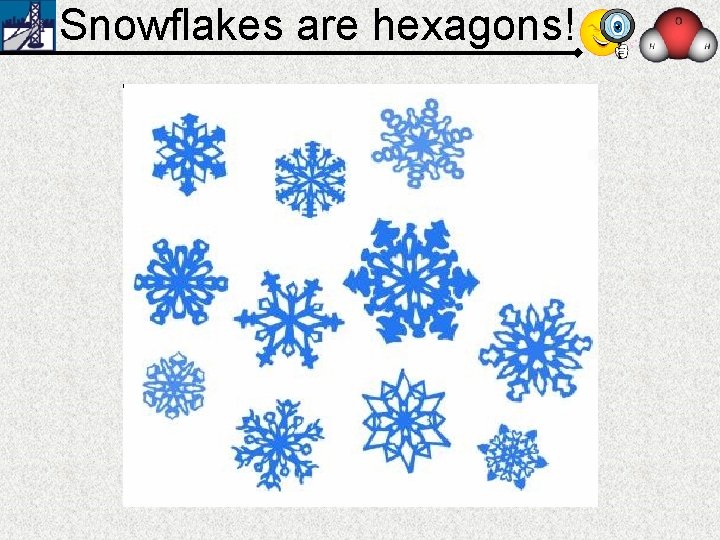
Snowflakes are hexagons!
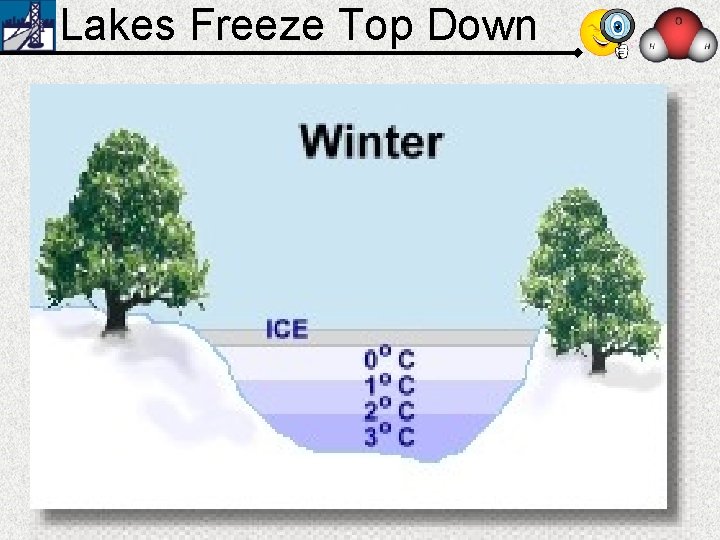
Lakes Freeze Top Down
Hydrogen Bonding in Water Another unique property of water is that it has a very high specific heat capacity This means that water can _______ absorb ___________. release large amounts of _______ and ____ energy as it is heated or cooled. However, these large changes in energy only result in _______ small in ________. temperature changes In other words, water resists changes in temperature. This is because in before you can make faster the molecules move _______ the hydrogen bonds between them broken when you heat water most have to be ______. Therefore, of the energy actually goes into breaking the hydrogen bonds. Water’s high specific heat helps to stabilize your body’s temperature _______ and the Earth’s different ______ within climates a suitable range for life.
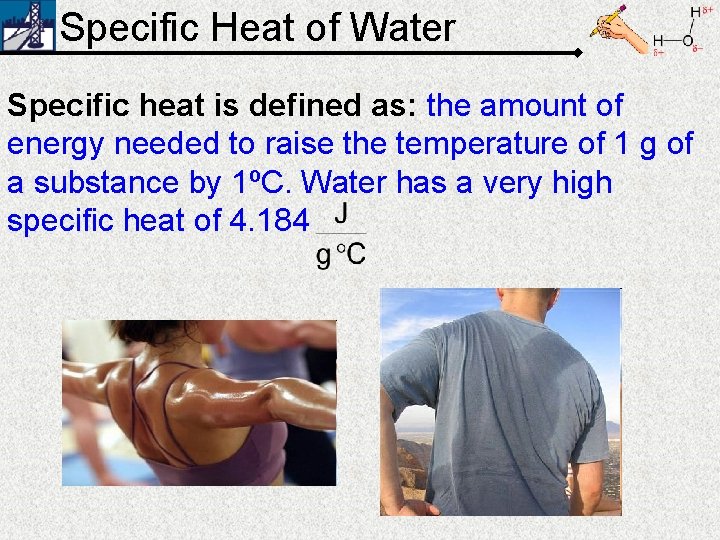
Specific Heat of Water Specific heat is defined as: the amount of energy needed to raise the temperature of 1 g of a substance by 1ºC. Water has a very high specific heat of 4. 184
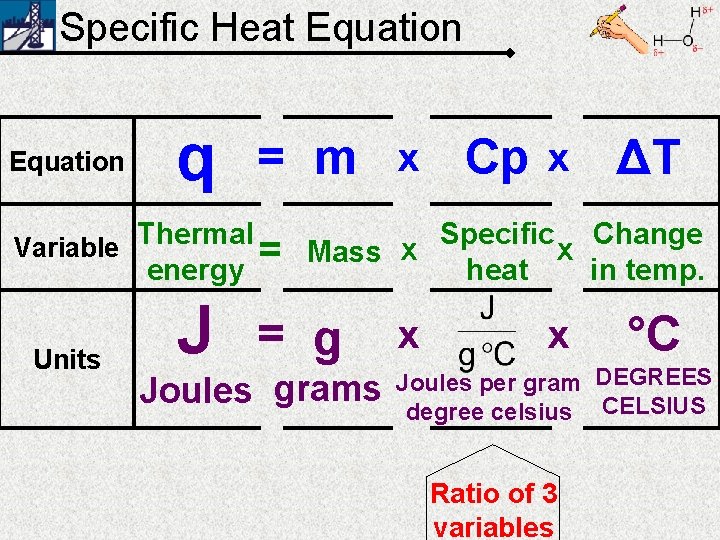
Specific Heat Equation q = m x Cp x ΔT Thermal Specific Change Variable x Mass x = energy heat in temp. Units J = g Joules grams x x °C Joules per gram DEGREES degree celsius CELSIUS Ratio of 3 variables
Specific Heat Lab Chemists conduct thermochemistry experiments in a device calorimeter which prevents loss called a _______of thermal energy to the surroundings. For this experiment, you will heat a sample of metal in a beaker of boiling water. This will allow you to assume that the metal and water are in _____________, meaning the metal is thermal equilibrium same temperature as the boiling water (_______). _______ 100°C Then, you will place the hot metal into a calorimeter containing room temperature water. By putting the hot metal into the room temperature water, the metal will cool and the water will heat up until the two reach _______ temperature thermal equilibrium (the same __________).
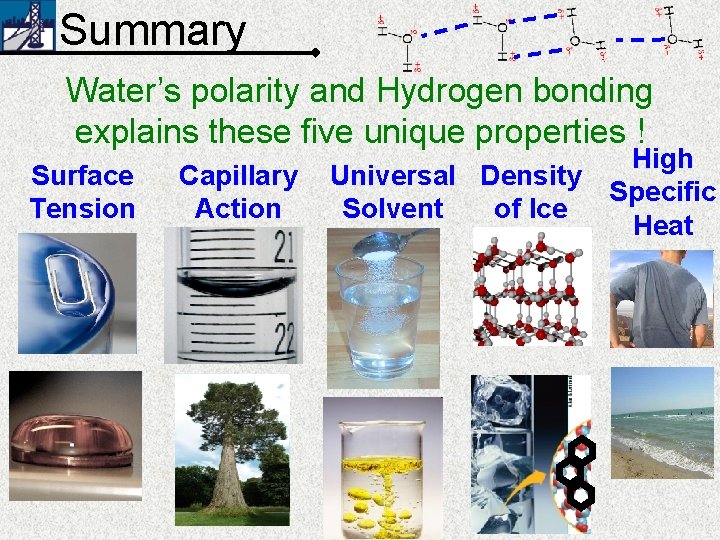
Summary Water’s polarity and Hydrogen bonding explains these five unique properties ! Surface Tension Capillary Action High Universal Density Specific Solvent of Ice Heat
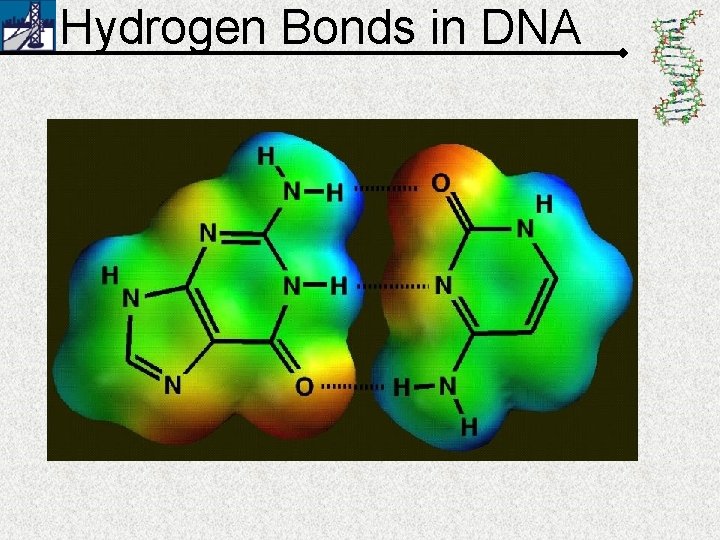
Hydrogen Bonds in DNA
- Slides: 24