
Sustainable Sanitation for all Dr Elisabeth v Mnch
Sustainable Sanitation for all Dr. Elisabeth v. Münch Urban Water and Sanitation Department UNESCO-IHE e. vonmunch@unesco-ihe. org A 30 min. lecture in joint Week 1 of all MSc programmes at UNESCO-IHE, 24 October 2007 1
The two main points that I want to make in this lecture 1. Awareness and some basic knowledge on sanitation issues is important for every one of us (regardless of your MSc specialisation) 2. It is not enough to implement any form of sanitation – it needs to be sustainable 2
Why is sanitation important for everyone? n n n We all contribute to the problem (we all produce urine, faeces, greywater and solid waste) We all have children who could fall sick from improper sanitation Sanitation is related to many different sectors of society 3

What does sanitation consist of? 1. Excreta management (faeces, urine) 2. Greywater management 3. Solid waste management 4. Drainage (for rainwater / stormwater) sewage When you mix excreta and greywater together (and industrial effluent and rainwater), you get sewage. Do we really have to mix them all together? Are there any other options? 4

Main aims of sanitation provision (applies to all sanitation systems) n n Improve health and quality of life Protect the environment Focus of UNESCOIHE’s mission: developing countries and countries in transition Child defecating in a canal in the slum of Gege in the city of Ibadan, Nigeria (Photo: Adebayo Alao, Sept. 2007) 5
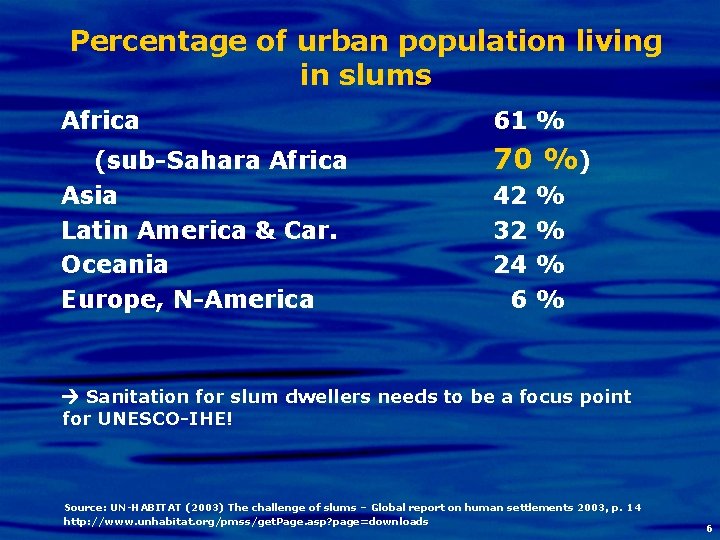
Percentage of urban population living in slums Africa 61 % (sub-Sahara Africa Asia Latin America & Car. Oceania Europe, N-America 70 %) 42 32 24 6 % % Sanitation for slum dwellers needs to be a focus point for UNESCO-IHE! Source: UN-HABITAT (2003) The challenge of slums – Global report on human settlements 2003, p. 14 http: //www. unhabitat. org/pmss/get. Page. asp? page=downloads 6
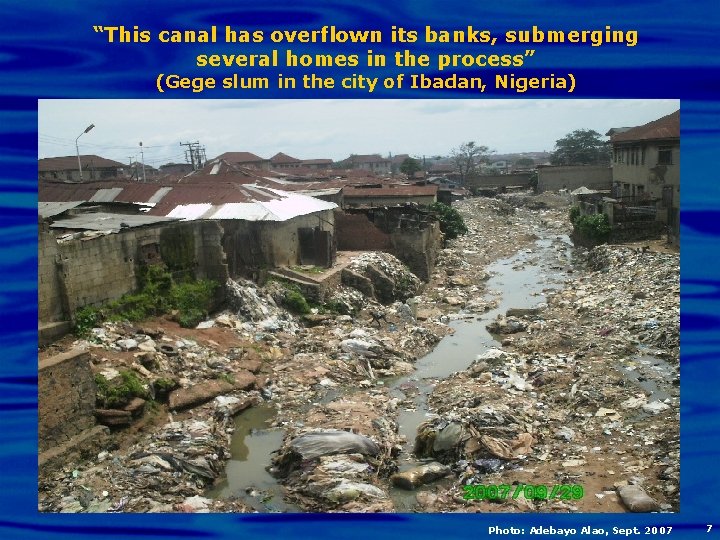
“This canal has overflown its banks, submerging several homes in the process” (Gege slum in the city of Ibadan, Nigeria) Photo: Adebayo Alao, Sept. 2007 7
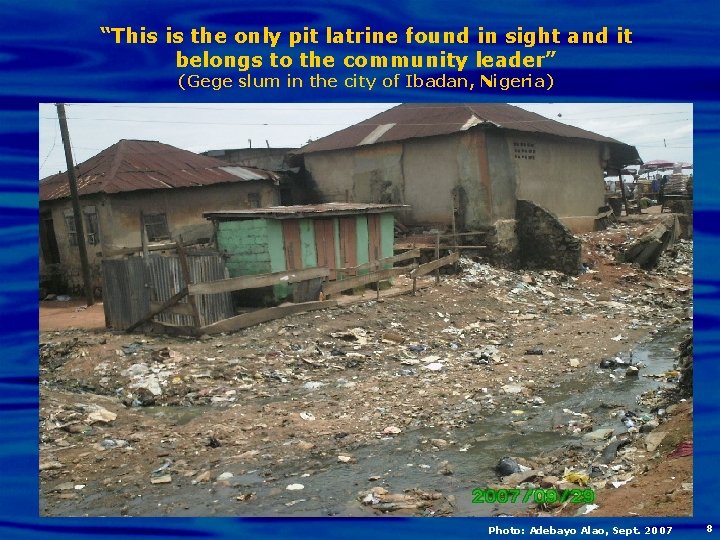
“This is the only pit latrine found in sight and it belongs to the community leader” (Gege slum in the city of Ibadan, Nigeria) Photo: Adebayo Alao, Sept. 2007 8
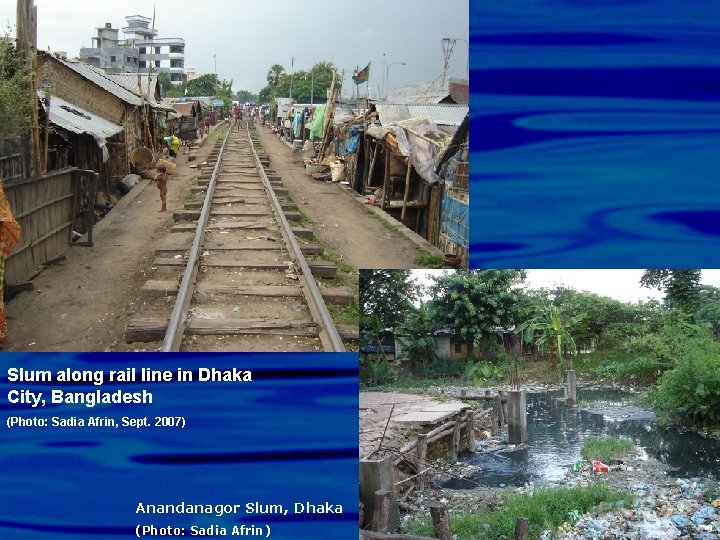
Slum along rail line in Dhaka City, Bangladesh (Photo: Sadia Afrin, Sept. 2007) Anandanagor Slum, Dhaka (Photo: Sadia Afrin) 9
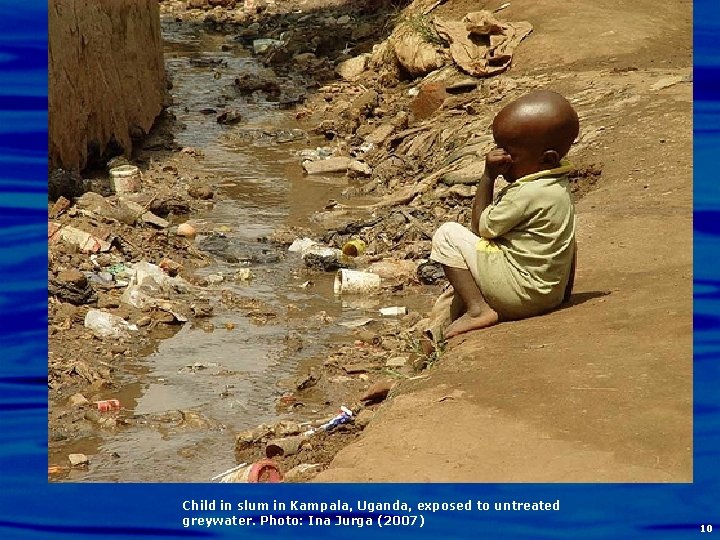
Child in slum in Kampala, Uganda, exposed to untreated greywater. Photo: Ina Jurga (2007) 10
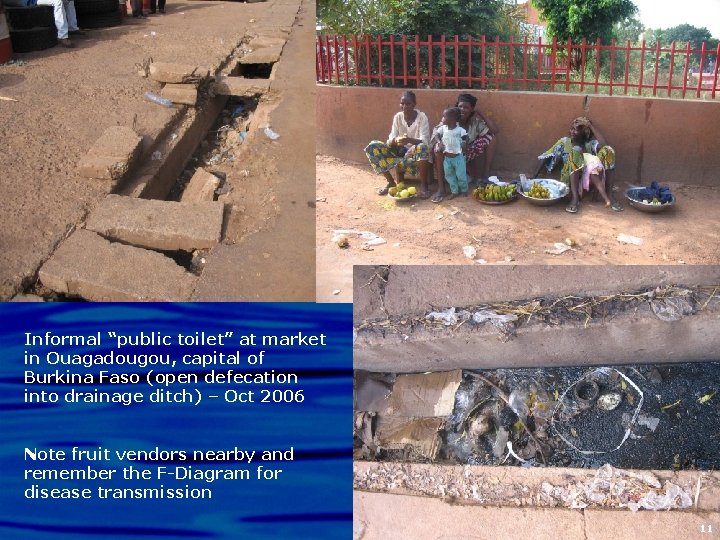
Informal “public toilet” at market in Ouagadougou, capital of Burkina Faso (open defecation into drainage ditch) – Oct 2006 Note fruit vendors nearby and remember the F-Diagram for disease transmission 11
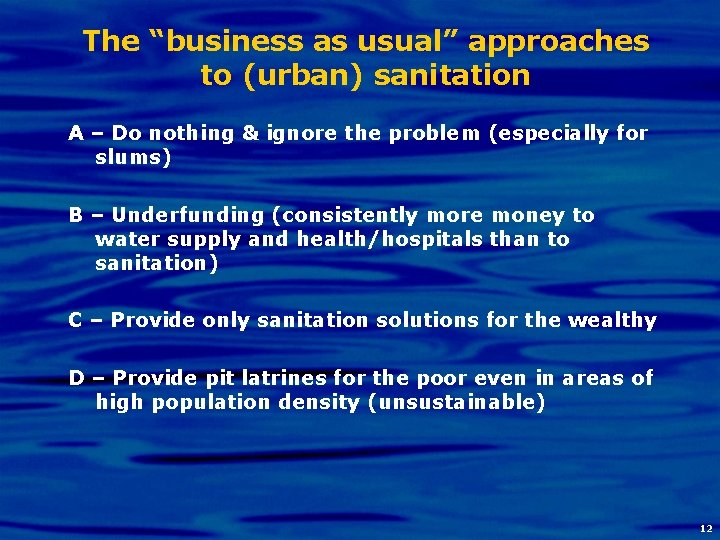
The “business as usual” approaches to (urban) sanitation A – Do nothing & ignore the problem (especially for slums) B – Underfunding (consistently more money to water supply and health/hospitals than to sanitation) C – Provide only sanitation solutions for the wealthy D – Provide pit latrines for the poor even in areas of high population density (unsustainable) 12
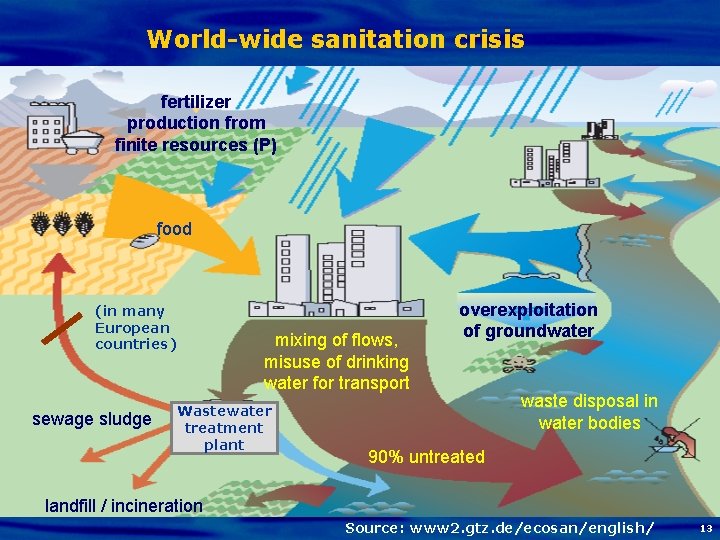
World-wide sanitation crisis fertilizer production from finite resources (P) food (in many European countries) sewage sludge mixing of flows, misuse of drinking water for transport Wastewater treatment plant overexploitation of groundwater waste disposal in water bodies 90% untreated landfill / incineration Source: www 2. gtz. de/ecosan/english/ 13
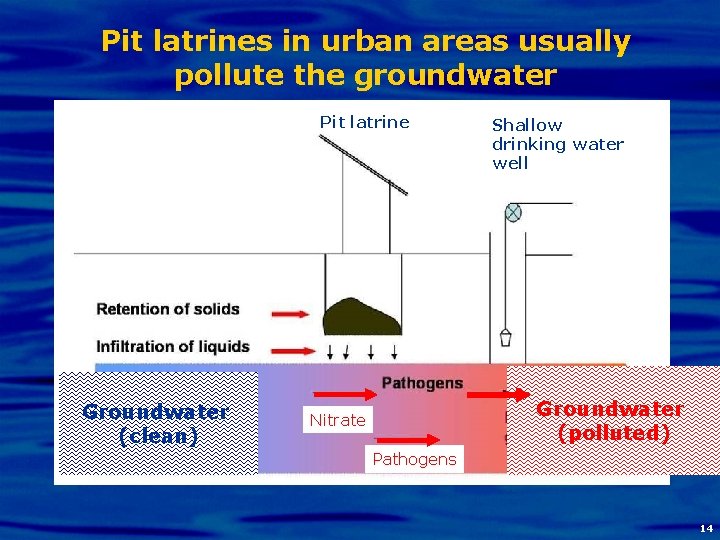
Pit latrines in urban areas usually pollute the groundwater Pit latrine Groundwater (clean) Shallow drinking water well Groundwater (polluted) Nitrate Pathogens 14
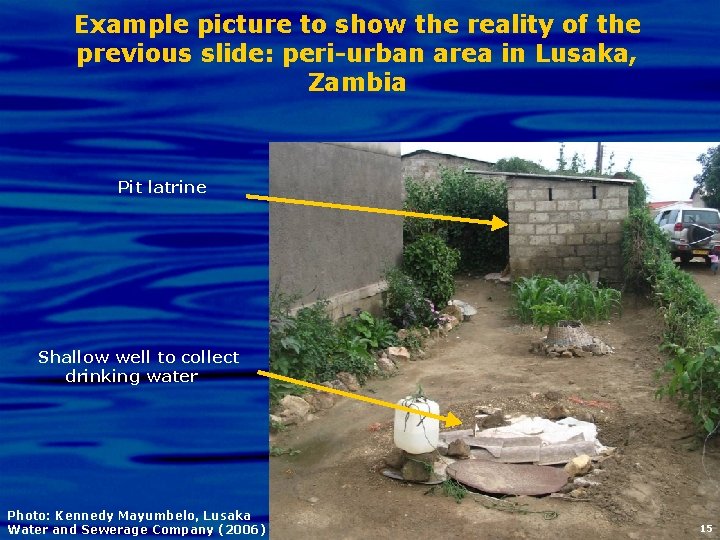
Example picture to show the reality of the previous slide: peri-urban area in Lusaka, Zambia Pit latrine Shallow well to collect drinking water Photo: Kennedy Mayumbelo, Lusaka Water and Sewerage Company (2006) 15
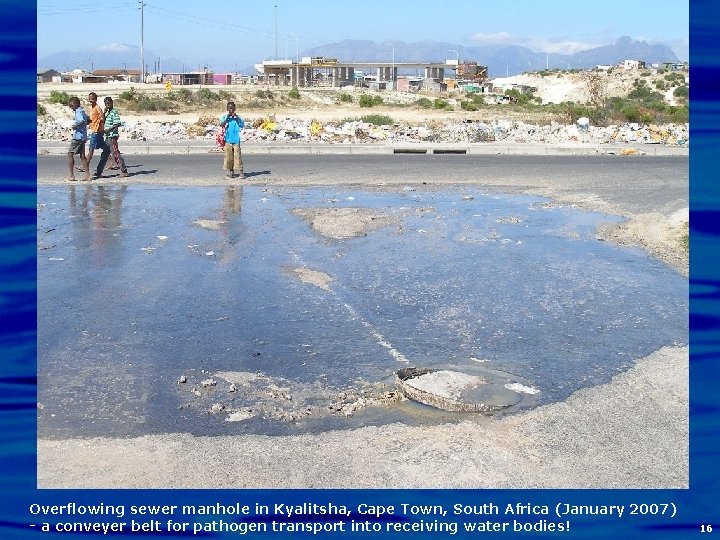
Overflowing sewer manhole in Kyalitsha, Cape Town, South Africa (January 2007) - a conveyer belt for pathogen transport into receiving water bodies! 16
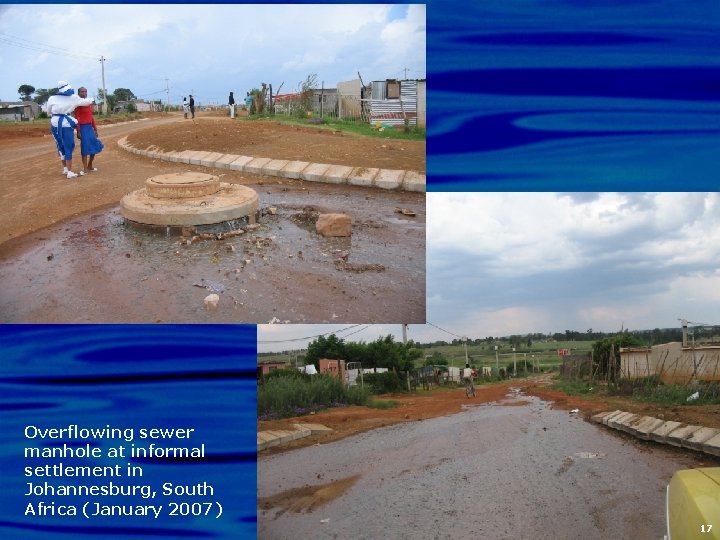
Overflowing sewer manhole at informal settlement in Johannesburg, South Africa (January 2007) 17
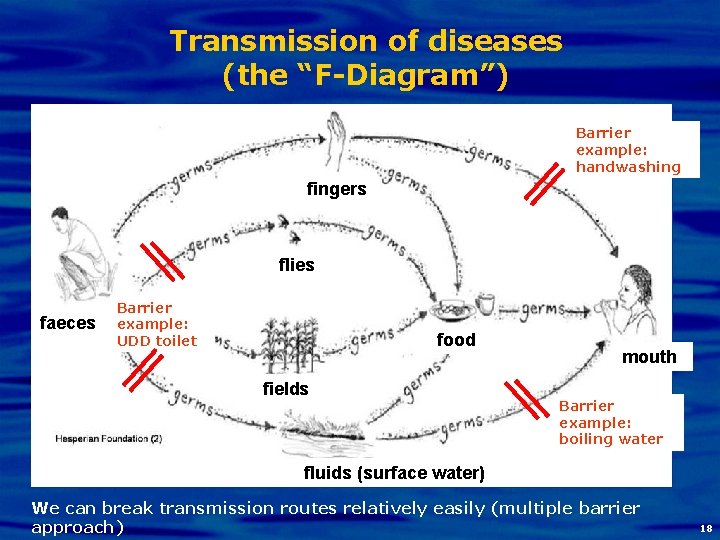
Transmission of diseases (the “F-Diagram”) Barrier example: handwashing fingers flies faeces Barrier example: UDD toilet food fields mouth Barrier example: boiling water fluids (surface water) We can break transmission routes relatively easily (multiple barrier approach) 18
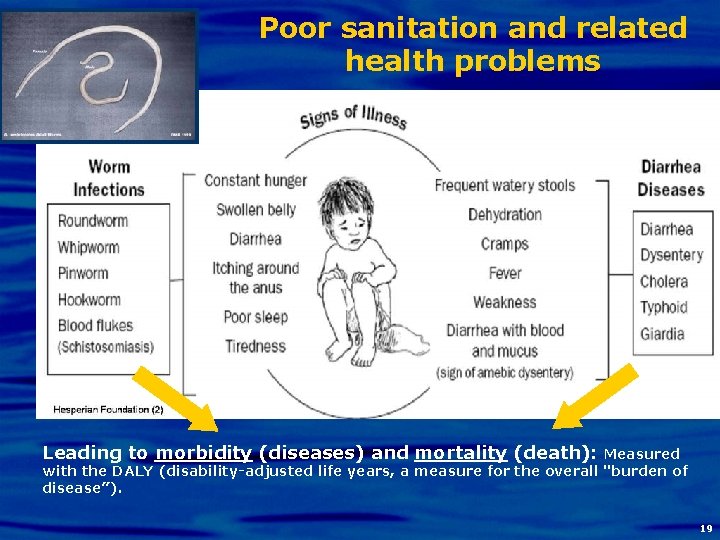
Poor sanitation and related health problems Leading to morbidity (diseases) and mortality (death): Measured with the DALY (disability-adjusted life years, a measure for the overall "burden of disease”). 19
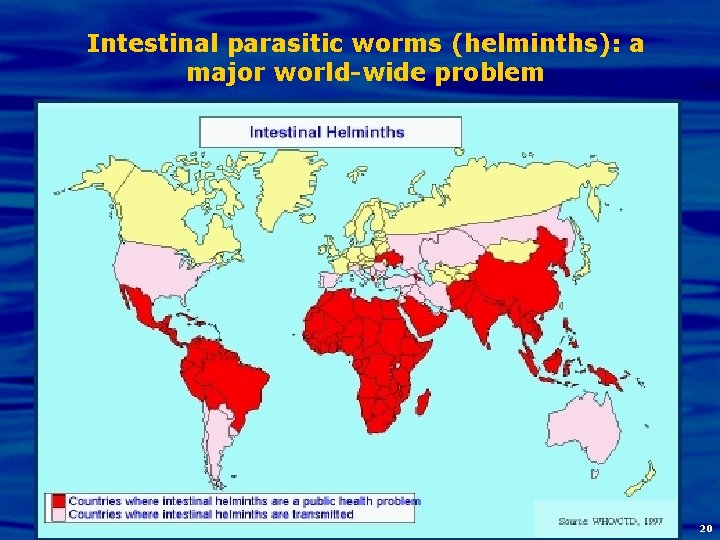
Intestinal parasitic worms (helminths): a major world-wide problem 20
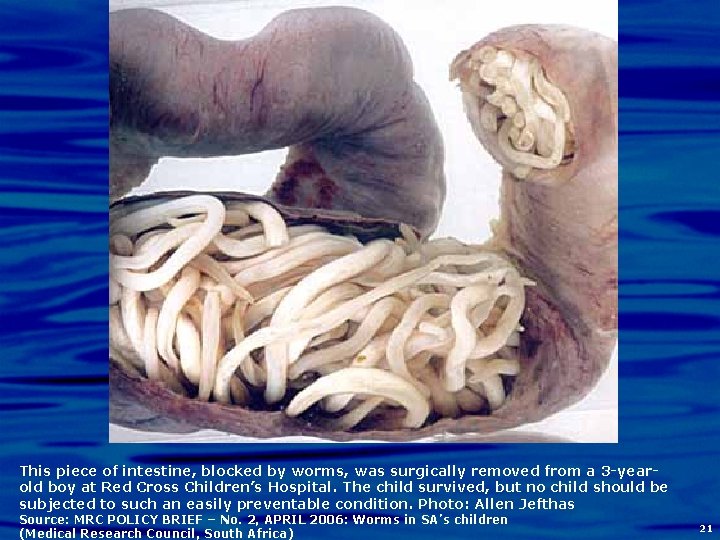
This piece of intestine, blocked by worms, was surgically removed from a 3 -yearold boy at Red Cross Children’s Hospital. The child survived, but no child should be subjected to such an easily preventable condition. Photo: Allen Jefthas Source: MRC POLICY BRIEF – No. 2, APRIL 2006: Worms in SA’s children (Medical Research Council, South Africa) 21
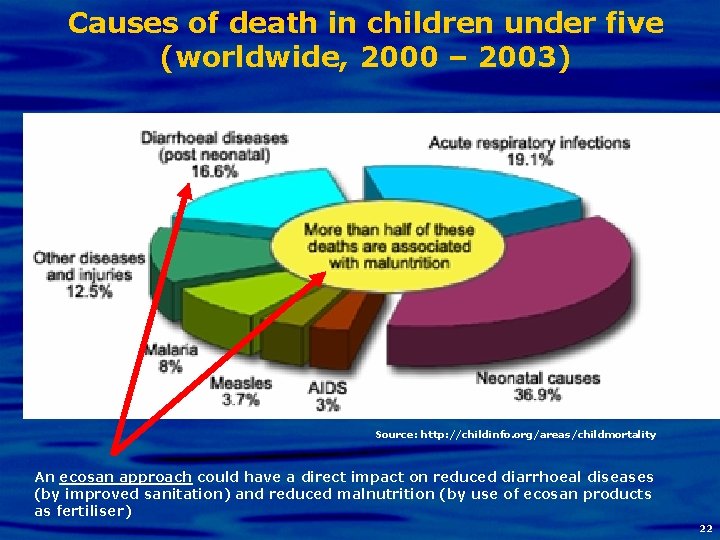
Causes of death in children under five (worldwide, 2000 – 2003) Source: http: //childinfo. org/areas/childmortality An ecosan approach could have a direct impact on reduced diarrhoeal diseases (by improved sanitation) and reduced malnutrition (by use of ecosan products as fertiliser) 22
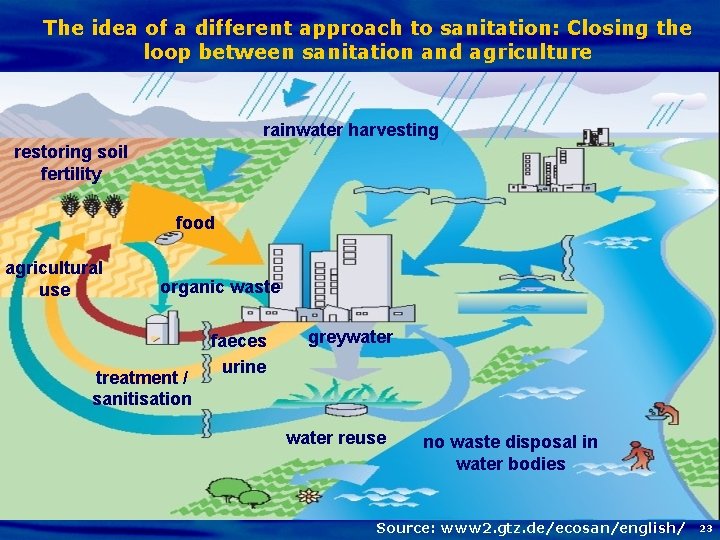
The idea of a different approach to sanitation: Closing the loop between sanitation and agriculture rainwater harvesting restoring soil fertility food agricultural use organic waste treatment / sanitisation faeces urine greywater reuse no waste disposal in water bodies Source: www 2. gtz. de/ecosan/english/ 23
What is ecological sanitation (ecosan)? (also called „sustainable sanitation“) The two main pillars of ecosan are: Reuse of the nutrients contained in urine and faeces in agriculture 2. Aim to be as sustainable as possible (see next slide) 1. n n Ecosan is not limited to a specific technology Ecosan may use urine diversion (UD) toilets without flushing water (but can also use other types of toilets) (Nutrients = nitrogen and phosphorus) 24
The concept of sustainability in relation to sanitation We consider sanitation systems sustainable if they: n are socially acceptable, n technically appropriate, n economically viable, n do not contribute to environmental degradation or depletion of the resource base, n protect and promote human health, and n are institutionally appropriate. Note: Sustainability is a relative indicator, not an absolute state (use it for comparisons) Source: Kvarnström and af Petersens (2004) 25
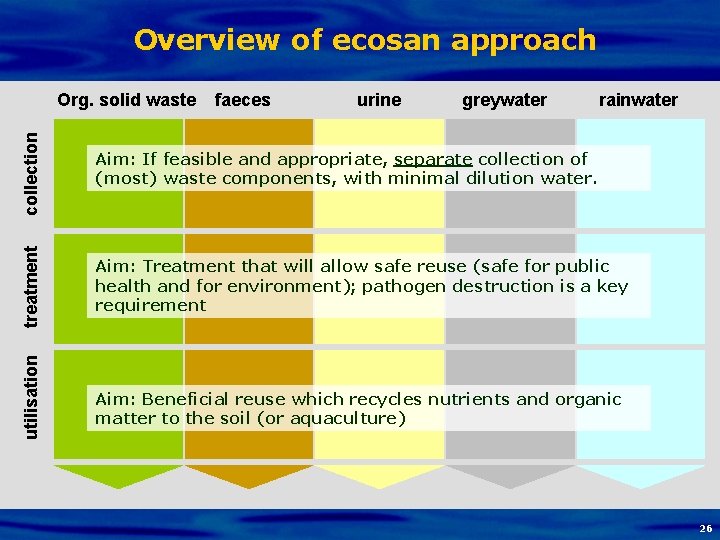
Overview of ecosan approach urine greywater rainwater Aim: If feasible and appropriate, separate collection of (most) waste components, with minimal dilution water. Aim: Treatment that will allow safe reuse (safe for public health and for environment); pathogen destruction is a key requirement utilisation collection faeces treatment Org. solid waste Aim: Beneficial reuse which recycles nutrients and organic matter to the soil (or aquaculture) 26
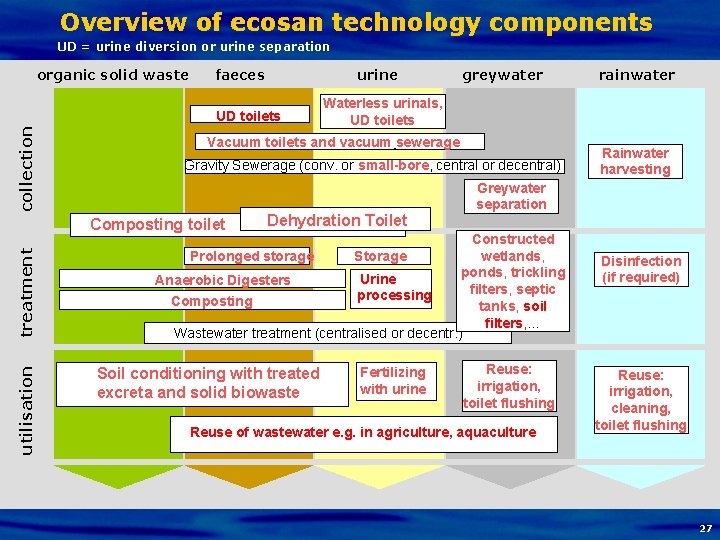
Overview of ecosan technology components UD = urine diversion or urine separation organic solid waste faeces urine collection UD toilets Gravity Sewerage (conv. or small-bore, central or decentral) - treatment Dehydration Toilet Fertilizing with urine Rainwater harvesting Greywater separation Constructed wetlands, Prolonged storage Storage ponds, trickling Urine Anaerobic Digesters filters, septic processing Composting tanks, soil filters, … Wastewater treatment (centralised or decentr. ) Soil conditioning with treated excreta and solid biowaste rainwater Waterless urinals, UD toilets Vacuum toilets and vacuum -sewerage Composting toilet utilisation greywater Reuse: irrigation, toilet flushing Reuse of wastewater e. g. in agriculture, aquaculture Disinfection (if required) Reuse: irrigation, cleaning, toilet flushing 27
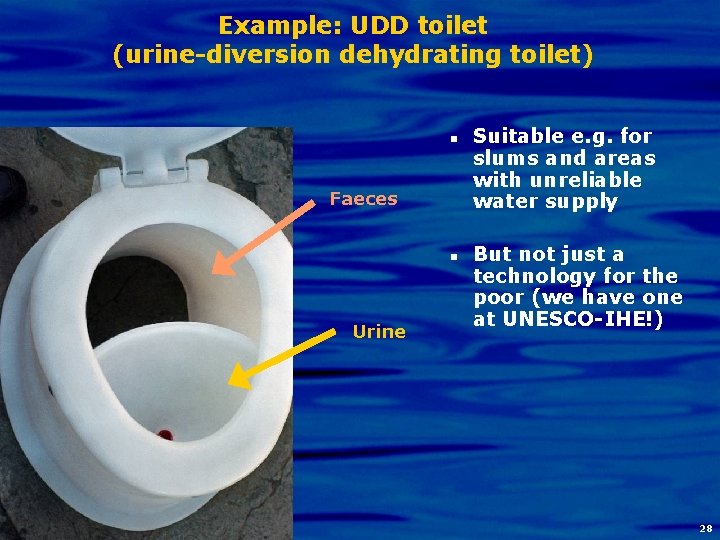
Example: UDD toilet (urine-diversion dehydrating toilet) n Faeces n Urine Suitable e. g. for slums and areas with unreliable water supply But not just a technology for the poor (we have one at UNESCO-IHE!) 28
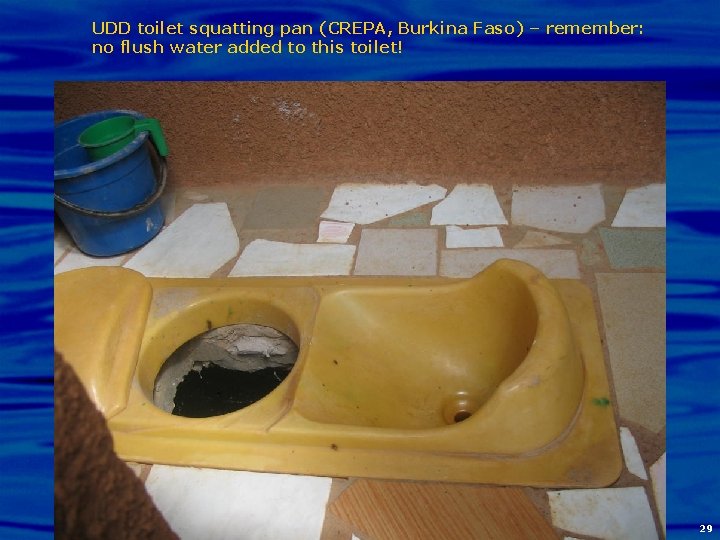
UDD toilet squatting pan (CREPA, Burkina Faso) – remember: no flush water added to this toilet! 29
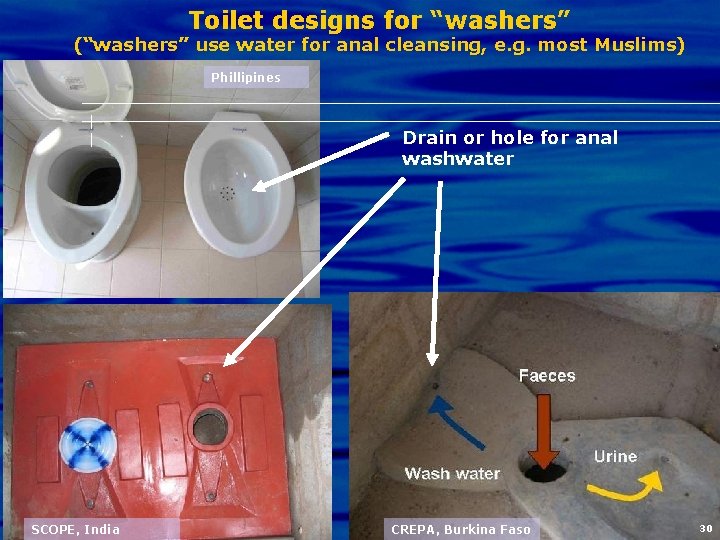
Toilet designs for “washers” (“washers” use water for anal cleansing, e. g. most Muslims) Phillipines Drain or hole for anal washwater SCOPE, India CREPA, Burkina Faso 30
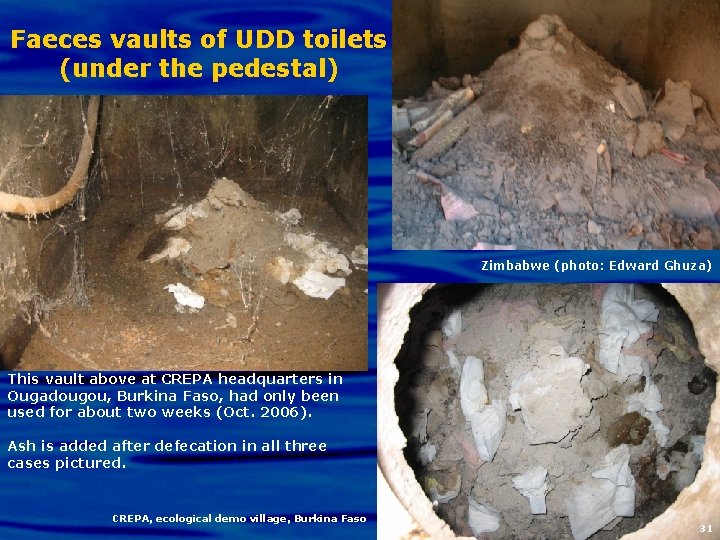
Faeces vaults of UDD toilets (under the pedestal) Zimbabwe (photo: Edward Ghuza) This vault above at CREPA headquarters in Ougadougou, Burkina Faso, had only been used for about two weeks (Oct. 2006). Ash is added after defecation in all three cases pictured. CREPA, ecological demo village, Burkina Faso 31
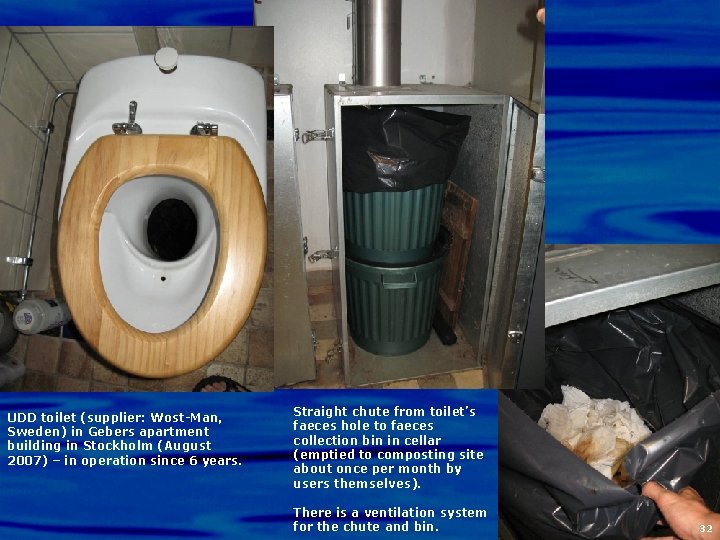
UDD toilet (supplier: Wost-Man, Sweden) in Gebers apartment building in Stockholm (August 2007) – in operation since 6 years. Straight chute from toilet’s faeces hole to faeces collection bin in cellar (emptied to composting site about once per month by users themselves). There is a ventilation system for the chute and bin. 32
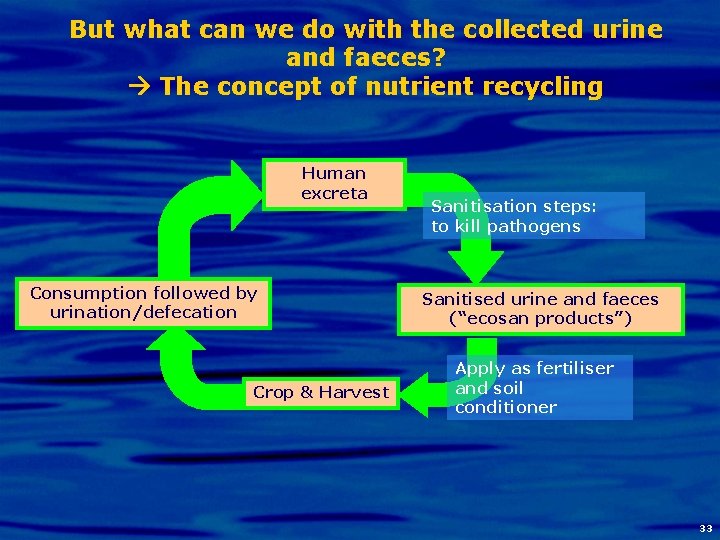
But what can we do with the collected urine and faeces? The concept of nutrient recycling Human excreta Consumption followed by urination/defecation Crop & Harvest Sanitisation steps: to kill pathogens Sanitised urine and faeces (“ecosan products”) Apply as fertiliser and soil conditioner 33
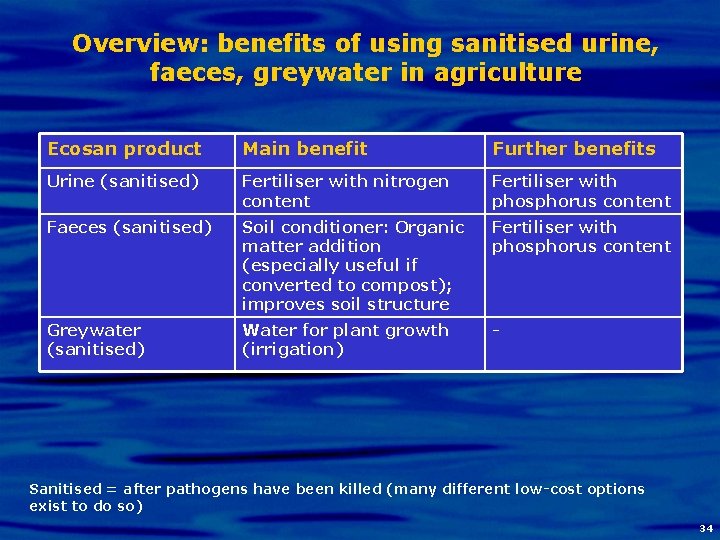
Overview: benefits of using sanitised urine, faeces, greywater in agriculture Ecosan product Main benefit Further benefits Urine (sanitised) Fertiliser with nitrogen content Fertiliser with phosphorus content Faeces (sanitised) Soil conditioner: Organic matter addition (especially useful if converted to compost); improves soil structure Fertiliser with phosphorus content Greywater (sanitised) Water for plant growth (irrigation) - Sanitised = after pathogens have been killed (many different low-cost options exist to do so) 34
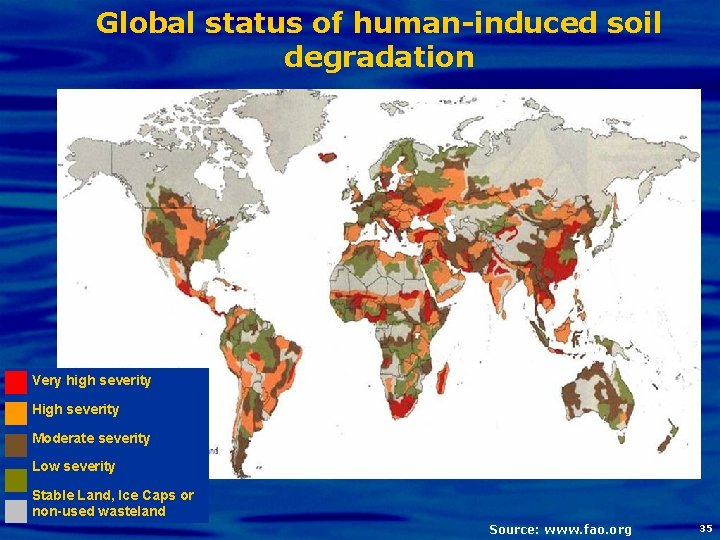
Global status of human-induced soil degradation Very high severity High severity Moderate severity Low severity Stable Land, Ice Caps or non-used wasteland Source: www. fao. org 35
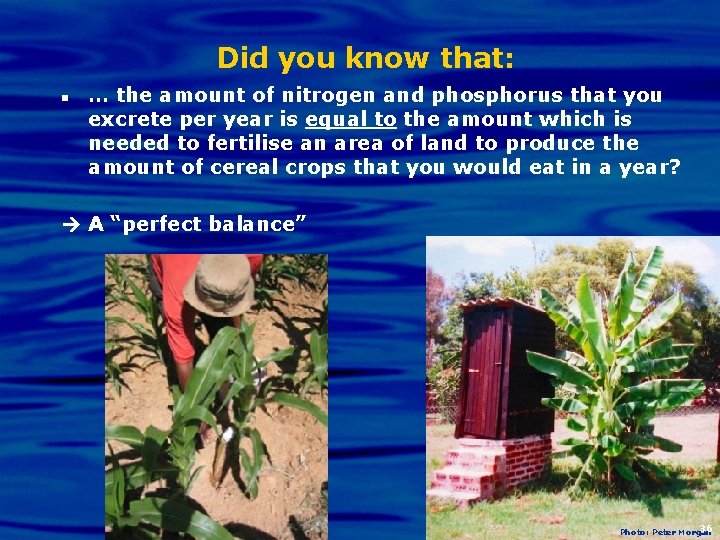
Did you know that: n … the amount of nitrogen and phosphorus that you excrete per year is equal to the amount which is needed to fertilise an area of land to produce the amount of cereal crops that you would eat in a year? A “perfect balance” 36 Photo: Peter Morgan
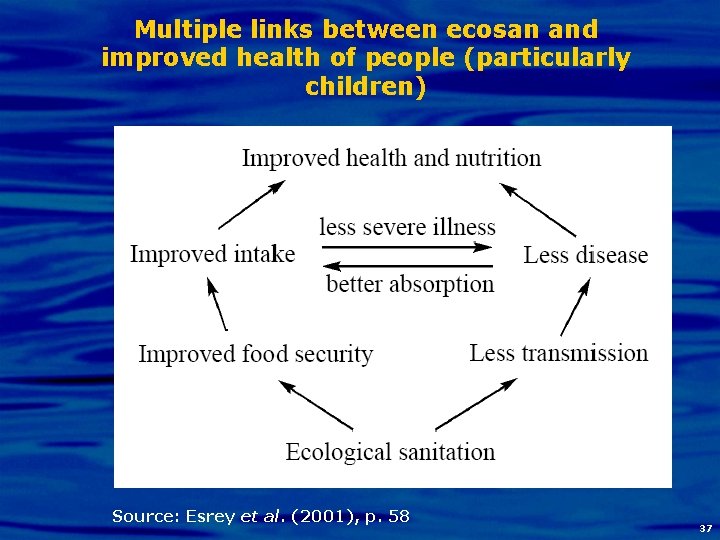
Multiple links between ecosan and improved health of people (particularly children) Source: Esrey et al. (2001), p. 58 37
Did you know that phosphorus (the key ingredient in fertiliser) is a limited resource? n n n At current rates of extraction (144 megatons per year) with no annual increase the commercially viable reserves will last 125 years At 3% annual increase, this will be only 50 years Morocco/West Sahara and China hold >70% of the global reserve US cheap reserves will be depleted in 2530 years By already 2020, rock phosphate may be the keystone resource of the world economy 38
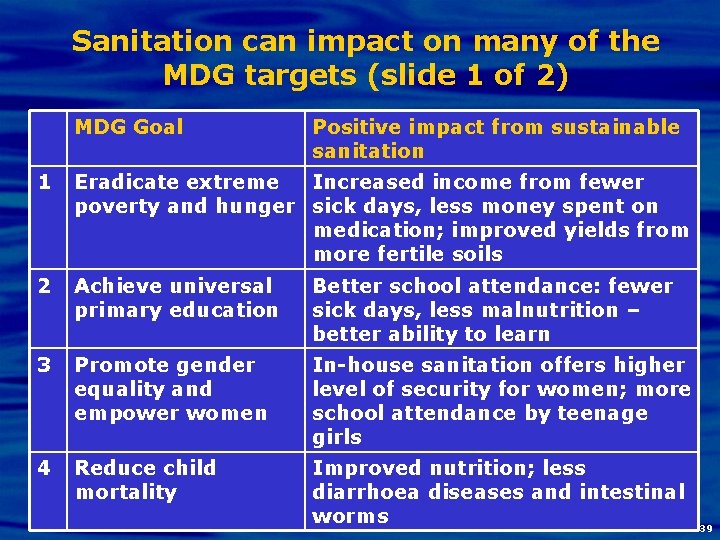
Sanitation can impact on many of the MDG targets (slide 1 of 2) MDG Goal Positive impact from sustainable sanitation 1 Eradicate extreme Increased income from fewer poverty and hunger sick days, less money spent on medication; improved yields from more fertile soils 2 Achieve universal primary education Better school attendance: fewer sick days, less malnutrition – better ability to learn 3 Promote gender equality and empower women In-house sanitation offers higher level of security for women; more school attendance by teenage girls 4 Reduce child mortality Improved nutrition; less diarrhoea diseases and intestinal worms 39
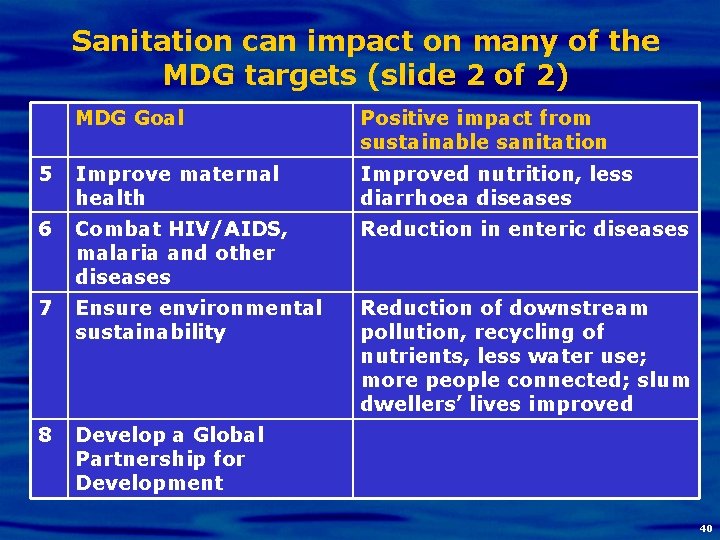
Sanitation can impact on many of the MDG targets (slide 2 of 2) MDG Goal Positive impact from sustainable sanitation 5 Improve maternal health Improved nutrition, less diarrhoea diseases 6 Combat HIV/AIDS, malaria and other diseases Reduction in enteric diseases 7 Ensure environmental sustainability Reduction of downstream pollution, recycling of nutrients, less water use; more people connected; slum dwellers’ lives improved 8 Develop a Global Partnership for Development 40
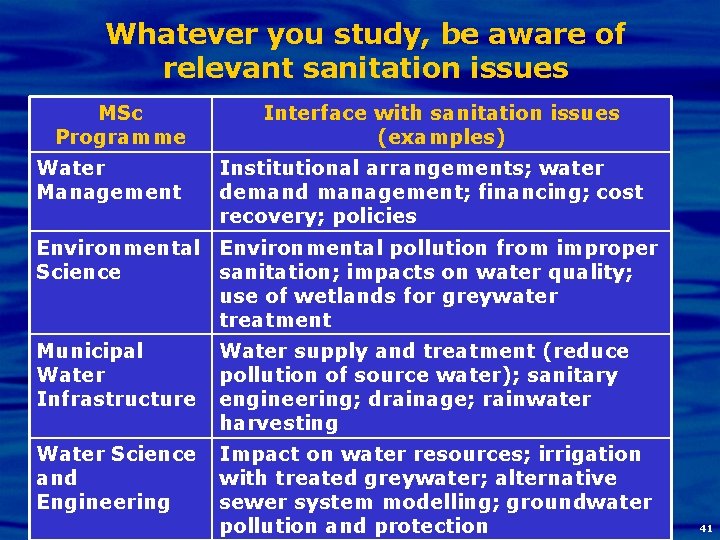
Whatever you study, be aware of relevant sanitation issues MSc Programme Water Management Interface with sanitation issues (examples) Institutional arrangements; water demand management; financing; cost recovery; policies Environmental pollution from improper Science sanitation; impacts on water quality; use of wetlands for greywater treatment Municipal Water Infrastructure Water supply and treatment (reduce pollution of source water); sanitary engineering; drainage; rainwater harvesting Water Science and Engineering Impact on water resources; irrigation with treated greywater; alternative sewer system modelling; groundwater pollution and protection 41
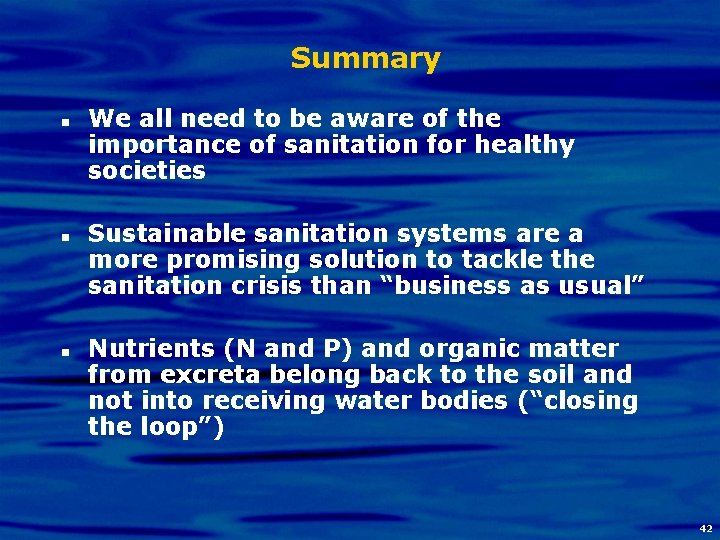
Summary n n n We all need to be aware of the importance of sanitation for healthy societies Sustainable sanitation systems are a more promising solution to tackle the sanitation crisis than “business as usual” Nutrients (N and P) and organic matter from excreta belong back to the soil and not into receiving water bodies (“closing the loop”) 42
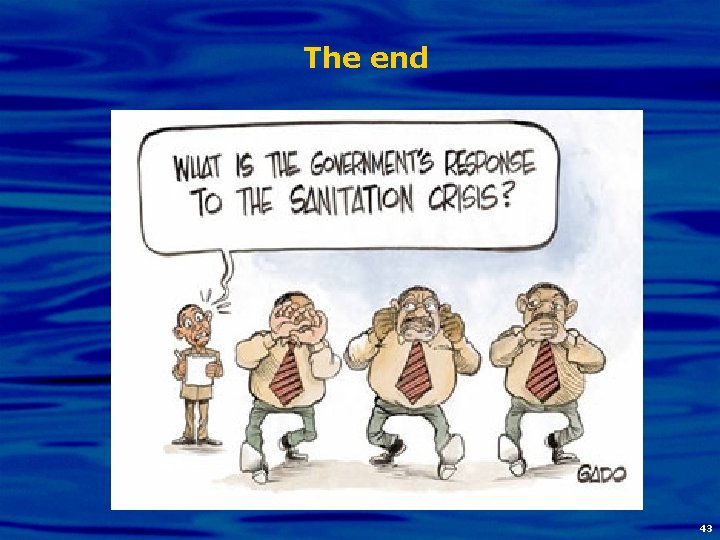
The end 43
Appendix (material for further reading) 44
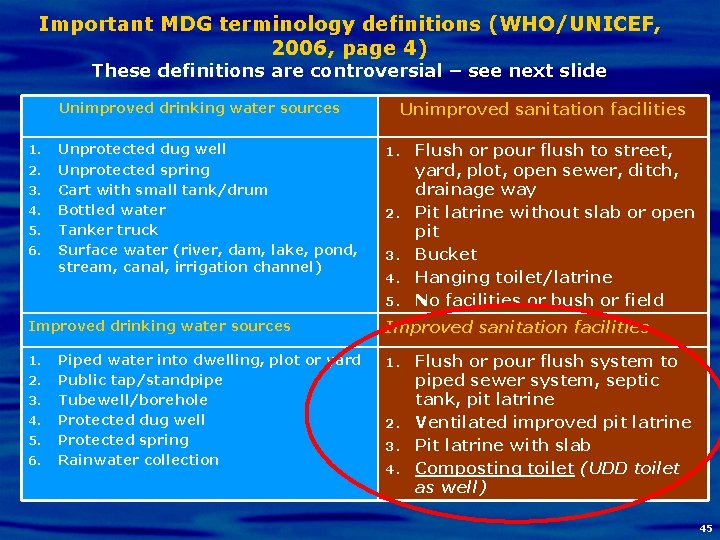
Important MDG terminology definitions (WHO/UNICEF, 2006, page 4) These definitions are controversial – see next slide Unimproved sanitation facilities Unimproved drinking water sources 1. 2. 3. 4. 5. 6. Unprotected dug well Unprotected spring Cart with small tank/drum Bottled water Tanker truck Surface water (river, dam, lake, pond, stream, canal, irrigation channel) 1. 2. 3. 4. 5. Improved drinking water sources 1. 2. 3. 4. 5. 6. Piped water into dwelling, plot or yard Public tap/standpipe Tubewell/borehole Protected dug well Protected spring Rainwater collection Flush or pour flush to street, yard, plot, open sewer, ditch, drainage way Pit latrine without slab or open pit Bucket Hanging toilet/latrine No facilities or bush or field Improved sanitation facilities Flush or pour flush system to piped sewer system, septic tank, pit latrine 2. Ventilated improved pit latrine 3. Pit latrine with slab 4. Composting toilet (UDD toilet as well) 1. 45
There are many difficulties with measuring access to “improved sanitation” (slide 1 of 2) n n Different countries use different criteria for measuring access to improved sanitation Toilets might be existing (and counted) but not being used, not used correctly or not maintained properly Public toilets are not counted but could be an adequate solution for slum areas Greywater management is generally not included in the analysis 46
There are many difficulties with measuring access to “improved sanitation” (slide 2 of 2) n No link is made to the overal Goal 7 on environmental sustainability n Improved sanitation could still be unsustainable and cause pollution, e. g. : n n n septic tanks and pit latrines without proper faecal sludge management sewer system without wastewater treatment plant or with poorly performing WWTP Perhaps it would be better to count access to sustainable sanitation? See also discussion on Ecosan. Res Discussion Forum in Nov 2006; keyword search: “MDG” (www. ecosanres. org) 47
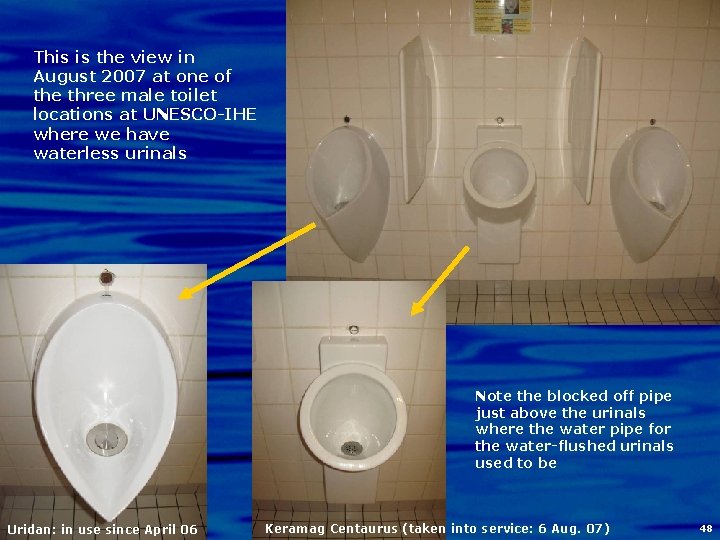
This is the view in August 2007 at one of the three male toilet locations at UNESCO-IHE where we have waterless urinals Note the blocked off pipe just above the urinals where the water pipe for the water-flushed urinals used to be Uridan: in use since April 06 Keramag Centaurus (taken into service: 6 Aug. 07) 48
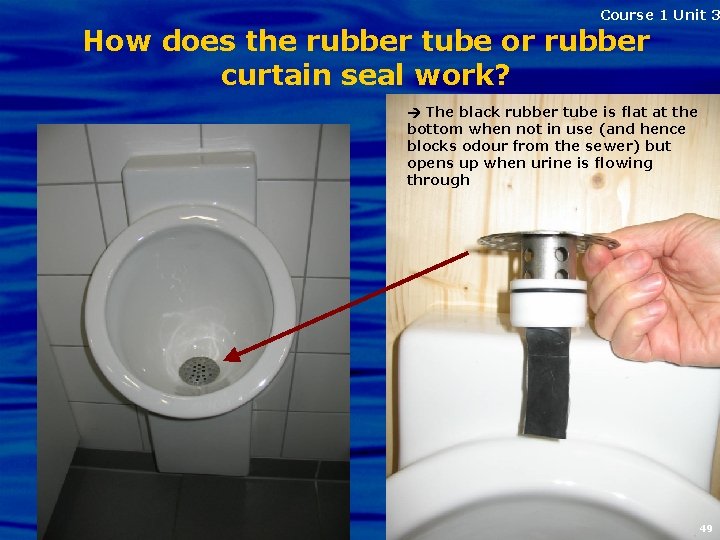
Course 1 Unit 3 How does the rubber tube or rubber curtain seal work? The black rubber tube is flat at the bottom when not in use (and hence blocks odour from the sewer) but opens up when urine is flowing through 49
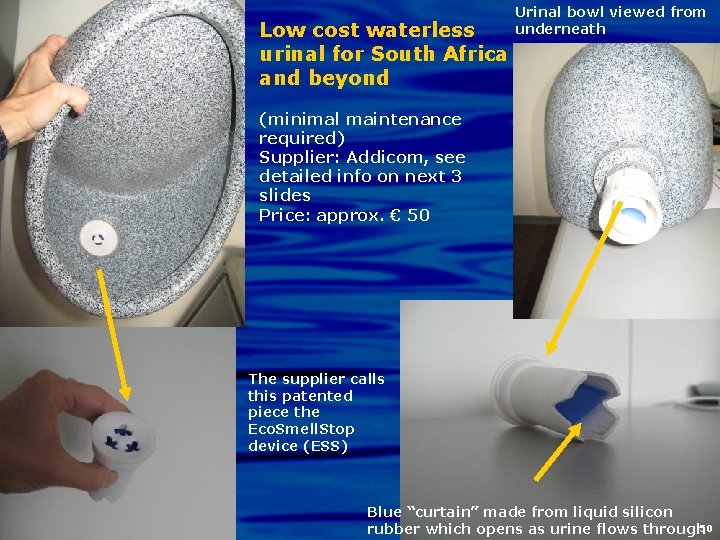
Low cost waterless urinal for South Africa and beyond Urinal bowl viewed from underneath (minimal maintenance required) Supplier: Addicom, see detailed info on next 3 slides Price: approx. € 50 The supplier calls this patented piece the Eco. Smell. Stop device (ESS) Blue “curtain” made from liquid silicon 50 rubber which opens as urine flows through
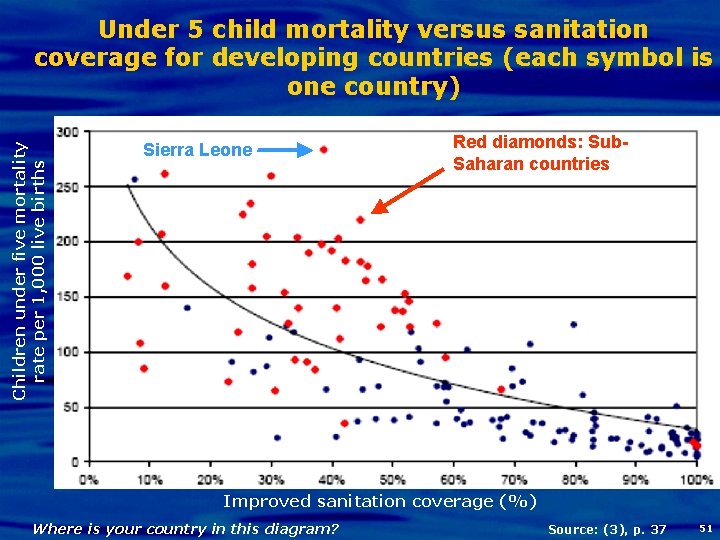
Children under five mortality rate per 1, 000 live births Under 5 child mortality versus sanitation coverage for developing countries (each symbol is one country) Sierra Leone Red diamonds: Sub. Saharan countries Improved sanitation coverage (%) Where is your country in this diagram? Source: (3), p. 37 51
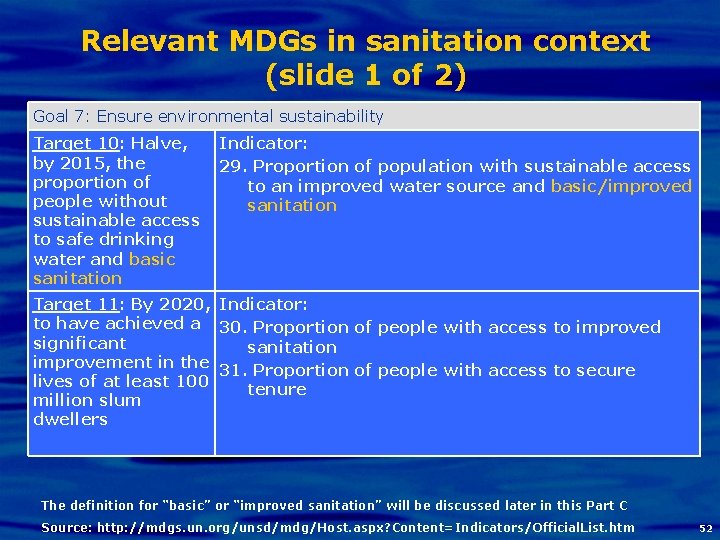
Relevant MDGs in sanitation context (slide 1 of 2) Goal 7: Ensure environmental sustainability Target 10: Halve, by 2015, the proportion of people without sustainable access to safe drinking water and basic sanitation Indicator: 29. Proportion of population with sustainable access to an improved water source and basic/improved sanitation Target 11: By 2020, Indicator: to have achieved a 30. Proportion of people with access to improved significant sanitation improvement in the 31. Proportion of people with access to secure lives of at least 100 tenure million slum dwellers The definition for “basic” or “improved sanitation” will be discussed later in this Part C Source: http: //mdgs. un. org/unsd/mdg/Host. aspx? Content=Indicators/Official. List. htm 52
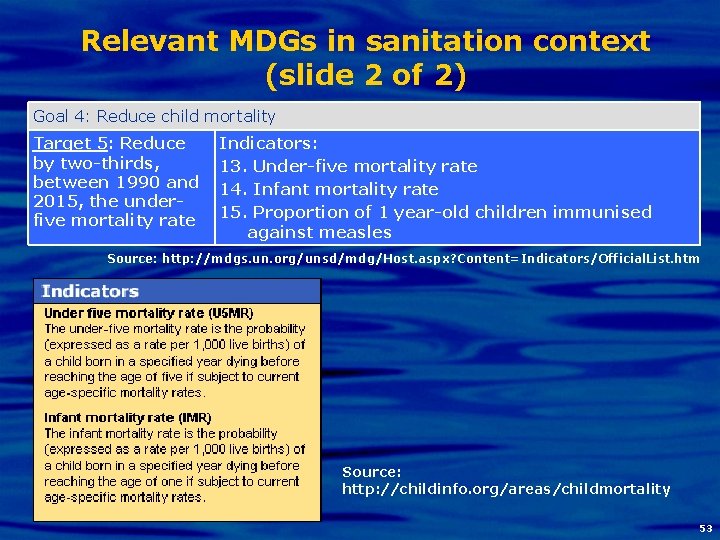
Relevant MDGs in sanitation context (slide 2 of 2) Goal 4: Reduce child mortality Target 5: Reduce by two-thirds, between 1990 and 2015, the underfive mortality rate Indicators: 13. Under-five mortality rate 14. Infant mortality rate 15. Proportion of 1 year-old children immunised against measles Source: http: //mdgs. un. org/unsd/mdg/Host. aspx? Content=Indicators/Official. List. htm Source: http: //childinfo. org/areas/childmortality 53
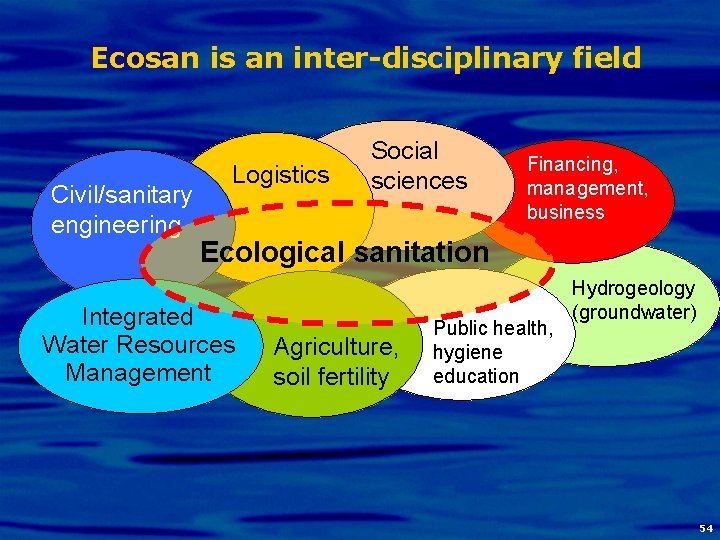
Ecosan is an inter-disciplinary field. Civil/sanitary engineering Logistics Social sciences Financing, management, business Ecological sanitation Integrated Water Resources Management Agriculture, soil fertility Public health, hygiene education Hydrogeology (groundwater) 54
Important websites for a wealth of knowledge on ecosan n GTZ ecosan sector project (Germany) n www. gtz. de/en/themen/umwelt-infrastruktur/wasser/8524. htm n Click on “further information” where you will find: n n Project datasheets Technology datasheets Publication database Ecosan. Res (Sweden, funded by SIDA, the Swedish Development Aid) n n n www. ecosanres. org Contains research reports funded by Ecosan. Res Join the Discussion Forum (338 members in July 2007), read the archived postings and make your own postings 55
Ecosan online course n The entire curriculum of UNESCO-IHE’s ecosan online course is available here: n n n www. lms. ihe. nl Login: ecosandemo Password: 1234 56
- Slides: 56