
Sustainable Rangeland Management Rocky Lemus Extension Forage Specialist
Sustainable Rangeland Management Rocky Lemus Extension Forage Specialist
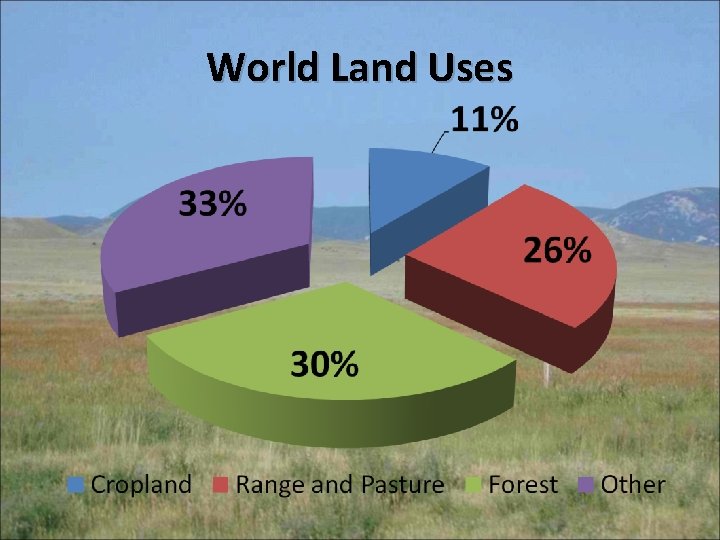
World Land Uses
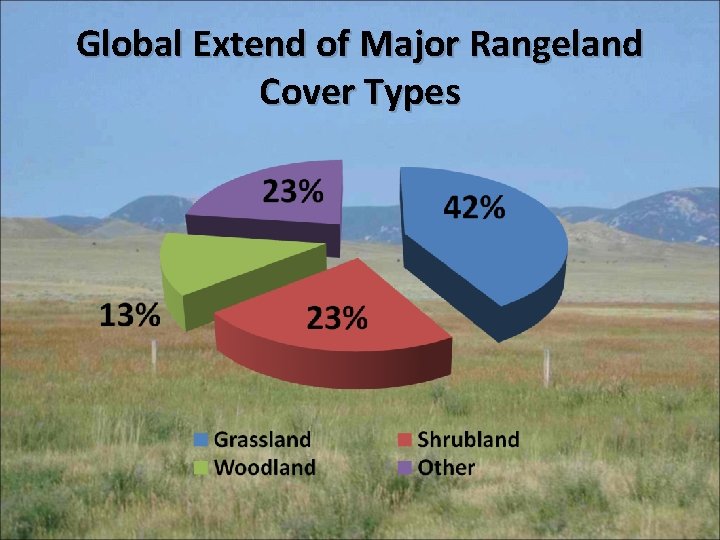
Global Extend of Major Rangeland Cover Types
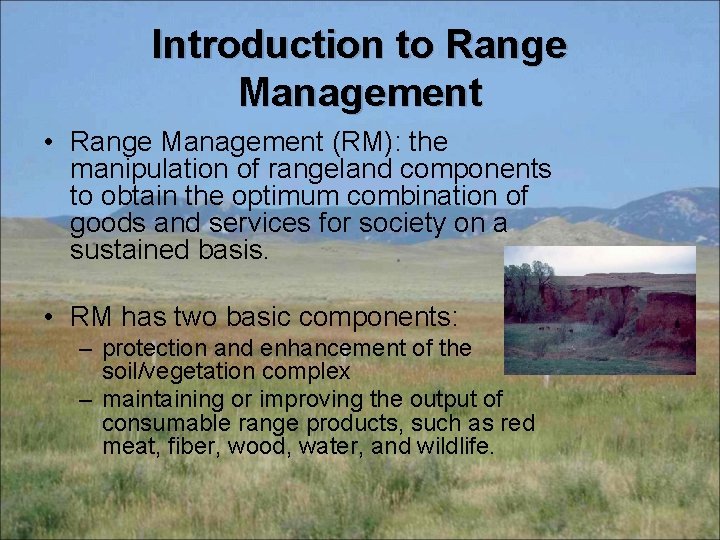
Introduction to Range Management • Range Management (RM): the manipulation of rangeland components to obtain the optimum combination of goods and services for society on a sustained basis. • RM has two basic components: – protection and enhancement of the soil/vegetation complex – maintaining or improving the output of consumable range products, such as red meat, fiber, wood, water, and wildlife.

Definition of Rangelands • Rangelands are vast natural landscapes in the form of grasslands, shrublands, woodlands, wetlands, and deserts. • Types of rangelands include tallgrass and shortgrass prairies, desert grasslands and shrublands, woodlands, savannas, chaparrals, steppes, and tundras. • Rangelands do not include barren desert, farmland, closed canopy forests, or land covered by solid rock, concrete and/or glaciers.

Important Terms • Rangeland: uncultivated land that will provide the necessities of life for grazing and browsing animals • Grazing: the consumption of standing forage (grasses and forbs) by an animal. • Browsing: the consumption of edible leaves and twigs (woody plants) by an animal. • Pastureland vs. rangeland – Pastureland receive periodic cultivation to maintain nonnative (introduced) forage species – They receive agronomic inputs such as irrigation and fertilization
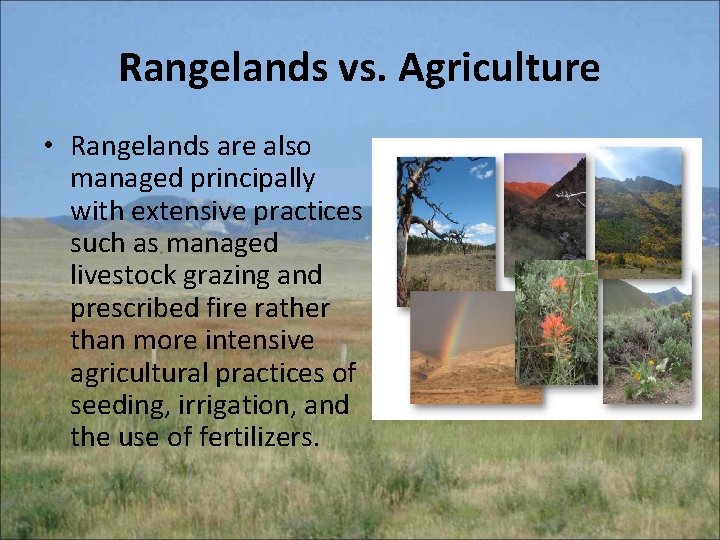
Rangelands vs. Agriculture • Rangelands are also managed principally with extensive practices such as managed livestock grazing and prescribed fire rather than more intensive agricultural practices of seeding, irrigation, and the use of fertilizers.
Rangelands vs. Ag Land • Rangelands are unsuitable for land uses such as cultivating agricultural crops due to soil quality and low rainfall levels. – Soils in arid areas typically have less organic matter than in other ecosystems, which greatly decreases their capability to support agriculture. • Less rainfall means grasses and shrubs will not grow as tall and thus often have deep roots. – This is the difference between rangeland other types of grasslands. – Rangelands are largely used for livestock grazing or reserved as part of a conservation program.
Importance of Fire • Fire is also an important regulator of range vegetation, whether set by humans or resulting from lightning. • Fires tend to reduce the abundance of woody plants and promote herbaceous plants including grasses, forbs, and grass-like plants. • The suppression or reduction of periodic wildfires from desert shrublands, savannas, or woodlands frequently invites the dominance of trees and shrubs to the near exclusion of grasses and forbs.
Physical and Vegetational Characteristics of Rangeland • It has been said that rangeland is a type of land that is. . . • ". . . too dry, too wet, too rocky, too steep, too cold, too hot, too sandy or too something for cultivation" • Characteristics of Rangeland Landscapes: are determined by 5 basic "controlling factors": – – – Climate Organisms Parent materials Topography Time
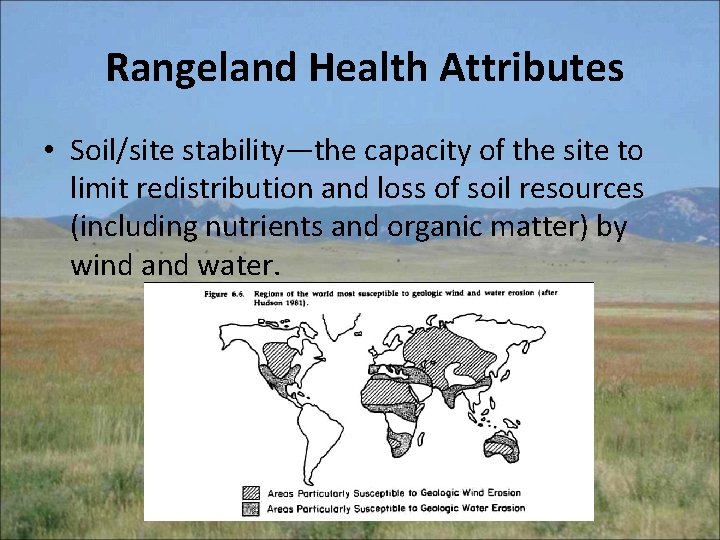
Rangeland Health Attributes • Soil/site stability—the capacity of the site to limit redistribution and loss of soil resources (including nutrients and organic matter) by wind and water.
Soil Limiting Factors • Parent Materials • p. H: indicates the status of exchangeable mineral ions. • • • – Most soil in rangelands are slightly basic – Calcareous soils with low precipitation. Depth: determine how much moisture a soil can hold. Texture: size of mineral particles (sand, silt, clay) Structure: how soil particles can be arranged. – Determines infiltration rates • Topography – Hopkin’s Law: relate altitude, latitude and longitude to existing vegetation. • 305 -m increase in altitude will result in the same phenological change that traveling 107 km north with no elevation. • Aspect: directional orientation of slopes • Slope: ↑ slope ↓ vegetation productivity per unit of precipitation – Less water enters the soil and more runs off as overland flow.
Soil Limiting Factors • Fertility – – Nitrogen (high total; low available) Carbonates (high; forms lime layer) Organic matter (high amounts; comes from high root turnover) Ion exchange capacity • Water holding capacity – (humus) - produces structure • Water availability – forces of extraction by plants vs. forces of retention. – Water stress - when rate of extraction lags behind rate of transpiration
Rangeland Health Attributes • Hydrologic function—the capacity of the site to capture, store, and safely release water from rainfall, run-on, and snowmelt (where relevant), to resist a reduction in this capacity, and to recover this capacity following degradation.
Rangeland Health Attributes • Integrity of the biotic community—the capacity of the site to support characteristic functional and structural communities in the context of normal variability, to resist loss of this function and structure due to disturbance, and to recover following disturbance.
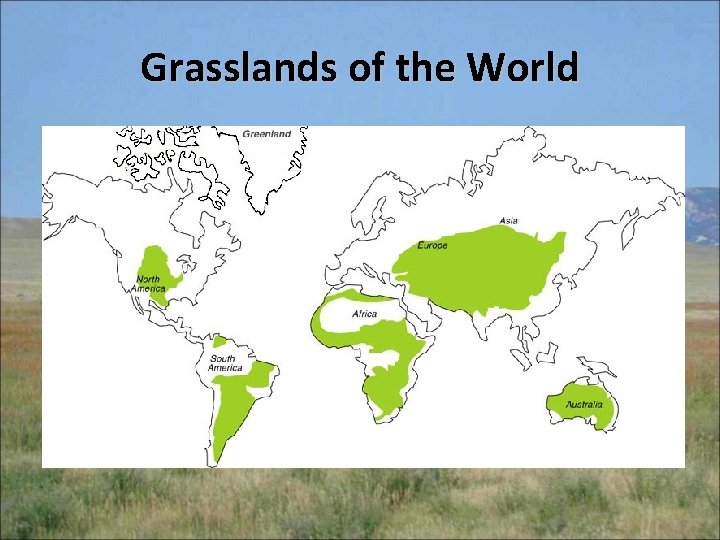
Grasslands of the World
Range Plant Production • Forages for grazing by livestock and wildlife: – Any given tract of rangeland can usually categorized as one of the following types of landscapes: • • Grassland, desert Forest/woodland Savannah Tundra/alpine
Animal Production • Analysis of Forage Usage on Rangeland by Ruminants – World = about 70% of the feed for domestic ruminants – US = about 50 -65% of the feed for domestic ruminants – (Wild Ruminants): about 95% of the feed for wild ruminants
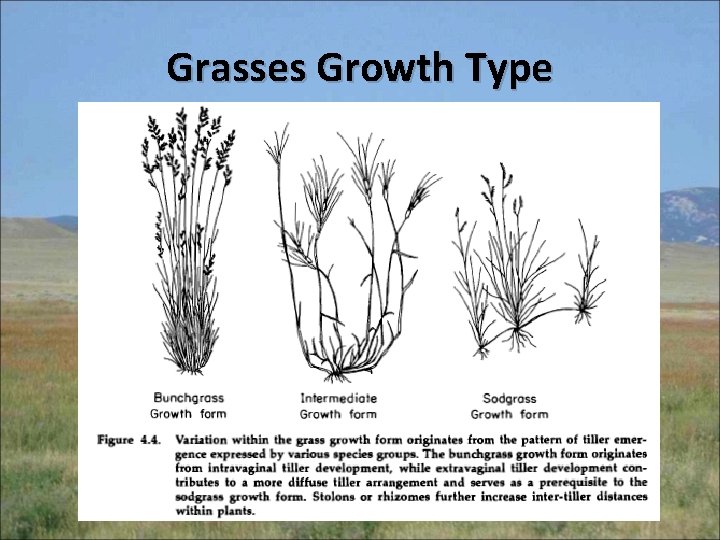
Grasses Growth Type
Vegetational Characteristics of Rangeland • Grasses- – • They are responsible for most net primary production, thus most of livestock forage and much of forage for wildlife. The following are characteristic: 1. Perennial Life Cycle: • Seed production = Do not seed themselves, rather reproduce by producing and storing food (CHO, protein) in: rhizomes, stolons, tillers
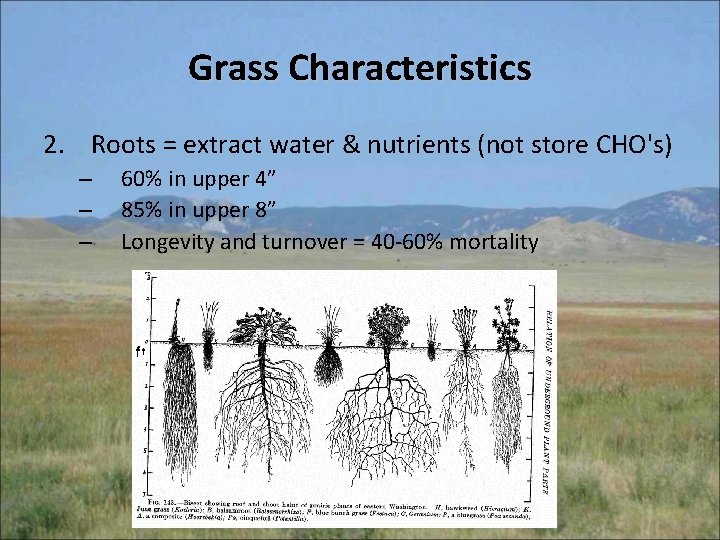
Grass Characteristics 2. Roots = extract water & nutrients (not store CHO's) – – – 60% in upper 4” 85% in upper 8” Longevity and turnover = 40 -60% mortality
Domestic Rangeland Livestock • Their productivity is determined by interaction of physical and vegetative factors • Some rangeland adaptation issues with large grazing animals: – – – – – diseases mineral deficiencies parasites toxic plants predators sparse forage extreme temperatures topography water
Importance and Area Extent of Rangelands • Land Area in Rangeland – World = about 50% (35 billion acres) – US = about 61% (1 billion acres, 48 states) – ~65% of the land in Texas is rangeland or pasture land used • There are moderate to dense stands of brush on approximately 66 million acres of Texas rangeland. • Federally-owned Rangelands of the West – ~ 30% (300 million acres, mostly in 11 western states) US land – ~30, 000 grazing permits (2% of US ranches), 1. 54 million AU • 3. 76% of beef cattle; $1. 48 x 109 (same stats for 2006)
Area Extent of Rangelands • Wildlife – hunting – ecotourism – biotic diversity (biodiversity) • Desertification • Recreation – Most outdoor activities, e. g. mountain biking, hiking, fishing. • Dude ranching. Aesthetics
Area Extent of Rangelands • Water – The Great Plains depends primarily on aquifers (e. g. , Oglalla) – The U. S. west depends on mountain rangelands for water supplies. Much of west averages <12" ppt/yr. – RM practices attempt to retain water on site, thus little potential to increase water production on desert or grassland range. – Rangeland use by livestock has the potential to affect: • • • flooding of streams sedimentation of streams and lakes longevity of reservoirs (silt rate) coliform bacteria counts flow rates of streams, springs riparian habitat use
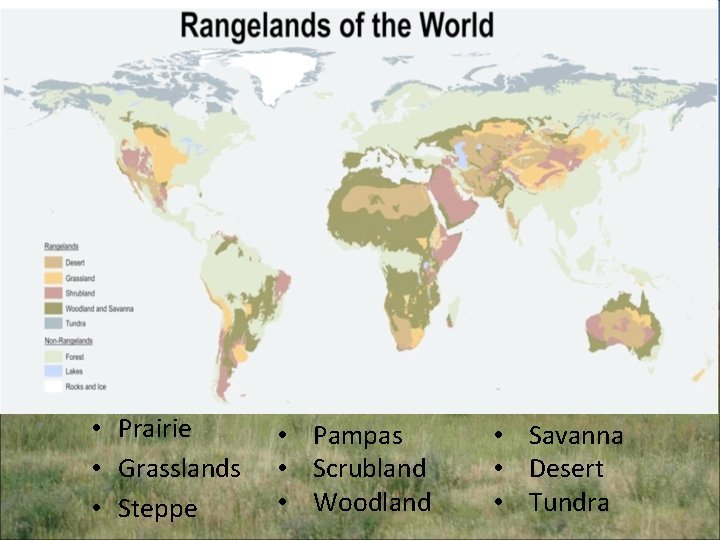
• Prairie • Grasslands • Steppe • Pampas • Scrubland • Woodland • Savanna • Desert • Tundra
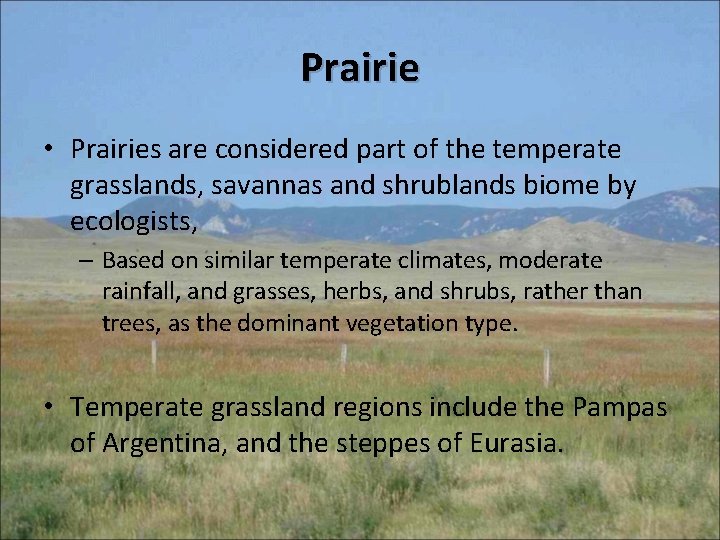
Prairie • Prairies are considered part of the temperate grasslands, savannas and shrublands biome by ecologists, – Based on similar temperate climates, moderate rainfall, and grasses, herbs, and shrubs, rather than trees, as the dominant vegetation type. • Temperate grassland regions include the Pampas of Argentina, and the steppes of Eurasia.
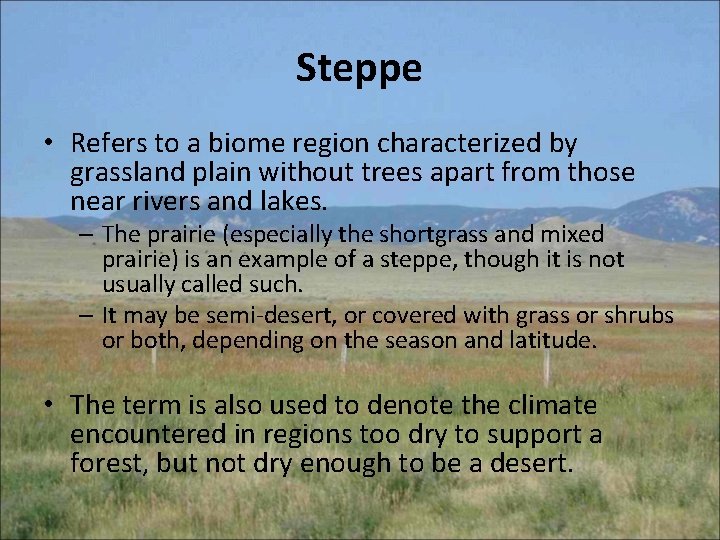
Steppe • Refers to a biome region characterized by grassland plain without trees apart from those near rivers and lakes. – The prairie (especially the shortgrass and mixed prairie) is an example of a steppe, though it is not usually called such. – It may be semi-desert, or covered with grass or shrubs or both, depending on the season and latitude. • The term is also used to denote the climate encountered in regions too dry to support a forest, but not dry enough to be a desert.
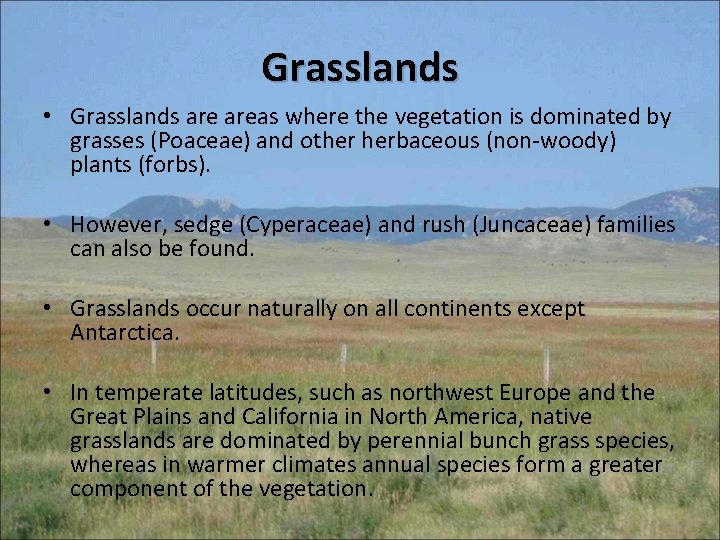
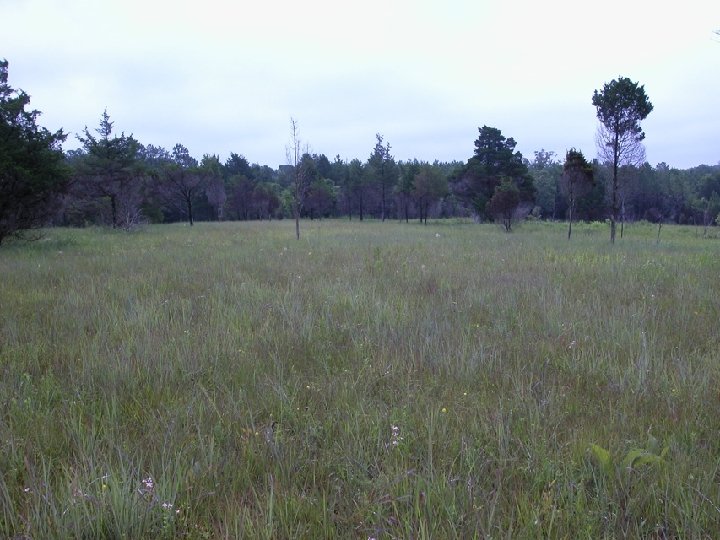
Grasslands • Grasslands areas where the vegetation is dominated by grasses (Poaceae) and other herbaceous (non-woody) plants (forbs). • However, sedge (Cyperaceae) and rush (Juncaceae) families can also be found. • Grasslands occur naturally on all continents except Antarctica. • In temperate latitudes, such as northwest Europe and the Great Plains and California in North America, native grasslands are dominated by perennial bunch grass species, whereas in warmer climates annual species form a greater component of the vegetation.
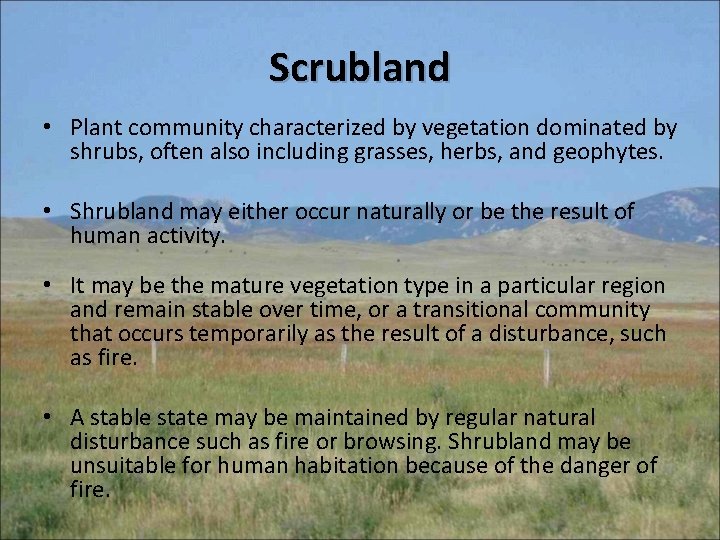
Scrubland • Plant community characterized by vegetation dominated by shrubs, often also including grasses, herbs, and geophytes. • Shrubland may either occur naturally or be the result of human activity. • It may be the mature vegetation type in a particular region and remain stable over time, or a transitional community that occurs temporarily as the result of a disturbance, such as fire. • A stable state may be maintained by regular natural disturbance such as fire or browsing. Shrubland may be unsuitable for human habitation because of the danger of fire.
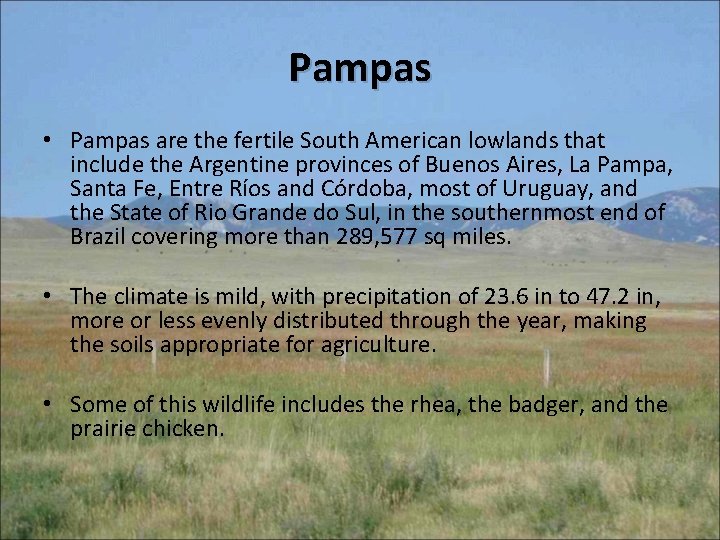
Pampas • Pampas are the fertile South American lowlands that include the Argentine provinces of Buenos Aires, La Pampa, Santa Fe, Entre Ríos and Córdoba, most of Uruguay, and the State of Rio Grande do Sul, in the southernmost end of Brazil covering more than 289, 577 sq miles. • The climate is mild, with precipitation of 23. 6 in to 47. 2 in, more or less evenly distributed through the year, making the soils appropriate for agriculture. • Some of this wildlife includes the rhea, the badger, and the prairie chicken.
Woodland • Low-density forest forming open habitats with plenty of sunlight and limited shade. – May support an understory of shrubs and herbaceous plants including grasses. – Woodland may form a transition to shrubland under drier conditions or during early stages of primary or secondary succession. – Higher densities and areas of trees, with largely closed canopy, provide extensive and nearly continuous shade are referred to as forest.
Savanna • Grassland ecosystem characterized by the trees being sufficiently small or widely spaced so that the canopy does not close. • The open canopy allows sufficient light to reach the ground to support an unbroken herbaceous layer consisting primarily of C 4 grasses.
Desert • Landscape or region that receives an extremely low amount of precipitation, less than enough to support growth of most plants. – Average annual precipitation is less than 10 in per year, or as areas where more water is lost by evapotranspiration than falls as precipitation. – Deserts cab be classed as hot desert or temperate desert.
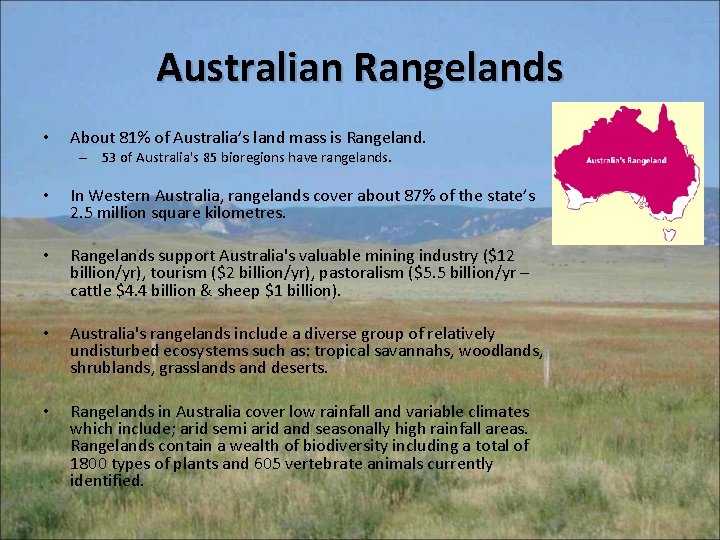
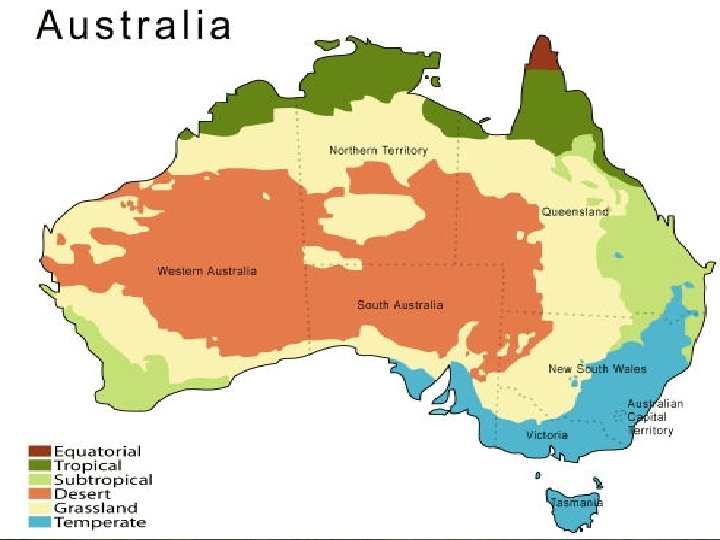
Australian Rangelands • About 81% of Australia’s land mass is Rangeland. – 53 of Australia's 85 bioregions have rangelands. • In Western Australia, rangelands cover about 87% of the state’s 2. 5 million square kilometres. • Rangelands support Australia's valuable mining industry ($12 billion/yr), tourism ($2 billion/yr), pastoralism ($5. 5 billion/yr – cattle $4. 4 billion & sheep $1 billion). • Australia's rangelands include a diverse group of relatively undisturbed ecosystems such as: tropical savannahs, woodlands, shrublands, grasslands and deserts. • Rangelands in Australia cover low rainfall and variable climates which include; arid semi arid and seasonally high rainfall areas. Rangelands contain a wealth of biodiversity including a total of 1800 types of plants and 605 vertebrate animals currently identified.
World Rangelands • South America – Rangelands in South America are located in regions with climate ranging from arid to sub-humid. Annual precipitation in these areas ranges from approximately 6– 60 inches. – Rangelands cover about 33% of the total land area. • Africa – In Kenya, rangelands make up for 75% of the land surface area, a nd are largely inhabited by nomadic pastoralists who are largely dependent on livestock. • Asia-China – In the past, rangelands in western China supported a pastoral economy and large wildlife populations. – Now the rangelands have shrunk do to population growth, economic, government, and social factors. – Rangeland types in China include; Semi-desert, Dry Alpine Grasslands, Alpine Dwarf Shrub, Wetland types.
Tundra • Biome where the tree growth is hindered by low temperatures and short growing seasons. • There are three types of tundra: Arctic tundra, Alpine tundra, and Antarctic tundra. • The he vegetation is composed of dwarf shrubs, sedges and grasses, mosses, and lichens. • Scattered trees grow in some tundra. – The ecotone (or ecological boundary region) between the tundra and the forest is known as the tree line or timberline
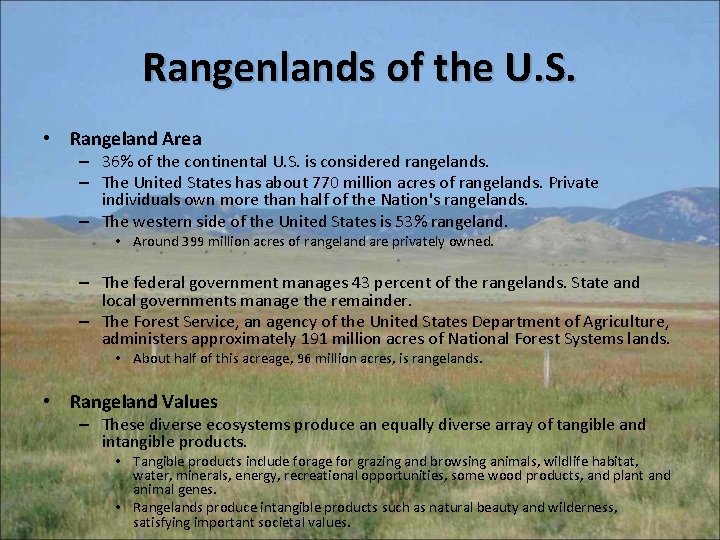
Rangenlands of the U. S. • Rangeland Area – 36% of the continental U. S. is considered rangelands. – The United States has about 770 million acres of rangelands. Private individuals own more than half of the Nation's rangelands. – The western side of the United States is 53% rangeland. • Around 399 million acres of rangeland are privately owned. – The federal government manages 43 percent of the rangelands. State and local governments manage the remainder. – The Forest Service, an agency of the United States Department of Agriculture, administers approximately 191 million acres of National Forest Systems lands. • About half of this acreage, 96 million acres, is rangelands. • Rangeland Values – These diverse ecosystems produce an equally diverse array of tangible and intangible products. • Tangible products include forage for grazing and browsing animals, wildlife habitat, water, minerals, energy, recreational opportunities, some wood products, and plant and animal genes. • Rangelands produce intangible products such as natural beauty and wilderness, satisfying important societal values.
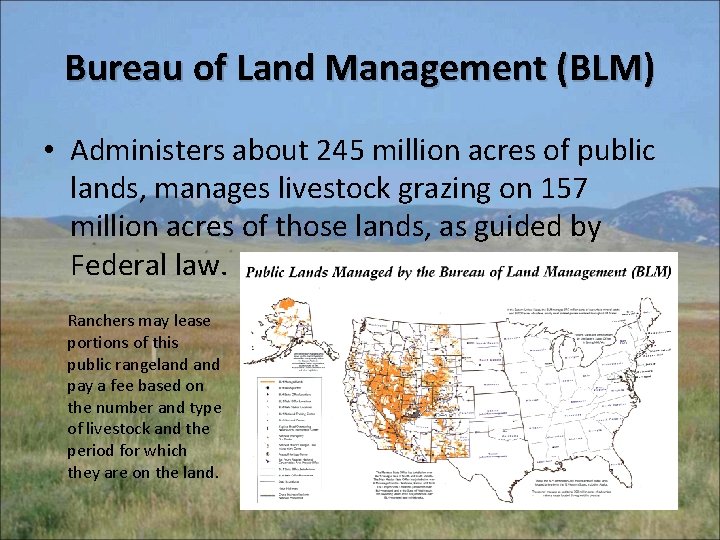
Bureau of Land Management (BLM) • Administers about 245 million acres of public lands, manages livestock grazing on 157 million acres of those lands, as guided by Federal law. Ranchers may lease portions of this public rangeland pay a fee based on the number and type of livestock and the period for which they are on the land.
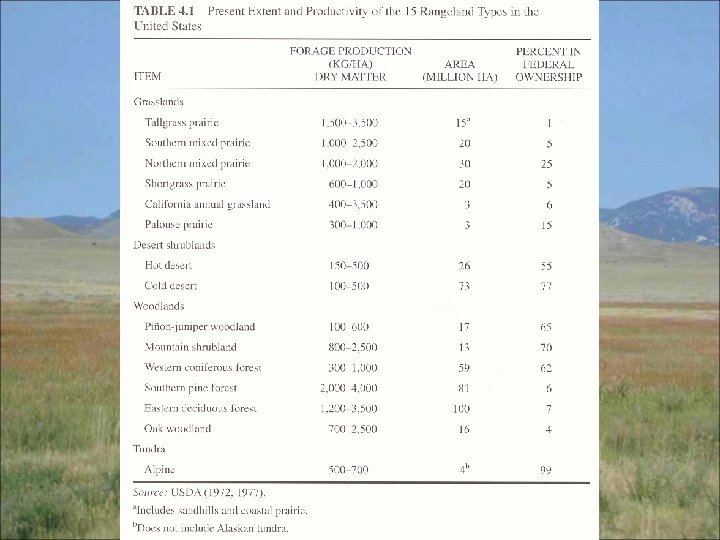
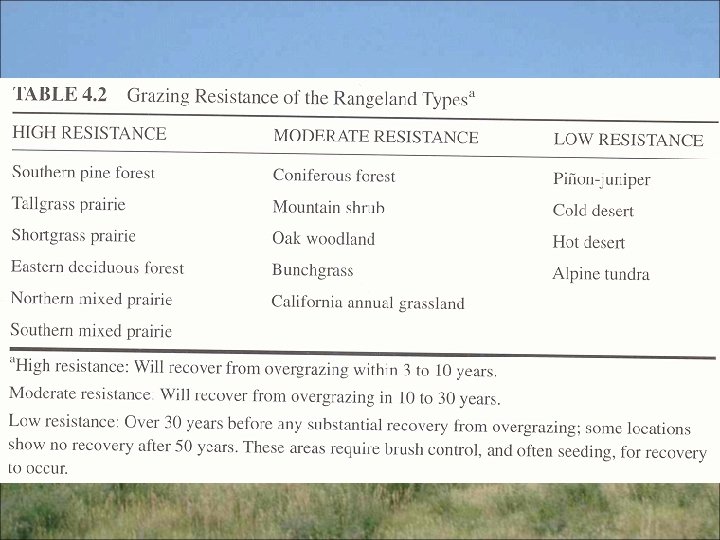
Rangeland Regions of the United States • Grassland – – – Tallgrass prairie Southern mixed prairie Northern mixed prairie Shortgrass prairie CA annual grassland Palouse Prairie • Desert Shrublands – Cold desert – Hot Desert • Woodlands – Piňon-juniper woodland – Mountain shrubland – Western coniferous forest – Southern pine forest – Eastern deciduous forest – Oak woodland • Tundra
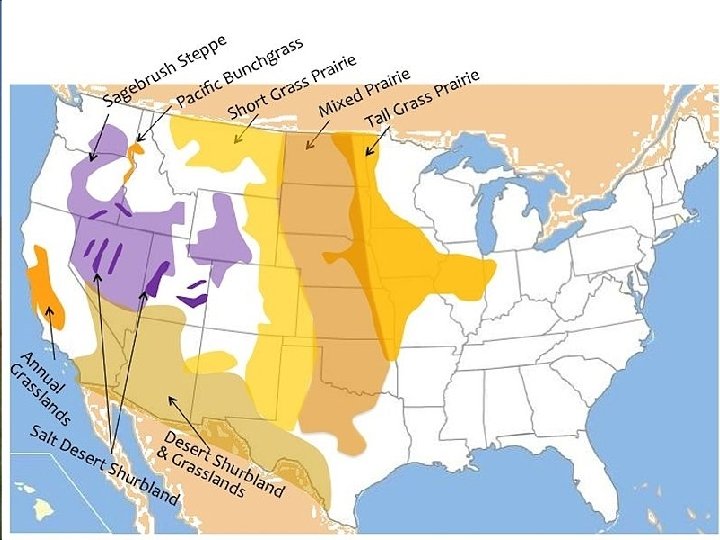
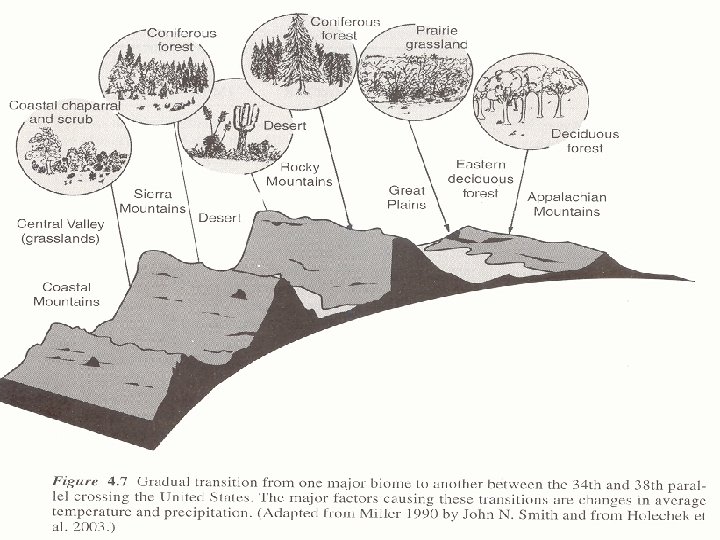
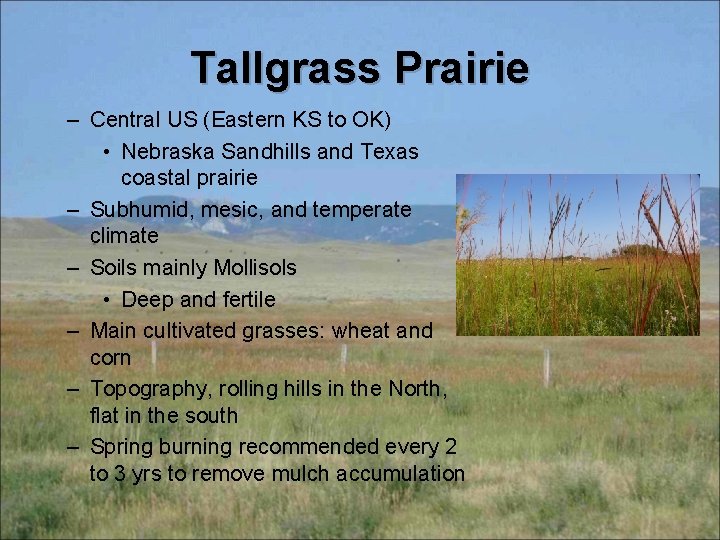
Tallgrass Prairie – Central US (Eastern KS to OK) • Nebraska Sandhills and Texas coastal prairie – Subhumid, mesic, and temperate climate – Soils mainly Mollisols • Deep and fertile – Main cultivated grasses: wheat and corn – Topography, rolling hills in the North, flat in the south – Spring burning recommended every 2 to 3 yrs to remove mulch accumulation
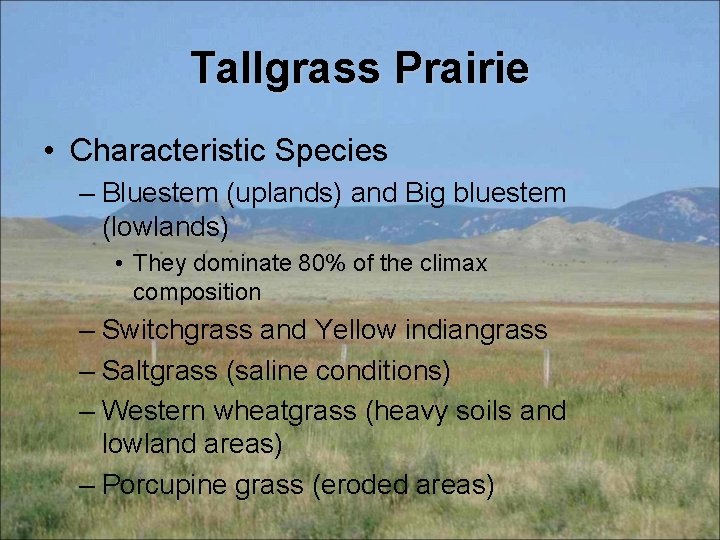
Tallgrass Prairie • Characteristic Species – Bluestem (uplands) and Big bluestem (lowlands) • They dominate 80% of the climax composition – Switchgrass and Yellow indiangrass – Saltgrass (saline conditions) – Western wheatgrass (heavy soils and lowland areas) – Porcupine grass (eroded areas)
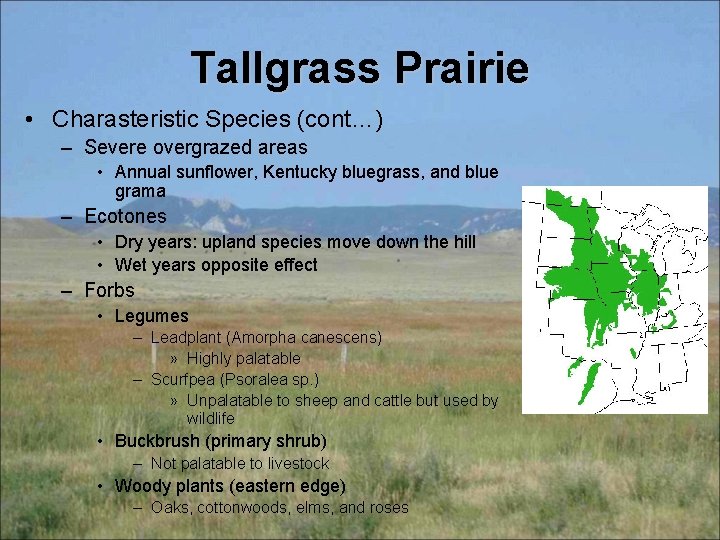
Tallgrass Prairie • Charasteristic Species (cont…) – Severe overgrazed areas • Annual sunflower, Kentucky bluegrass, and blue grama – Ecotones • Dry years: upland species move down the hill • Wet years opposite effect – Forbs • Legumes – Leadplant (Amorpha canescens) » Highly palatable – Scurfpea (Psoralea sp. ) » Unpalatable to sheep and cattle but used by wildlife • Buckbrush (primary shrub) – Not palatable to livestock • Woody plants (eastern edge) – Oaks, cottonwoods, elms, and roses
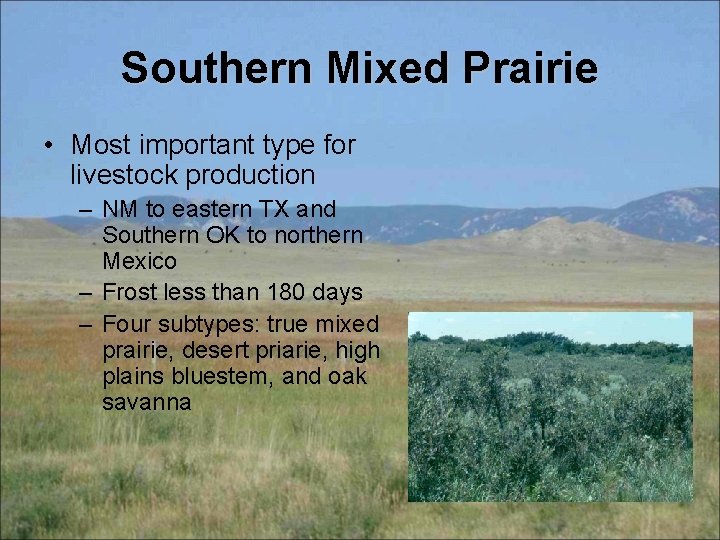
Southern Mixed Prairie • Most important type for livestock production – NM to eastern TX and Southern OK to northern Mexico – Frost less than 180 days – Four subtypes: true mixed prairie, desert priarie, high plains bluestem, and oak savanna
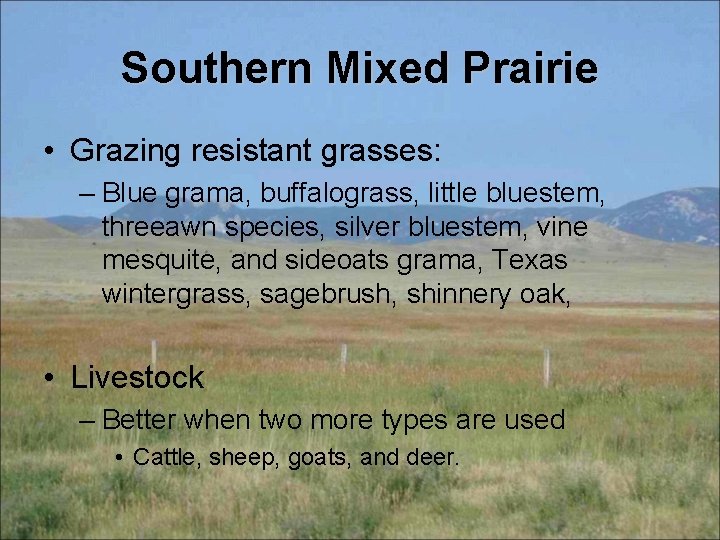
Southern Mixed Prairie • Grazing resistant grasses: – Blue grama, buffalograss, little bluestem, threeawn species, silver bluestem, vine mesquite, and sideoats grama, Texas wintergrass, sagebrush, shinnery oak, • Livestock – Better when two more types are used • Cattle, sheep, goats, and deer.
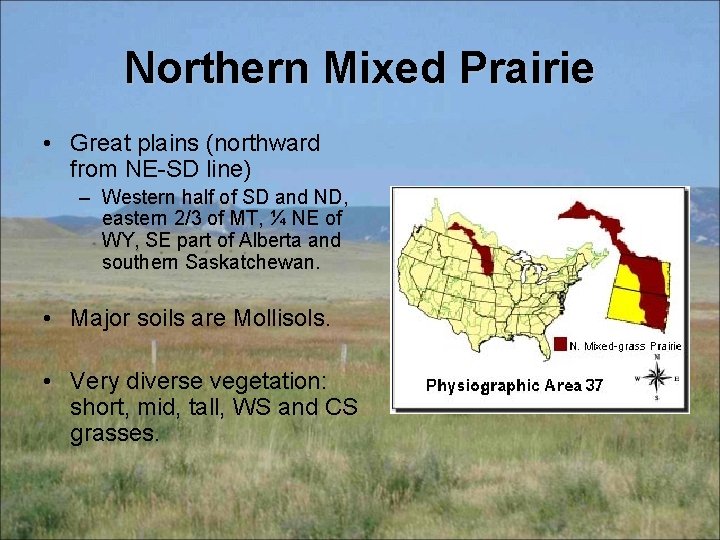
Northern Mixed Prairie • Great plains (northward from NE-SD line) – Western half of SD and ND, eastern 2/3 of MT, ¼ NE of WY, SE part of Alberta and southern Saskatchewan. • Major soils are Mollisols. • Very diverse vegetation: short, mid, tall, WS and CS grasses.
Northern Mixed Prairie • Vegetation: – Winter feed: shrubs and blue grama – Early spring feed: • CS: bluebunch wheatgrass, bluegrasses • Crested wheatgrass and Russian Wildrye (introduced species) – Not highly recommended for large acreage due to low quaility in summer and winter. – N fertilization can improve quality but not recommended because CS bunchgrasses and WS grasses can be replaced by western wheatgrass and annual bromes. – Late spring feed: green needlegrass, needleandthread, western wheatgrass – High quality summer and fall forage • Little bluestem, blue grama, and sideoats – Rough fescue (MT, E Alberta, and Saskatchewan).
Northern Mixed Prairie • Vegetation – Shrubs: • • • Heavy soils in low lands: Silver sagebrush Xeric portions: Big sagebrush Hillsides: Skunkbrush sumac Creek bottoms: western snowberry and rose species Saline areas: fourwing saltbush and black greasewood – Ponderosa pine: • Prairie sandreed, bigblestem, soapweed yucca • Annual bromes, Russian thistle, and prickly pear
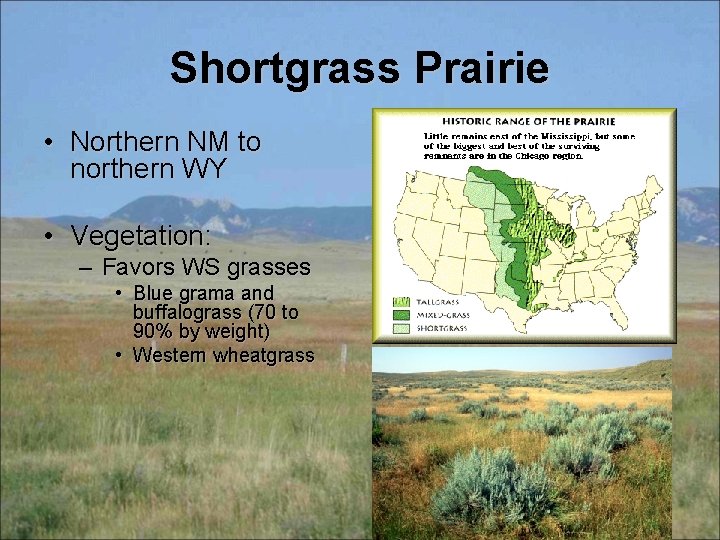
Shortgrass Prairie • Northern NM to northern WY • Vegetation: – Favors WS grasses • Blue grama and buffalograss (70 to 90% by weight) • Western wheatgrass
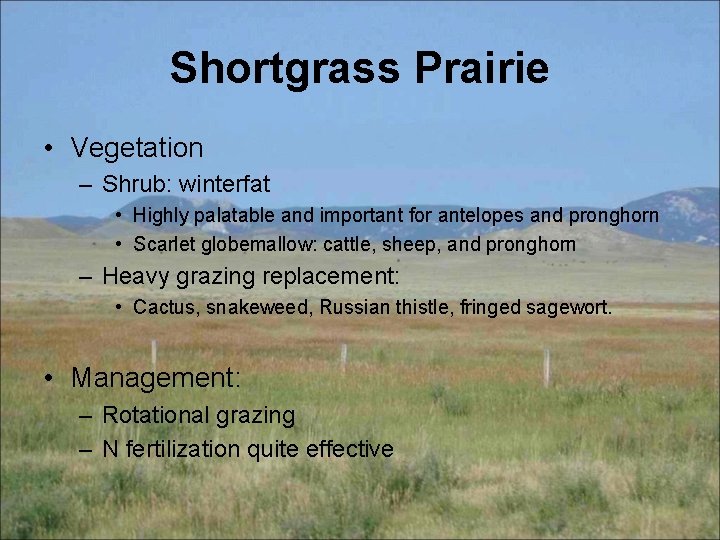
Shortgrass Prairie • Vegetation – Shrub: winterfat • Highly palatable and important for antelopes and pronghorn • Scarlet globemallow: cattle, sheep, and pronghorn – Heavy grazing replacement: • Cactus, snakeweed, Russian thistle, fringed sagewort. • Management: – Rotational grazing – N fertilization quite effective
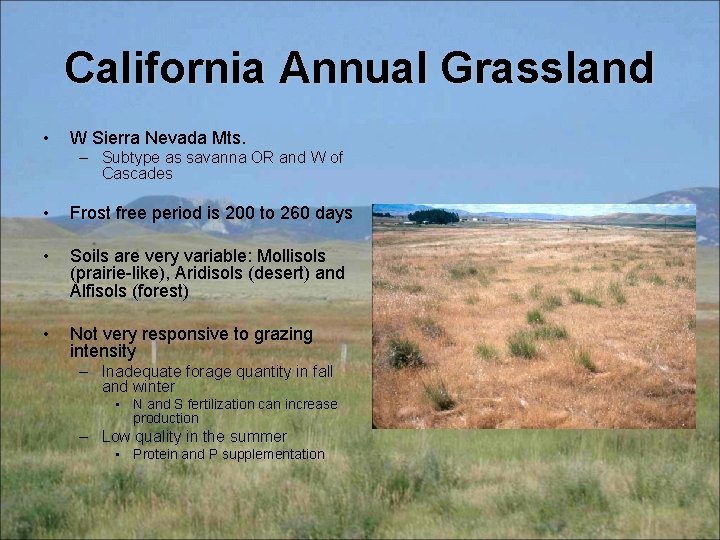
California Annual Grassland • W Sierra Nevada Mts. – Subtype as savanna OR and W of Cascades • Frost free period is 200 to 260 days • Soils are very variable: Mollisols (prairie-like), Aridisols (desert) and Alfisols (forest) • Not very responsive to grazing intensity – Inadequate forage quantity in fall and winter • N and S fertilization can increase production – Low quality in the summer • Protein and P supplementation
California Annual Grassland • Vegetation: – CSG: purple needlegrass, nodding needlegrass, prairie junegrass, pine bluegrass, California melicgrass, creeping wildrye, California oatgrass. • Today: fires and overgrazing – Slender oat, wild oat, soft brome, ripgut brome, foxtail brome, and little barley. – Shrubs and trees: • Pointleaf manzanita, wedgeleaf ceanothus, , hollyleag buckthorn, poison oak, chamise, California scrub oak, blue oak, and interior live oak.
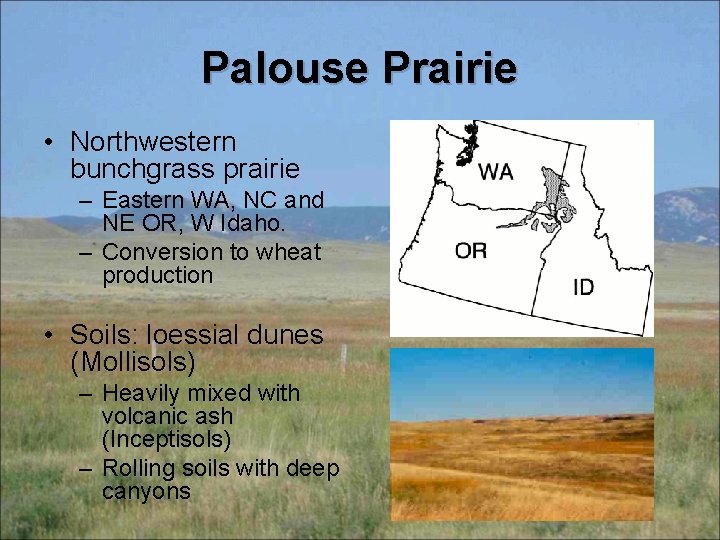
Palouse Prairie • Northwestern bunchgrass prairie – Eastern WA, NC and NE OR, W Idaho. – Conversion to wheat production • Soils: loessial dunes (Mollisols) – Heavily mixed with volcanic ash (Inceptisols) – Rolling soils with deep canyons
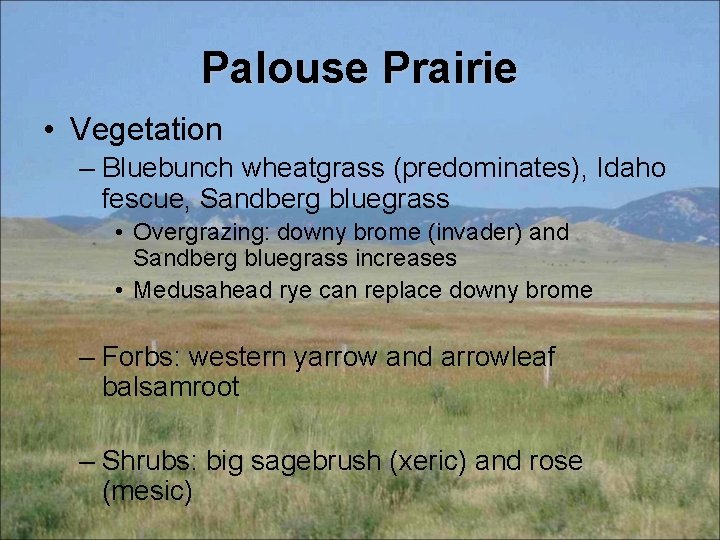
Palouse Prairie • Vegetation – Bluebunch wheatgrass (predominates), Idaho fescue, Sandberg bluegrass • Overgrazing: downy brome (invader) and Sandberg bluegrass increases • Medusahead rye can replace downy brome – Forbs: western yarrow and arrowleaf balsamroot – Shrubs: big sagebrush (xeric) and rose (mesic)
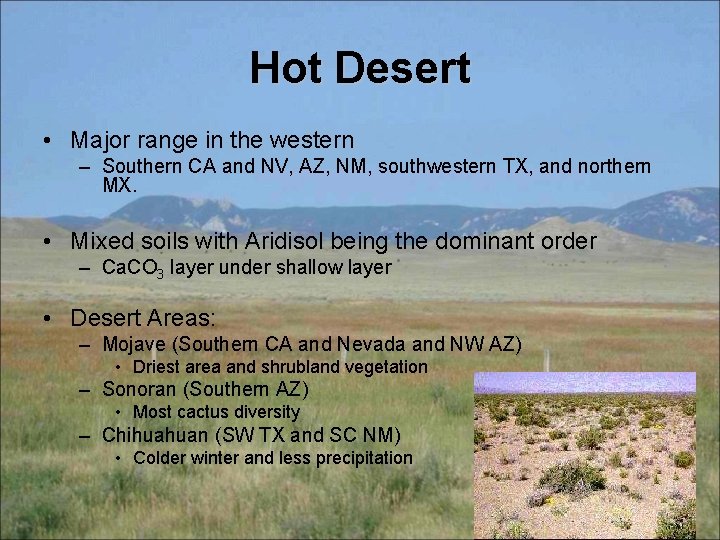
Hot Desert • Major range in the western – Southern CA and NV, AZ, NM, southwestern TX, and northern MX. • Mixed soils with Aridisol being the dominant order – Ca. CO 3 layer under shallow layer • Desert Areas: – Mojave (Southern CA and Nevada and NW AZ) • Driest area and shrubland vegetation – Sonoran (Southern AZ) • Most cactus diversity – Chihuahuan (SW TX and SC NM) • Colder winter and less precipitation
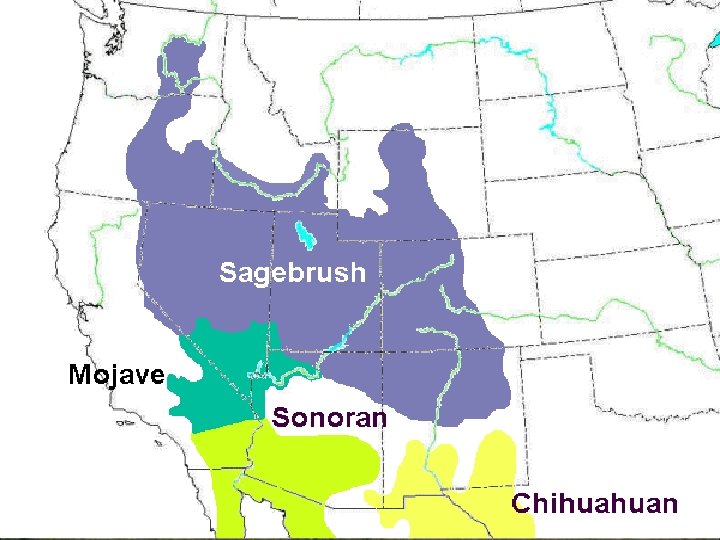
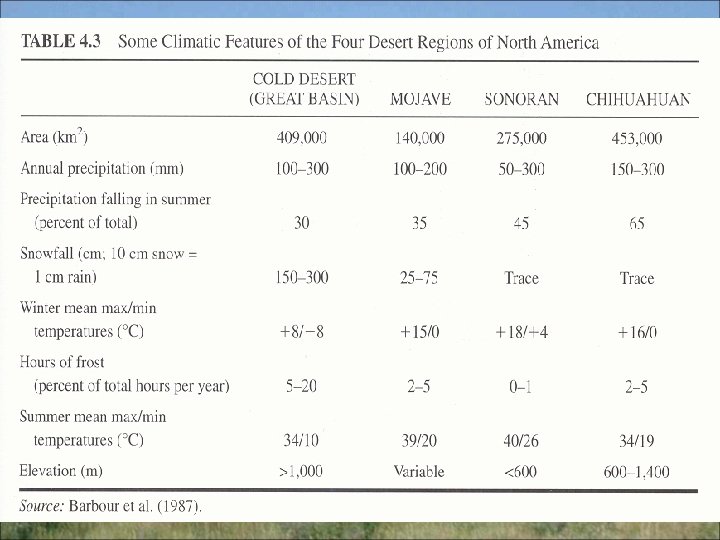
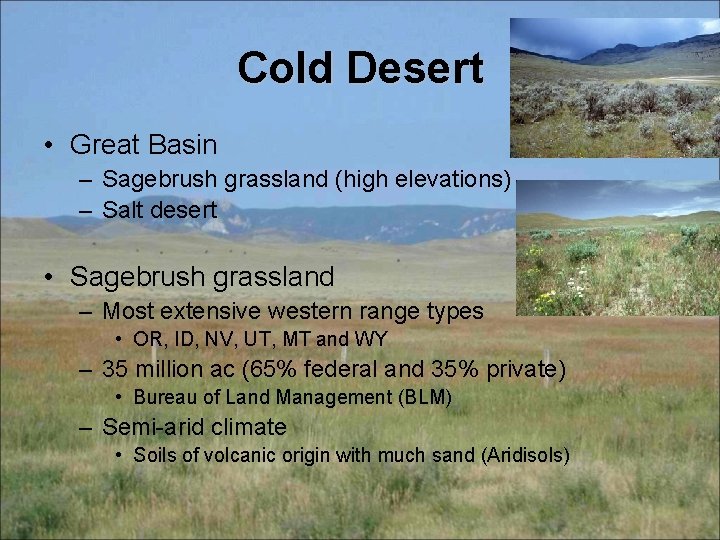
Cold Desert • Great Basin – Sagebrush grassland (high elevations) – Salt desert • Sagebrush grassland – Most extensive western range types • OR, ID, NV, UT, MT and WY – 35 million ac (65% federal and 35% private) • Bureau of Land Management (BLM) – Semi-arid climate • Soils of volcanic origin with much sand (Aridisols)
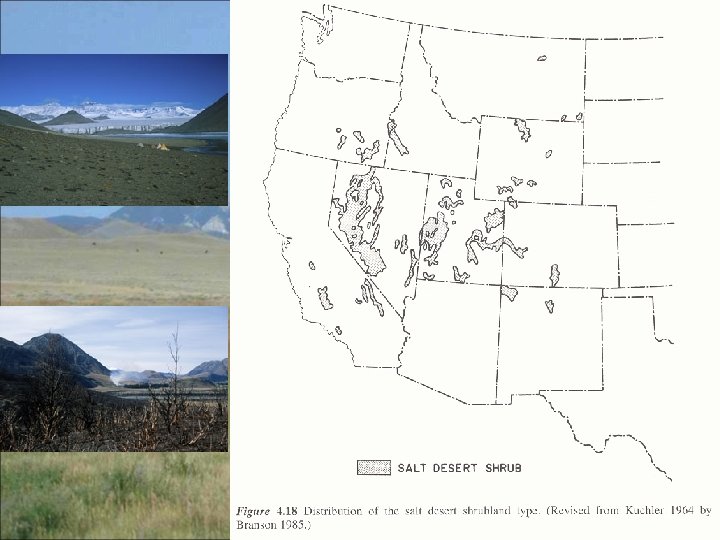
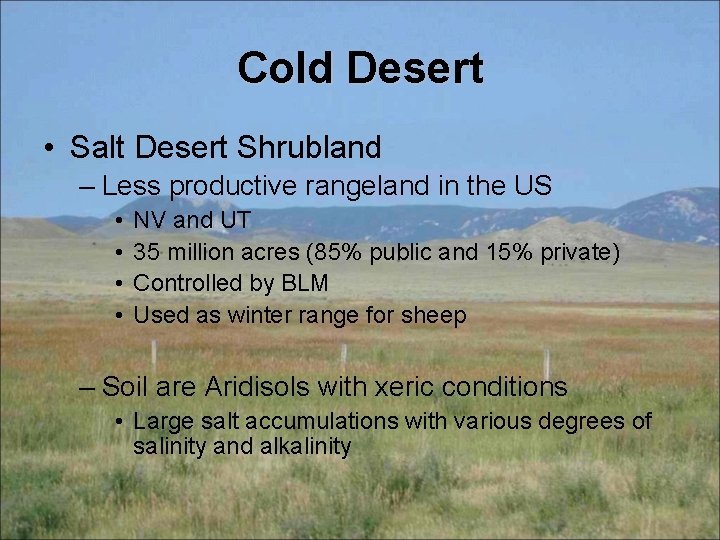
Cold Desert • Salt Desert Shrubland – Less productive rangeland in the US • • NV and UT 35 million acres (85% public and 15% private) Controlled by BLM Used as winter range for sheep – Soil are Aridisols with xeric conditions • Large salt accumulations with various degrees of salinity and alkalinity
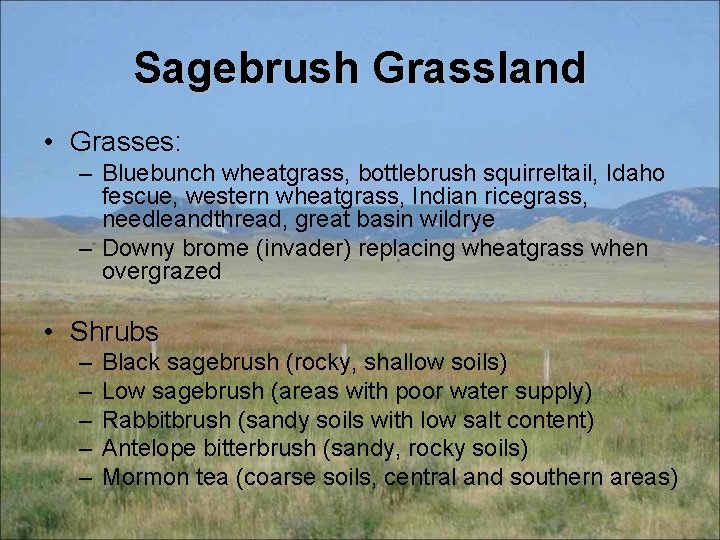
Sagebrush Grassland • Grasses: – Bluebunch wheatgrass, bottlebrush squirreltail, Idaho fescue, western wheatgrass, Indian ricegrass, needleandthread, great basin wildrye – Downy brome (invader) replacing wheatgrass when overgrazed • Shrubs – – – Black sagebrush (rocky, shallow soils) Low sagebrush (areas with poor water supply) Rabbitbrush (sandy soils with low salt content) Antelope bitterbrush (sandy, rocky soils) Mormon tea (coarse soils, central and southern areas)
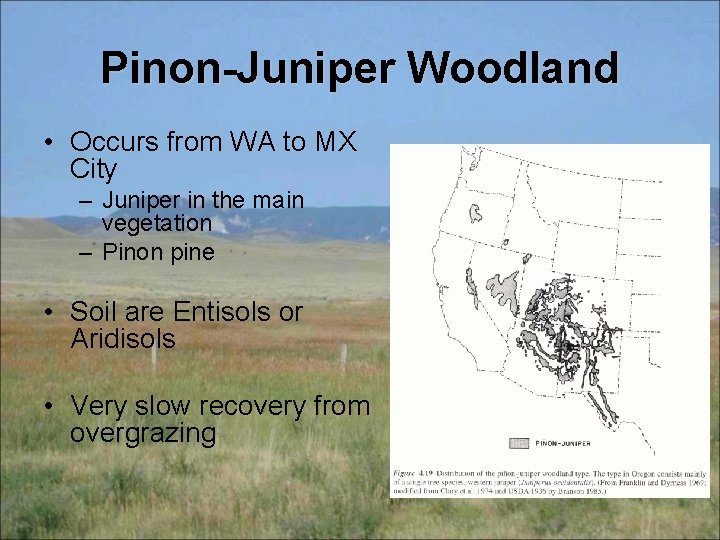
Pinon-Juniper Woodland • Occurs from WA to MX City – Juniper in the main vegetation – Pinon pine • Soil are Entisols or Aridisols • Very slow recovery from overgrazing
Mountain Browse • Rocky Mountains and Sierra Nevada • Soils: Entisols and Inceptisols • Shrubs are dominant vegetation – Chokecherry, buckbrush, gambel oak, true mountain mahogany, and antelope bitterbrush (forage) • Utilization – Cattle and sheep spring and early summer to mule deer
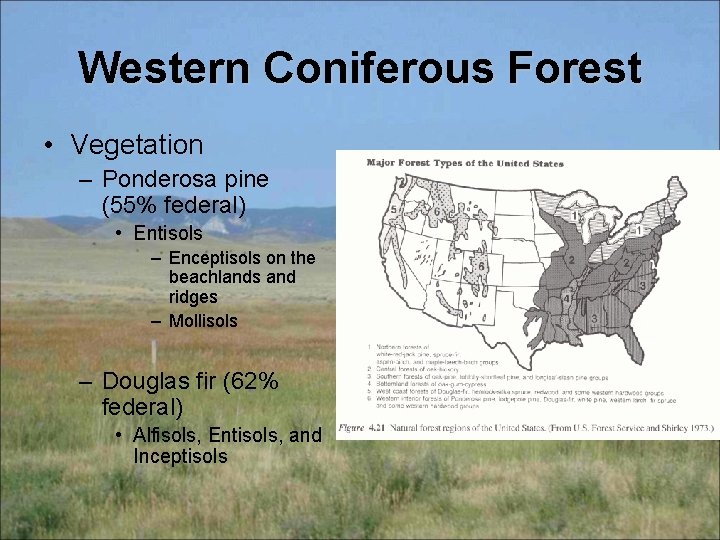
Western Coniferous Forest • Vegetation – Ponderosa pine (55% federal) • Entisols – Enceptisols on the beachlands and ridges – Mollisols – Douglas fir (62% federal) • Alfisols, Entisols, and Inceptisols
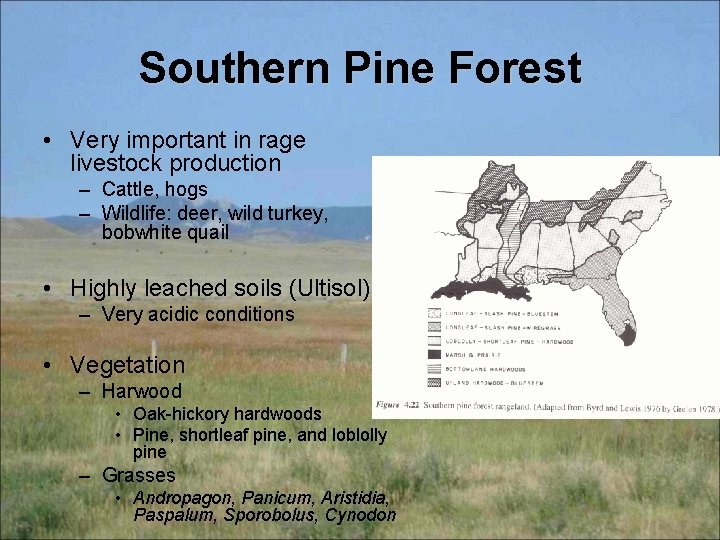
Southern Pine Forest • Very important in rage livestock production – Cattle, hogs – Wildlife: deer, wild turkey, bobwhite quail • Highly leached soils (Ultisol) – Very acidic conditions • Vegetation – Harwood • Oak-hickory hardwoods • Pine, shortleaf pine, and loblolly pine – Grasses • Andropagon, Panicum, Aristidia, Paspalum, Sporobolus, Cynodon
Eastern Deciduous Forest • Covers a large area – MO, IN, OH, KY, VA, WI • Rotational grazing a main scheme • Vegetation – Trees: maples, birches, oak, hickories, beeches, and basswood – Grasses: Andropagon (bluestem), Fetusca (fescue), Phleum (timothy), Poa (bluegrass), Bromus (brome), Lolium (ryegrass), and Dactylis (orchardgrass).
Oak Woodland • Vegetation – Shinery oak: S. NM – Gambel oak: central and south Rockies – Open savanna: tree oaks (CA, OR, S. AZ, C. TX)
Alpine Tundra • Vegetation – Perennial, herbaceous, shrubby vascular plants – Crytograms: Mosses, lichens – Shrubs: willow (Salicaceae) and heath (Ericaceae) families – Saxifrige, rose, mustard, buckwheat and pink • Grazed by sheep
The Black Belt Prairie • The Black Belt is a subdivision of the East Gulf Coastal Plain physiogeographic province. • It forms a cresentic region extending from Mc. Nary County in extreme southern Tennessee, south through east-central Mississippi and east to Russell County, Alabama near the Georgia state line. • The region is approximately 310 miles long and up to 25 miles wide, but narrowing at its northern and eastern extremes. • The entire region is underlain by Selma Chalk formed from Upper Cretaceous marine deposits. • Three major plant communities: open prairie, chalk outcrop, and forest.
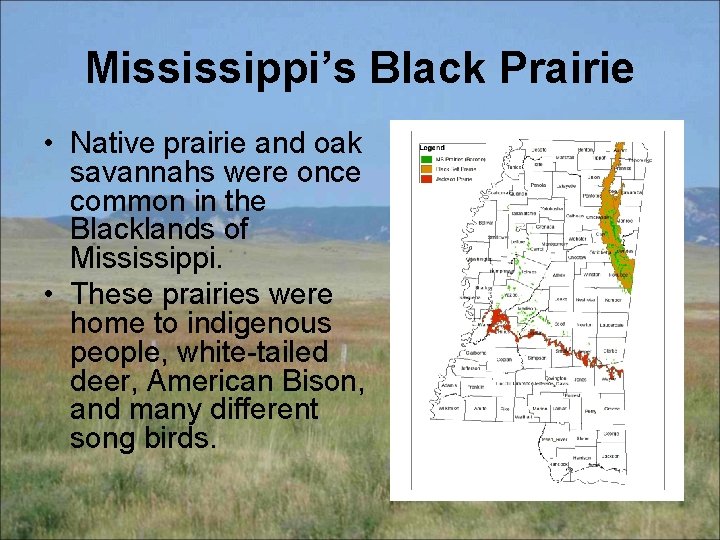
Mississippi’s Black Prairie • Native prairie and oak savannahs were once common in the Blacklands of Mississippi. • These prairies were home to indigenous people, white-tailed deer, American Bison, and many different song birds.
Native Grasses • Native warm season grasses are indigenous to the Northeastern United States but now are found growing naturally only in isolated pockets throughout the region. • Warm-season grasses found include: switchgrass, big bluestem, little bluestem, Indiangrass, purpletop, eastern gamagrass, and sideoats grama.
Native Grasses • Importance: – These native warm season grasses provide extremely valuable habitat for ground-nesting birds and many mammals. – They are very deep rooted, making for long lasting, stress tolerant, low maintenance plants. – The root biomass of native warm season grasses far exceeds that of the introduced cool-season grasses. • This characteristic provides increased organic matter in soils and more rapid infiltration rates. The bunch-type habit of these grasses provides space for the inclusion of native forbs and legumes to further improve habitat quality. .
Reluctance to Native Grasses • Not as readily available, are more expensive, and have relatively low seedling vigor compared to cool-season grasses, which results in a longer establishment period. • The primary seeding window is limited to the early spring, but late fall/early winter seedings are a possible option on droughty soils with little weed competition. • Many of the warm season grasses produce chaffy seeds with long awns, which do not efficiently flow through a conventional grass seeder.
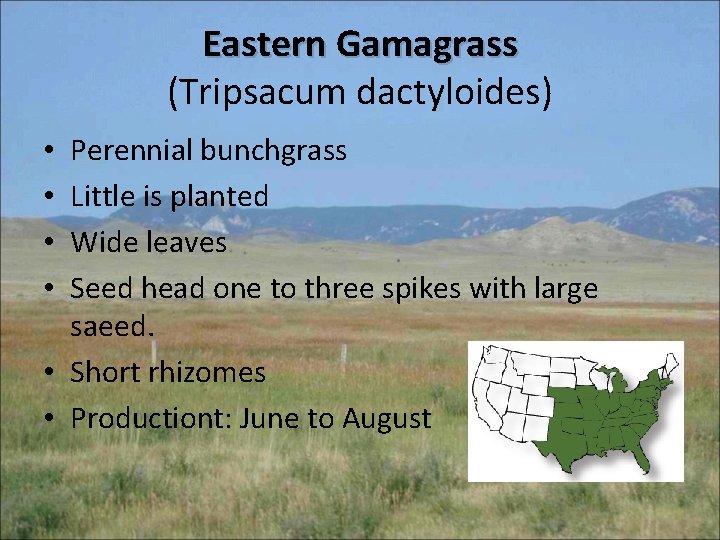
Eastern Gamagrass (Tripsacum dactyloides) Perennial bunchgrass Little is planted Wide leaves Seed head one to three spikes with large saeed. • Short rhizomes • Productiont: June to August • •
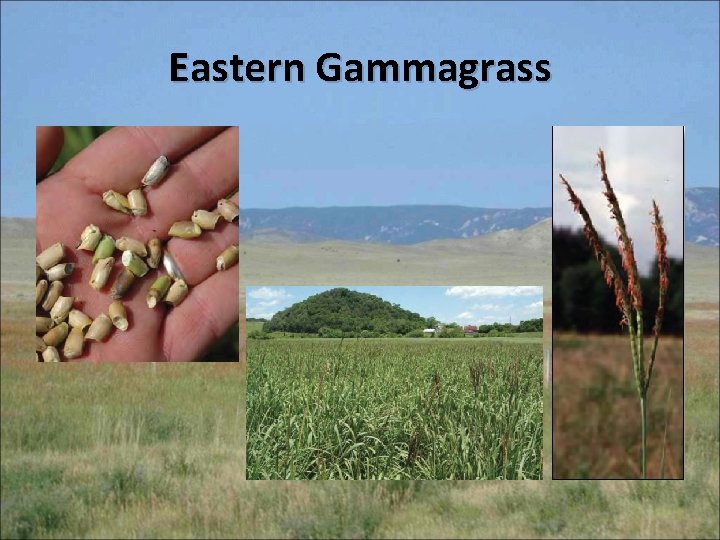
Eastern Gammagrass
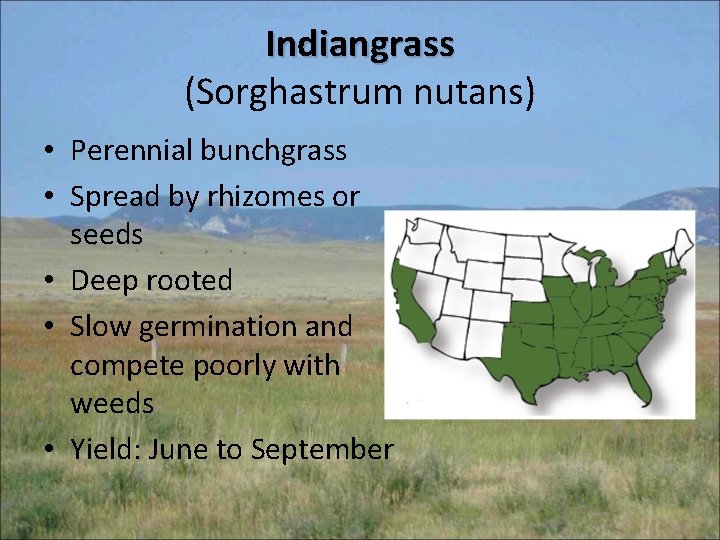
Indiangrass (Sorghastrum nutans) • Perennial bunchgrass • Spread by rhizomes or seeds • Deep rooted • Slow germination and compete poorly with weeds • Yield: June to September
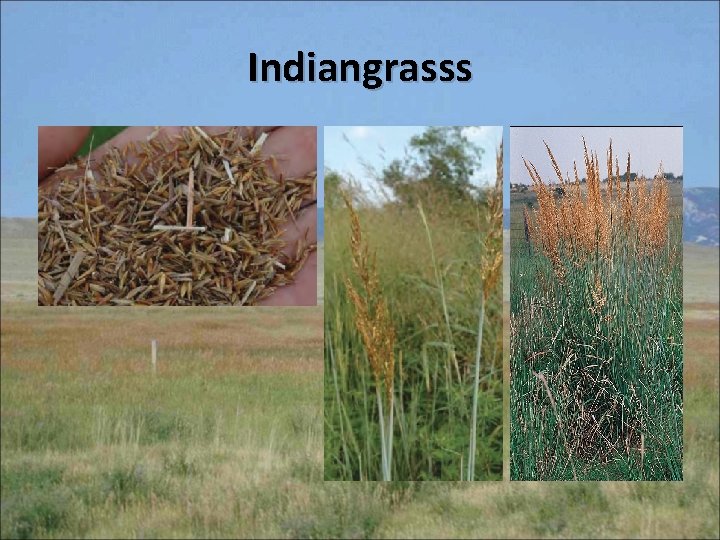
Indiangrasss
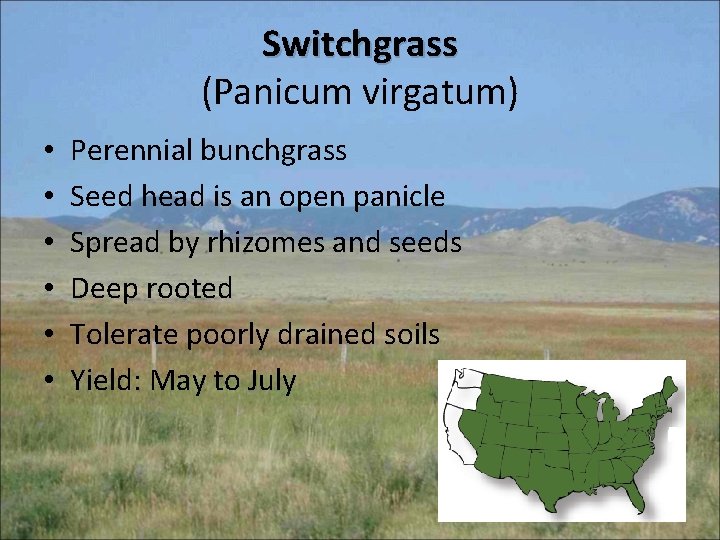
Switchgrass (Panicum virgatum) • • • Perennial bunchgrass Seed head is an open panicle Spread by rhizomes and seeds Deep rooted Tolerate poorly drained soils Yield: May to July
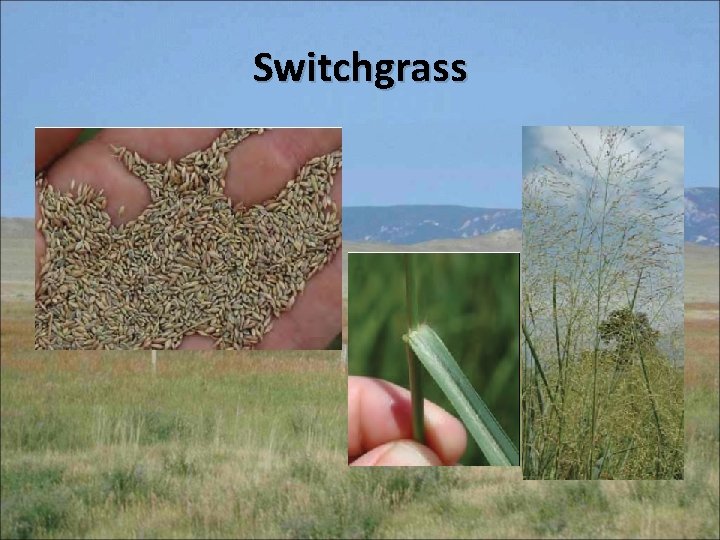
Switchgrass
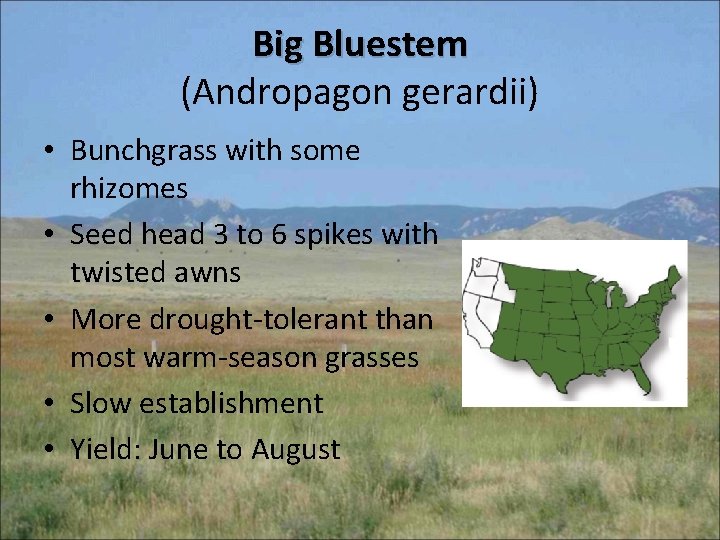
Big Bluestem (Andropagon gerardii) • Bunchgrass with some rhizomes • Seed head 3 to 6 spikes with twisted awns • More drought-tolerant than most warm-season grasses • Slow establishment • Yield: June to August
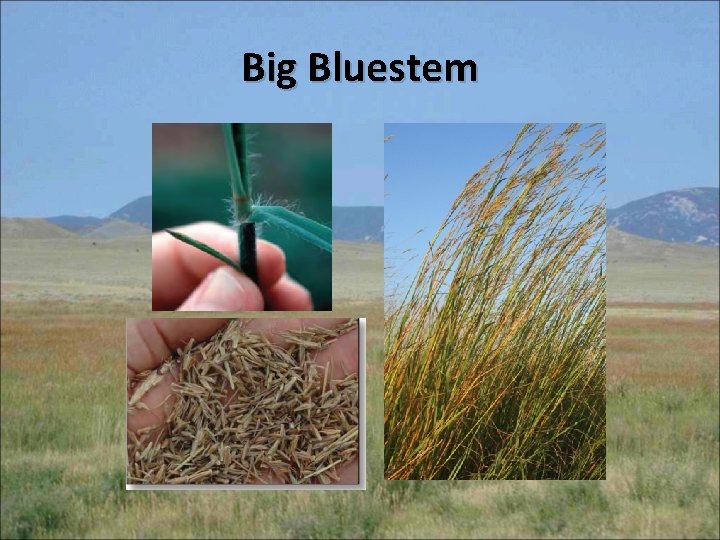
Big Bluestem
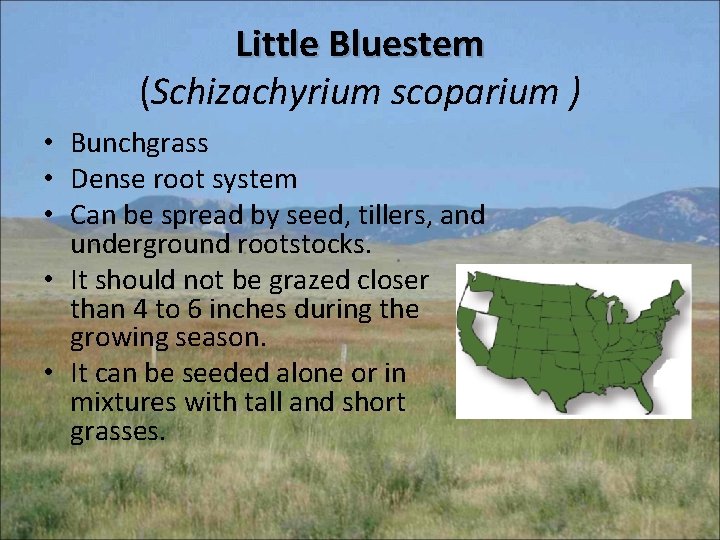
Little Bluestem (Schizachyrium scoparium ) • Bunchgrass • Dense root system • Can be spread by seed, tillers, and underground rootstocks. • It should not be grazed closer than 4 to 6 inches during the growing season. • It can be seeded alone or in mixtures with tall and short grasses.
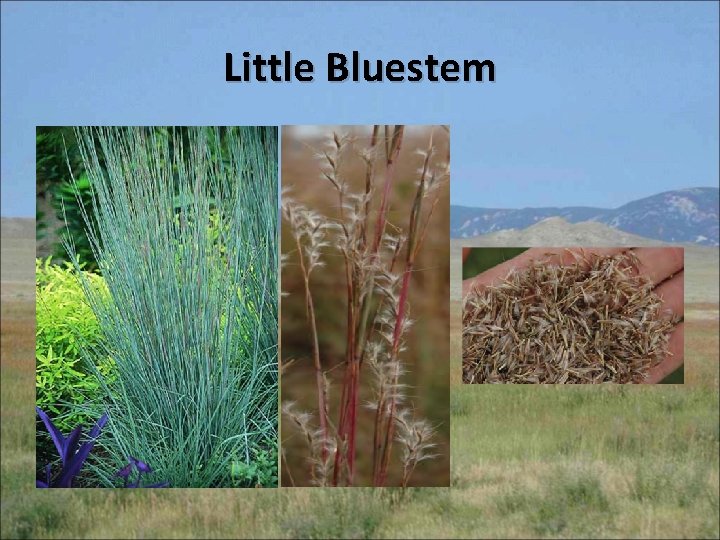
Little Bluestem
Environmental Impacts and Conservation of Rangeland • In addition to promoting native vegetation, rangelands also help sequester carbon in their soils. • Specific management programs have been created to help this continue effectively. • They do not allow significant amounts of soil to remain undisturbed and vulnerable to emitting carbon into the atmosphere. • Similar management programs have shown a significant increase in carbon storage annually in rangeland soils. • With rangelands covering so much of the world's land surface conserving soils and protecting native vegetation is key to long-term sustainability.
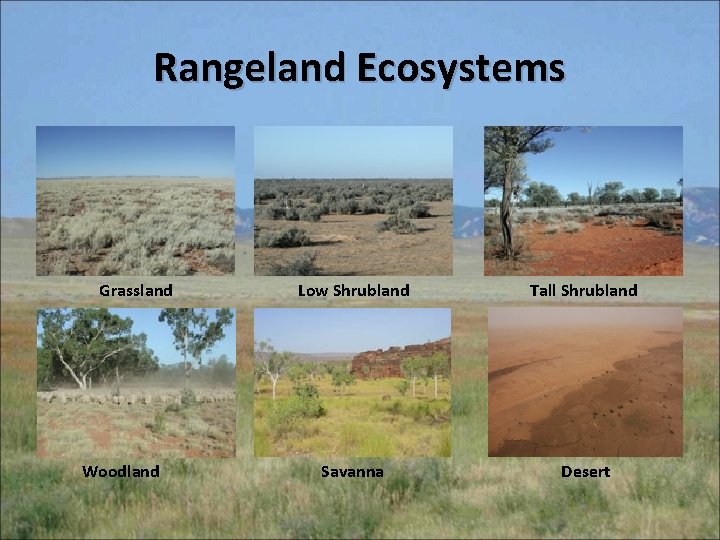
Rangeland Ecosystems Grassland Woodland Low Shrubland Tall Shrubland Savanna Desert
- Slides: 91