
SUSTAINABLE HEALTHY COMMUNITIES RESEARCH PROGRAM Scoping The Building
SUSTAINABLE & HEALTHY COMMUNITIES RESEARCH PROGRAM Scoping: The Building Blocks for HIA 101 Track 3 rd Annual National HIA Meeting Tuesday, June 16, 2015 Lauren Adkins, MPH, CPH CSS-Dynamac 6/16/2015 Steve White, MURP Oregon Public Health Institute The views expressed in this presentation are those of the author[s] and do not necessarily reflect the views or policies of the U. S. Environmental Protection Agency or the Oregon Public Health Institute. 1
SUSTAINABLE & HEALTHY COMMUNITIES RESEARCH PROGRAM Session Purpose This presentation is designed for the HIA 101 Track for new and potential HIA practitioners. The most important step for any study is the planning step. In HIA, planning occurs in Scoping, which sets the stage for the rest of the Assessment. Many different processes occur simultaneously. Objectives: q Build capacity to develop and complete the Scoping step. q Expand knowledge of HIA resources available to expedite the Scoping step. q Raise awareness for the level of involvement and resources needed to complete the Scoping step. 6/16/2015 2
SUSTAINABLE & HEALTHY COMMUNITIES RESEARCH PROGRAM Proctor Creek’s Boone Boulevard Green Street Project Health Impact Assessment (Atlanta, Georgia) CASE STUDY OVERVIEW 6/16/2015 3
SUSTAINABLE & HEALTHY COMMUNITIES RESEARCH PROGRAM HIA Case Study EPA led an HIA that evaluated the proposed Boone Boulevard Green Street Project sited in the headwaters of Proctor Creek in Atlanta, Georgia. Problems Facing Community: • Pervasive flooding • Impaired water quality • Illegal dumping • Blight (derelict and vacant properties) • Aging infrastructure
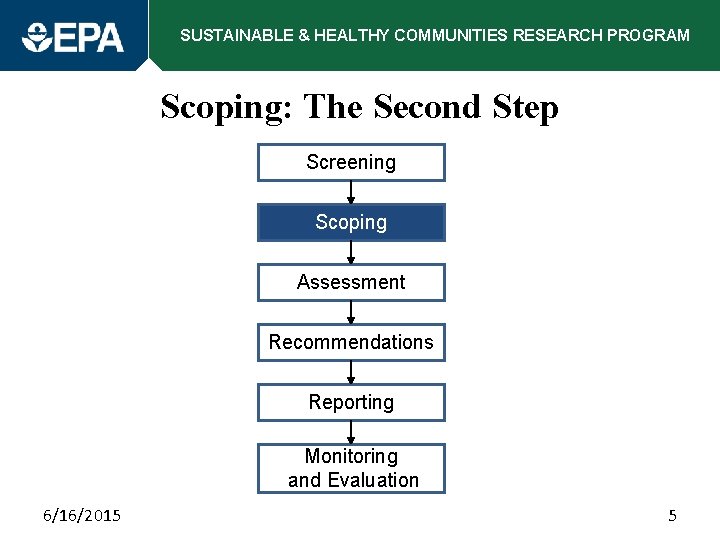
SUSTAINABLE & HEALTHY COMMUNITIES RESEARCH PROGRAM Scoping: The Second Step Screening Scoping Assessment Recommendations Reporting Monitoring and Evaluation 6/16/2015 5
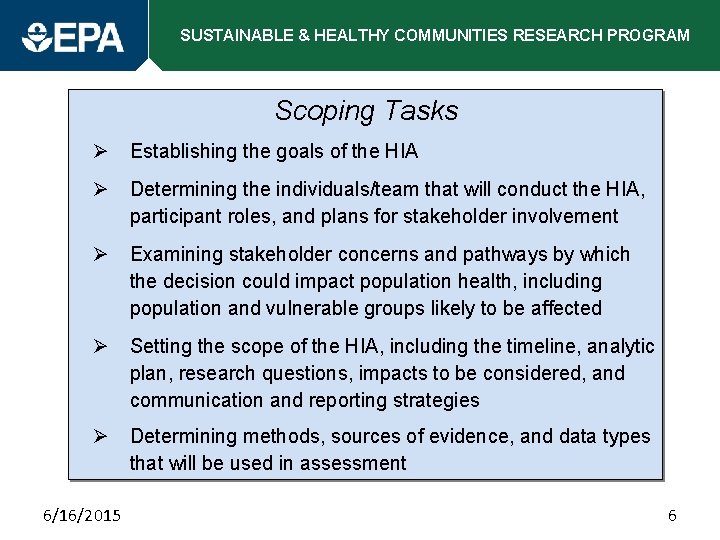
SUSTAINABLE & HEALTHY COMMUNITIES RESEARCH PROGRAM Scoping Tasks Ø Establishing the goals of the HIA Ø Determining the individuals/team that will conduct the HIA, participant roles, and plans for stakeholder involvement Ø Examining stakeholder concerns and pathways by which the decision could impact population health, including population and vulnerable groups likely to be affected Ø Setting the scope of the HIA, including the timeline, analytic plan, research questions, impacts to be considered, and communication and reporting strategies Ø Determining methods, sources of evidence, and data types that will be used in assessment 6/16/2015 6
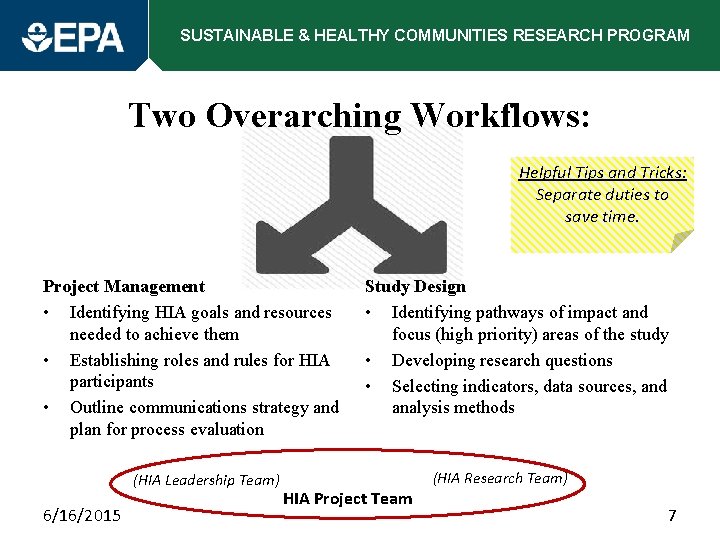
SUSTAINABLE & HEALTHY COMMUNITIES RESEARCH PROGRAM Two Overarching Workflows: Helpful Tips and Tricks: Separate duties to save time. Project Management • Identifying HIA goals and resources needed to achieve them • Establishing roles and rules for HIA participants • Outline communications strategy and plan for process evaluation (HIA Leadership Team) 6/16/2015 Study Design • Identifying pathways of impact and focus (high priority) areas of the study • Developing research questions • Selecting indicators, data sources, and analysis methods (HIA Research Team) HIA Project Team 7
SUSTAINABLE & HEALTHY COMMUNITIES RESEARCH PROGRAM Steve White, Oregon Public Health Institute TASKS RELATED TO PROJECT MANAGEMENT 6/16/2015 8
SUSTAINABLE & HEALTHY COMMUNITIES RESEARCH PROGRAM Tasks Related to Project Management • • • Developing HIA project goals Identifying and obtaining resources needed Establishing roles and responsibilities ― Key considerations for managing expectations Developing a communications strategy/plan HIA quality assurance ― Designing the process evaluation 6/16/2015 9
SUSTAINABLE & HEALTHY COMMUNITIES RESEARCH PROGRAM Developing HIA Project Goals Good goals are: • Achievable • Measurable—you can know if they’ve been achieved HIA Goals often focus on: • Informing the decision • Capacity-building • Partnerships Helpful Tips and Tricks: Involve key stakeholders to the best extent and as early as possible. 6/16/2015 HIA Goals from the Case Study: • Add a vehicle for equitable inclusion of all stakeholders in the decision-making process. • Assess the effectiveness of the proposed green infrastructure project and raise awareness of the environmental, economic, and societal impacts related to health. • Provide recommendations to the proposed project that incorporate approaches to stormwater management, ecosystem restoration, and community revitalization. • Increase transparency, local accountability, community empowerment, and ownership of the proposed plan through meaningful stakeholder engagement. 10
SUSTAINABLE & HEALTHY COMMUNITIES RESEARCH PROGRAM Identifying and Obtaining Resources • Timing – Build in buffer periods in the HIA timeline to avoid missed deadlines. – Review other HIAs to see how long they took, given the health impacts appraised and the level of stakeholder engagement. Helpful Tips and Tricks: Bring the right people to the table. • Funding – If possible, use existing and publically-available tools, data, and methods. – Ensure enough funding to cover unexpected expenses. • Personnel and other resources – Consider existing and new partnerships to gain access to needed resources. 6/16/2015 Helpful Tips and Tricks: Don’t reinvent the wheel. 11
SUSTAINABLE & HEALTHY COMMUNITIES RESEARCH PROGRAM 6/16/2015 12
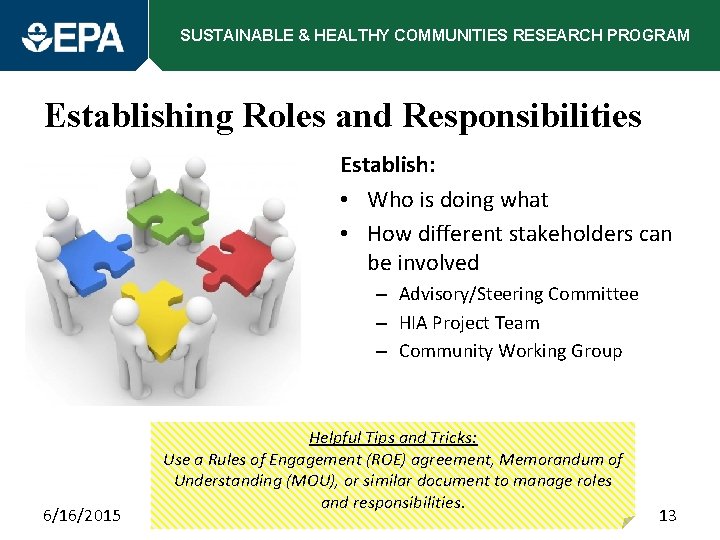
SUSTAINABLE & HEALTHY COMMUNITIES RESEARCH PROGRAM Establishing Roles and Responsibilities Establish: • Who is doing what • How different stakeholders can be involved – Advisory/Steering Committee – HIA Project Team – Community Working Group 6/16/2015 Helpful Tips and Tricks: Use a Rules of Engagement (ROE) agreement, Memorandum of Understanding (MOU), or similar document to manage roles and responsibilities. 13
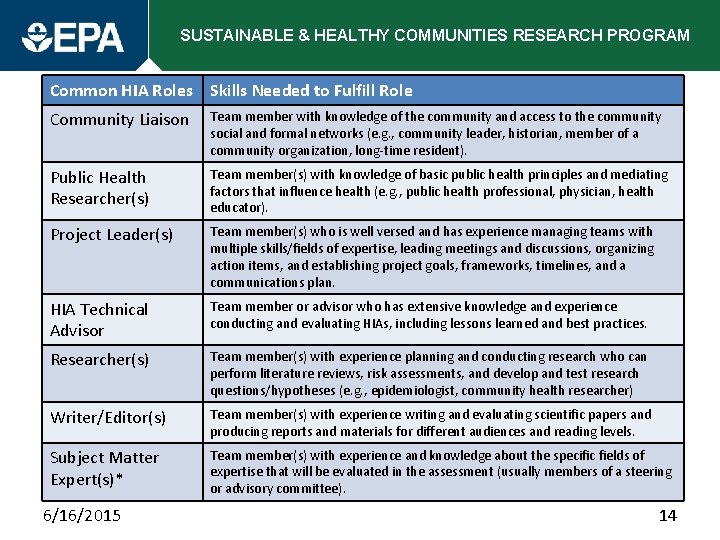
SUSTAINABLE & HEALTHY COMMUNITIES RESEARCH PROGRAM Common HIA Roles Skills Needed to Fulfill Role Common HIA Roles and Skills Needed Community Liaison Team member with knowledge of the community and access to the community social and formal networks (e. g. , community leader, historian, member of a community organization, long-time resident). Public Health Researcher(s) Team member(s) with knowledge of basic public health principles and mediating factors that influence health (e. g. , public health professional, physician, health educator). Project Leader(s) Team member(s) who is well versed and has experience managing teams with multiple skills/fields of expertise, leading meetings and discussions, organizing action items, and establishing project goals, frameworks, timelines, and a communications plan. HIA Technical Advisor Team member or advisor who has extensive knowledge and experience conducting and evaluating HIAs, including lessons learned and best practices. Researcher(s) Team member(s) with experience planning and conducting research who can perform literature reviews, risk assessments, and develop and test research questions/hypotheses (e. g. , epidemiologist, community health researcher) Writer/Editor(s) Team member(s) with experience writing and evaluating scientific papers and producing reports and materials for different audiences and reading levels. Subject Matter Expert(s)* Team member(s) with experience and knowledge about the specific fields of expertise that will be evaluated in the assessment (usually members of a steering or advisory committee). 6/16/2015 14
SUSTAINABLE & HEALTHY COMMUNITIES RESEARCH PROGRAM Scoping Tool: Stakeholder Analysis Worksheet 6/16/2015 Source: Stakeholder Participation Working Group of the 2010 HIA of the Americas Workshop. (2012) “Guidance and Best Practices for Stakeholder Participation in HIA (version 1. 0). ” 15
SUSTAINABLE & HEALTHY COMMUNITIES RESEARCH PROGRAM Managing Expectations • • • Develop goals of the HIA collaboratively. Focus on what/who is needed to inform the decision. Discuss anticipated “inputs” and “outputs. ” Remember: HIA is part science, part art. Communicate with stakeholders throughout the project. Question for the audience 6/16/2015 16
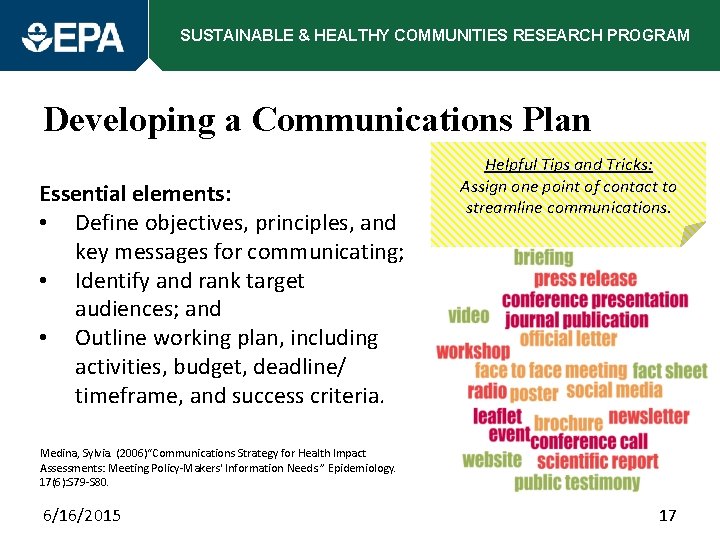
SUSTAINABLE & HEALTHY COMMUNITIES RESEARCH PROGRAM Developing a Communications Plan Essential elements: • Define objectives, principles, and key messages for communicating; • Identify and rank target audiences; and • Outline working plan, including activities, budget, deadline/ timeframe, and success criteria. Helpful Tips and Tricks: Assign one point of contact to streamline communications. Medina, Sylvia. (2006)“Communications Strategy for Health Impact Assessments: Meeting Policy-Makers' Information Needs. ” Epidemiology. 17(6): S 79 -S 80. 6/16/2015 17
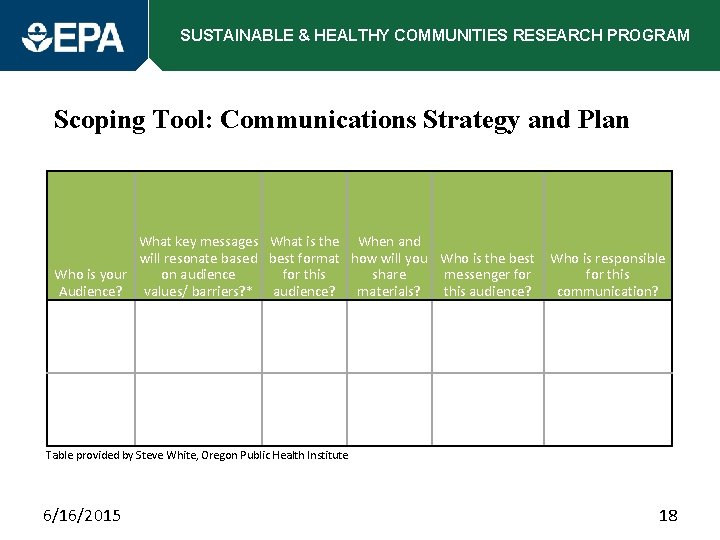
SUSTAINABLE & HEALTHY COMMUNITIES RESEARCH PROGRAM Scoping Tool: Communications Strategy and Plan What key messages What is the When and will resonate based best format how will you Who is the best Who is responsible on audience for this share messenger for this Who is your Audience? values/ barriers? * audience? materials? this audience? communication? Table provided by Steve White, Oregon Public Health Institute 6/16/2015 18
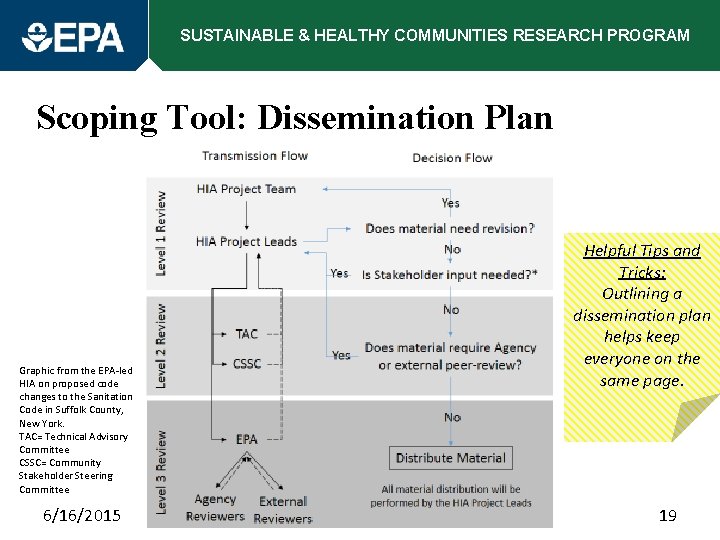
SUSTAINABLE & HEALTHY COMMUNITIES RESEARCH PROGRAM Scoping Tool: Dissemination Plan Graphic from the EPA-led HIA on proposed code changes to the Sanitation Code in Suffolk County, New York. TAC= Technical Advisory Committee CSSC= Community Stakeholder Steering Committee 6/16/2015 Helpful Tips and Tricks: Outlining a dissemination plan helps keep everyone on the same page. 19
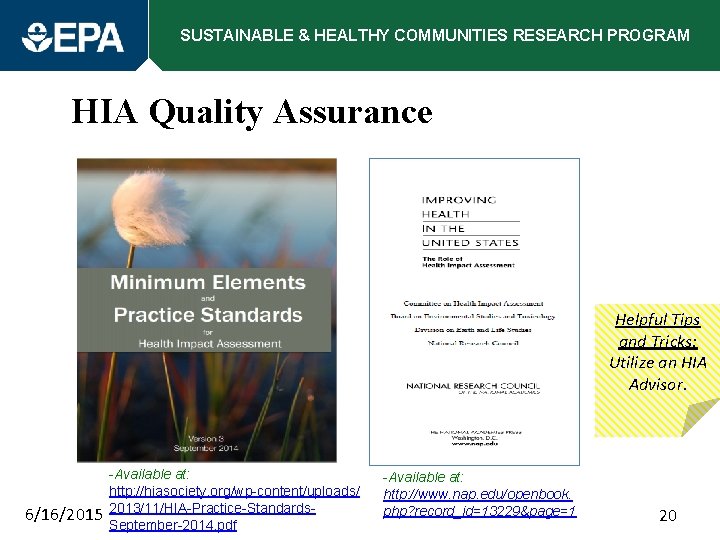
SUSTAINABLE & HEALTHY COMMUNITIES RESEARCH PROGRAM HIA Quality Assurance Helpful Tips and Tricks: Utilize an HIA Advisor. 6/16/2015 -Available at: http: //hiasociety. org/wp-content/uploads/ 2013/11/HIA-Practice-Standards. September-2014. pdf -Available at: http: //www. nap. edu/openbook. php? record_id=13229&page=1 20
SUSTAINABLE & HEALTHY COMMUNITIES RESEARCH PROGRAM Designing the Process Evaluation A process evaluation documents and analyzes the early development and actual implementation of the HIA, assessing whether strategies were implemented as planned and whether expected output was actually produced. Considerations for Process Evaluation: • Did the HIA follow best practices? • Did the HIA adhere to the plan for implementation? • Were the HIA Project goals achieved? 6/16/2015 Helpful Tips and Tricks: Process evaluation can be completed as the project progresses, and can help inform midcourse corrections and improvements. 21
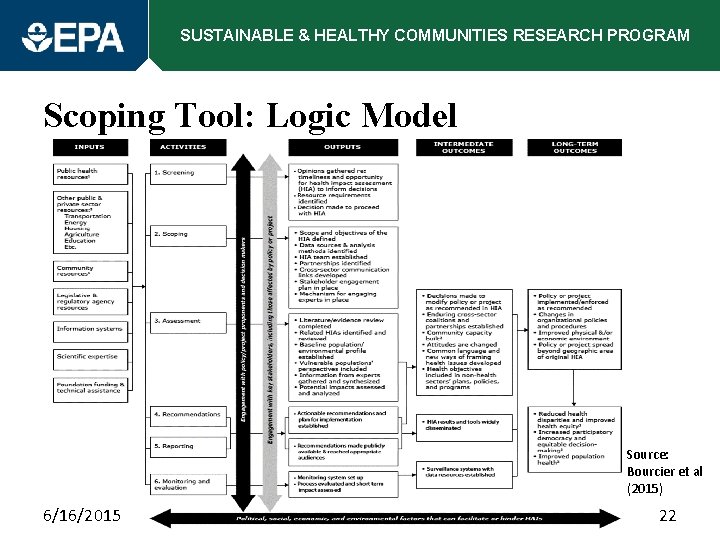
SUSTAINABLE & HEALTHY COMMUNITIES RESEARCH PROGRAM Scoping Tool: Logic Model Source: Bourcier et al (2015) 6/16/2015 22
SUSTAINABLE & HEALTHY COMMUNITIES RESEARCH PROGRAM Lauren Adkins, CSS-Dynamac TASKS RELATED TO STUDY DESIGN 6/16/2015 23
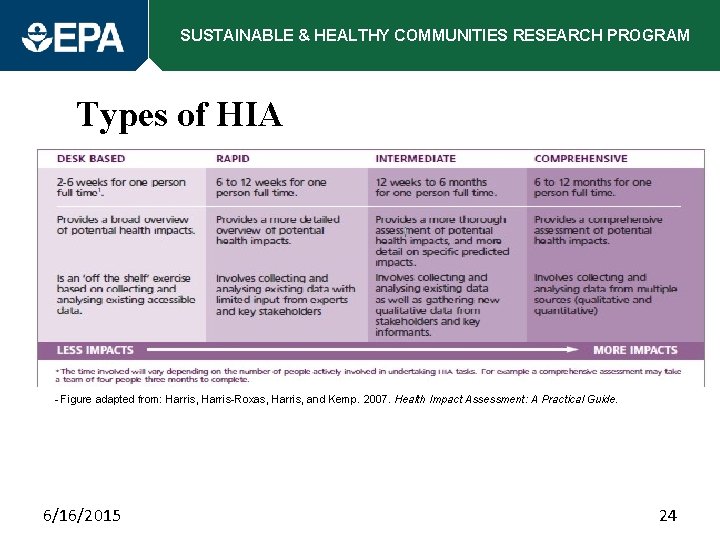
SUSTAINABLE & HEALTHY COMMUNITIES RESEARCH PROGRAM Types of HIA - Figure adapted from: Harris, Harris-Roxas, Harris, and Kemp. 2007. Health Impact Assessment: A Practical Guide. 6/16/2015 24
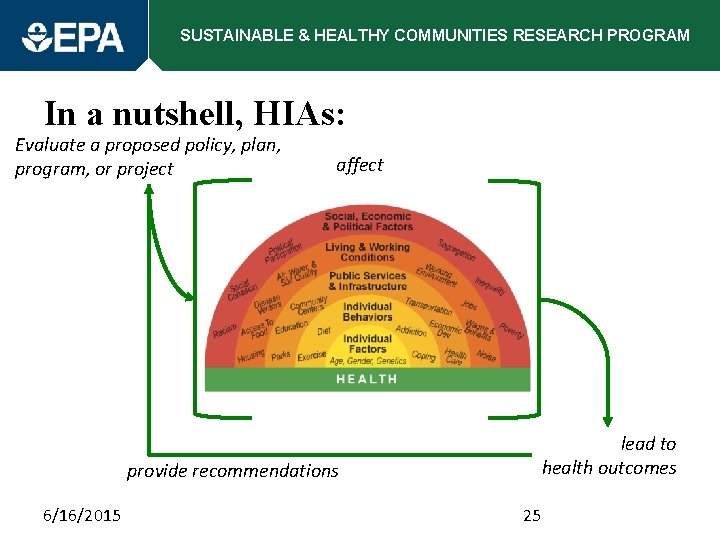
SUSTAINABLE & HEALTHY COMMUNITIES RESEARCH PROGRAM In a nutshell, HIAs: Evaluate a proposed policy, plan, program, or project affect lead to health outcomes provide recommendations 6/16/2015 25
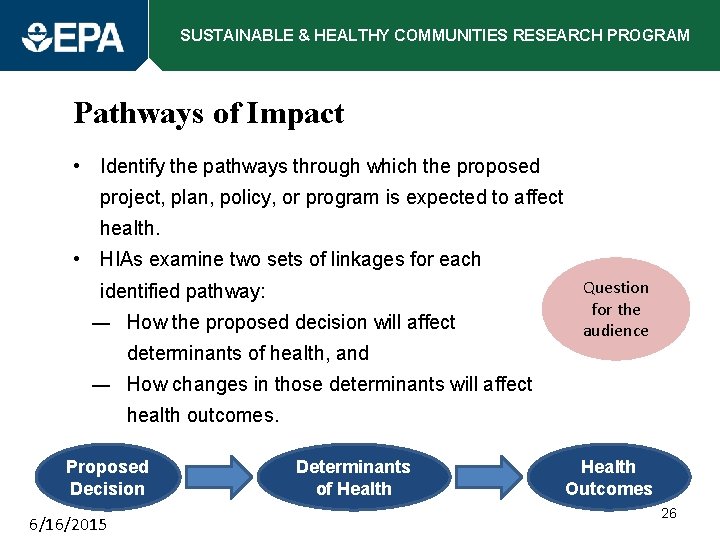
SUSTAINABLE & HEALTHY COMMUNITIES RESEARCH PROGRAM Pathways of Impact • Identify the pathways through which the proposed project, plan, policy, or program is expected to affect health. • HIAs examine two sets of linkages for each identified pathway: ― How the proposed decision will affect Question for the audience determinants of health, and ― How changes in those determinants will affect health outcomes. Proposed Decision 6/16/2015 Determinants of Health Outcomes 26
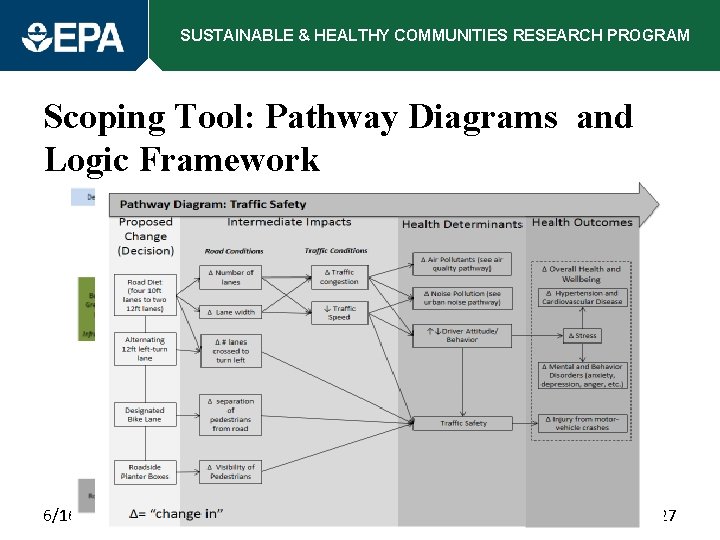
SUSTAINABLE & HEALTHY COMMUNITIES RESEARCH PROGRAM Scoping Tool: Pathway Diagrams and Logic Framework 6/16/2015 27
SUSTAINABLE & HEALTHY COMMUNITIES RESEARCH PROGRAM Identifying the Focus of Your Study • Start comprehensive. – Ask “what are all of the potential impacts? ” • Establish priorities. – Identify the main concerns/interests. – Solicit and utilize stakeholder input. • Select the health impacts to be appraised. – Ask “what can be accomplished with the resources available? ” 6/16/2015 Helpful Tips and Tricks: Make sure the scope of impacts is achievable with the funding, personnel, and timing available. 28
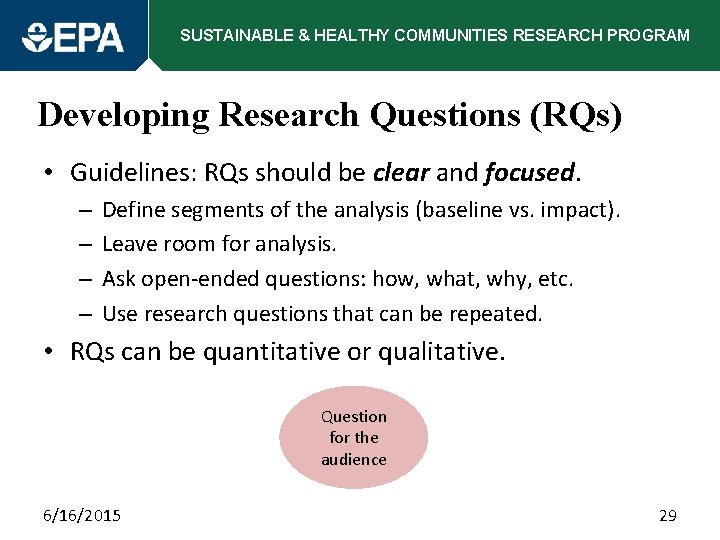
SUSTAINABLE & HEALTHY COMMUNITIES RESEARCH PROGRAM Developing Research Questions (RQs) • Guidelines: RQs should be clear and focused. – – Define segments of the analysis (baseline vs. impact). Leave room for analysis. Ask open-ended questions: how, what, why, etc. Use research questions that can be repeated. • RQs can be quantitative or qualitative. Question for the audience 6/16/2015 29
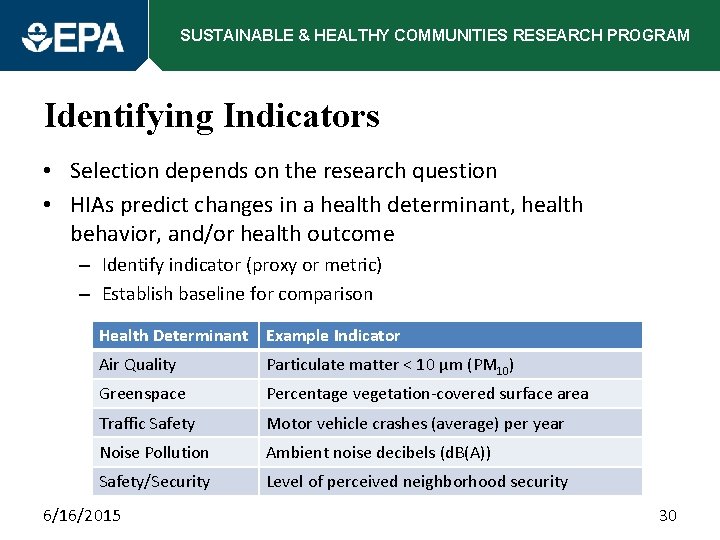
SUSTAINABLE & HEALTHY COMMUNITIES RESEARCH PROGRAM Identifying Indicators • Selection depends on the research question • HIAs predict changes in a health determinant, health behavior, and/or health outcome – Identify indicator (proxy or metric) – Establish baseline for comparison Health Determinant Example Indicator Air Quality Particulate matter < 10 μm (PM 10) Greenspace Percentage vegetation-covered surface area Traffic Safety Motor vehicle crashes (average) per year Noise Pollution Ambient noise decibels (d. B(A)) Safety/Security Level of perceived neighborhood security 6/16/2015 30
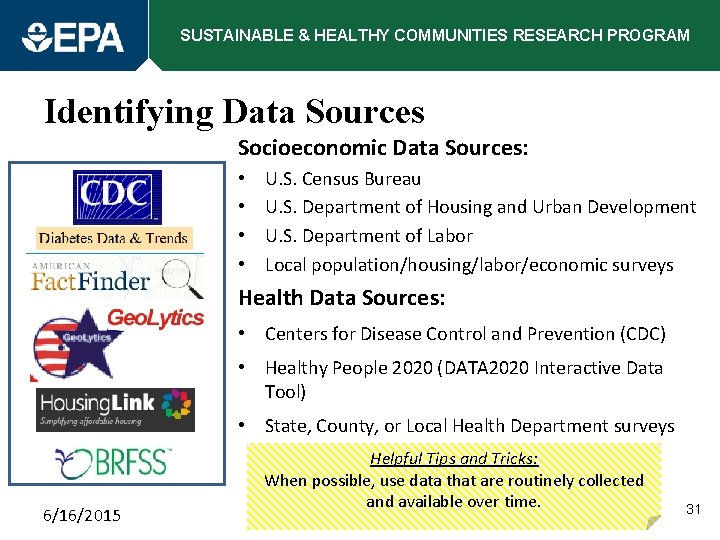
SUSTAINABLE & HEALTHY COMMUNITIES RESEARCH PROGRAM Identifying Data Sources Socioeconomic Data Sources: • • U. S. Census Bureau U. S. Department of Housing and Urban Development U. S. Department of Labor Local population/housing/labor/economic surveys Health Data Sources: • Centers for Disease Control and Prevention (CDC) • Healthy People 2020 (DATA 2020 Interactive Data Tool) • State, County, or Local Health Department surveys 6/16/2015 Helpful Tips and Tricks: When possible, use data that are routinely collected and available over time. 31
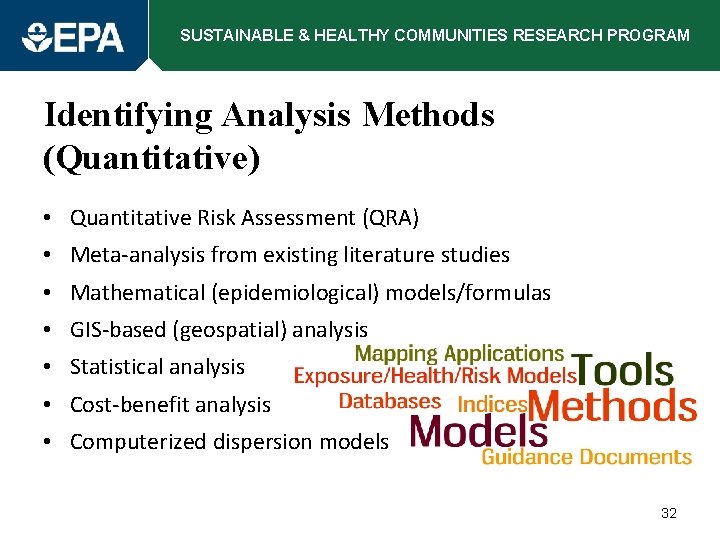
SUSTAINABLE & HEALTHY COMMUNITIES RESEARCH PROGRAM Identifying Analysis Methods (Quantitative) • Quantitative Risk Assessment (QRA) • Meta-analysis from existing literature studies • Mathematical (epidemiological) models/formulas • GIS-based (geospatial) analysis • Statistical analysis • Cost-benefit analysis • Computerized dispersion models 32
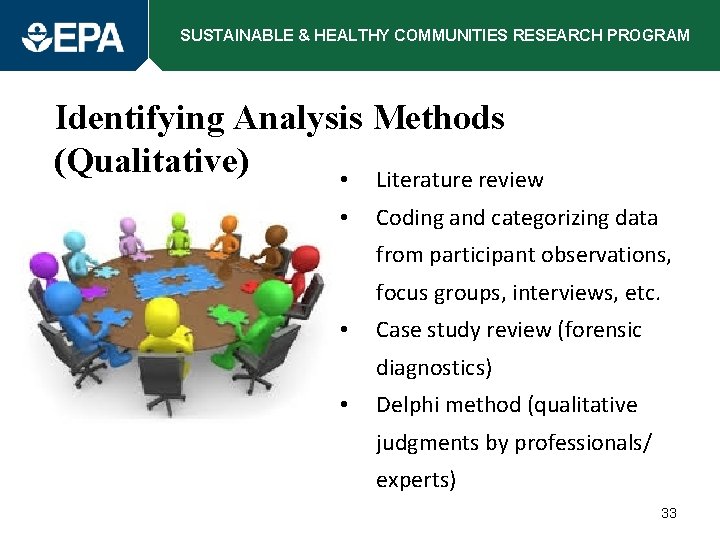
SUSTAINABLE & HEALTHY COMMUNITIES RESEARCH PROGRAM Identifying Analysis Methods (Qualitative) • Literature review • Coding and categorizing data from participant observations, focus groups, interviews, etc. • Case study review (forensic diagnostics) • Delphi method (qualitative judgments by professionals/ experts) 33
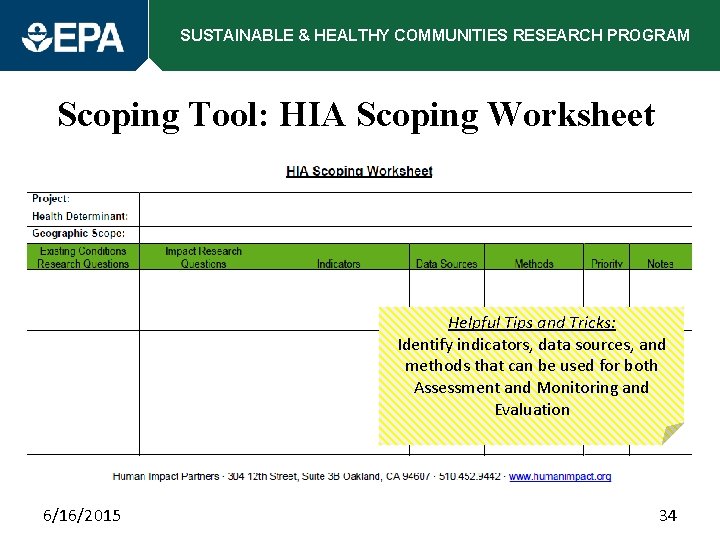
SUSTAINABLE & HEALTHY COMMUNITIES RESEARCH PROGRAM Scoping Tool: HIA Scoping Worksheet Helpful Tips and Tricks: Identify indicators, data sources, and methods that can be used for both Assessment and Monitoring and Evaluation 6/16/2015 34
SUSTAINABLE & HEALTHY COMMUNITIES RESEARCH PROGRAM Identifying Limitations and Assumptions Quantitative Methods • • • Estimations Easier to replicate Focus is on “scientific data” Limited by sample More objective Qualitative Methods • Characterizations • Not readily replicable • Focus is on “stakeholders' input” • Limited by representation • More subjective Ways to address limitations and assumptions: • Sensitivity analysis • Monte-carlo simulations 6/16/2015 35
SUSTAINABLE & HEALTHY COMMUNITIES RESEARCH PROGRAM GROUP ACTIVITY AND DISCUSSION 6/16/2015 36
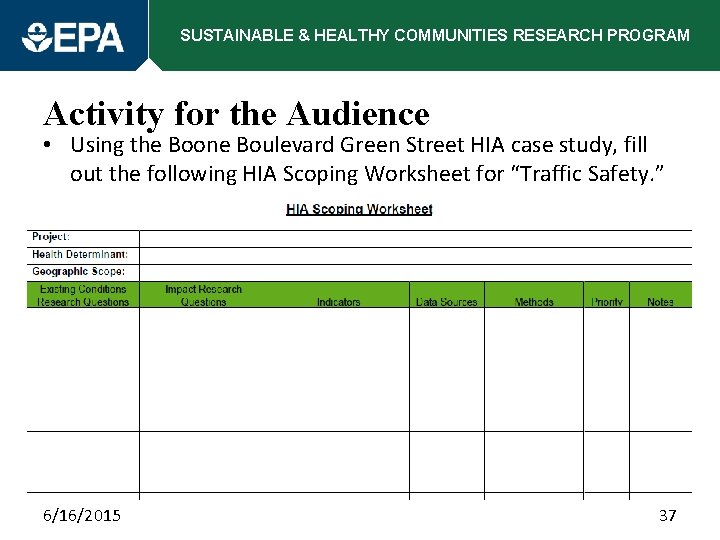
SUSTAINABLE & HEALTHY COMMUNITIES RESEARCH PROGRAM Activity for the Audience • Using the Boone Boulevard Green Street HIA case study, fill out the following HIA Scoping Worksheet for “Traffic Safety. ” 6/16/2015 37
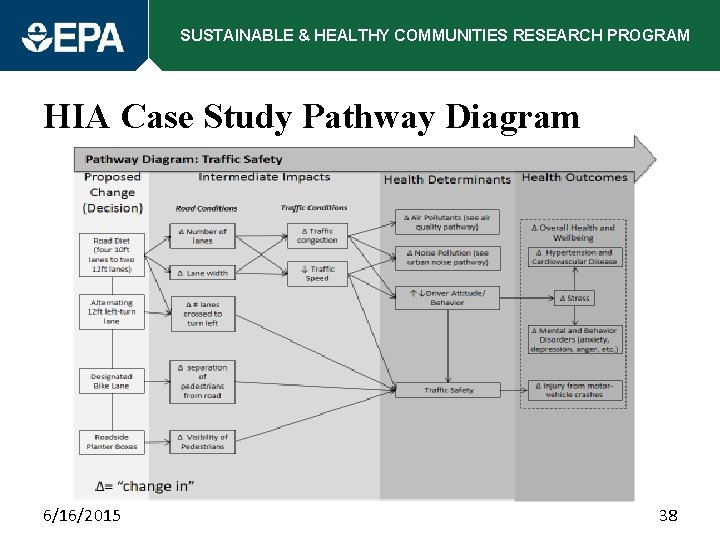
SUSTAINABLE & HEALTHY COMMUNITIES RESEARCH PROGRAM HIA Case Study Pathway Diagram 6/16/2015 38
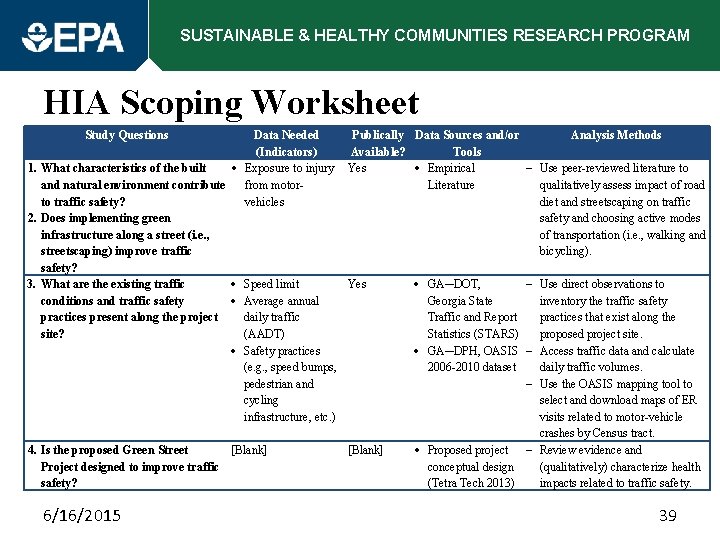
SUSTAINABLE & HEALTHY COMMUNITIES RESEARCH PROGRAM HIA Scoping Worksheet Study Questions Data Needed Publically (Indicators) Available? 1. What characteristics of the built Exposure to injury Yes and natural environment contribute from motorto traffic safety? vehicles 2. Does implementing green infrastructure along a street (i. e. , streetscaping) improve traffic safety? 3. What are the existing traffic Speed limit Yes conditions and traffic safety Average annual practices present along the project daily traffic site? (AADT) Safety practices (e. g. , speed bumps, pedestrian and cycling infrastructure, etc. ) 4. Is the proposed Green Street [Blank] Project designed to improve traffic safety? 6/16/2015 [Blank] Data Sources and/or Analysis Methods Tools Empirical – Use peer-reviewed literature to Literature qualitatively assess impact of road diet and streetscaping on traffic safety and choosing active modes of transportation (i. e. , walking and bicycling). GA─DOT, – Use direct observations to Georgia State inventory the traffic safety Traffic and Report practices that exist along the Statistics (STARS) proposed project site. GA─DPH, OASIS – Access traffic data and calculate 2006 -2010 dataset daily traffic volumes. – Use the OASIS mapping tool to select and download maps of ER visits related to motor-vehicle crashes by Census tract. Proposed project – Review evidence and conceptual design (qualitatively) characterize health (Tetra Tech 2013) impacts related to traffic safety. 39
SUSTAINABLE & HEALTHY COMMUNITIES RESEARCH PROGRAM QUESTIONS AND ANSWERS 6/16/2015 40
SUSTAINABLE & HEALTHY COMMUNITIES RESEARCH PROGRAM SESSION WRAP-UP 6/16/2015 41
SUSTAINABLE & HEALTHY COMMUNITIES RESEARCH PROGRAM Common Challenges • Underestimation of time and resources needed • Competing time demands of HIA participants and key stakeholder groups • Changes in decision-maker priorities and politics 6/16/2015 Successful Strategies • Creating a diverse team with varying skills and experiences • Continuous and consistent involvement of key stakeholder groups • Timely, appropriate, and compelling messaging 42
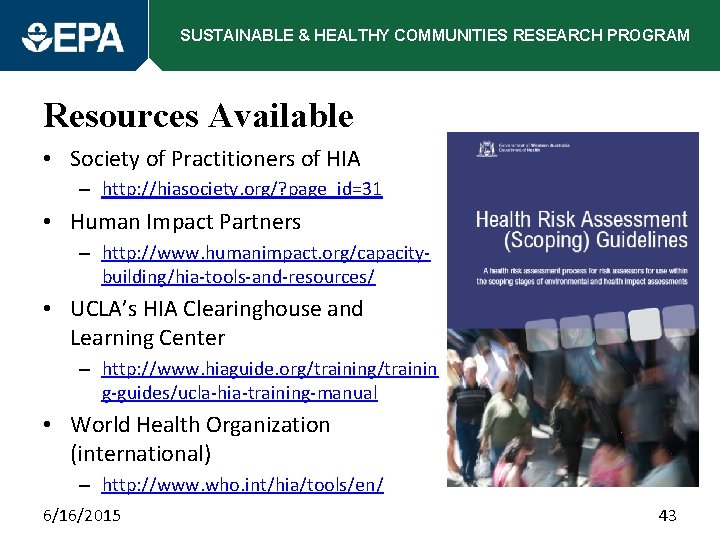
SUSTAINABLE & HEALTHY COMMUNITIES RESEARCH PROGRAM Resources Available • Society of Practitioners of HIA – http: //hiasociety. org/? page_id=31 • Human Impact Partners – http: //www. humanimpact. org/capacitybuilding/hia-tools-and-resources/ • UCLA’s HIA Clearinghouse and Learning Center – http: //www. hiaguide. org/trainin g-guides/ucla-hia-training-manual • World Health Organization (international) – http: //www. who. int/hia/tools/en/ 6/16/2015 43
SUSTAINABLE & HEALTHY COMMUNITIES RESEARCH PROGRAM Closing Remarks • Scoping is the most critical step in the HIA process. – Separate duties to save time. – Engage key stakeholders to the best extent and as early as possible. • There are many resources, tools, and guides to help you develop and complete this step. – Don’t reinvent the wheel. – Utilize an HIA Advisor • HIA is part science, part art. – Use a ROE Agreement. – Assign one point of contact. – Make sure the scope of impacts is achievable with the data, time, and resources available. 6/16/2015 44
SUSTAINABLE & HEALTHY COMMUNITIES RESEARCH PROGRAM Lauren Adkins adkins. lauren@epa. gov 513 -569 -7218 6/16/2015 Thank You! Steve White steve@ophi. org 503 -227 -5502 x 228 45
- Slides: 45