
Sustainable Future Energy Scenarios and Possibility of Fusion
Sustainable Future Energy Scenarios and Possibility of Fusion Satoshi Konishi: SEE/3 -1 Ra FUTURE POSSIBILITY OF CARBON SEQUESTRATION BY “Emission Credit” BIOMASS FUSION HYBRID SYSTEMS Shutaro Takeda : SEE/3 -1 Rb ECONOMIC PERFORMANCE OF FUSION POWER PLANT ON “Future Electricity” FUTURE DEREGULATED ELECTRICITY MARKET Nam Hoseok : SEE/3 -1 Rb TECHNO-ECONOMIC ANALYSIS OF DIESEL AND Institute of Advanced Energy, Kyoto HYDROGENUniversity “Synthetic Fuel” PRODUCTION VIA FUSION Oct. 26, 2018 BIOMASS HYBRID MODEL Mahatma Mandir Convention and Exhibition Center, Gujarat, India 27 th IAEA Fusion Energy Conference
Introduction What should fusion do in the future energy? 1. Electricity - Electricity Market is rapidly changing. Large fraction of renewables, smaller grids in developing countries, dispersed system, increased vulnerability, and deregulated market require: increased demand response, less impact and effect of stabilizing grids 2. Fuel, Heat, Industrial - Fuels to substitute fossil with less (zero) CO 2 emission (hydrogen? ) - freights, aviation and heavy transport, residential and industrial fuels
Introduction-2 What CAN fusion do in the future energy market? …we have to know the market and maximize the chance of fusion 1. Electricity SEE/3 -1 Rb Takeda The Economic Performance of Fusion Power Plant on Future Deregulated Electricity Market - Electricity price varies by bidding market. - Fusion will sell in forward market and balancing market. responding power highly evaluated/unplanned outage penalty 2. Fuel, Heat, Industrial SEE/3 -1 Rc Nam Techno-economic analysis of diesel and hydrogen production via Fusion-Biomass Hybrid Model - Fusion heat used for conversion of biomass to hydrogen or carbon-free diesel - freights, aviation and heavy transport, residential and industrial fuels 3. Global environment and climate change SEE/3 -1 Ra Konishi Future Possibility of Carbon Sequestration by Biomas-Fusion
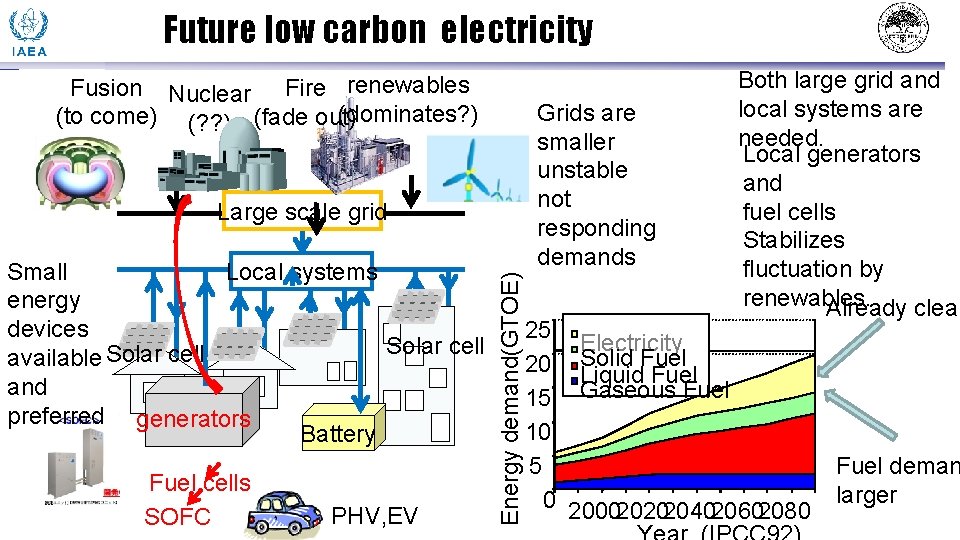
Future low carbon electricity Fusion Nuclear Fire renewables (dominates? ) (to come) (? ? ) (fade out) Grids are smaller unstable not responding demands Small Local systems energy devices Solar cell available Solar cell and preferred generators Battery Fuel cells SOFC PHV, EV Energy demand(GTOE) Large scale grid 25 20 15 10 5 0 Both large grid and local systems are needed. Local generators and fuel cells Stabilizes fluctuation by renewables. Already clean Electricity Solid Fuel Liquid Fuel Gaseous Fuel 20002020204020602080 Fuel deman larger
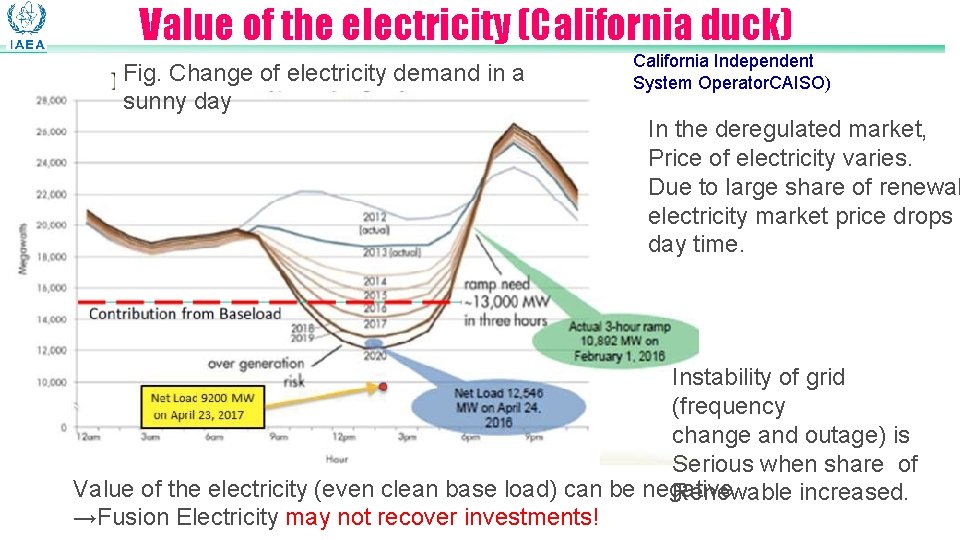
Value of the electricity (California duck) Fig. Change of electricity demand in a sunny day California Independent System Operator. CAISO) In the deregulated market, Price of electricity varies. Due to large share of renewab electricity market price drops day time. Instability of grid (frequency change and outage) is Serious when share of Value of the electricity (even clean base load) can be negative. Renewable increased. →Fusion Electricity may not recover investments!
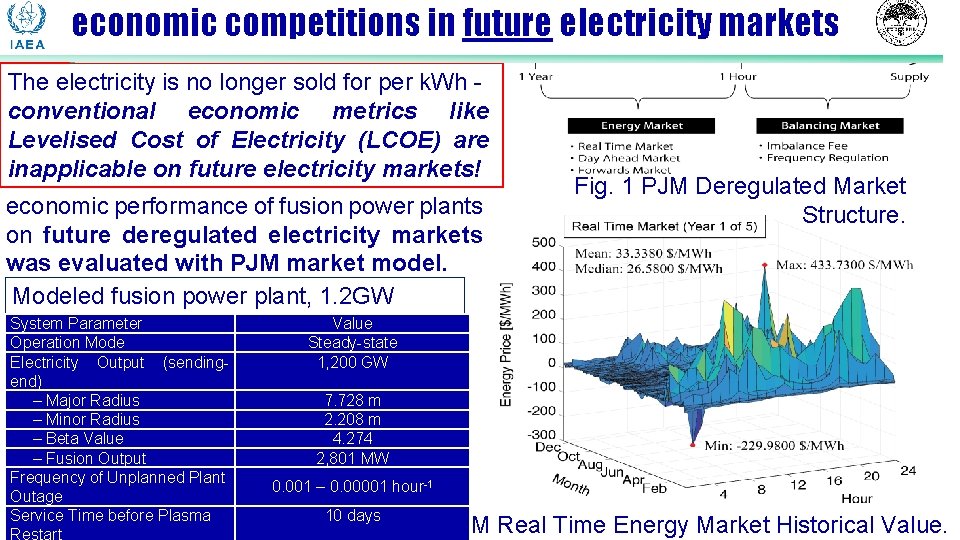
economic competitions in future electricity markets The electricity is no longer sold for per k. Wh conventional economic metrics like Levelised Cost of Electricity (LCOE) are inapplicable on future electricity markets! economic performance of fusion power plants on future deregulated electricity markets was evaluated with PJM market model. Modeled fusion power plant, 1. 2 GW System Parameter Value steady Operation Mode Electricity Output (sendingend) – Major Radius – Minor Radius – Beta Value – Fusion Output Frequency of Unplanned Plant Outage Service Time before Plasma Fig. 1 PJM Deregulated Market Structure. Steady-state 1, 200 GW 7. 728 m 2. 208 m 4. 274 2, 801 MW 0. 001 – 0. 00001 hour-1 10 days Fig. 2 PJM Real Time Energy Market Historical Value.
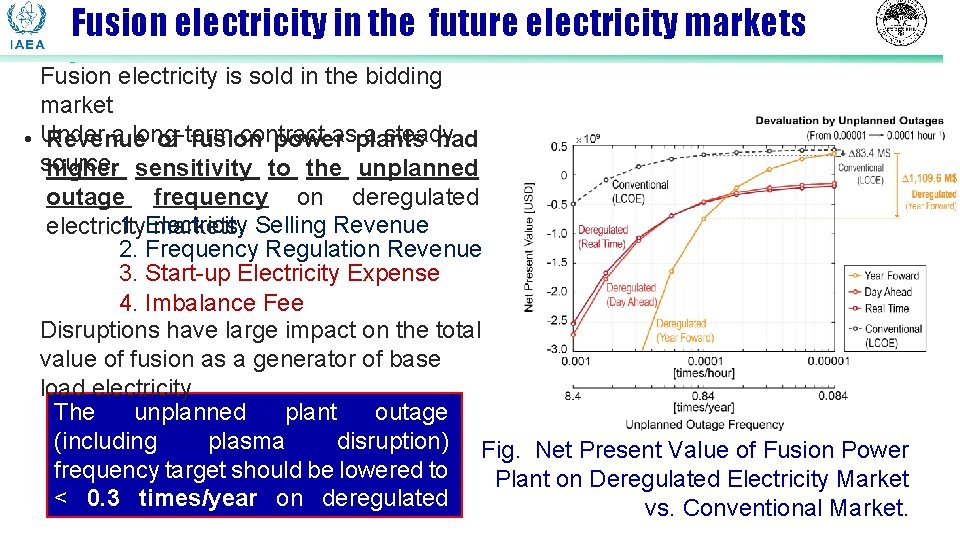
Fusion electricity in the future electricity markets Fusion electricity is sold in the bidding market a long-term contract asplants a steady • Under Revenue of fusion power had source. higher sensitivity to the unplanned outage frequency on deregulated 1. Electricity electricity markets. Selling Revenue 2. Frequency Regulation Revenue 3. Start-up Electricity Expense 4. Imbalance Fee Disruptions have large impact on the total value of fusion as a generator of base load electricity The unplanned plant outage (including plasma disruption) Fig. Net Present Value of Fusion Power frequency target should be lowered to Plant on Deregulated Electricity Market < 0. 3 times/year on deregulated vs. Conventional Market. electricity markets.
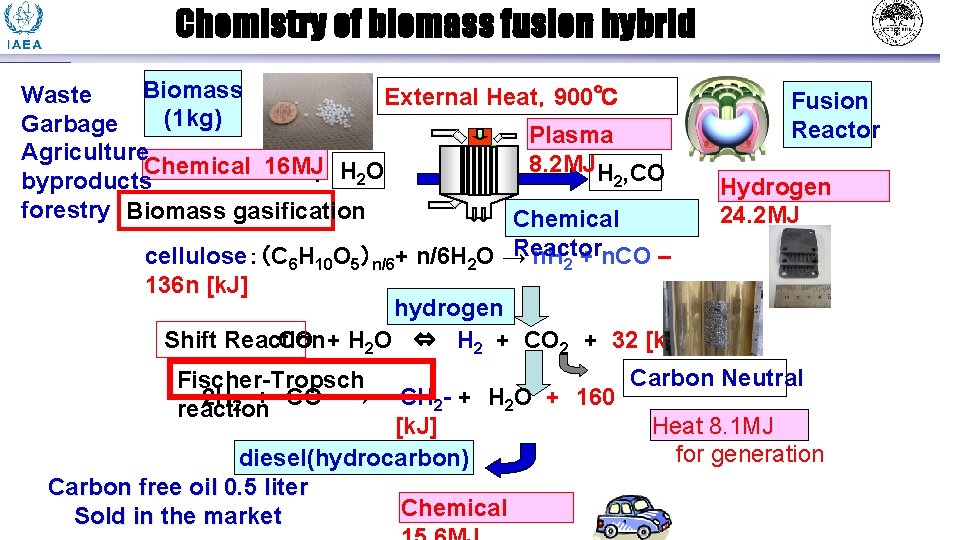
Chemistry of biomass fusion hybrid Biomass Waste External Heat,900℃ (1 kg) Garbage Plasma Agriculture 8. 2 MJ H , CO Chemical 16 MJ H O + 2 2 byproducts forestry Biomass gasification Chemical Fusion Reactor Hydrogen 24. 2 MJ Reactor cellulose:(C 6 H 10 O 5)n/6+ n/6 H 2 O → n. H 2 + n. CO – 136 n [k. J] hydrogen Shift Reaction CO + H 2 O ⇔ H 2 + CO 2 + 32 [k. J] Carbon Neutral Fischer-Tropsch 2 H 2 + CO → -CH 2 - + H 2 O + 160 reaction Heat 8. 1 MJ [k. J] for generation diesel(hydrocarbon) Carbon free oil 0. 5 liter Chemical Sold in the market
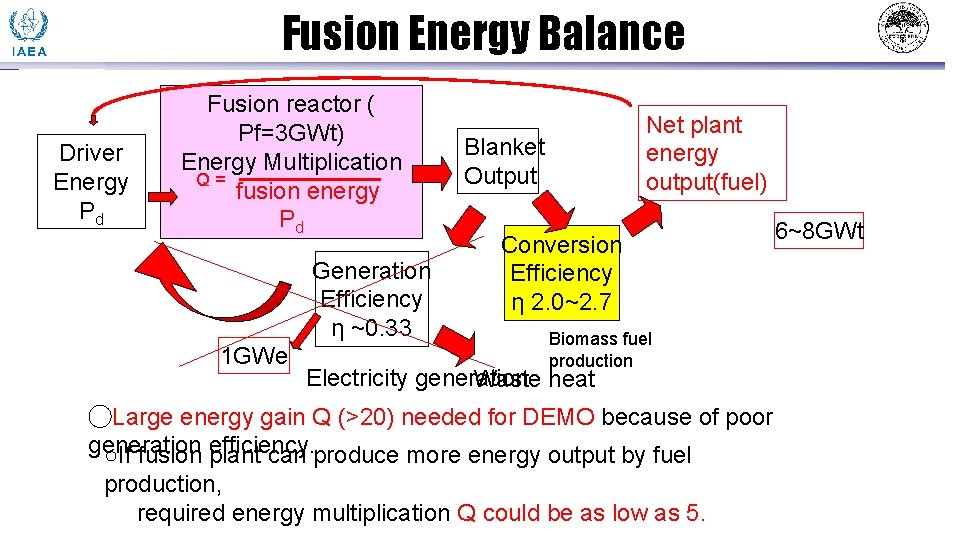
Fusion Energy Balance Driver Energy Pd Fusion reactor ( Pf=3 GWt) Energy Multiplication Q= fusion energy Pd Generation Efficiency η ~0. 33 1 GWe Net plant energy output(fuel) Blanket Output Conversion Efficiency η 2. 0~2. 7 Biomass fuel production Electricity generation Waste heat ◯Large energy gain Q (>20) needed for DEMO because of poor generation ○If fusion efficiency. plant can produce more energy output by fuel production, required energy multiplication Q could be as low as 5. 6~8 GWt
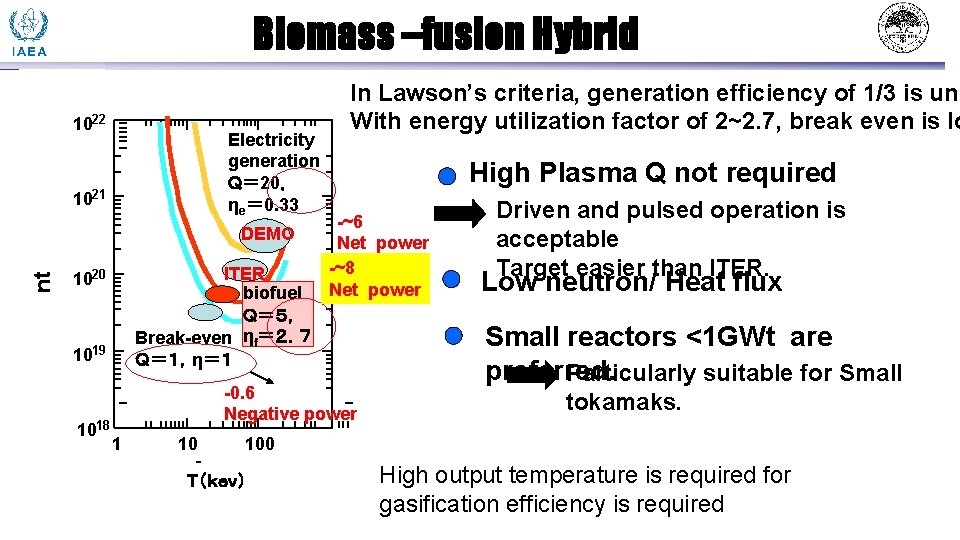
Biomass –fusion Hybrid 1022 Electricity generation Q= 20, ηe= 0. 33 1021 nt DEMO ITER biofuel Q=5, Break-even ηf=2.7 Q=1,η=1 1020 1019 1018 In Lawson’s criteria, generation efficiency of 1/3 is una With energy utilization factor of 2~2. 7, break even is lo High Plasma Q not required -~6 Net power -~8 Net power -0. 6 Negative power 1 10 Driven and pulsed operation is acceptable Target easier than ITER. Low neutron/ Heat flux Small reactors <1 GWt are preferred. Particularly suitable for Small tokamaks. 100 T(kev) High output temperature is required for gasification efficiency is required
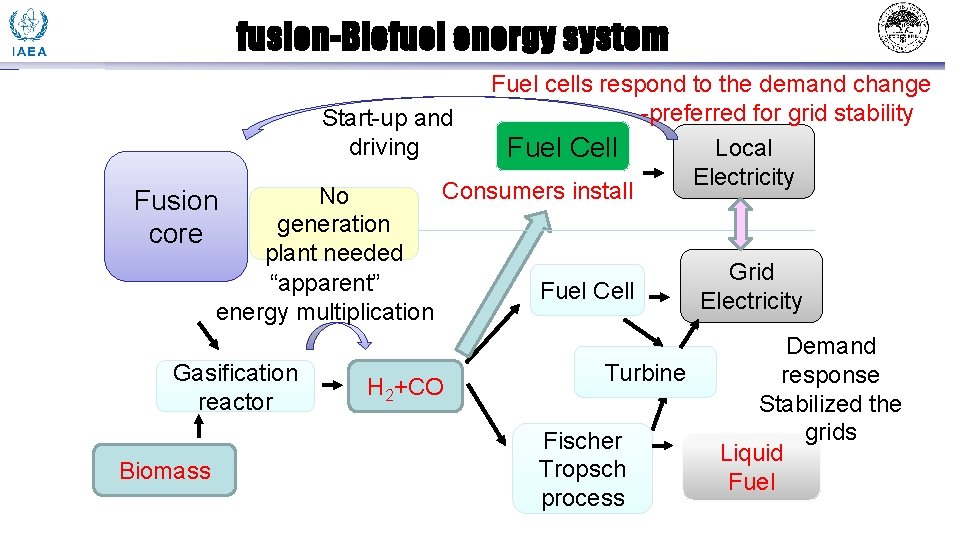
fusion-Biofuel energy system Fuel cells respond to the demand change -preferred for grid stability Start-up and driving Local Fuel Cell Electricity Consumers install No Fusion generation core plant needed Grid “apparent” Fuel Cell Electricity energy multiplication Demand Turbine Gasification response H 2+CO reactor Stabilized the grids Fischer Liquid Tropsch Biomass Fuel process
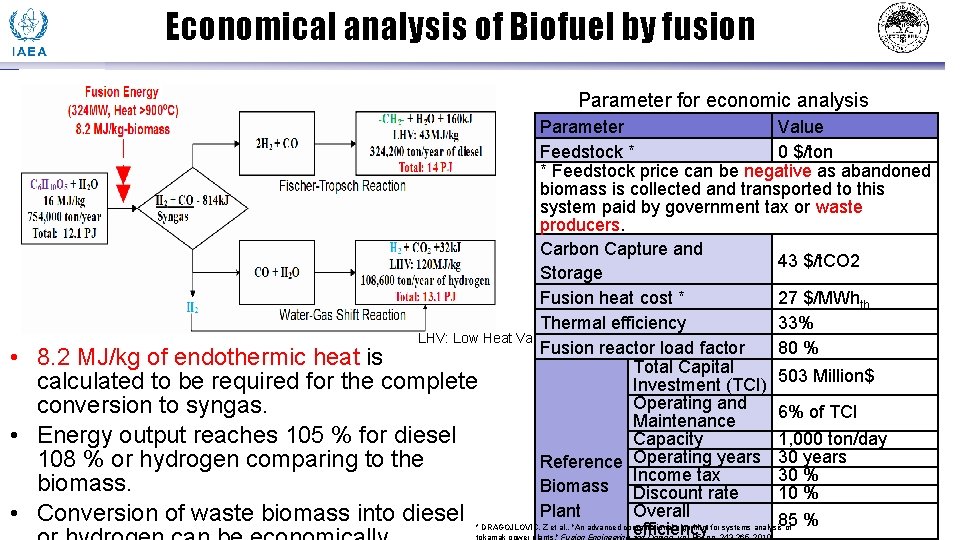
Economical analysis of Biofuel by fusion Parameter for economic analysis • • • Parameter Value Feedstock * 0 $/ton * Feedstock price can be negative as abandoned biomass is collected and transported to this system paid by government tax or waste producers. Carbon Capture and 43 $/t. CO 2 Storage Fusion heat cost * 27 $/MWhth Thermal efficiency 33% LHV: Low Heat Value Fusion reactor load factor 80 % 8. 2 MJ/kg of endothermic heat is Total Capital calculated to be required for the complete Investment (TCI) 503 Million$ Operating and conversion to syngas. 6% of TCI Maintenance Energy output reaches 105 % for diesel Capacity 1, 000 ton/day 108 % or hydrogen comparing to the Reference Operating years 30 years Income tax 30 % biomass. Biomass Discount rate 10 % Overall Conversion of waste biomass into diesel * DRAGOJLOVIC, Plant 85 Z et al. , "An advanced computational algorithm for systems analysis of % efficiency tokamak power plants, " Fusion Engineering and Design, vol. 85, pp. 243 -265, 2010.
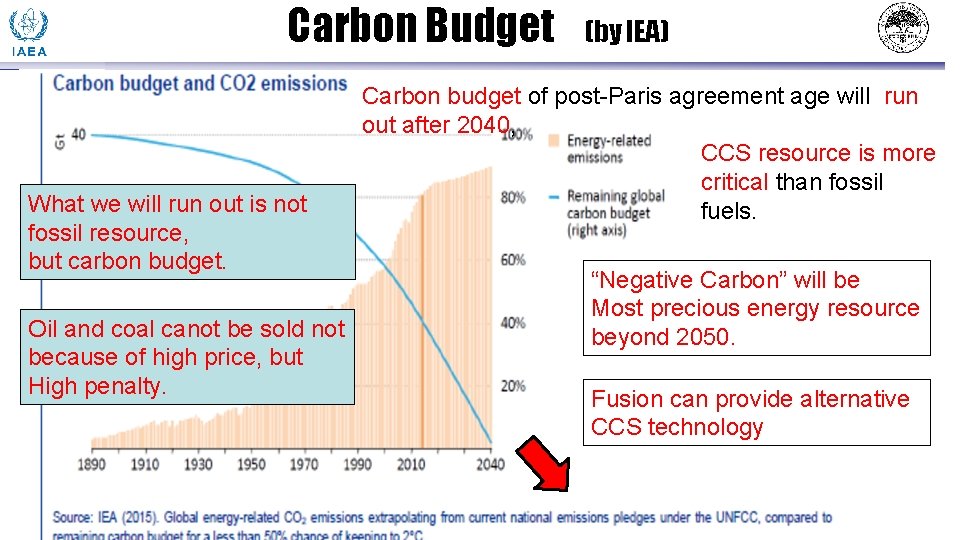
Carbon Budget What we will run out is not fossil resource, but carbon budget. Oil and coal canot be sold not because of high price, but High penalty. (by IEA) Carbon budget of post-Paris agreement age will run out after 2040, CCS resource is more critical than fossil fuels. “Negative Carbon” will be Most precious energy resource beyond 2050. Fusion can provide alternative CCS technology
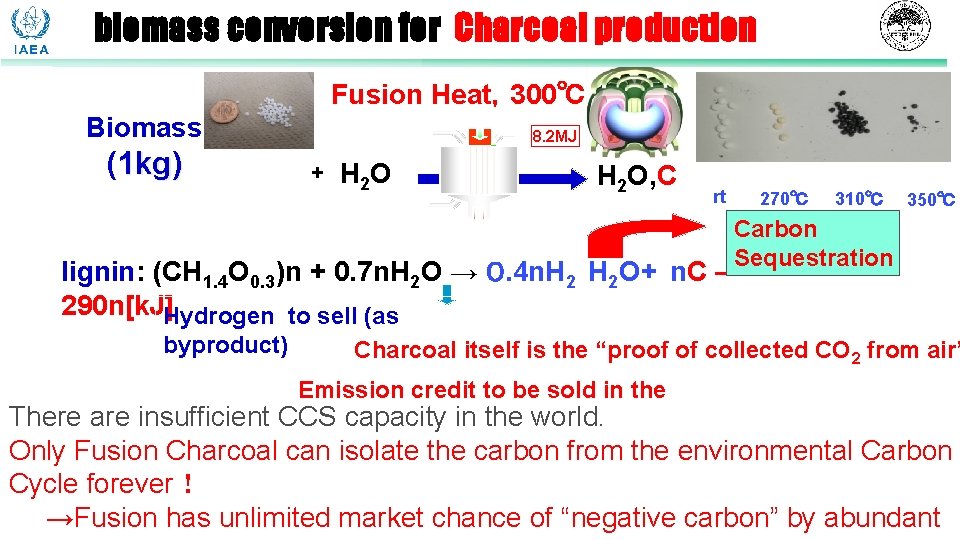
biomass conversion for Charcoal production Fusion Heat,300℃ Biomass (1 kg) 8. 2 MJ + H 2 O, C rt lignin: (CH 1. 4 O 0. 3)n + 0. 7 n. H 2 O → 0. 4 n. H 2 O+ n. C – 290 n[k. J]Hydrogen to sell (as byproduct) 270℃ 310℃ 350℃ Carbon Sequestration Charcoal itself is the “proof of collected CO 2 from air” Emission credit to be sold in the There are insufficient CCS capacity in the world. Only Fusion Charcoal can isolate the carbon from the environmental Carbon Cycle forever! →Fusion has unlimited market chance of “negative carbon” by abundant
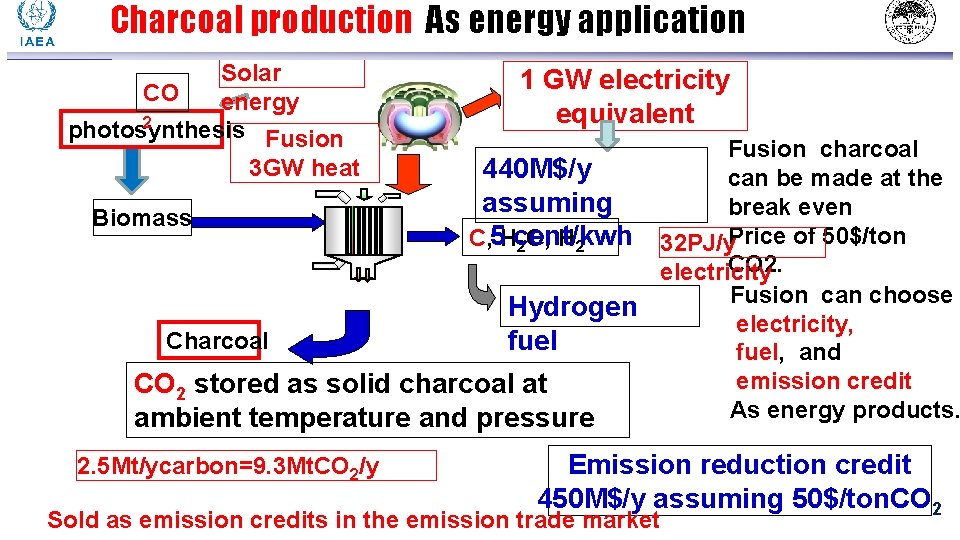
Charcoal production As energy application Solar CO energy 2 photosynthesis Fusion 1 GW electricity equivalent Fusion charcoal 3 GW heat 440 M$/y can be made at the assuming break even Biomass C, 5 Hcent/kwh 32 PJ/y. Price of 50$/ton 2 O, H 2 CO 2. electricity Fusion can choose Hydrogen electricity, Charcoal fuel, and emission credit CO 2 stored as solid charcoal at As energy products. ambient temperature and pressure 2. 5 Mt/ycarbon=9. 3 Mt. CO 2/y Emission reduction credit 450 M$/y assuming 50$/ton. CO 2 Sold as emission credits in the emission trade market
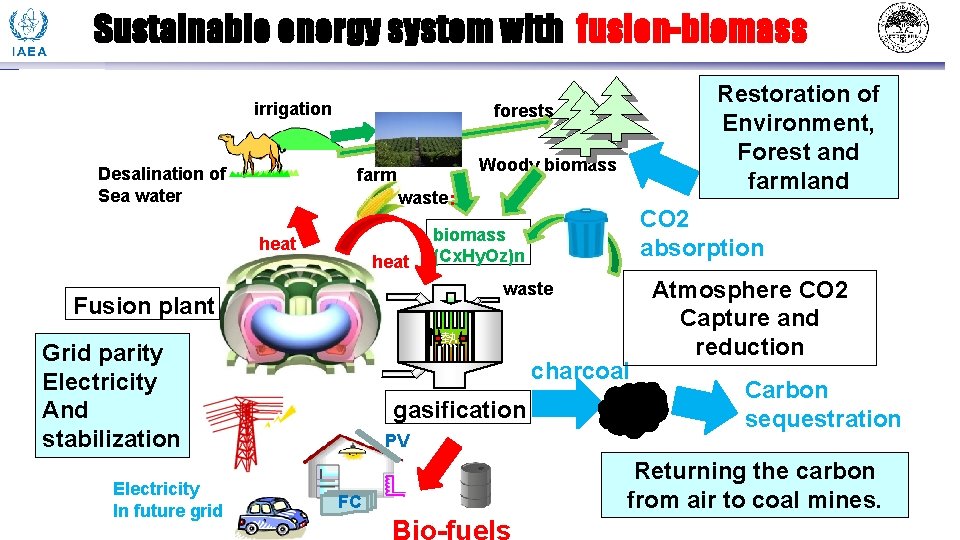
Sustainable energy system with fusion-biomass irrigation Desalination of Sea water forests Woody biomass farm waste: heat CO 2 absorption biomass (Cx. Hy. Oz)n waste Fusion plant 熱 Grid parity Electricity And stabilization Electricity In future grid Restoration of Environment, Forest and farmland charcoal gasification PV FC Atmosphere CO 2 Capture and reduction Carbon sequestration Returning the carbon from air to coal mines.
Summary of future energy system study Future Energy Systems analyzed to reconsider fusion target. 1. Base load electricity may not make expected return of investment. Levelized Cost of Electricity (LCOE) is not suitable for economical evaluation, Electricity will be sold by bidding ; price is determined by the market mechanism. - as a base load electricity, outage frequency has strong impact. More conservative design required 2. Biomass-fuel by fusion is economically viable to replace fossil (diesel) and hydrogen. Required Q is <5, easier for near future reactor target. Estimated break-even cost is competitive for diesel/H 2. 3. Carbon Sequestration by Fusion-Charcoal Can be sold as CO 2 credit in emission trade market.
Conclusion If the final target of the fusion development is the pursuit of the “sustainable development” of humankind, Generating electricity is not sufficient. we have to develop and design fusion to meet the future requirements (not past). The entire scope of the fusion deployment may be ・to achieve best grid compatibility in the clean electricity supply mix, to adopt to future grids ・Clean Fuel (gas and liquid) production from waste biomass to provide fossil substitute, and ・to provide technology to capture and decrease CO 2 from atmosphere, by charcoal production for negative carbon cycle

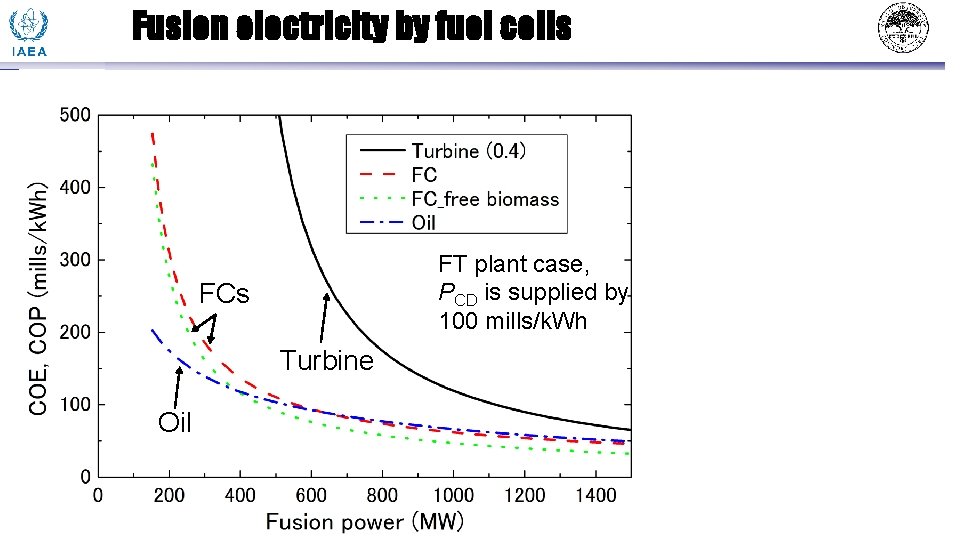
Fusion electricity by fuel cells FT plant case, PCD is supplied by 100 mills/k. Wh FCs Turbine Oil
- Slides: 20