
Sustainable Food Value Chain for Food Security in
Sustainable Food Value Chain for Food Security in Arena of Climate Change National Workshop On “Food Security and Climate Change” Tuesday, 2 June, 2015 Anand Agricultural University, Anand, Gujarat HETAL C SEJU NCCSD 1

National Council for Climate Change, Sustainable Development and Public Leadership Sustainable Food Value Chain • Currently a Food Value Chain exists It operates for ü Small farmers – to local traders – APMC – wholesaler – retailers – consumers ü Big farmers - APMC – wholesaler – retailers - consumers Milk in Gujarat ü Animal holder – milk produce societies – district union – market federation
National Council for Climate Change, Sustainable Development and Public Leadership • But current value chain does not pay attention to losses harvesting – to marketing – up to consumer level – these range from 5% to 25% • If they are plugged, farmers can get increased income by 5% to 25%. So will be food stock enhanced by same percentage. • This help both – Sustainable Livelihood and Food Security
National Council for Climate Change, Sustainable Development and Public Leadership Causes of food losses and waste Food is mostly lost and wasted, because of the way food is: • produced; • handled after harvest; • stored; • preserved; and • processed • Transported In addition, food is lost and wasted due to people’s lack of access to better market as a result of: • insufficient income; • forced to make sale to local traders cum money lender – for example in Gujarat 54% farmers are indebted while in Andhra Pradesh is 84% • lack of or inadequate infrastructure, such as roads, railways, waterways, port infrastructure. • Lack of facility of bulk transport at local level 4
National Council for Climate Change, Sustainable Development and Public Leadership With the end users – consumers it is due to : • how food is stored; • prepared and cooked; in case of vegetable and fruits – how it is sliced and • Wastage due to people buying more food than they need, take more food in their plates than they can eat – leave residue in the plate and finally throw all these in garbage. 5
National Council for Climate Change, Sustainable Development and Public Leadership Food production stage Vegetable commodities and products • Pre-harvest cultivating and harvesting practices influence the post-harvest life of products due to decisions made regarding what, when and how to plant and when to harvest (FAO, 1998). • Pre-harvest – this includes selection crop, quality of seeds, cultivation practices, quantity of water, type of soil all affect post-harvest quality, shelf life and postharvest losses. The selection of crop should be based on soil fertility and farmers should be guided by soil health analysis. • Good post-harvest practices can also prolong the post-harvest life particularly of fruits and vegetables. • Sometimes food may be lost due to premature harvesting as farmers may decide to harvest crops earlier, because they are food insecure or need to generate income. • It may also happen that harvesting is undertaken too late or that losses occur during harvesting due to damage and/or spillage. 6

National Council for Climate Change, Sustainable Development and Public Leadership Smart agricultural practices and rules of harvesting • Smart agricultural practices involve adequate soil management, selection of crop which soil fertility can support, use of certified seeds, management of weeds, crop protection and maintenance of crop hygiene. • The latter involves the collection and removal of decaying plants, fruits and weed that can lead to infections in vegetables and fruits, which may result in post-harvest losses and waste. The basic rules of harvesting with the aim to get the crops in the best possible condition to the market are: • harvest during the lowest temperature of the day: early morning or late afternoon; • do not harvest produce when it is raining or when there is dew, when the produce is wet it is more likely to decay as well as it is more vulnerable to damage; and • make sure to protect the harvested produce from sunlight if it cannot be immediately transported. 7

National Council for Climate Change, Sustainable Development and Public Leadership Post-harvest handling and food storage stage and food processing stage Vegetable commodities, livestock and dairy products and fish commodities Food losses and waste of crop, livestock and fish products at the postharvest handling & storage stages and at the processing stage may occur due to: • spoilage, as a result of lack of or inadequate cooling facilities and lack of adequate infrastructure for transportation; • spillage, contamination, and degradation are a result of poor and inadequate handling during transport and storage. They are also due to processing, such as during washing, peeling, slicing and boiling of fruits, vegetables. • inadequate preservation of the products; • packaging, as a result of damaging due to use of poor quality containers. (FAO, 1989; Parfitt et al. , 2010; FAO, 2010 b; FAO, 2011 d) 8
National Council for Climate Change, Sustainable Development and Public Leadership Good post-harvest handling and storage practices A variety of practices and technologies are available for reducing postharvest losses related to post-harvest handling and storage. Good handling practices in order to avoid mechanical damages include ensuring that: • Bags are not too full if they need to be stacked on top of each other; • Bags are not dropped or thrown; • produce is not directly put on the soil, in particular soil with a high moisture content; • containers and field containers are clean; • the produce is not brought into contact with oil, gasoline or chemicals that should not be applied; • produce is largely kept in the shade to reduce the temperature of fresh produce; • produce is field packaged, which reduces costs by improving the speed of post-harvest handling and reduces losses and waste (FAO, 1989) 9
National Council for Climate Change, Sustainable Development and Public Leadership Other possible interventions to reduce food losses include: • immediate transportation after harvesting of crops, and landing in the case of fish; • using improved preservation and processing techniques including threshing and solar drying of produce; • using low cost and efficient storage and cooling structures; and • using practices, i. e. pasteurization and milk processing into cheese and yoghurt, to maintain product quality and extend post-harvest life. 10
National Council for Climate Change, Sustainable Development and Public Leadership Public Distributions System • In our country government buys food grains and makes available through fare price network – at a specified price – which is subsidized to poor families. • This system involves – procurement, packing, transportation to storage – godowns and from there to retail FPS. • Entire system needs modern management and practices to reduce transportation losses, storage losses and spoilage – which is huge. 11
National Council for Climate Change, Sustainable Development and Public Leadership Public actions to support food chain interventions to reduce, reuse or recycle food stuffs Government can not directly reduce, reuse or recycle food stuffs produced by farmers but certainly can guide the farmers to change management practices, technologies and behavior in order to reduce, reuse or recycle their produce and create an enabling environment. • Set an example by itself by reducing godown and transits losses in public distribution system and including re-cycle use of wastage. • Creating a policy and institutional enabling environment for incentivizing reduction in losses • Awareness raising and advocacy for reuse – recycle waste – agro, cow dung and urine, and food 12
National Council for Climate Change, Sustainable Development and Public Leadership • Building partnerships and alliances by promoting women self help groups for village level group market and local processing, encouraging and assisting youth to set-up micro-enterprise and adapt modern agricultural practices. • Supporting product and process innovation and research at the stage assign specific responsibilities to agricultural universities • Capacity development – farmers, godown maneger, APMC managers and even housewives. 13
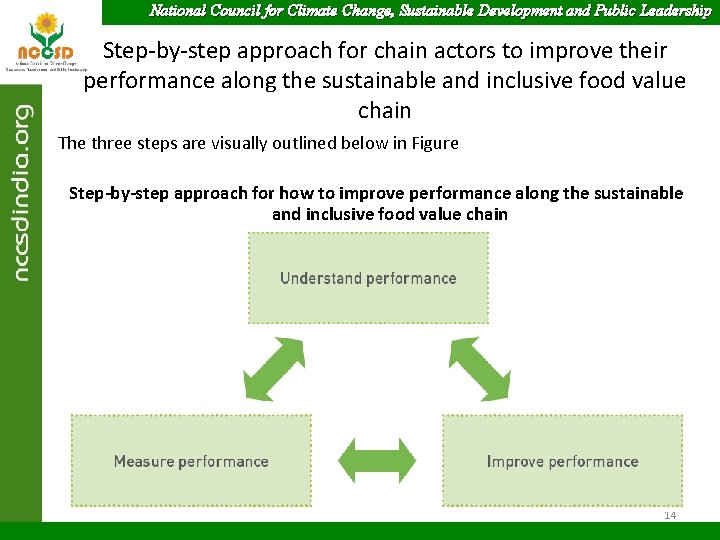
National Council for Climate Change, Sustainable Development and Public Leadership Step-by-step approach for chain actors to improve their performance along the sustainable and inclusive food value chain The three steps are visually outlined below in Figure Step-by-step approach for how to improve performance along the sustainable and inclusive food value chain 14
National Council for Climate Change, Sustainable Development and Public Leadership Case Studies 15
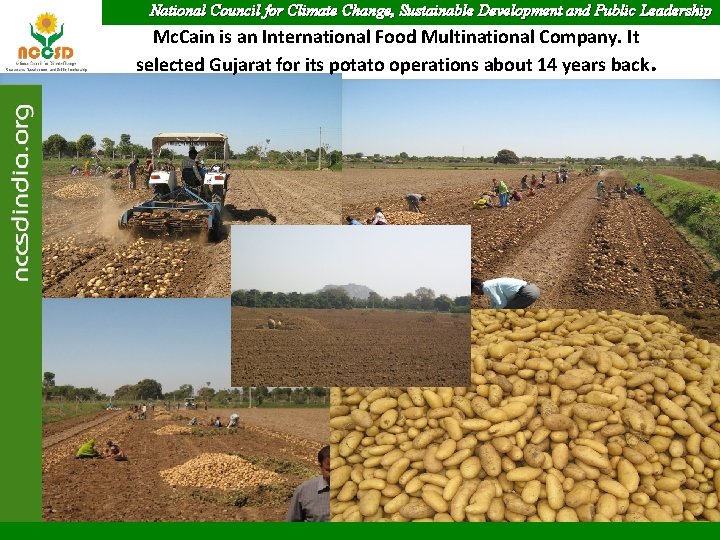
National Council for Climate Change, Sustainable Development and Public Leadership Mc. Cain is an International Food Multinational Company. It selected Gujarat for its potato operations about 14 years back.
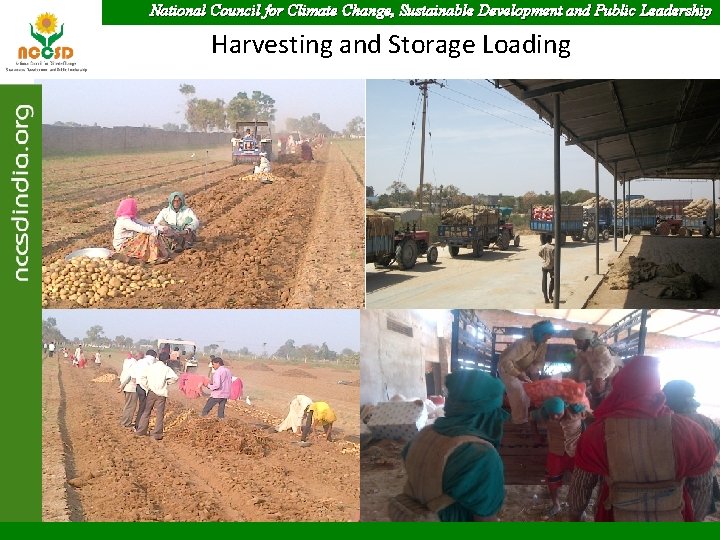
National Council for Climate Change, Sustainable Development and Public Leadership Harvesting and Storage Loading 17
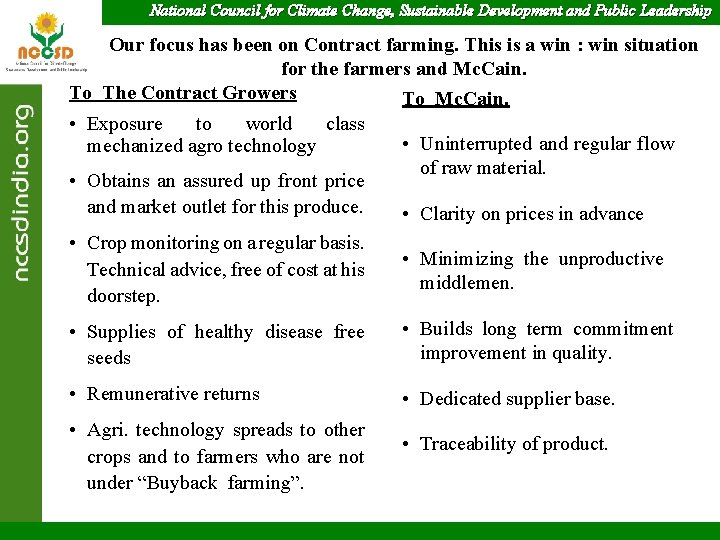
National Council for Climate Change, Sustainable Development and Public Leadership Our focus has been on Contract farming. This is a win : win situation for the farmers and Mc. Cain. To The Contract Growers To Mc. Cain. • Exposure to world class • Uninterrupted and regular flow mechanized agro technology of raw material. • Obtains an assured up front price and market outlet for this produce. • Clarity on prices in advance • Crop monitoring on a regular basis. Technical advice, free of cost at his doorstep. • Minimizing the unproductive middlemen. • Supplies of healthy disease free seeds • Builds long term commitment improvement in quality. • Remunerative returns • Dedicated supplier base. • Agri. technology spreads to other crops and to farmers who are not under “Buyback farming”. • Traceability of product.
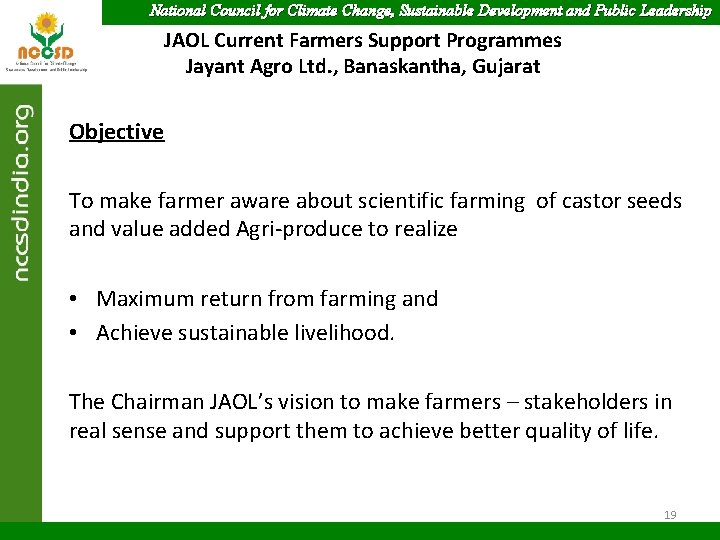
National Council for Climate Change, Sustainable Development and Public Leadership JAOL Current Farmers Support Programmes Jayant Agro Ltd. , Banaskantha, Gujarat Objective To make farmer aware about scientific farming of castor seeds and value added Agri-produce to realize • Maximum return from farming and • Achieve sustainable livelihood. The Chairman JAOL’s vision to make farmers – stakeholders in real sense and support them to achieve better quality of life. 19
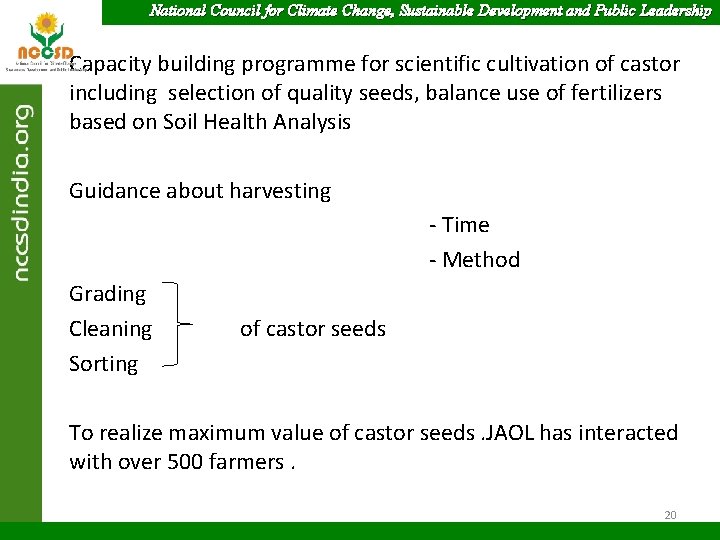
National Council for Climate Change, Sustainable Development and Public Leadership Capacity building programme for scientific cultivation of castor including selection of quality seeds, balance use of fertilizers based on Soil Health Analysis Guidance about harvesting - Time - Method Grading Cleaning of castor seeds Sorting To realize maximum value of castor seeds. JAOL has interacted with over 500 farmers. 20
National Council for Climate Change, Sustainable Development and Public Leadership Value Added Agriculture • JAOL is purchasing castor seeds at farmers’ door step • It provides them price of the day which is prevalent in the market • It provides bags for packaging and cleaning equipment • It assists farmers to form group – village association so that a truck load of seeds can be sent • Farmers have got price of castor seeds which prevalent in Deesa Market in their own village 21
National Council for Climate Change, Sustainable Development and Public Leadership Thank You National Council for Climate Change, Sustainable Development and Public Leadership (NCCSD) Patel Block, Rajdeep Electronics Compound, Stadium Circle, Navrangpura, Ahmedabad – 380 014. Gujarat, INDIA. Phone: + 91 79 -26421580 (Off) Email: info@nccsdindia. org Website: www. nccsdindia. org 22
- Slides: 22