
SUSTAINABLE FOOD FOOD GLOBALIZATION TRANSNATIONAL MEETING MESSINA M
SUSTAINABLE FOOD & FOOD GLOBALIZATION TRANSNATIONAL MEETING MESSINA M A Y 2018 ECOFOOD-BIOFOOD & FAIRTRADE
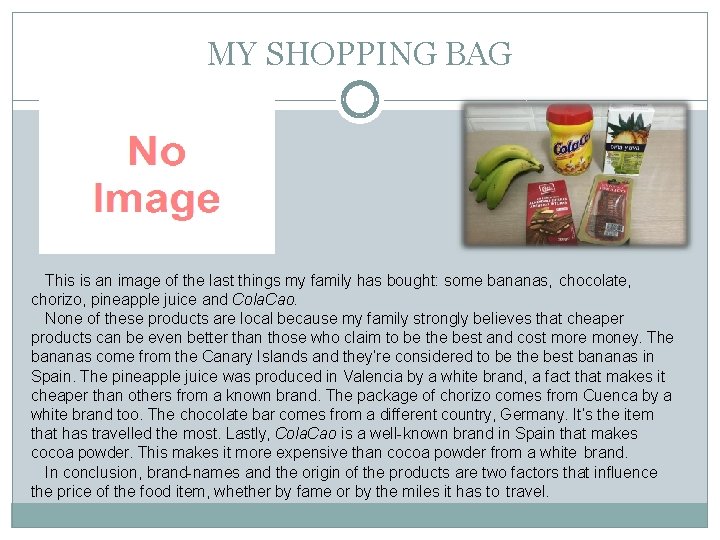
MY SHOPPING BAG This is an image of the last things my family has bought: some bananas, chocolate, chorizo, pineapple juice and Cola. Cao. None of these products are local because my family strongly believes that cheaper products can be even better than those who claim to be the best and cost more money. The bananas come from the Canary Islands and they’re considered to be the best bananas in Spain. The pineapple juice was produced in Valencia by a white brand, a fact that makes it cheaper than others from a known brand. The package of chorizo comes from Cuenca by a white brand too. The chocolate bar comes from a different country, Germany. It’s the item that has travelled the most. Lastly, Cola. Cao is a well-known brand in Spain that makes cocoa powder. This makes it more expensive than cocoa powder from a white brand. In conclusion, brand-names and the origin of the products are two factors that influence the price of the food item, whether by fame or by the miles it has to travel.
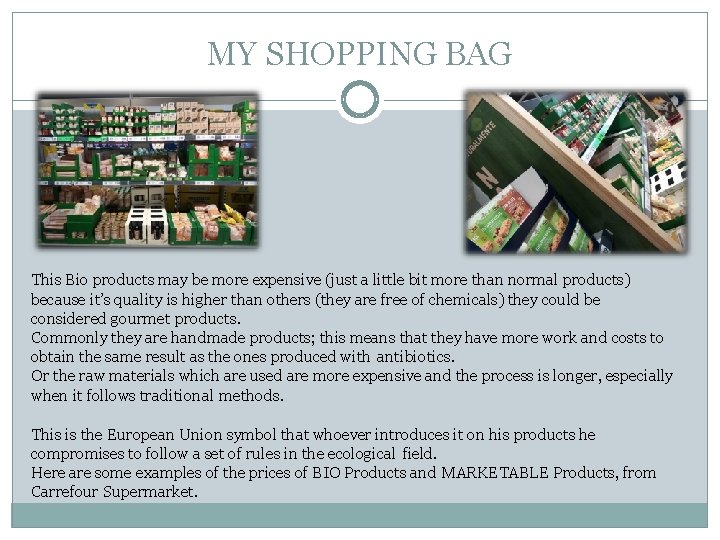
MY SHOPPING BAG This Bio products may be more expensive (just a little bit more than normal products) because it’s quality is higher than others (they are free of chemicals) they could be considered gourmet products. Commonly they are handmade products; this means that they have more work and costs to obtain the same result as the ones produced with antibiotics. Or the raw materials which are used are more expensive and the process is longer, especially when it follows traditional methods. This is the European Union symbol that whoever introduces it on his products he compromises to follow a set of rules in the ecological field. Here are some examples of the prices of BIO Products and MARKETABLE Products, from Carrefour Supermarket.
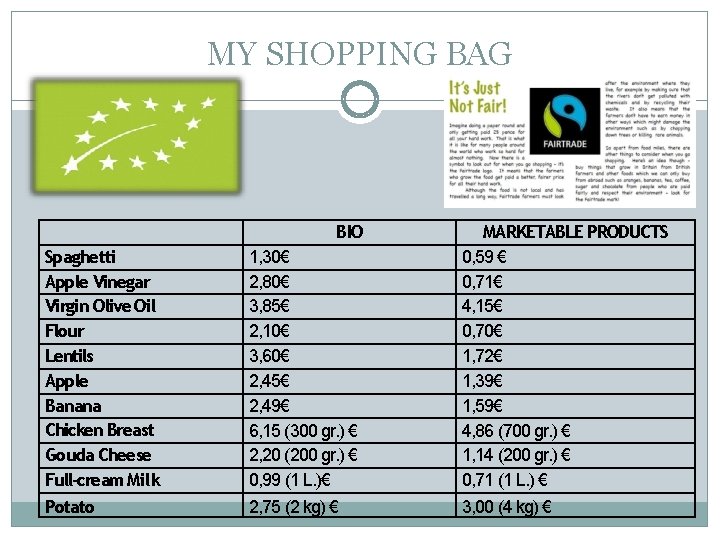
MY SHOPPING BAG BIO Spaghetti Apple Vinegar Virgin Olive Oil Flour Lentils Apple Banana Chicken Breast Gouda Cheese Full-cream Milk Potato 1, 30€ 2, 80€ 3, 85€ 2, 10€ 3, 60€ 2, 45€ 2, 49€ 6, 15 (300 gr. ) € 2, 20 (200 gr. ) € 0, 99 (1 L. )€ 2, 75 (2 kg) € MARKETABLE PRODUCTS 0, 59 € 0, 71€ 4, 15€ 0, 70€ 1, 72€ 1, 39€ 1, 59€ 4, 86 (700 gr. ) € 1, 14 (200 gr. ) € 0, 71 (1 L. ) € 3, 00 (4 kg) €
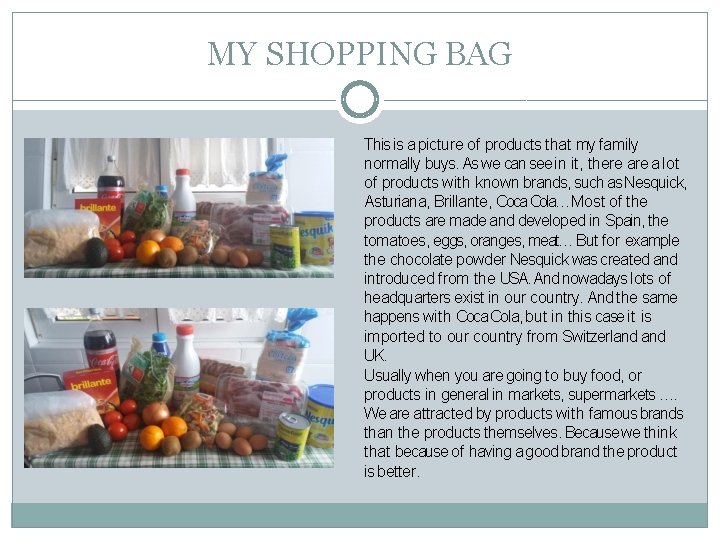
MY SHOPPING BAG This is a picture of products that my family normally buys. As we can see in it, there a lot of products with known brands, such as Nesquick, Asturiana, Brillante, Coca Cola… Most of the products are made and developed in Spain, the tomatoes, eggs, oranges, meat… But for example the chocolate powder Nesquick was created and introduced from the USA. And nowadays lots of headquarters exist in our country. And the same happens with Coca Cola, but in this case it is imported to our country from Switzerland UK. Usually when you are going to buy food, or products in general in markets, supermarkets …. We are attracted by products with famous brands than the products themselves. Because we think that because of having a good brand the product is better.
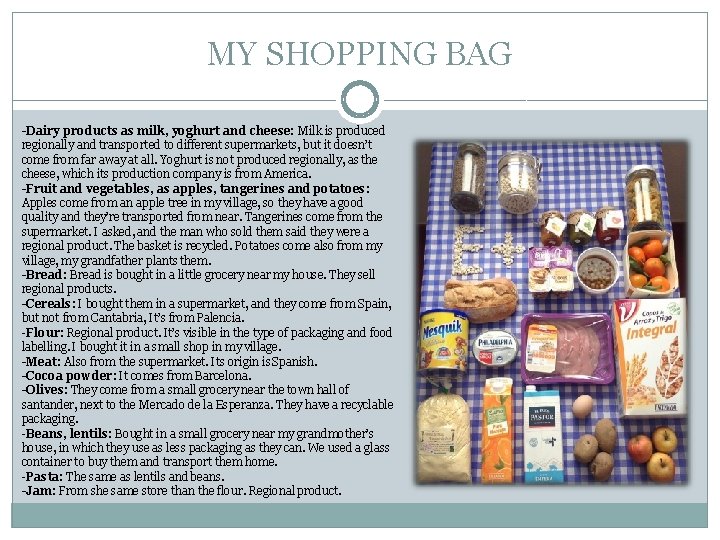
MY SHOPPING BAG -Dairy products as milk, yoghurt and cheese: Milk is produced regionally and transported to different supermarkets, but it doesn’t come from far away at all. Yoghurt is not produced regionally, as the cheese, which its production company is from America. -Fruit and vegetables, as apples, tangerines and potatoes: Apples come from an apple tree in my village, so they have a good quality and they’re transported from near. Tangerines come from the supermarket. I asked, and the man who sold them said they were a regional product. The basket is recycled. Potatoes come also from my village, my grandfather plants them. -Bread: Bread is bought in a little grocery near my house. They sell regional products. -Cereals: I bought them in a supermarket, and they come from Spain, but not from Cantabria, It’s from Palencia. -Flour: Regional product. It’s visible in the type of packaging and food labelling. I bought it in a small shop in my village. -Meat: Also from the supermarket. Its origin is Spanish. -Cocoa powder: It comes from Barcelona. -Olives: They come from a small grocery near the town hall of santander, next to the Mercado de la Esperanza. They have a recyclable packaging. -Beans, lentils: Bought in a small grocery near my grandmother’s house, in which they use as less packaging as they can. We used a glass container to buy them and transport them home. -Pasta: The same as lentils and beans. -Jam: From she same store than the flour. Regional product.
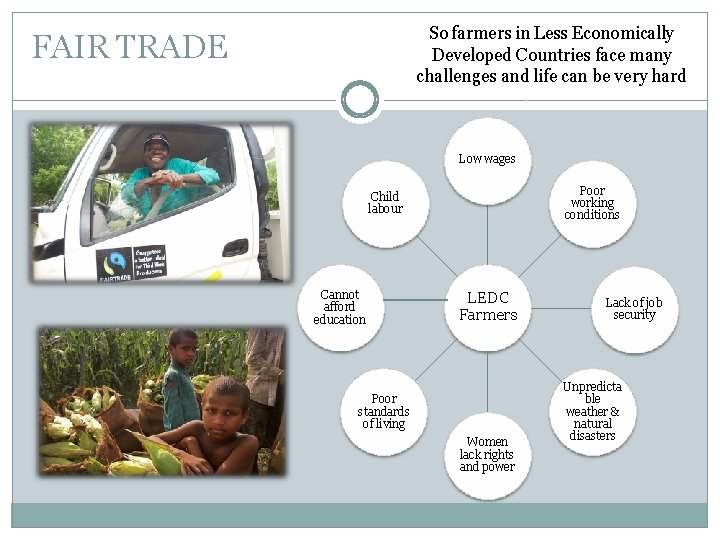
So farmers in Less Economically Developed Countries face many challenges and life can be very hard FAIR TRADE Low wages Poor working conditions Child labour Cannot afford education LEDC Farmers Poor standards of living Women lack rights and power Lack of job security Unpredicta ble weather & natural disasters
Fairtrade Principles Fair trade food production aims to provide fair prices and better working conditions for famers and farm workers Fairtrade premium to invest in community Technical training There are now over 1. 65 million fairtrade farmers and workers in 1, 226 producer organisations in 74 countries (fairtrade. org) Guaranteed minimum price & secure income Fair wage Fairtrade Sustainable farming methods Safe working conditions Protection of workers’ rights No child labour
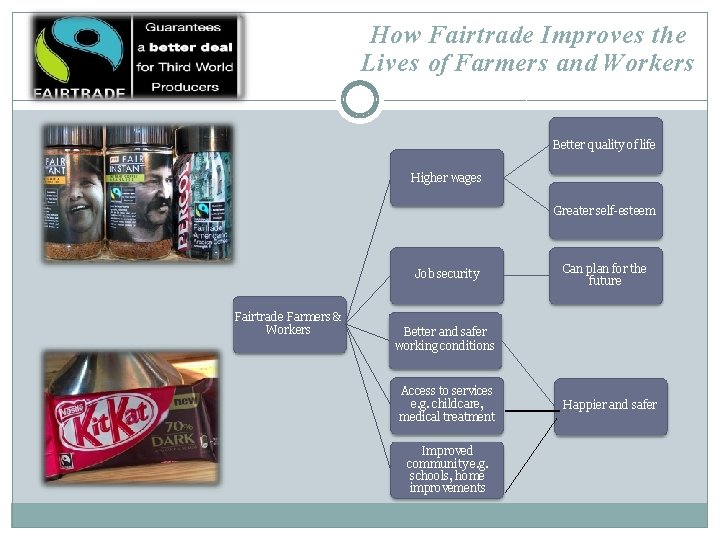
How Fairtrade Improves the Lives of Farmers and Workers Better quality of life Higher wages Greater self-esteem Job security Fairtrade Farmers & Workers Can plan for the future Better and safer working conditions Access to services e. g. childcare, medical treatment Improved community e. g. schools, home improvements Happier and safer
When you buy a product with the Fairtrade mark you know it has been certified to offer a better deal for the farmers and workers involved Photo: Luke Payn
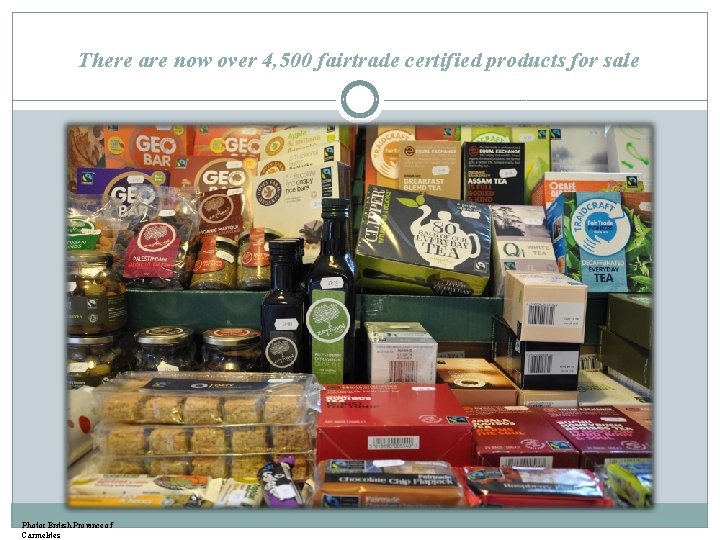
There are now over 4, 500 fairtrade certified products for sale Photo: British Province of Carmelites
Credits M A R I O FU E N T E L U CIA IG LES IAS J O N E PA G A L D AY E L E N A MIÑ OR A N D R E A T U R I E N ZO L U C Y C A S TA Ñ E D A
- Slides: 12