
Sustainable Fisheries Division Southeast Fisheries Science Center Miami
Sustainable Fisheries Division Southeast Fisheries Science Center, Miami, Florida Managing Stock Complexes Using Indicator Species: Pros and Cons Caribbean Fishery Management Council: SSC Meeting San Juan, Puerto Rico April 19, 2016 Shannon L. Cass-Calay and Clay E. Porch
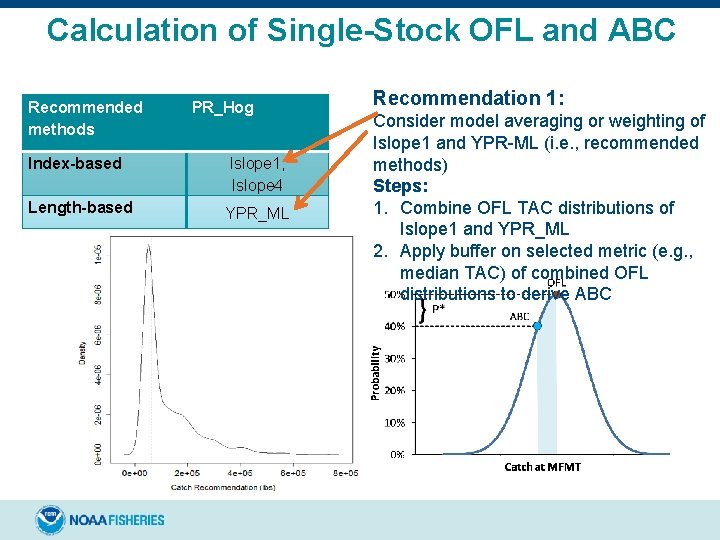
Calculation of Single-Stock OFL and ABC Recommended methods PR_Hog Index-based Islope 1, Islope 4 Length-based YPR_ML Recommendation 1: Consider model averaging or weighting of Islope 1 and YPR-ML (i. e. , recommended methods) Steps: 1. Combine OFL TAC distributions of Islope 1 and YPR_ML 2. Apply buffer on selected metric (e. g. , median TAC) of combined OFL distributions to derive ABC
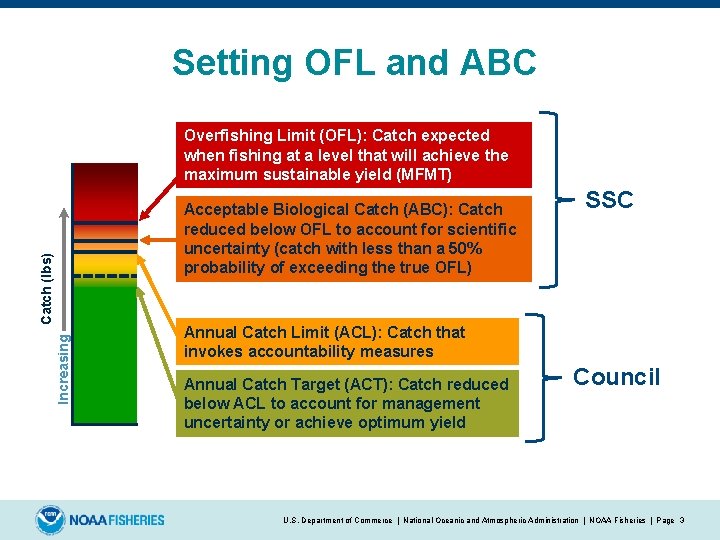
Setting OFL and ABC Overfishing Limit (OFL): Catch expected when fishing at a level that will achieve the maximum sustainable yield (MFMT) Increasing Catch (lbs) Acceptable Biological Catch (ABC): Catch reduced below OFL to account for scientific uncertainty (catch with less than a 50% probability of exceeding the true OFL) SSC Annual Catch Limit (ACL): Catch that invokes accountability measures Annual Catch Target (ACT): Catch reduced below ACL to account for management uncertainty or achieve optimum yield Council U. S. Department of Commerce | National Oceanic and Atmospheric Administration | NOAA Fisheries | Page 3

ABC Control Rule Guidelines • The ABC control rule should consider reducing fishing mortality (MFMT) as stock size declines • The determination of ABC should be based, when possible, on the probability that a catch equal to the stock’s ABC would result in overfishing (P*). The probability of overfishing cannot exceed 50% and should be a lower value. • The control rule may be used in a tiered approach to address different levels of scientific uncertainty U. S. Department of Commerce | National Oceanic and Atmospheric Administration | NOAA Fisheries | Page 4

ABC Control Rule • The ABC control rule should consider reducing fishing mortality (MFMT) as stock size declines Rebuilding plan required MFMT U. S. Department of Commerce | National Oceanic and Atmospheric Administration | NOAA Fisheries | Page 5

ABC Control Rule • The determination of ABC should be based, when possible, on the probability that a catch equal to the stock’s ABC would result in overfishing (P*). The probability of overfishing cannot exceed 50% and should be a lower value. U. S. Department of Commerce | National Oceanic and Atmospheric Administration | NOAA Fisheries | Page 6

Example ABC Control Rule in words Tier 1 • Condition for use: Assessment provides estimate of OFL based on maximum sustainable yield or its proxy and a probability density function of the OFL that reflects scientific uncertainty 1 if B > MSST B / MSST if B < MSST • MFMT = d. FMSY , where d = • OFL = catch at MFMT • ABC determined from PDF of OFL where acceptable probability of overfishing is 40% U. S. Department of Commerce | National Oceanic and Atmospheric Administration | NOAA Fisheries | Page 7
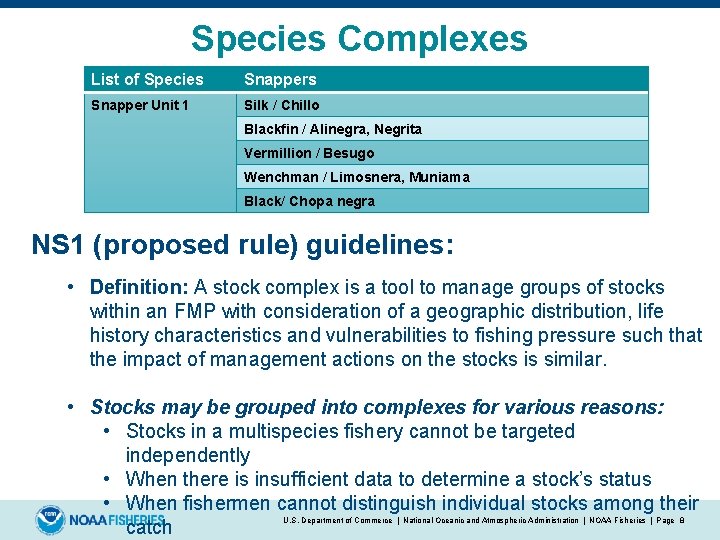
Species Complexes List of Species Snapper Unit 1 Silk / Chillo Blackfin / Alinegra, Negrita Vermillion / Besugo Wenchman / Limosnera, Muniama Black/ Chopa negra NS 1 (proposed rule) guidelines: • Definition: A stock complex is a tool to manage groups of stocks within an FMP with consideration of a geographic distribution, life history characteristics and vulnerabilities to fishing pressure such that the impact of management actions on the stocks is similar. • Stocks may be grouped into complexes for various reasons: • Stocks in a multispecies fishery cannot be targeted independently • When there is insufficient data to determine a stock’s status • When fishermen cannot distinguish individual stocks among their catch U. S. Department of Commerce | National Oceanic and Atmospheric Administration | NOAA Fisheries | Page 8
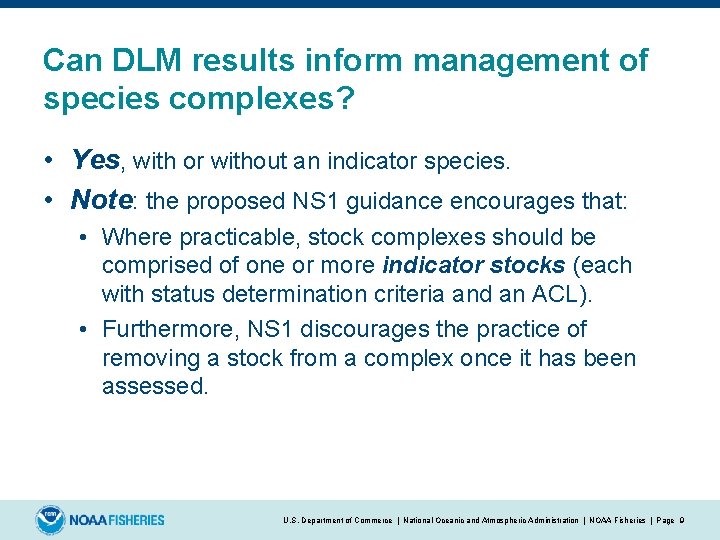
Can DLM results inform management of species complexes? • Yes, with or without an indicator species. • Note: the proposed NS 1 guidance encourages that: • Where practicable, stock complexes should be comprised of one or more indicator stocks (each with status determination criteria and an ACL). • Furthermore, NS 1 discourages the practice of removing a stock from a complex once it has been assessed. U. S. Department of Commerce | National Oceanic and Atmospheric Administration | NOAA Fisheries | Page 9
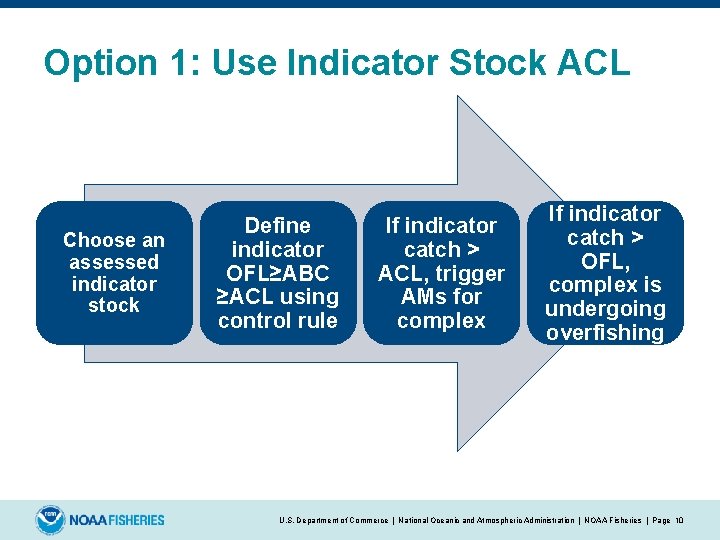
Option 1: Use Indicator Stock ACL Choose an assessed indicator stock Define indicator OFL≥ABC ≥ACL using control rule If indicator catch > ACL, trigger AMs for complex If indicator catch > OFL, complex is undergoing overfishing U. S. Department of Commerce | National Oceanic and Atmospheric Administration | NOAA Fisheries | Page 10
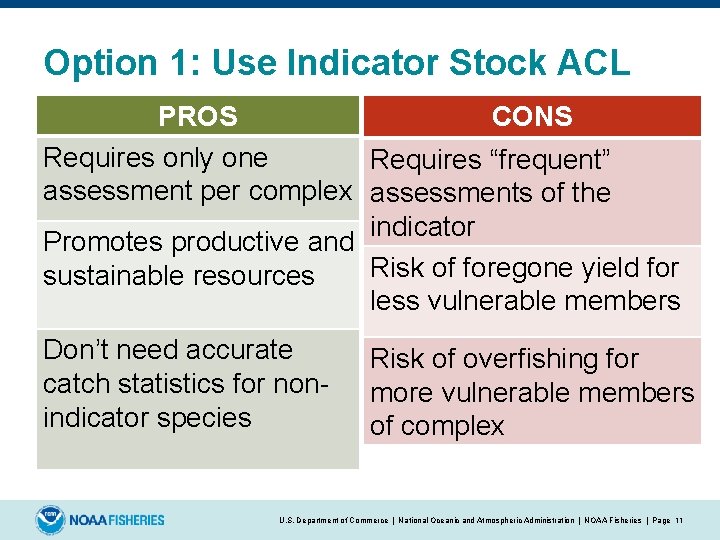
Option 1: Use Indicator Stock ACL CONS PROS Requires only one Requires “frequent” assessment per complex assessments of the indicator Promotes productive and Risk of foregone yield for sustainable resources less vulnerable members Don’t need accurate catch statistics for nonindicator species Risk of overfishing for more vulnerable members of complex U. S. Department of Commerce | National Oceanic and Atmospheric Administration | NOAA Fisheries | Page 11
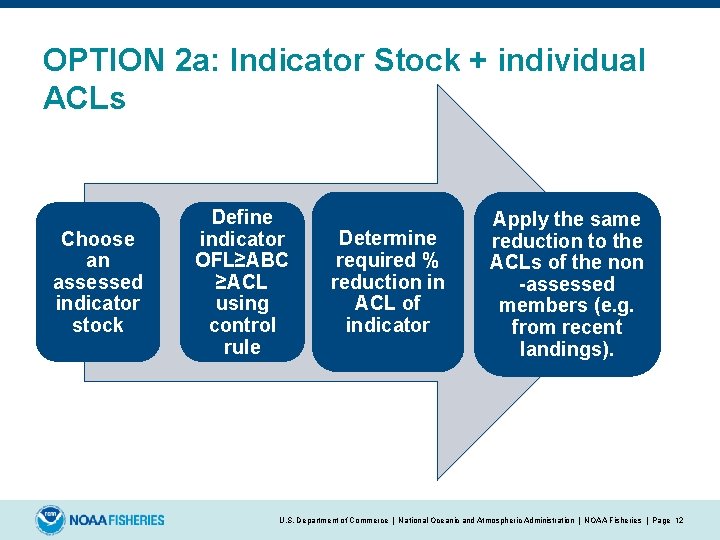
OPTION 2 a: Indicator Stock + individual ACLs Choose an assessed indicator stock Define indicator OFL≥ABC ≥ACL using control rule Determine required % reduction in ACL of indicator Apply the same reduction to the ACLs of the non -assessed members (e. g. from recent landings). U. S. Department of Commerce | National Oceanic and Atmospheric Administration | NOAA Fisheries | Page 12
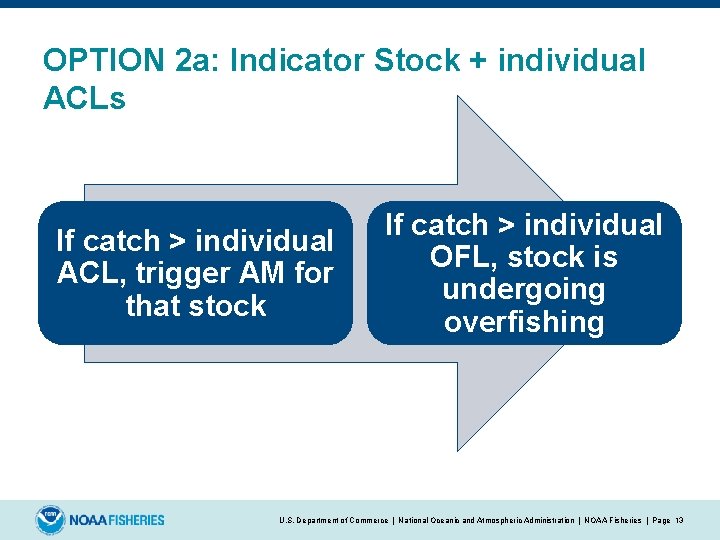
OPTION 2 a: Indicator Stock + individual ACLs If catch > individual ACL, trigger AM for that stock If catch > individual OFL, stock is undergoing overfishing U. S. Department of Commerce | National Oceanic and Atmospheric Administration | NOAA Fisheries | Page 13
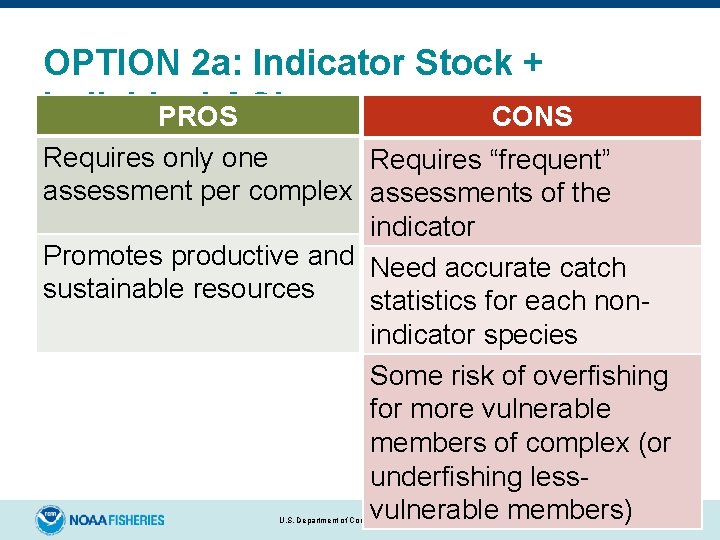
OPTION 2 a: Indicator Stock + Individual ACL CONS PROS Requires only one Requires “frequent” assessment per complex assessments of the indicator Promotes productive and Need accurate catch sustainable resources statistics for each nonindicator species Some risk of overfishing for more vulnerable members of complex (or underfishing lessvulnerable members) U. S. Department of Commerce | National Oceanic and Atmospheric Administration | NOAA Fisheries | Page 14
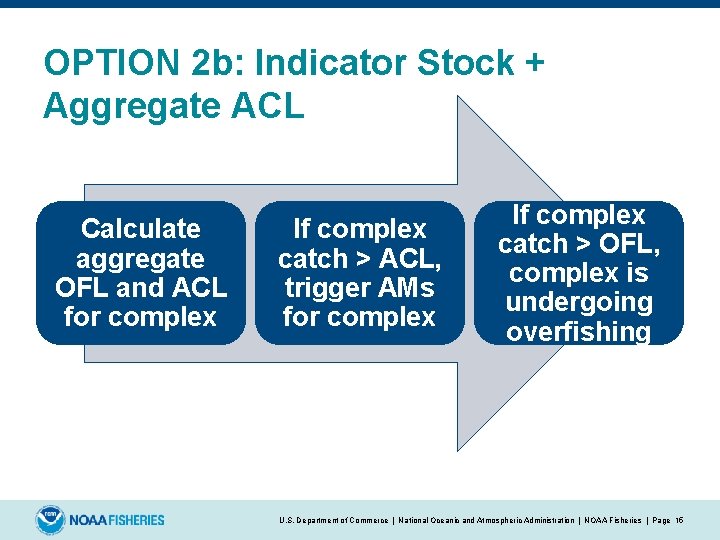
OPTION 2 b: Indicator Stock + Aggregate ACL Calculate aggregate OFL and ACL for complex If complex catch > ACL, trigger AMs for complex If complex catch > OFL, complex is undergoing overfishing U. S. Department of Commerce | National Oceanic and Atmospheric Administration | NOAA Fisheries | Page 15
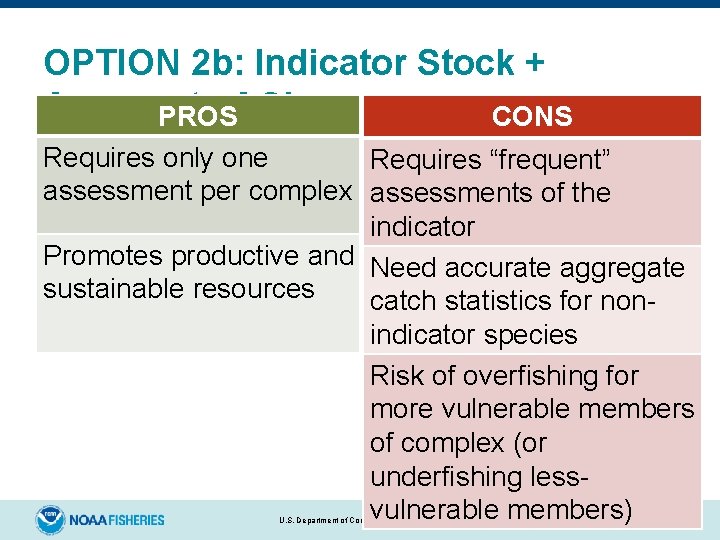
OPTION 2 b: Indicator Stock + Aggregate CONS PROSACL Requires only one Requires “frequent” assessment per complex assessments of the indicator Promotes productive and Need accurate aggregate sustainable resources catch statistics for nonindicator species Risk of overfishing for more vulnerable members of complex (or underfishing lessvulnerable members) U. S. Department of Commerce | National Oceanic and Atmospheric Administration | NOAA Fisheries | Page 16
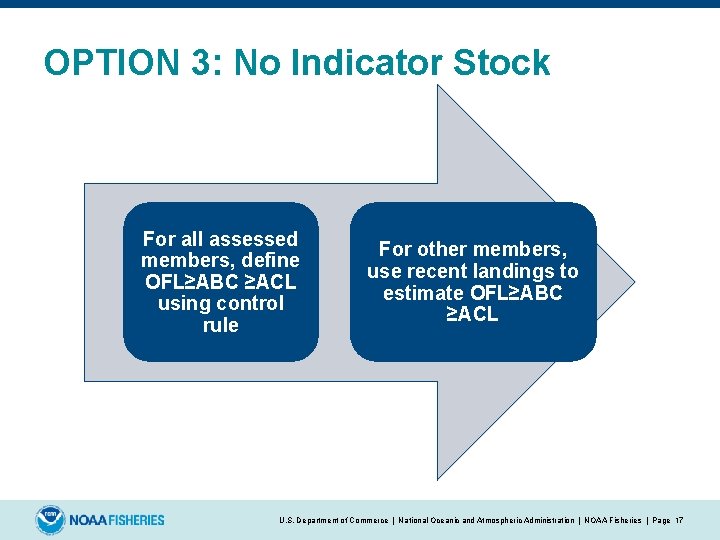
OPTION 3: No Indicator Stock For all assessed members, define OFL≥ABC ≥ACL using control rule For other members, use recent landings to estimate OFL≥ABC ≥ACL U. S. Department of Commerce | National Oceanic and Atmospheric Administration | NOAA Fisheries | Page 17
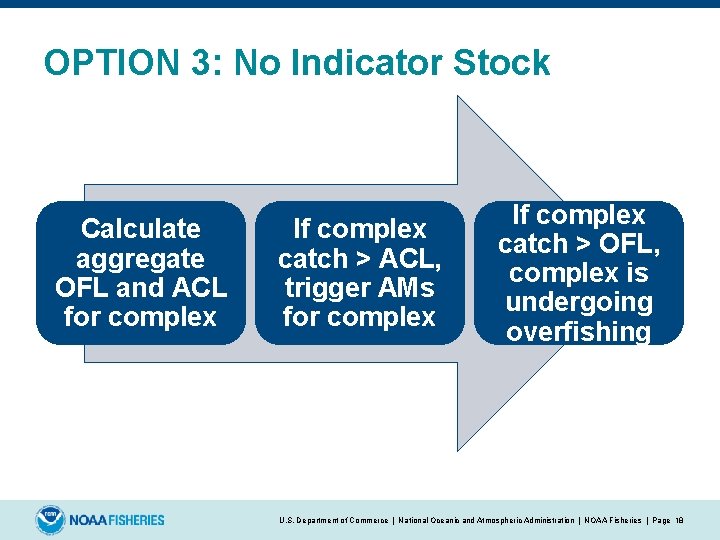
OPTION 3: No Indicator Stock Calculate aggregate OFL and ACL for complex If complex catch > ACL, trigger AMs for complex If complex catch > OFL, complex is undergoing overfishing U. S. Department of Commerce | National Oceanic and Atmospheric Administration | NOAA Fisheries | Page 18
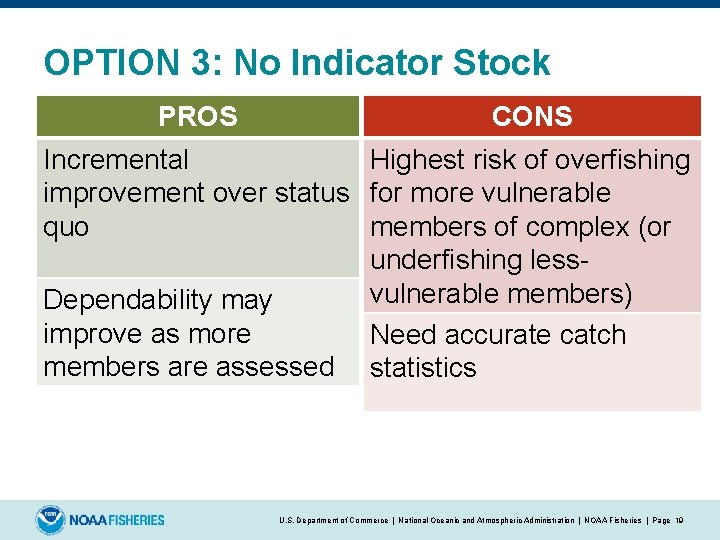
OPTION 3: No Indicator Stock PROS CONS Highest risk of overfishing Incremental improvement over status for more vulnerable members of complex (or quo underfishing lessvulnerable members) Dependability may improve as more Need accurate catch members are assessed statistics U. S. Department of Commerce | National Oceanic and Atmospheric Administration | NOAA Fisheries | Page 19
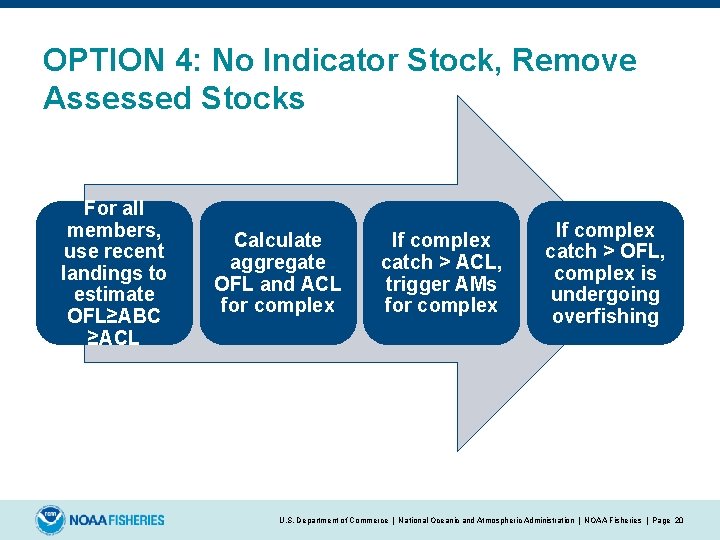
OPTION 4: No Indicator Stock, Remove Assessed Stocks For all members, use recent landings to estimate OFL≥ABC ≥ACL Calculate aggregate OFL and ACL for complex If complex catch > ACL, trigger AMs for complex If complex catch > OFL, complex is undergoing overfishing U. S. Department of Commerce | National Oceanic and Atmospheric Administration | NOAA Fisheries | Page 20
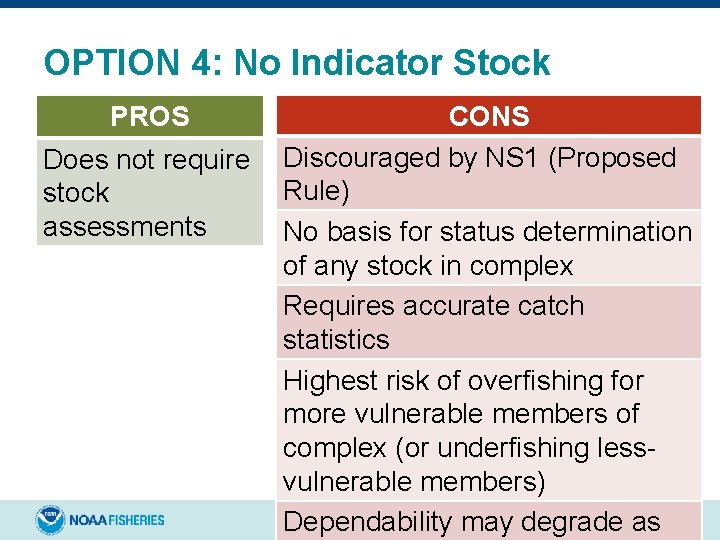
OPTION 4: No Indicator Stock PROS Does not require stock assessments CONS Discouraged by NS 1 (Proposed Rule) No basis for status determination of any stock in complex Requires accurate catch statistics Highest risk of overfishing for more vulnerable members of complex (or underfishing lessvulnerable members) Dependability may degrade as U. S. Department of Commerce | National Oceanic and Atmospheric Administration | NOAA Fisheries | Page 21
Conclusions 1. NMFS and the SEFSC support the use of indicator species to manage species complexes. 2. Stock complexes should be comprised of species with similar geographic range, life history, vulnerability etc. 3. Given bullet 2, options #1 and #2 ab are preferred as they are most likely to promote productive and sustainable resources. U. S. Department of Commerce | National Oceanic and Atmospheric Administration | NOAA Fisheries | Page 22
- Slides: 22