
Sustainable Finance Aotearoa New Zealands Sustainable Finance Roadmap
Sustainable Finance: Aotearoa New Zealand’s Sustainable Finance Roadmap for Action Friday 20 th November 2020 Pip Best and Erica Miles
Sustainable finance in Aotearoa New Zealand § What is sustainable finance? § Why is sustainable finance important? § What is New Zealand’s Sustainable Finance Roadmap for Action? § What’s the relevance of sustainable finance to accountants? § How can I be involved in next steps? ‘’The need to seek a greater balance between financial gain today and a more inclusive future for all, where future generations have access to the resources required to meet their needs, has never been greater’’. Matt Whineray and Karen Silk Slide 2

What is sustainable finance? Sustainable finance isn’t about been “green”. Its about changing the way investment and lending decisions are made, so that environmental, social and economic factors are integral and negative impacts, both immediately and over the long-term, are avoided. A sustainable financial system is one which: • Recognises that its real purpose is to serve the long-term needs of society and the planet • Is resilient, robust and agile through the integration of environmental, social and economic factors • One where investment decisions are directed towards environmental, social and economic prosperity.
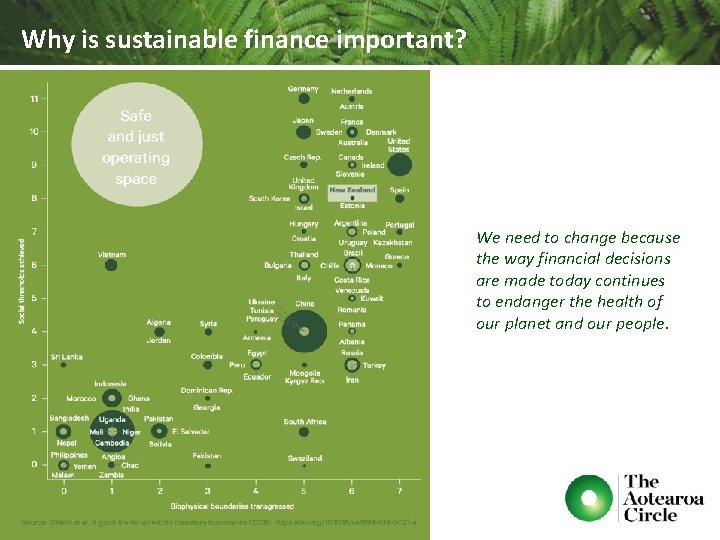
Why is sustainable finance important? We need to change because the way financial decisions are made today continues to endanger the health of our planet and our people.
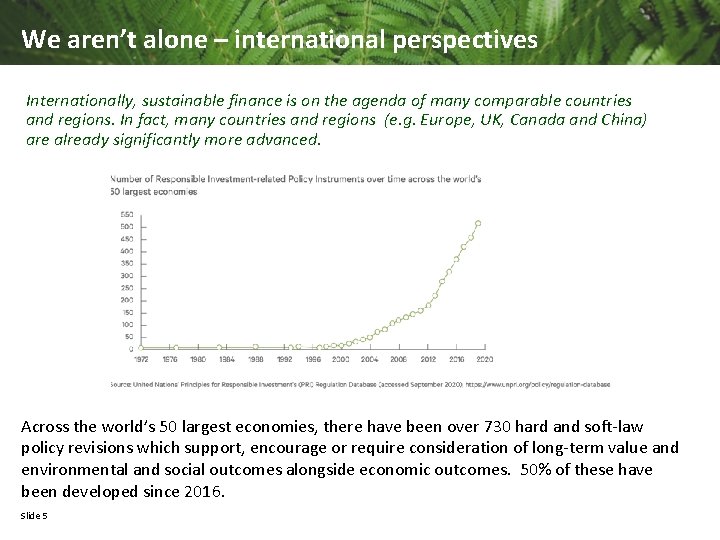
We aren’t alone – international perspectives Internationally, sustainable finance is on the agenda of many comparable countries and regions. In fact, many countries and regions (e. g. Europe, UK, Canada and China) are already significantly more advanced. Across the world’s 50 largest economies, there have been over 730 hard and soft-law policy revisions which support, encourage or require consideration of long-term value and environmental and social outcomes alongside economic outcomes. 50% of these have been developed since 2016. Slide 5
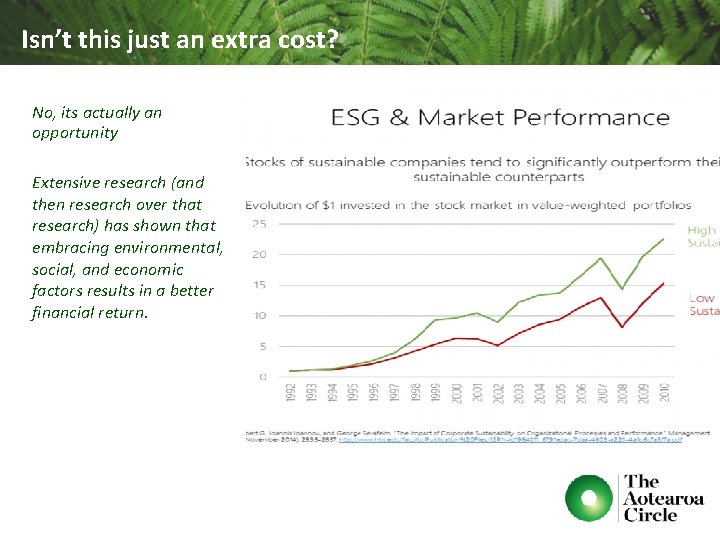
Isn’t this just an extra cost? No, its actually an opportunity Extensive research (and then research over that research) has shown that embracing environmental, social, and economic factors results in a better financial return.
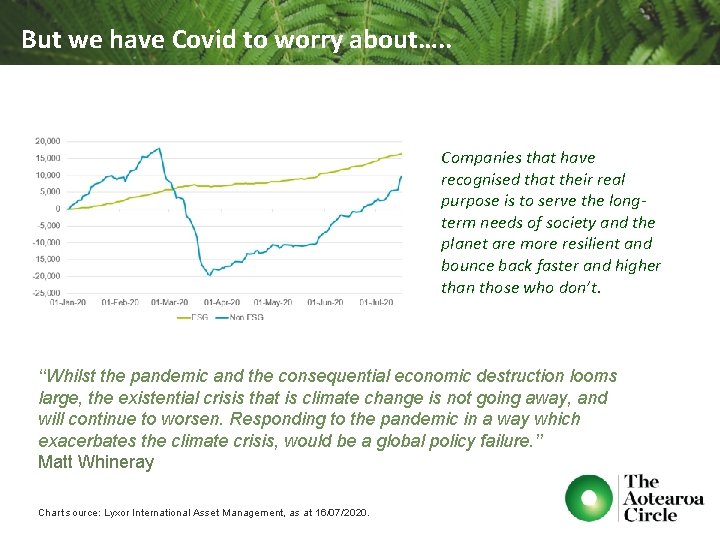
But we have Covid to worry about…. . Companies that have recognised that their real purpose is to serve the longterm needs of society and the planet are more resilient and bounce back faster and higher than those who don’t. ‘‘Whilst the pandemic and the consequential economic destruction looms large, the existential crisis that is climate change is not going away, and will continue to worsen. Responding to the pandemic in a way which exacerbates the climate crisis, would be a global policy failure. ’’ Matt Whineray Chart source: Lyxor International Asset Management, as at 16/07/2020.
Our Sustainable Finance Roadmap for Action
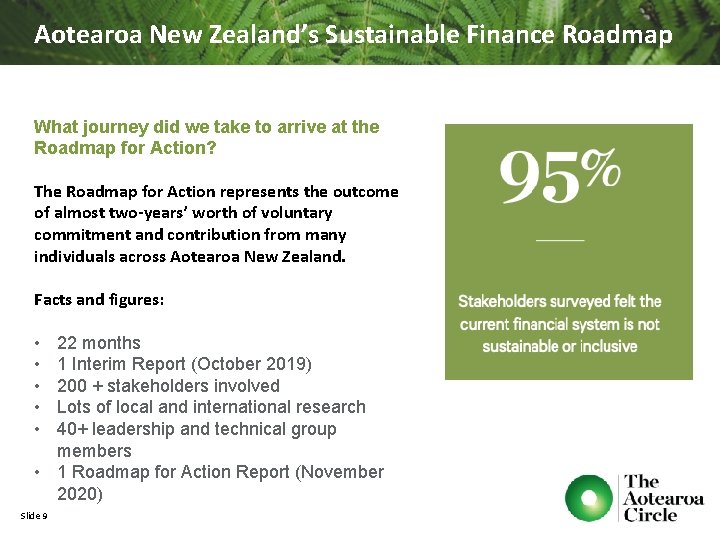
Aotearoa New Zealand’s Sustainable Finance Roadmap What journey did we take to arrive at the Roadmap for Action? The Roadmap for Action represents the outcome of almost two-years’ worth of voluntary commitment and contribution from many individuals across Aotearoa New Zealand. Facts and figures: • • • 22 months 1 Interim Report (October 2019) 200 + stakeholders involved Lots of local and international research 40+ leadership and technical group members • 1 Roadmap for Action Report (November 2020) Slide 9
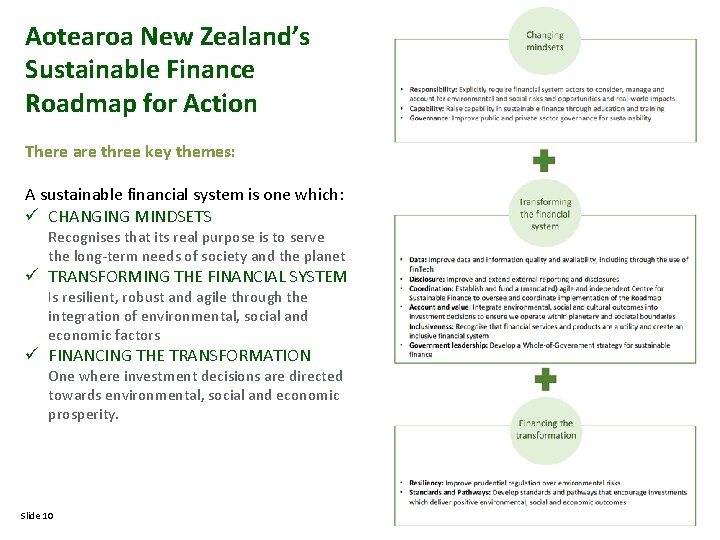
Aotearoa New Zealand’s Sustainable Finance Roadmap for Action There are three key themes: A sustainable financial system is one which: ü CHANGING MINDSETS Recognises that its real purpose is to serve the long-term needs of society and the planet ü TRANSFORMING THE FINANCIAL SYSTEM Is resilient, robust and agile through the integration of environmental, social and economic factors ü FINANCING THE TRANSFORMATION One where investment decisions are directed towards environmental, social and economic prosperity. Slide 10
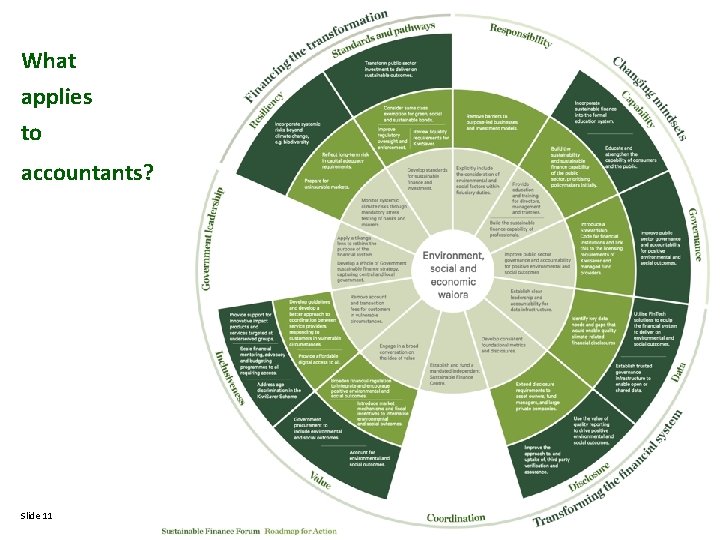
What applies to accountants? ? Slide 11
What’s the relevance to accountants? Examples of sustainable finance in action: • Value is defined more broadly than just financial value • CAPEX decisions have a longer payback and include positive environmental and social outcomes • Higher CAPEX costs, which lead to lower OPEX, are easier to approve • Recycling and reusing materials provides environmental, social and economic value (e. g. through waste levies) • Companies are more resilient through a defined social purpose • Companies that consider environmental, social and economic outcomes attract capital (nationally and internationally) more easily and cheaply than those who don’t • Investors and directors are clear that environmental and social outcomes are part of their fiduciary and governance duties. We don't just need money to be pouring into the system, we also need smart state institutions to manage it. . . and a smart state to work smartly with smart companies to deliver Slide 12 really important solutions to public problems (Mariana Mazzucato).
Getting involved – next steps You don’t need to wait for Government regulation – e. g. climate change will impact you, and your business, regardless. Some immediate actions you can take: • Get involved in CA ANZ’s workstreams (e. g. disclosures, education programme) • Think about you and your Board’s governance of ‘sustainability’ (https: //www. sbc. org. nz/resources/guides/good-corporate-governance-sbcchecklist) • Think about your social purpose – organisations with a purpose financially outperform those who don’t • Change your financial models to encompass environmental, social and economic risks and opportunities - build off the TCFD requirements which will soon apply to listed entities.
For questions contact us: Pip Best: pip. best@nz. ey. com Erica Miles: ermiles 0@outlook. com For a copy of the Roadmap for Action: https: //www. theaotearoacircle. nz/sustainablefinance Slide 14
- Slides: 14