
SUSTAINABLE ENGINEERING INFRASTRUCTURE FOR ACCELERATED RURAL DEVELOPMENT THE
SUSTAINABLE ENGINEERING INFRASTRUCTURE FOR ACCELERATED RURAL DEVELOPMENT – THE ROLE OF PERVASIVE BROADBAND INFRASTRUCTURES – Keynote address on the occasion of the 2018 National Engineering Conference and Annual General Meeting of the Nigerian Society of Engineers held at Kaduna in November, 2018. Prof. U. G. Danbatta, FNSE, FRAES, FAEng Executive Vice Chairman Nigerian Communications Commission
Outline 1 What is Broadband 2 Industry Context 3 Nigerian Broadband Initiative 4 Conclusion 2
What is Broadband? Broadband within the Nigerian context is defined as an internet experience where the user can access the most demanding content in real time at a minimum speed of 1. 5 Mbps. It is categorized into Fixed(Wired) Broadband Wireless Broadband. Wireless is using Spectrum Resources, while Fixed is largely delivered by Optical Fiber. We will be focusing on Fixed Broadband
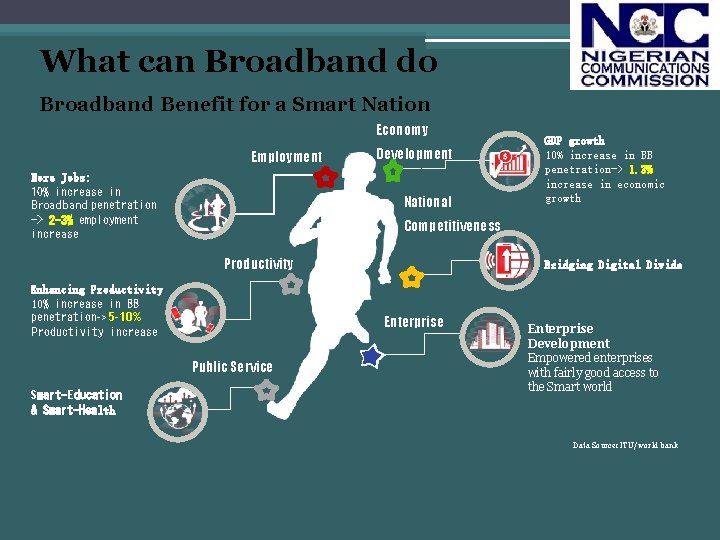
What can Broadband do Broadband Benefit for a Smart Nation Economy Employment More Jobs: 10% increase in Broadband penetration -> 2 -3% employment increase Development National Competitiveness Productivity Enhancing Productivity 10% increase in BB penetration->5 -10% Productivity increase Bridging Digital Divide Enterprise Public Service Smart-Education & Smart-Health GDP growth 10% increase in BB penetration-> 1. 3% increase in economic growth Enterprise Development Empowered enterprises with fairly good access to the Smart world Data Source: ITU/world bank
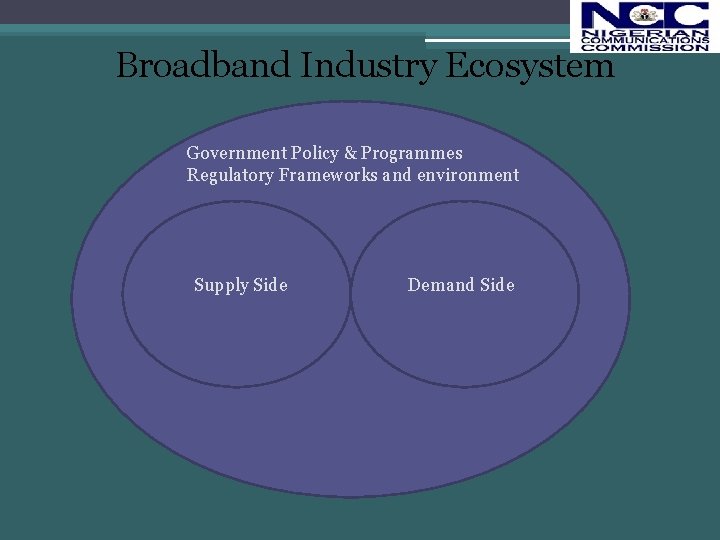
Broadband Industry Ecosystem Government Policy & Programmes Regulatory Frameworks and environment Supply Side Demand Side
Brief Nigerian Telecommunications Industry Overview 1. 2. 3. 4. 5. 6. 7. 8. 9. 10. 11. Increasing use of data enabled devices (Smartphones, dongles, Mi. Fis etc). Voice service more wide spread than data. Internet and VAS usage increasing. Increasing network coverage for 3 G and 4 G data services Increased Colocation (especially for passive infrastructure) Reducing Average Revenues per User. Increasing competition among players. Data infrastructure deployment and the internet market is dominated by the 4 vertically integrated GSM service providers Fixed-line service substitution with mobile services due to lack of fixed infrastructure. The insurgency in the north east threatens the operations and network expansion plans of service providers in the region. With pervasive voice services objective largely achieved, focus on growth of data services and provision of optimal Qo. S delivery.
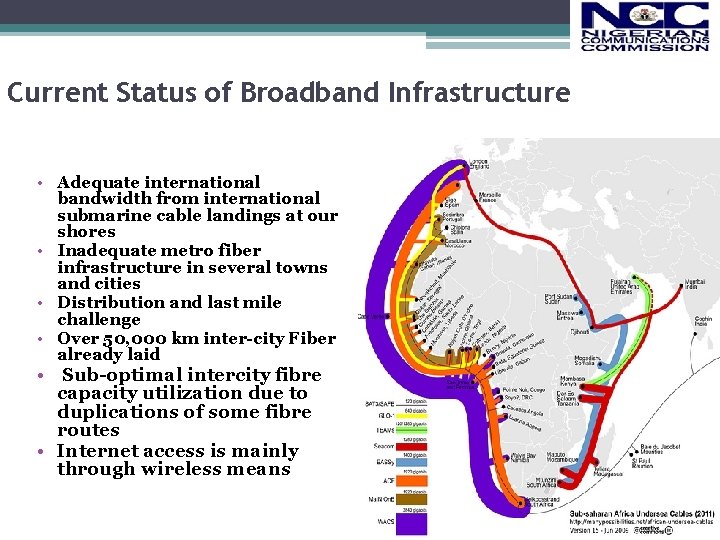
Current Status of Broadband Infrastructure • Adequate international bandwidth from international submarine cable landings at our shores • Inadequate metro fiber infrastructure in several towns and cities • Distribution and last mile challenge • Over 50, 000 km inter-city Fiber already laid • Sub-optimal intercity fibre capacity utilization due to duplications of some fibre routes • Internet access is mainly through wireless means
Challenges of broadband Development in Nigeria § Duplication of backhaul inter-city infrastructure along major towns and cities; § Slow pace of deployment of fibre infrastructure to the hinterland; § Inability to drive data into the broader regions of the country at affordable prices; § Lack of metropolitan fibre mesh networks in cities accross Nigeria; § High cost of leasing fibre backbone infrastructure; § Multiple taxation/ High Rights charges/Multiple regulation. of Way § About 12% of Base Stations are connected to fibre (Ro. W) 4
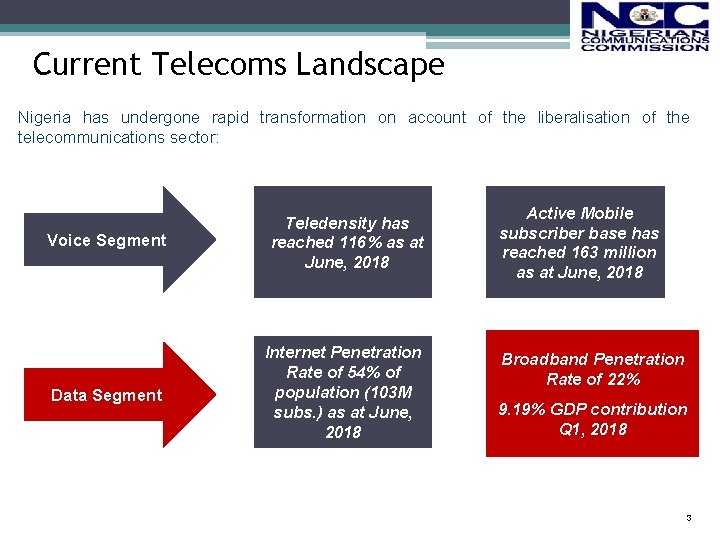
Current Telecoms Landscape Nigeria has undergone rapid transformation on account of the liberalisation of the telecommunications sector: Voice Segment Teledensity has reached 116% as at June, 2018 Data Segment Internet Penetration Rate of 54% of population (103 M subs. ) as at June, 2018 Active Mobile subscriber base has reached 163 million as at June, 2018 Broadband Penetration Rate of 22% 9. 19% GDP contribution Q 1, 2018 3
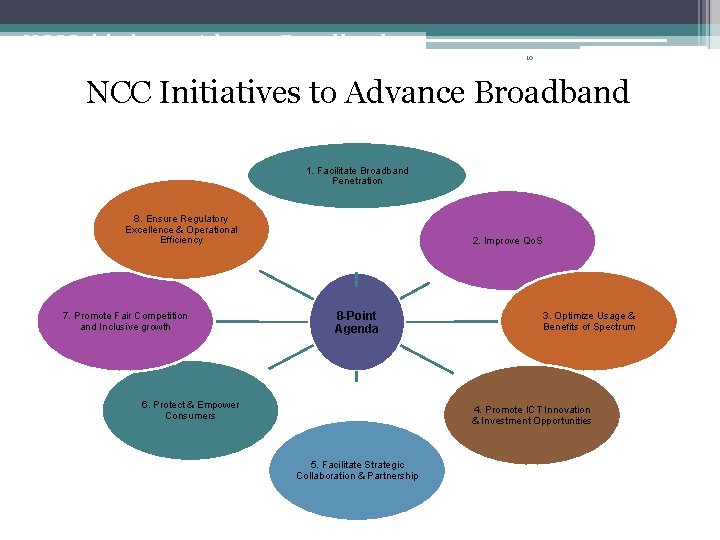
NCC Initiatives to Advance Broadband 10 NCC Initiatives to Advance Broadband 1. Facilitate Broadband Penetration 8. Ensure Regulatory Excellence & Operational Efficiency 7. Promote Fair Competition and Inclusive growth 2. Improve Qo. S 8 -Point Agenda 6. Protect & Empower Consumers 3. Optimize Usage & Benefits of Spectrum 4. Promote ICT Innovation & Investment Opportunities 5. Facilitate Strategic Collaboration & Partnership
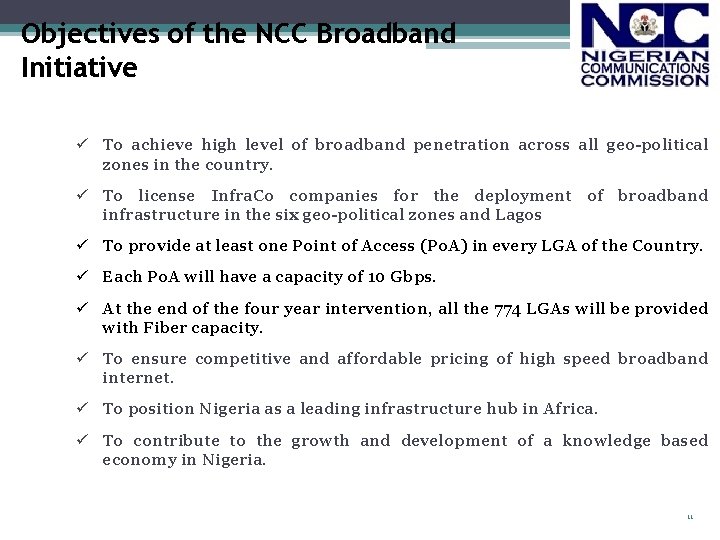
Objectives of the NCC Broadband Introduction Initiative ü To achieve high level of broadband penetration across all geo-political zones in the country. ü To license Infra. Co companies for the deployment of broadband infrastructure in the six geo-political zones and Lagos ü To provide at least one Point of Access (Po. A) in every LGA of the Country. ü Each Po. A will have a capacity of 10 Gbps. ü At the end of the four year intervention, all the 774 LGAs will be provided with Fiber capacity. ü To ensure competitive and affordable pricing of high speed broadband internet. ü To position Nigeria as a leading infrastructure hub in Africa. ü To contribute to the growth and development of a knowledge based economy in Nigeria. 11
NCC’s Strategy to Facilitate Broadband Penetration The strategy adopted by the Commission to facilitate broadband penetration includes: üLicensing of Infrastructure Companies (Infracos) ü Auctioning of Spectrum üAttracting Investments üBridging Access Gaps üStakeholders Engagement
NCC Initiatives to Advance Broadband NCC’s Initiatives to Advance Broadband 13 The NCC will continue to drive and support high speed broadband connectivity to end users through various initiatives. Some of these are: 1. License Infra. Cos on a regional basis to provide metropolitan fibre and wholesale transmission services on a non-discriminatory, open access and price regulated basis. 2. Infracos to deploy at least one access point in every LGA of their licence area including rural areas 3. Already licensed the 2. 3 GHz spectrum for wholesale wireless last mile services. 4. On-going discussions with various levels of Government to facilitate speed in processing permits, harmonisation of tax regimes and ease of deployment of infrastructure, including streamlining Ro. W charges. 5. Institute price caps for leased transmission capacity to address anti- competitive pricing. 6. Auction and assign required spectrum for wireless and mobile broadband on an open and transparent basis.
Provision of Capacity for the Wireless Last Mile • Broadband is the centrepiece of the digital age. • National Backbone Broadband Networks in conjunction with latest generation mobile telecommunications will drive the digital economy. • Broadband aim to deliver - Availability - Accessibility – Affordability. • Spectrum is a critical mobile infrastructure. • The Commission will strive to provide the required frequency spectrum capacity by: – Facilitating the re-farming of existing spectrum held by operators to provide broadband services without impacting their Qo. S delivery. – The Auction of 2. 5 / 2. 6 GHz spectrum, 700 MHz band (once available), and the assignment of other spectrum bands in an open and transparent manner 14
Conclusion • Optimal deployment of broadband infrastructures via the Infraco model in the face of existing broadband infrastructure challenges is critical to driving broadband availability, accessibility and affordability in Nigeria • The availability of broadband infrastructure will unlock new opportunities and drive a second wave of growth in the telecommunications industry and the economy after the exponential growth of voice service • Telecommunications contribution to the economy (over 8%) is significant and will continue to grow • Broadband is a productivity enabling technology • Right of Way (Ro. W) is the most critical success factor for this project • The process for new spectrum auctions and assignments to drive mobile and wireless broadband is ongoing ▫ Digital Dividend (700 MHz) – for 4 G LTE coverage requirements ▫ 2. 5 / 2. 6 GHz spectrum auction for 4 G LTE capacity requirements ▫ Facilitation of the Re-farming of existing frequencies for LTE ▫ Assignment of more high capacity spectrum bands like (e. g. 70/80 GHz spectrum bands)
Prof. U. G. Danbatta, FNSE, FRAES, FAEng Executive Vice Chairman Nigerian Communications Commission
- Slides: 16