
Sustainable Development Statistics Indicators Decision Making Reena Shah
Sustainable Development Statistics, Indicators & Decision Making Reena Shah Division for Sustainable Development United Nations Department of Economic and Social Affairs (Trinidad, 27 -31 October 2003)
Overview Uses of statistics and indicators Policy demands for statistics and indicators Using statistics and indicators for decisionmaking Information pyramid Purposes of indicators Criteria for indicator selection CSD list of indicators MDG list of indicators Particular issues with environmental data
Uses of statistics and indicators Planning Formulating laws, policies and regulations Designing market instruments Research and education Media Public participation
Policy demand for statistics and indicators (UNCED) Chapter 40: Information for Decision-Making Par. 40. 6: Development of Indicators of Sustainable Development “ Countries at the national level and international governmental and non-governmental organizations at the international level should develop the concept of indicators of sustainable development in order to identify such indicators……” Par. 40. 7: Promotion of the Global Use of Indicators “…. The organs and organizations of the UN system … could provide recommendations for harmonized development of indicators at the national, regional and global levels, and for incorporation of a suitable set of these indicators in common, regularly updated, and widely accessible reports and databases, for use at the international level, subject to national sovereignty considerations”
Policy demand for statistics and indicators (CSD 3) The CSD 3 rd Session (1995) approved a 5 year Programme of Work on Indicators of Sustainable Development Main Objective: A core list of indicators of sustainable development accessible to decision-makers at the national level by the year 2001. Achieved by defining them, elucidating their methodologies and providing training and other capacity-building activities, as relevant.
Policy demand for statistics and indicators (WSSD) Strengthen national and regional information and statistical and analytical services relevant to sustainable development polices and programmes … (WSSD: X, 129); Encourage and promote further work on indicators for sustainable development by countries at the national level … (WSSD: X, 130, 131); Develop information systems that make the sharing of valuable data possible … (WSSD: X, 132 (b)); Support countries, particularly developing countries in their national efforts to collect data that are accurate, long-term, consistent and reliable (WSSD: X, 133 (a)).
Policy demand for statistics and indicators (CSD 11 -2003) Encourages further work on indicators for sustainable development by countries at the national level, including integration of gender aspects, on a voluntary basis, in line with national conditions and priorities (CSD 11 par. 13) Underscores that reporting to the CSD be guided by…. effective use of indicators…. . (CSD 11 par. 14 d)
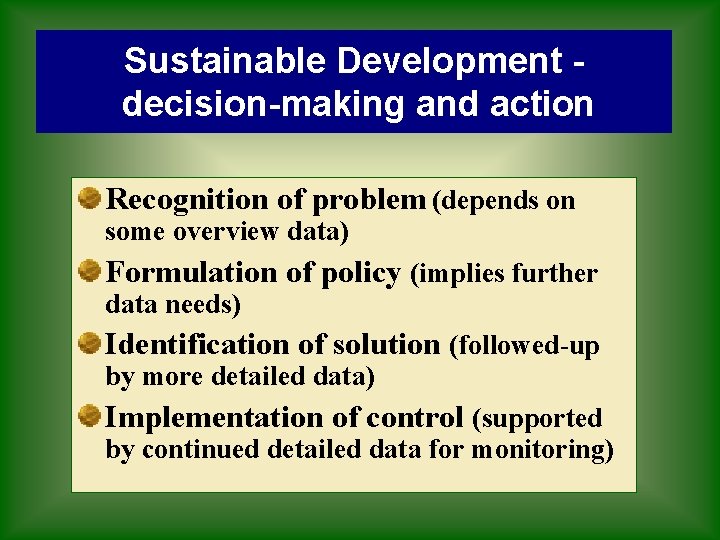
Sustainable Development decision-making and action Recognition of problem (depends on some overview data) Formulation of policy (implies further data needs) Identification of solution (followed-up by more detailed data) Implementation of control (supported by continued detailed data for monitoring)
Using statistics and indicators in decision-making for sustainable development What are the priority issues? Which statistics/indicators are needed to measure the issues? Do the statistics/indicators exist? Are the data readily available? What are the data sources? How are the data collected? What is the data coverage? What is the periodicity of data collection? What is the quality of the data?
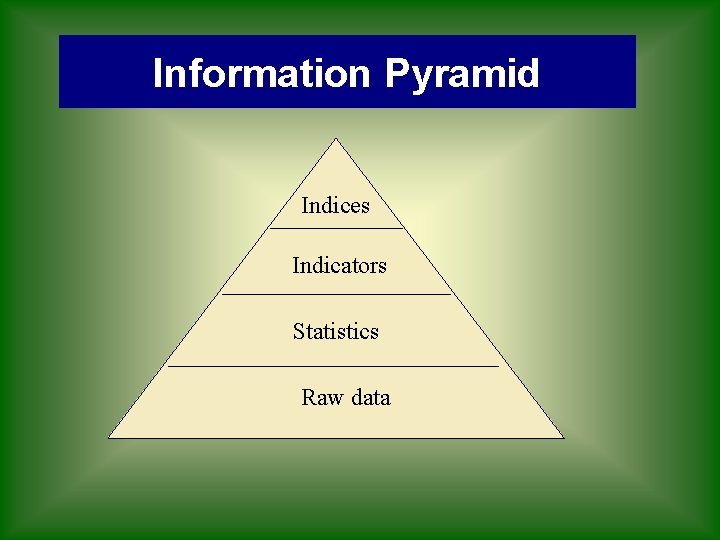
Information Pyramid Indices Indicators Statistics Raw data
Purposes of indicators Defining objectives Assessing present and future direction with respect to goals and values Evaluating specific programmes Demonstrating progress Measuring changes in a specific condition or situation over time Determining impact of programmes and conveying messages
Criteria for indicator selection Policy-relevant Specific Valid Reliable Sensitive Measurable User-friendly Cost-effective
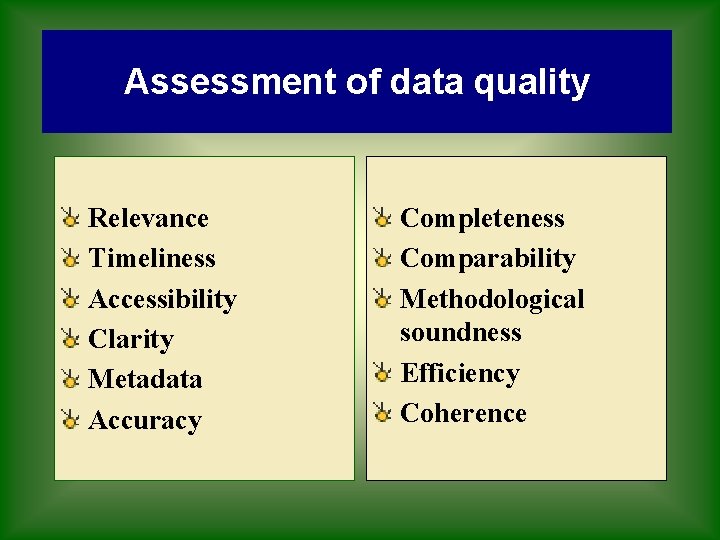
Assessment of data quality Relevance Timeliness Accessibility Clarity Metadata Accuracy Completeness Comparability Methodological soundness Efficiency Coherence
Sustainable Development frameworks and indicators Frameworks and approaches Lists of indicators Focus of this presentation is on the Commission on Sustainable Development (CSD) list of indicators and the Millennium Development Indicators
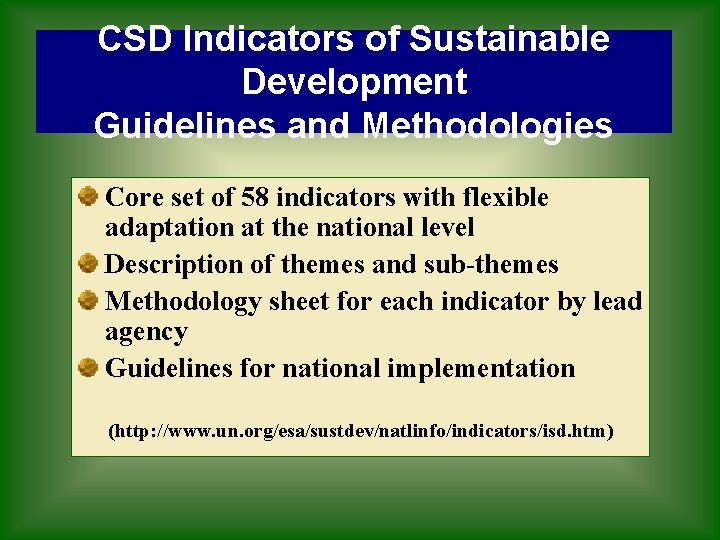
CSD Indicators of Sustainable Development Guidelines and Methodologies Core set of 58 indicators with flexible adaptation at the national level Description of themes and sub-themes Methodology sheet for each indicator by lead agency Guidelines for national implementation (http: //www. un. org/esa/sustdev/natlinfo/indicators/isd. htm)

Indicators of Sustainable Development
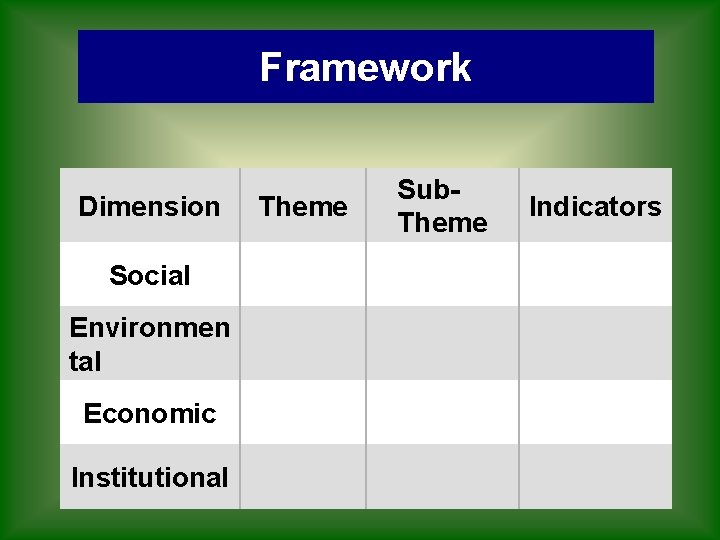
Framework Dimension Social Environmen tal Economic Institutional Theme Sub. Theme Indicators
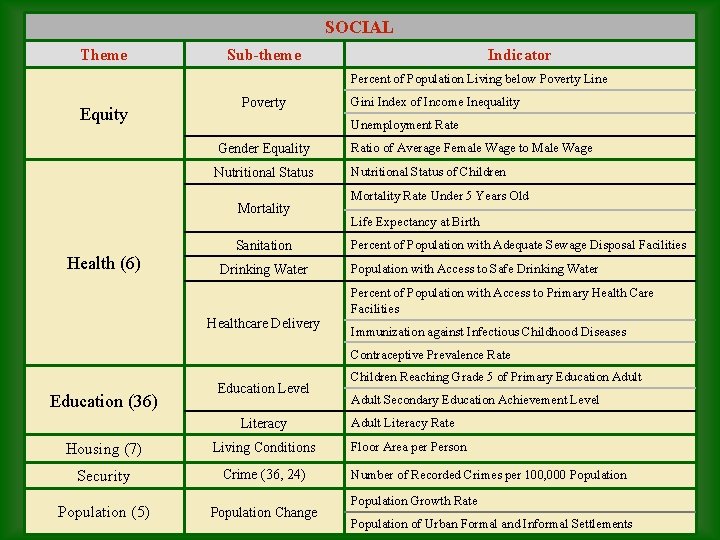
SOCIAL Theme Sub-theme Indicator Percent of Population Living below Poverty Line Equity Poverty Unemployment Rate Gender Equality Ratio of Average Female Wage to Male Wage Nutritional Status of Children Mortality Sanitation Health (6) Gini Index of Income Inequality Drinking Water Mortality Rate Under 5 Years Old Life Expectancy at Birth Percent of Population with Adequate Sewage Disposal Facilities Population with Access to Safe Drinking Water Percent of Population with Access to Primary Health Care Facilities Healthcare Delivery Immunization against Infectious Childhood Diseases Contraceptive Prevalence Rate Education (36) Education Level Literacy Housing (7) Living Conditions Security Crime (36, 24) Population (5) Population Change Children Reaching Grade 5 of Primary Education Adult Secondary Education Achievement Level Adult Literacy Rate Floor Area per Person Number of Recorded Crimes per 100, 000 Population Growth Rate Population of Urban Formal and Informal Settlements
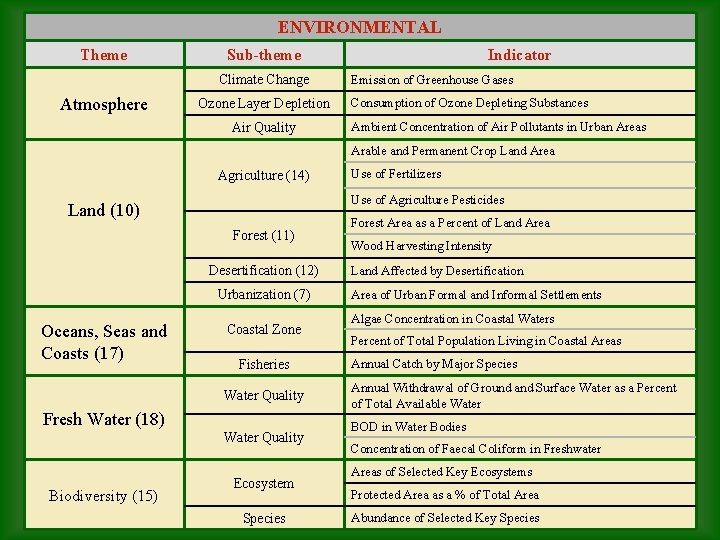
ENVIRONMENTAL Theme Sub-theme Climate Change Atmosphere Ozone Layer Depletion Air Quality Indicator Emission of Greenhouse Gases Consumption of Ozone Depleting Substances Ambient Concentration of Air Pollutants in Urban Areas Arable and Permanent Crop Land Area Agriculture (14) Use of Agriculture Pesticides Land (10) Forest (11) Desertification (12) Urbanization (7) Oceans, Seas and Coasts (17) Coastal Zone Fisheries Water Quality Fresh Water (18) Water Quality Biodiversity (15) Use of Fertilizers Ecosystem Species Forest Area as a Percent of Land Area Wood Harvesting Intensity Land Affected by Desertification Area of Urban Formal and Informal Settlements Algae Concentration in Coastal Waters Percent of Total Population Living in Coastal Areas Annual Catch by Major Species Annual Withdrawal of Ground and Surface Water as a Percent of Total Available Water BOD in Water Bodies Concentration of Faecal Coliform in Freshwater Areas of Selected Key Ecosystems Protected Area as a % of Total Area Abundance of Selected Key Species
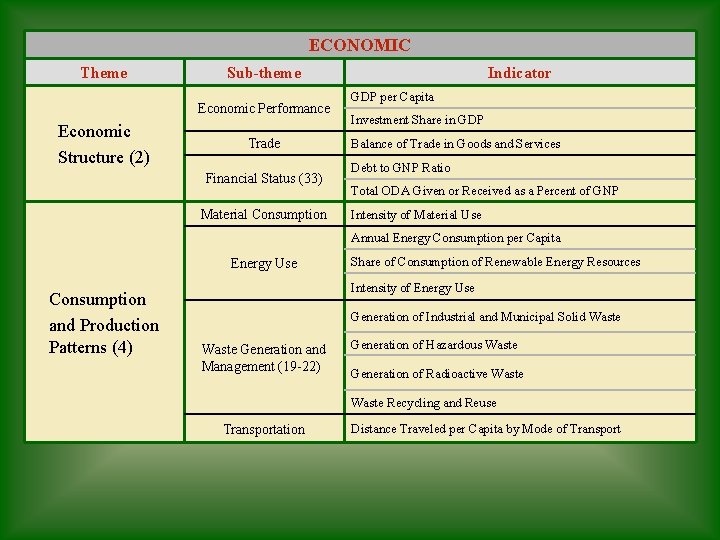
ECONOMIC Theme Sub-theme Economic Performance Economic Structure (2) Trade Financial Status (33) Material Consumption Indicator GDP per Capita Investment Share in GDP Balance of Trade in Goods and Services Debt to GNP Ratio Total ODA Given or Received as a Percent of GNP Intensity of Material Use Annual Energy Consumption per Capita Energy Use Consumption and Production Patterns (4) Share of Consumption of Renewable Energy Resources Intensity of Energy Use Generation of Industrial and Municipal Solid Waste Generation and Management (19 -22) Generation of Hazardous Waste Generation of Radioactive Waste Recycling and Reuse Transportation Distance Traveled per Capita by Mode of Transport
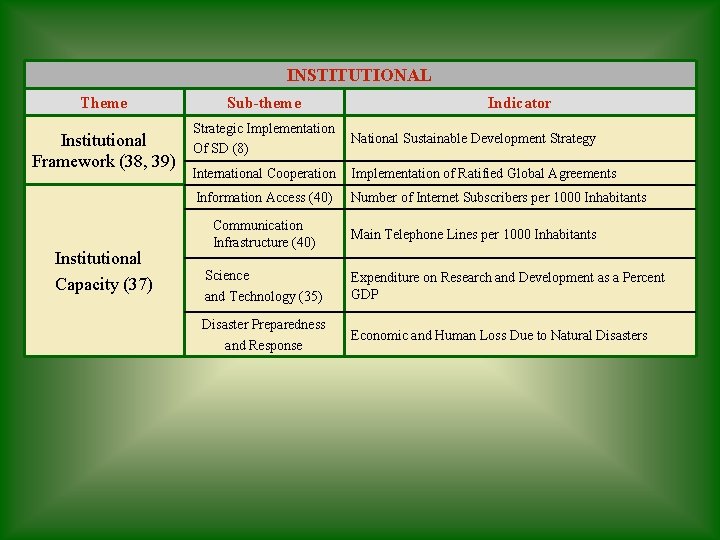
INSTITUTIONAL Theme Institutional Framework (38, 39) Institutional Capacity (37) Sub-theme Indicator Strategic Implementation Of SD (8) National Sustainable Development Strategy International Cooperation Implementation of Ratified Global Agreements Information Access (40) Number of Internet Subscribers per 1000 Inhabitants Communication Infrastructure (40) Main Telephone Lines per 1000 Inhabitants Science and Technology (35) Expenditure on Research and Development as a Percent GDP Disaster Preparedness and Response Economic and Human Loss Due to Natural Disasters

Millennium Declaration Adopted by the United Nations General Assembly in 2000 by 189 nations Commitment to a set of values and principles 8 Millennium Development Goals 18 Targets and 48 Indicators to be reported on by member states (http: //millenniumindicators. un. org/unsd/mi/mi_goals. asp)
Challenges Lack of data and development capacity International harmonization efforts Further indicator development in “less advanced” substantive areas Training in integrated information management
DSD Focus DSD responding to challenges by: Support for regional indicator networks Sustainable Development Information Management for SIDS in the Caribbean Region Country projects Disaster reduction indicators in the context of sustainable development with ISDR & UNDP

Guidelines National Coordinating Mechanism & Focal Point Gap analysis including a baseline assessment and priority selection through a consultative process Assessment of capacity-building needs Action Plan Dissemination strategy Periodic evaluation and re-assessment
Particular issues in the compilation of environmental statistics and indicators Indicator is not always relevant Lack of coordination at the national level Politically sensitive data Lack of resources Different definitions and/or classifications Lack of adequate time series Duplicate data sources and/or conflicting values Some examples from the CARICOM region
- Slides: 26