
SUSTAINABLE DEVELOPMENT PRINCIPLES Sustainable Development and Environmental Awareness
SUSTAINABLE DEVELOPMENT PRINCIPLES Sustainable Development and Environmental Awareness 1
Lesson Learning Goals At the end of this lesson you should be able to: è Define sustainable development and list at least five core themes è Explain the ‘precautionary principle’ è Name at least six areas of concern in the Mekong River Basin è Give examples of winners and losers in the traditional ways of development Sustainable Development and Environmental Awareness 2
Lesson Learning Goals (Cont’d) At the end of this lesson you should be able to: è Describe the links between unsustainable development, poverty, hunger, and disease è List principle development requirements for healthy communities and indigenous peoples è Summarise requirements for sustainable development of land water resources è Draw a hierarchy of waste management Sustainable options Development and Environmental Awareness 3
Definitions of Sustainable Development that meets the needs of the present without compromising the ability of future generations to meet their own needs (Brundland Commission - Our Common Future, 1987) A sustainable society enables its members to achieve a high quality of life in ways that are ecologically sustainable (United Nations) Sustainable Development and Environmental Awareness 4
A Goal for Sustainable Development To enable each individual to live life to their full potential physical, mental, and spiritual development (1992 Earth Summit - Agenda 21) Sustainable Development and Environmental Awareness 5
Some Core Themes of Sustainable Development è è è We do not inherit the earth from our ancestors, we are borrowing it from our children Awareness leads to appropriate action Prevention of pollution Conservation of natural resources (i. e. , preserving natural capital) Systems thinking - interdependence of all life Sustainable Development and Environmental Awareness 6
More Core Themes of Sustainable Development è è è Those who reap the benefits of development must bear the costs Those who bear the costs of development should share in the benefits Those affected by development must participate in decision making Engineering ‘fixes’ alone do not constitute sustainable development Precautionary principle Sustainable Development and Environmental Awareness 7
Precautionary Principle Where there are threats of serious or irreversible damage, lack of full scientific certainty shall not be used as a reason for postponing cost-effective measures to prevent environmental degradation (Agenda 21) Sustainable Development and Environmental Awareness 8
1992 Earth Summit Agenda 21 Themes è è è Economic, social, and ecological factors must be integrated in political and business decision making - they are surely integrated in workings of the natural world Institutions must move out of their narrow, specialised ‘niches’ to integrate and interact with one another Decentralise management of resources; empower local communities Sustainable Development and Environmental Awareness 9
Areas of Concern in Agenda 21 and the MRB è è è è Poverty alleviation Human consumption patterns Demographics and human settlements (e. g. , population growth) Human health Biodiversity Freshwater and coastal resources Land resources, especially forests Sustainable Development and Environmental Awareness 10
More Areas of Concern in Agenda 21 and the MRB è è è è Mountainous areas Agriculture and rural development Toxic chemicals and hazardous wastes Solid wastes Protecting the atmosphere Women, children, youth, indigenous people Institutional and legal frameworks Sustainable Development and Environmental Awareness 11
Development, Poverty and Hunger è è è Poverty and ecosystem degradation result from externalised environmental and social costs of market transactions Some groups are enriched at the expense of the environment Key criterion for sustainable development is whether the needs of the least advantaged, most vulnerable members of society are met (United Nations Environment Program, 1995) Sustainable Development and Environmental Awareness 12
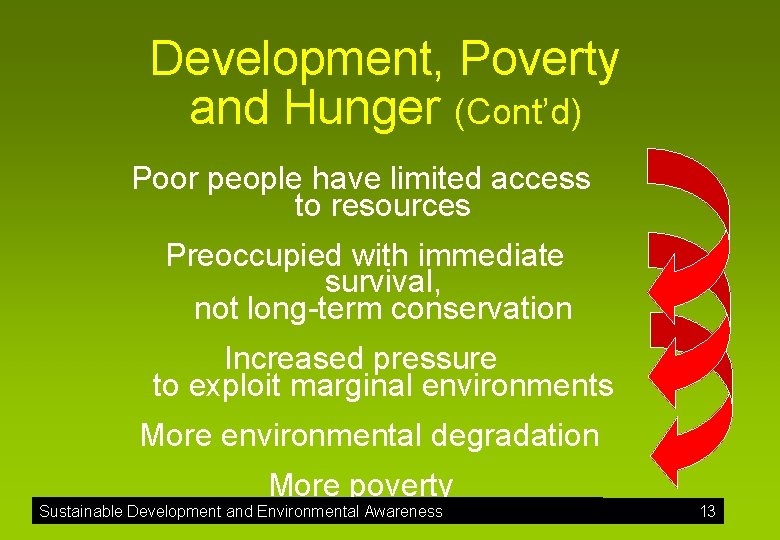
Development, Poverty and Hunger (Cont’d) Poor people have limited access to resources Preoccupied with immediate survival, not long-term conservation Increased pressure to exploit marginal environments More environmental degradation More poverty Sustainable Development and Environmental Awareness 13
Development, Poverty and Hunger (Cont’d) è è Environmental conservation policies must not aggravate poverty and hunger Any development which significantly impacts natural resources can create poverty Excessive and wasteful use of resources leads to poverty and hunger Human population numbers, their distribution, and their consumption of resources create poverty and hunger Sustainable Development and Environmental Awareness 14
The Poor and Environmental Degradation è Environmental degradation affects poor people most through: » polluted and unsafe water » inadequate sanitation » erosion, flooding » exposure to toxic waste » loss of local resources - food, fuel Sustainable Development and Environmental Awareness 15
The Poor and Environmental Degradation (Cont’d) Reducing poverty is a prerequisite for sustainable development Sustainable Development and Environmental Awareness 16
Environment and Health Some environmental causes of ill health: è Water pollution from humans and industry è Overcrowding, especially in urban centres è Unhealthy working conditions è Modifying the natural environment, e. g: » schistosomiasis, malaria, Japanese encephalitis from reservoirs, irrigation » pesticide contamination from agriculture » air pollution from vehicles in big cities Sustainable Development and Environmental Awareness 17
Creating Health Communities Sustainable development must contribute to: è physical, social, spiritual, and economic well-being è safe drinking water and sanitation è safe, nutritious food, and overall hygiene è adequate housing è health care services and health education è disease control Sustainable Development and Environmental Awareness 18 è lower infant mortality and longer life
Development and Indigenous Peoples Development has often caused native peoples to lose: è è Means of livelihood Ancestral land, traditions, cultural values, self -determination, dignity Frequently the outcomes of development are: è è Unemployment Increased poverty, ill-health, societal breakdown, crime Sustainable Development and Environmental Awareness 19
Land Use and Forestry è è è Conduct land use planning on a watershed (basin-wide) basis Integrate traditional with modern methods of land use Preserve ecosystem values in mountains and lowlands Prevent unsanctioned conversion of forest lands to other uses Promote multiple use of forests Sustainable Development and Environmental Awareness 20
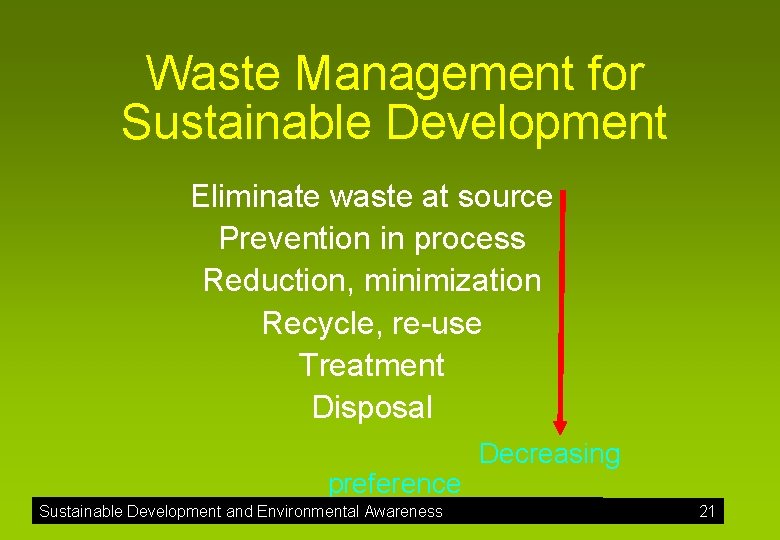
Waste Management for Sustainable Development Eliminate waste at source Prevention in process Reduction, minimization Recycle, re-use Treatment Disposal preference Sustainable Development and Environmental Awareness Decreasing 21
Freshwater Resources è è Less than 1% of the water on earth is freshwater Sustainable development requires: » Adequate supplies of good quality water » Preservation of hydrological, biological, chemical functions of ecosystems » Staying within limits of water systems’ capacity » Control of water-borne disease vectors (Agenda 21) Sustainable Development and Environmental Awareness 22
The Sustainable Development Journey Sustainable development is a journey, not a destination… and there are no short cuts Sustainable Development and Environmental Awareness 23
Vehicles for the Sustainable Development Journey è è è Visionary policies Cross-sectoral legislation and institutions Integrated Resource and Environmental Management (IREM) Cumulative Effects Assessment (CEA) Strategic Environmental Assessment (SEA) Environmental awareness and public participation in decisions Sustainable Development and Environmental Awareness 24
Concluding Thoughts Important points to remember are: è Sustainable development must respect the rights and dignity of all human beings and the environment è Core themes are pollution prevention, conservation, equitable sharing of benefits, stakeholder input to decisions è Sustainable development can succeed only if it addresses poverty, hunger, disease, and illiteracy Sustainable Development and Environmental Awareness 25
Concluding Thoughts (Cont’d) Additional points to remember are: è è è Economic, social, and environmental factors must be integrated and equitable Sustainable development becomes more precarious as the number of disadvantaged people increases Sustainable development depends on preserving healthy land water resources Sustainable Development and Environmental Awareness 26
- Slides: 26