
SUSTAINABLE DEVELOPMENT GOAL 3 Ensure healthy lives and
SUSTAINABLE DEVELOPMENT GOAL 3 Ensure healthy lives and promote well-being for all at all ages
What is Sustainable Development? The Sustainable Development Goals, otherwise known as the Global Goals, build on the Millennium Development Goals(MDGs), eight anti-poverty targets that the world committed to achieving by 2015. The MDGs, adopted in 2000, aimed at an array of issues that included slashing poverty, hunger, disease, gender inequality, and access to water and sanitation. Enormous progress has been made on the MDGs, showing the value of a unifying agenda underpinned by goals and targets. Despite this success, the indignity of poverty has not been ended for all. The new SDGs, and the broader sustainability agenda, go much further than the MDGs, addressing the root causes of poverty and the universal need for development that works for all people. UNDP Administrator Helen Clark noted: "This agreement marks an important milestone in putting our world on an inclusive and sustainable course. If we all work together, we have a chance of meeting citizens’ aspirations for peace, prosperity, and wellbeing, and to preserve our planet. " The Sustainable Development Goals will now finish the job of the MDGs, and ensure that no one is left behind.
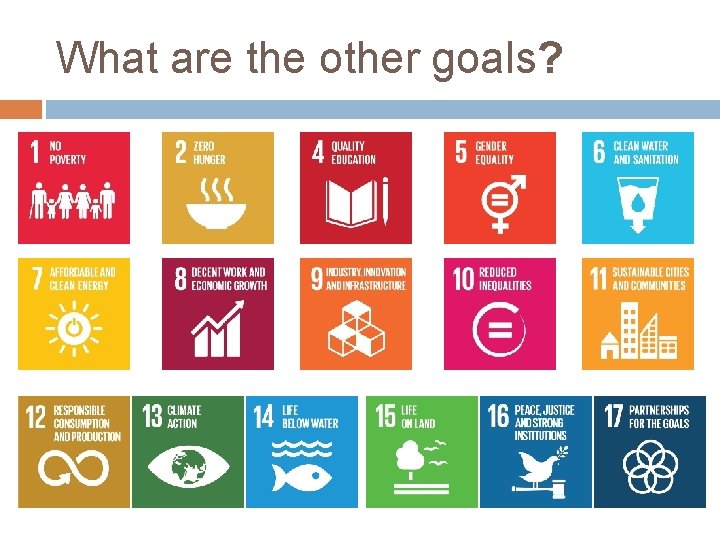
What are the other goals?
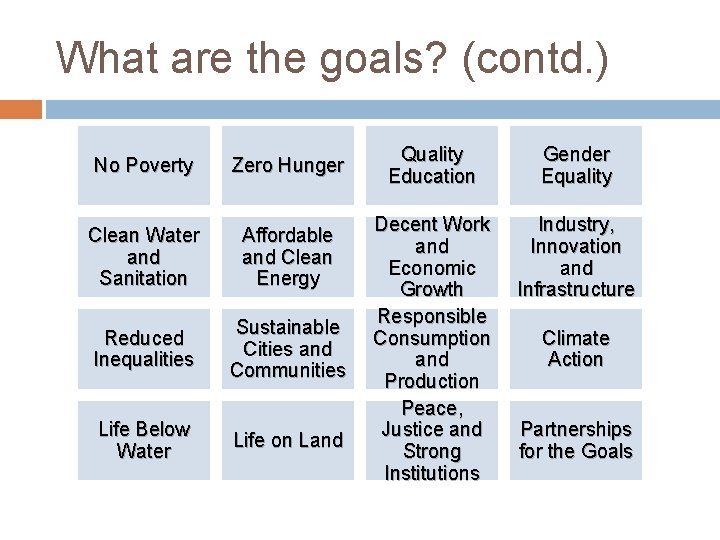
What are the goals? (contd. ) No Poverty Zero Hunger Clean Water and Sanitation Affordable and Clean Energy Reduced Inequalities Sustainable Cities and Communities Life Below Water Life on Land Quality Education Gender Equality Decent Work and Economic Growth Responsible Consumption and Production Peace, Justice and Strong Institutions Industry, Innovation and Infrastructure Climate Action Partnerships for the Goals
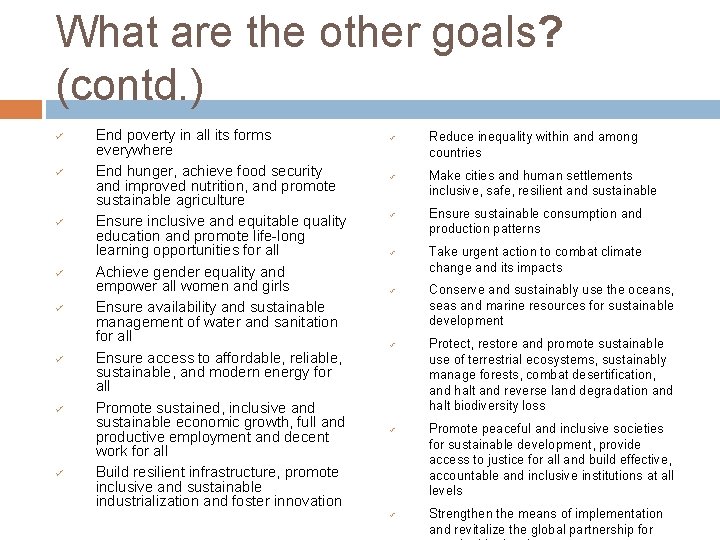
What are the other goals? (contd. ) ü ü ü ü End poverty in all its forms everywhere End hunger, achieve food security and improved nutrition, and promote sustainable agriculture Ensure inclusive and equitable quality education and promote life-long learning opportunities for all Achieve gender equality and empower all women and girls Ensure availability and sustainable management of water and sanitation for all Ensure access to affordable, reliable, sustainable, and modern energy for all Promote sustained, inclusive and sustainable economic growth, full and productive employment and decent work for all Build resilient infrastructure, promote inclusive and sustainable industrialization and foster innovation ü ü ü ü Reduce inequality within and among countries Make cities and human settlements inclusive, safe, resilient and sustainable Ensure sustainable consumption and production patterns Take urgent action to combat climate change and its impacts Conserve and sustainably use the oceans, seas and marine resources for sustainable development Protect, restore and promote sustainable use of terrestrial ecosystems, sustainably manage forests, combat desertification, and halt and reverse land degradation and halt biodiversity loss Promote peaceful and inclusive societies for sustainable development, provide access to justice for all and build effective, accountable and inclusive institutions at all levels Strengthen the means of implementation and revitalize the global partnership for
What are the proposed Global Goals? Having an integrated approach to supporting progress across the multiple goals is crucial to achieving the SDGs, and UNDP is uniquely placed to support that process. q All 17 SDGs are connected to UNDP’s Strategic Plan focus areas: sustainable development, democratic governance and peace building, and climate and disaster resilience. Goals Number 1 on poverty, Number 10 on inequality and Number 16 on governance are particularly central to UNDP’s current work and long-term plans.
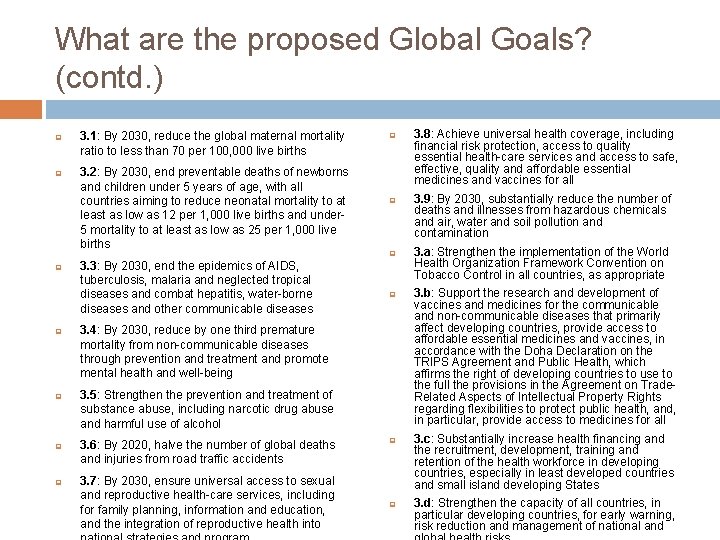
What are the proposed Global Goals? (contd. ) q q q q 3. 1: By 2030, reduce the global maternal mortality ratio to less than 70 per 100, 000 live births 3. 2: By 2030, end preventable deaths of newborns and children under 5 years of age, with all countries aiming to reduce neonatal mortality to at least as low as 12 per 1, 000 live births and under 5 mortality to at least as low as 25 per 1, 000 live births 3. 3: By 2030, end the epidemics of AIDS, tuberculosis, malaria and neglected tropical diseases and combat hepatitis, water-borne diseases and other communicable diseases q q 3. 4: By 2030, reduce by one third premature mortality from non-communicable diseases through prevention and treatment and promote mental health and well-being 3. 5: Strengthen the prevention and treatment of substance abuse, including narcotic drug abuse and harmful use of alcohol 3. 6: By 2020, halve the number of global deaths and injuries from road traffic accidents 3. 7: By 2030, ensure universal access to sexual and reproductive health-care services, including for family planning, information and education, and the integration of reproductive health into q q 3. 8: Achieve universal health coverage, including financial risk protection, access to quality essential health-care services and access to safe, effective, quality and affordable essential medicines and vaccines for all 3. 9: By 2030, substantially reduce the number of deaths and illnesses from hazardous chemicals and air, water and soil pollution and contamination 3. a: Strengthen the implementation of the World Health Organization Framework Convention on Tobacco Control in all countries, as appropriate 3. b: Support the research and development of vaccines and medicines for the communicable and non-communicable diseases that primarily affect developing countries, provide access to affordable essential medicines and vaccines, in accordance with the Doha Declaration on the TRIPS Agreement and Public Health, which affirms the right of developing countries to use to the full the provisions in the Agreement on Trade. Related Aspects of Intellectual Property Rights regarding flexibilities to protect public health, and, in particular, provide access to medicines for all 3. c: Substantially increase health financing and the recruitment, development, training and retention of the health workforce in developing countries, especially in least developed countries and small island developing States 3. d: Strengthen the capacity of all countries, in particular developing countries, for early warning, risk reduction and management of national and
What is the 2030 Agenda for Sustainable Development? At the Sustainable Development Summit on 25 September, 2015, UN Member States will adopt the 2030 Agenda for Sustainable Development, which includes a set of 17 Sustainable Development Goals (SDGs) to end poverty, fight inequality and injustice, and tackle climate change by 2030. The SDGs, otherwise known as the Global Goals, build on the Millennium Development Goals (MDGs), eight anti-poverty targets that the world committed to achieving by 2015. The MDGs, adopted in 2000, aimed at an array of issues that included slashing poverty, hunger, disease, gender inequality, and access to water and sanitation. Enormous progress has been made on the MDGs, showing the value of a unifying agenda underpinned by goals and targets. Despite this success, the indignity of poverty has not been ended for all. The new Global Goals, and the broader sustainability agenda, go much further than the MDGs, addressing the root causes of poverty and the universal need for development that works for all people. UNDP Administrator Helen Clark noted: "This agreement marks an important milestone in putting our world on an inclusive and sustainable course. If we all work together, we have a chance of meeting citizens’ aspirations for peace, prosperity, and wellbeing, and to preserve our planet. " The Global Goals will now finish the job of the MDGs, and ensure that no one is left behind.
History – Background The United Nations is now in the process of defining Sustainable Development Goals as part a new sustainable development agenda that must finish the job and leave no one behind. This agenda, to be launched at the Sustainable Development Summit in September 2015, is currently being discussed at the UN General Assembly, where Member States and civil society are making contributions to the agenda. The process of arriving at the post 2015 development agenda is Member State-led with broad participation from Major Groups and other civil society stakeholders. There have been numerous inputs to the agenda, notably a set of Sustainable Development Goals proposed by an open working group of the General Assembly, the report of an intergovernmental committee of experts on sustainable development financing, General Assembly dialogues on technology facilitation and many others. In December, UN Secretary-General Ban Ki-moon released his Synthesis Report, which summarizes these inputs and presents the vision for the post-2015 sustainable development agenda. Drawing from the experience of two decades of development practice and from the inputs gathered through an open and inclusive process, the report The Road to Dignity by 2030 charts a road map to achieve dignity in the next 15 years. Mr. Ban formally presented his report on 8 January to Member States. In an interview, Mr. Ban’s Special Adviser on Post-2015 Development Planning Amina J. Mohammed said that one of the main takeaways of the report is “the hope and the opportunity that we have ahead of us […] This is a generation that can do what we need to do to achieve many of the challenges that we see ahead of us. So if there is anything that we are taking away from this report it is that by 2030 we can end poverty, we can transform lives and we can find ways to protect the planet while doing that. ” The United Nations has also played a facilitating role in the global conversation on the post-2015 development agenda and supported broad consultations such as the My. World survey. It also has the responsibility of supporting Member States by providing evidence-based inputs, analytical thinking and field experience.
History – Millennium Development Goals q q q Ø Ø Ø q Ensuring a life with dignity 2015 is the year when countries will shape and adopt a new development agenda that will build on the Millennium Development Goals (MDGs). The Millennium Development Goals were established in the year 2000 and include eight anti-poverty targets to be accomplished by 2015. Since then, enormous progress has been made towards achieving the MDGs: Global poverty continues to decline More children than ever are attending primary school Child deaths have dropped dramatically Access to safe drinking water has been greatly expanded Targeted investments in fighting malaria, AIDS and tuberculosis have saved millions The MDGs are making a real difference in people’s lives, and this progress can be expanded in most of the world’s countries with strong leadership and accountability
Achievements in MDGs
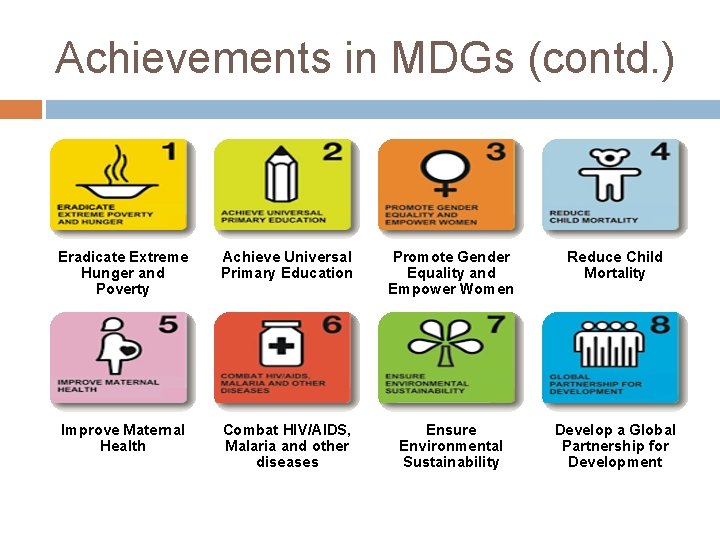
Achievements in MDGs (contd. ) Eradicate Extreme Hunger and Poverty Achieve Universal Primary Education Promote Gender Equality and Empower Women Reduce Child Mortality Improve Maternal Health Combat HIV/AIDS, Malaria and other diseases Ensure Environmental Sustainability Develop a Global Partnership for Development
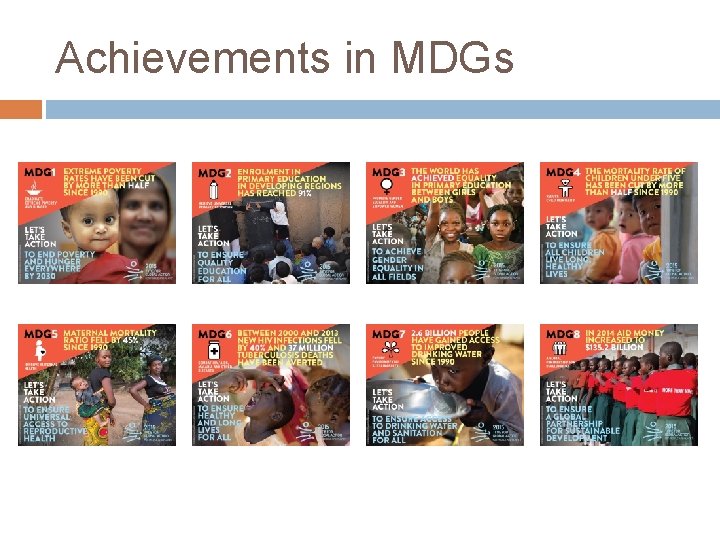
Achievements in MDGs (contd. ) ü ü Extreme poverty rates has been cut by more than half since 1990 Enrolment in primary education in developing regions has reached 91% The world has achieved equality in primary education between girls and boys The mortality rate of children under five has been cut my more than half since 1990 ü ü Maternal mortality ratio fell by 45% since 1990 Between 2000 and 2013 new HIV infections fell by 40% and 37 million tuberculosis infections has been averted 2. 6 billion people have gained access to improved drinking water since 1990 In 2014 aid money increased to $135. 2 billion
Facts and Figures Child health 17, 000 fewer children die each day than in 1990, but more than six million children still die before their fifth birthday each year Since 2000, measles vaccines have averted nearly 15. 6 million deaths Despite determined global progress, an increasing proportion of child deaths are in sub-Saharan Africa and Southern Asia. Four out of every five deaths of children under age five occur in these regions. Children born into poverty are almost twice as likely to die before the age of five as those from wealthier families. Children of educated mothers—even mothers with only primary schooling—are more likely to survive than children of mothers with no education.
Facts and Figures (contd. ) Maternal health Maternal mortality has fallen by almost 50 per cent since 1990 In Eastern Asia, Northern Africa and Southern Asia, maternal mortality has declined by around two-thirds But maternal mortality ratio – the proportion of mothers that do not survive childbirth compared to those who do – in developing regions is still 14 times higher than in the developed regions More women are receiving antenatal care. In developing regions, antenatal care increased from 65 per cent in 1990 to 83 per cent in 2012 Only half of women in developing regions receive the recommended amount of health care they need Fewer teens are having children in most developing regions, but progress has slowed. The large increase in contraceptive use in the 1990 s was not matched in the 2000 s The need for family planning is slowly being met for more women, but demand is increasing at a rapid pace
Facts and Figures (contd. ) HIV/AIDS, malaria and other diseases At the end of 2014, there were 13. 6 million people accessing antiretroviral therapy New HIV infections in 2013 were estimated at 2. 1 million, which was 38 per cent lower than in 2001 At the end of 2013, there were an estimated 35 million people living with HIV At the end of 2013, 240 000 children were newly infected with HIV New HIV infections among children have declined by 58 per cent since 2001 Globally, adolescent girls and young women face genderbased inequalities, exclusion, discrimination and violence, which put them at increased risk of acquiring HIV is the leading cause of death for women of reproductive age worldwide
Facts and Figures (contd. ) HIV/AIDS, malaria and other diseases (contd. ) TB-related deaths in people living with HIV have fallen by 36% since 2004 There were 250 000 new HIV infections among adolescents in 2013, two thirds of which were among adolescent girls AIDS is now the leading cause of death among adolescents (aged 10 – 19) in Africa and the second most common cause of death among adolescents globally In many settings, adolescent girls’ right to privacy and bodily autonomy is not respected, as many report that their first sexual experience was forced As of 2013, 2. 1 million adolescents were living with HIV Over 6. 2 million malaria deaths have been averted between 2000 and 2015, primarily of children under five years of age in sub-Saharan Africa. The global malaria incidence rate has fallen by an estimated 37 per cent and the morality rates by 58 per cent Between 2000 and 2013, tuberculosis prevention, diagnosis and treatment interventions saved an estimated 37 million lives. The tuberculosis mortality rate fell by 45 per cent and the prevalence rate by 41 per cent between 1990 and 2013
Challenges of SDGs in Bangladesh A key challenge of sustainable development in Bangladesh is population which is at centre of sustainable development. While population growth degrades the environment sustainable development seeks to ensure higher quality of life for population of the present generation as well as the future generation. Other challenges of sustainable development include poverty and inequality, unplanned urbanization, energy security, inefficient water resources management, natural disasters and climate change.
Challenges – Population q Bangladesh has made commendable achievements in decelerating population growth. Still the population and its growth are far from what the country needs to achieve sustainability particularly social sustainability. A large population along with high population growth required faster growth of agricultural production with significant pressure on environment. Some of the ways in which population growth has impacted on environment includes degradation of agricultural land through unbalanced use of chemical fertilizers, decline in tree cover due to collection of fuel wood, hill cutting and shift of land to crop agriculture, arsenic contamination of underground water due to over-pumping of underground water for irrigation, loss of open water fish stock due to over-fishing, decline in livestock because of lack of grazing land. The challenge facing the country is to reduce the population growth at a faster rate so that population creates less stress on natural and built resources and basic services.
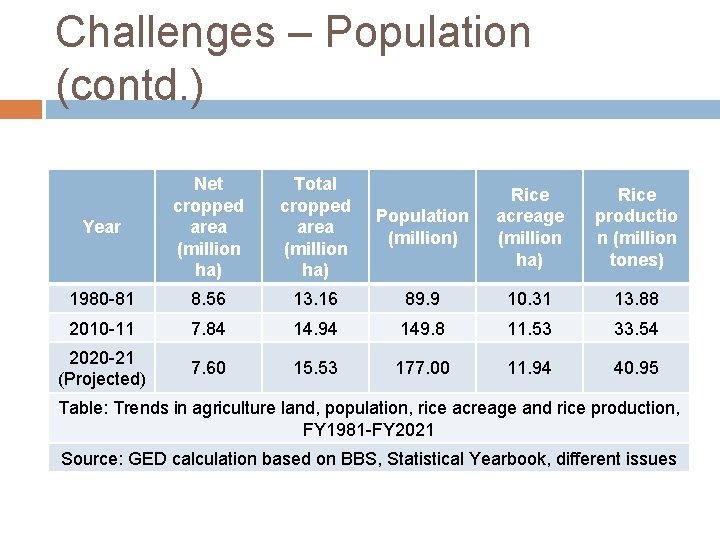
Challenges – Population (contd. ) Year Net cropped area (million ha) Total cropped area (million ha) 1980 -81 8. 56 2010 -11 2020 -21 (Projected) Population (million) Rice acreage (million ha) Rice productio n (million tones) 13. 16 89. 9 10. 31 13. 88 7. 84 14. 94 149. 8 11. 53 33. 54 7. 60 15. 53 177. 00 11. 94 40. 95 Table: Trends in agriculture land, population, rice acreage and rice production, FY 1981 -FY 2021 Source: GED calculation based on BBS, Statistical Yearbook, different issues
Challenges – Poverty and Inequality q Significant reduction in poverty has taken place in the last four decades – the incidence of poverty as measured by headcount rate declined from more than 80 percent in 1973 -74 to 31. 5 percent in 2010. Despite notable progress in poverty reduction Bangladesh faces the stark reality that about 46. 8 million of its population still live in poverty. Another reality is that income inequality has increased over the years. No process of development and eradication of poverty can be conceived of without putting caring for environment and sustainable development at the center stage. On the other hand, as the poor depend heavily on nature for 41 their livelihood, without the whole-hearted involvement of the poor, caring for environment becomes an extremely difficult task.
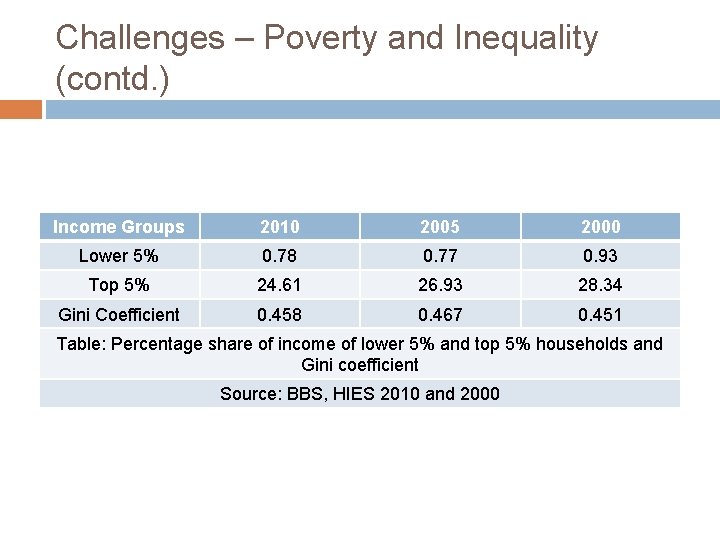
Challenges – Poverty and Inequality (contd. ) Income Groups 2010 2005 2000 Lower 5% 0. 78 0. 77 0. 93 Top 5% 24. 61 26. 93 28. 34 Gini Coefficient 0. 458 0. 467 0. 451 Table: Percentage share of income of lower 5% and top 5% households and Gini coefficient Source: BBS, HIES 2010 and 2000
Challenges – Unplanned Urbanization q Bangladesh has been experiencing rapid increase in urban population since its independence resulting in increase in the proportion of urban population to total population from 8. 2 percent to 23. 3 percent during the 1974 -2011 period. It is estimated that 33 percent of the population will be living in the cities by 2021. Unplanned development of the urban centers is a serious problem confronting the country now. Urban areas particularly the big cities including Dhaka have serious pollution problems with respect to solid waste management, growth of slum areas without supply of clean water, and sanitation facilities, with congested living conditions, inadequate drainage system, and untreated industrial waste disposal. Most of these factors affect the urban poor in terms of general hardship, ill-health and even death. As usual it is the women and the children who are the worst victims.
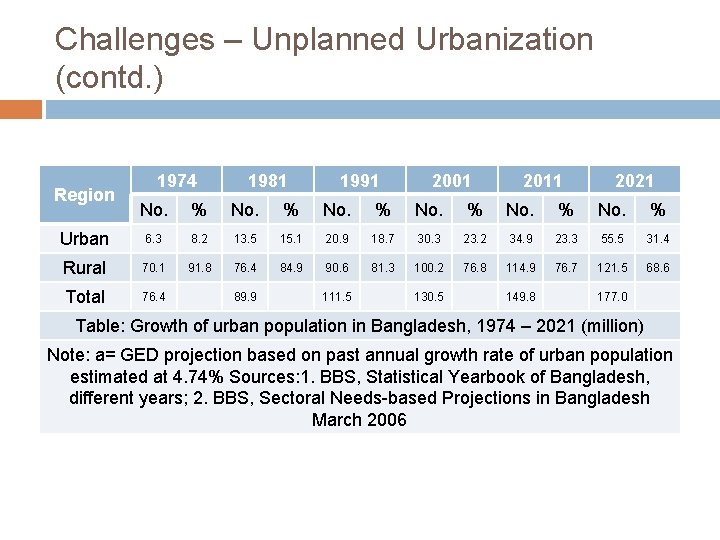
Challenges – Unplanned Urbanization (contd. ) Region 1974 1981 1991 2001 2011 2021 No. % Urban 6. 3 8. 2 13. 5 15. 1 20. 9 18. 7 30. 3 23. 2 34. 9 23. 3 55. 5 31. 4 Rural 70. 1 91. 8 76. 4 84. 9 90. 6 81. 3 100. 2 76. 8 114. 9 76. 7 121. 5 68. 6 Total 76. 4 89. 9 111. 5 130. 5 149. 8 177. 0 Table: Growth of urban population in Bangladesh, 1974 – 2021 (million) Note: a= GED projection based on past annual growth rate of urban population estimated at 4. 74% Sources: 1. BBS, Statistical Yearbook of Bangladesh, different years; 2. BBS, Sectoral Needs-based Projections in Bangladesh March 2006
Challenges – Energy Security q Energy is one of the primary drivers of economic growth and sustainable development. Lack of coverage and quality of energy supply is one of the key barriers to development of both industry and agriculture sector.
Challenges – Inefficient Water Resources and Management q Even though water resource is an integral part of economic and social development of Bangladesh, it is managed poorly. The entire water resource system is now at a degraded state. Many sectors including agriculture, fisheries, industry, navigation, and ecosystem are heavily dependent on water resource system. In this context, the restoration of water resource system is a primary challenge that the country has to meet in order to ensure its sustainable development.
Challenges – Natural Disasters q Bangladesh experiences frequent natural disasters, which cause loss of life, and damage to infrastructure and economic assets, and adverse impact on lives and livelihoods, especially of poor people. Frequently occurring disasters like flood, cyclone and river erosion nullifies many development gains and sets back the country. The country has gained considerable experience and repute in management of disasters over the years, and this will be key to firmly establish the country on the path towards sustainable development.
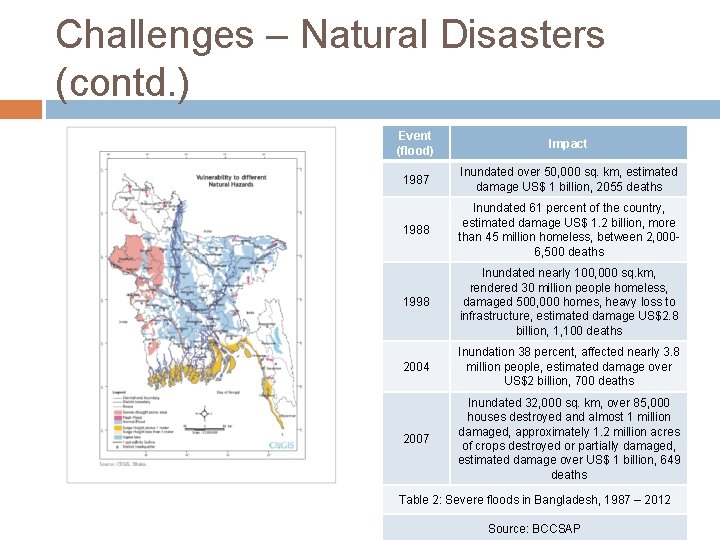
Challenges – Natural Disasters (contd. ) Event (flood) Impact 1987 Inundated over 50, 000 sq. km, estimated damage US$ 1 billion, 2055 deaths 1988 Inundated 61 percent of the country, estimated damage US$ 1. 2 billion, more than 45 million homeless, between 2, 0006, 500 deaths 1998 Inundated nearly 100, 000 sq. km, rendered 30 million people homeless, damaged 500, 000 homes, heavy loss to infrastructure, estimated damage US$2. 8 billion, 1, 100 deaths 2004 Inundation 38 percent, affected nearly 3. 8 million people, estimated damage over US$2 billion, 700 deaths 2007 Inundated 32, 000 sq. km, over 85, 000 houses destroyed and almost 1 million damaged, approximately 1. 2 million acres of crops destroyed or partially damaged, estimated damage over US$ 1 billion, 649 deaths Table 2: Severe floods in Bangladesh, 1987 – 2012 Source: BCCSAP
Challenges – Climate Change q Bangladesh is widely recognized to be one of the most climate vulnerable countries in the world. Climate change will exacerbate many of the current problems and natural hazards the country faces now. Increasing temperature will affect agriculture production threatening the hard earned food security the country now enjoys. Increasing sea level may permanently submerge large tract of flat coastal land forcing large scale migration
Other Challenges The plan, strategies to achieve sustainable development in Bangladesh discussed in previous chapter. Government has a plan and lots of supporting strategies too to achieve sustainable development. But we have challenges in every sector of sustainable development. The challenges of sustainable development in Bangladesh are described in this chapter. Challenges are described based on respective sectors. The sectors are: ü Agriculture and Rural Development ü Industry ü Transport Sector ü Human Resource Development ü Urban Environment ü Social Security and Protection ü Good Governance ü Economic Growth ü Other Challenges From all of the challenges of Social Security and Protection is the main challenge to me. Lack of social security and protection can destroy all the achievements achieved in other sectors. If Bangladesh unable to ensure social security and protection for its entire people then the positive result of development will be a joke. It will seem like that “we have all, but we are unable to get it or use it”. The challenges of this particular sector with all other sectors are described below. We can compare the difference of this sector and other sectors there.
Bangladesh Success Girl children in Bangladesh's primary schools now outnumber boys because of a successful education policy Economic growth and Bangladesh’s economic model have remained pro-poor. Substantial reductions in the poverty rate, from around 50 per cent in 2000 to just over 30 per cent in 2010, alongside broad welfare improvements, have been secured. This is rooted both in basic conditions, relatively low inequality and the high level of labor intensity, and in successive Governments ensuring macroeconomic stability and growth promoting policies. With the global economic recovery, positive demographics and improving business and investor confidence, growth may accelerate above its current trend rate of 6 to 6 ½ per cent in the coming years. Bangladesh retains a deep commitment to social solidarity and to a progressive development agenda. Many MDG successes, in areas ranging from poverty reduction to exceptional improvements in infant mortality, to greater gender equity have been secured. The Government has also shown itself, able to recognize delivery weaknesses and marshal resources accordingly. This is most clear in relation to maternal mortality, where a goal which was well–off track, secured a 30% reduction in deaths during child birth over a four to five year interval. This bodes well for future interventions to capitalize on MDG successes – such as social protection reforms, and improved access to healthcare and schooling. On-going Government actions have greatly improved disaster preparedness and recovery. Given the extreme vulnerabilities faced, the country’s track record has been exceptional improving human security and saving lives. While extreme climatic events still sadly result in some fatalities, these have been reduced dramatically. This provides a sound basis for addressing allied and pressing questions of environmental sustainability.
Frequently Asked Questions v Ø What are the Millennium Development Goals? At the beginning of the new millennium, world leaders gathered at the UN to shape a broad vision to fight poverty in its many dimensions. That vision— which translated into eight goals, ranging from halving extreme poverty rates, to halting the spread of HIV/AIDS and providing universal primary education—has remained the overarching development framework for the world for the last 15 years. Progress towards the eight goals is measured through 21 targets and 60 official When are the MDGs expected to end? Ø The MDGs are expected to conclude on 31 December 2015 v
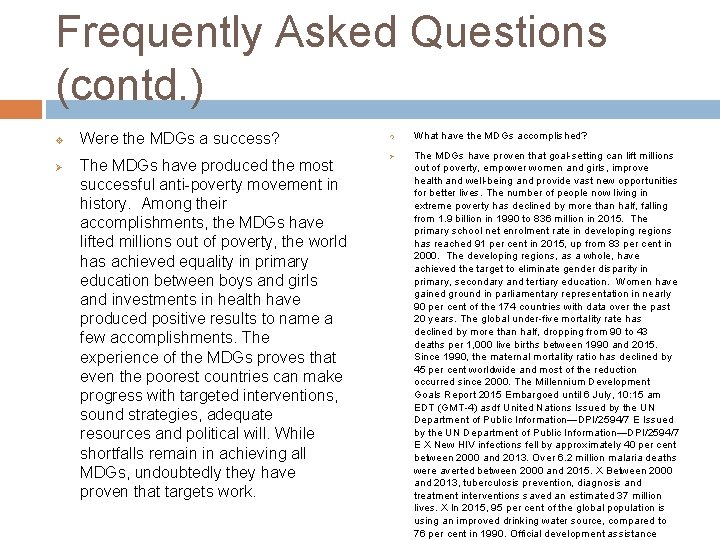
Frequently Asked Questions (contd. ) v Ø Were the MDGs a success? The MDGs have produced the most successful anti-poverty movement in history. Among their accomplishments, the MDGs have lifted millions out of poverty, the world has achieved equality in primary education between boys and girls and investments in health have produced positive results to name a few accomplishments. The experience of the MDGs proves that even the poorest countries can make progress with targeted interventions, sound strategies, adequate resources and political will. While shortfalls remain in achieving all MDGs, undoubtedly they have proven that targets work. v What have the MDGs accomplished? Ø The MDGs have proven that goal-setting can lift millions out of poverty, empower women and girls, improve health and well-being and provide vast new opportunities for better lives. The number of people now living in extreme poverty has declined by more than half, falling from 1. 9 billion in 1990 to 836 million in 2015. The primary school net enrolment rate in developing regions has reached 91 per cent in 2015, up from 83 per cent in 2000. The developing regions, as a whole, have achieved the target to eliminate gender disparity in primary, secondary and tertiary education. Women have gained ground in parliamentary representation in nearly 90 per cent of the 174 countries with data over the past 20 years. The global under-five mortality rate has declined by more than half, dropping from 90 to 43 deaths per 1, 000 live births between 1990 and 2015. Since 1990, the maternal mortality ratio has declined by 45 per cent worldwide and most of the reduction occurred since 2000. The Millennium Development Goals Report 2015 Embargoed until 6 July, 10: 15 am EDT (GMT-4) asdf United Nations Issued by the UN Department of Public Information—DPI/2594/7 E X New HIV infections fell by approximately 40 per cent between 2000 and 2013. Over 6. 2 million malaria deaths were averted between 2000 and 2015. X Between 2000 and 2013, tuberculosis prevention, diagnosis and treatment interventions saved an estimated 37 million lives. X In 2015, 95 per cent of the global population is using an improved drinking water source, compared to 76 per cent in 1990. Official development assistance
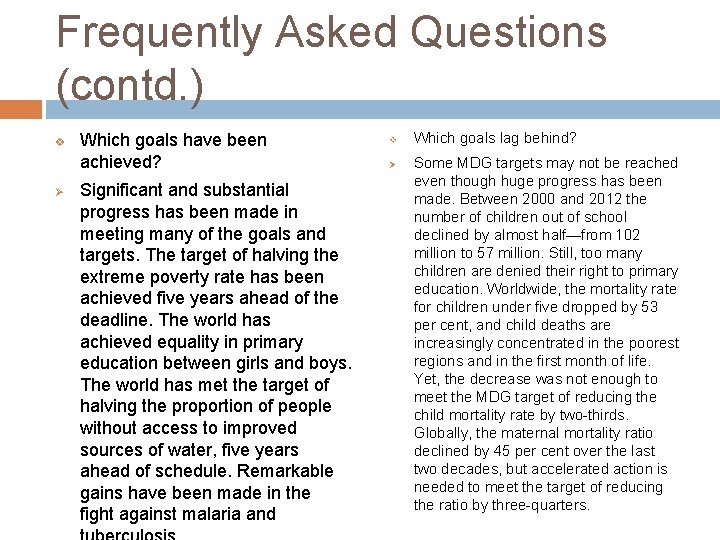
Frequently Asked Questions (contd. ) v Ø Which goals have been achieved? Significant and substantial progress has been made in meeting many of the goals and targets. The target of halving the extreme poverty rate has been achieved five years ahead of the deadline. The world has achieved equality in primary education between girls and boys. The world has met the target of halving the proportion of people without access to improved sources of water, five years ahead of schedule. Remarkable gains have been made in the fight against malaria and v Ø Which goals lag behind? Some MDG targets may not be reached even though huge progress has been made. Between 2000 and 2012 the number of children out of school declined by almost half—from 102 million to 57 million. Still, too many children are denied their right to primary education. Worldwide, the mortality rate for children under five dropped by 53 per cent, and child deaths are increasingly concentrated in the poorest regions and in the first month of life. Yet, the decrease was not enough to meet the MDG target of reducing the child mortality rate by two-thirds. Globally, the maternal mortality ratio declined by 45 per cent over the last two decades, but accelerated action is needed to meet the target of reducing the ratio by three-quarters.
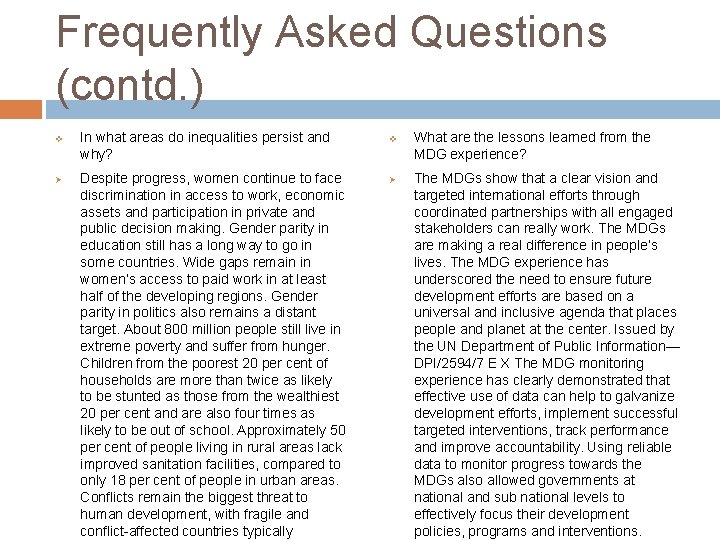
Frequently Asked Questions (contd. ) v Ø In what areas do inequalities persist and why? Despite progress, women continue to face discrimination in access to work, economic assets and participation in private and public decision making. Gender parity in education still has a long way to go in some countries. Wide gaps remain in women’s access to paid work in at least half of the developing regions. Gender parity in politics also remains a distant target. About 800 million people still live in extreme poverty and suffer from hunger. Children from the poorest 20 per cent of households are more than twice as likely to be stunted as those from the wealthiest 20 per cent and are also four times as likely to be out of school. Approximately 50 per cent of people living in rural areas lack improved sanitation facilities, compared to only 18 per cent of people in urban areas. Conflicts remain the biggest threat to human development, with fragile and conflict-affected countries typically v Ø What are the lessons learned from the MDG experience? The MDGs show that a clear vision and targeted international efforts through coordinated partnerships with all engaged stakeholders can really work. The MDGs are making a real difference in people’s lives. The MDG experience has underscored the need to ensure future development efforts are based on a universal and inclusive agenda that places people and planet at the center. Issued by the UN Department of Public Information— DPI/2594/7 E X The MDG monitoring experience has clearly demonstrated that effective use of data can help to galvanize development efforts, implement successful targeted interventions, track performance and improve accountability. Using reliable data to monitor progress towards the MDGs also allowed governments at national and sub national levels to effectively focus their development policies, programs and interventions.
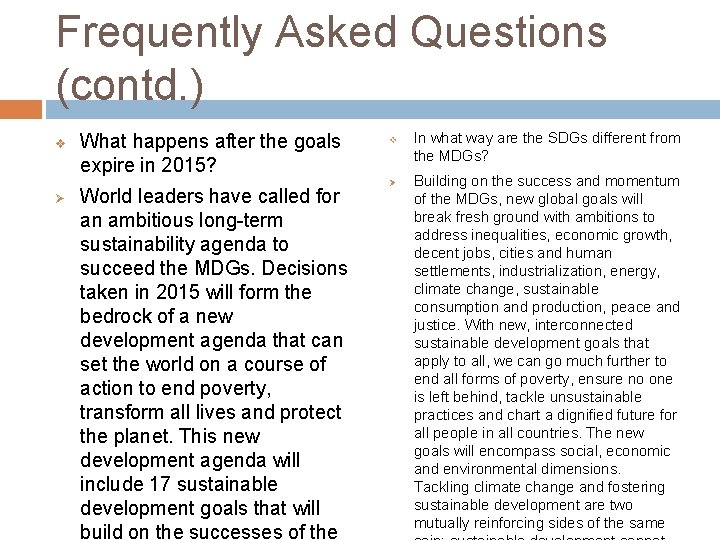
Frequently Asked Questions (contd. ) v Ø What happens after the goals expire in 2015? World leaders have called for an ambitious long-term sustainability agenda to succeed the MDGs. Decisions taken in 2015 will form the bedrock of a new development agenda that can set the world on a course of action to end poverty, transform all lives and protect the planet. This new development agenda will include 17 sustainable development goals that will build on the successes of the v Ø In what way are the SDGs different from the MDGs? Building on the success and momentum of the MDGs, new global goals will break fresh ground with ambitions to address inequalities, economic growth, decent jobs, cities and human settlements, industrialization, energy, climate change, sustainable consumption and production, peace and justice. With new, interconnected sustainable development goals that apply to all, we can go much further to end all forms of poverty, ensure no one is left behind, tackle unsustainable practices and chart a dignified future for all people in all countries. The new goals will encompass social, economic and environmental dimensions. Tackling climate change and fostering sustainable development are two mutually reinforcing sides of the same
Frequently Asked Questions (contd. ) v Ø How will the MDGs Report’s recommendations influence the SDGs? There are many lessons from the experience of the MDGs and they serve as a springboard for our next steps. The efforts to achieve the MDGs which have been documented in the Report provide a framework for the necessary action to be undertaken in the context of the SDGs. We now know that we need to tackle root causes and do more to integrate the economic, social and environmental dimensions of sustainable development. Building on the success and momentum of the MDGs, the new post-2015 development agenda will guide our efforts to ensure sustainable development for all. The new goals and targets will reach further to ensure that sustainable development reaches all people and that no one is left behind. We must ensure that endeavors made by governments, the international community, civil society and the private sector reach those who are most vulnerable, are not counted and have not shared the improvements over the last 15 years. v Ø Won’t the post-2015 development agenda suffer from similar shortcomings to the MDGs? A major lesson learned from the MDGs is the importance of an inclusive process to create the new sustainable development agenda. Global consultations indicate that people want a global development agenda, backed by national policy action that can empower them to realize the future they want. The MDGs have shown the importance of national ownership of the development agenda and a participatory approach to goal setting. In September 2015, world leaders will gather to adopt a set of new ambitious goals for the post 2015 development agenda. All of the world will work to implement the Agenda within their own countries and at the regional and global levels. They will at the same time take into account different national realities, capacities and levels of development. Engaging all relevant stakeholders in implementation of the new Agenda is critically important. The mobilization of financial resources (both public and private, domestic and international) as well as capacity-building, the transfer of environmentally sound technologies and a wide range of other supportive policies and measures will be required. Issued by the UN Department of Public Information—DPI/2594/7 E
Credits and Sources http: //www. un. org/sustainabledevelopment-goals/ https: //sustainabledevelopment. un. org/? menu=1300 http: //www. undp. org/content/undp/en/home/mdgoverview/pos t-2015 -development-agenda. html http: //www. unmillenniumproject. org/goals/ http: //www. plancomm. gov. bd/wpcontent/uploads/2013/09/National-Sustainable-Development. Strategy. pdf
- Slides: 38