
Sustainable Development Goal 2 Zero Hunger Goal 2
Sustainable Development Goal #2 Zero Hunger Goal 2: End hunger, achieve food security and improved nutrition and promote sustainable agriculture Developing countries have fought against hunger from the year 2000 to 2015, through the Millennium Development Goal # 1. Through these efforts, the prevalence of hunger declined, from 15 per cent according to figures for 2000 to 2002, to 11 per cent according to figures for 2014 to 2016. We still need to find better and innovative ways to achieve food security. Climate change has negatively impacted agriculture by causing prolonged drought leading to famine as well as natural disasters such as floods, which are destroying farm lands while causing massive displacements of individuals. By focusing on participatory rural development and transformation of agricultural systems, we will become food secure, provide nutritional needs for 795 million people currently in need of food aid and have a plan for the 2 Billion people projected for 2050 (UN Website, 2017) https: //youtu. be/9 yo 1 ln. IFfuc
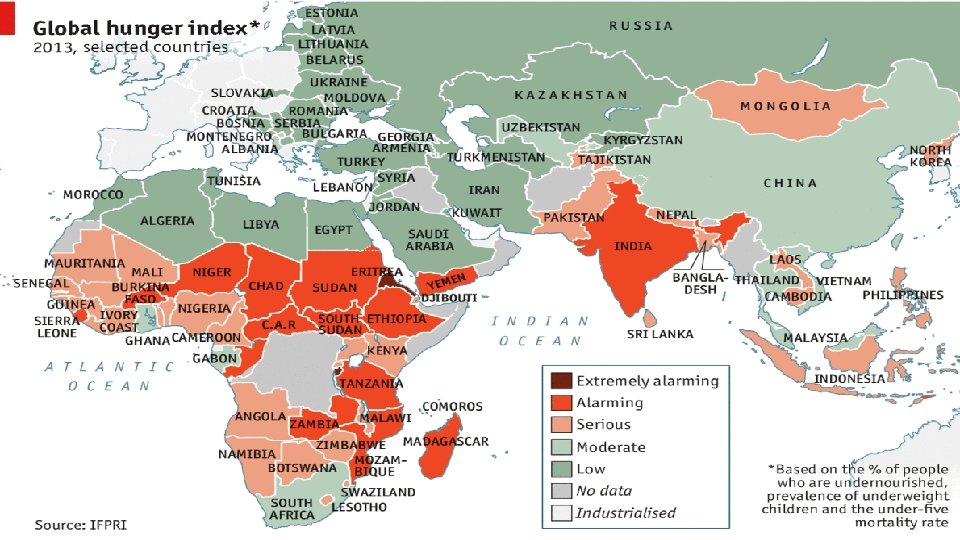
Hunger Facts and Figures Currently 795 million are undernourished majority of whom live in developing countries Approximately two thirds of the above population come from Asia 281 million people from the above figure come from Southern Asia while in sub-Saharan Africa, projections for the 2014 -2016 period indicate a rate of undernourishment of almost 23 per cent. Half of the deaths in children under 5 , is caused by poor nutrition 45%, and one in four suffer from stunting 66 million primary school-age children attend classes hungry across the developing world, with 23 million in Africa alone. Food security Agriculture is still the single largest employer in the world, providing sources of income for poor rural households. Agriculture accounts for 80 per cent of food consumed most of which is still rain fed. It is thus, imperative to invest in small scale women and men farmers so as to increase food security and nutrition. Encourage more resilient and sustainable farming systems that will encourage crop diversity which will contribute to farming of resistant crops as well as more nutritious foods. Promote equitable access to resources for women as well as men as this could reduce the number of hungry in the world by up to 150 million. Promote access to electricity especially for those living in rural areas of the developing world. Energy poverty in many regions is a fundamental barrier to reducing hunger and ensuring that the world can produce enough food to meet future demand.
Key Targets End hunger and ensure sufficient food access by all people all year round End all forms of malnutrition, stunting and wasting Double the agricultural productivity and increase the income of smallscale food producers Ensure sustainable food production systems and implement resilient agricultural practices Maintain the genetic diversity of seeds Increase investment in rural infrastructure to enhance agricultural productive capacity in developing countries Correct and prevent trade restrictions and distortions in world agricultural markets Adopt measures to ensure the proper functioning of food commodity markets and their derivatives
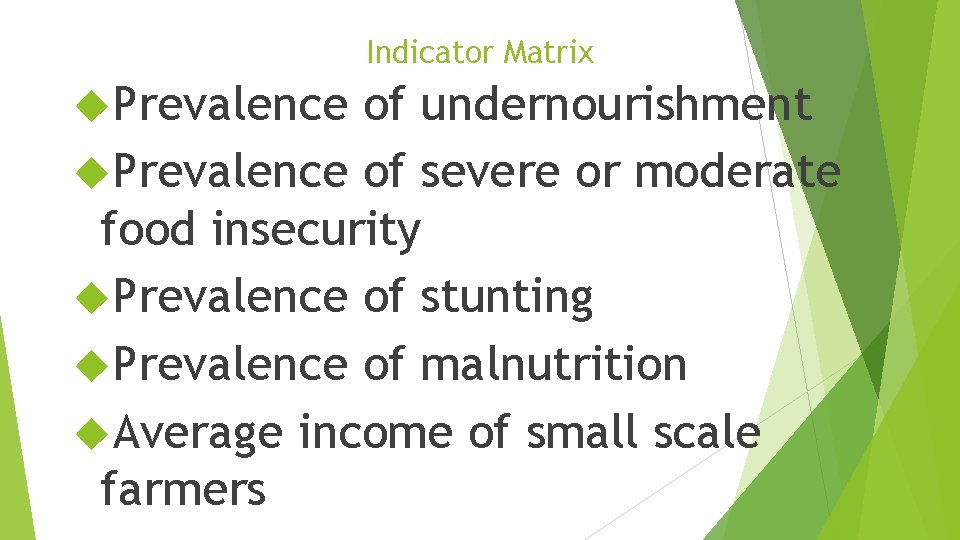
Indicator Matrix Prevalence of undernourishment Prevalence of severe or moderate food insecurity Prevalence of stunting Prevalence of malnutrition Average income of small scale farmers
- Slides: 5