
Sustainable Community Development Network Leadership Forum Attracting Residents
Sustainable Community Development Network Leadership Forum: Attracting Residents & Building Community Resilience through Cultivating Diversity June 26 th, 2018 Shad Henderson Director of Community Partnerships & Investments
Our mission is to support the people, organizations and partnerships committed to creating and maintaining healthy neighborhoods.
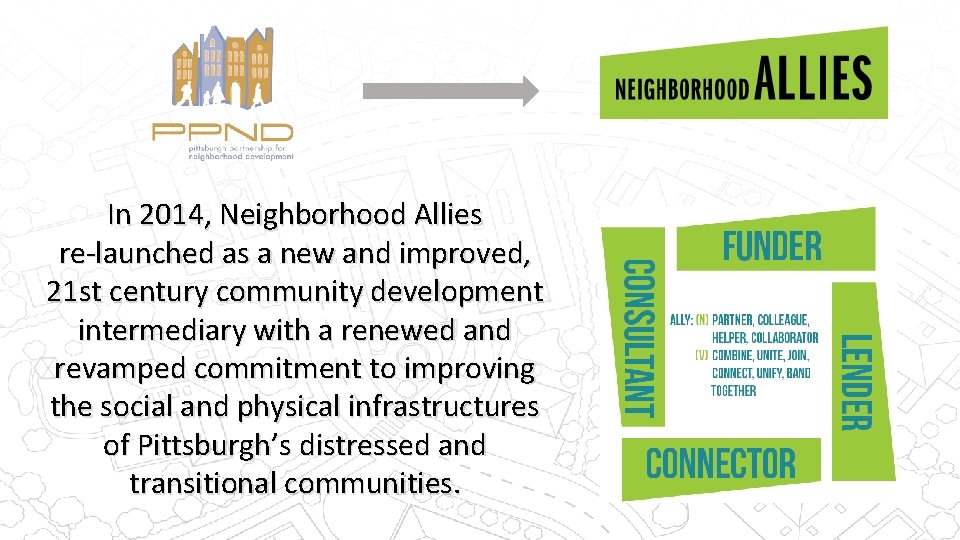
In 2014, Neighborhood Allies re-launched as a new and improved, 21 st century community development intermediary with a renewed and revamped commitment to improving the social and physical infrastructures of Pittsburgh’s distressed and transitional communities.

Healthy Neighborhoods Framework

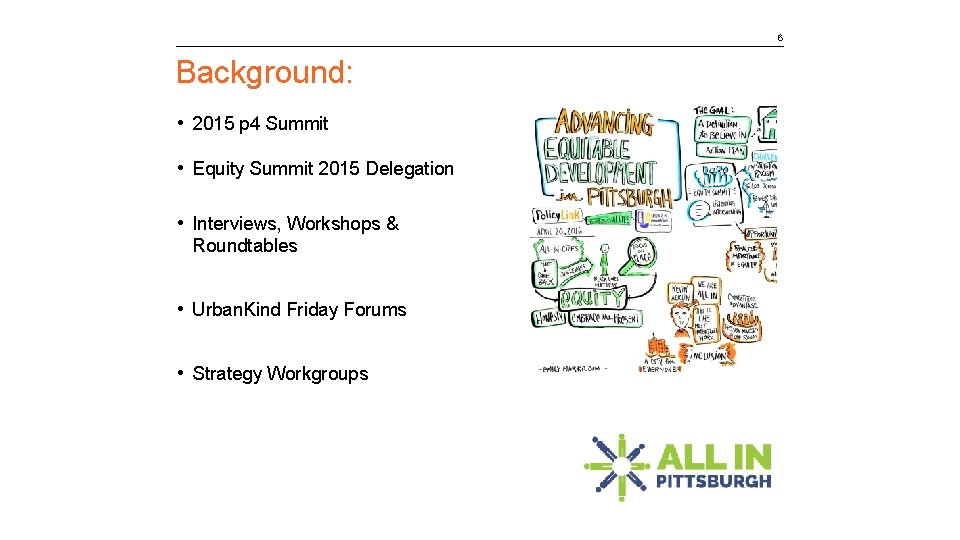
6 Background: • 2015 p 4 Summit • Equity Summit 2015 Delegation • Interviews, Workshops & Roundtables • Urban. Kind Friday Forums • Strategy Workgroups
7 Defining Equitable Development Equitable development is a positive development strategy to ensure everyone participates in and benefits from our region’s economic transformation—especially the low-income residents, communities of color, immigrants, the disabled and others at risk of being left behind. It requires an intentional focus on eliminating racial inequities and barriers, and making accountable and catalytic investments to ensure lowerwealth residents: • Live in healthy, safe, opportunity-rich neighborhoods that reflect their culture (and are not displaced from them); • Connect to economic and ownership opportunities; and • Have voice and influence in the decisions that shape their neighborhoods.
Equitable Development in Pittsburgh: Moving from Vision to Action An Equitable Development Agenda for Pittsburgh I. Raise the Bar for New Development II. Make All Neighborhoods Healthy Communities of Opportunity III. Expand Employment and Ownership Opportunities IV. Embed Racial Equity Throughout Pittsburgh’s Institutions and Businesses V. Build Community Power, Voice, & Capacity 8
9 Results Based Accountability Framework • Identifies the target population for our efforts • Identifies indicators by which to measure success • Prioritizes strategies to reach results Target Population: 340, 000 people living at or below 200% of AMI, in Allegheny County with an initial focus of 105, 000 who live in the City
10 Core Team: Roles and Responsibilities Neighborhood Allies • Lead Convener of the Collaborative • Provide overall coordination • Project Management • Research Support Urban Innovation 21 • Support economic and entrepreneurship components of the work Urban Kind • Lead the community and resident engagement • Provide research support • Plan and lead Action Team meetings • Help connect to broader equitable development initiatives Mongalo-Winston Consulting • Project management support • Coordinate the Implementation Team • Facilitate Steering Committee Meetings, and Assist with Action Teams • Coordinate policy efforts with development community Policy. Link • Provides policy research and data • Advocacy • Coalition Building
11 Steering Committee: Committed to date: Housing Alliance Pittsburgh United Action Housing PNC Bank Key Bank Dollar Bank Buhl Foundation The Pittsburgh Foundation The Hillman Foundation The Heinz Endowments Chatham: Center for Women’s Entrepreneurship Partners 4 Work The Allegheny Conference URA City Planning City Council District 6 Allegheny County District 10 Office of Mayor William Peduto Homewood Children’s Village The Kingsley Association Trek Development East End Development Partners City Commission on Human Relations • Cross-sector partnership: public and private sector, nonprofit, philanthropy, and community orgs. • First convened in August 2017 • Action Teams formed
12 Housing Action Team Indicators • Housing burden for renters and owners (share paying 30% of income on housing costs) • Homeownership rate in opportunity rich neighborhoods • Residents are more able to stay in their neighborhood. Indicates stable income and ability to buy; demonstrates a commitment to invest in the neighborhood • The number of affordable housing units (available to households at or below 80%, 50% and 30% of AMI) • Ensure that there is affordable housing in all neighborhoods, not just neighborhoods of last resort; ensure that neighborhoods offer desirable amenities including connection to transit
13 Housing Action Team Priorities: 2018 -2019 • Advocate for the creation of a new PA Housing Tax Credit (Policy) ○ Led by the Housing Alliance of PA; will provide a new source of funding for affordable housing. • Implement a tenant protections policy to enhance tenants’ ability to stay in safe, quality housing (Program/Policy) ○ Work with local partners to identify best practices and appropriate local models • Encourage broader use of p 4 metrics with a specific focus on the equity metrics (Education & Advocacy) ○ In addition to the URA, developers (including Action Housing) can use the metrics as a reference tool.
14 Employment & Entrepreneurship Action Team Indicators • Percentage of residents living at or below 200% of Poverty • Jobless rate (share of working-age population not currently employed) • Number of minority-owned businesses • In subsequent years we would like to track jobs being created by minority businesses
15 Employment & Entrepreneurship Action Team Priorities: 2018 -2019 • Change hiring behavior at organizations & corporations (Systems Change) ○ Confirm commitments from Steering Committee members to implement the Rooney Rule in hiring and purchasing (within one year) ○ Advance equity within organizations by assessing and implementing a tracking tool such as the Sustainable Pittsburgh Challenge with a broader cohort of organizations • Increase access to capital ○ ○ Work with participating banks to create more funding opportunities for minority entrepreneurs Promote the URA’s micro enterprise loan program

Thank You!
- Slides: 16