
Sustainable aviation how to implement the concept in
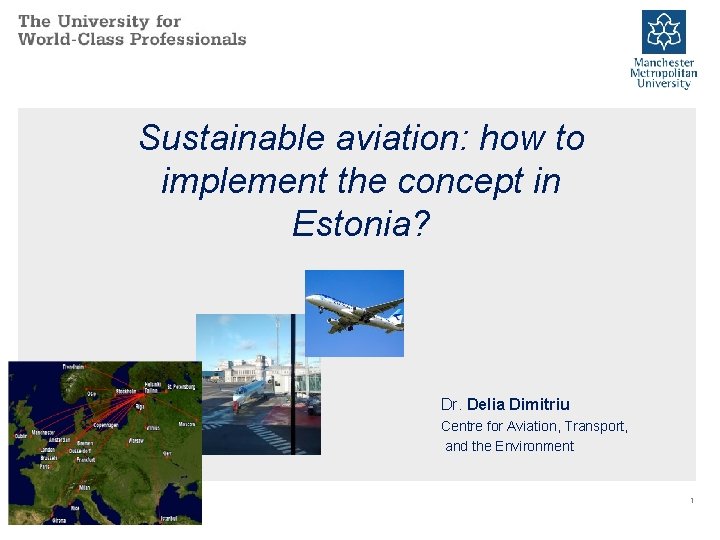
Sustainable aviation: how to implement the concept in Estonia? Dr. Delia Dimitriu Centre for Aviation, Transport, and the Environment Rovinari – 19 June 2013 1
Sustainability . Determining the complex environmental, economic and social impacts that are defining aviation’s future: Ø Environmental aspects Ø Economic aspects Ø Social aspects A balance is needed between these three pillars… Sustainable development is development that meets the needs of the present without compromising the ability of future generations to meet their own needs. - From Our Common Future (the Brundtland Report) 2
Aviation, an Economic Engine Air transport is a major contributor to global economic prosperity. If aviation were a country, it would rank 19 th in terms of the size of economy. Every day… » » 8. 6 million passengers » » 99, 700 flights » » $17. 5 billion worth of goods carried (ATAG, 2014) 3
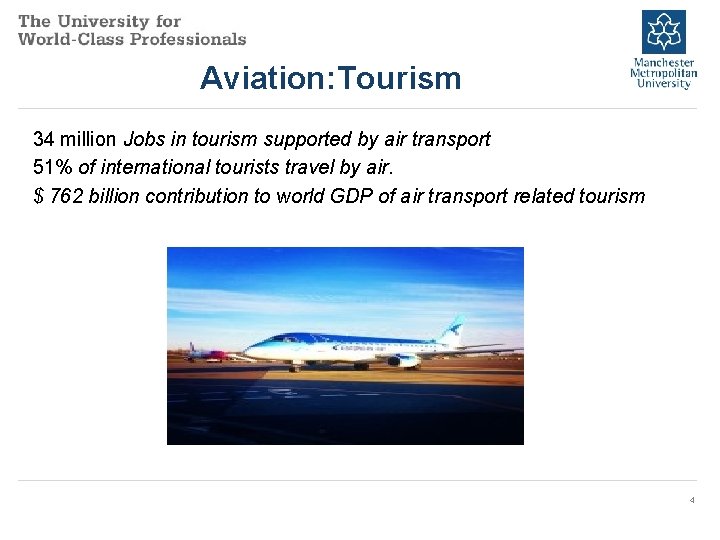
Aviation: Tourism 34 million Jobs in tourism supported by air transport 51% of international tourists travel by air. $ 762 billion contribution to world GDP of air transport related tourism 4
Social Aspects Aviation brings significant socially-related benefits, such as: ØFreedom of mobility ØLeisure ØHealth and welfare improvements through poverty reduction ØCultural enrichment and diversity ØConnecting global society ØJobs/employment opportunities 5
Aviation’s Role in Global Aid and Social Development In times of natural disaster or conflict, communities can quickly become displaced, isolated and left without proper access to food, water and shelter. Commercial carriers fly personnel between major cities and ships deliver bulk food provisions to the nearest ports, etc. In many cases, the presence of humanitarian staff depends on the availability of an air service to get them there and to get them out quickly when necessary. 6
Aviation: environmental responsibility Ø Worldwide, flights produced 705 million tonnes of CO 2 in 2013. Ø 2% of global CO 2 emissions ( globally, humans produced over 36 billion tonnes of CO 2). Ø 70% Aviation emissions per passenger kilometre are over 70% less than in the 1960 s High ocupancy: - Aircraft 77% - Train 40% - Coach 60% - Car 30% 7
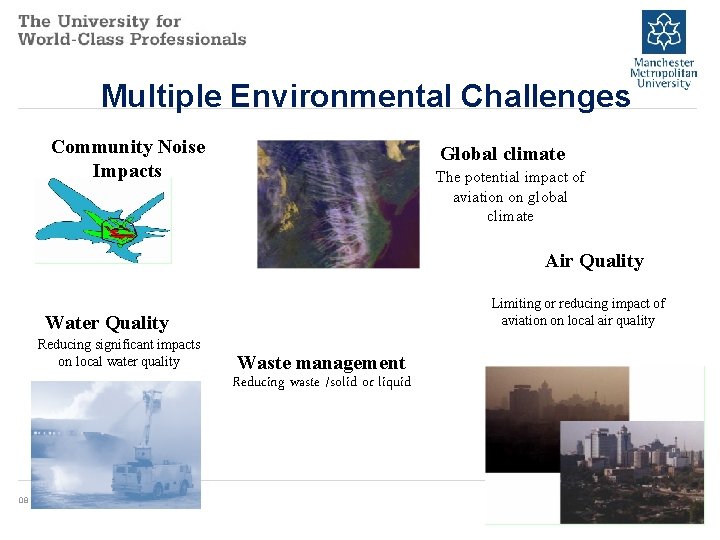
Multiple Environmental Challenges Community Noise Impacts Global climate The potential impact of aviation on global climate Air Quality Limiting or reducing impact of aviation on local air quality Water Quality Reducing significant impacts on local water quality 08 September 2021 Waste management Reducing waste /solid or liquid MSc Short Course 8
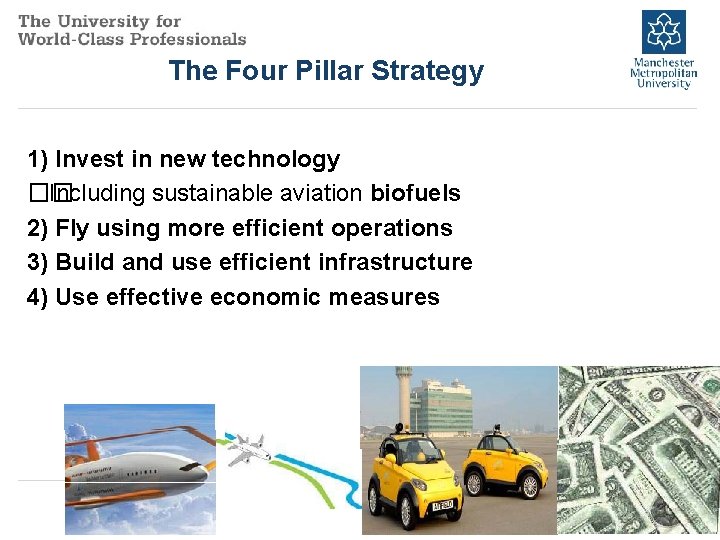
The Four Pillar Strategy 1) Invest in new technology �� Including sustainable aviation biofuels 2) Fly using more efficient operations 3) Build and use efficient infrastructure 4) Use effective economic measures MSc Short Course 9
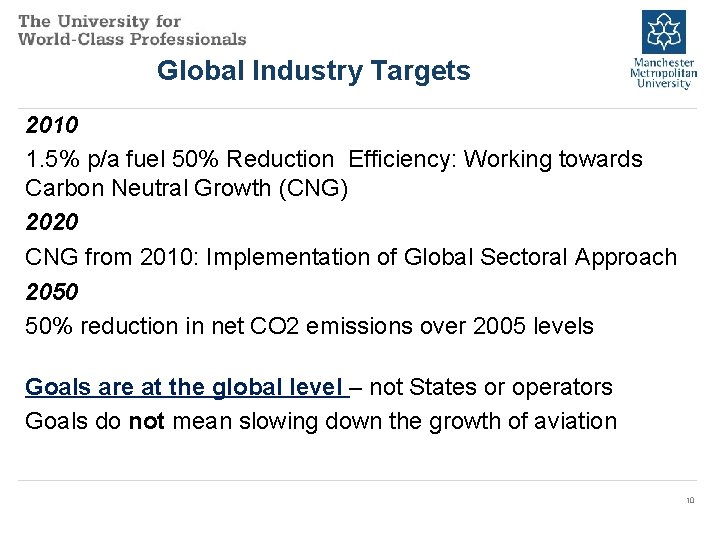
Global Industry Targets 2010 1. 5% p/a fuel 50% Reduction Efficiency: Working towards Carbon Neutral Growth (CNG) 2020 CNG from 2010: Implementation of Global Sectoral Approach 2050 50% reduction in net CO 2 emissions over 2005 levels Goals are at the global level – not States or operators Goals do not mean slowing down the growth of aviation 10
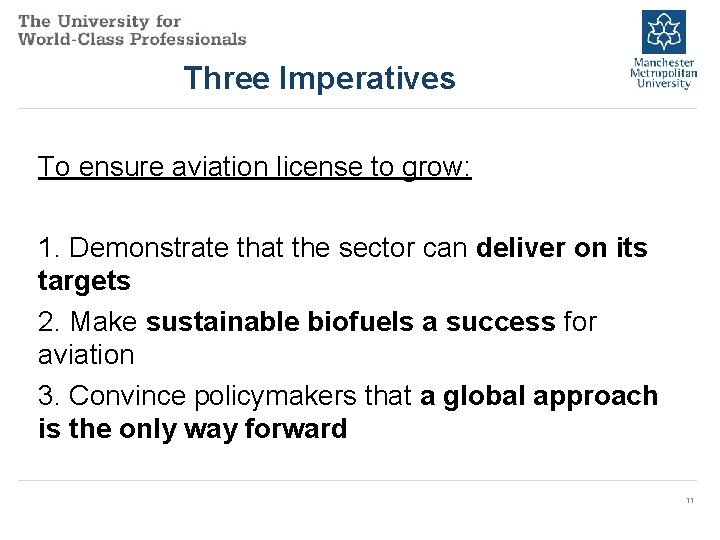
Three Imperatives To ensure aviation license to grow: 1. Demonstrate that the sector can deliver on its targets 2. Make sustainable biofuels a success for aviation 3. Convince policymakers that a global approach is the only way forward 11

Aircraft Emissions in the Environment Sun 08 September 2021 MSc Short Course 12 Figure adapted from 1999 Atmospheric Effects of Aviation Project NASA /FAA /EPA Partnership poster
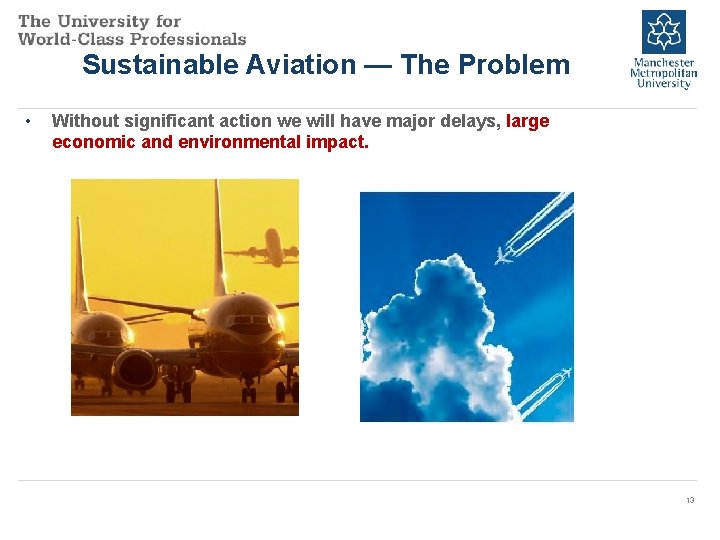
Sustainable Aviation — The Problem • Without significant action we will have major delays, large economic and environmental impact. 13
Sustainable Aviation — The Initiative • Goal: Develop technologies that will allow a tripling of capacity with a reduction in environmental impact. 14
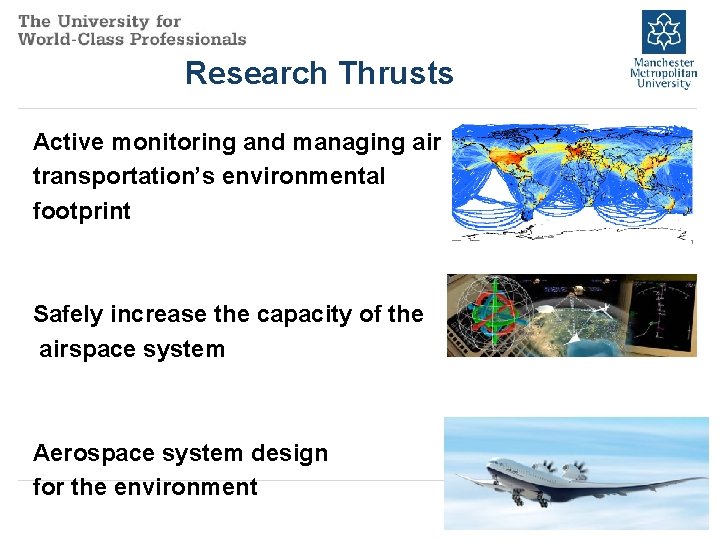
Research Thrusts Active monitoring and managing air transportation’s environmental footprint Safely increase the capacity of the airspace system Aerospace system design for the environment 15

Aviation Sector Initiatives (1) 1. Research - Understanding the issue - Modelling and simulation - Air Traffic Operations - Environmental management to reduce impact 2. Implementation - projects on aviation growth, airport capacity, ATM/New operational procedures; alternative fuels, etc. 16
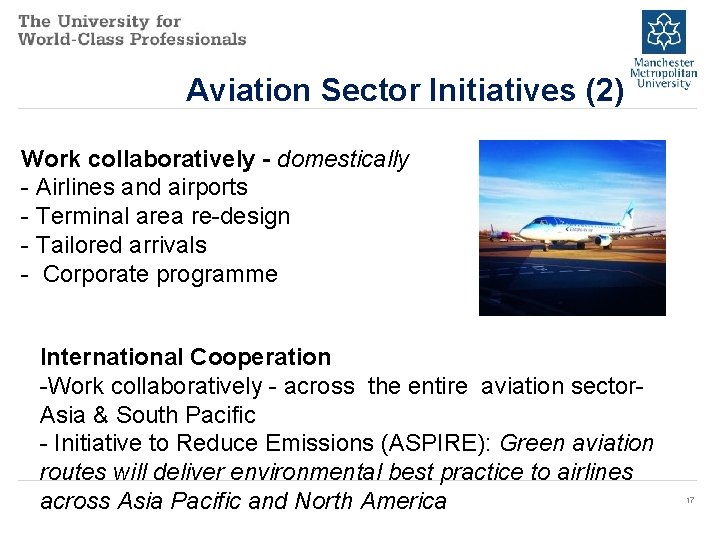
Aviation Sector Initiatives (2) Work collaboratively - domestically - Airlines and airports - Terminal area re-design - Tailored arrivals - Corporate programme International Cooperation -Work collaboratively - across the entire aviation sector. Asia & South Pacific - Initiative to Reduce Emissions (ASPIRE): Green aviation routes will deliver environmental best practice to airlines across Asia Pacific and North America 17
Biofuel Opportunities • Biofuels: present and future challenges: the feedstock for them would be algae; camelina; mallee trees, jatropha and halophytes; • Already commercial, as well as military, planes did some tests: – Air New Zealand (jatropha), Continental Airlines (jatropha & algae), Japan Airlines (jatropha, camelina, and algae), and KLM (camelina). - Gol- 300 flights summer 2014, using farnesane (sugar cane based) • The importance of biofuels popularization in order to establish a market for production, distribution, and operation on a daily basis. The need: production at an affordable price ‘available and affordable’ 18
Collaboration on Infrastructure • The ATCs target by 2050 is 96 percent airspace efficiency, which means that planes will be taking only the most efficient routes. • Importantly is collaborative decision making of all stakeholders: air navigation services providers, governments, airports, and airlines 19
Collaboration on Operations Flight operations (eg. APU fuel savings, pilot technique and flight management, engine out, taxi out): - flight dispatch (e. g. , cost index optimized and pilot & dispatcher additional fuel); - engineering and maintenance (including APU maintenance, aerodynamic & airframe drag); - regulatory measures (ground operations and performance based navigation). 20
Exploring the Interdependences • Interdependencies lead to CO 2 reductions, environmental concern increase, and foster investment in alternative energy sources. • The noise and emissions are very crucial concerns for communities, therefore, airports should work on the relationship from the very beginning, as when a problem appears, that is too late. • Flight path designations due to noise preferential routes, track concentration, and continuous descent approach are important to work on, however, airports cannot forget recording and responding to complaints. • Airports need to have communities involved, and then the regulator is more likely to help. 21
Stakeholders • • Governments Regulators Airports Airlines ANSP Public/ airport residents NGOs Research community 22
Target_short-term: reducing noise & CO 2 Ø Noise & emissions improvements have historically gone hand -in-hand Ø Aviation cannot afford to lose ground on either: - Conventional architecture can both improve fuel burn and reduce noise levels to be within airport boundary - Open rotors, while promising, require more development to resolve inherent noise issues 23
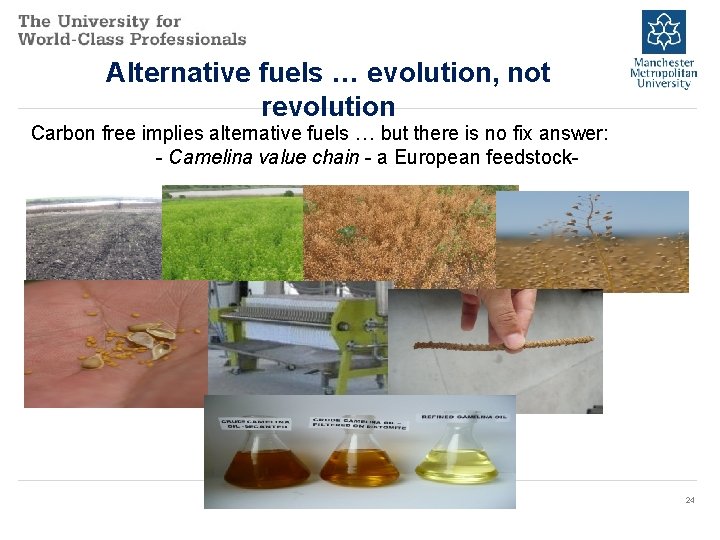
Alternative fuels … evolution, not revolution Carbon free implies alternative fuels … but there is no fix answer: - Camelina value chain - a European feedstock- 24
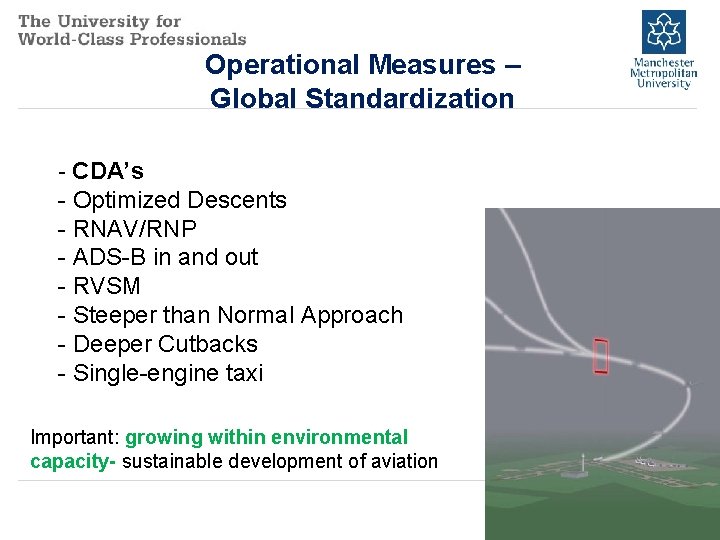
Operational Measures – Global Standardization - CDA’s - Optimized Descents - RNAV/RNP - ADS-B in and out - RVSM - Steeper than Normal Approach - Deeper Cutbacks - Single-engine taxi Important: growing within environmental capacity- sustainable development of aviation 25
How to implement the sustainability concept in Estonia; case study: Tallinn/Tartu Airport(s) Objectives • To identify appropriate definition for sustainability at Tartu Airport, linked to its role in supporting regional development • To design necessary steps for implementation of a sustainability strategy in line with stakeholders expectation and priorities • To assess implications of the findings through a roundtable discussion with main stakeholders, including airline representatives • To identify initial sustainable indicators and potential targets • To describe a suite of possible projects and sources for funding as part of a sustainable development action plan • To assist in the development of an information package to support the airport dialogue with its various stakeholders. 26

Approach • Review of best practice in airport sustainability to inform the drafting of a be-spoke • Design a Sustainable Development Strategy for Tartu/ Tallinn Airport • Stakeholders dialogue, involving interviews to refine the Sustainable Development Strategy • Consultation with key stakeholders over an implementation action plan 27
Phase 1: Initial review Task Ø Define what is meant by sustainability for Tartu/Tallinn Airport Ø Examine the existing EIA study, other internal sources, as well as national & local requirements regarding environmental compliance and existing references to sustainability Ø Review of lead-edge airports’ sustainability strategies: focus on noise management and action plan; air quality; water…waste Ø Clarify the role of the airport in the region, identify the social and economic benefits and the environmental and social costs associated with the Airport’s operation and expansion Output - Report: compare current Tartu position and initiatives with accepted best practice across the sector in order to identify gaps in provision and how best to meet these challenges 28
Phase 2: Identify steps towards attainment of a sustainability strategy Task 1 a. Clarify potential constraints to growth and explain how they might be addressed: i. e. identify if noise is an issue b. Assess the priorities regarding development of Tartu/Tallinn Airport, expressed by its line management in existing statements and documents. c. Understand the implications for future sustainability arising from predicted growth Task 2 In the light of identified future priorities and emerging sustainable development objectives, derived from the gap analysis above, produce a draft sustainable development strategy for Tartu/Tallinn Airport. Output - Draft Sustainable Development Strategy (SD) 29
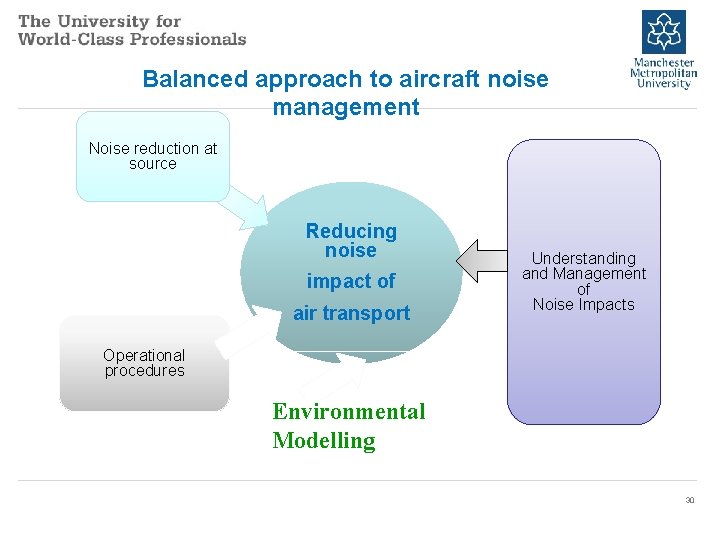
Balanced approach to aircraft noise management Noise reduction at source Reducing noise impact of air transport Understanding and Management of Noise Impacts Operational procedures Environmental Modelling 30
Phase 3. Stakeholder feed-back on draft strategy Task 1 Ø Identify the main stakeholders of Tartu/Tallinn Airport Ø Design an interactive stakeholder event (roundtable) to ensure input into the emergent Sustainable Development Strategy Ø Organise and deliver the stakeholder roundtable in cooperation with Tartu/Tallinn Airport and Tartu/Tallinn County Council (the owners? ) Task 2 Ø Assess the roundtable findings and define roles and responsibilities in developing SD approaches Ø Develop a toolkit to communicate the Airport commitment to sustainability to its principle stakeholders – its employees, passengers, airlines, retailers, tenants, suppliers etc. and the communities in which it operates. Output – Stakeholder Roundtable Event & Report with findings, roles and responsibilities 31
Phase 4. Identify possible projects and funding sources Task 1 Action Plan Ø Develop initial sustainability indicators- identify possible improvement targets Ø Identify project designed to deliver improvements to core sustainable indicators; with links to the EIA (Environmental Impact Assessment) and any emergent EMS (environmental management system), as appropriate. Ø Liaise with local university to identify possible research partners for future projects. Ø Liaise with the Environmental Agency regarding the update of the existing noise strategy, noise maps and action plan (s) Ø Indicate possible funding sources. Task 2 Prepare 1 article to promote sustainability approach of Tartu/Tallinn Airport Output – SD Action Plan and 1 article (content to be agreed by Airport(s) senior management) 32
Conclusion Ø Ø Aviation is growing world-wide, and so is its environmental impact Approach needs to be proactive…better than reactive; Every aspect needs to be assessed and mitigated accordingly Assess and manage accordingly: § noise § air quality § emissions § climate change § water, waste § energy, etc. 33
Conclusion (2) If aviation is to continue to play a role in newly emerging visions for sustainability, it must demonstrate that it can deliver a positive balance across social, economic and environmental metrics… cultural & political approach to be considered Furthermore, all practical opportunities to minimize adverse impacts should be seen to be achieved, otherwise aviation will not be perceived by society as achieving the required balance. 34
Conclusion (3) New initiative for sustainable aviation provides: • A strategic approach to develop business: managing environment responsible means cost reduction • A framework for integrating research in the sector • A vital field of study for future students • A focus on the most important problem in aviation • Questions? 35
Thank You For Your Attention 36
- Slides: 36