
Sustainable Agriculture LESSON 1 HOW MUCH IS 1
Sustainable Agriculture LESSON 1
HOW MUCH IS 1 MILLION? If I spend $1000 every day, how many days would it take to spend 1 million dollars? 2. 7 years or 1, 000 days
HOW MUCH IS 1 BILLION? If I spend $1000 every day, how many days would it take to spend 1 billion dollars? 1, 000 days or 2, 740 years! What is the current world population? 7 billion What is the world population projected to be in 2050? 9 billion
INTRODUCTION TO SUSTAINABLE AGRICULTURE Watch the Journey 2050 Introduction Video As you watch, discover: • Why 2050? • What is the sustainability barrel? • What is the ripple effect?
WHY 2050? How many years until we reach the year 2050? How old will you be in 2050?
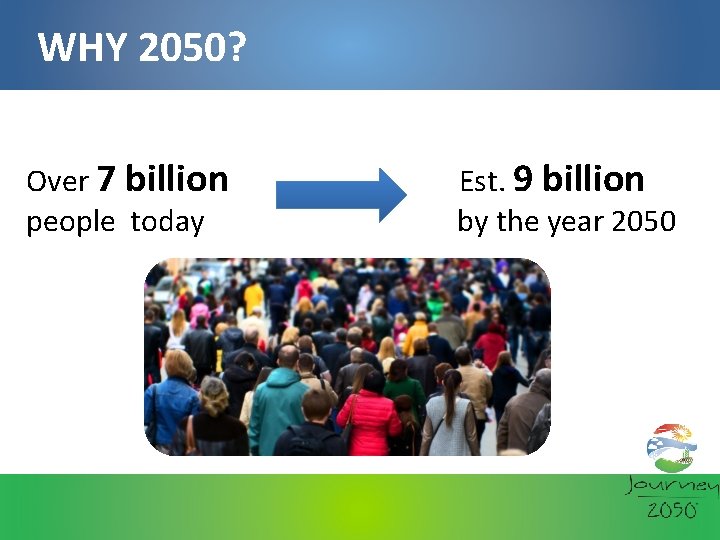
WHY 2050? Over 7 billion Est. 9 billion people today by the year 2050
WHY 2050? What resources will we need more of in order to feed 2 billion additional people? Food Fuel Fiber Medicines Timber Who provides these resources? Farmers and other agricultural professionals
WHY 2050? It is predicted we will need to grow 60 -70% more food than we currently grow today, on the same amount of land or less. To accomplish this goal, will there be increased or decreased pressure on Earth’s natural resources?
WHAT IS THE SUSTAINABILITY BARREL?
SUSTAINABILITY BARREL It is estimated that by 2050, our growing population will require the equivalent of all the food grown in the last 500 years put together. Can a corn farmer with 100 acres take their same land, soil, corn seeds, water, and tractors and double their crop from one year to the next simply because there is a demand for more corn? No! There are limitations
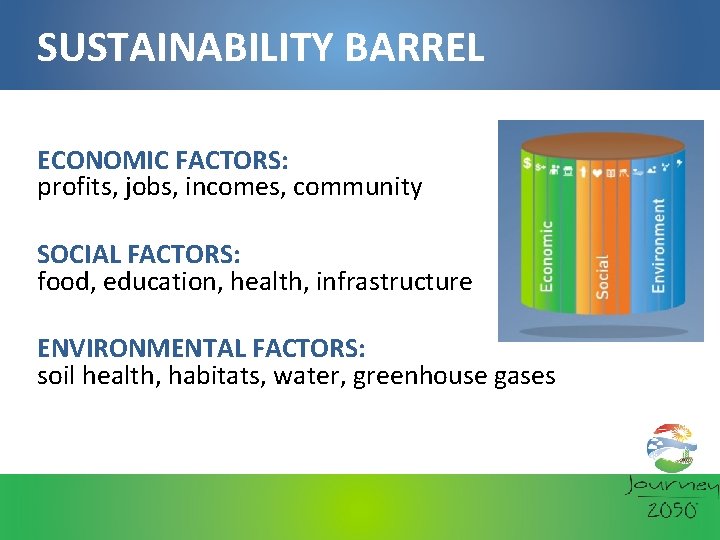
SUSTAINABILITY BARREL ECONOMIC FACTORS: profits, jobs, incomes, community SOCIAL FACTORS: food, education, health, infrastructure ENVIRONMENTAL FACTORS: soil health, habitats, water, greenhouse gases
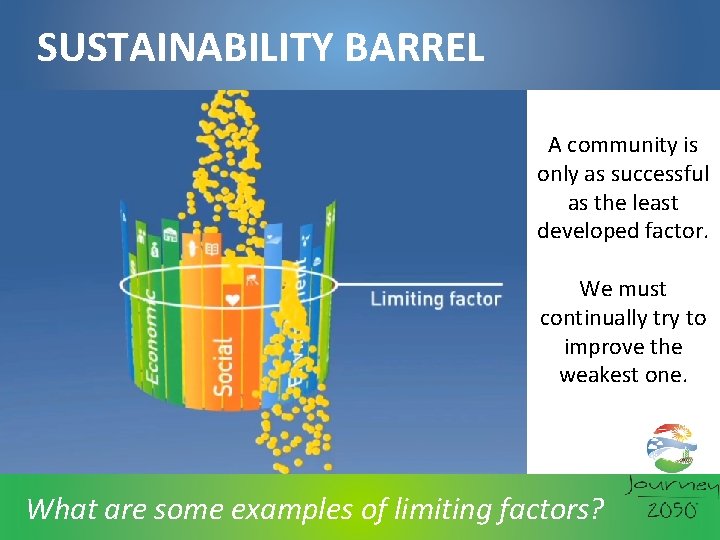
SUSTAINABILITY BARREL A community is only as successful as the least developed factor. We must continually try to improve the weakest one. What are some examples of limiting factors?
WHAT IS THE RIPPLE EFFECT?
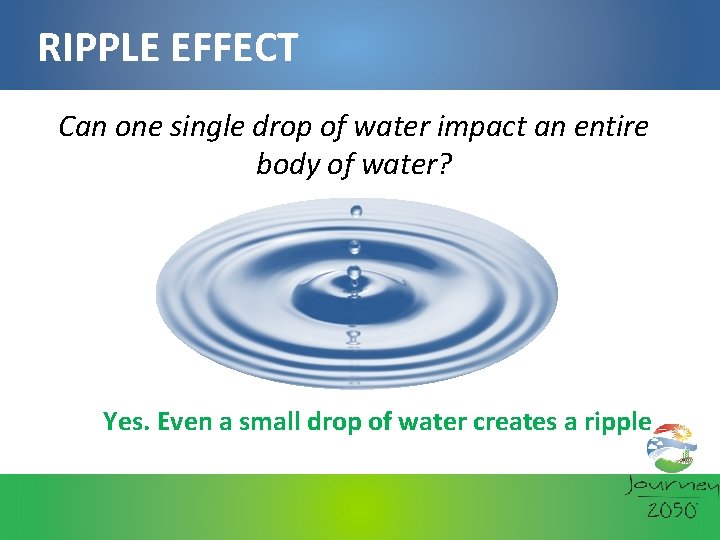
RIPPLE EFFECT Can one single drop of water impact an entire body of water? Yes. Even a small drop of water creates a ripple
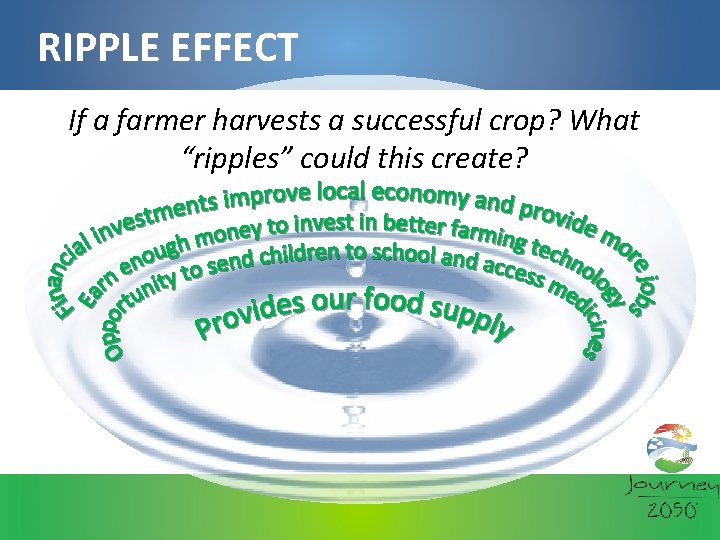
RIPPLE EFFECT If a farmer harvests a successful crop? What “ripples” could this create?
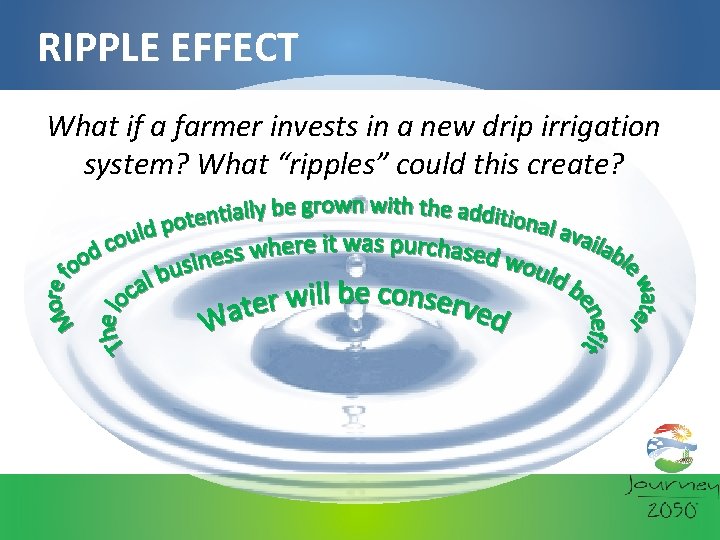
RIPPLE EFFECT What if a farmer invests in a new drip irrigation system? What “ripples” could this create?
SUSTAINABILITY FARMING GAME LEVEL 1 DEMO
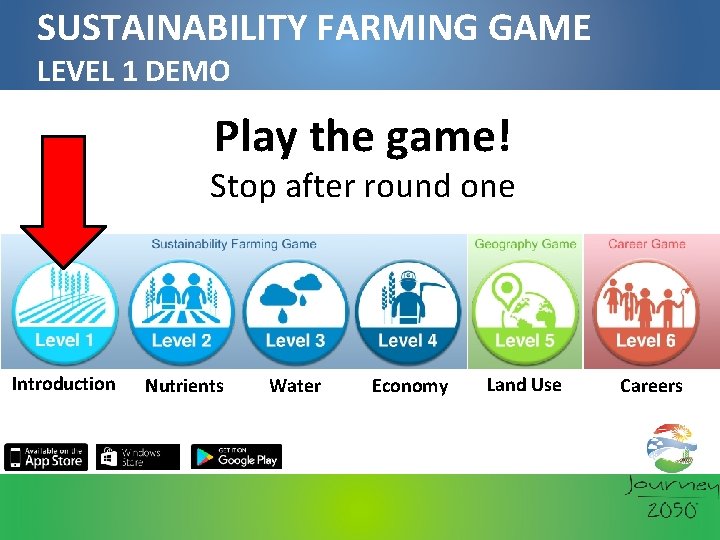
SUSTAINABILITY FARMING GAME LEVEL 1 DEMO Play the game! Stop after round one Introduction Nutrients Water Economy Land Use Careers
FOLLOW-UP DISCUSSION
FOLLOW-UP DISCUSSION • After growing your first crop, did you invest some of your money to purchase additional land? Why or why not? • What was your limiting factor in your sustainability barrel? What did this mean? • What were some of the ripple effects of your farming choices?
DO PEOPLE WASTE FOOD?
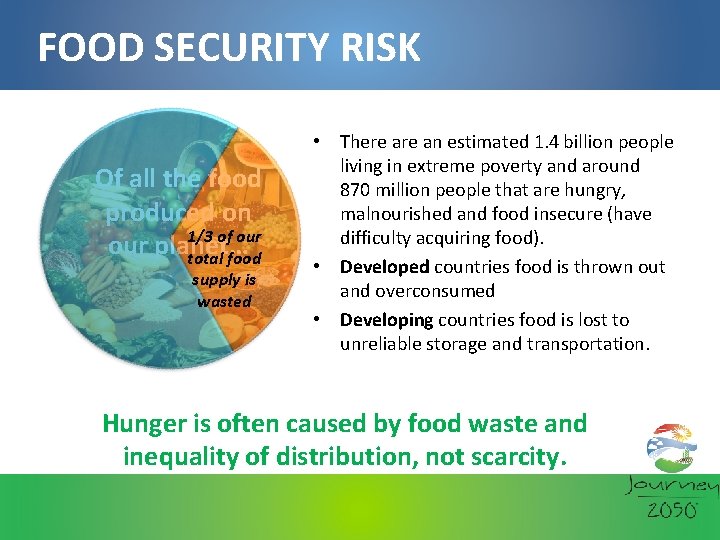
FOOD SECURITY RISK Of all the food produced on 1/3 of our planet… total food supply is wasted • There an estimated 1. 4 billion people living in extreme poverty and around 870 million people that are hungry, malnourished and food insecure (have difficulty acquiring food). • Developed countries food is thrown out and overconsumed • Developing countries food is lost to unreliable storage and transportation. Hunger is often caused by food waste and inequality of distribution, not scarcity.
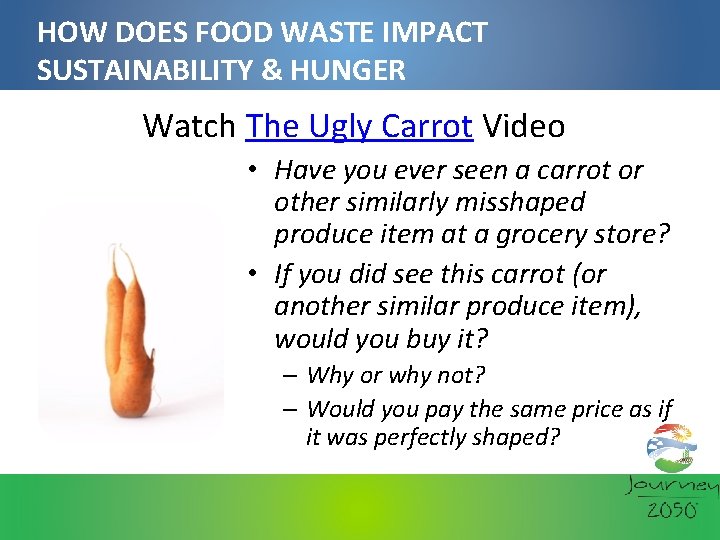
HOW DOES FOOD WASTE IMPACT SUSTAINABILITY & HUNGER Watch The Ugly Carrot Video • Have you ever seen a carrot or other similarly misshaped produce item at a grocery store? • If you did see this carrot (or another similar produce item), would you buy it? – Why or why not? – Would you pay the same price as if it was perfectly shaped?
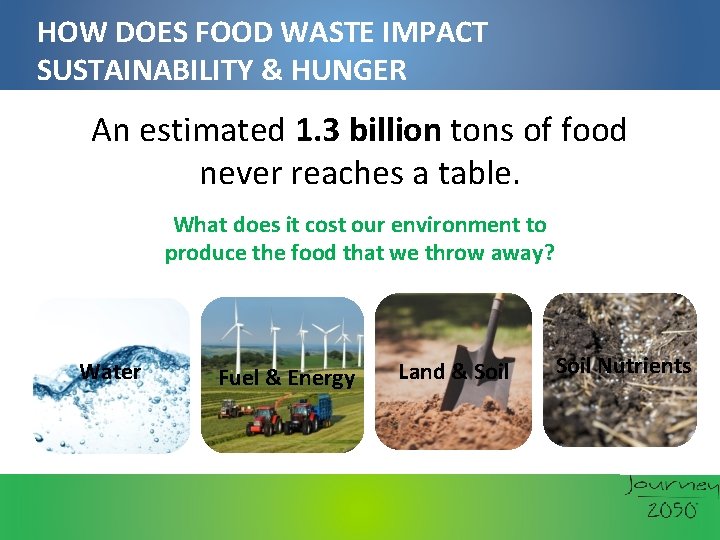
HOW DOES FOOD WASTE IMPACT SUSTAINABILITY & HUNGER An estimated 1. 3 billion tons of food never reaches a table. What does it cost our environment to produce the food that we throw away? Water Fuel & Energy Land & Soil Nutrients
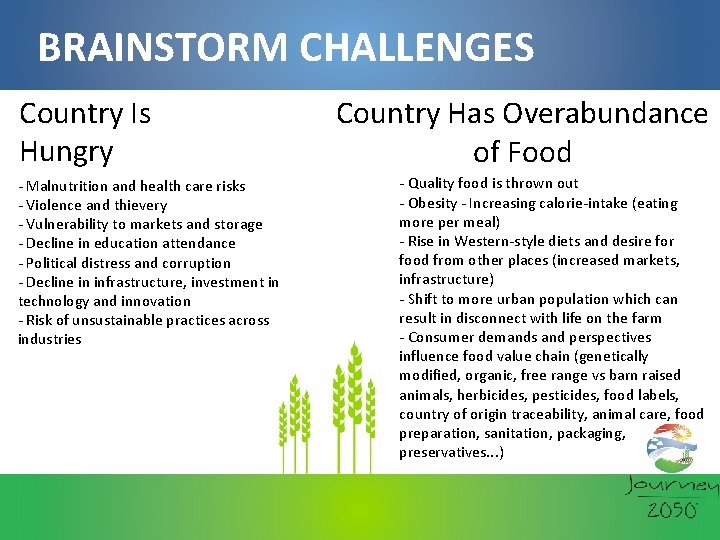
BRAINSTORM CHALLENGES Country Is Hungry - Malnutrition and health care risks - Violence and thievery - Vulnerability to markets and storage - Decline in education attendance - Political distress and corruption - Decline in infrastructure, investment in technology and innovation - Risk of unsustainable practices across industries Country Has Overabundance of Food - Quality food is thrown out - Obesity - Increasing calorie-intake (eating more per meal) - Rise in Western-style diets and desire for food from other places (increased markets, infrastructure) - Shift to more urban population which can result in disconnect with life on the farm - Consumer demands and perspectives influence food value chain (genetically modified, organic, free range vs barn raised animals, herbicides, pesticides, food labels, country of origin traceability, animal care, food preparation, sanitation, packaging, preservatives. . . )
WRAP-UP • By 2050, it is expected that our world will grow from 7 billion to 9 billion people. • Sustainable agriculture is the practice of producing our food, fiber and fuel in a way that is profitable to the farmer, supports a healthy quality of life and protects our natural resources (land, air and water). • Many factors can limit our ability to produce food for a growing population. These limiting factors are depicted in the sustainability barrel. • Using sustainable agricultural practices can improve our society through the ripple effect.
WRAP-UP • Over one-third of our food is wasted in both developing and developed countries. • Hunger is often caused by food waste and inequality of distribution, not scarcity. • Food waste decreases sustainability due to the inefficient use of natural resources, such as arable land, soil nutrients, water and energy. • Food waste can negatively affect our quality of life and create undesirable outcomes in a country.
Questions? JOURNEY 2050@AGRIUM. COM
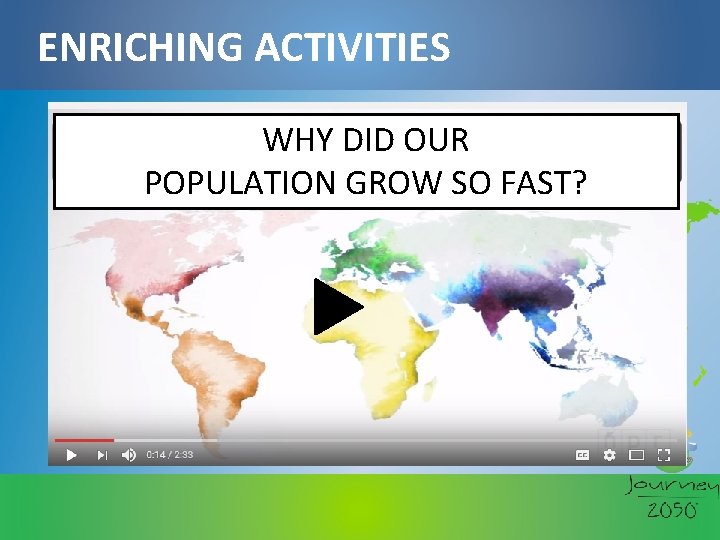
ENRICHING ACTIVITIES WHY DID OUR POPULATION GROW SO FAST?
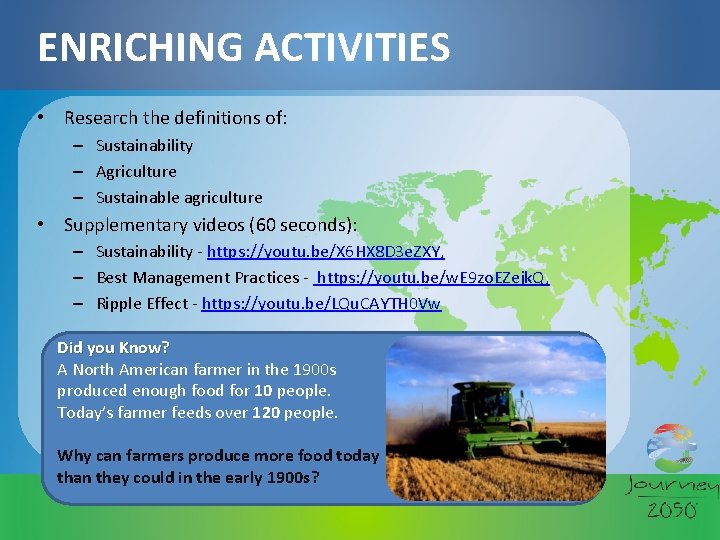
ENRICHING ACTIVITIES • Research the definitions of: – Sustainability – Agriculture – Sustainable agriculture • Supplementary videos (60 seconds): – Sustainability - https: //youtu. be/X 6 HX 8 D 3 e. ZXY, – Best Management Practices - https: //youtu. be/w. E 9 zo. EZejk. Q, – Ripple Effect - https: //youtu. be/LQu. CAYTH 0 Vw Did you Know? A North American farmer in the 1900 s produced enough food for 10 people. Today’s farmer feeds over 120 people. Why can farmers produce more food today than they could in the early 1900 s?
ENRICHING ACTIVITIES • Read National Geographic’s How Reducing Food Waste Could Ease Climate Change • Watch the DNews segment Why Do We Waste $1 Trillion of Food A Year? • Develop a marketing plan to decrease wasted food by marketing produce that is safe and healthy, but imperfect in size or shape. Show the video clip Inglorious Fruits and Vegetables as an example.
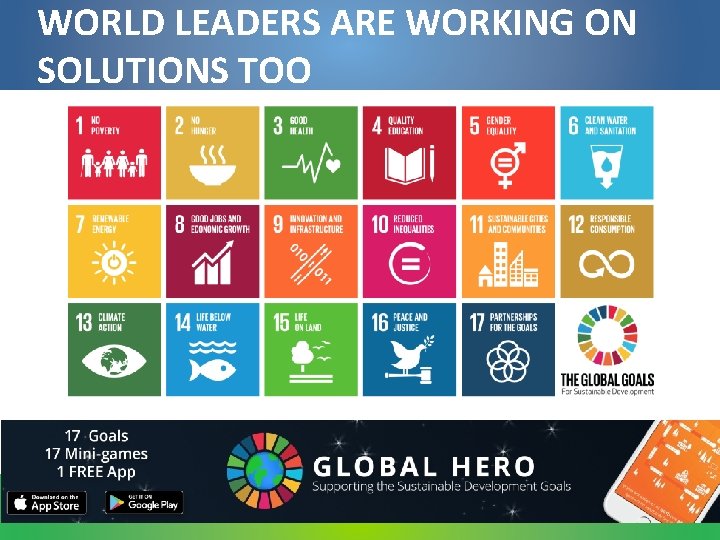
WORLD LEADERS ARE WORKING ON SOLUTIONS TOO
- Slides: 32