
SUSTAINABILITY REPORTING Ranjani Krishnan Michigan State University Agenda
SUSTAINABILITY REPORTING Ranjani Krishnan Michigan State University
Agenda • Role and relevance of sustainability accounting • Sustainability reporting – Mandatory • SEC • EPA – Voluntary • • GRI IIRC SASB CDP • Sustainable Management Accounting • Sustainability Management Systems – ISO 14000 – ISO 26000 – PWC: Total Impact Measurement and Management (TIMM) • Teaching and research opportunities
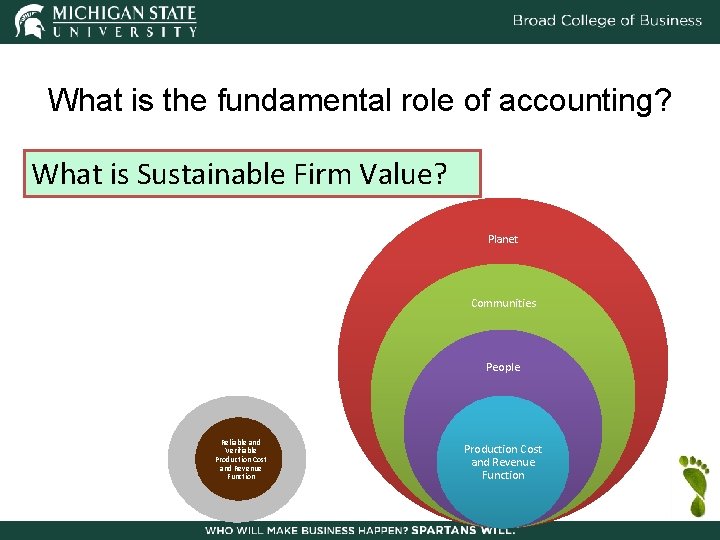
What is the fundamental role of accounting? Reflect Firm Value Reflect Sustainable Firm Value What is Sustainable Firm Value? Planet Communities People Reliable and Verifiable Production Cost and Revenue Function

Relevance • Relevance for Valuation versus Relevance for Decision Making • Learning Curves • Cost Elasticity • B to B Contracting • 20% Material – using a particular model of market behavior
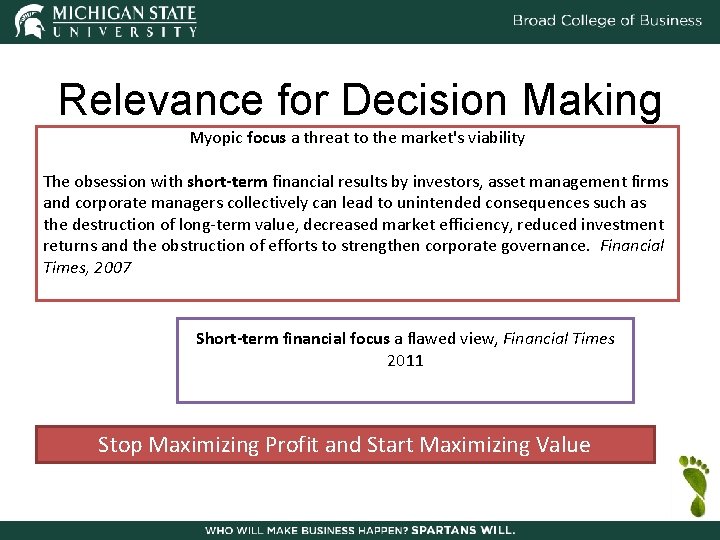
Relevance for Decision Making Myopic focus a threat to the market's viability The obsession with short-term financial results by investors, asset management firms and corporate managers collectively can lead to unintended consequences such as the destruction of long-term value, decreased market efficiency, reduced investment returns and the obstruction of efforts to strengthen corporate governance. Financial Times, 2007 Short-term financial focus a flawed view, Financial Times 2011 Stop Maximizing Profit and Start Maximizing Value
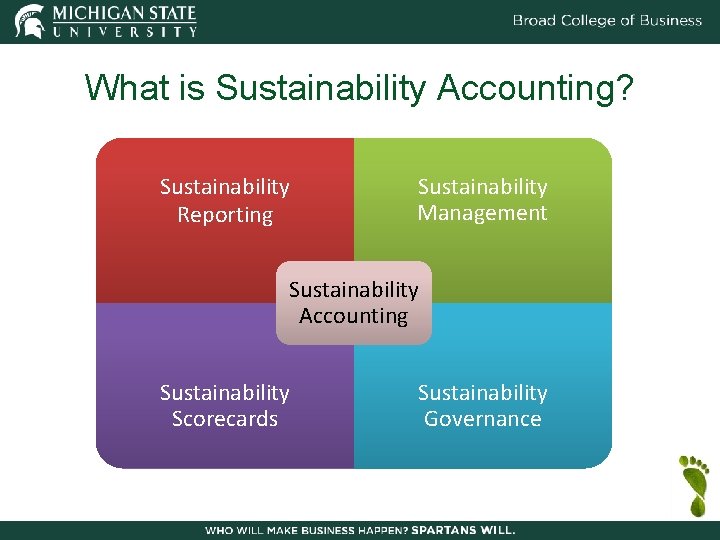
What is Sustainability Accounting? Sustainability Reporting Sustainability Management Sustainability Accounting Sustainability Scorecards Sustainability Governance
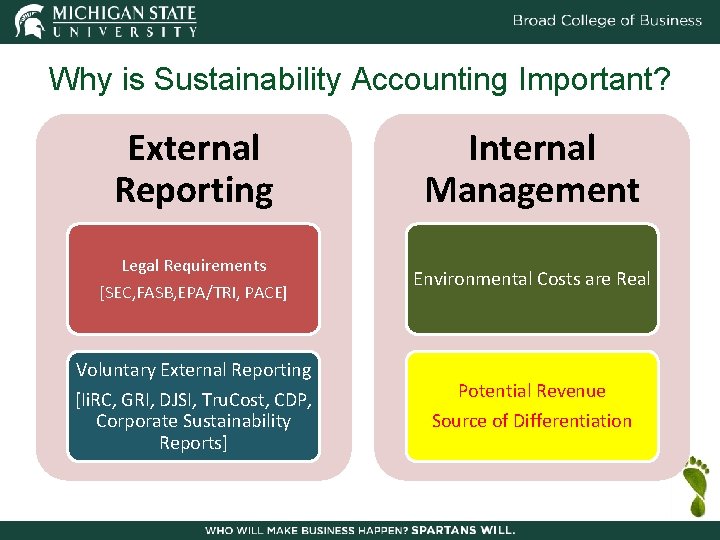
Why is Sustainability Accounting Important? External Reporting Internal Management Legal Requirements [SEC, FASB, EPA/TRI, PACE] Environmental Costs are Real Voluntary External Reporting [Ii. RC, GRI, DJSI, Tru. Cost, CDP, Corporate Sustainability Reports] Potential Revenue Source of Differentiation
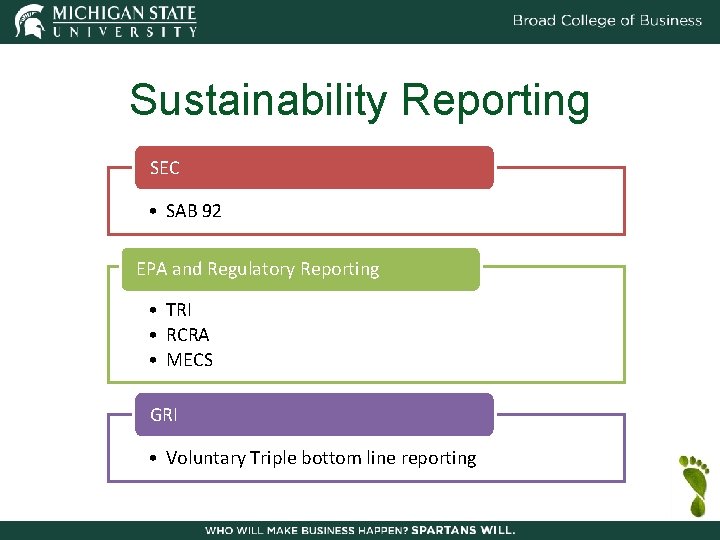
Sustainability Reporting SEC • SAB 92 EPA and Regulatory Reporting • TRI • RCRA • MECS GRI • Voluntary Triple bottom line reporting
Sustainability Reporting - SEC • Staff Accounting Bulletin (SAB) 92 – Disclosure of • material effects of environmental regulations • pending legal proceedings and likely impacts – Co-ordination with EPA for liabilities information • Insufficient disclosure may lead to SEC fines ($500 K for each violation)
Sustainability Reporting - EPA • Toxic Releases inventory(TRI) – Quantities of toxic chemicals, pollution prevention, disposal • Resource Recovery and Conservation Act (RCRA) – Hazardous materials/wastes cradle to grave accounting through manifest system • Manufacturing Energy Consumption Survey (MECS) • Greenhouse Gas Reporting (2010)
MODELS – GRI, IIRC, SASB VOLUNTARY REPORTING
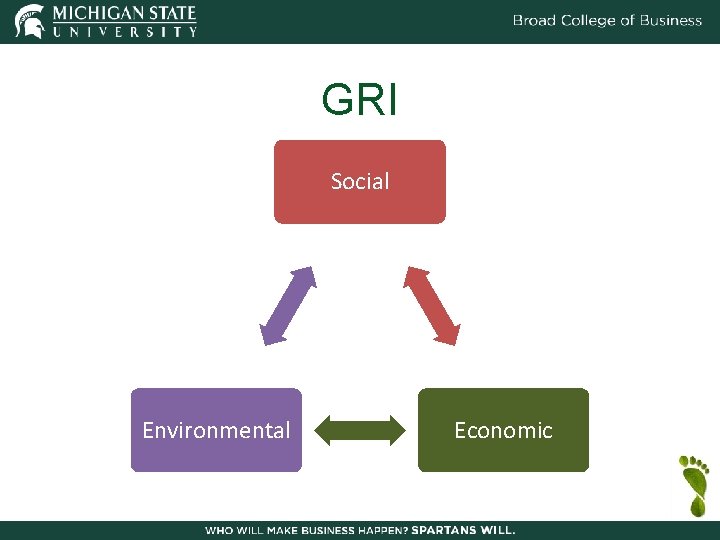
Sustainability Reporting – Global Reporting Initiative (GRI) • http: //www. globalreporting. org • Goal – to produce a report that “reflect[s] the organization’s economic, environmental and social impacts” and should include all material information • materiality is defined as information that could “substantively influence the assessments and decisions of stakeholders” • UNEP sponsored but independent • Facilitate comparisons – over time – across organizations
GRI Social Environmental Economic
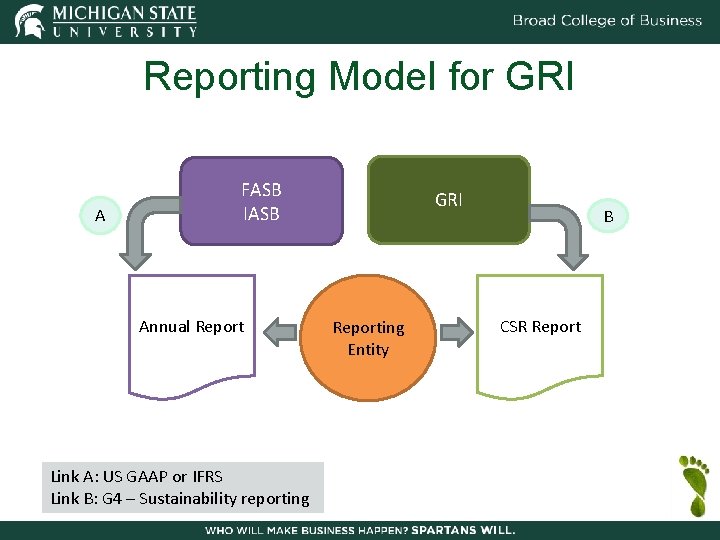
Reporting Model for GRI A FASB IASB Annual Report Link A: US GAAP or IFRS Link B: G 4 – Sustainability reporting GRI Reporting Entity B CSR Report
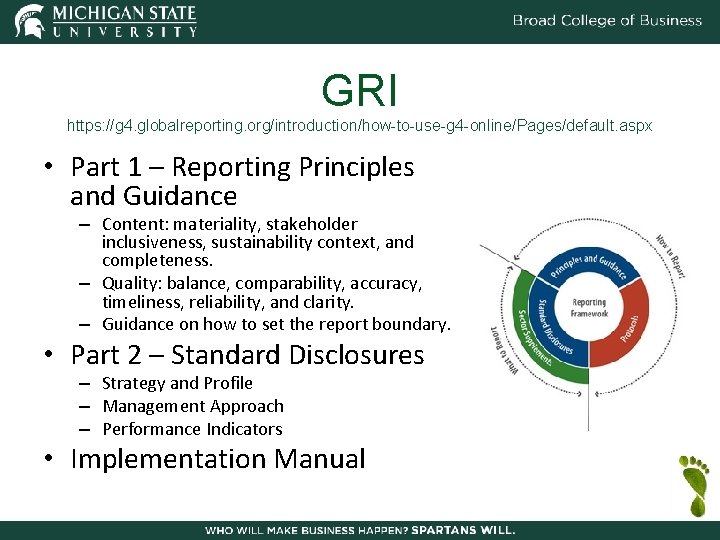
GRI https: //g 4. globalreporting. org/introduction/how-to-use-g 4 -online/Pages/default. aspx • Part 1 – Reporting Principles and Guidance – Content: materiality, stakeholder inclusiveness, sustainability context, and completeness. – Quality: balance, comparability, accuracy, timeliness, reliability, and clarity. – Guidance on how to set the report boundary. • Part 2 – Standard Disclosures – Strategy and Profile – Management Approach – Performance Indicators • Implementation Manual
GRI Performance Sectors covered q. Financial services sector q. Electric utilities sector q. Mining & metals sector q. Food processing sector q. NGO sector q. Media q. Oil and gas q. Airport operators q. Construction


https: //www. globalreporting. org/resourcelibrary/G 3 -English-Electric-Utilities-Sector-Supplement-Quick-Reference-Sheet. pdf

IIRC
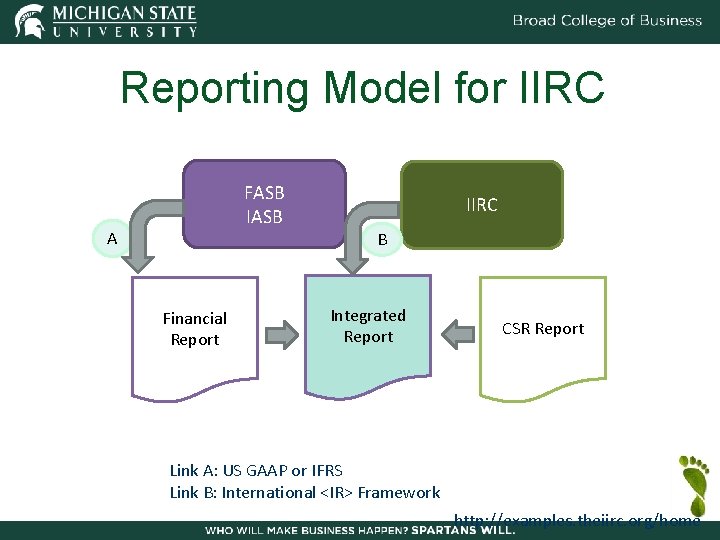
Reporting Model for IIRC FASB IASB A IIRC B Financial Report Integrated Report CSR Report Link A: US GAAP or IFRS Link B: International <IR> Framework http: //examples. theiirc. org/home
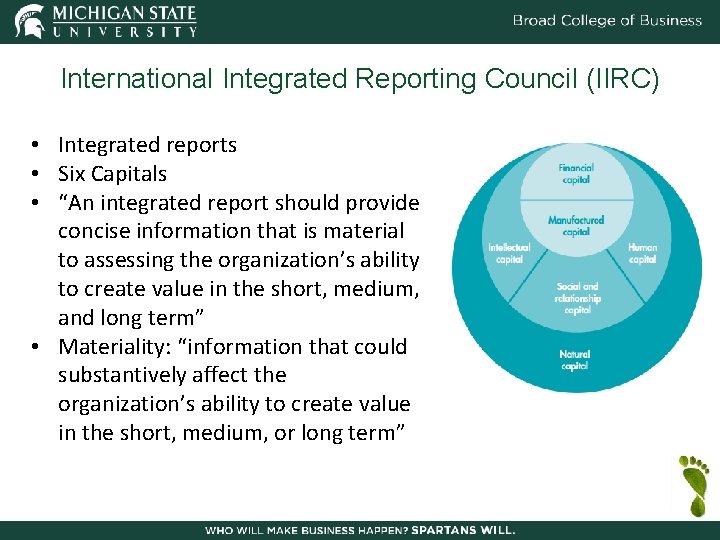
International Integrated Reporting Council (IIRC) • Integrated reports • Six Capitals • “An integrated report should provide concise information that is material to assessing the organization’s ability to create value in the short, medium, and long term” • Materiality: “information that could substantively affect the organization’s ability to create value in the short, medium, or long term”

SASB
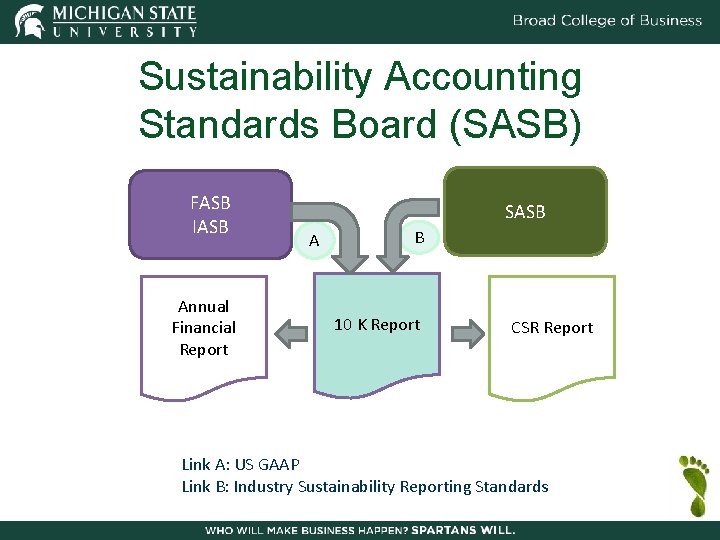
Sustainability Accounting Standards Board (SASB) FASB IASB Annual Financial Report SASB A B 10 K Report CSR Report Link A: US GAAP Link B: Industry Sustainability Reporting Standards
SASB • Integrated reporting • Aid U. S. public companies in meeting the requirement of Item 303 of Regulation S-K to disclose material information in the management discussion and analysis section of 10 -K and 20 -F filings – Known trends and uncertainties that could affect a registrant’s operations • Aims to provide standardized accounting metrics for industry-level material sustainability issues. • While GRI’s materiality threshold is set around stakeholder decision making, SASB is focused on equity and debt investors, • SASB follows U. S. securities law – materiality as information that could be viewed by the reasonable investor as having significantly altered the total mix of information made available. • Most restrictive definition of materiality, potentially minimizing the set of non-financial information to be disclosed.
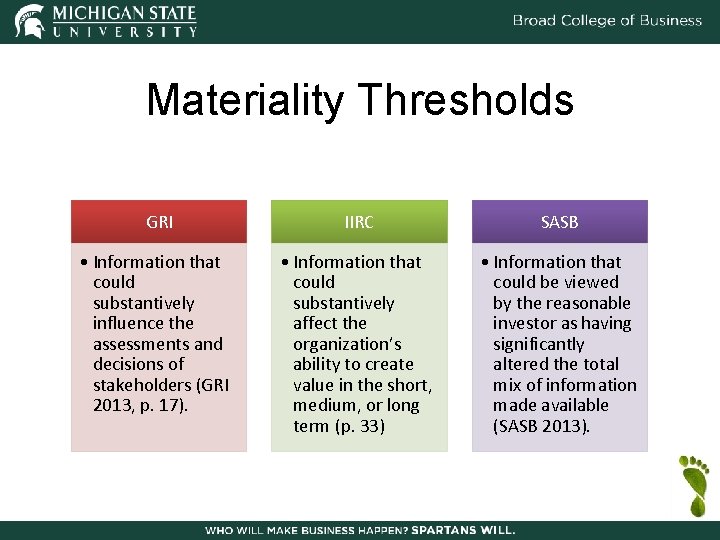
Materiality Thresholds GRI IIRC SASB • Information that could substantively influence the assessments and decisions of stakeholders (GRI 2013, p. 17). • Information that could substantively affect the organization’s ability to create value in the short, medium, or long term (p. 33) • Information that could be viewed by the reasonable investor as having significantly altered the total mix of information made available (SASB 2013).

CDP
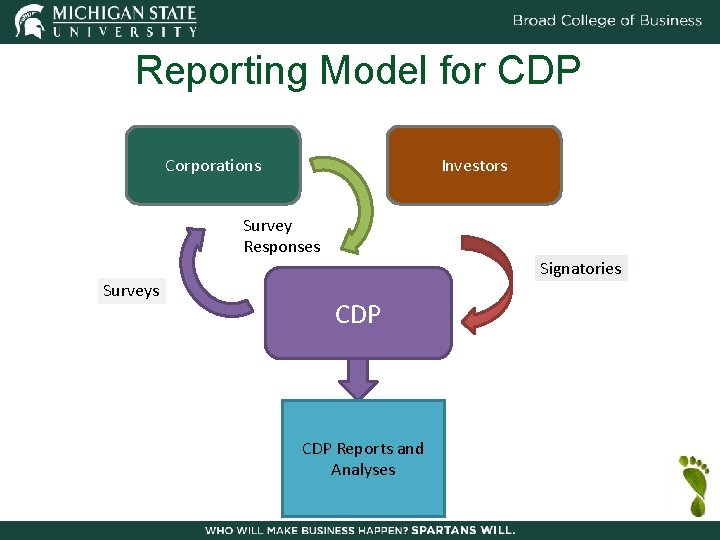
Reporting Model for CDP Corporations Investors Survey Responses Surveys Signatories CDP Reports and Analyses
CDP(Carbon Disclosure Project) • The focus of GRI, IIRC, and SASB are all on entity-level reporting directly to users. • Firms report directly to CDP on certain environmental issues, and CDP then produces a set of reports and also provides access to the database of their survey data. • Using the data from their surveys, CDP produces three sets of primary reports – Greenhouse gas emissions – Water management – Climate change strategies • Objective: – “investors and cities are better able to mitigate risk, capitalize on opportunities and make investment decisions that drive action towards a more sustainable world. ”
Sustainability Management Accounting – Environment
Why Environmental Management Accounting? • Environmental costs are real business costs • Potential Revenue Sources • Improved decisions – Product pricing, responsibility accounting, negotiations • Current accounting systems are not designed for identifying and managing environmental costs – PWC
Types of Environmental Costs • Conventional costs of compliance, – Installation and operation of pollution treatment equipment • Other changes to the firm’s production technology – Substitution of raw materials – Changes in type of energy used – Other process changes e. g. operating parameters • General administrative expenses • Changes in productivity growth rate
Environmental Regulations and Firms’ Accounting Systems • Field studies indicate that firms’ costing systems do not sufficiently capture environmental costs (Epstein, WRI Green Ledgers). • Joshi et al. (TAR 2001) found hidden costs 8 -10 times the reported costs • Case Studies of specific product-lines in firms indicating that regulatory costs are about 15% - 20% of total cost, of which only about 2% are separately identified (WRI). • Price-Waterhouse survey of 445 companies, 49% responded that they do not identify all costs of compliance.
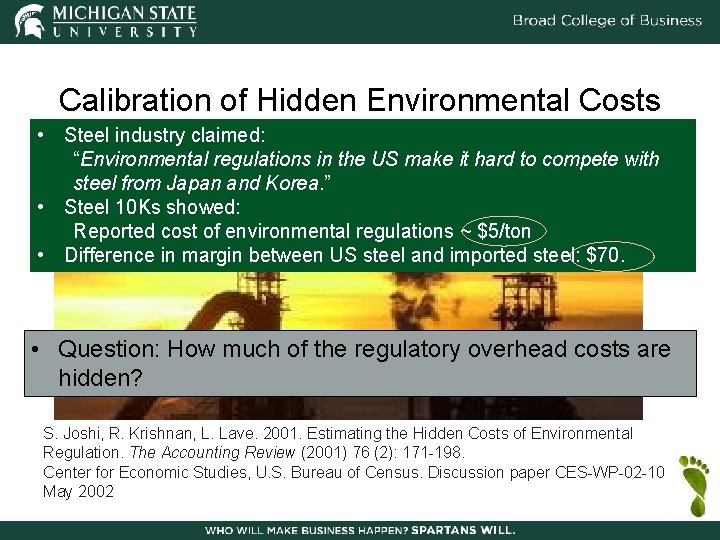
Calibration of Hidden Environmental Costs • Steel industry claimed: “Environmental regulations in the US make it hard to compete with steel from Japan and Korea. ” • Steel 10 Ks showed: Reported cost of environmental regulations ~ $5/ton • Difference in margin between US steel and imported steel: $70. • Question: How much of the regulatory overhead costs are hidden? S. Joshi, R. Krishnan, L. Lave. 2001. Estimating the Hidden Costs of Environmental Regulation. The Accounting Review (2001) 76 (2): 171 -198. Center for Economic Studies, U. S. Bureau of Census. Discussion paper CES-WP-02 -10 May 2002
Hidden Environmental Costs • Plant-level econometric analysis using data from Census Bureau and other sources. • Result – Accounting systems HUGELY misestimate costs. – High magnitude of hidden costs • A $1 increase in identified overhead cost, increases total cost at the margin by $9. 23 for Integrated Steel Plants and $10. 68 for Mini Mills. • That is, $8. 23 - $9. 28 costs were hidden for every one dollar of visible costs!
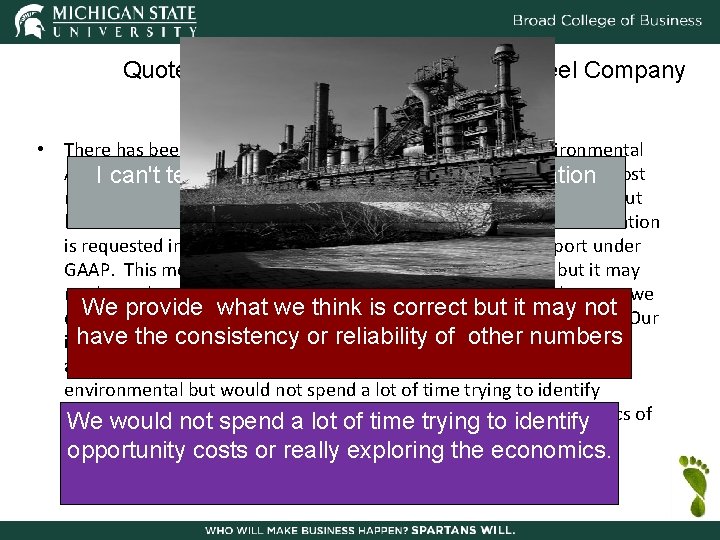
Quote from Controller of Fortune 100 Steel Company • There has been so much turnover in our Accounting and Environmental Affairs Departments that the people who would have prepared the cost I can't tell you much about how that information reports are no longer with the company. So I can't tell you much about was gathered and compiled. how that information was gathered and compiled. Often the information is requested in a form different than from what we use to report under GAAP. This means that we provide what we think is correct but it may not have the consistency or reliability of other numbers, just because we We provide what we think is correct but it may not don't have a system in place to routinely define and gather the data. Our have the consistency or reliability of other numbers intent is to report the information at the lowest cost with the least amount of effort. We would identify direct costs that we believe are environmental but would not spend a lot of time trying to identify overhead costs or opportunity costs or really exploring the economics of We would not spend a lot of time trying to identify the cost. opportunity costs or really exploring the economics.
ENVIRONMENTAL MANAGEMENT SYSTEM - ISO 14000
Why ISO 14000? • Multiplicity of environmental standards – UK - BS 7750, US - Chemical Association Responsible Care ®, EU - Ecomanagement and Auditing Scheme (EMAS) • How to communicate company’s intent with consumers, regulators, investors, environmental groups in a standardized manner?
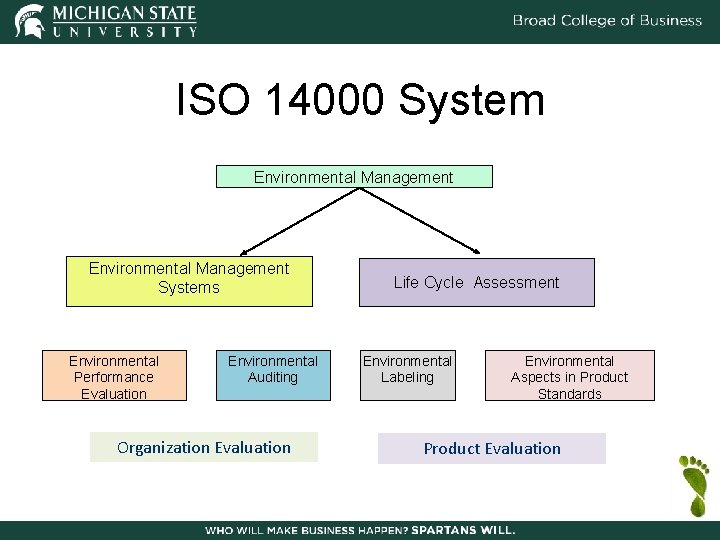
ISO 14000 System Environmental Management Systems Environmental Performance Evaluation Environmental Auditing Organization Evaluation Life Cycle Assessment Environmental Labeling Environmental Aspects in Product Standards Product Evaluation
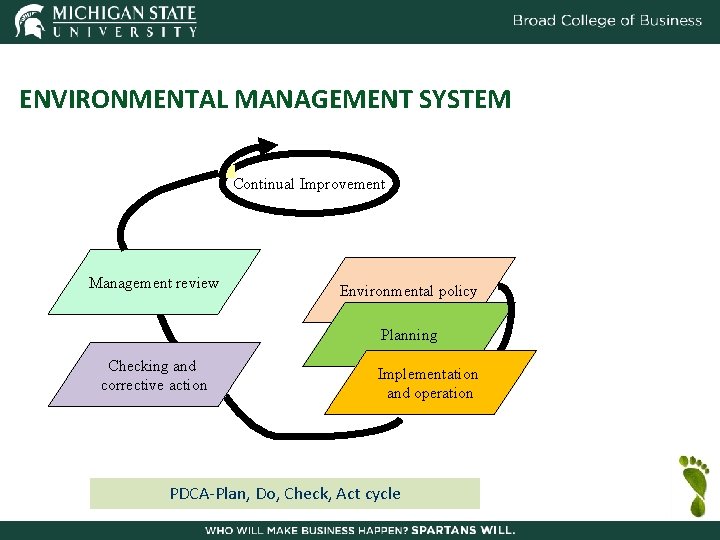
ENVIRONMENTAL MANAGEMENT SYSTEM Continual Improvement Management review Environmental policy Planning Checking and corrective action Implementation and operation PDCA-Plan, Do, Check, Act cycle
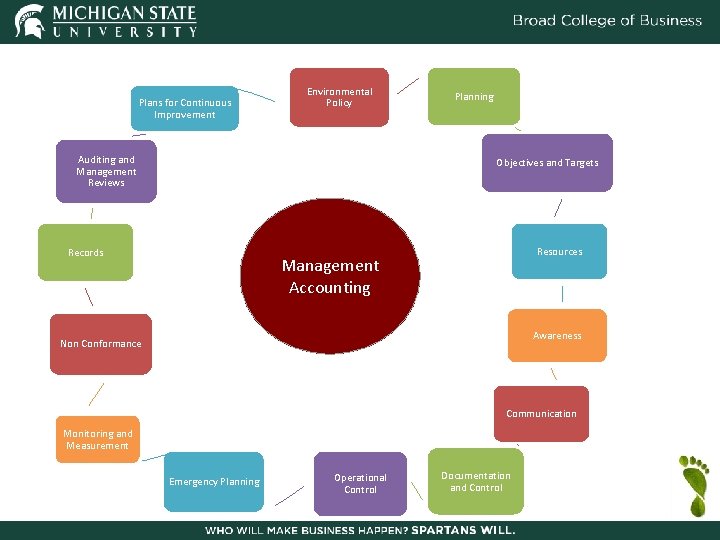
Plans for Continuous Improvement Environmental Policy Auditing and Management Reviews Planning Objectives and Targets Records Resources Management Accounting Awareness Non Conformance Communication Monitoring and Measurement Emergency Planning Operational Control Documentation and Control
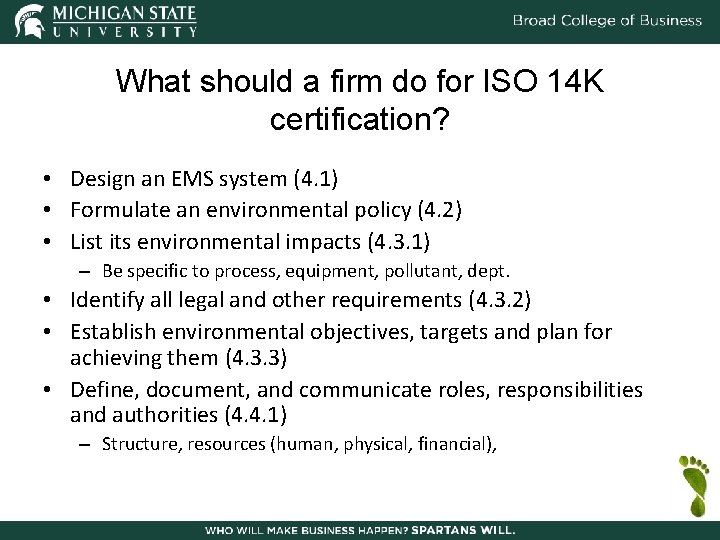
What should a firm do for ISO 14 K certification? • Design an EMS system (4. 1) • Formulate an environmental policy (4. 2) • List its environmental impacts (4. 3. 1) – Be specific to process, equipment, pollutant, dept. • Identify all legal and other requirements (4. 3. 2) • Establish environmental objectives, targets and plan for achieving them (4. 3. 3) • Define, document, and communicate roles, responsibilities and authorities (4. 4. 1) – Structure, resources (human, physical, financial),
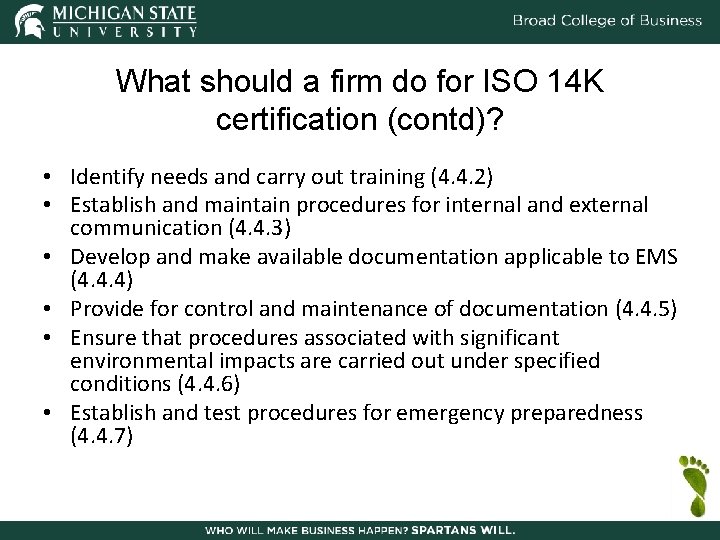
What should a firm do for ISO 14 K certification (contd)? • Identify needs and carry out training (4. 4. 2) • Establish and maintain procedures for internal and external communication (4. 4. 3) • Develop and make available documentation applicable to EMS (4. 4. 4) • Provide for control and maintenance of documentation (4. 4. 5) • Ensure that procedures associated with significant environmental impacts are carried out under specified conditions (4. 4. 6) • Establish and test procedures for emergency preparedness (4. 4. 7)
What accredited certification to ISO 14001 does not mean • Important: ISO does not specify performance targets. It is only a process standard. • • ISO 14001 does not define specific environmental performance criteria. ISO 14001 does not ensure that the organization is currently achieving optimal environmental performance. The ISO 14001 accredited certification process does not include a full regulatory compliance audit and cannot ensure that violations of legal requirements will never occur, though full legal compliance is the organization’s goal. Accredited certification to ISO 14001 does not necessarily indicate that the organization will be able to prevent environmental accidents from occurring
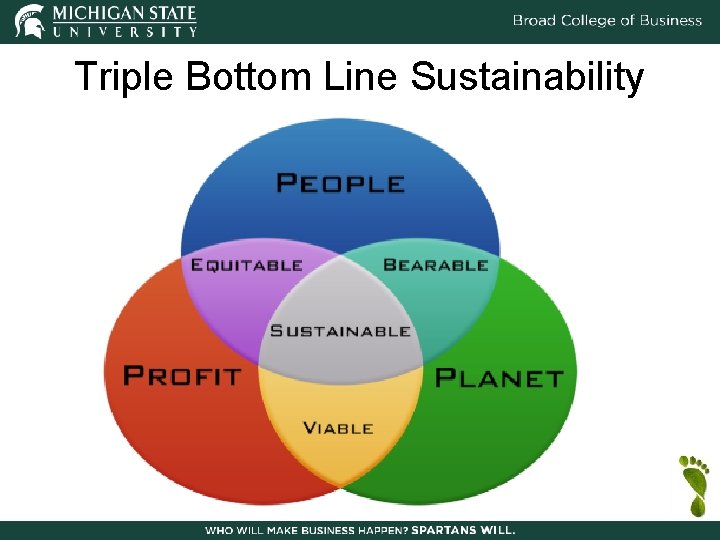
Triple Bottom Line Sustainability
ISO 26000 Guidance on integrating social responsibility throughout an organization. This includes guidance related to: understanding the social responsibility of an organization, integrating social responsibility throughout an organization, communication related to social responsibility, improving the credibility of an organization regarding social responsibility, reviewing progress and improving performance and evaluating voluntary initiatives for social responsibility. ISO 26 K IS NOT CERTIFIABLE (only guidance)

http: //www. iso. org/iso_catalogue/management_and_leadership_standards/social_responsibility/sr_discovering_iso 26000. htm

PWC
PWC-Total Impact Measurement and Management (TIMM)

How do all these fit into business strategy? How do we monitor strategic performance?
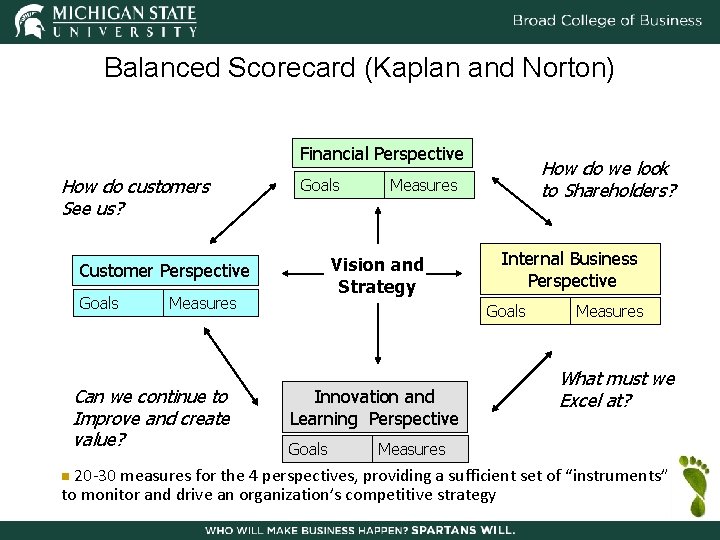
Balanced Scorecard (Kaplan and Norton) Financial Perspective How do customers See us? Goals Measures Can we continue to Improve and create value? Measures Internal Business Perspective Vision and Strategy Customer Perspective Goals How do we look to Shareholders? Goals Innovation and Learning Perspective Goals Measures What must we Excel at? Measures n 20 -30 measures for the 4 perspectives, providing a sufficient set of “instruments” to monitor and drive an organization’s competitive strategy
Sustainability Score Card (SSC) • Linking and integrating environmental, and social performance with overall business strategy • Identifying value drivers for environmental and social performance • Designing performance measures which are “instruments” to monitor and drive competitive strategy • Testing, validating, and refining SSC

IMPLICATIONS FOR TEACHING AND RESEARCH
Professional Accounting Futures Practice Teaching Research
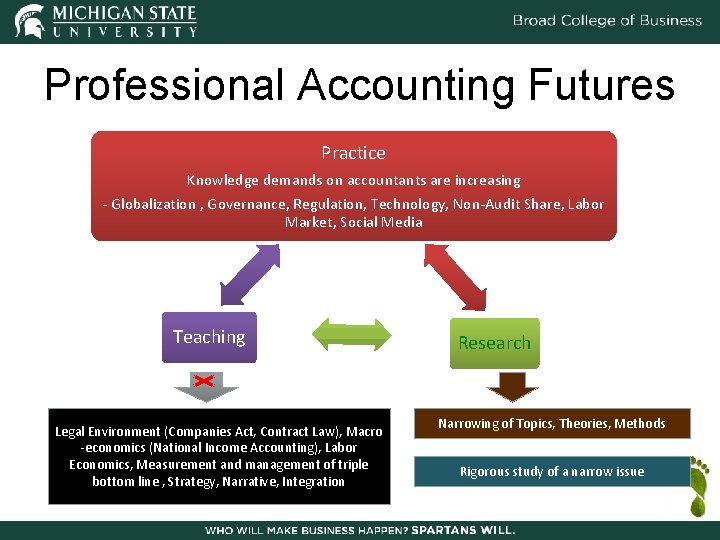
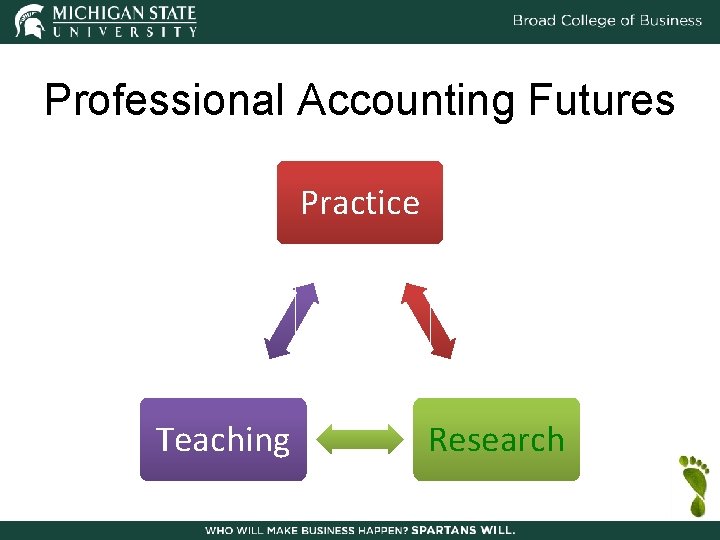
Professional Accounting Futures Practice Knowledge demands on accountants are increasing - Globalization , Governance, Regulation, Technology, Non-Audit Share, Labor Market, Social Media Teaching Legal Environment (Companies Act, Contract Law), Macro -economics (National Income Accounting), Labor Economics, Measurement and management of triple bottom line , Strategy, Narrative, Integration Research Narrowing of Topics, Theories, Methods Rigorous study of a narrow issue
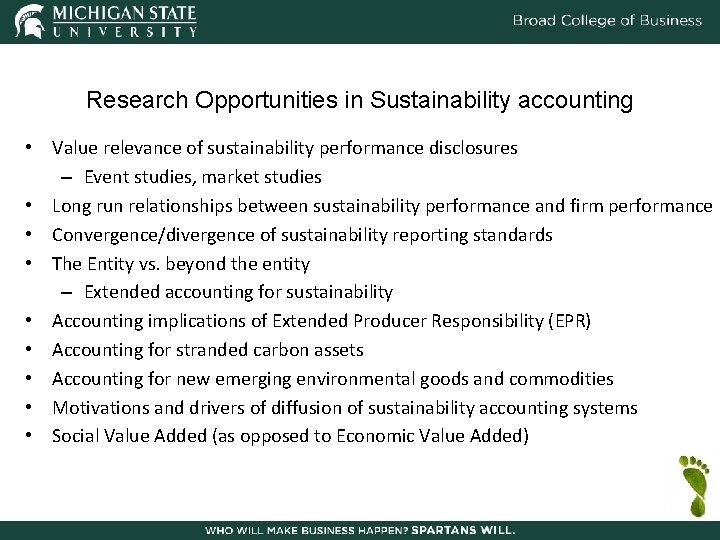
Research Opportunities in Sustainability accounting • Value relevance of sustainability performance disclosures – Event studies, market studies • Long run relationships between sustainability performance and firm performance • Convergence/divergence of sustainability reporting standards • The Entity vs. beyond the entity – Extended accounting for sustainability • Accounting implications of Extended Producer Responsibility (EPR) • Accounting for stranded carbon assets • Accounting for new emerging environmental goods and commodities • Motivations and drivers of diffusion of sustainability accounting systems • Social Value Added (as opposed to Economic Value Added)
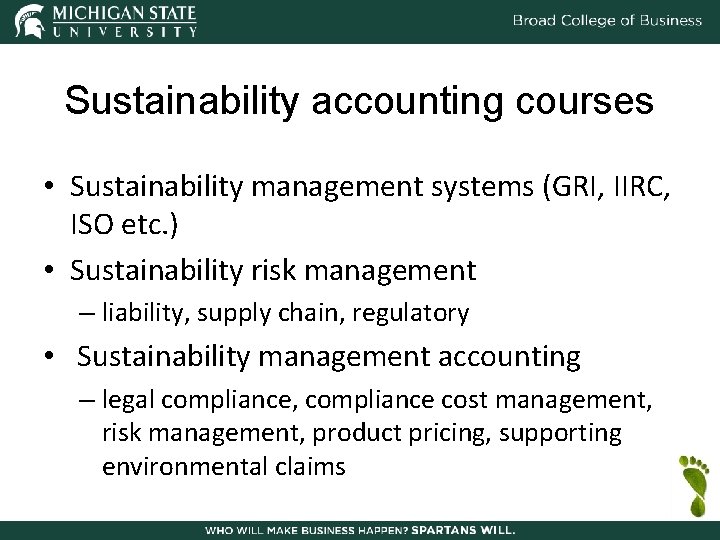
Sustainability accounting courses • Sustainability management systems (GRI, IIRC, ISO etc. ) • Sustainability risk management – liability, supply chain, regulatory • Sustainability management accounting – legal compliance, compliance cost management, risk management, product pricing, supporting environmental claims
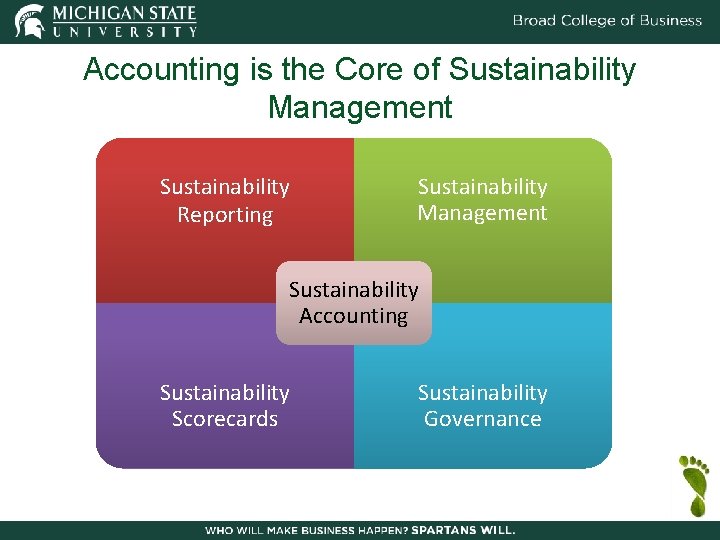
Accounting is the Core of Sustainability Management Sustainability Reporting Sustainability Management Sustainability Accounting Sustainability Scorecards Sustainability Governance
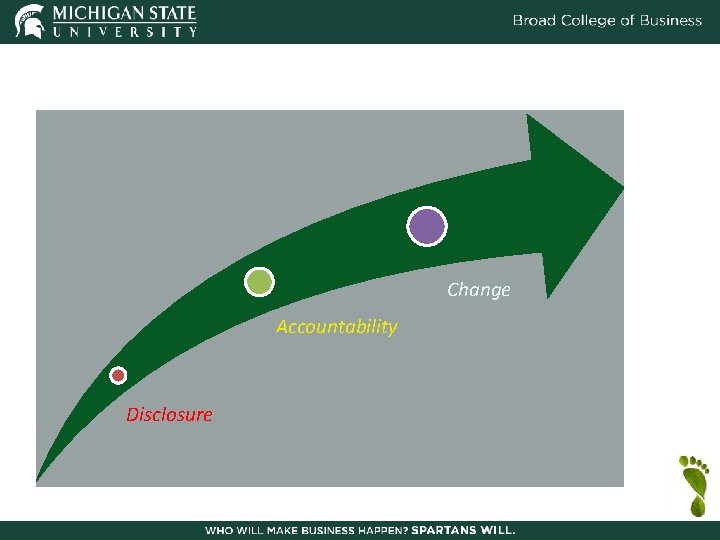
Change Accountability Disclosure

- Slides: 60