
Sustainability Radical resource productivity Whole system design Biomimicry
Sustainability Radical resource productivity Whole system design Biomimicry Green chemistry Industrial ecology Renewable energy Green nanotechnology R. Shanthini 17 Oct 2011
Green Chemistry (Sustainable Chemistry) design of chemical products and processes that reduce or eliminate the use and generation of hazardous substances. R. Shanthini 17 Oct 2011 Source: Anastas, P. T & Warner, J. C. Green Chemistry: Theory and Practice
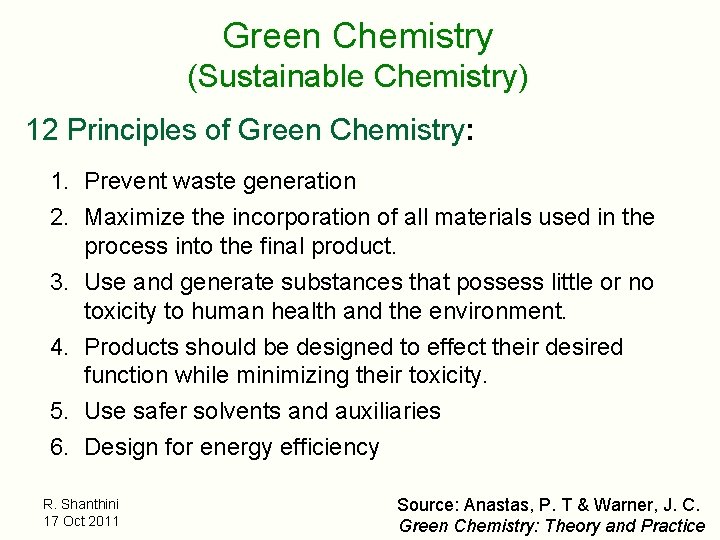
Green Chemistry (Sustainable Chemistry) 12 Principles of Green Chemistry: 1. Prevent waste generation 2. Maximize the incorporation of all materials used in the process into the final product. 3. Use and generate substances that possess little or no toxicity to human health and the environment. 4. Products should be designed to effect their desired function while minimizing their toxicity. 5. Use safer solvents and auxiliaries 6. Design for energy efficiency R. Shanthini 17 Oct 2011 Source: Anastas, P. T & Warner, J. C. Green Chemistry: Theory and Practice
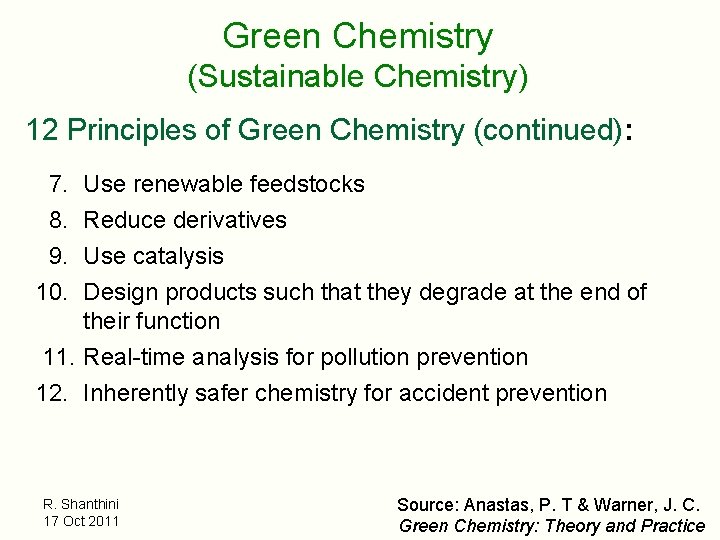
Green Chemistry (Sustainable Chemistry) 12 Principles of Green Chemistry (continued): 7. 8. 9. 10. Use renewable feedstocks Reduce derivatives Use catalysis Design products such that they degrade at the end of their function 11. Real-time analysis for pollution prevention 12. Inherently safer chemistry for accident prevention R. Shanthini 17 Oct 2011 Source: Anastas, P. T & Warner, J. C. Green Chemistry: Theory and Practice
Green Chemistry (Sustainable Chemistry) Products of Green Chemistry: Bioplastics. Plastics made from plants, including corn, potatoes or other agricultural products, even agricultural waste. Products already available are forks, knives and spoons made from potato starch and biodegradable packaging made from corn. R. Shanthini 17 Oct 2011

Green Engineering 9 Principles of Green Engineering: 1. Engineer processes and products holistically, use system analysis and integrate environmental impact assessment tools 2. Conserve and improve natural ecosystems while protecting human health and well-being 3. Use life cycle thinking in all engineering activities 4. Ensure that all material and energy inputs and outputs are as inherently safe and benign as possible 5. Minimize depletion of natural resources R. Shanthini 17 Oct 2011 Source: EPA 2006, What is Green Engineering?
Green Engineering 9 Principles of Green Engineering (continued): 6. Strive to prevent waste 7. Develop and apply engineering solutions, while being cognizant of local geography, aspirations and cultures 8. Create engineering solutions beyond current or dominant technologies; improve, innovate and invent (technologies) to achieve sustainability 9. Actively engage communities and stakeholders in development of engineering solutions R. Shanthini 17 Oct 2011 Source: EPA 2006, What is Green Engineering?
Earth Systems Engineering A multidisciplinary (engineering, science, social science, and governance) process of solution development that takes a holistic view of natural and human system interactions is known as Earth Systems Engineering. - US National Academy for Engineering R. Shanthini 17 Oct 2011
Earth Systems Engineering Earth System Engineering emphasizes five main characteristics that apply to all branches of engineering R. Shanthini 17 Oct 2011
Earth Systems Engineering Characteristic 1: Our ability to cause planetary change through technology is growing faster than our ability to understand manage the technical, social, economic, environmental, and ethical consequences of such change. Since modern engineering systems have the power to significantly affect the environment far into the future, many engineering decisions cannot be made independently of the surrounding natural and humanmade systems. R. Shanthini 17 Oct 2011 http: //www. naturaledgeproject. net/ESSPCLP-Intro_to_SDPreliminaries. Keynote 1. aspx
Earth Systems Engineering Characteristic 2: The traditional approach that engineering is only a process to devise and implement a chosen solution amid several purely technical options must be challenged. A more holistic approach to engineering requires an understanding of interactions between engineered and non-engineered systems, inclusion of nontechnical issues, and a system approach (rather than a Cartesian approach) to simulate and comprehend such interactions. R. Shanthini 17 Oct 2011 http: //www. naturaledgeproject. net/ESSPCLP-Intro_to_SDPreliminaries. Keynote 1. aspx
Earth Systems Engineering Characteristic 3: The quality of engineering decisions in society directly affects the quality of life of human and natural systems today and in the future. R. Shanthini 17 Oct 2011 http: //www. naturaledgeproject. net/ESSPCLP-Intro_to_SDPreliminaries. Keynote 1. aspx
Earth Systems Engineering Characteristic 4: There is a need for a new educational approach that will give engineering students a broader perspective beyond technical issues and an exposure to the principles of sustainable development, renewable resources management, and systems thinking. This does not mean that existing engineering curricula need to be changed in their entirety. Rather, new holistic components need to be integrated, emphasizing more of a system approach to engineering education. R. Shanthini 17 Oct 2011 http: //www. naturaledgeproject. net/ESSPCLP-Intro_to_SDPreliminaries. Keynote 1. aspx
Earth Systems Engineering Characteristic 5: Multi-disciplinary research is needed to create new quantitative tools and methods to better manage non-natural systems so that such systems have a longer life cycle and are less disruptive to natural systems in general. R. Shanthini 17 Oct 2011 http: //www. naturaledgeproject. net/ESSPCLP-Intro_to_SDPreliminaries. Keynote 1. aspx
![[engineers should] strive to accomplish the beneficial objectives of their work with the lowest](http://slidetodoc.com/presentation_image_h/c1ada769fe30928ce09605b3f69ff7ff/image-15.jpg "[engineers should] strive to accomplish the beneficial objectives of their work with the lowest")
[engineers should] strive to accomplish the beneficial objectives of their work with the lowest possible consumption of raw materials and energy and the lowest production of wastes and any kind of pollution. - 2001 Model Code of Ethics The World Federation of Engineering Organisations R. Shanthini 17 Oct 2011
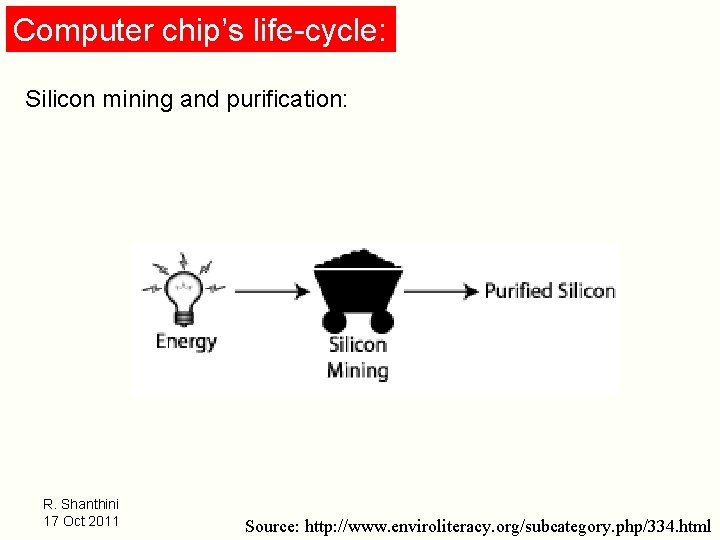
Computer chip’s life-cycle: Silicon mining and purification: R. Shanthini 17 Oct 2011 Source: http: //www. enviroliteracy. org/subcategory. php/334. html
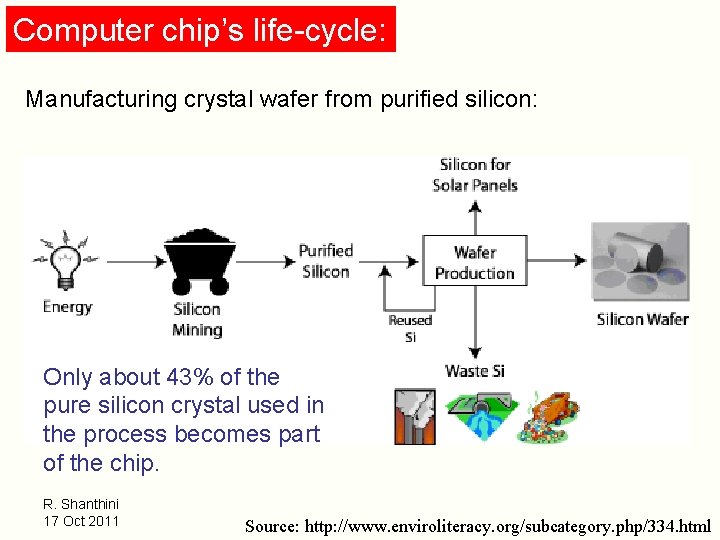
Computer chip’s life-cycle: Manufacturing crystal wafer from purified silicon: Only about 43% of the pure silicon crystal used in the process becomes part of the chip. R. Shanthini 17 Oct 2011 Source: http: //www. enviroliteracy. org/subcategory. php/334. html
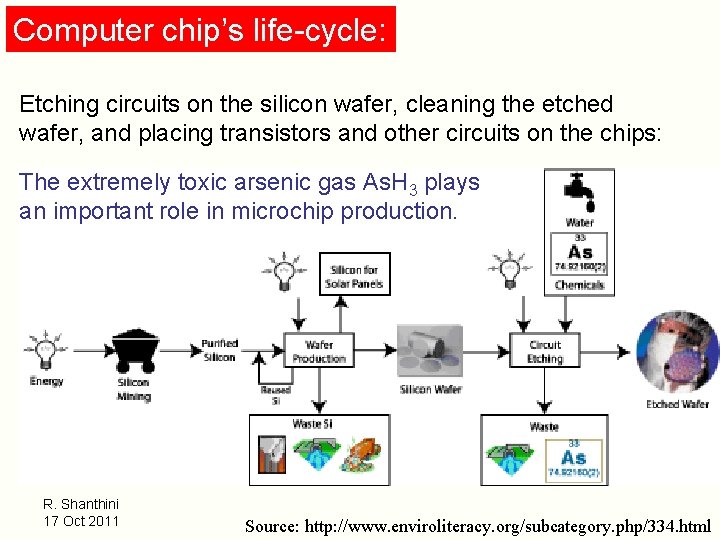
Computer chip’s life-cycle: Etching circuits on the silicon wafer, cleaning the etched wafer, and placing transistors and other circuits on the chips: The extremely toxic arsenic gas As. H 3 plays an important role in microchip production. R. Shanthini 17 Oct 2011 Source: http: //www. enviroliteracy. org/subcategory. php/334. html
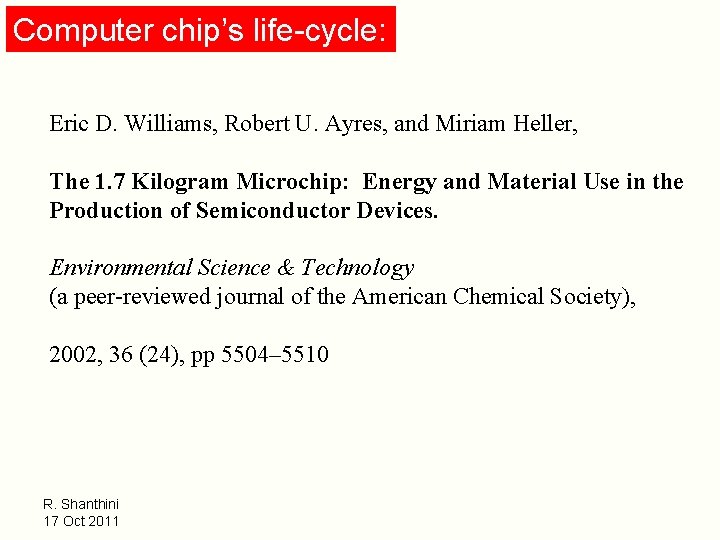
Computer chip’s life-cycle: Eric D. Williams, Robert U. Ayres, and Miriam Heller, The 1. 7 Kilogram Microchip: Energy and Material Use in the Production of Semiconductor Devices. Environmental Science & Technology (a peer-reviewed journal of the American Chemical Society), 2002, 36 (24), pp 5504– 5510 R. Shanthini 17 Oct 2011
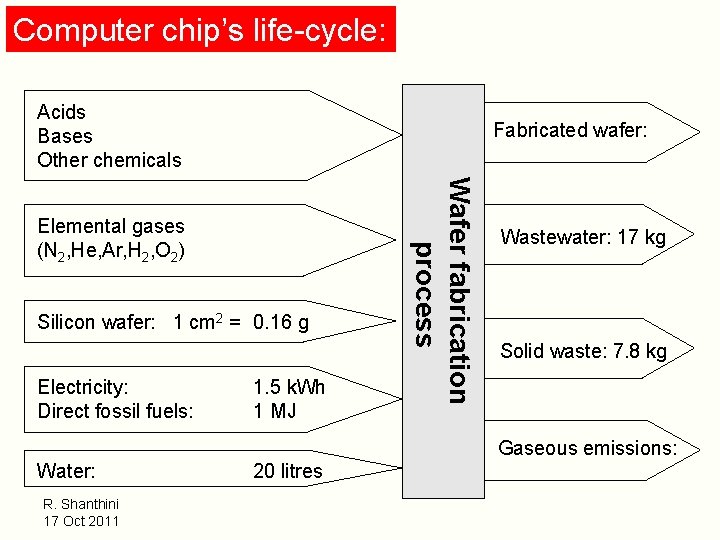
Computer chip’s life-cycle: Acids Bases Other chemicals Fabricated wafer: Silicon wafer: 1 cm 2 = 0. 16 g Electricity: Direct fossil fuels: 1. 5 k. Wh 1 MJ Wafer fabrication process Elemental gases (N 2, He, Ar, H 2, O 2) Wastewater: 17 kg Solid waste: 7. 8 kg Gaseous emissions: Water: R. Shanthini 17 Oct 2011 20 litres
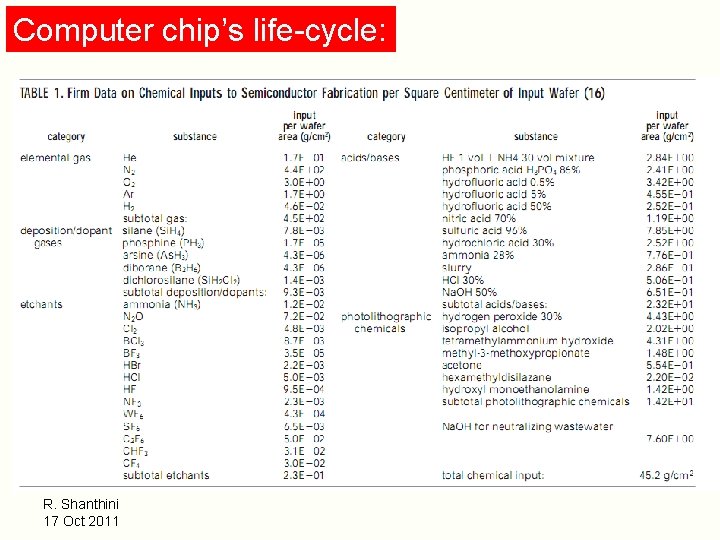
Computer chip’s life-cycle: R. Shanthini 17 Oct 2011
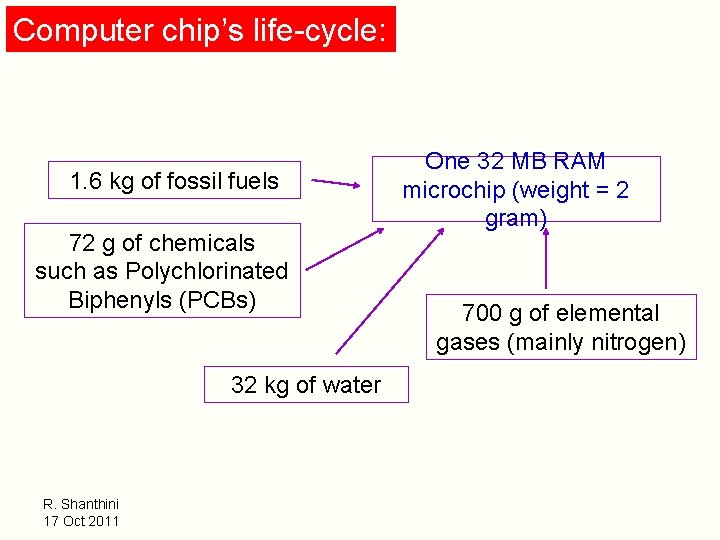
Computer chip’s life-cycle: 1. 6 kg of fossil fuels 72 g of chemicals such as Polychlorinated Biphenyls (PCBs) 32 kg of water R. Shanthini 17 Oct 2011 One 32 MB RAM microchip (weight = 2 gram) 700 g of elemental gases (mainly nitrogen)
Sustainability Radical resource productivity Whole system design Biomimicry Green chemistry Industrial ecology Renewable energy Green nanotechnology R. Shanthini 17 Oct 2011
Industrial Ecology: - No waste - Energy efficiently utilized - No materials beyond those required to start the system - Complete recycling within the system R. Shanthini 17 Oct 2011 Source: S. Manahan, Industrial Ecology, 1999
Industrial Ecology: "One of the most important concepts of industrial ecology is that, like the biological system, it rejects the concept of waste. " R. Shanthini 17 Oct 2011 Source: T. Graedel and B. Allenby, Industrial Ecology, 1995
Industrial Ecology: Let us take a look at a functional industrial ecosystem R. Shanthini 17 Oct 2011
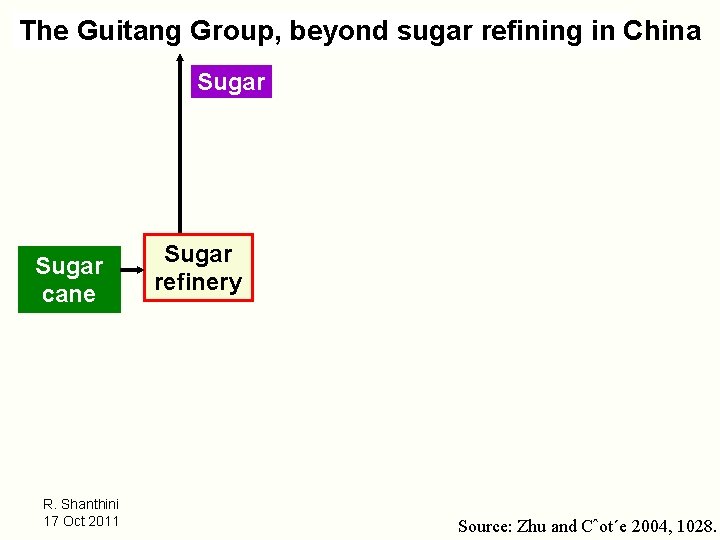
The Guitang Group, beyond sugar refining in China Sugar cane R. Shanthini 17 Oct 2011 Sugar refinery Source: Zhu and Cˆot´e 2004, 1028.
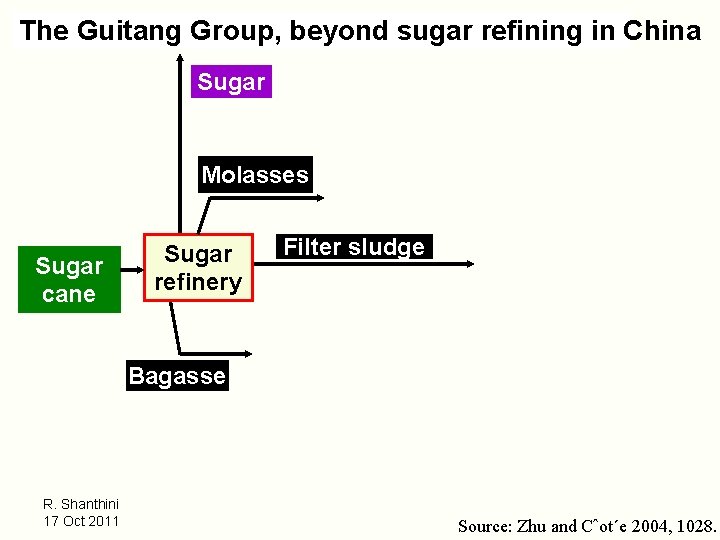
The Guitang Group, beyond sugar refining in China Sugar Molasses Sugar cane Sugar refinery Filter sludge Bagasse R. Shanthini 17 Oct 2011 Source: Zhu and Cˆot´e 2004, 1028.
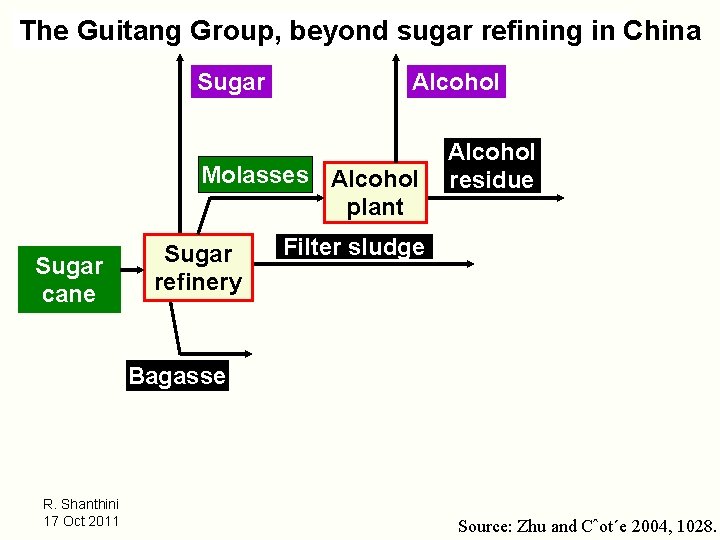
The Guitang Group, beyond sugar refining in China Sugar Alcohol Molasses Alcohol plant Sugar cane Sugar refinery Alcohol residue Filter sludge Bagasse R. Shanthini 17 Oct 2011 Source: Zhu and Cˆot´e 2004, 1028.
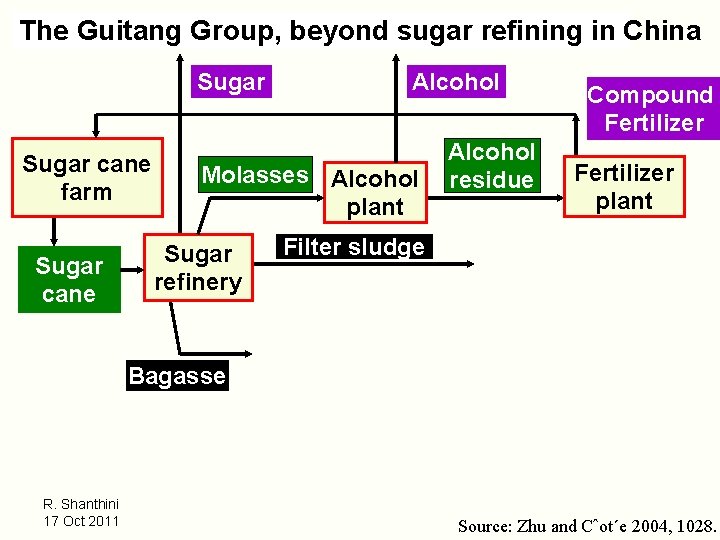
The Guitang Group, beyond sugar refining in China Sugar cane farm Sugar cane Alcohol Molasses Alcohol plant Sugar refinery Alcohol residue Compound Fertilizer plant Filter sludge Bagasse R. Shanthini 17 Oct 2011 Source: Zhu and Cˆot´e 2004, 1028.
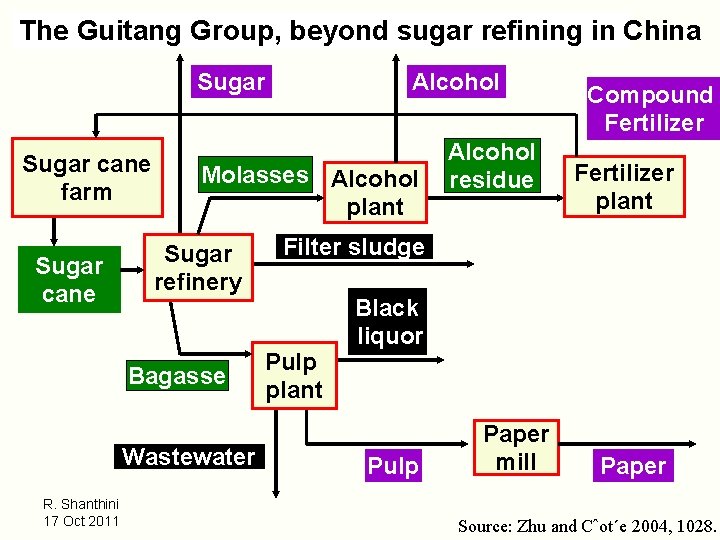
The Guitang Group, beyond sugar refining in China Sugar cane farm Sugar cane Molasses Alcohol plant Sugar refinery Bagasse Wastewater R. Shanthini 17 Oct 2011 Alcohol residue Compound Fertilizer plant Filter sludge Pulp plant Black liquor Pulp Paper mill Paper Source: Zhu and Cˆot´e 2004, 1028.
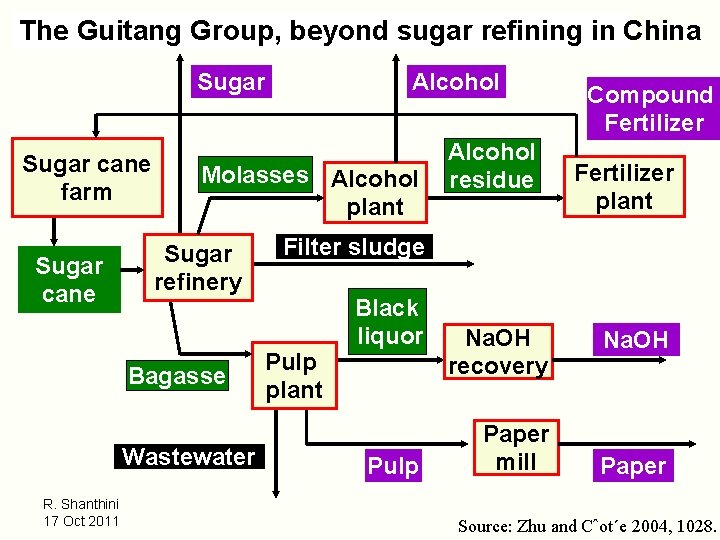
The Guitang Group, beyond sugar refining in China Sugar cane farm Sugar cane Molasses Alcohol plant Sugar refinery Bagasse Wastewater R. Shanthini 17 Oct 2011 Alcohol residue Compound Fertilizer plant Filter sludge Pulp plant Black liquor Pulp Na. OH recovery Paper mill Na. OH Paper Source: Zhu and Cˆot´e 2004, 1028.
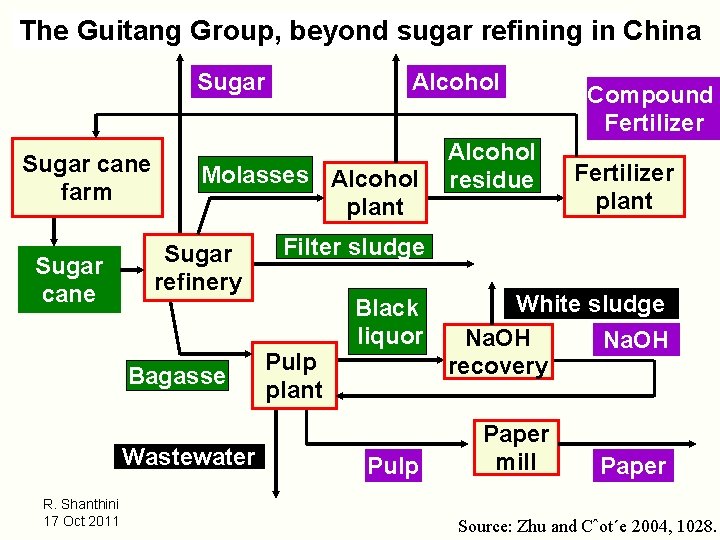
The Guitang Group, beyond sugar refining in China Sugar cane farm Sugar cane Molasses Alcohol plant Sugar refinery Bagasse Wastewater R. Shanthini 17 Oct 2011 Alcohol residue Compound Fertilizer plant Filter sludge Pulp plant Black liquor Pulp White sludge Na. OH recovery Paper mill Paper Source: Zhu and Cˆot´e 2004, 1028.
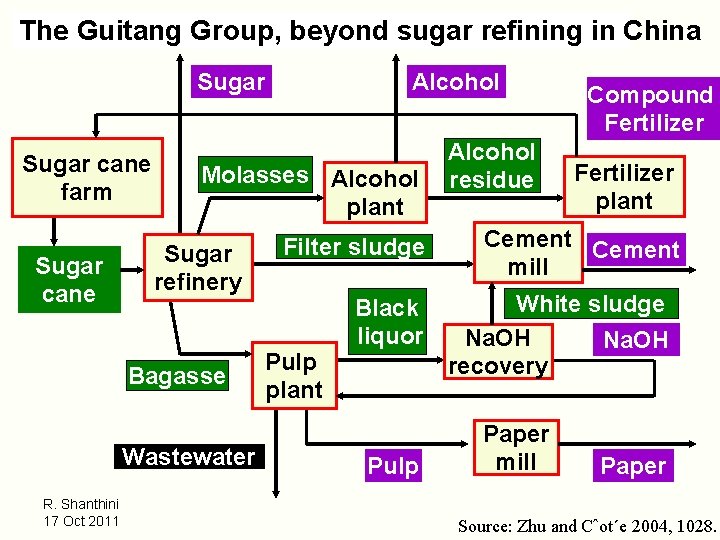
The Guitang Group, beyond sugar refining in China Sugar cane farm Sugar cane Molasses Alcohol plant Sugar refinery Bagasse Wastewater R. Shanthini 17 Oct 2011 Alcohol Filter sludge Pulp plant Black liquor Pulp Alcohol residue Compound Fertilizer plant Cement mill White sludge Na. OH recovery Paper mill Paper Source: Zhu and Cˆot´e 2004, 1028.
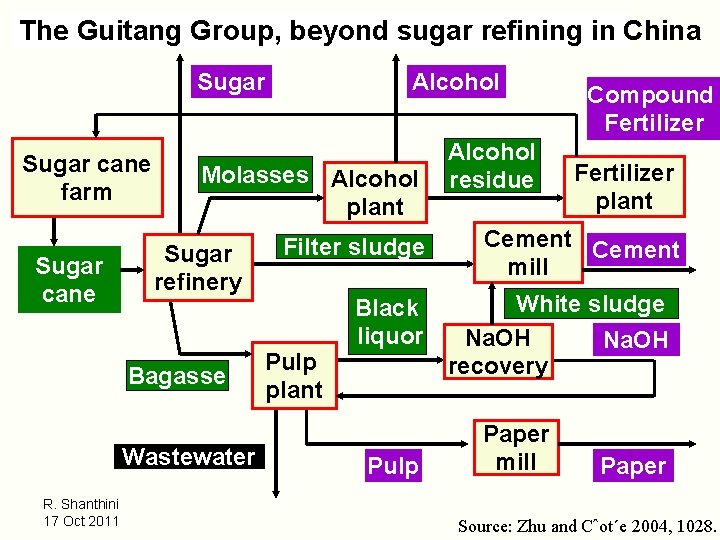
The Guitang Group, beyond sugar refining in China Sugar cane farm Sugar cane Molasses Alcohol plant Sugar refinery Bagasse Wastewater R. Shanthini 17 Oct 2011 Alcohol Filter sludge Pulp plant Black liquor Pulp Alcohol residue Compound Fertilizer plant Cement mill White sludge Na. OH recovery Paper mill Paper Source: Zhu and Cˆot´e 2004, 1028.
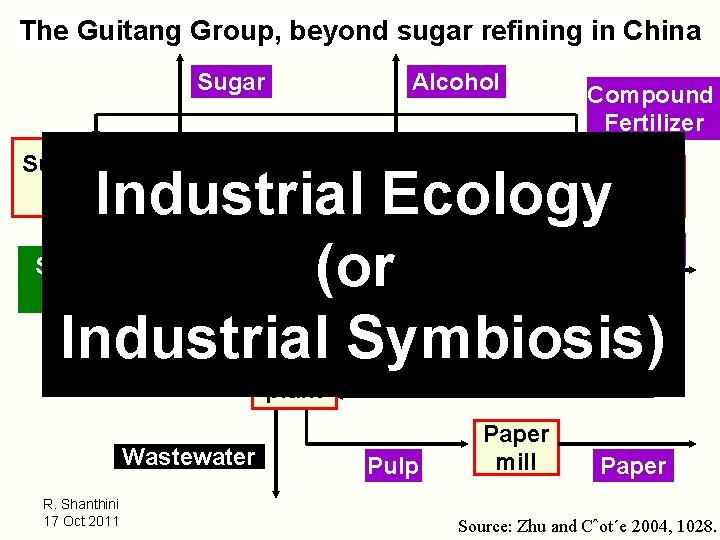
The Guitang Group, beyond sugar refining in China Sugar cane farm Alcohol residue Compound Fertilizer plant Industrial Ecology (or Industrial Symbiosis) Sugar cane Molasses Alcohol plant Sugar refinery Bagasse Wastewater R. Shanthini 17 Oct 2011 Filter sludge Pulp plant Black liquor Pulp Cement mill White sludge Na. OH recovery Paper mill Paper Source: Zhu and Cˆot´e 2004, 1028.
The Guitang Group, beyond sugar refining in China - This industrial symbiosis took 40 years to develop. - It has been spontaneously developed first through internal investments, and then through cooperation with partners in the regions. - Developing by-product exchanges is beneficial in many ways (reduced emissions, reduced disposal costs and revenue from by-product utilization). - Improving environmental standards (ISO 9001 certification in 1998) - However, it is counter to traditional business trends such as focusing on their core competence and avoiding development of “distracting” profit centers. R. Shanthini 17 Oct 2011 Source: Q. Zhu, E. A. Lowe, Y. Wei, and D. Barnes, 2007. Industrial Symbiosis in China: A Case Study of the Guitang Group. J. of Industrial Ecology 11(1): 31 -42
Industrial Symbiosis at Kalundborg, Denmark go to the presentation on The Industrial Symbiosis at Kalundborg, Denmark by Jørgen Christensen Consultant to the Symbiosis Institute R. Shanthini 17 Oct 2011 http: //continuing-education. epfl. ch/webdav/site/continuing-education/ shared/Industrial%20 Ecology/Presentations/11%20 Christensen. pdf
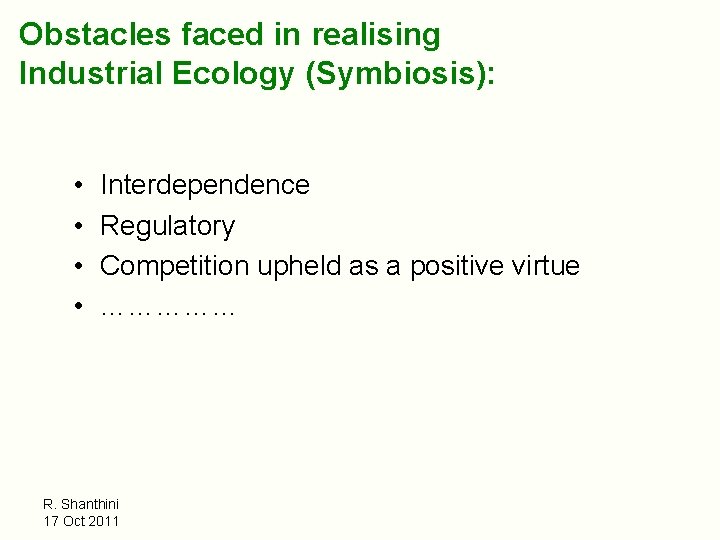
Obstacles faced in realising Industrial Ecology (Symbiosis): • • Interdependence Regulatory Competition upheld as a positive virtue …………… R. Shanthini 17 Oct 2011
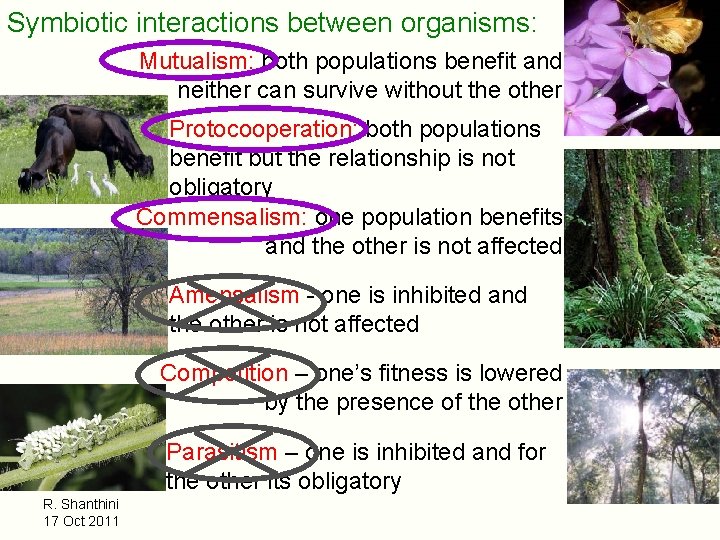
Symbiotic interactions between organisms: Mutualism: both populations benefit and neither can survive without the other Protocooperation: both populations benefit but the relationship is not obligatory Commensalism: one population benefits and the other is not affected Amensalism - one is inhibited and the other is not affected Competition – one’s fitness is lowered by the presence of the other Parasitism – one is inhibited and for the other its obligatory R. Shanthini 17 Oct 2011
Conditions Favorable for Eco-Industrial Development: • Regulations that penalize waste and provide firms’ incentives to seek symbiotic relationships with other firms R. Shanthini 17 Oct 2011 Source: Mary Schlarb, Eco-Industrial Development: A Strategy for Building Sustainable Communities, 2001
Conditions Favorable for Eco-Industrial Development: • Regulations that penalize waste and provide firms’ incentives to seek symbiotic relationships with other firms • Supply of by-products must meet demand (and vice versa) • Form relationships based on connections or institutional framework to reduce transaction costs • Proximity to compatible firms with stable supply and quality of byproducts R. Shanthini 17 Oct 2011 Source: Mary Schlarb, Eco-Industrial Development: A Strategy for Building Sustainable Communities, 2001
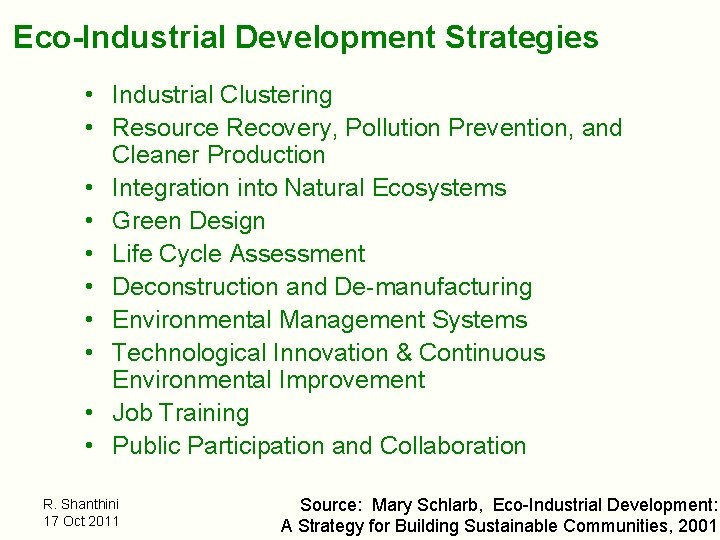
Eco-Industrial Development Strategies • Industrial Clustering • Resource Recovery, Pollution Prevention, and Cleaner Production • Integration into Natural Ecosystems • Green Design • Life Cycle Assessment • Deconstruction and De-manufacturing • Environmental Management Systems • Technological Innovation & Continuous Environmental Improvement • Job Training • Public Participation and Collaboration R. Shanthini 17 Oct 2011 Source: Mary Schlarb, Eco-Industrial Development: A Strategy for Building Sustainable Communities, 2001
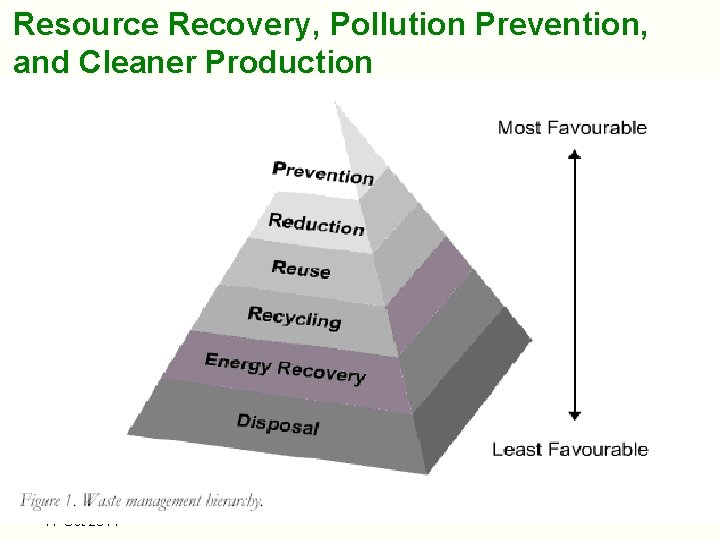
Resource Recovery, Pollution Prevention, and Cleaner Production R. Shanthini 17 Oct 2011

Green Design R. Shanthini 17 Oct 2011
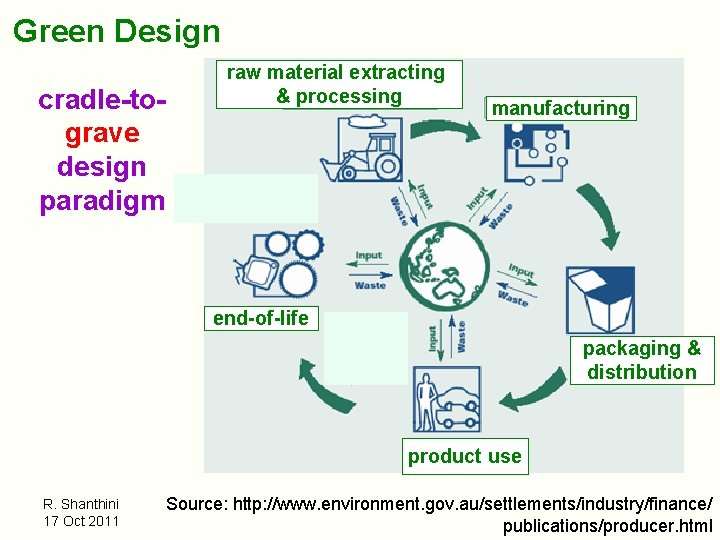
Green Design cradle-tograve design paradigm raw material extracting & processing manufacturing recycling end-of-life repair & reuse packaging & distribution product use R. Shanthini 17 Oct 2011 Source: http: //www. environment. gov. au/settlements/industry/finance/ publications/producer. html
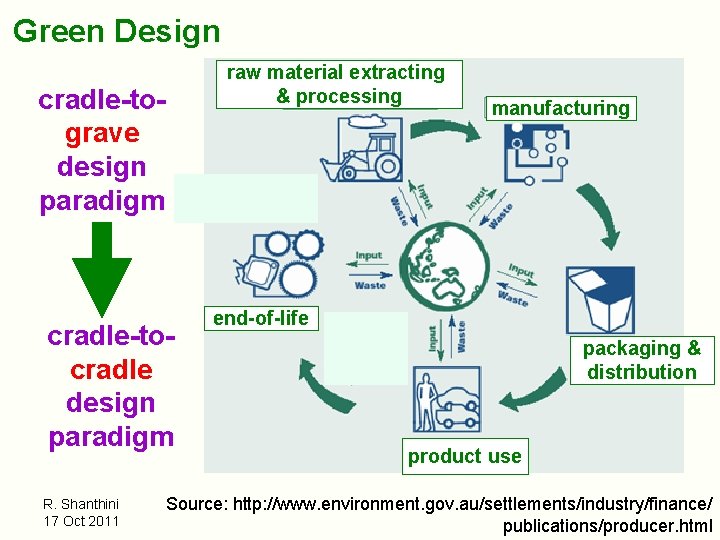
Green Design cradle-tograve design paradigm cradle-tocradle design paradigm R. Shanthini 17 Oct 2011 raw material extracting & processing manufacturing recycle end-of-life repair & reuse packaging & distribution product use Source: http: //www. environment. gov. au/settlements/industry/finance/ publications/producer. html

Green Design R. Shanthini 17 Oct 2011
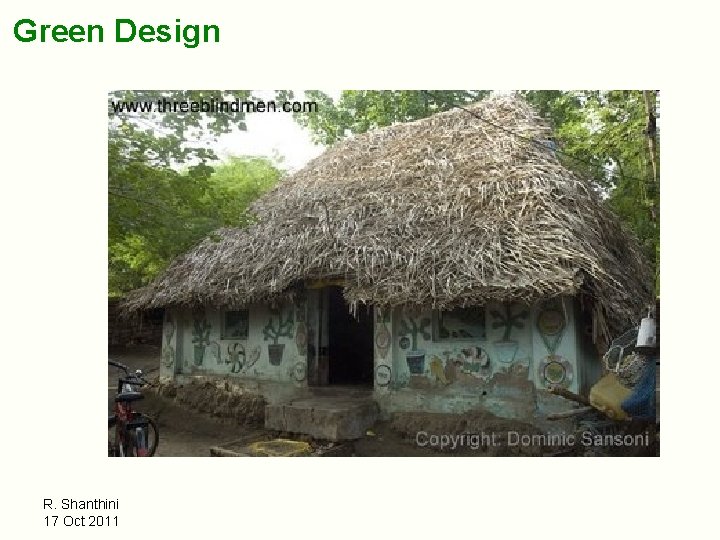
Green Design R. Shanthini 17 Oct 2011
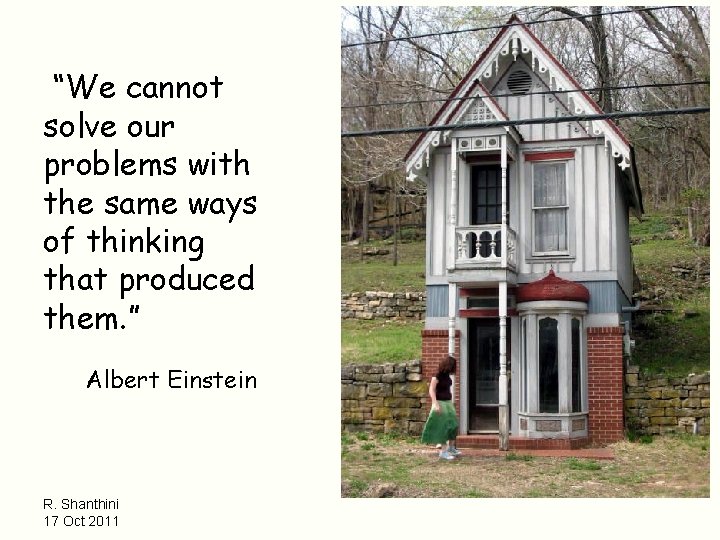
“We cannot solve our problems with the same ways of thinking that produced them. ” Albert Einstein R. Shanthini 17 Oct 2011
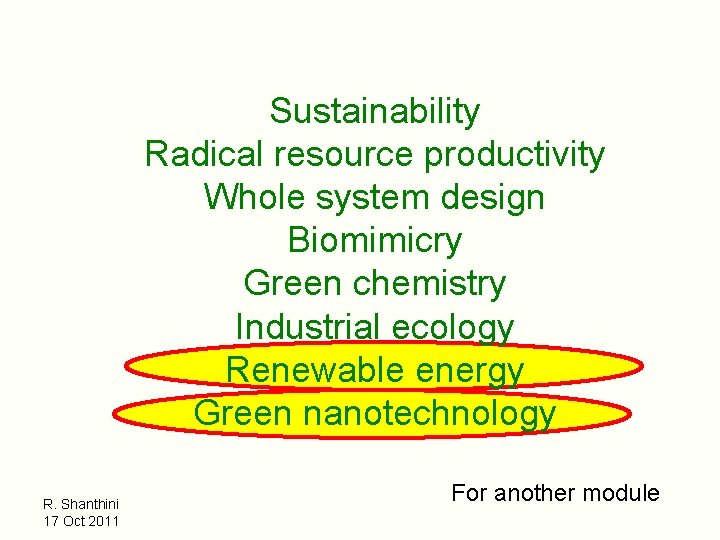
Sustainability Radical resource productivity Whole system design Biomimicry Green chemistry Industrial ecology Renewable energy Green nanotechnology R. Shanthini 17 Oct 2011 For another module
- Slides: 51