
Sustainability Plan V 1 0 Dan Stancil Power
Sustainability Plan V 1. 0 Dan Stancil Power. America PI Professor and Head Department of Electrical & Computer Engineering North Carolina State University ddstanci@ncsu. edu
Coupled Futures of Power. America & FREEDM Power. America FREEDM Future Renewable Electric Energy Delivery & Management, an NSF Engineering Research Center Dreamstime. com
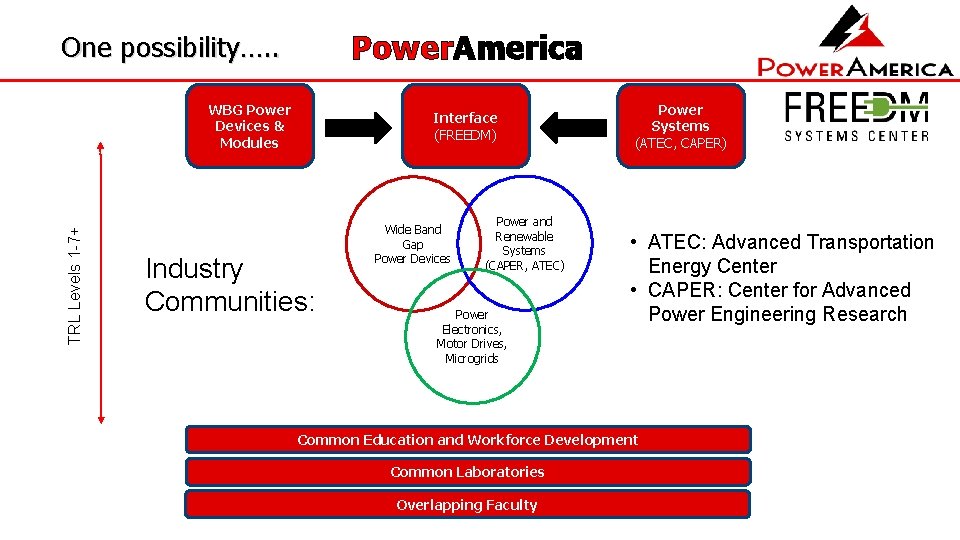
Power. America One possibility…. . TRL Levels 1 -7+ WBG Power Devices & Modules Interface (FREEDM) Industry Communities: Wide Band Gap Power Devices Power and Renewable Systems (CAPER, ATEC) Power Electronics, Motor Drives, Microgrids Power Systems (ATEC, CAPER) • ATEC: Advanced Transportation Energy Center • CAPER: Center for Advanced Power Engineering Research Common Education and Workforce Development Common Laboratories Overlapping Faculty
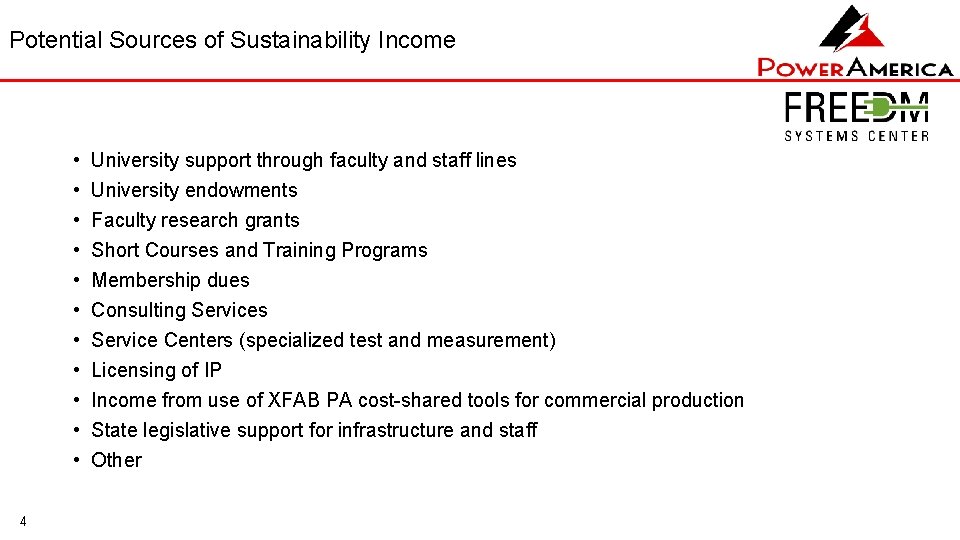
Potential Sources of Sustainability Income • • • 4 University support through faculty and staff lines University endowments Faculty research grants Short Courses and Training Programs Membership dues Consulting Services Service Centers (specialized test and measurement) Licensing of IP Income from use of XFAB PA cost-shared tools for commercial production State legislative support for infrastructure and staff Other
University Support • NC State – Faculty and Staff lines • ~15 FREEDM faculty • ~5 new PA faculty – ~$750 k-$1 M equivalent continuing commitment • 1 staff position – ~$45 k continuing commitment from ECE – University support for the MS in Electric Power Systems Engineering (EPSE) – $1. 5 M Endowment given to FREEDM from Duke • Will generate ~$60 k/year • Partner Universities – Faculty lines – Course & Educational Program support 5
Faculty Research Grants • NC State – 20 faculty x $500 k/yr/fac = $10 M annual research expenditures • In FY 14 -15, ECE faculty had $482 k/yr in external expenditures, on average – Support for students, staff, and post-docs – Research funds to access PA Service Centers for research • Partner Universities – Collaborate on joint proposals – Any university can lead a collaborative project 6
Short Courses and Training Programs • Tailored to the needs of working professionals • At NC State or in collaboration with partner universities • 4 courses/year • 25 participants per course • $1500 -$3000 per participant • Total revenue: $150 k-$300 k/yr 7
Membership Dues • Three industry communities after merger of Power. America and FREEDM – Semiconductor Power Devices – Power Electronics, Motor Drives, Microgrids – Power and Renewable Energy Systems • Multiple membership levels – Full Sustaining – Full Member – Affiliate Members – Startup Members – University & Non-profit members – National Labs • Anticipate total revenue to be $3 M-$4 M 8
Consulting Services and Service Centers • Services to span the full space from WBG devices, PE, and Power Systems – Low cost manufacturing at XFAB using PA MOSFET and JBS processes – Development of packaging and module solutions – Custom high voltage/current/temperature reliability testing – WBG circuit topology simulations and development – Prototype demonstration and validation at NC State PE facilities • Examples from existing service centers: – Analytical Instrumentation Facility generates about $1 M/yr – NC State University Nanofabrication Facility generates about $300 k/yr (has the potential for $1 M/yr) 9
Licensing of IP and income from XFAB • NC State University IP Revenue model – 40% inventors – 50% Office of Technology Transfer – 5% NC State College of Engineering – 5% ECE Department – The potential for diversion to PA is sufficiently small to make this an insignificant source of revenue • For PA funded IP that generates revenue, a portion of that revenue will be used to reimburse the patent filing cost • XFAB revenue – Income from use of XFAB PA cost-shared tools for commercial production purposes 10
State Legislative Support • State provided initial $250 k support for the Advanced Transportation Energy Center (ATEC) • Golden LEAF provided about $38 M to design, build and equip BTEC, the Biomanufacturing Training and Education Center • State committed $10 M to PA • Additional support should be plausible, if we can make a good case for impact on jobs and the economy 11
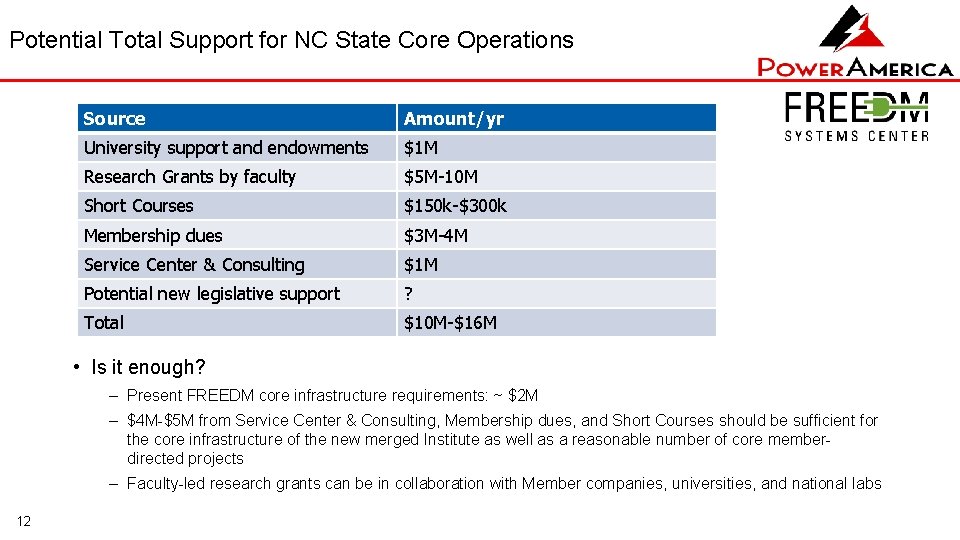
Potential Total Support for NC State Core Operations Source Amount/yr University support and endowments $1 M Research Grants by faculty $5 M-10 M Short Courses $150 k-$300 k Membership dues $3 M-4 M Service Center & Consulting $1 M Potential new legislative support ? Total $10 M-$16 M • Is it enough? – Present FREEDM core infrastructure requirements: ~ $2 M – $4 M-$5 M from Service Center & Consulting, Membership dues, and Short Courses should be sufficient for the core infrastructure of the new merged Institute as well as a reasonable number of core memberdirected projects – Faculty-led research grants can be in collaboration with Member companies, universities, and national labs 12
Summary • PA and FREEDM have an integrated future at NC State – This enhances sustainability of both – Leverages infrastructure – Expands industry base • Collaboration with partner universities from both organizations is valued and will be continued – Joint projects and proposals – Joint offering of short courses • Estimates of revenue that can be generated from Institute activities appear to be adequate for: – Support of core infrastructure at NC State – Support of core member-directed projects • Research activities and projects can be further expanded with faculty-led Federal research grants, and may be in collaboration with any member organization 13
Key Questions for Discussion • How can we estimate potential income from XFAB use of PA-supplied equipment in commercial processes? • What are opportunities for services to be provided for a fee? – i. e. , what do you need to do but have difficulty doing or finding someone who can do? 15
- Slides: 15