
Sustainability n Thinking about the Food Distribution Chart
Sustainability

n Thinking about the Food Distribution Chart from yesterday, what are some of the environmental impacts of food distribution? n In your group, how does food distribution impact the following? n Soil n Air n Fresh Water n Oceans n Biodiversity
Sustainability and Stewardship n Sustainability – conditions that prevent depletion of natural resources n Stewardship: the careful and responsible management of something entrusted to one’s care.
UNESCO proposes that: n Sustainable agriculture should consider: n The quality of the food grown n Social and environmental impacts of food processing n Health of the people living near processing plants n Impact of transportation of food (United Nations Educational, Scientific, and Cultural Organization)

Pro’s and Con’s of Sustainable Agriculture n Mini Debate – form 2 groups of five. n Half of you will be arguing from the perspective that Sustainability is great n The other half will be arguing from the perspective that sustainability is impractical and utopian. n You get 15 -20 minutes to form an argument for your side of the debate. Then we will split up the groups and debate the topic. n Each side of the debate will get to say 3 statements each. You will also get the chance to rebut the other groups 3 statements.
Topics to Consider n Energy conservation – wind and solar power n Use of biofuels n Methane Emissions n Practicality of sustainable solutions n Finances n Biosecurity n Agroforestry
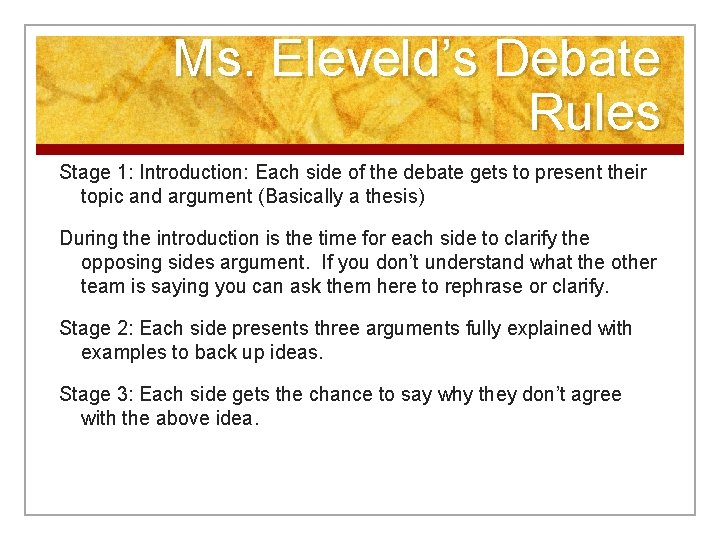
Ms. Eleveld’s Debate Rules Stage 1: Introduction: Each side of the debate gets to present their topic and argument (Basically a thesis) During the introduction is the time for each side to clarify the opposing sides argument. If you don’t understand what the other team is saying you can ask them here to rephrase or clarify. Stage 2: Each side presents three arguments fully explained with examples to back up ideas. Stage 3: Each side gets the chance to say why they don’t agree with the above idea.

It starts with YOU n Diet – the types of foods you chose to eat and buy. E. g. do you buy free range eggs? Do you choose fair trade products when possible? Organic? n Products – what types of products you buy. E. g. Plastic packaging? Glass packaging? Plastic waterbottles vs glass, take away containers, plastic vs reusable bags n Choice of Local vs imported foods n Reducing the amount of waste you produce – e. g. wasting food, buying heavily packaged products. n Avoiding bioaccumulation and reducing your toxic burden – n n Bioaccumulation: “the build-up of substances, such as toxic chemical, in various tissues of a living organism”. Toxic Burden – the amount you are exposed to toxins and chemicals.
- Slides: 8