
Sustainability Assessment Model and its application Dr Katie
Sustainability Assessment Model and its application Dr Katie Begg Institute of Energy and Sustainable Development, De Montfort University KITE
Purpose l l Article 12 states that the CDM should contribute to a host country sustainable development path but how should this be achieved? Develop a tool to assess benefits from small scale community projects for host government approval procedures – – – l Overall assessment of benefits Balanced project Redesign to maximise benefits if necessary Assist design of projects for project developers KITE
Approach l l l l Based on the Sustainable Livelihood Framework Multi Criteria Decision analysis (MCDA) Recognises that all decisions are subjective Multiple and conflicting objectives Uncertainty and complexity Creative Applied to small scale community projects Project partner testing KITE
S-L at the Project Level l Small scale energy projects should also be about improving people’s livelihoods l What is a livelihood- it is assets (material and social) and activities required for a means of living l A livelihood is sustainable when it can cope with shocks and stresses, and can develop its assets and capabilities without undermining the natural resource base KITE

What is a Sustainable Livelihoods Framework? l The S-L framework assesses the main factors that influence livelihoods to assist the design of interventions l Looks complex and ‘jargon’ based. It does not need to be followed rigidly - can be broken up. l It is a logical checklist and can provide an analysis to the strengths and constraints to livelihoods. KITE

Sustainable Livelihoods Framework LIVELIHOOD ASSETS VULNERABILITY CONTEXT SHOCKS TRENDS SEASONALITY H S N Influence & access P F LIVELIHOOD OUTCOMES POLICY INSTITUTIONS AND PROCESSES LIVELIHOOD STRATEGIES • NR Based • Non-NR • Migration More income Increased well being More sustainable NR base Reduced vulnerability Improved Food Security ASSETS & CONTEXT What we have to work with. . . STRATEGIES & OUTCOMES …what we want to achieve KITE

Livelihood Outcomes l Increased wellbeing – l Increased income – l ICS: conservation of forest with less wood and charcoal use Improved food security – l MHP: more opportunities for income generation/ ICS: savings from less charcoal used More sustainable natural resource base – l ICS: reduced indoor air pollution and accompanying health risks MHP irrigation Reduced Vulnerability – ICS: due to above KITE
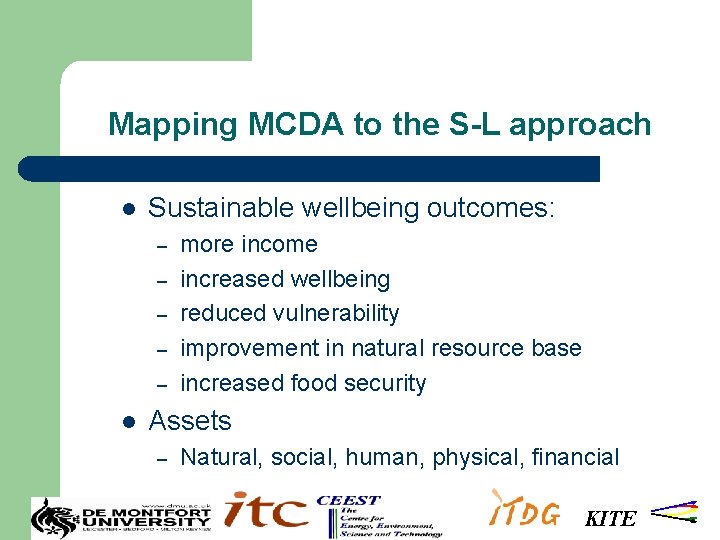
Mapping MCDA to the S-L approach l Sustainable wellbeing outcomes: – – – l more income increased wellbeing reduced vulnerability improvement in natural resource base increased food security Assets – Natural, social, human, physical, financial KITE
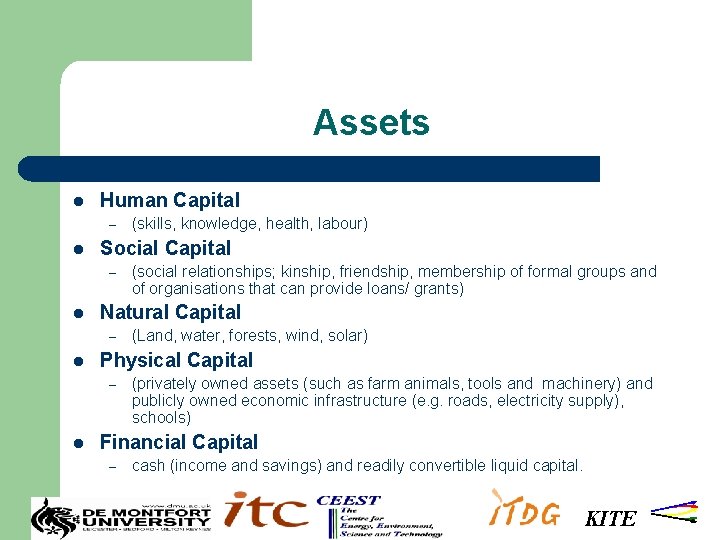
Assets l Human Capital – l Social Capital – l (Land, water, forests, wind, solar) Physical Capital – l (social relationships; kinship, friendship, membership of formal groups and of organisations that can provide loans/ grants) Natural Capital – l (skills, knowledge, health, labour) (privately owned assets (such as farm animals, tools and machinery) and publicly owned economic infrastructure (e. g. roads, electricity supply), schools) Financial Capital – cash (income and savings) and readily convertible liquid capital. KITE
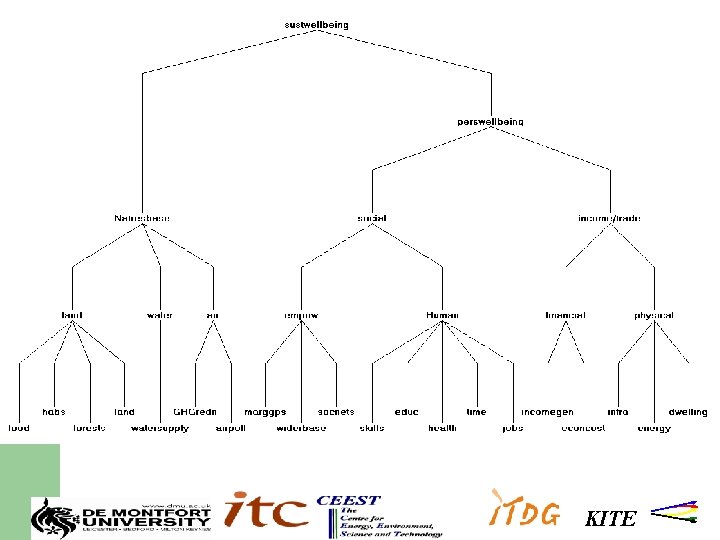
Value Tree KITE
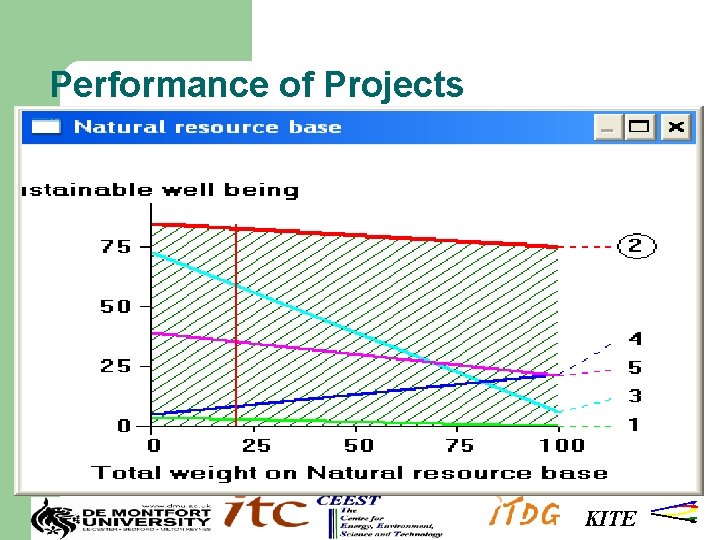
Performance of Projects KITE
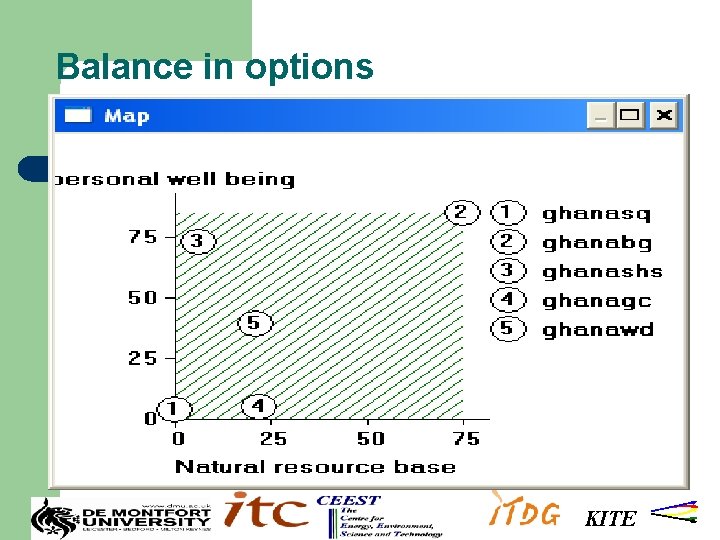
Balance in options KITE
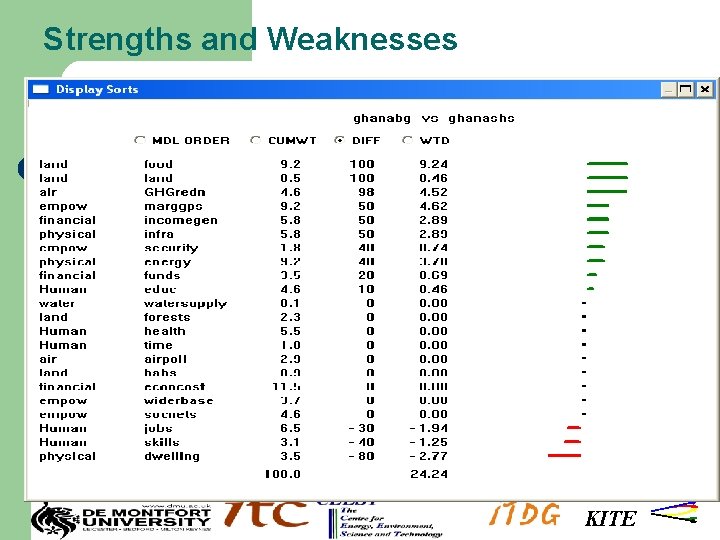
Strengths and Weaknesses KITE
SAM : a thinking ‘person’s’ guide l l l Grounded in theory and practice of Decision Analysis. Does not use arbitrary scales, looks at balance as well as performance Handles qualitative and quantitative inputs Allows comparison with the Status Quo and with benchmark projects List of examples of additional actions to improve projects Helps maximise the benefits KITE
- Slides: 14