
Sustainability and LEED Presented by Michelle Leader LEED
Sustainability and LEED® Presented by: Michelle Leader, LEED AP Marketing Specialist Sto Corp.
LEED Leadership in Energy and Environmental Design® (Information in this presentation is from “An Introduction to the U. S. Green Building Council and the LEED® Green Building Rating System” Copyright 2005, U. S. Green Building Council)

What Is LEED® ? • A Green Building rating system for construction projects developed by the USGBC* • Focuses on environmental impact, use of resources, and occupant health • Provides a standard for measurement • Promotes whole-building, integrated design processes *US Green Building Council
USGBC • US Green Building Council – National Non-Profit Organization – Diverse membership of organizations – Consensus Driven, Committee Based Product Development – Developer and Administrator of the LEED Green Building Rating System®
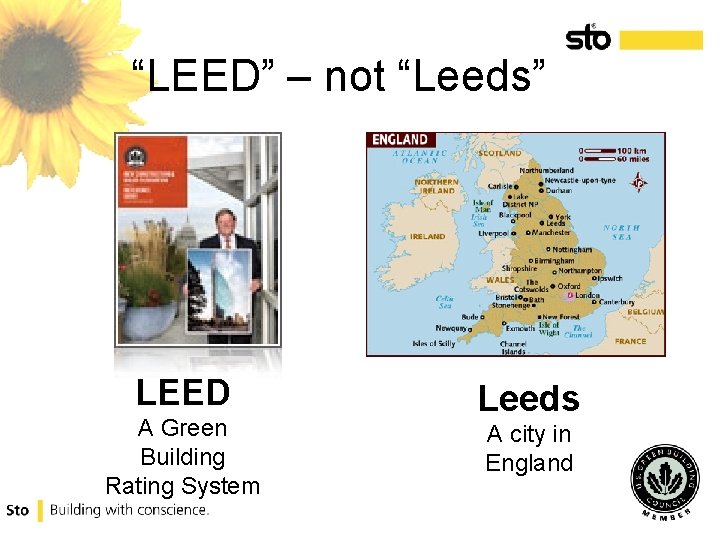
“LEED” – not “Leeds” LEED A Green Building Rating System Leeds A city in England
Very Important • There are NO “LEED-Certified” products or companies – Only a project (building) can be “LEED Certified” • A product CANNOT “GIVE POINTS” to a LEED project • A product “CAN CONTRIBUTE TOWARD” or “COMPLY WITH” LEED credit requirements • An individual can become a “LEED Accredited Professional”

LEED Rating Systems ® • Rating systems tailored to different types of projects – LEED NC : for New Construction and Major Renovations / Additions – released 2000 – LEED EB : for Existing Buildings – released 2004 – LEED CI : for Commercial Interiors – released 2004 – LEED CS : for Core and Shell – released 2005 – LEED H : for Homes – released Fall 2007 – LEED ND : For Neighborhood Developments - scheduled 2009
LEED Project Certification • Points are awarded for meeting certain green performance criteria in each of 6 LEED Credit Categories – 69 total points available • Total number of points achieved determines certification level
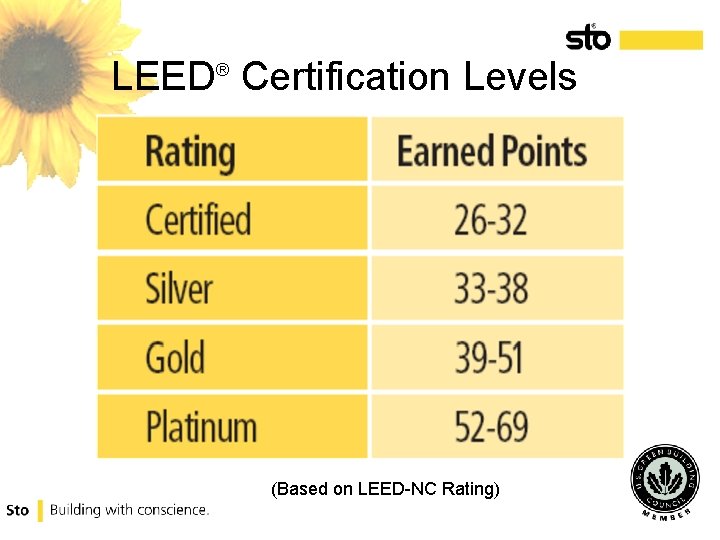
LEED Certification Levels ® (Based on LEED-NC Rating)

LEED® Credit Categories* *LEED NC version 2. 2 Innovative Design (5 pts) Sustainable Sites (14 pts) 5 Indoor Environmental Quality (15 pts) 14 15 5 13 Water Efficiency (5 pts) 17 Materials & Resources (13 pts) Total Possible Points = 69 Energy & Atmosphere (17 pts)
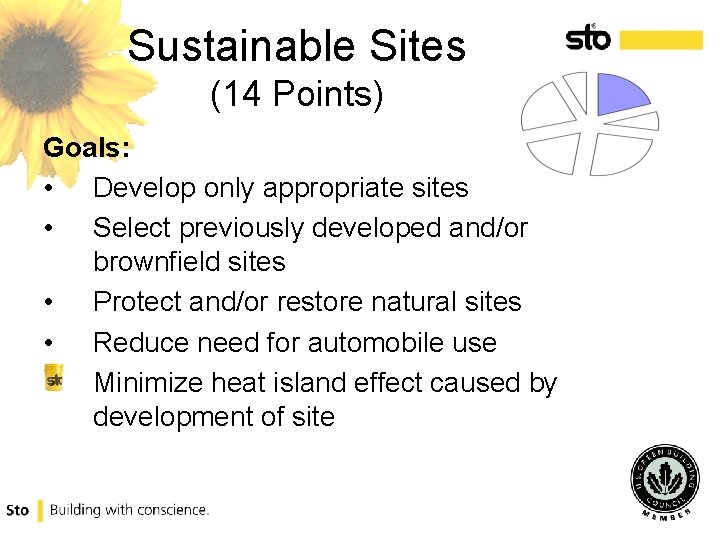
Sustainable Sites (14 Points) Goals: • Develop only appropriate sites • Select previously developed and/or brownfield sites • Protect and/or restore natural sites • Reduce need for automobile use Minimize heat island effect caused by development of site
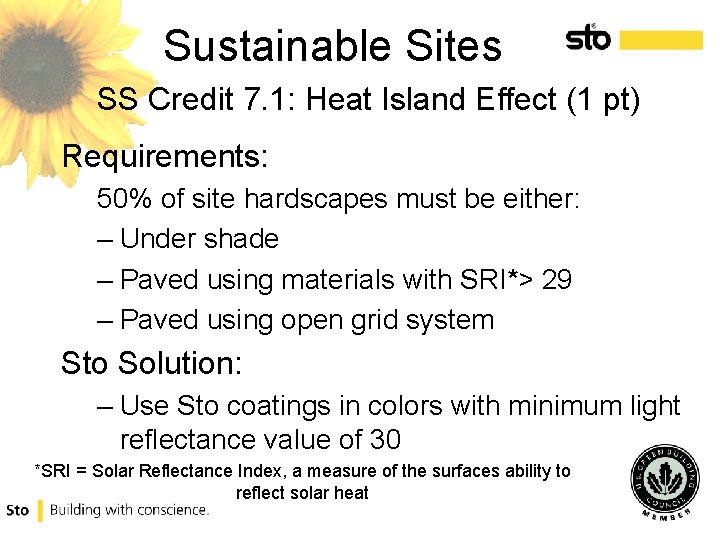
Sustainable Sites SS Credit 7. 1: Heat Island Effect (1 pt) Requirements: 50% of site hardscapes must be either: – Under shade – Paved using materials with SRI*> 29 – Paved using open grid system Sto Solution: – Use Sto coatings in colors with minimum light reflectance value of 30 *SRI = Solar Reflectance Index, a measure of the surfaces ability to reflect solar heat
Water Efficiency (5 Points) Goals: • Reduce the quantity of water needed for the building • Reduce municipal water supply and treatment burden
Energy & Atmosphere (17 Points) Goals: Optimize energy efficiency • Encourage renewable and alternative energy sources • Support ozone protection protocols
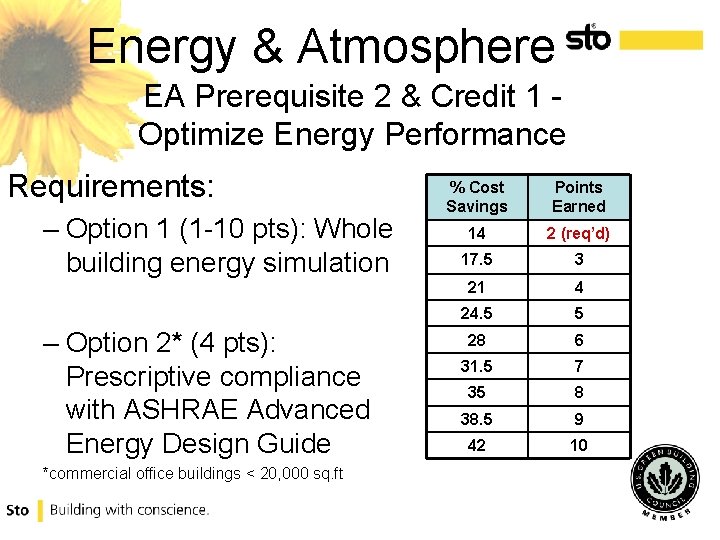
Energy & Atmosphere EA Prerequisite 2 & Credit 1 Optimize Energy Performance Requirements: – Option 1 (1 -10 pts): Whole building energy simulation – Option 2* (4 pts): Prescriptive compliance with ASHRAE Advanced Energy Design Guide *commercial office buildings < 20, 000 sq. ft % Cost Savings Points Earned 14 2 (req’d) 17. 5 3 21 4 24. 5 5 28 6 31. 5 7 35 8 38. 5 9 42 10
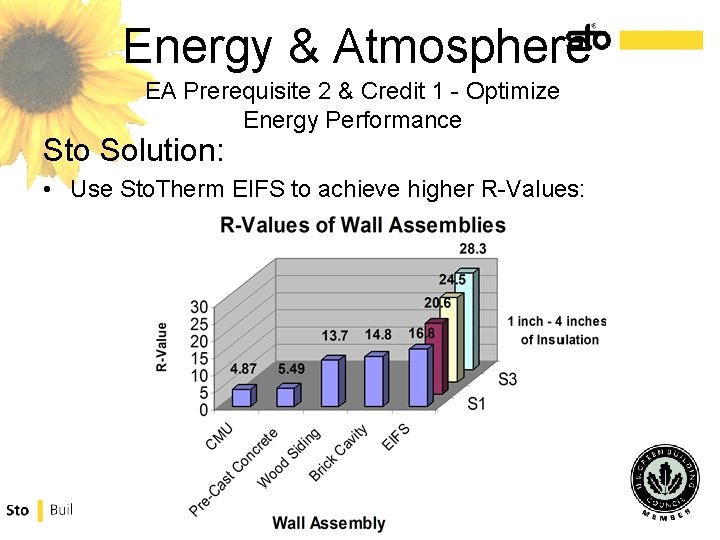
Energy & Atmosphere EA Prerequisite 2 & Credit 1 - Optimize Energy Performance Sto Solution: • Use Sto. Therm EIFS to achieve higher R-Values:
Materials & Resources (13 Points) Goals: Reduce the amount of materials needed Reduce and manage waste Use materials with less environmental impact – salvaged, recycled, renewable Reduce impacts associated with transporting materials to the project site
Materials and Resources MR Credit 1. 1 & 1. 2: Building Reuse (1 -2 pts) Requirements: • Maintain at least 75% (95% for 2 points) of existing walls, floors Sto Solutions: • re. Store program • Sto. Therm EIFS - reclad • Sto. Prep surface preparation
Materials and Resources MR Credit 2. 1 & 2. 2: Construction Waste Mgmt (1 -2 pts) Requirements: • Divert 50% (75% for 2 points) of construction waste from disposal Sto Solutions: • Recyclable pails / bags • Sto. Silo
Materials and Resources MR Credit 4. 1 & 4. 2: Recycled content (1 -2 pts) Requirements: • Minimum of 10% (20% for 2 pts) of products used on project made from recycled materials (Recycled Content = Post-Consumer content + ½ Post-Industrial content) Sto Solutions: • Products containing recycled content: – Sto BTS & BTS Silo – Sto. Guard Gold Coat & Emerald. Coat
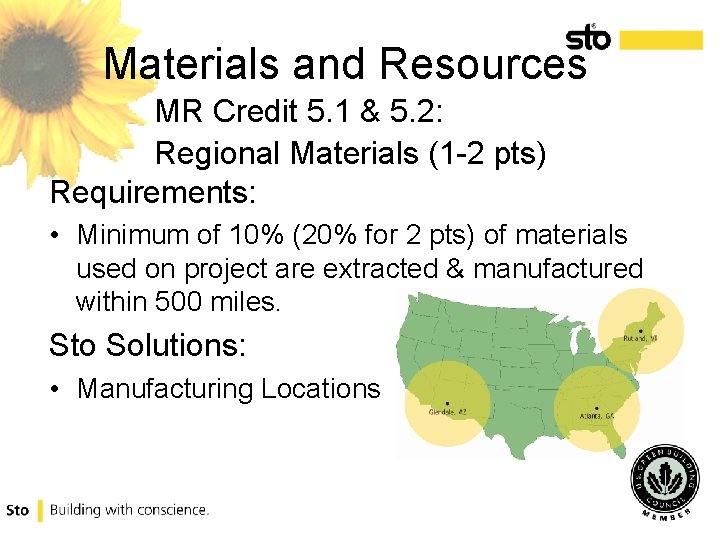
Materials and Resources MR Credit 5. 1 & 5. 2: Regional Materials (1 -2 pts) Requirements: • Minimum of 10% (20% for 2 pts) of materials used on project are extracted & manufactured within 500 miles. Sto Solutions: • Manufacturing Locations

LEED Documentation
Indoor Environmental Quality (15 Points) Goals: • Establish good indoor air quality Eliminate, reduce and manage the sources of indoor air pollution • Ensure thermal comfort and systems controllability • Provide for occupant connection to the outdoor environment
Indoor Environmental Quality EQ Credit 4. 2: Low Emitting Paints & Coatings (1 pt) Requirements: • All interior paints & coatings have VOC content < 50 g/L Sto Solutions: • Sto VOC Compliance with SCAQMD* levels (June, 2008) * South Coast Air Quality Management District: all coatings < 50 g/L
Innovation in Design (up to 5 Points) Goals: • Recognize exceptional performance in any achieved LEED credit Recognize innovation in green building categories not specifically addressed by LEED credits • Use LEED AP* on project * LEED Accredited Professional
Innovation in Design ID Credits 1. 1 -1. 4: Innovation in Design (up to 4 pts) Requirements: • Show exceptional performance in credit category, or demonstrate innovative sustainable solution Sto Solutions: • Sto. Coat™ Lotusan® Coating • Reduced structural requirements of Sto. Therm™ claddings
Sto & LEED Credit Summary
LEED Project Certification • Project Team Registers Project on-line with USGBC (www. usgbc. org) • Project team submits documentation demonstrating achievement of points • See www. leedbuilding. org for details on certification review process, schedule, and fees
Become a LEED AP • 2 Hour Computerized Exam – LEED Rating System – LEED Certification Process – Whole building design • Study resources (www. usgbc. org) – 1 - day LEED Workshops – On-line training courses – LEED Reference Guide • Register for exam at www. gbci. org – GBCI = Green Building Certification Institute
Sto Sustainability Resources Item Sto LEED Webpage Status Sto LEED Brochure (S 643 B) Available on DSI & www. stocorp. com LEED AP on Staff mleader@stocorp. com or (800)221 -2397 x 3284 LEED Product Assessment Whitepaper R-Values Comparison Chart Available on website LEED Product Compliance Documentation Available on website and e. Submittals www. stocorp. com/LEED Available on website
Resources • USGBC website www. usgbc. org – – LEED Training classes and workshops LEED Rating Guides List of LEED AP’s and USGBC members Listing of state and local incentives for green building • Green. Building Certification Institute – www. gbci. org – Administers LEED AP exam • 2030 Challenge website www. architecture 2030. org • Database of state incentives for renewable energy www. dsireusa. org
- Slides: 31