
Suspicious Activity Monitoring DANIEL HAGGERTY FEDERAL RESERVE BANK
Suspicious Activity Monitoring DANIEL HAGGERTY, FEDERAL RESERVE BANK OF ATLANTA KYLE STORM, FEDERAL RESERVE BANK OF CHICAGO
Intro and Disclaimer This presentation expresses the views of the speaker and not the opinion or policies of the Federal Reserve of Atlanta/Chicago, Board of Governors, or any other entity within the Federal Reserve System.
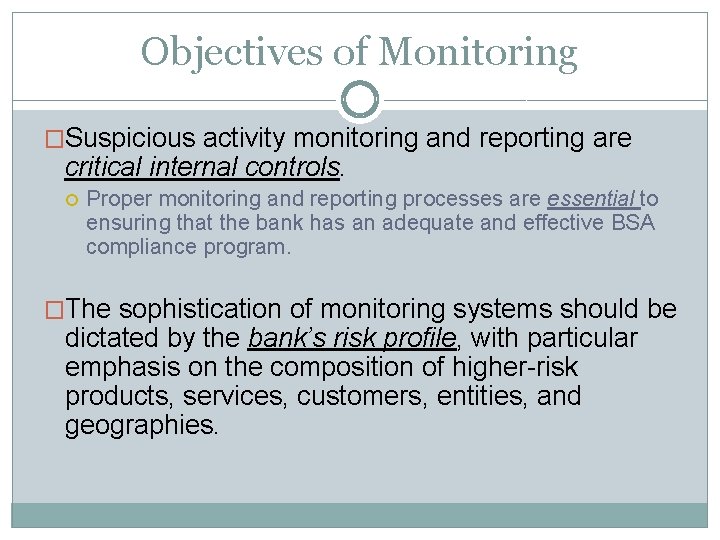
Objectives of Monitoring �Suspicious activity monitoring and reporting are critical internal controls. Proper monitoring and reporting processes are essential to ensuring that the bank has an adequate and effective BSA compliance program. �The sophistication of monitoring systems should be dictated by the bank’s risk profile, with particular emphasis on the composition of higher-risk products, services, customers, entities, and geographies.
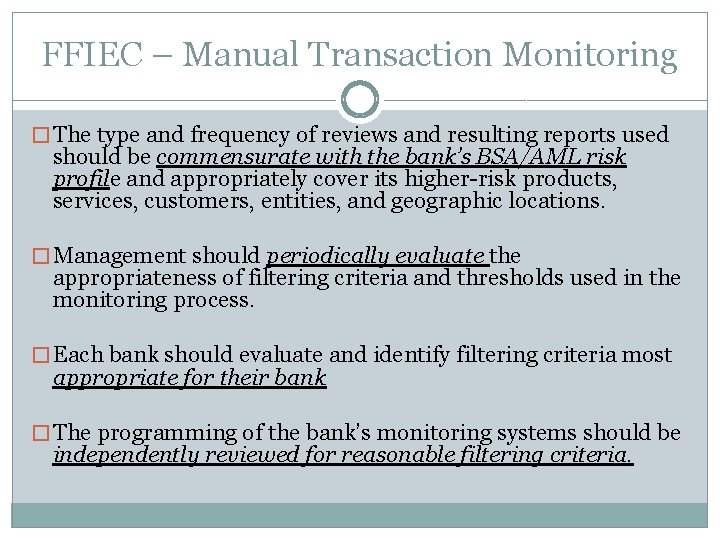
FFIEC – Manual Transaction Monitoring � The type and frequency of reviews and resulting reports used should be commensurate with the bank’s BSA/AML risk profile and appropriately cover its higher-risk products, services, customers, entities, and geographic locations. � Management should periodically evaluate the appropriateness of filtering criteria and thresholds used in the monitoring process. � Each bank should evaluate and identify filtering criteria most appropriate for their bank � The programming of the bank’s monitoring systems should be independently reviewed for reasonable filtering criteria.
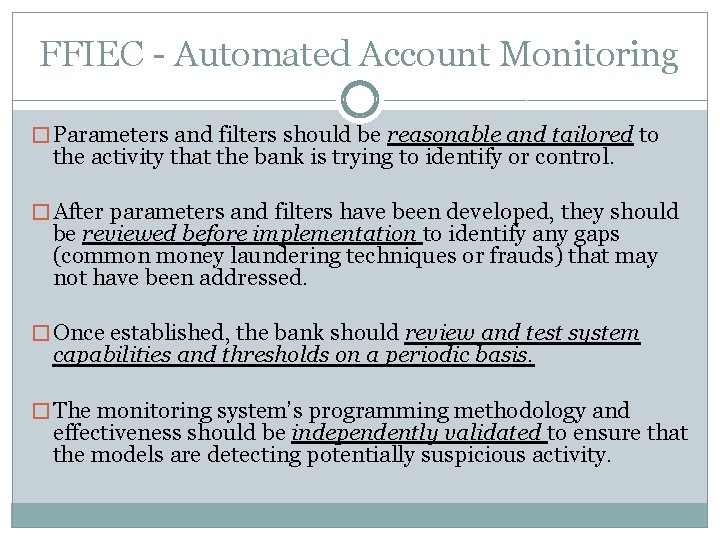
FFIEC - Automated Account Monitoring � Parameters and filters should be reasonable and tailored to the activity that the bank is trying to identify or control. � After parameters and filters have been developed, they should be reviewed before implementation to identify any gaps (common money laundering techniques or frauds) that may not have been addressed. � Once established, the bank should review and test system capabilities and thresholds on a periodic basis. � The monitoring system’s programming methodology and effectiveness should be independently validated to ensure that the models are detecting potentially suspicious activity.
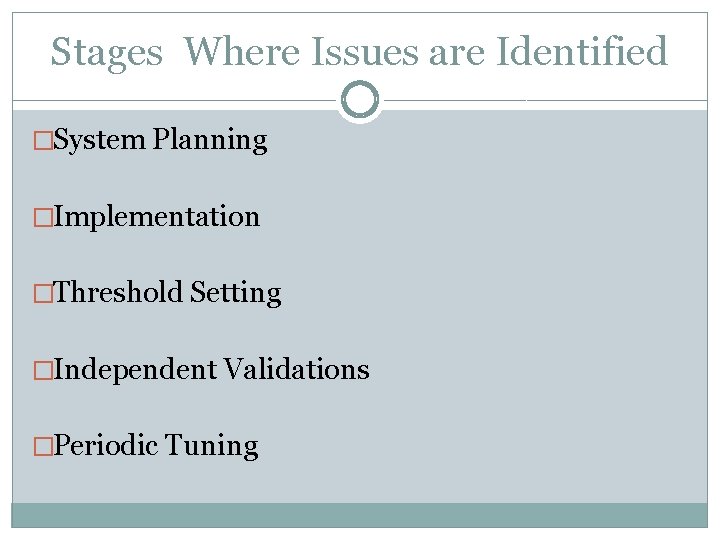
Stages Where Issues are Identified �System Planning �Implementation �Threshold Setting �Independent Validations �Periodic Tuning
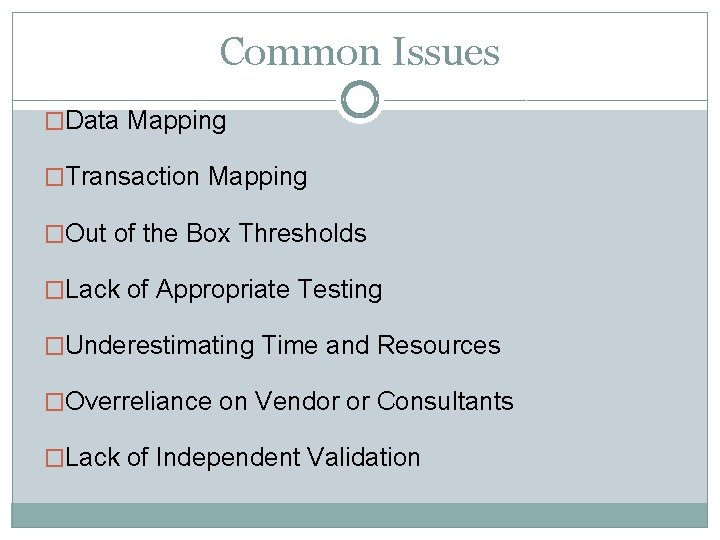
Common Issues �Data Mapping �Transaction Mapping �Out of the Box Thresholds �Lack of Appropriate Testing �Underestimating Time and Resources �Overreliance on Vendor or Consultants �Lack of Independent Validation
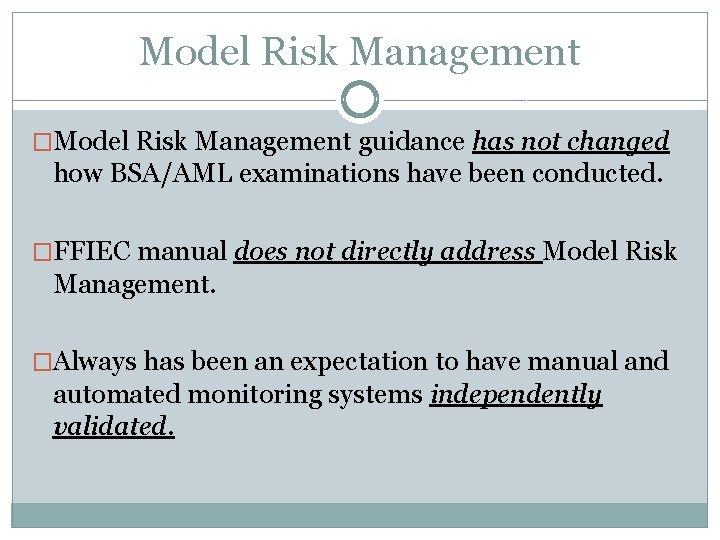
Model Risk Management �Model Risk Management guidance has not changed how BSA/AML examinations have been conducted. �FFIEC manual does not directly address Model Risk Management. �Always has been an expectation to have manual and automated monitoring systems independently validated.
Data Validations �Ensure all appropriate transactions are flowing into the system and can be verified or reconciled. �Test data mapping to ensure that fields are accurate. �Validate data inputs into the BSA/AML system. �Ideally, for transactions that are not fed into the system, ensure that the bank knows that they are not fed into the system and determine management’s method for monitoring those transactions.
Rule or Parameter Validations � Default settings/parameters are “starting places” only. Each financial institution must tailor settings/parameters to manage risk profile � Review and evaluate rules, parameters, and thresholds used by the system Should assess filtering criteria Should assess alert scoring (if applicable) Should assess quality and number of alerts Should assess the rules in regards to bank risks (including geographies, products, services, customer base) Should ensure that red flags are reasonably incorporated into rules or parameters.
Working as Intended �Provides confidence that the monitoring is performs as intended. �Determines whether the specifications and applications are appropriated developed. �Determines if the system is operating free of material system defects. �Determines whether reporting tools within the system are accurate. �Should entail testing of the system, and if done on inhouse software, transaction testing for your institution.
System Governance � Developing and maintaining strong governance, policies, and controls is fundamentally important to AML/BSA system effectiveness. Even if the development, implementation, use, and validation are satisfactory, a weak governance function will reduce the overall effectiveness of the system. � Important elements of AML/BSA System Governance: Board/Committee Oversight Policies and Procedures Roles and Responsibilities Change Controls
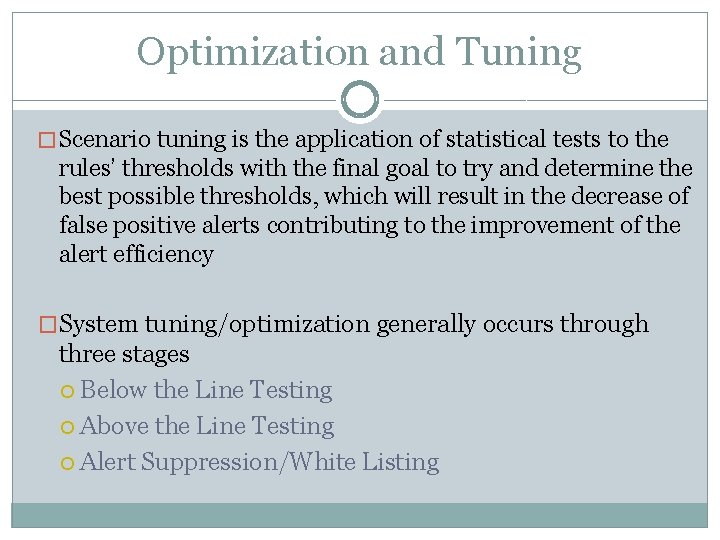
Optimization and Tuning � Scenario tuning is the application of statistical tests to the rules’ thresholds with the final goal to try and determine the best possible thresholds, which will result in the decrease of false positive alerts contributing to the improvement of the alert efficiency �System tuning/optimization generally occurs through three stages Below the Line Testing Above the Line Testing Alert Suppression/White Listing

Questions ?
- Slides: 14