
SURVIVORS Extraordinary tales from the wild and beyond
SURVIVORS Extraordinary tales from the wild and beyond Day Six

This halfterm’s new book. Have you read it? Do you know what it is about?
LC: Can I produce a Tanka poem? Toolkit ◦ Syllables ◦ Watch for syllables https: //www. youtube. com/watch? v=ps. UPYR 235 O 8
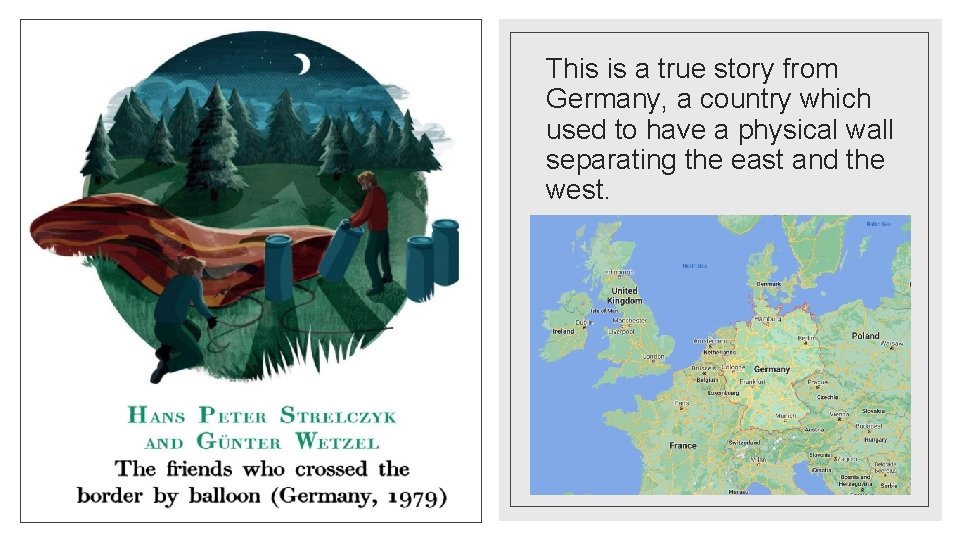
This is a true story from Germany, a country which used to have a physical wall separating the east and the west.
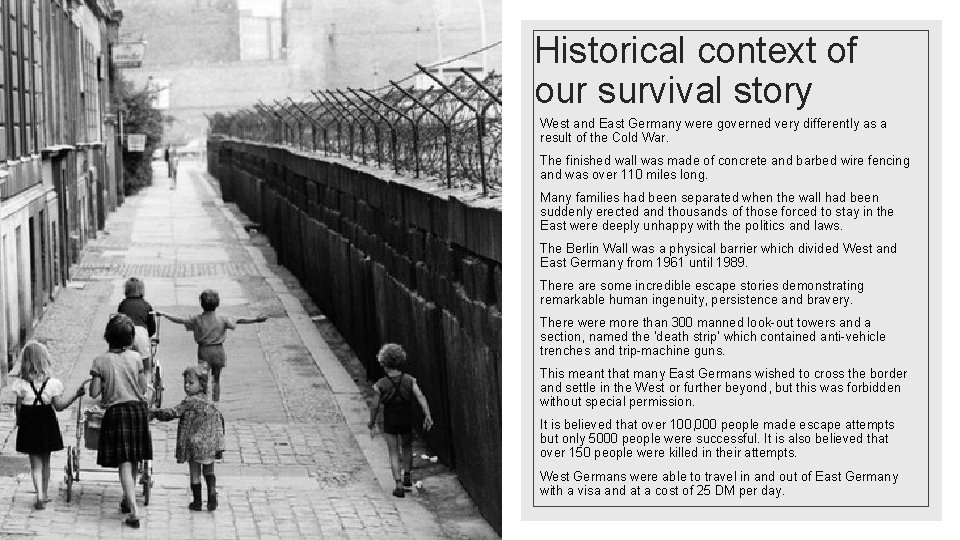
Historical context of our survival story West and East Germany were governed very differently as a result of the Cold War. The finished wall was made of concrete and barbed wire fencing and was over 110 miles long. Many families had been separated when the wall had been suddenly erected and thousands of those forced to stay in the East were deeply unhappy with the politics and laws. The Berlin Wall was a physical barrier which divided West and East Germany from 1961 until 1989. There are some incredible escape stories demonstrating remarkable human ingenuity, persistence and bravery. There were more than 300 manned look-out towers and a section, named the ‘death strip’ which contained anti-vehicle trenches and trip-machine guns. This meant that many East Germans wished to cross the border and settle in the West or further beyond, but this was forbidden without special permission. It is believed that over 100, 000 people made escape attempts but only 5000 people were successful. It is also believed that over 150 people were killed in their attempts. West Germans were able to travel in and out of East Germany with a visa and at a cost of 25 DM per day.
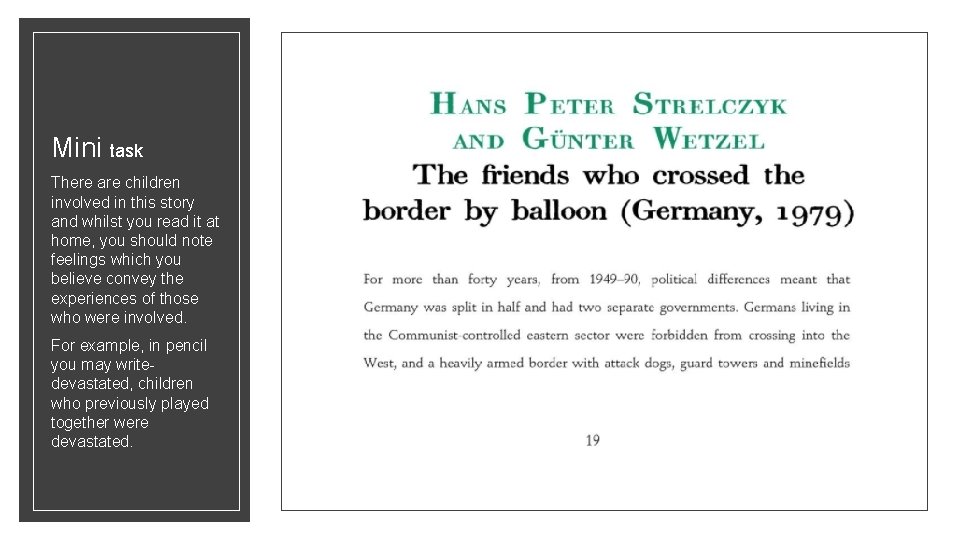
Mini task There are children involved in this story and whilst you read it at home, you should note feelings which you believe convey the experiences of those who were involved. For example, in pencil you may writedevastated, children who previously played together were devastated.
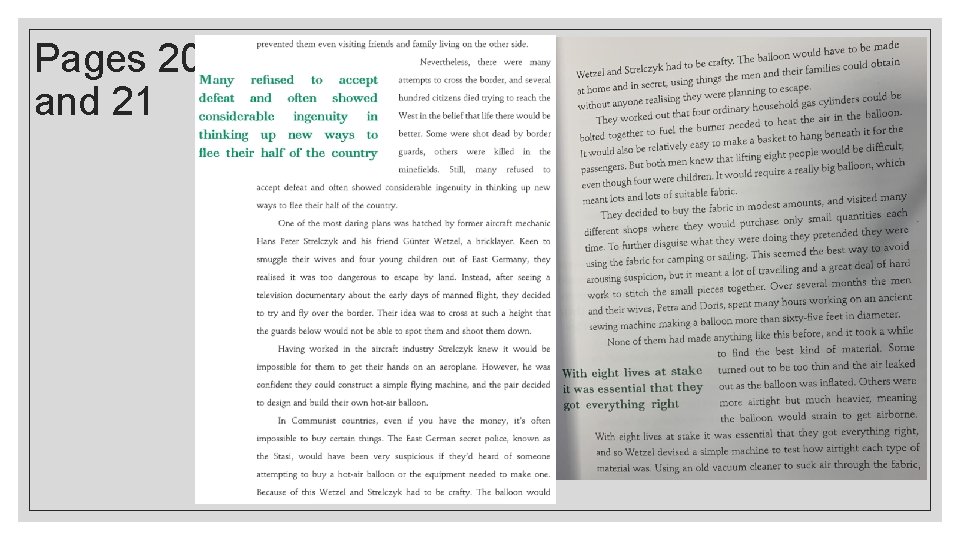
Pages 20 and 21
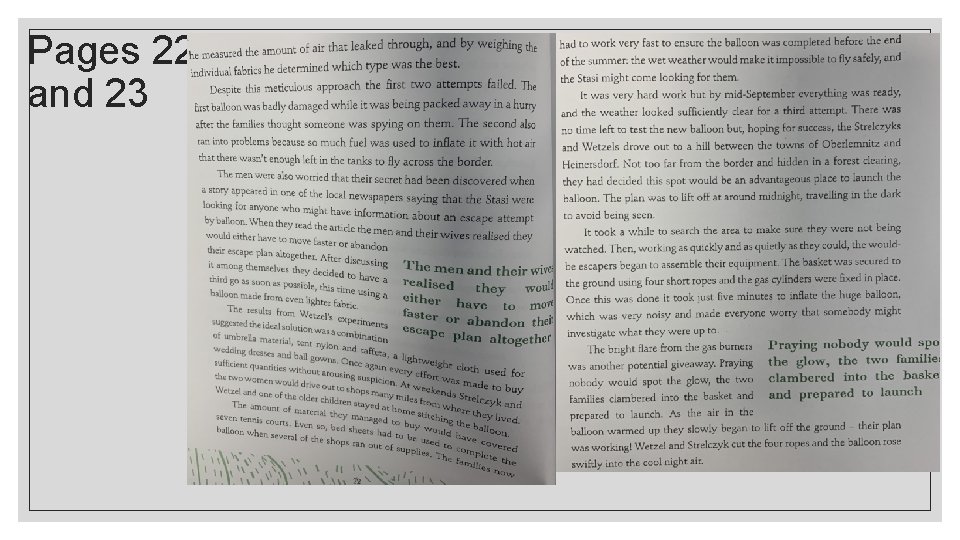
Pages 22 and 23
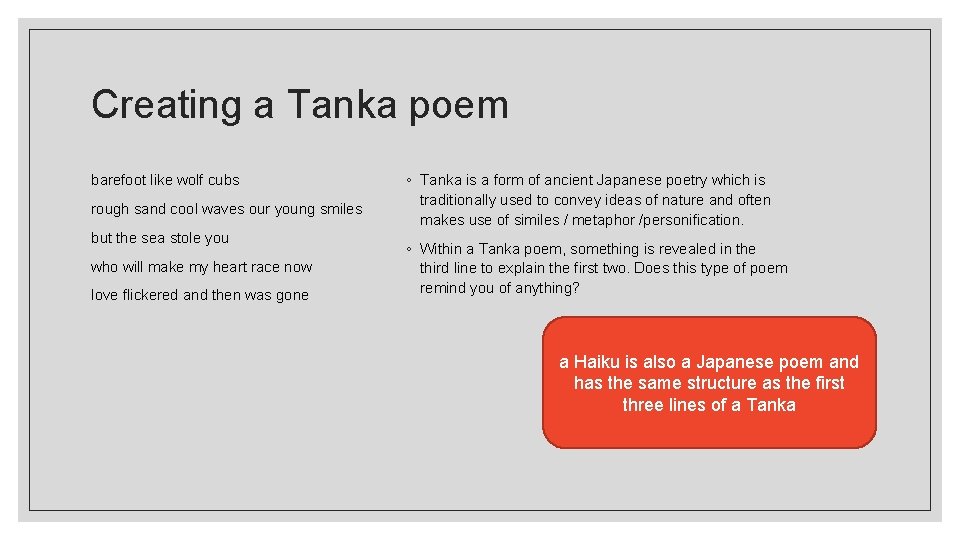
Creating a Tanka poem barefoot like wolf cubs rough sand cool waves our young smiles but the sea stole you who will make my heart race now love flickered and then was gone ◦ Tanka is a form of ancient Japanese poetry which is traditionally used to convey ideas of nature and often makes use of similes / metaphor /personification. ◦ Within a Tanka poem, something is revealed in the third line to explain the first two. Does this type of poem remind you of anything? a Haiku is also a Japanese poem and has the same structure as the first three lines of a Tanka
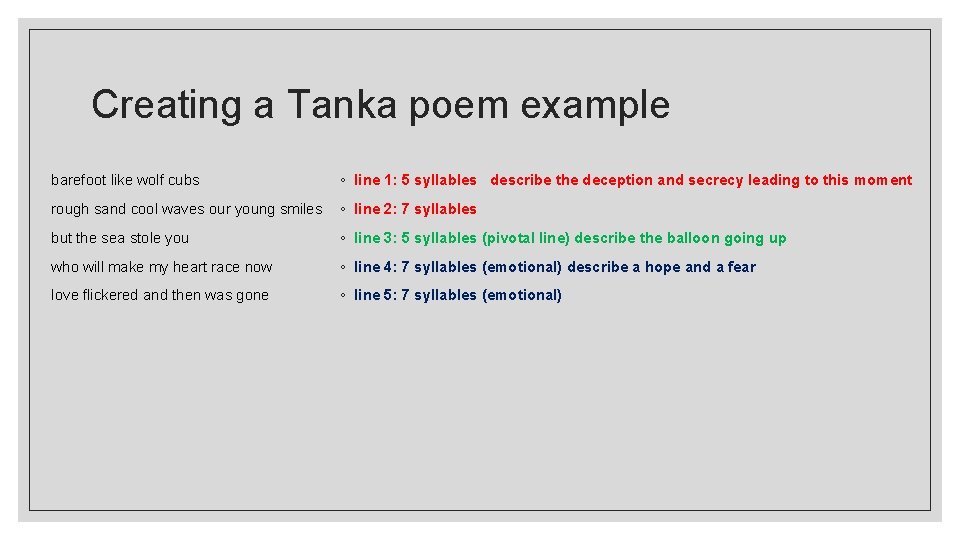
Creating a Tanka poem example barefoot like wolf cubs ◦ line 1: 5 syllables describe the deception and secrecy leading to this moment rough sand cool waves our young smiles ◦ line 2: 7 syllables but the sea stole you ◦ line 3: 5 syllables (pivotal line) describe the balloon going up who will make my heart race now ◦ line 4: 7 syllables (emotional) describe a hope and a fear love flickered and then was gone ◦ line 5: 7 syllables (emotional)

Creating a Tanka poem example related to our story slow as grass grows tall ◦ line 1: 5 syllables describe the deception and secrecy leading to this moment meticulous plans followed ◦ line 2: 7 syllables she jolts and soars high ◦ line 3: 5 syllables (pivotal line) describe the balloon going up eight pairs of white knuckles grip ◦ line 4: 7 syllables (emotional) describe a hope and a fear eight sets of hopes soar with her ◦ line 5: 7 syllables (emotional)
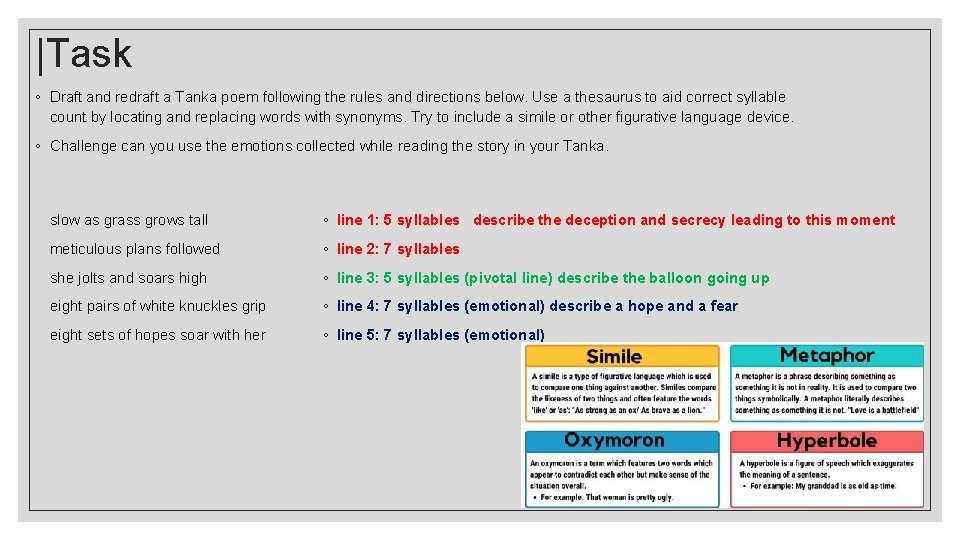
|Task ◦ Draft and redraft a Tanka poem following the rules and directions below. Use a thesaurus to aid correct syllable count by locating and replacing words with synonyms. Try to include a simile or other figurative language device. ◦ Challenge can you use the emotions collected while reading the story in your Tanka. slow as grass grows tall ◦ line 1: 5 syllables describe the deception and secrecy leading to this moment meticulous plans followed ◦ line 2: 7 syllables she jolts and soars high ◦ line 3: 5 syllables (pivotal line) describe the balloon going up eight pairs of white knuckles grip ◦ line 4: 7 syllables (emotional) describe a hope and a fear eight sets of hopes soar with her ◦ line 5: 7 syllables (emotional)
SURVIVORS Extraordinary tales from the wild and beyond Day Seven
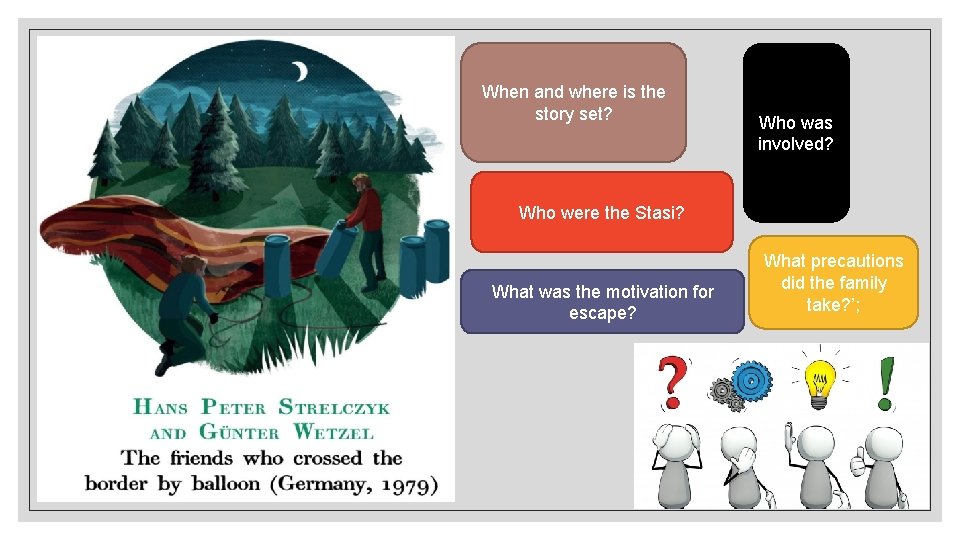
When and where is the story set? Who was involved? Who were the Stasi? What was the motivation for escape? What precautions did the family take? ’;
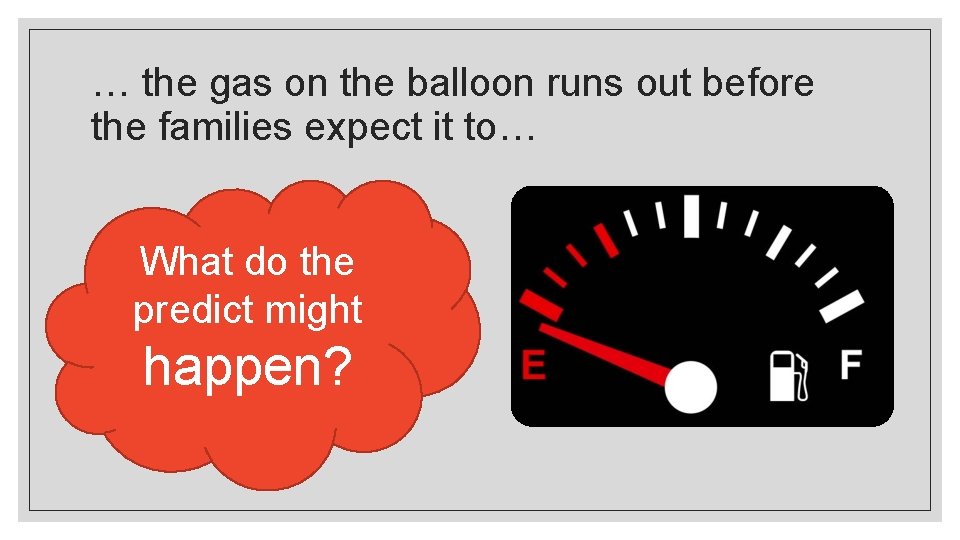
… the gas on the balloon runs out before the families expect it to… What do the predict might happen?
LC: Can I write a condensed version of the balloon escape? Toolkit How formal should this story be? Think about the content of the narrative
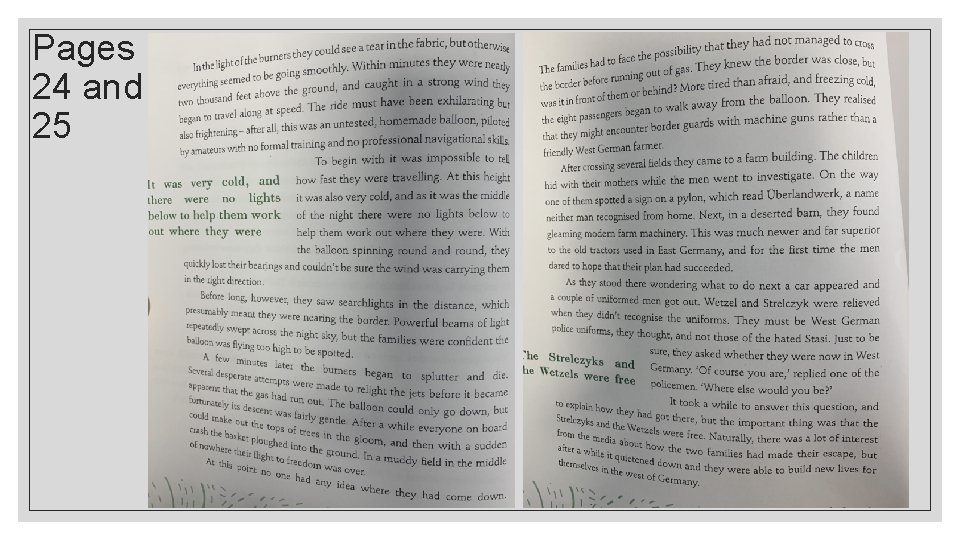
Pages 24 and 25
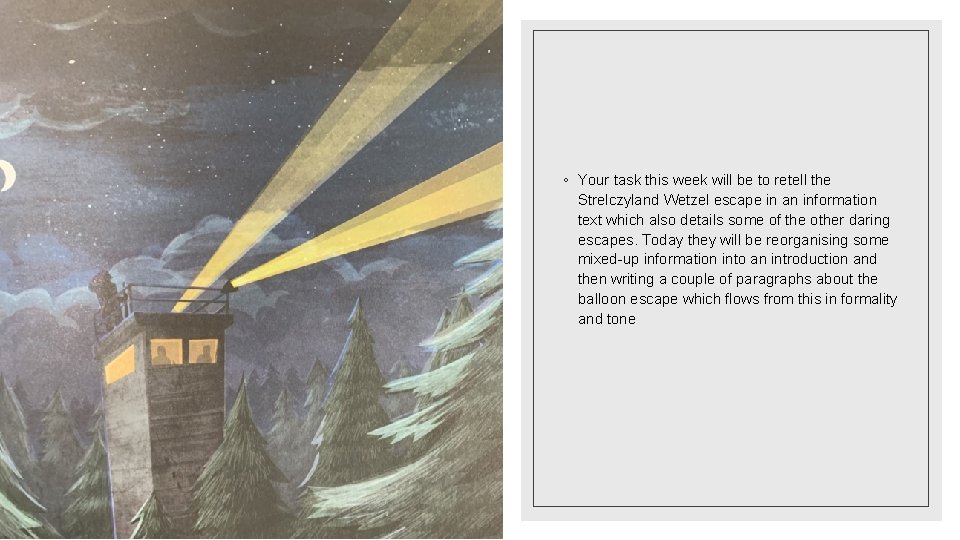
◦ Your task this week will be to retell the Strelczyland Wetzel escape in an information text which also details some of the other daring escapes. Today they will be reorganising some mixed-up information into an introduction and then writing a couple of paragraphs about the balloon escape which flows from this in formality and tone
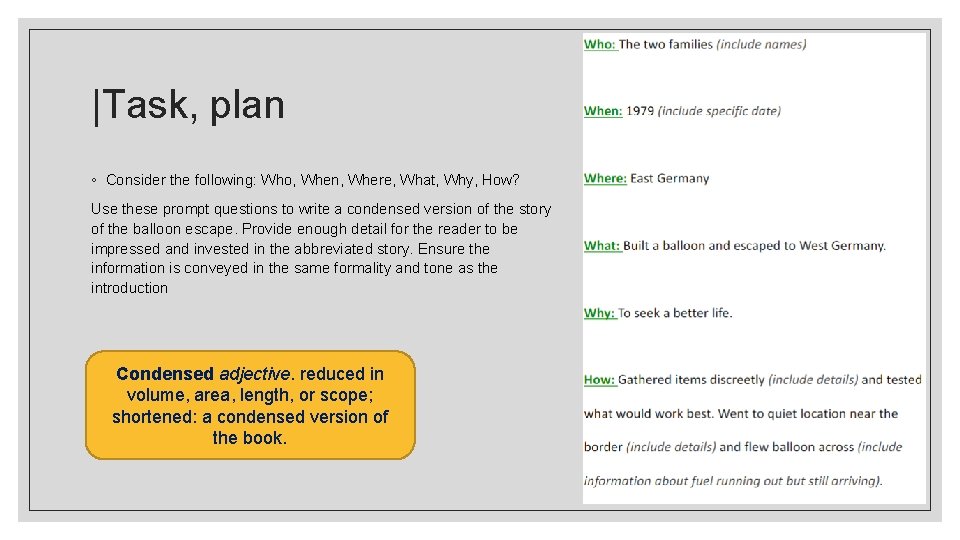
|Task, plan ◦ Consider the following: Who, When, Where, What, Why, How? Use these prompt questions to write a condensed version of the story of the balloon escape. Provide enough detail for the reader to be impressed and invested in the abbreviated story. Ensure the information is conveyed in the same formality and tone as the introduction Condensed adjective. reduced in volume, area, length, or scope; shortened: a condensed version of the book.
SURVIVORS Extraordinary tales from the wild and beyond Day Eight
LC: Can I tell the story of an escape? Toolkit
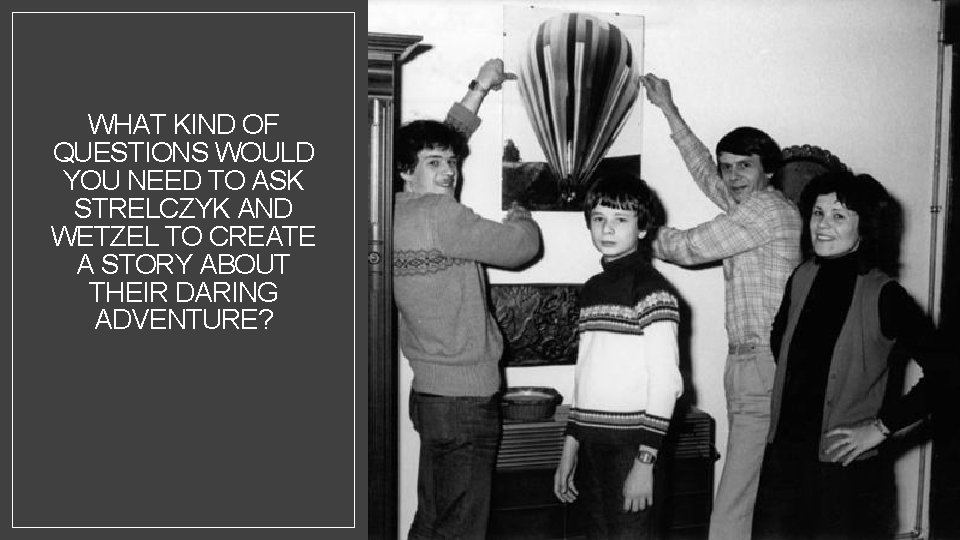
WHAT KIND OF QUESTIONS WOULD YOU NEED TO ASK STRELCZYK AND WETZEL TO CREATE A STORY ABOUT THEIR DARING ADVENTURE?
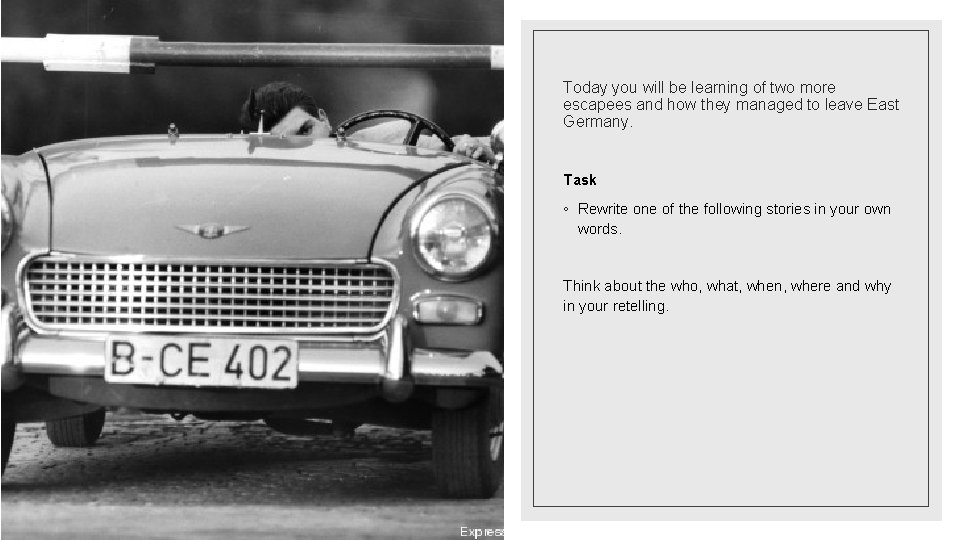
Today you will be learning of two more escapees and how they managed to leave East Germany. Task ◦ Rewrite one of the following stories in your own words. Think about the who, what, when, where and why in your retelling.
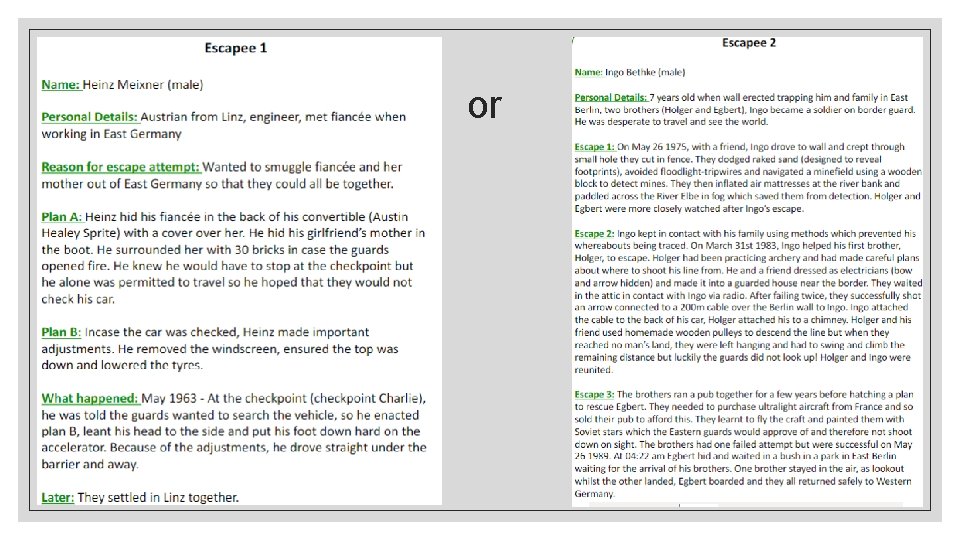
or
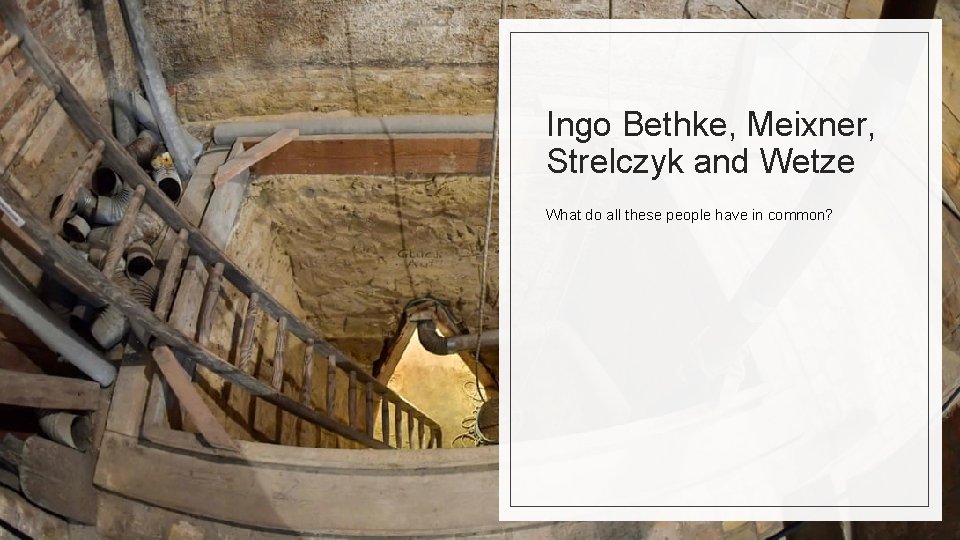
Ingo Bethke, Meixner, Strelczyk and Wetze What do all these people have in common?
SURVIVORS Extraordinary tales from the wild and beyond Day Nine
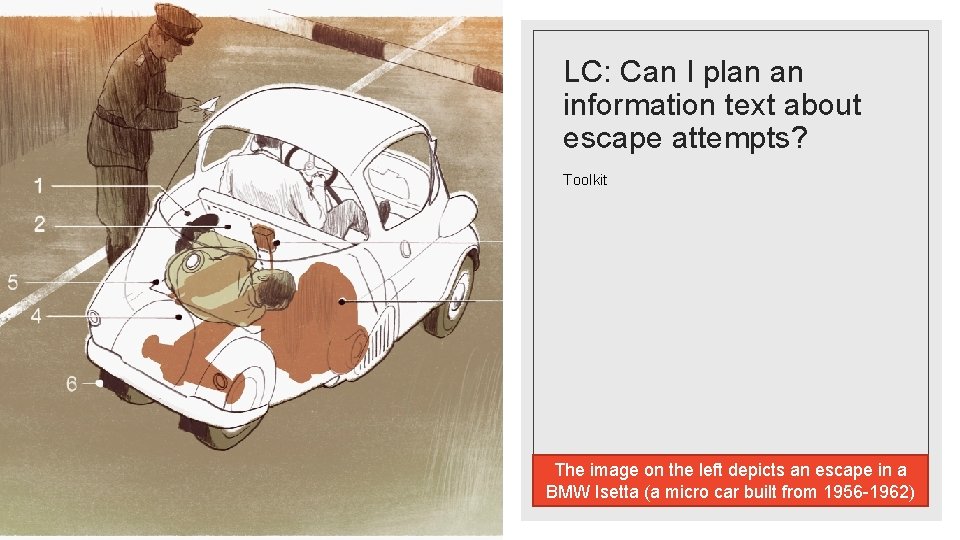
LC: Can I plan an information text about escape attempts? Toolkit The image on the left depicts an escape in a BMW Isetta (a micro car built from 1956 -1962)
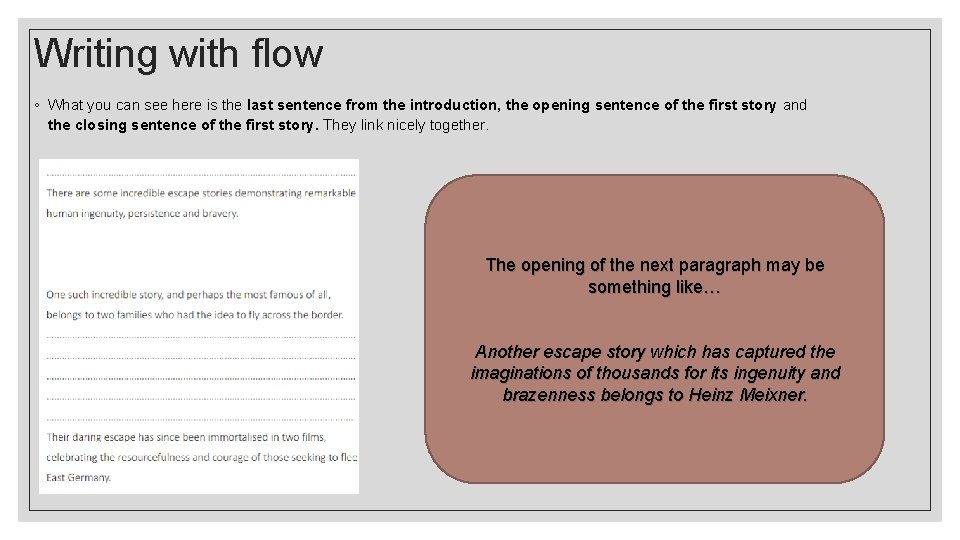
Writing with flow ◦ What you can see here is the last sentence from the introduction, the opening sentence of the first story and the closing sentence of the first story. They link nicely together. The opening of the next paragraph may be something like… Another escape story which has captured the imaginations of thousands for its ingenuity and brazenness belongs to Heinz Meixner.
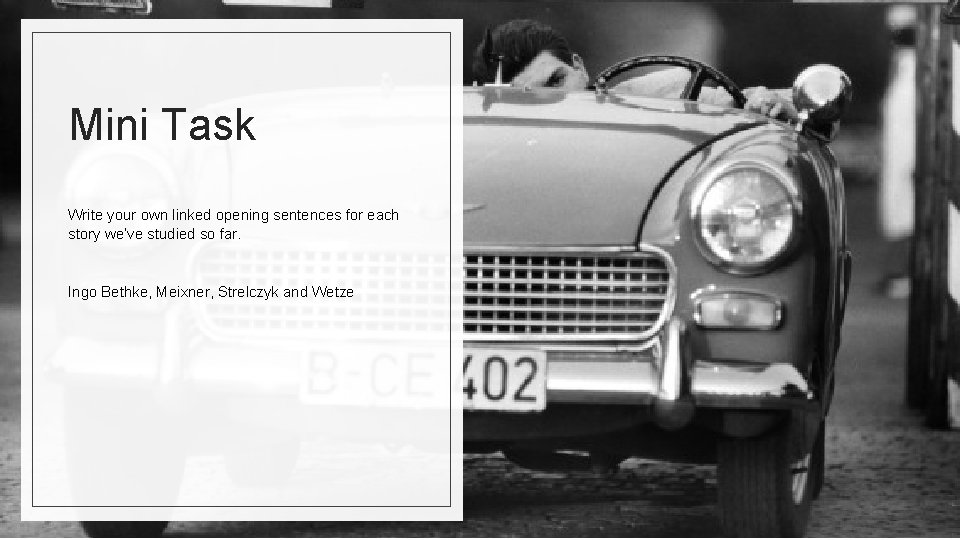
Mini Task Write your own linked opening sentences for each story we’ve studied so far. Ingo Bethke, Meixner, Strelczyk and Wetze
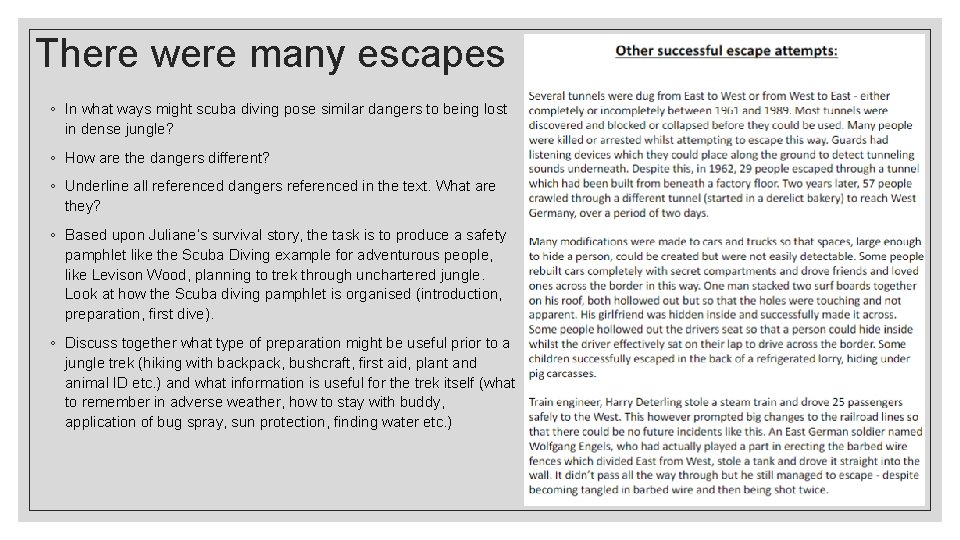
There were many escapes ◦ In what ways might scuba diving pose similar dangers to being lost in dense jungle? ◦ How are the dangers different? ◦ Underline all referenced dangers referenced in the text. What are they? ◦ Based upon Juliane’s survival story, the task is to produce a safety pamphlet like the Scuba Diving example for adventurous people, like Levison Wood, planning to trek through unchartered jungle. Look at how the Scuba diving pamphlet is organised (introduction, preparation, first dive). ◦ Discuss together what type of preparation might be useful prior to a jungle trek (hiking with backpack, bushcraft, first aid, plant and animal ID etc. ) and what information is useful for the trek itself (what to remember in adverse weather, how to stay with buddy, application of bug spray, sun protection, finding water etc. )
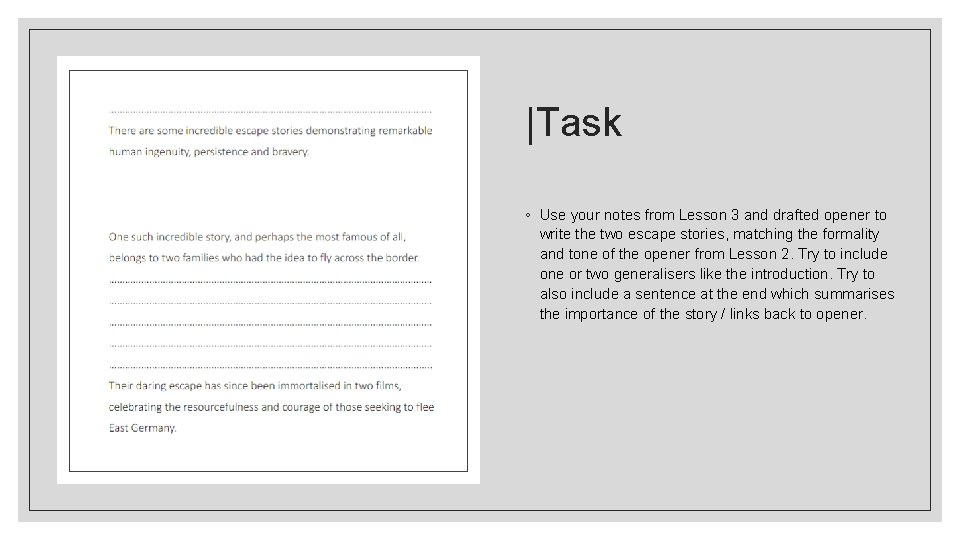
|Task ◦ Use your notes from Lesson 3 and drafted opener to write the two escape stories, matching the formality and tone of the opener from Lesson 2. Try to include one or two generalisers like the introduction. Try to also include a sentence at the end which summarises the importance of the story / links back to opener.
SURVIVORS Extraordinary tales from the wild and beyond Day Ten
LC: Can I write a non-fiction text? Toolkit Cohesive paragraphs
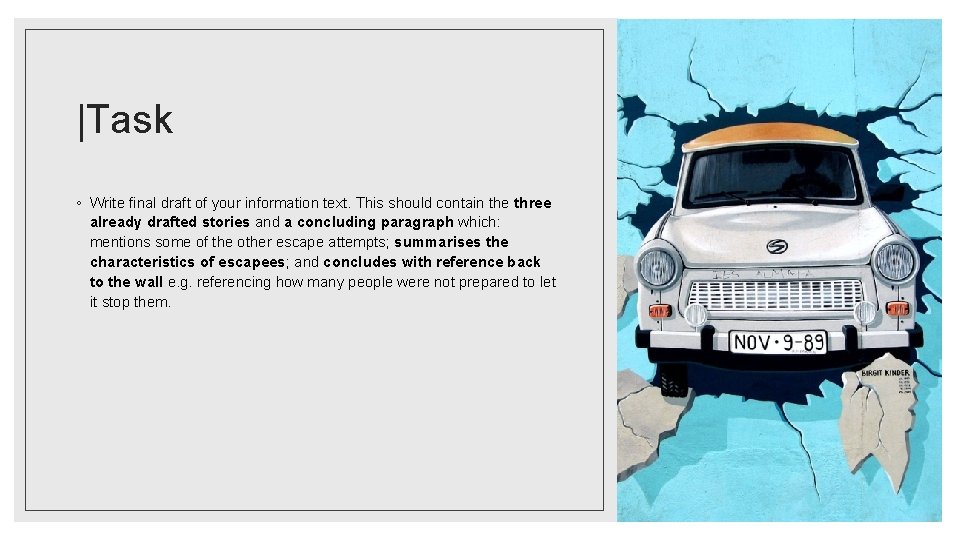
|Task ◦ Write final draft of your information text. This should contain the three already drafted stories and a concluding paragraph which: mentions some of the other escape attempts; summarises the characteristics of escapees; and concludes with reference back to the wall e. g. referencing how many people were not prepared to let it stop them.
- Slides: 34