
SURVIVAL The Art of Staying Alive Knowledge Dispels
- Slides: 22
SURVIVAL The Art of Staying Alive
Knowledge Dispels Fear • Fear is an emotional response to a real or perceived danger • Uncontrolled fear = PANIC • Knowledge helps your rational brain to calm your emotions. • “I know I can get through this” vs. “I hope I can get through this”; or worse “I don’t know how I’m going to get through this!”
PREPARE + PRACTISE = SURVIVE • Know where you’re going and the conditions you’re likely to encounter so you can PREPARE. • PRACTISE - Know how to use the equipment you are taking. • Imagine some of the possible problems you might face & your response in adverse situations.
THE BIG 5 TO SURVIVE Water - potable Warmth – windproofing & fire Shelter – rain, cold and sun Signals – day & night – audible, visual & directional • Food – from various sources • •
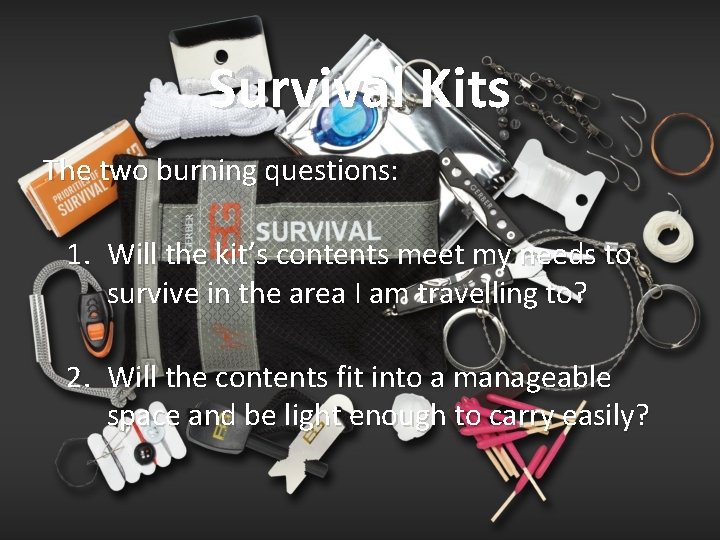
Survival Kits The two burning questions: 1. Will the kit’s contents meet my needs to survive in the area I am travelling to? 2. Will the contents fit into a manageable space and be light enough to carry easily?
? WHAT WOULD YOU TAKE? Design your own survival kit. • Think of the BIG 5 to survive • Try to find things that can multitask • Bob Cooper survival expert puts about 34 items in his kit. • Complete pages 4, 5 & 6 questions
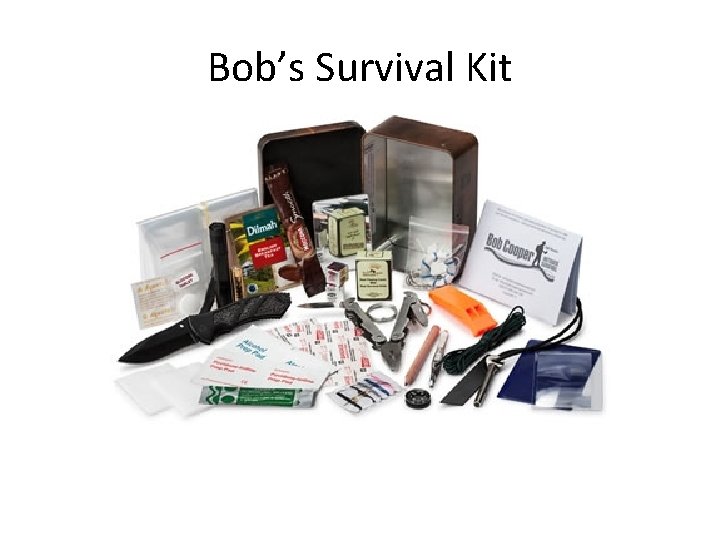
What Bob brings 1. Plastic container - for storage, mixing bowl, cup, for digging 2. Compass - direction finding 3. Flint (with attached striker) - fire lighting 4. Hacksaw blade - striker for flint, cutting metal 5. Cotton pad - first aid, can also be pulled apart for firelighting tinder 6. Whistle - signalling 7. Knife - cutting, probing 8. Plastic mirror - signalling, assist with self-first-aid 9. Tweezers - removing splinters, other minor operations
What Bob brings 10. Large plastic bags - water procurement, wind/ waterproofing, carrying water, storage, improvised emergency flotation devices 11. Needle - probing, sewing (make sure eye big enough to take fishing line or cord) 12. Fishing line - fishing, binding, sewing, snares in Ziploc bag 13. Fishing hooks - fishing, gaff 14. Brass swivel - stops line twisting 15. Sinkers - line weights, can be polished as a lure 16. Trace wire - fishing trace, binding, snaring, general repairs 17. Stock cubes - soup, alfoil wrapping as fishing line (note: stock cubes contain MSG)
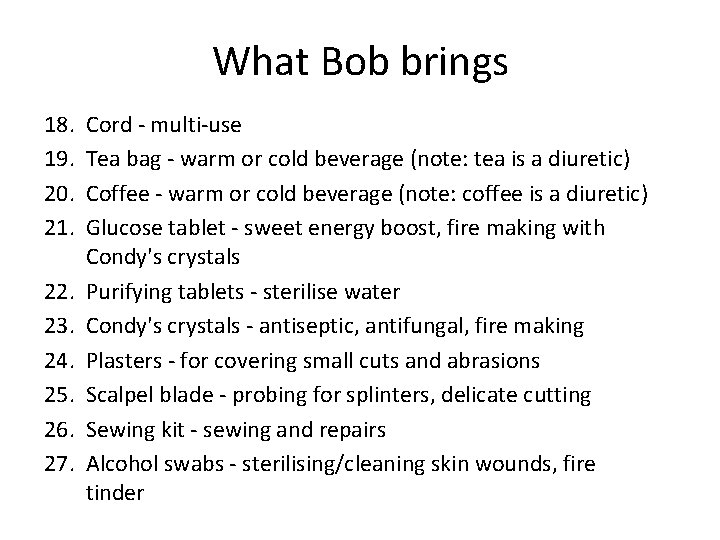
What Bob brings 18. 19. 20. 21. 22. 23. 24. 25. 26. 27. Cord - multi-use Tea bag - warm or cold beverage (note: tea is a diuretic) Coffee - warm or cold beverage (note: coffee is a diuretic) Glucose tablet - sweet energy boost, fire making with Condy's crystals Purifying tablets - sterilise water Condy's crystals - antiseptic, antifungal, fire making Plasters - for covering small cuts and abrasions Scalpel blade - probing for splinters, delicate cutting Sewing kit - sewing and repairs Alcohol swabs - sterilising/cleaning skin wounds, fire tinder
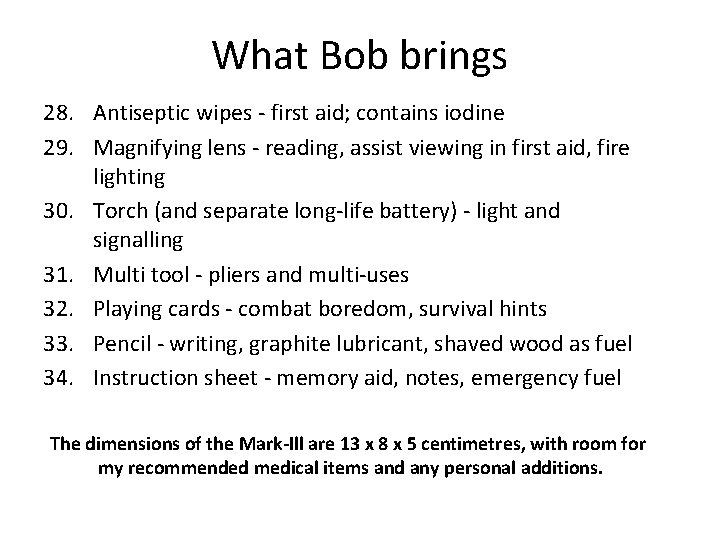
What Bob brings 28. Antiseptic wipes - first aid; contains iodine 29. Magnifying lens - reading, assist viewing in first aid, fire lighting 30. Torch (and separate long-life battery) - light and signalling 31. Multi tool - pliers and multi-uses 32. Playing cards - combat boredom, survival hints 33. Pencil - writing, graphite lubricant, shaved wood as fuel 34. Instruction sheet - memory aid, notes, emergency fuel The dimensions of the Mark-Ill are 13 x 8 x 5 centimetres, with room for my recommended medical items and any personal additions.
Bob’s Survival Kit
Water - the nectar of life • About 800 ml of water is lost through breathing each day • We should drink around 1 l of water per 25 kg of body weight per day • Body fluid reduction of 1% impairs the body’s thermoregulation system • By the time you feel thirsty you could be more than 3% dehydrated • Lack of water will impair your ability to make rational decisions.
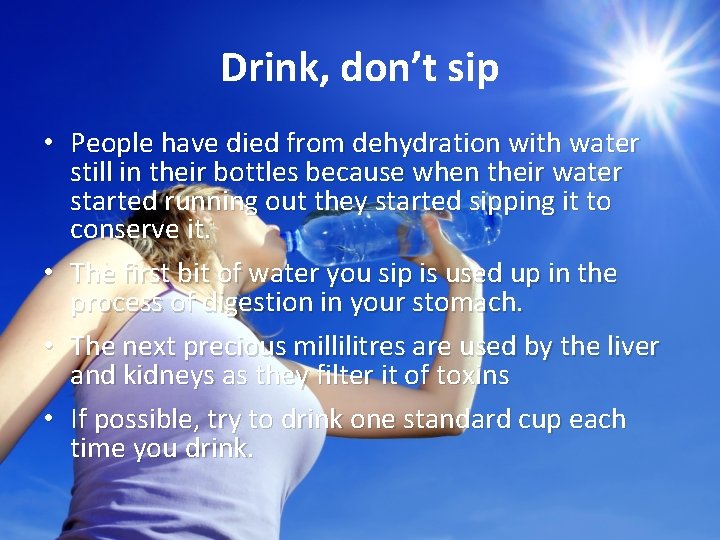
Drink, don’t sip • People have died from dehydration with water still in their bottles because when their water started running out they started sipping it to conserve it. • The first bit of water you sip is used up in the process of digestion in your stomach. • The next precious millilitres are used by the liver and kidneys as they filter it of toxins • If possible, try to drink one standard cup each time you drink.
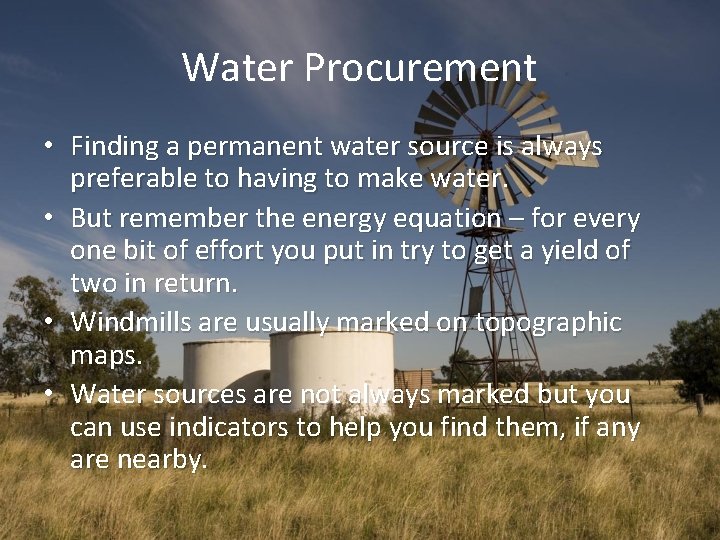
Water Procurement • Finding a permanent water source is always preferable to having to make water. • But remember the energy equation – for every one bit of effort you put in try to get a yield of two in return. • Windmills are usually marked on topographic maps. • Water sources are not always marked but you can use indicators to help you find them, if any are nearby.
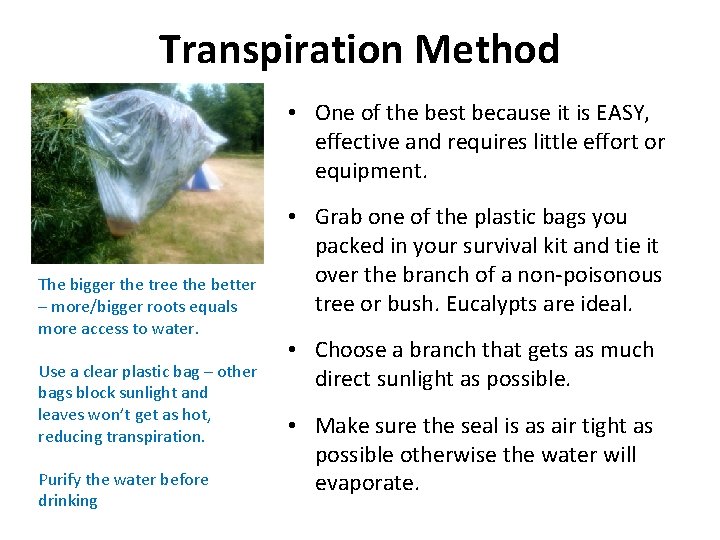
Transpiration Method • One of the best because it is EASY, effective and requires little effort or equipment. The bigger the tree the better – more/bigger roots equals more access to water. Use a clear plastic bag – other bags block sunlight and leaves won’t get as hot, reducing transpiration. Purify the water before drinking • Grab one of the plastic bags you packed in your survival kit and tie it over the branch of a non-poisonous tree or bush. Eucalypts are ideal. • Choose a branch that gets as much direct sunlight as possible. • Make sure the seal is as air tight as possible otherwise the water will evaporate.
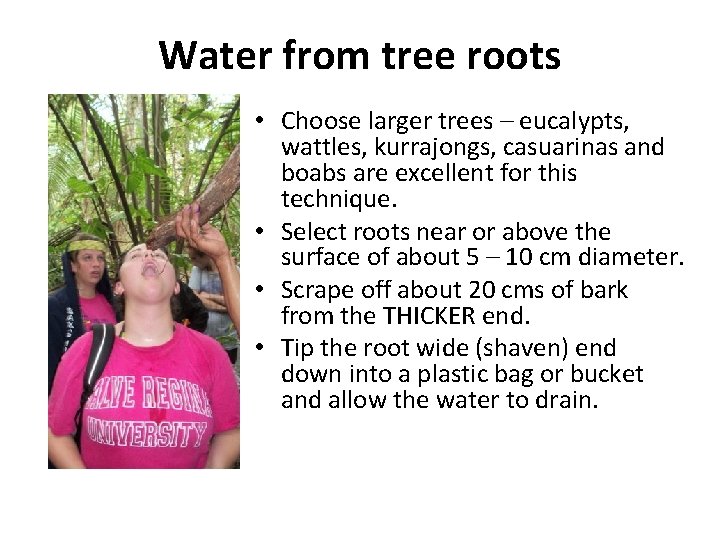
Water from tree roots • Choose larger trees – eucalypts, wattles, kurrajongs, casuarinas and boabs are excellent for this technique. • Select roots near or above the surface of about 5 – 10 cm diameter. • Scrape off about 20 cms of bark from the THICKER end. • Tip the root wide (shaven) end down into a plastic bag or bucket and allow the water to drain.
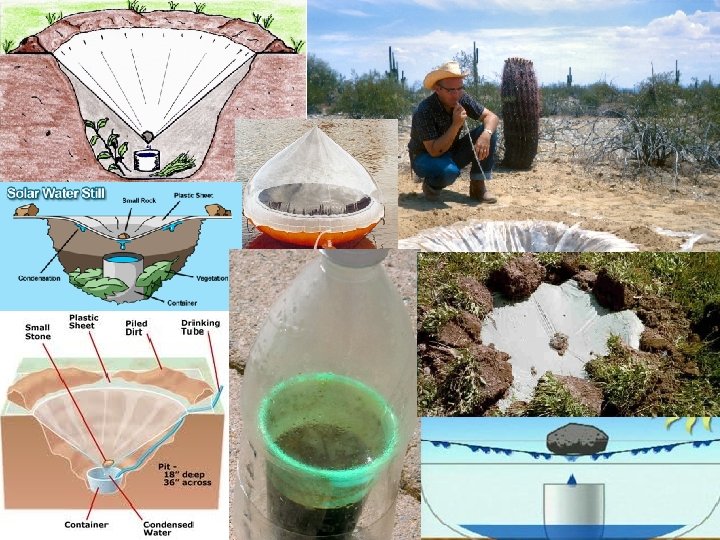
Solar still or box • Good way to purify brackish or salty water. • Dig a hole or find a box (cardboard box lined with plastic, esky, tool box, plastic tub). • If digging a hole try to get down into the moist sub-soil. • Place as much non-poisonous leaves or plants, brackish water as possible in the hole/box. • Put a clean, empty container (cup or bowl, empty tin can) in the centre of the hole/box. • Cover with plastic and seal - by putting soil around the plastic (for a hole in the ground) or by tying cord around the box. • Weight the plastic in the centre so that it dips down towards the empty container. Water will condense on the plastic and eventually drip down into your container.
Other water sources • CAR AIR CONDITIONER – needs to be working. Turn on air conditioner and allow to work for a while. Find the overflow pipe and place a container under it to catch the water as it drips off. Half a tank of fuel will yield several litres. • COLLECT DEW – use a credit card as a scraper to gather it, wipe over dewy surfaces with a cloth and squeeze out the water, if nights are dewy spread out a plastic sheet to collect more dew. • SUCCULENTS - Pigface can be squeezed in your hand let the water dribble into your mouth. Better still put heaps of it into a shirt, roll it up tight squeeze it into a plastic sheet to collect.
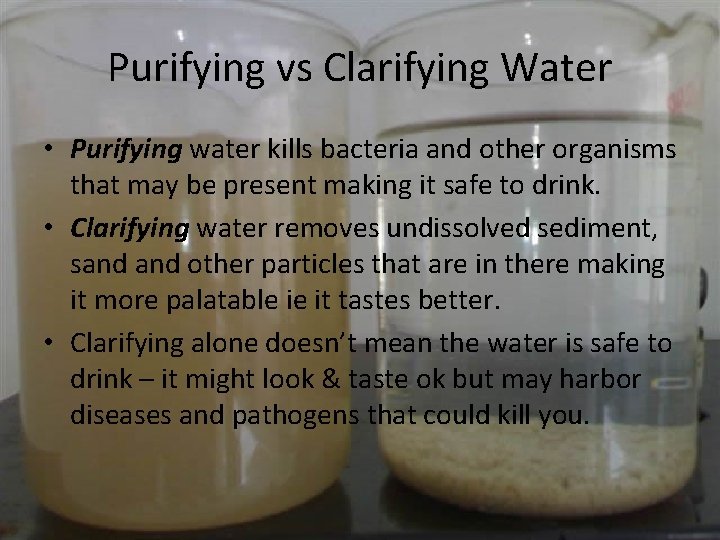
Purifying vs Clarifying Water • Purifying water kills bacteria and other organisms that may be present making it safe to drink. • Clarifying water removes undissolved sediment, sand other particles that are in there making it more palatable ie it tastes better. • Clarifying alone doesn’t mean the water is safe to drink – it might look & taste ok but may harbor diseases and pathogens that could kill you.
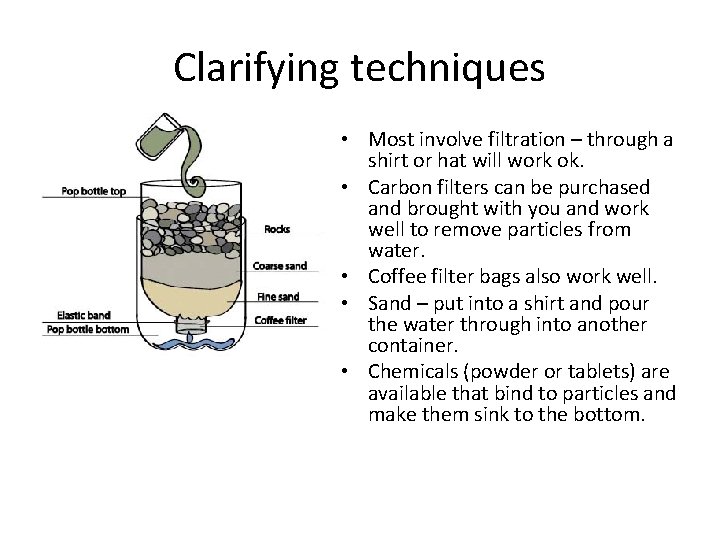
Clarifying techniques • Most involve filtration – through a shirt or hat will work ok. • Carbon filters can be purchased and brought with you and work well to remove particles from water. • Coffee filter bags also work well. • Sand – put into a shirt and pour the water through into another container. • Chemicals (powder or tablets) are available that bind to particles and make them sink to the bottom.
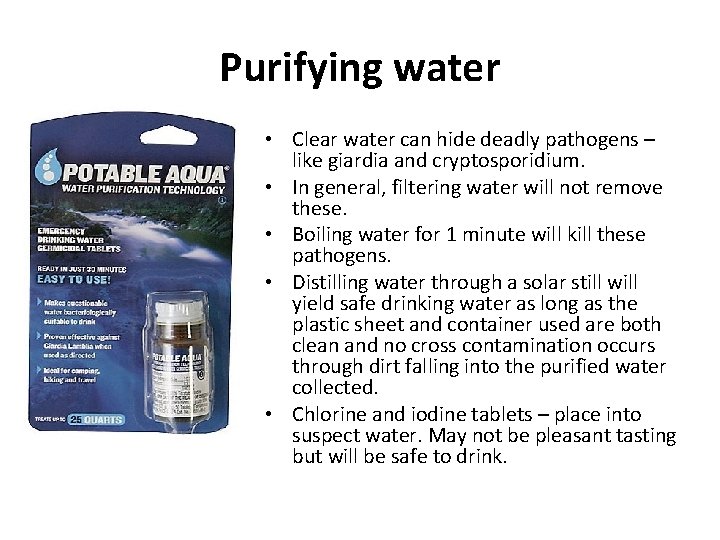
Purifying water • Clear water can hide deadly pathogens – like giardia and cryptosporidium. • In general, filtering water will not remove these. • Boiling water for 1 minute will kill these pathogens. • Distilling water through a solar still will yield safe drinking water as long as the plastic sheet and container used are both clean and no cross contamination occurs through dirt falling into the purified water collected. • Chlorine and iodine tablets – place into suspect water. May not be pleasant tasting but will be safe to drink.