
Survival Skills for Supervisors The Supervisor Series Level

- Slides: 46
Survival Skills for Supervisors The Supervisor Series, Level 1 Effective Conflict Resolution Mary Kay Williams 2015
Goal Ø In this seminar we will work to help you create a thoughtful and systematic approach to conflict by finding ways to effectively manage conflict in the workplace.
Learner Outcomes Ø In this program you will: Ø Define conflict in the workplace. Ø Identify the situations and sources of conflict. Ø Recognize how the Thomas-Kilmann Instrument (TKI) can help you identify conflict resolution styles. Ø Build and develop strategies for effectively resolving conflict in the workplace. Ø Determine what positive actions you can take as a supervisor to resolve conflicts in your workplace.
Your Role Ø Ø Ø Participate in activities Learn from everyone Apply information to personal situations Be challenged Have fun!
Ground Rules Ø What we say in this room will stay in this room. Ø We can disagree with one another and provide feedback as long as we do so constructively and respectfully. Ø We will listen when someone else is speaking.
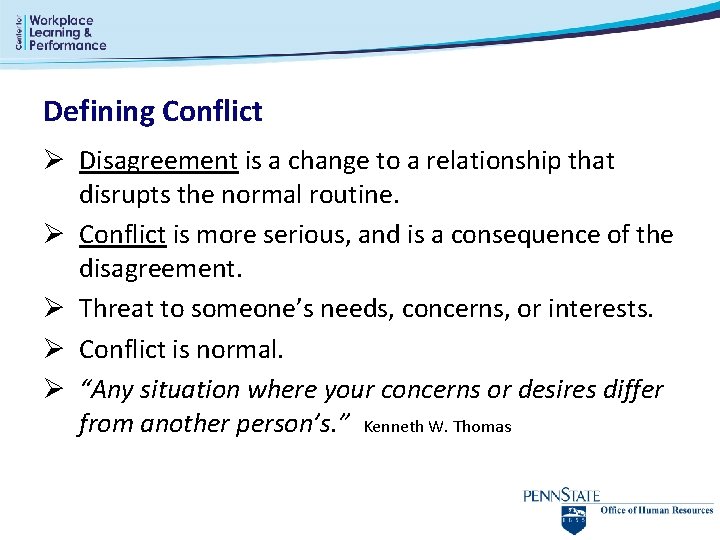
Defining Conflict Ø Disagreement is a change to a relationship that disrupts the normal routine. Ø Conflict is more serious, and is a consequence of the disagreement. Ø Threat to someone’s needs, concerns, or interests. Ø Conflict is normal. Ø “Any situation where your concerns or desires differ from another person’s. ” Kenneth W. Thomas
Write some words, descriptions, and thoughts about conflict.
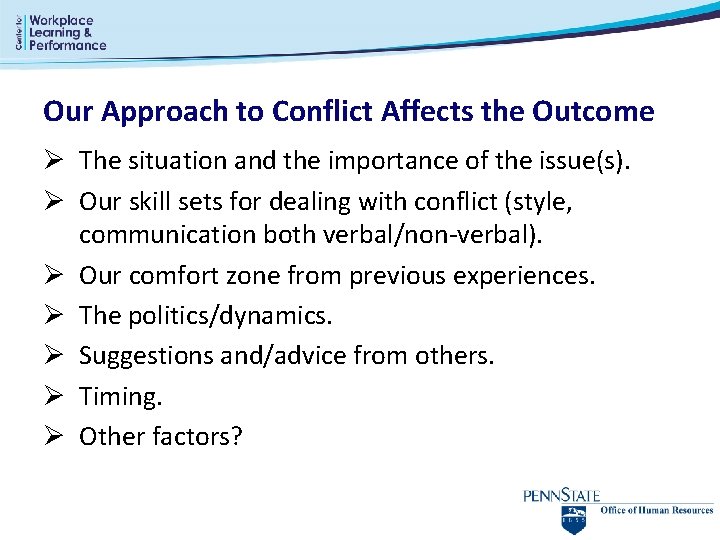
Our Approach to Conflict Affects the Outcome Ø The situation and the importance of the issue(s). Ø Our skill sets for dealing with conflict (style, communication both verbal/non-verbal). Ø Our comfort zone from previous experiences. Ø The politics/dynamics. Ø Suggestions and/advice from others. Ø Timing. Ø Other factors?
What gets in your way when you approach conflict? What do you use to your advantage to find success?
Causes of Conflict Ø Conflict can arise when any one or more of the following causes occur. Ø Put a check by the ones that you have personally experienced. Ø Work in teams to come up with some real world examples of these causes.
Causes of Conflict Ø Ø Ø Resources: time, staff, money, etc. Goals: different visions for success, etc. Personality Differences: extraverts/introverts, etc. Psychological Needs: respect, power, belonging, etc. Values: honesty, fidelity, etc.
Causes of Conflict Ø Rules/regulations/policies: interpretations, etc. Ø Customs/habits: tapping your pencil, procrastination, etc. Ø Egos/competition: only one winner, I want your job, etc. Ø Information: too little or too much. Ø Physical or mental health issues: Ø Others?
Assumptions Ø Conflict is avoidable. Ø Conflict is not avoidable. Not everyone is going to like or agree with everyone else. Ø Conflict produces inappropriate reactions by the people involved. Ø Sometimes reactions are inappropriate. Sometimes they are very appropriate. Ø Conflict creates polarization within the organization. Ø Communities can become polarized over things like whether they need a new high school or whether the present school is adequate.
Assumptions Ø We should avoid conflict. Ø Trying to stop all conflict is a waste of time and energy. Ø Conflict can have either constructive or destructive effects.
Types of Conflict Ø Work with your team to discuss examples of each of these conflicts. Make suggestions for how to effectively deal with each type. Ø Ø Intra-personal: struggles within a person. Inter-personal: conflict between two people. Intra-group: conflict within a group. Inter-group: two different groups in conflict with one another.
Types of Conflict – Intra-personal Ø Inner conflicts are often about questions of integrity, values, and ethics — about doing the right thing versus what you want to do. Ø Inner conflict can be difficult to recognize. Ø Sometimes this conflict is difficult to live with.
Types of Conflict – Intra-personal Examples Ø You disagree with your boss about a decision that has just been made. Part of you thinks you should be strong and voice your opposition. Another part of you says to just sit tight.
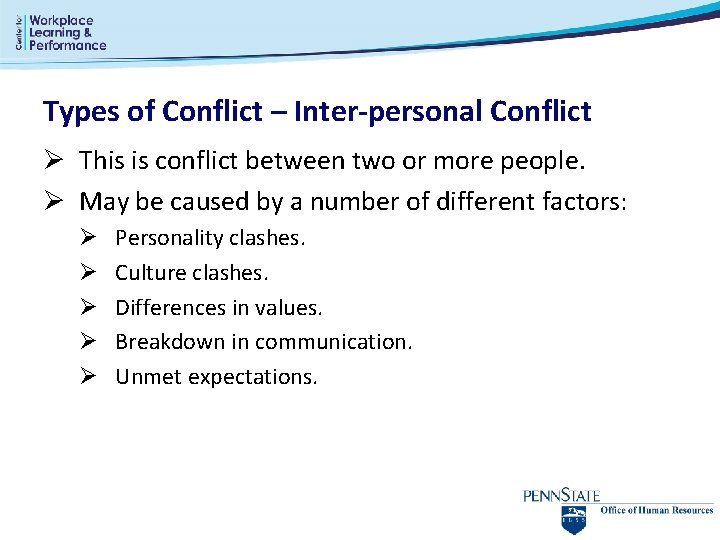
Types of Conflict – Inter-personal Conflict Ø This is conflict between two or more people. Ø May be caused by a number of different factors: Ø Ø Ø Personality clashes. Culture clashes. Differences in values. Breakdown in communication. Unmet expectations.
Types of Conflict – Intra-group Conflict Ø Conflict within a group. Ø For example, harassment between groups of teammates. Veterans and rookies in the NFL.
Types of Conflict – Inter-group Conflict Ø Group conflict may be independent of the people occupying the roles. Ø For example, conflict between marketing and production is common.
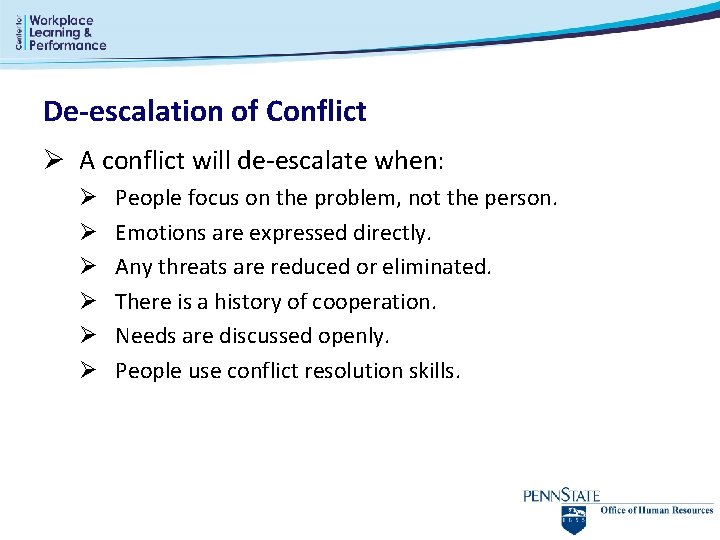
De-escalation of Conflict Ø A conflict will de-escalate when: Ø Ø Ø People focus on the problem, not the person. Emotions are expressed directly. Any threats are reduced or eliminated. There is a history of cooperation. Needs are discussed openly. People use conflict resolution skills.
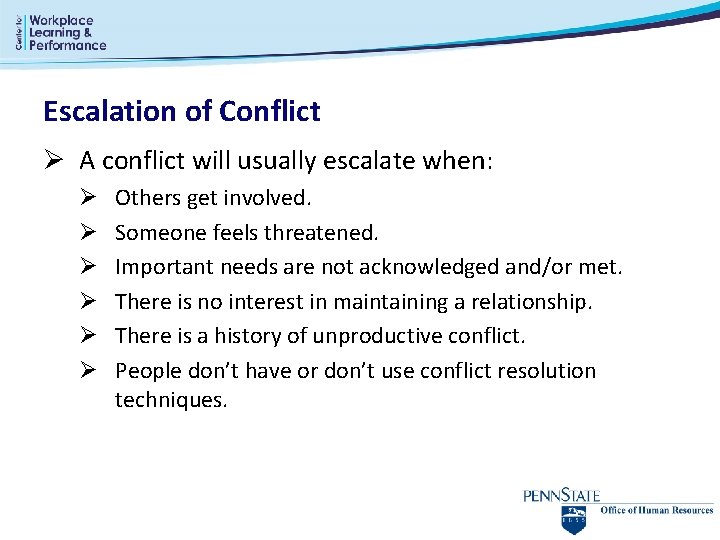
Escalation of Conflict Ø A conflict will usually escalate when: Ø Ø Ø Others get involved. Someone feels threatened. Important needs are not acknowledged and/or met. There is no interest in maintaining a relationship. There is a history of unproductive conflict. People don’t have or don’t use conflict resolution techniques.
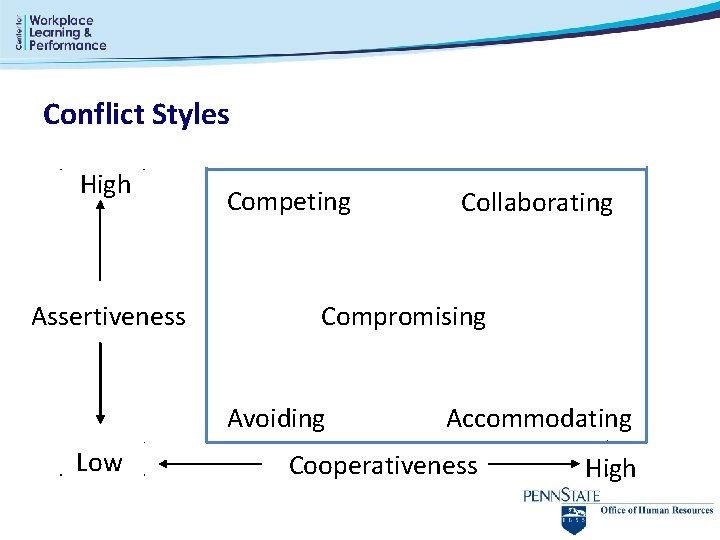
Conflict Styles Ø There are five basic “reactions” or styles to deal with conflict.
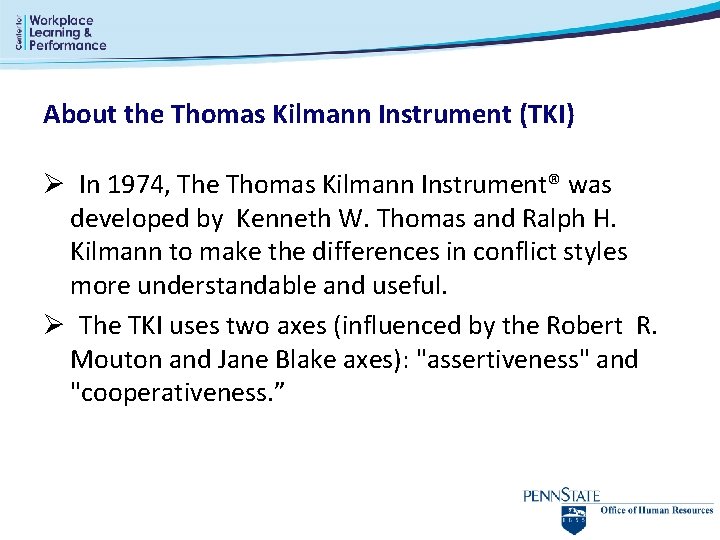
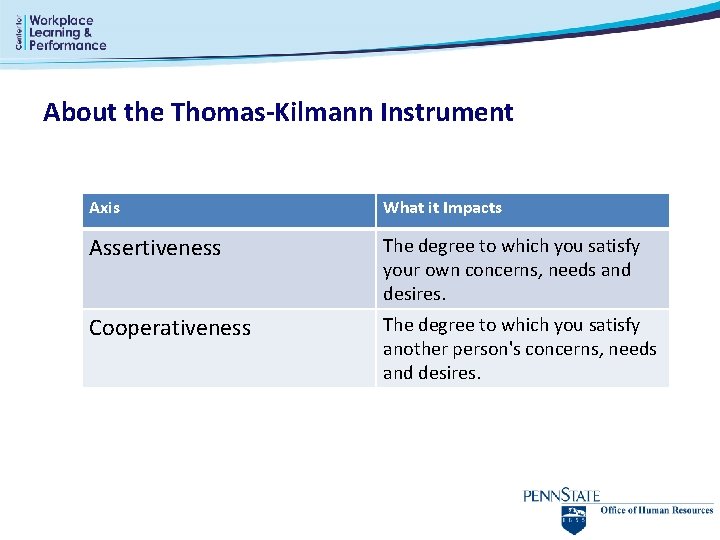
About the Thomas Kilmann Instrument (TKI) Ø In 1974, The Thomas Kilmann Instrument® was developed by Kenneth W. Thomas and Ralph H. Kilmann to make the differences in conflict styles more understandable and useful. Ø The TKI uses two axes (influenced by the Robert R. Mouton and Jane Blake axes): "assertiveness" and "cooperativeness. ”
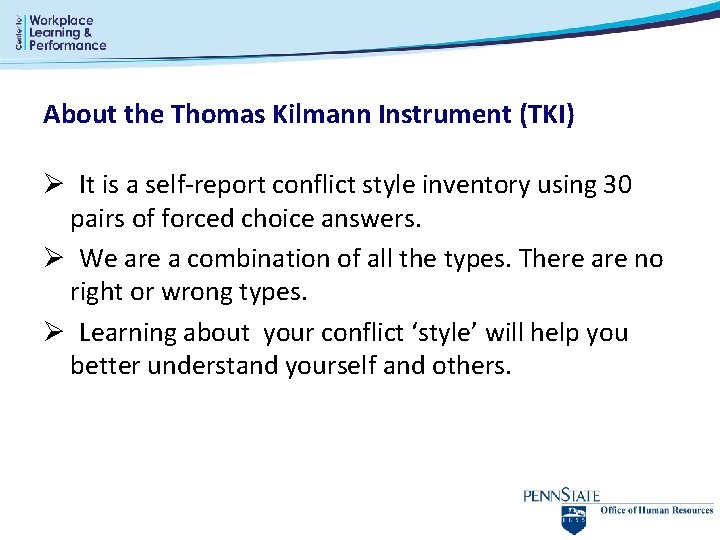
About the Thomas Kilmann Instrument (TKI) Ø It is a self-report conflict style inventory using 30 pairs of forced choice answers. Ø We are a combination of all the types. There are no right or wrong types. Ø Learning about your conflict ‘style’ will help you better understand yourself and others.
About the Thomas-Kilmann Instrument Axis What it Impacts Assertiveness The degree to which you satisfy your own concerns, needs and desires. Cooperativeness The degree to which you satisfy another person's concerns, needs and desires.
Conflict Styles High Assertiveness Competing Compromising Avoiding Low Collaborating Accommodating Cooperativeness High
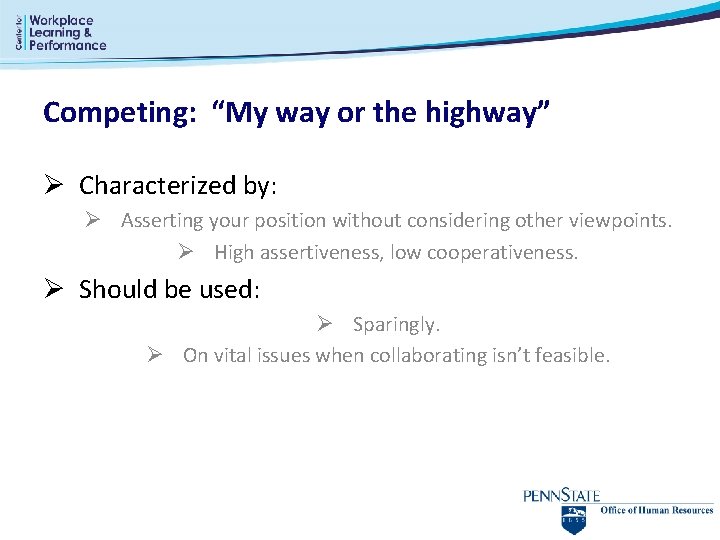
Competing: “My way or the highway” Ø Characterized by: Ø Asserting your position without considering other viewpoints. Ø High assertiveness, low cooperativeness. Ø Should be used: Ø Sparingly. Ø On vital issues when collaborating isn’t feasible.
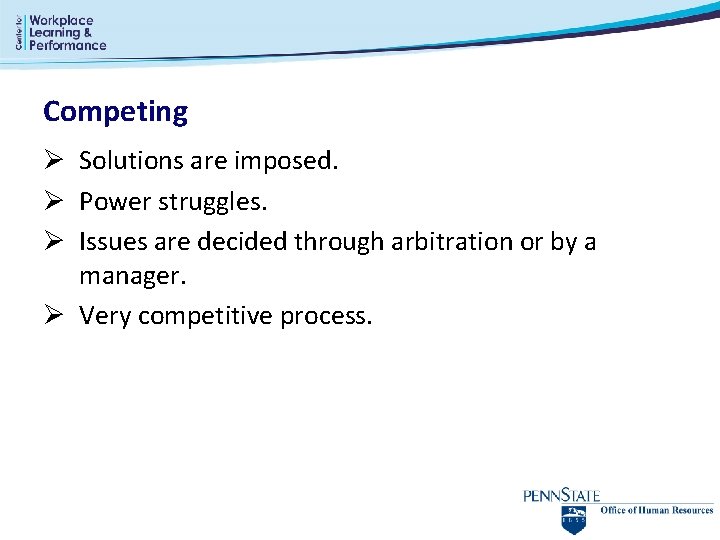
Competing Ø Solutions are imposed. Ø Power struggles. Ø Issues are decided through arbitration or by a manager. Ø Very competitive process.
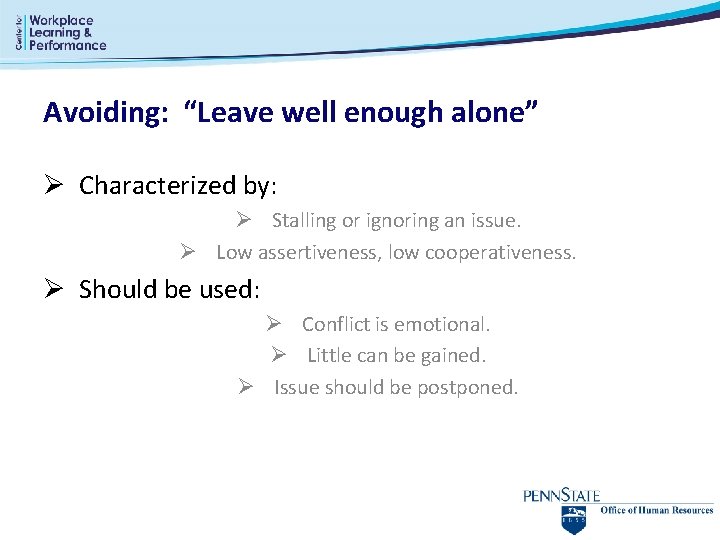
Avoiding: “Leave well enough alone” Ø Characterized by: Ø Stalling or ignoring an issue. Ø Low assertiveness, low cooperativeness. Ø Should be used: Ø Conflict is emotional. Ø Little can be gained. Ø Issue should be postponed.
Avoiding Ø Withdrawal. Ø Ignoring or hiding issues that would contribute to the conflict.
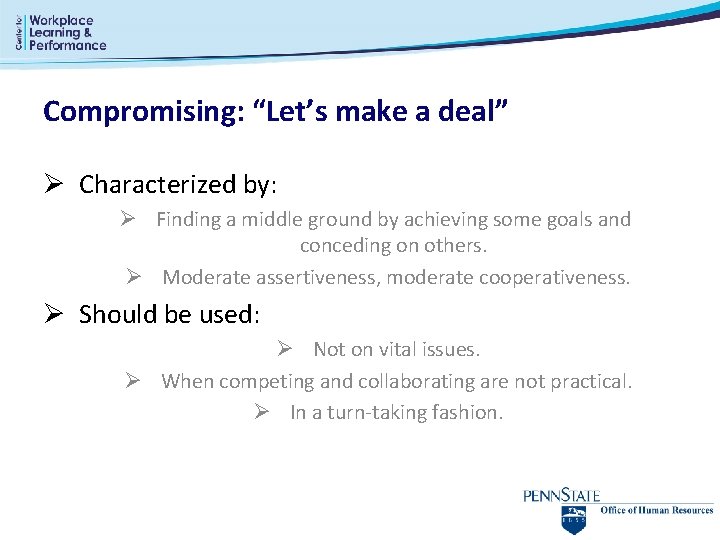
Compromising: “Let’s make a deal” Ø Characterized by: Ø Finding a middle ground by achieving some goals and conceding on others. Ø Moderate assertiveness, moderate cooperativeness. Ø Should be used: Ø Not on vital issues. Ø When competing and collaborating are not practical. Ø In a turn-taking fashion.
Compromising Ø Give something to get something. Ø Some accommodation and adjustments are used to get acceptable outcomes. Ø Outcomes may be acceptable but they are not the best.
Accommodating: “Kill them with kindness” Ø Characterized by: Ø Focusing on the goals and concerns of others. Ø Low assertiveness, with cooperativeness. Ø Should be used: Ø Yield to a better position. Ø You are overruled. Ø It is important to others. Ø Clean up hard feelings.
Accommodating Ø Soften harshness, emotions, or main issues to maintain peace and harmony.
Collaborating: “Two heads are better than one” Ø Characterized by: Ø Desire to fully satisfy both sides of an issue. Ø High assertiveness, high cooperativeness. Ø Should be used: Ø Under conditions that enable collaboration. Ø On important issues.
Collaborating Ø Issues are uncovered, conversation encouraged, and conflict is resolved. Ø Only the collaborating style achieves real conflict resolution. Ø Problem-solving (collaborating) identifies and works through the causes of conflict.
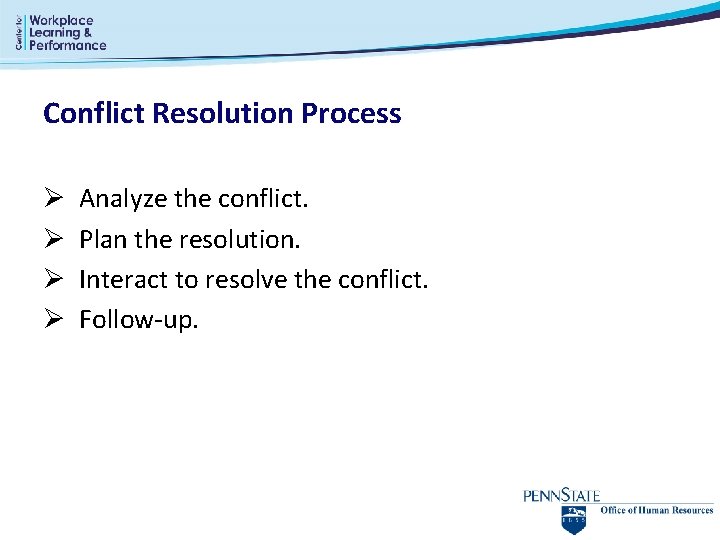
Conflict Resolution Process Ø Ø Analyze the conflict. Plan the resolution. Interact to resolve the conflict. Follow-up.
Reflections
Conflict Situations: What Would You Do? Ø Small groups, please. Ø 30 minute exercise. Ø 10 minutes to discuss at your table. Ø 5 minutes for your thoughts. Ø Choose a leader and note-taker. Ø Begin!
Other Appendix Paragraphs: on your own Ø Ø Communication Issues. Dealing with Emotion. Visualizing Conflict Worksheet for a Positive Resolution.
Appendix Ø Ø Ø Mental preparation for conflict. Communication Issues. Dealing with Emotion. Visualizing Conflict Worksheet for a Positive Resolution.
Mental Preparation for Conflict Ø Most important part of preparation is attitude. Ø Conflict resolution skills can help us deal with our fears. Ø More than one way to satisfy concerns. Ø Good preparation means success. Ø Know the issues involved. Ø Plan your strategy.
Mental Preparation for Conflict Ø Do your homework. Ø Look at the situation through the other person’s eyes. Ø Brainstorm some options with your colleagues. Ø Know your hot buttons (stressors). Ø What makes you feel angry, defensive, fearful, or guilty?
Mental Preparation for Conflict Ø The final and most difficult test is to remain calm in the face of all these challenges. Ø If we get emotional, the ball game is almost over. Ø Two angry and frustrated people will seldom be able to think through a solution that works.