
Survivable Telecommunication Network Design Under Different Types of
Survivable Telecommunication Network Design Under Different Types of Failures Hanan Luss and Richard T. Wong IEEE TRANSACTIONS ON SYSTEMS, MAN, AND CYBERNETICS—PART A: SYSTEMS AND HUMANS, VOL. 34, NO. 4, JULY 2004 Presented by Huan-Ting Chen, OPLab, IM, NTU 2007/3/19 OPLab, IM, NTU
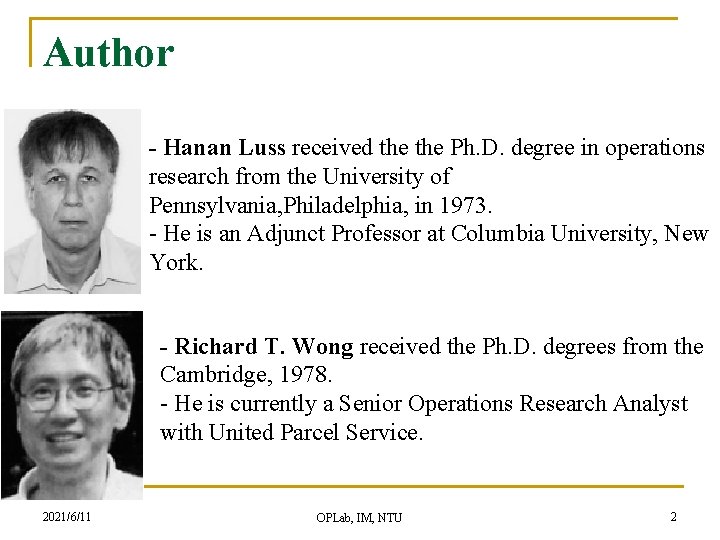
Author - Hanan Luss received the Ph. D. degree in operations research from the University of Pennsylvania, Philadelphia, in 1973. - He is an Adjunct Professor at Columbia University, New York. - Richard T. Wong received the Ph. D. degrees from the Cambridge, 1978. - He is currently a Senior Operations Research Analyst with United Parcel Service. 2021/6/11 OPLab, IM, NTU 2
Outline n n n Introduction - Principal Issues for Survivable Network Design - Message of Paper Three approaches - Under Partial Link Failure - Under Node Failure Conclusions 2021/6/11 OPLab, IM, NTU 3
Outline n n n Introduction - Principal Issues for Survivable Network Design - Message of Paper Three approaches - Under Partial Link Failure - Under Node Failure Conclusions 2021/6/11 OPLab, IM, NTU 4
Introduction n Principal Issues for Survivable Network Design - Reroute the traffic of a failure of a network element - Restoration protocols 2021/6/11 OPLab, IM, NTU 5
Introduction n Message of Paper - Augmenting capacities - Under a single failure 2021/6/11 OPLab, IM, NTU 6
Outline n n n Introduction - Principal Issues for Survivable Network Design - Message of Paper Three Approaches - Under Partial Link Failure - Under Node Failure Conclusions 2021/6/11 OPLab, IM, NTU 7
Three Approaches n Three different scenarios - Restoration under a single partial link failure - Restoration under a single node failure 2021/6/11 OPLab, IM, NTU 8
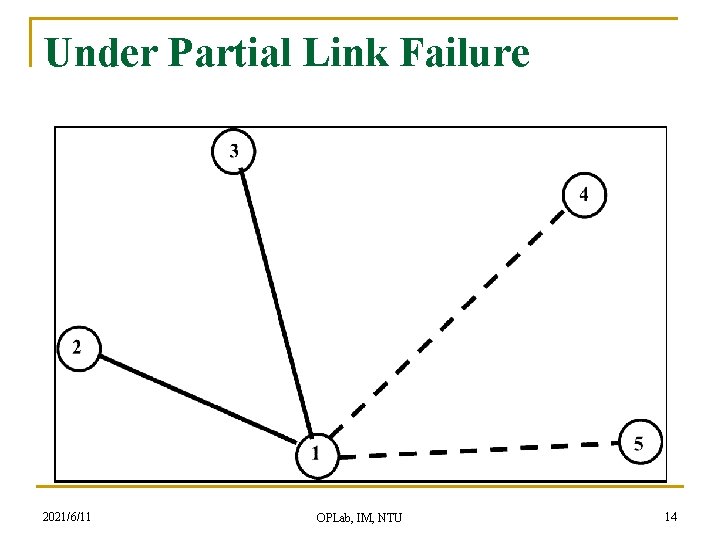
Under Partial Link Failure n n Augments network capacity Under a single partial link failure - A link component failed on one link 2021/6/11 OPLab, IM, NTU 9
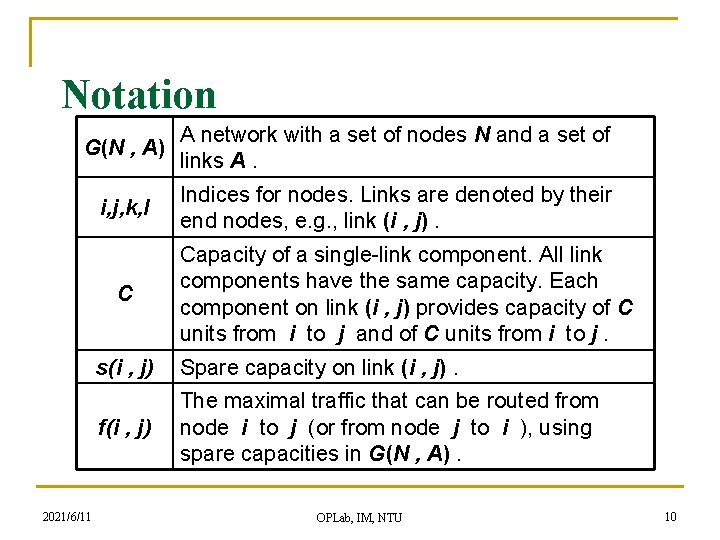
Notation G(N , A) A network with a set of nodes N and a set of links A. i, j, k, l Indices for nodes. Links are denoted by their end nodes, e. g. , link (i , j). C 2021/6/11 Capacity of a single-link component. All link components have the same capacity. Each component on link (i , j) provides capacity of C units from i to j and of C units from i to j. s(i , j) Spare capacity on link (i , j). f(i , j) The maximal traffic that can be routed from node i to j (or from node j to i ), using spare capacities in G(N , A). OPLab, IM, NTU 10

Under Partial Link Failure n n Guarantees the network will survive a single partial link failure on any link of G(N , A). Goal - Constructs a spanning tree V(N , A) where each link (i , j) V(N , A) has f(i , j) C. 2021/6/11 OPLab, IM, NTU 11
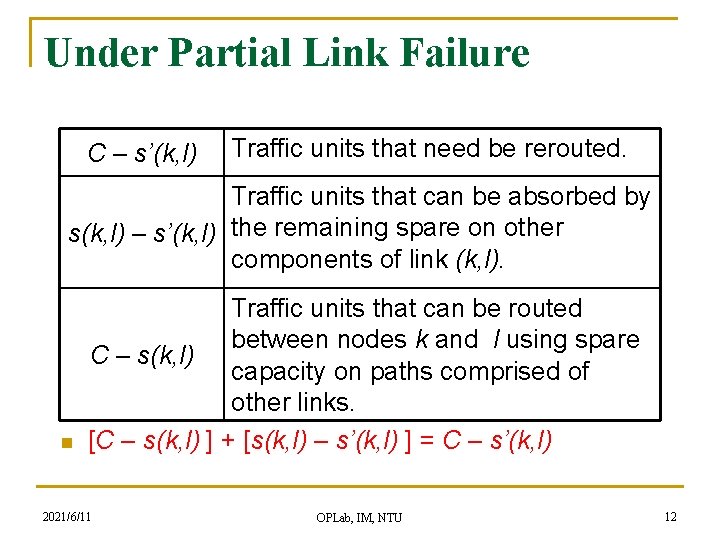
Under Partial Link Failure C – s’(k, l) Traffic units that need be rerouted. Traffic units that can be absorbed by s(k, l) – s’(k, l) the remaining spare on other components of link (k, l). n Traffic units that can be routed between nodes k and l using spare C – s(k, l) capacity on paths comprised of other links. [C – s(k, l) ] + [s(k, l) – s’(k, l) ] = C – s’(k, l) 2021/6/11 OPLab, IM, NTU 12
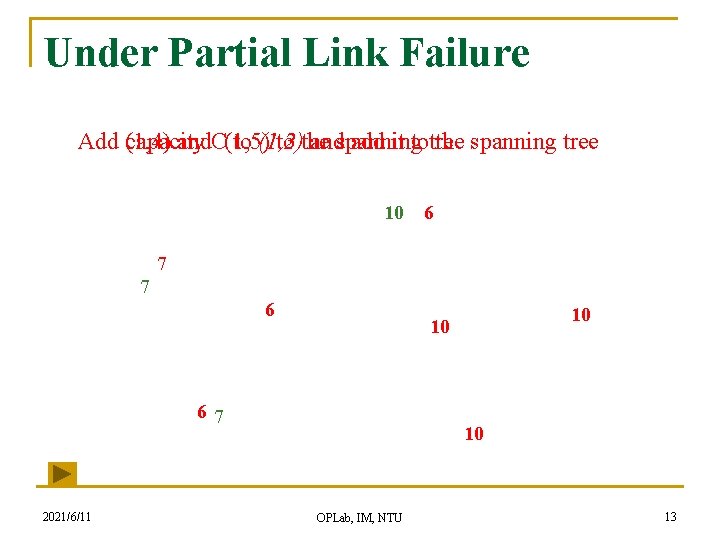
Under Partial Link Failure Add (1, 4) capacity and. C(1, 5) to (1, 2) (1, 3) to the andspanning add it totree the spanning tree 10 6 7 7 6 67 2021/6/11 10 10 10 OPLab, IM, NTU 13
Under Partial Link Failure 2021/6/11 OPLab, IM, NTU 14
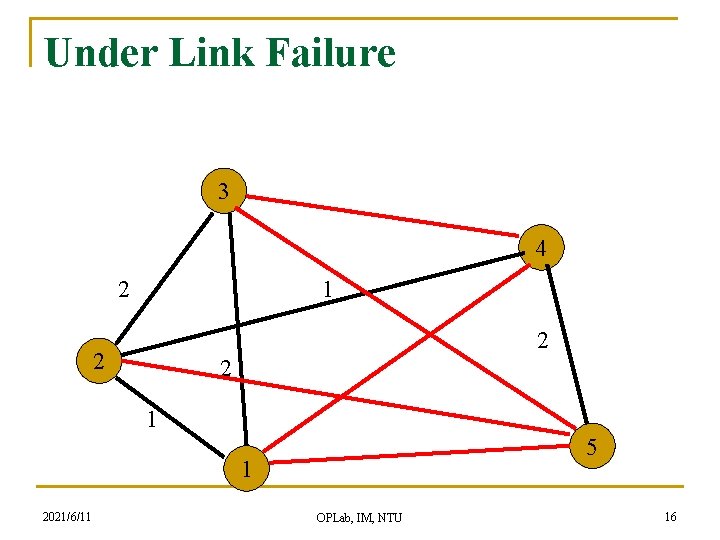
Under Link Failure n n n Augments network capacity Under a single link failure g(i , j):Traffic on link (i , j) that needs to be restored in the event that link (i , j) A fails. 2021/6/11 OPLab, IM, NTU 15
Under Link Failure 3 4 2 1 2 2 2 1 5 1 2021/6/11 OPLab, IM, NTU 16
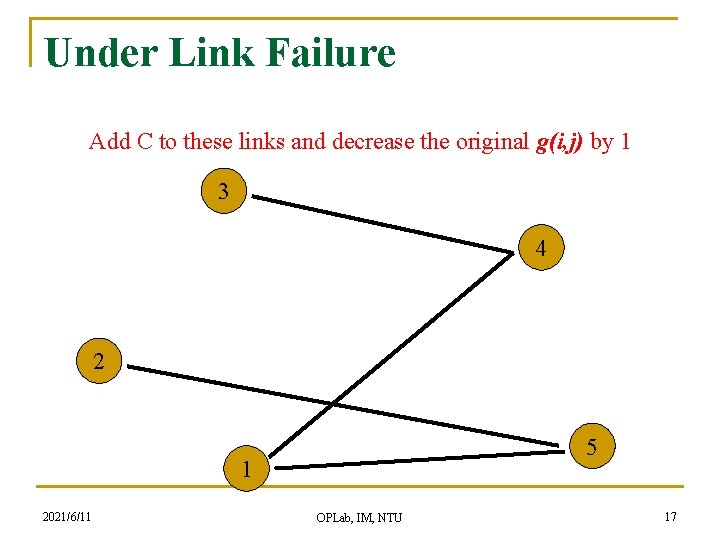
Under Link Failure Add C to these links and decrease the original g(i, j) by 1 3 4 2 5 1 2021/6/11 OPLab, IM, NTU 17
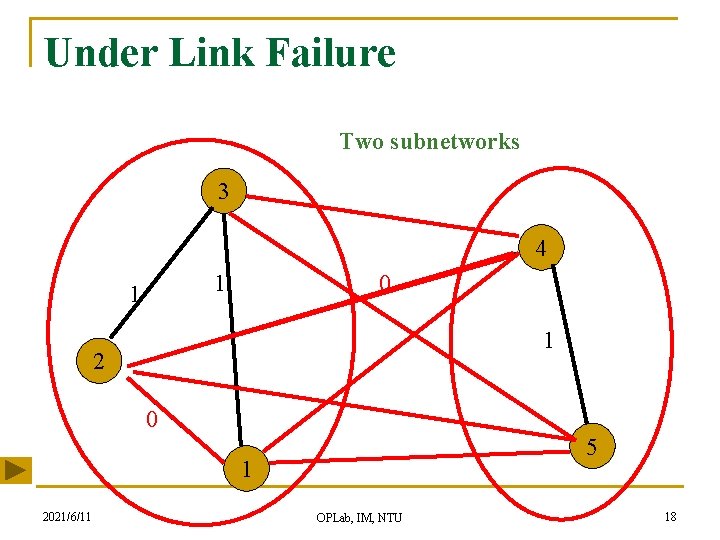
Under Link Failure Two subnetworks 3 4 1 1 0 1 2 0 5 1 2021/6/11 OPLab, IM, NTU 18
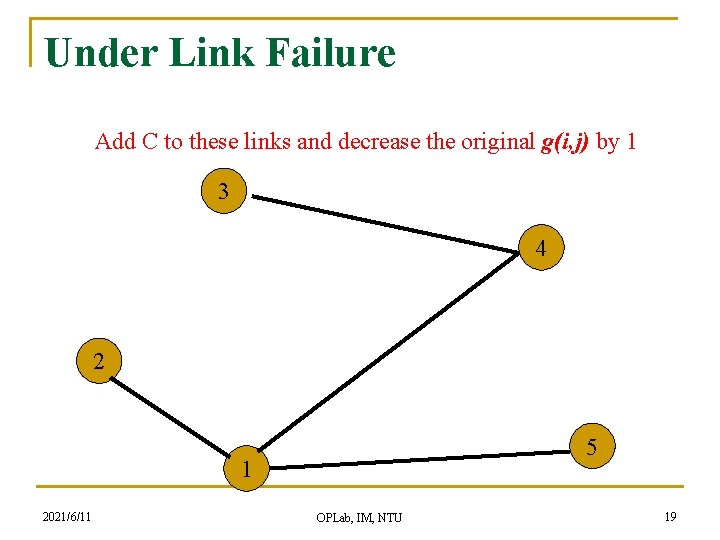
Under Link Failure Add C to these links and decrease the original g(i, j) by 1 3 4 2 5 1 2021/6/11 OPLab, IM, NTU 19
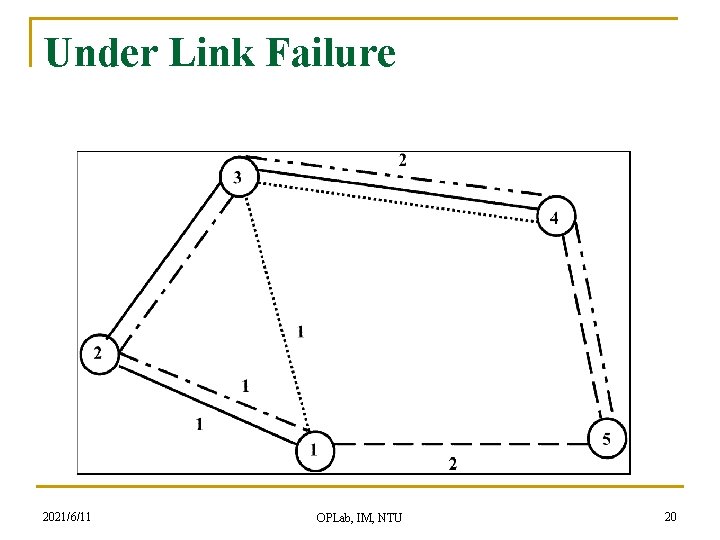
Under Link Failure 2021/6/11 OPLab, IM, NTU 20
Under Node Failure n n n Augments network capacity Under a single node failure Construct a restoration ring 2021/6/11 OPLab, IM, NTU 21
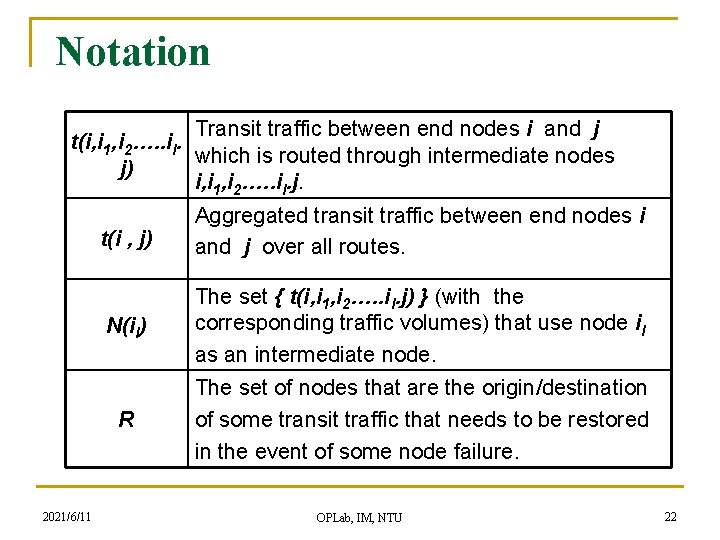
Notation Transit traffic between end nodes i and j t(i, i 1, i 2…. . il. which is routed through intermediate nodes j) i, i 1, i 2…. . il. j. 2021/6/11 t(i , j) Aggregated transit traffic between end nodes i and j over all routes. N(il) The set { t(i, i 1, i 2…. . il. j) } (with the corresponding traffic volumes) that use node il as an intermediate node. R The set of nodes that are the origin/destination of some transit traffic that needs to be restored in the event of some node failure. OPLab, IM, NTU 22
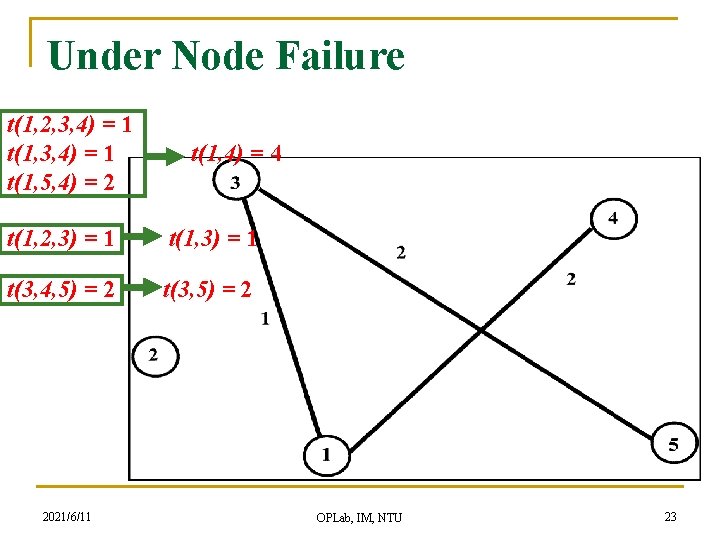
Under Node Failure t(1, 2, 3, 4) = 1 t(1, 5, 4) = 2 t(1, 4) = 4 t(1, 2, 3) = 1 t(1, 3) = 1 t(3, 4, 5) = 2 t(3, 5) = 2 2021/6/11 OPLab, IM, NTU 23
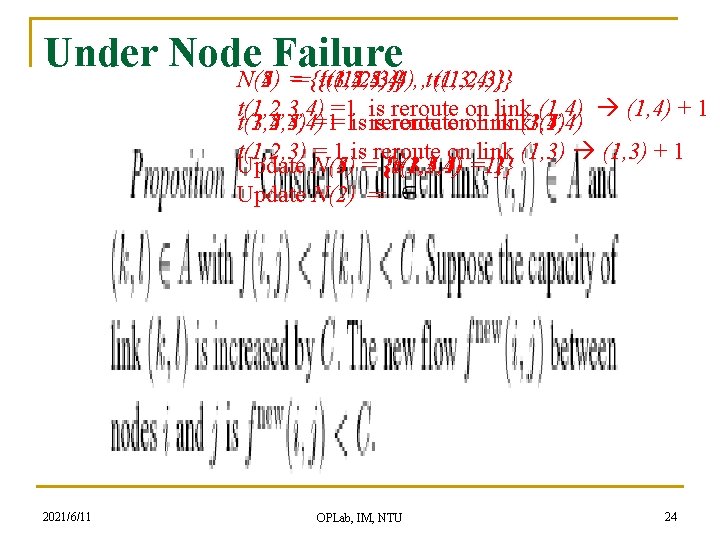
Under Node Failure N(2) = ={t(1, 5, 4)} {t(1, 2, 3, 4) t(1, 2, 3)} N(3) N(4) N(5) {t(1, 2, 3, 4) {t(3, 4, 5) } , , t(1, 3, 4)} t(1, 2, 3, 4) =1 is reroute on link (1, 4) + 1 t(1, 2, 3, 4)=1=1 is isreroute t(3, 4, 5) t(1, 5, 4) rerouteononlink(1, 4) (3, 5) (1, 4) t(1, 2, 3) = 1 is reroute on link (1, 3) + 1 Update N(5) N(3) = N(4) = {t(1, 3, 4) {t(3, 4, 5) =1} {t(1, 5, 4) = 1} Update N(2) = 2021/6/11 OPLab, IM, NTU 24
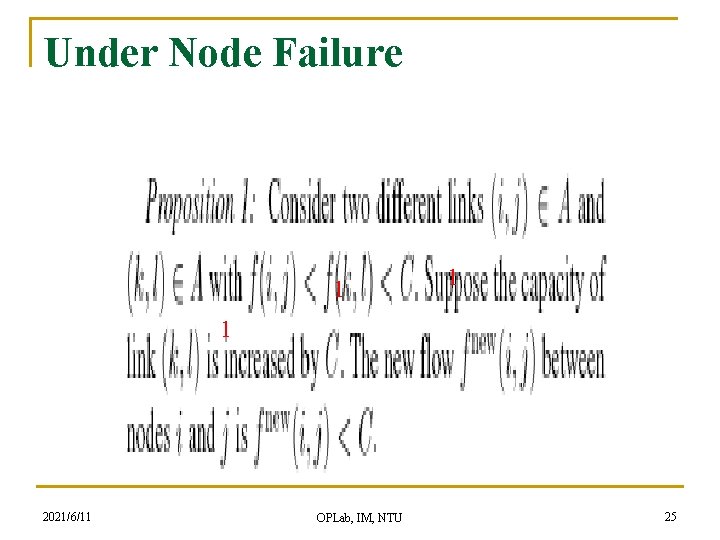
Under Node Failure 1 1 1 2021/6/11 OPLab, IM, NTU 25
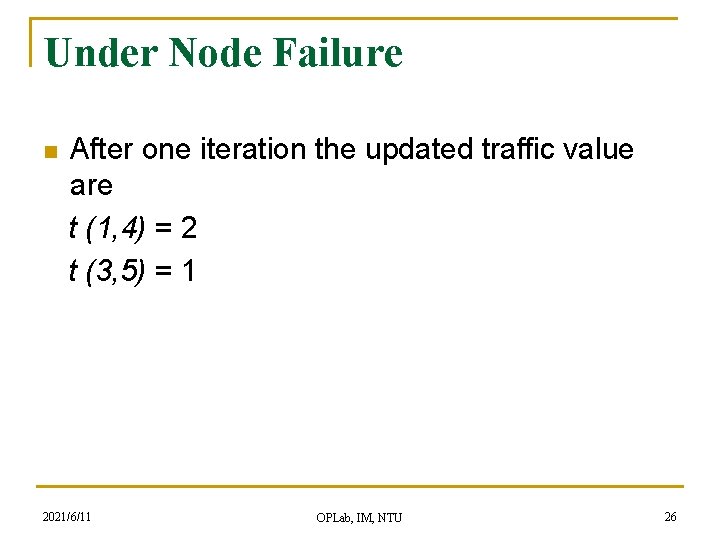
Under Node Failure n After one iteration the updated traffic value are t (1, 4) = 2 t (3, 5) = 1 2021/6/11 OPLab, IM, NTU 26
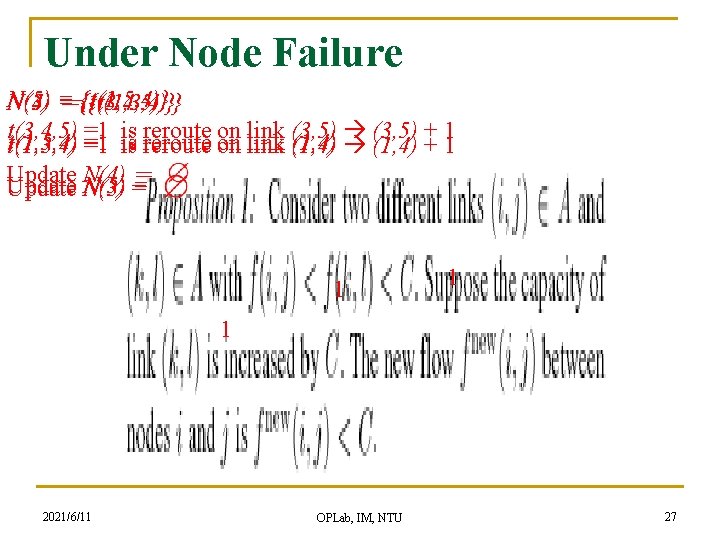
Under Node Failure N(5) N(3) = ={t(1, 5, 4)} {t(1, 3, 4)}} N(4) {t(3, 4, 5) =1 is reroute on link (3, 5) + 1 t(1, 5, 4) =1 is reroute on link (1, 4) t(1, 3, 4) (1, 4) + 1 Update = Update N(4) N(5) = N(3) = 1 1 1 2021/6/11 OPLab, IM, NTU 27
Under Node Failure 2021/6/11 OPLab, IM, NTU 28
Outline n n n Introduction - Principal Issues for Survivable Network Design - Message of Paper Three approaches - Under Partial Link Failure - Under Node Failure Conclusions 2021/6/11 OPLab, IM, NTU 29

Conclusions n n The goal of this paper is to present several survivable designs by augmenting capacities along prudently selected variants of spanning tree and ring structures. Future work may evaluate the designs by comparing the results to those obtained by other heuristics. 2021/6/11 OPLab, IM, NTU 30
Thanks for your listening 2021/6/11 OPLab, IM, NTU 31
2021/6/11 OPLab, IM, NTU 32
Consider a network with multiple disconnected subnetworks and suppose a spanning tree can be constructed on the complementary graphs of subnetworks m = 1 , 2. The number of links comprising the two spanning trees is less than the number of links of a spanning tree on the complementary graph of a subnetwork that is the union of the two. Consider two disconnected subnetworks. A spanning tree always exists on the complementary graph of a subnetwork that is the union of the two. 2021/6/11 OPLab, IM, NTU 33
Under Partial Link Failure n n C – s’(k, l) : traffic units need be rerouted. s(k, l) – s’(k, l) : traffic units can be absorbed by the remaining spare on other components of link (k, l). C – s(k, l) : traffic units can be routed between nodes k and l using spare capacity on paths comprised of other links. [C – s(k, l) ] + [s(k, l) – s’(k, l) ] = C – s’(k, l) 2021/6/11 OPLab, IM, NTU 37
- Slides: 34