
Surveys and Interviews Research Methods Interviewing and Surveys
- Slides: 17
Surveys and Interviews Research Methods
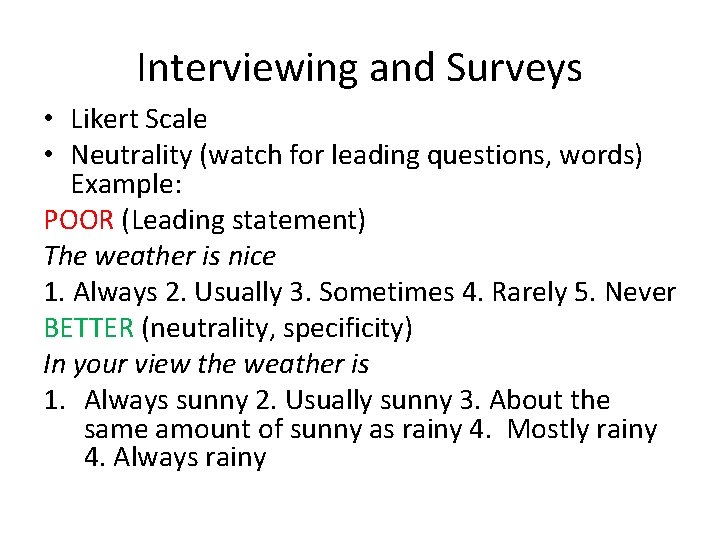
Interviewing and Surveys • Likert Scale • Neutrality (watch for leading questions, words) Example: POOR (Leading statement) The weather is nice 1. Always 2. Usually 3. Sometimes 4. Rarely 5. Never BETTER (neutrality, specificity) In your view the weather is 1. Always sunny 2. Usually sunny 3. About the same amount of sunny as rainy 4. Mostly rainy 4. Always rainy
VALS Survey • Repeated questions in certain ways. • Turning the phrase. • Output linked to Prescribed Research Outcome and Rubric. • Rubric based on theory and ethnographic analysis.
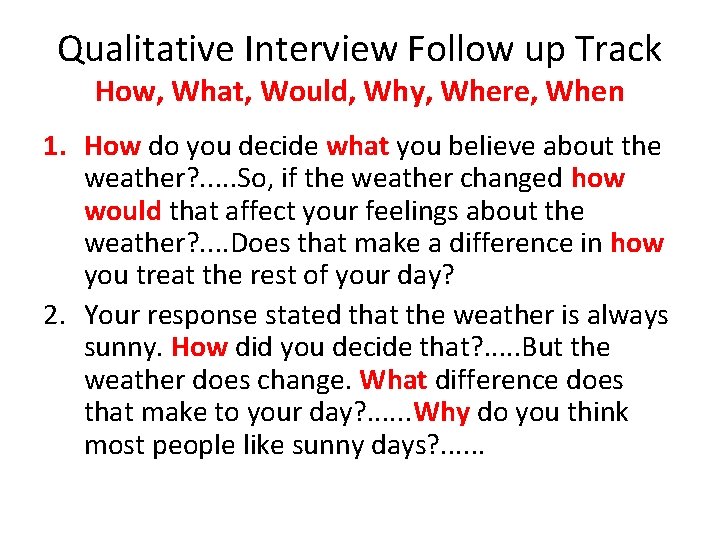
Qualitative Interview Follow up Track How, What, Would, Why, Where, When 1. How do you decide what you believe about the weather? . . . So, if the weather changed how would that affect your feelings about the weather? . . Does that make a difference in how you treat the rest of your day? 2. Your response stated that the weather is always sunny. How did you decide that? . . . But the weather does change. What difference does that make to your day? . . . Why do you think most people like sunny days? . . .
Ethnographic Based Qualitative Interview You would have completed a strong ethnographic field study and now wish support it with actual interview responses. Typical Ethnographic Interview: 25 leading questions with follow up questions. • 20 questions for a full-fledged survey. 40 minutes to one hour. Respondents must reflect the field you research. Key consultants are critical here. Interview is transcribed and coded with the same method as field notes and then inserted as appropriate within your final narrative.
Qualitative Interview Follow up Track How, What, Why, Where, When 3. Where do you make decisions about the weather? . . . If you knew the weather was to be better in another location, how would that affect your feelings about the weather? . . Does that make a difference in where choose to live? 4. Your response stated that the weather is always sunny. On what did you base that decision? . . . But the weather does change. If it was rainy, how would that affect your day? . . . What do you think about people who prefer rain? . . .
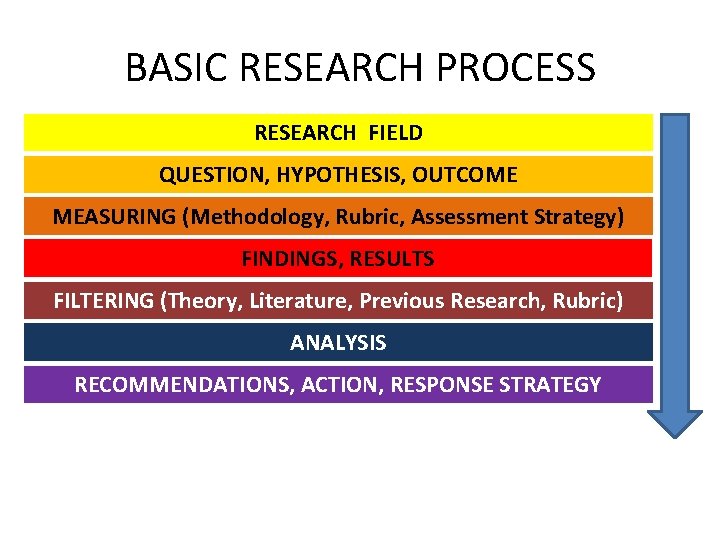
BASIC RESEARCH PROCESS RESEARCH FIELD QUESTION, HYPOTHESIS, OUTCOME MEASURING (Methodology, Rubric, Assessment Strategy) FINDINGS, RESULTS FILTERING (Theory, Literature, Previous Research, Rubric) ANALYSIS RECOMMENDATIONS, ACTION, RESPONSE STRATEGY
Policy Measurement Dr. Hans Tokke
Main Idea • The main idea with the measurement and analysis section is to find a means to support your policy and policy strategy • Connect the policy “need” to the policy “strategy” to the policy “result” • What is the other side of the question? (i. e. The Trenton Civil Lobbyist Lawyer).
The Concept of Measurement • The textbook by Wheelan takes a quite quantitative approach to analysis. • Policy aligned to the calculable. • The issue for non-profit organizations is that much of what they do is subjective and value based, so pure numbers crunching metrics can be difficult (Illus. The Bread Mission in DC)
Some basic ways to think • Mean: What do the people as a group you are analyzing think about this? The constituency need. How can this be best represented? • Demographics • Survey material • Census • Opinion research
Some basic ways to think • Median • Where is the balance (middle point) of the approach? (think about the Urban Planning Models). • How many agree compared to disagree? This might be a good way to think about political segmentation on the “sides” of issues.
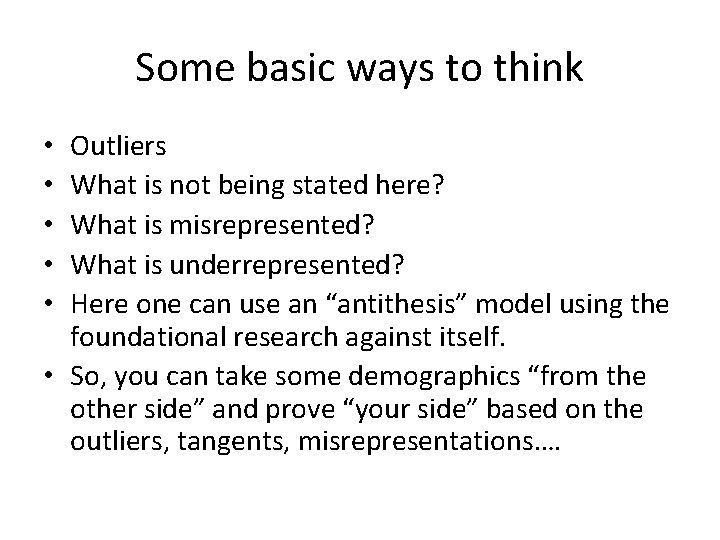
Some basic ways to think Outliers What is not being stated here? What is misrepresented? What is underrepresented? Here one can use an “antithesis” model using the foundational research against itself. • So, you can take some demographics “from the other side” and prove “your side” based on the outliers, tangents, misrepresentations…. • • •
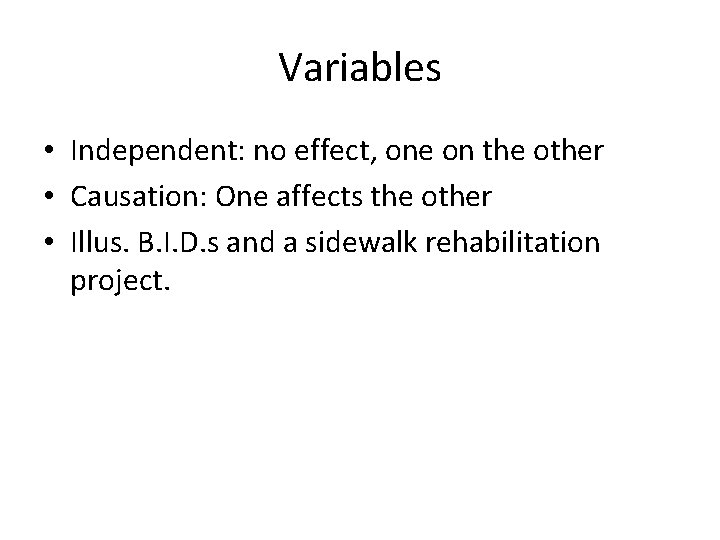
Variables • Independent: no effect, one on the other • Causation: One affects the other • Illus. B. I. D. s and a sidewalk rehabilitation project.
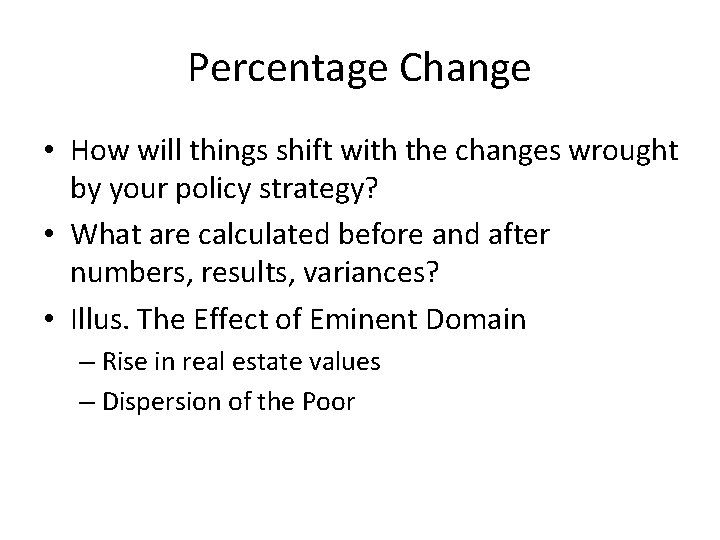
Percentage Change • How will things shift with the changes wrought by your policy strategy? • What are calculated before and after numbers, results, variances? • Illus. The Effect of Eminent Domain – Rise in real estate values – Dispersion of the Poor
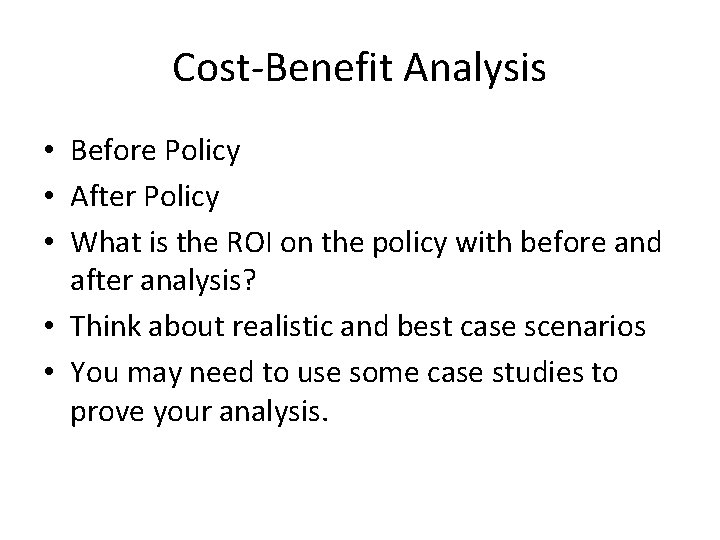
Cost-Benefit Analysis • Before Policy • After Policy • What is the ROI on the policy with before and after analysis? • Think about realistic and best case scenarios • You may need to use some case studies to prove your analysis.
Conclusion • Think about the policy need • Calculate in your mind the best approach to arrive at a policy solution • Consider a policy strategy • Find a mechanism through measurement (which may even be action research!) to support the rationale of your policy strategy.