
Surveying II Lecture 2 Detail Surveys Tacheometry Total



- Slides: 24
Surveying II. Lecture 2. Detail Surveys, Tacheometry, Total Stations, Traversing
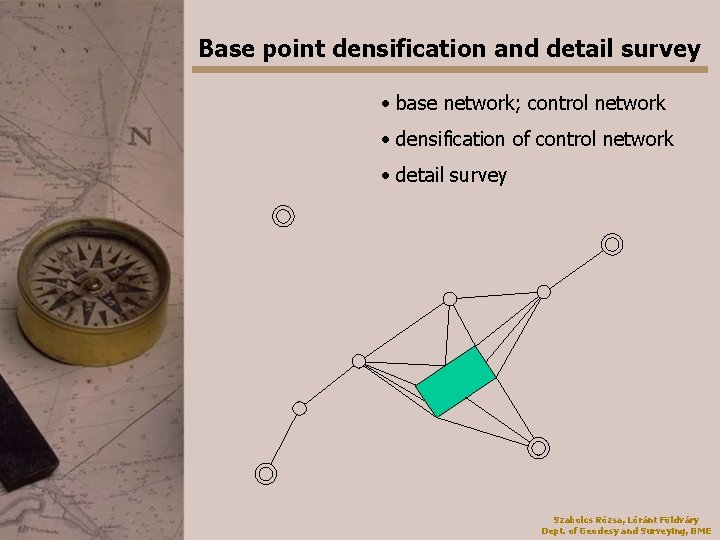
Base point densification and detail survey • base network; control network • densification of control network • detail survey Szabolcs Rózsa, Lóránt Földváry Dept. of Geodesy and Surveying, BME
Base point densification and detail survey Densification of control network • traversing • GNSS Detail survey • detail points of: • buildings • linear objects (e. g. electric poles) • rectangular buildings • arcs • topography Szabolcs Rózsa, Lóránt Földváry Dept. of Geodesy and Surveying, BME
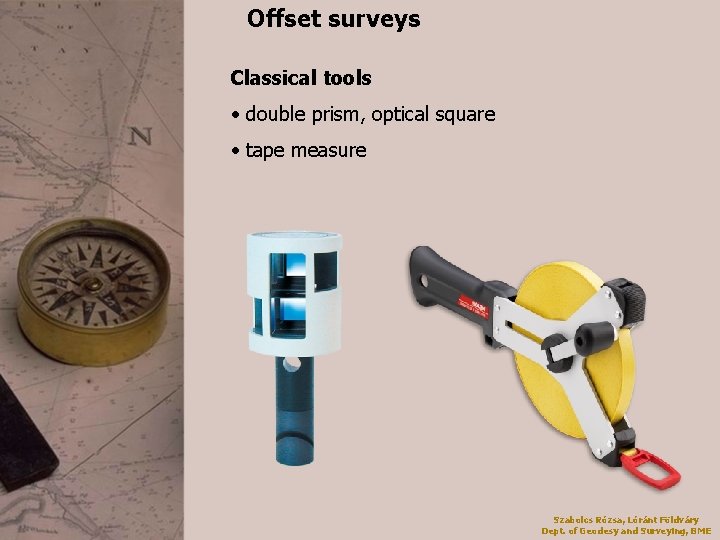
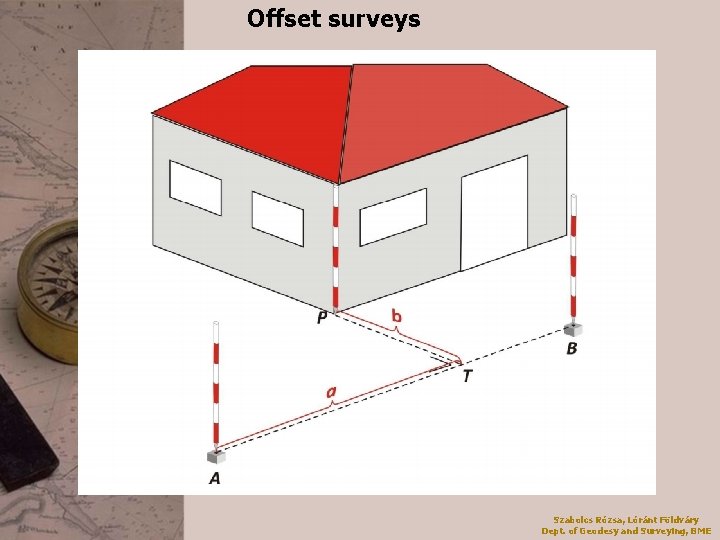
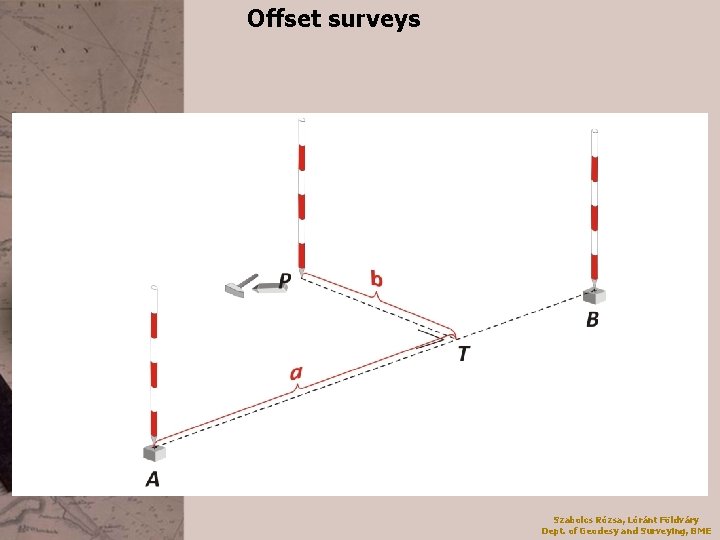
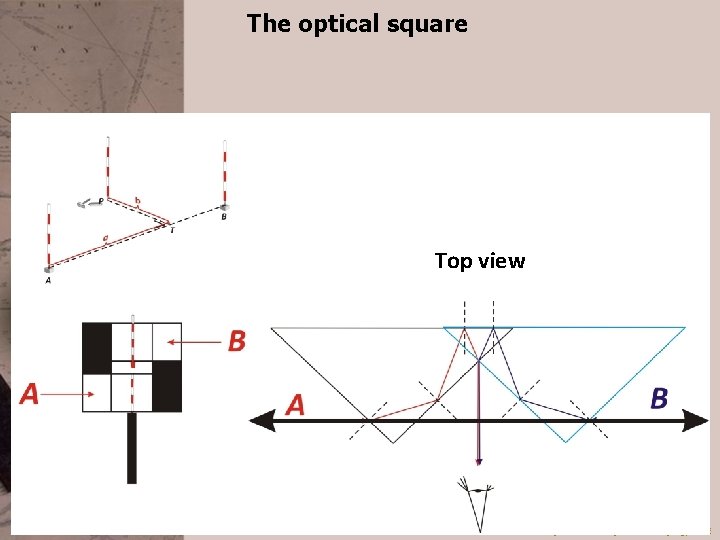
Offset surveys Classical tools • double prism, optical square • tape measure Szabolcs Rózsa, Lóránt Földváry Dept. of Geodesy and Surveying, BME
Offset surveys Szabolcs Rózsa, Lóránt Földváry Dept. of Geodesy and Surveying, BME
Offset surveys Szabolcs Rózsa, Lóránt Földváry Dept. of Geodesy and Surveying, BME
The optical square Top view Szabolcs Rózsa, Lóránt Földváry Dept. of Geodesy and Surveying, BME
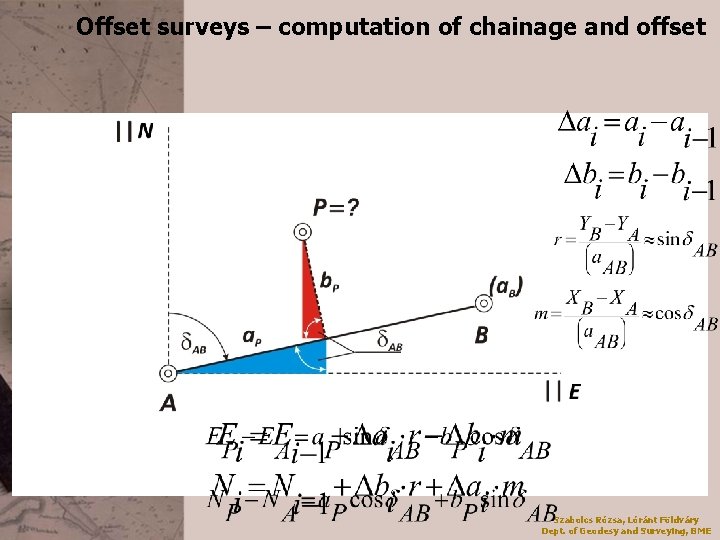
Offset surveys – computation of chainage and offset Szabolcs Rózsa, Lóránt Földváry Dept. of Geodesy and Surveying, BME
Offset surveys – computation of chainage and offset Szabolcs Rózsa, Lóránt Földváry Dept. of Geodesy and Surveying, BME
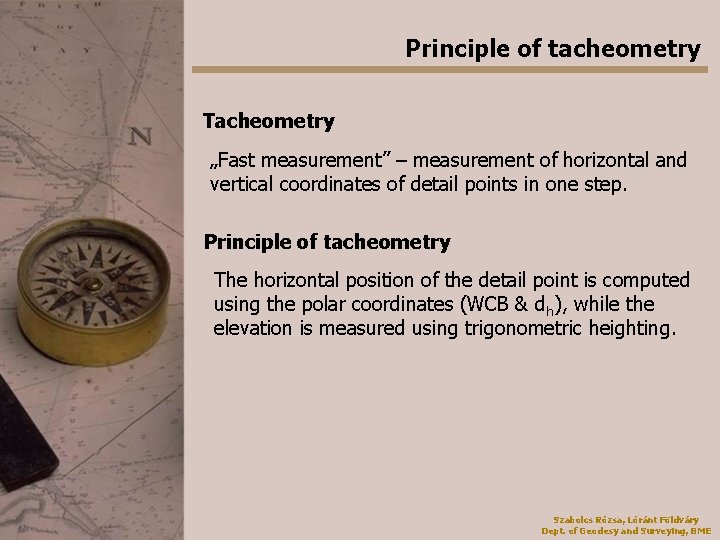
Principle of tacheometry Tacheometry „Fast measurement” – measurement of horizontal and vertical coordinates of detail points in one step. Principle of tacheometry The horizontal position of the detail point is computed using the polar coordinates (WCB & dh), while the elevation is measured using trigonometric heighting. Szabolcs Rózsa, Lóránt Földváry Dept. of Geodesy and Surveying, BME
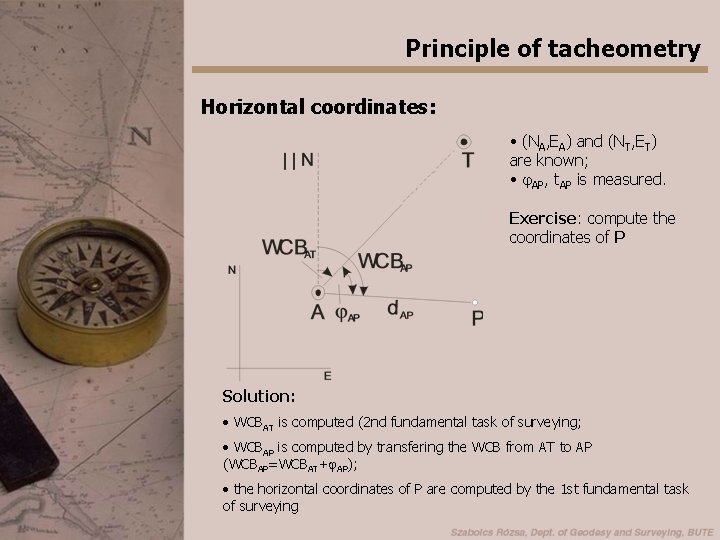
Principle of tacheometry Horizontal coordinates: • (NA, EA) and (NT, ET) are known; • j. AP, t. AP is measured. Exercise: compute the coordinates of P Solution: • WCBAT is computed (2 nd fundamental task of surveying; • WCBAP is computed by transfering the WCB from AT to AP (WCBAP=WCBAT+j. AP); • the horizontal coordinates of P are computed by the 1 st fundamental task of surveying
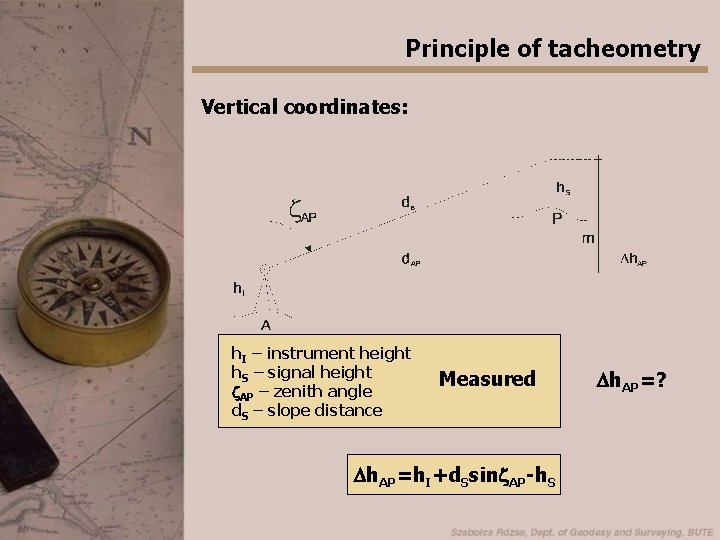
Principle of tacheometry Vertical coordinates: h. I – instrument height h. S – signal height z. AP – zenith angle d. S – slope distance Measured Dh. AP=h. I+d. Ssinz. AP-h. S Dh. AP=?
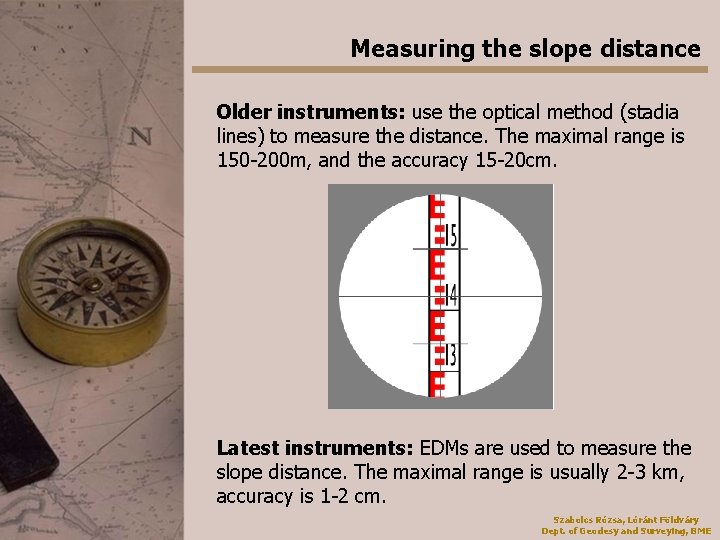
Measuring the slope distance Older instruments: use the optical method (stadia lines) to measure the distance. The maximal range is 150 -200 m, and the accuracy 15 -20 cm. Latest instruments: EDMs are used to measure the slope distance. The maximal range is usually 2 -3 km, accuracy is 1 -2 cm. Szabolcs Rózsa, Lóránt Földváry Dept. of Geodesy and Surveying, BME
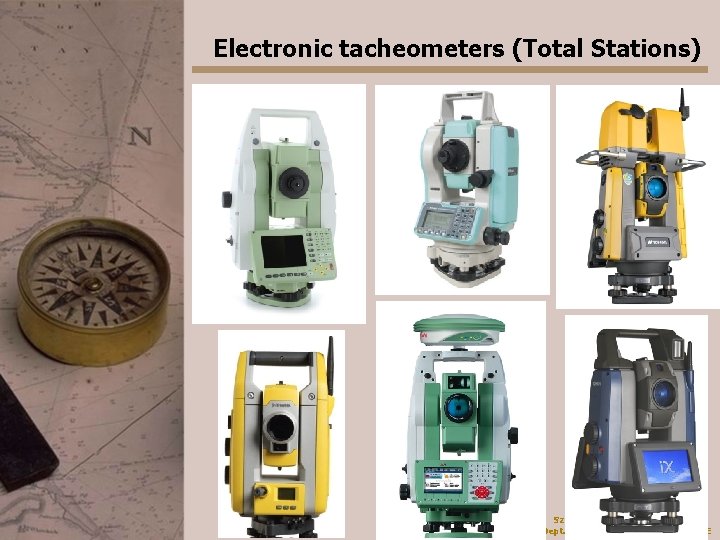
Electronic tacheometers (Total Stations) Szabolcs Rózsa, Lóránt Földváry Dept. of Geodesy and Surveying, BME
Electronic tacheometers (Total Stations) Important features: • automated distance measurements and angular observations; • the observations can be corrected for the effect of systematic error, and reduced to the MSL; • the data can be recorded for later use; • observation software enables the instrument to compute coordinates and stake out. Szabolcs Rózsa, Lóránt Földváry Dept. of Geodesy and Surveying, BME
Operation of Total Stations • Centering and leveling the instrument by the operator • observing the slope distance (ds), correcting the effect of the reflector constant, the frequency error and the meteorological correction; • the horizontal (Hz) and vertical (V) angles are read, and the effects of the collimation and index error are accounted for; • the horizontal distance (dh) and the elevation difference is (Dh) is computed (instrument and signal height must be entered previously); • the data set (ds, Hz, V) or (Hz, dh, Dh) is logged. Szabolcs Rózsa, Lóránt Földváry Dept. of Geodesy and Surveying, BME
Important software of Total Stations 1. Free station establishment The station coordinates are computed using angular and distance observations to known points (resection, arc-section and their combination). In most cases the orientation is also done. 2. Determination of the elevation of the station by trigonometric heighting to known stations. 3. Orientation of the horizontal circle by taking horizontal angle observations to known stations. 4. Computation of rectangular coordinates (N, E) using the polar coordinates (provisional WCB and horizontal distance) Szabolcs Rózsa, Lóránt Földváry Dept. of Geodesy and Surveying, BME
Important software of Total Stations 5. Tie distance The horizontal distance between two measured detail points can be computed using their coordinates. 6. Remote object by measuring the horizontal distance to the vertical of a remote object, and the zenith angle. Szabolcs Rózsa, Lóránt Földváry Dept. of Geodesy and Surveying, BME
Detail surveys using tacheometry Preparation • densification of control network; • finding suitable places for free station establishment. Detail survey • detail points of: • buildings; • linear objects (e. g. electric poles); • rectangular buildings; • arcs; • topography. Szabolcs Rózsa, Lóránt Földváry Dept. of Geodesy and Surveying, BME
Detail surveys using tacheometry Identifying the detail points • drawing a sketch of the area, and marking the detail points on it with ID numbers; • recording the coordinates or observations with the same ID numbers; • ensure that the two numberings are identical; Mapping the survey • marking the positions of the detail points in a given scale; • the elevation of topographic points should be written on the map; • contour lines are interpolated between the measured topographic points. Szabolcs Rózsa, Lóránt Földváry Dept. of Geodesy and Surveying, BME
Principle of Traversing deflection angle d. S 1 d 23 d 12 3 traverse point 2 traverse legs • Determine the WCB of the first leg; • measure the length of the first leg; • compute the coordinates of the traverse point No. 1, using the 1 st fundamental task of surveying; • measure the deflection angle at point 1; • compute the WCB of the second leg; • continue with step 2. Szabolcs Rózsa, Lóránt Földváry Dept. of Geodesy and Surveying, BME
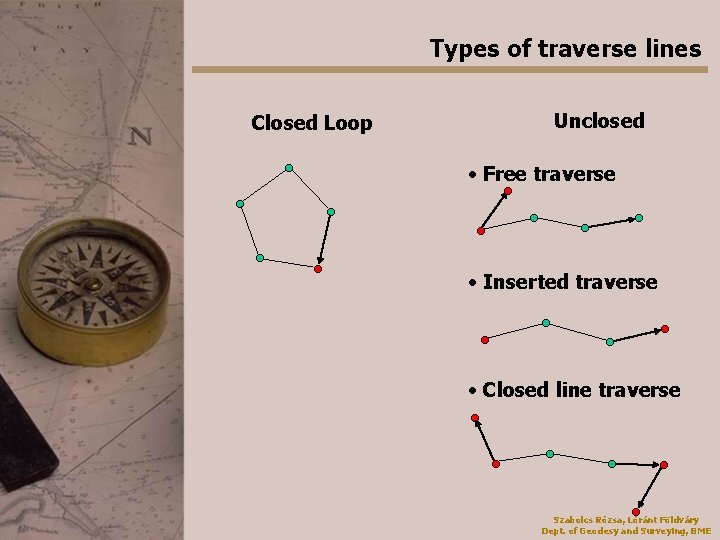
Types of traverse lines Closed Loop Unclosed • Free traverse • Inserted traverse • Closed line traverse Szabolcs Rózsa, Lóránt Földváry Dept. of Geodesy and Surveying, BME
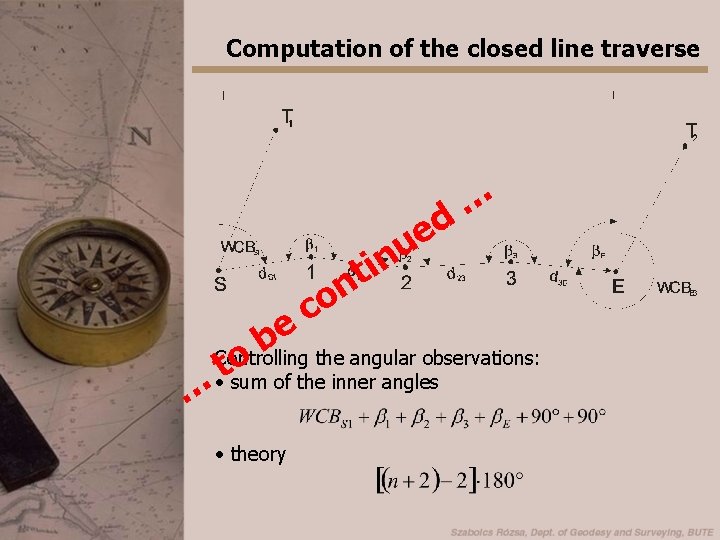
Computation of the closed line traverse d e u … n i t n o c … e b Controlling the angular observations: o t • sum of the inner angles • theory
Thank You for Your Attention!