
Surveying CALCULATING SURFACE AREAS OF IRREGULAR SHAPED FIELDS
- Slides: 24
Surveying CALCULATING SURFACE AREAS OF IRREGULAR SHAPED FIELDS
Computation of Area and Volume The main objective of the surveying is to compute the areas and volumes. Generally, the lands will be of irregular shaped polygons. There are formulae readily available for regular polygons like, triangle, rectangle, square and other polygons. But for determining the areas of irregular polygons, different methods are used.
CALCULATING SURFACE AREAS OF IRREGULAR SHAPED FIELDS A common problem for a surveyor is the calculation of the surface area of a farmer's field. The fields are often irregular which makes direct calculation of their areas difficult. In such case fields are divided into a number of regular areas (triangles, rectangles, etc. ), of which the surfaces can be calculated with simple formulas. All areas are calculated separately and the sum of these areas gives the total area of the field.
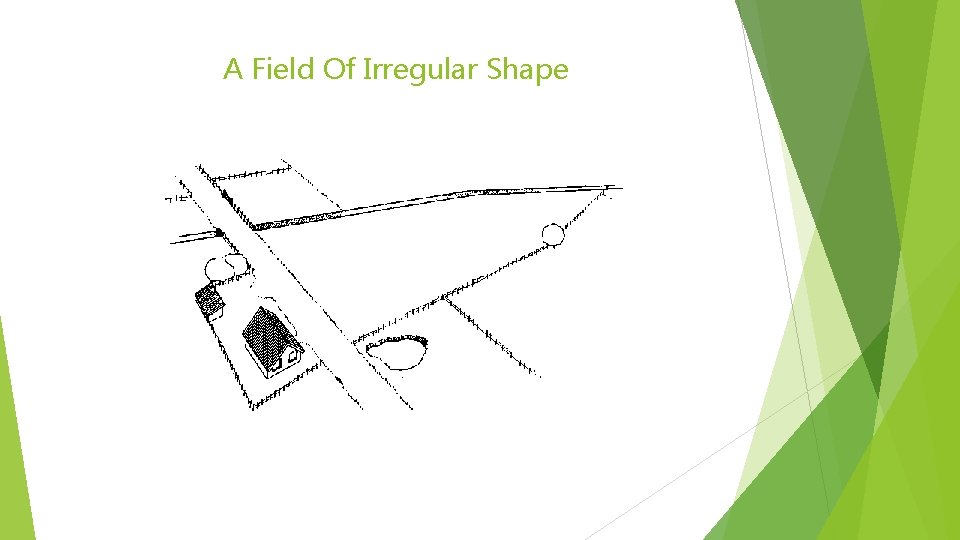
A Field Of Irregular Shape
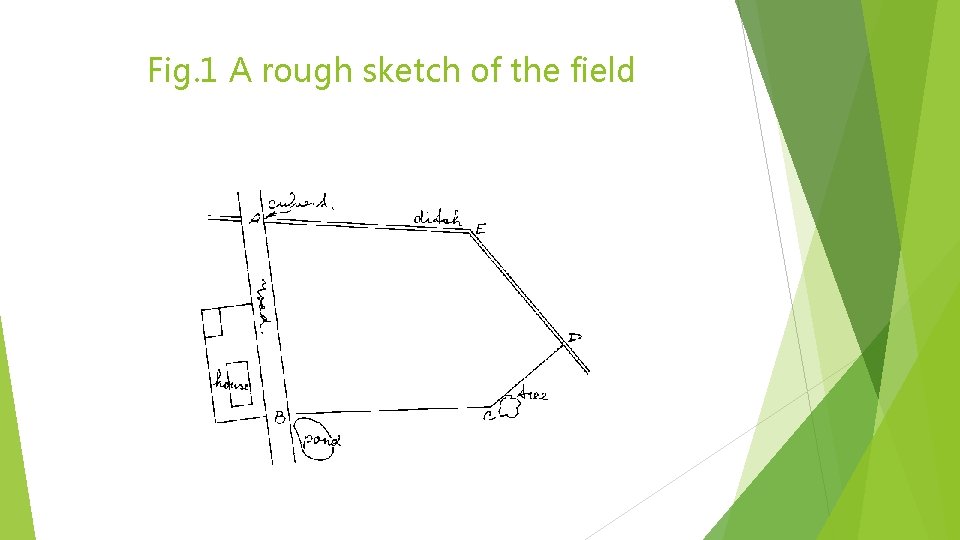
Example 1 Figure 1. shows a field with an irregular shape of which the surface area must be determined. The procedure to follow is: Step 1 Make a rough sketch of the field indicating the corners of the field (A, B, C, D and E) and the field borders (straight lines). In addition some major landmark! are indicated (roads, ditches, houses, trees, etc. ) that may help to locate the field.
Fig. 1 A rough sketch of the field
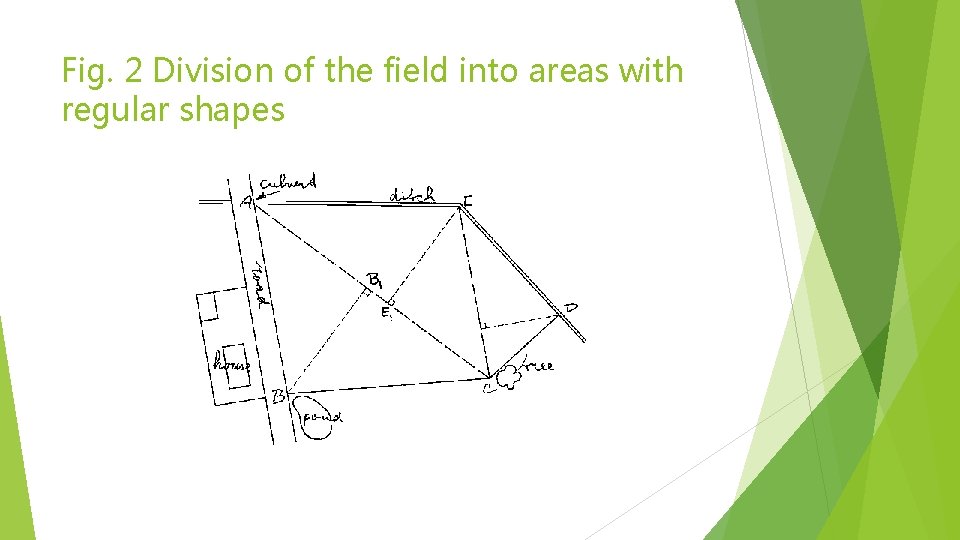
Step 2 Divide the field, as indicated on the sketch, into areas with regular shapes. In this example, the field can be divided into 3 triangles ABC (base AC and height BB, ), AEC (base AC and height EE 1) and CDE (base EC and height DD 1) (see Fig. 2).
Fig. 2 Division of the field into areas with regular shapes
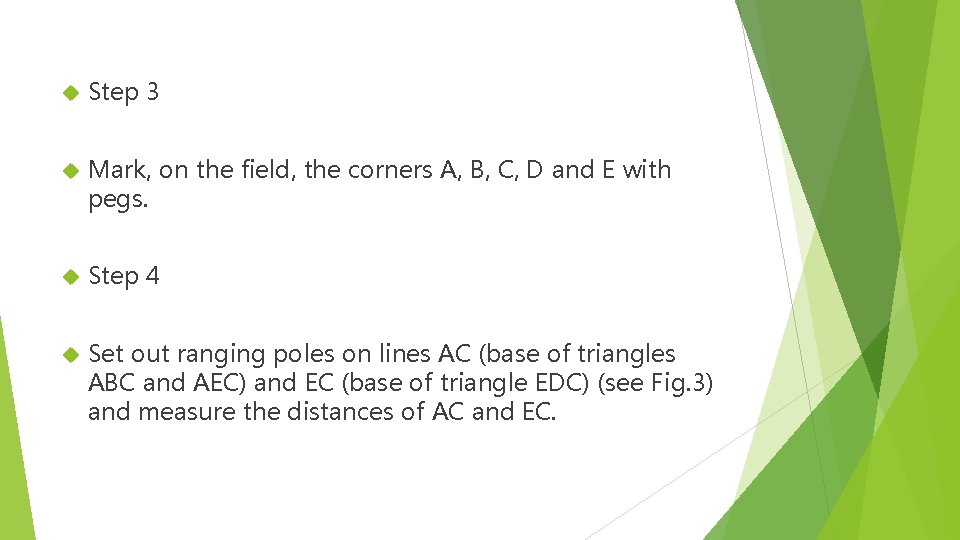
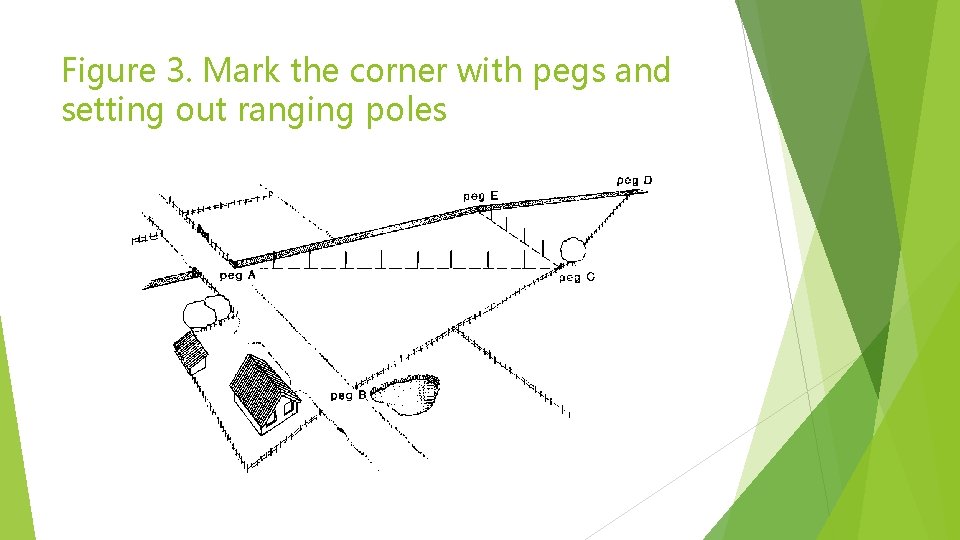
Step 3 Mark, on the field, the corners A, B, C, D and E with pegs. Step 4 Set out ranging poles on lines AC (base of triangles ABC and AEC) and EC (base of triangle EDC) (see Fig. 3) and measure the distances of AC and EC.
Figure 3. Mark the corner with pegs and setting out ranging poles
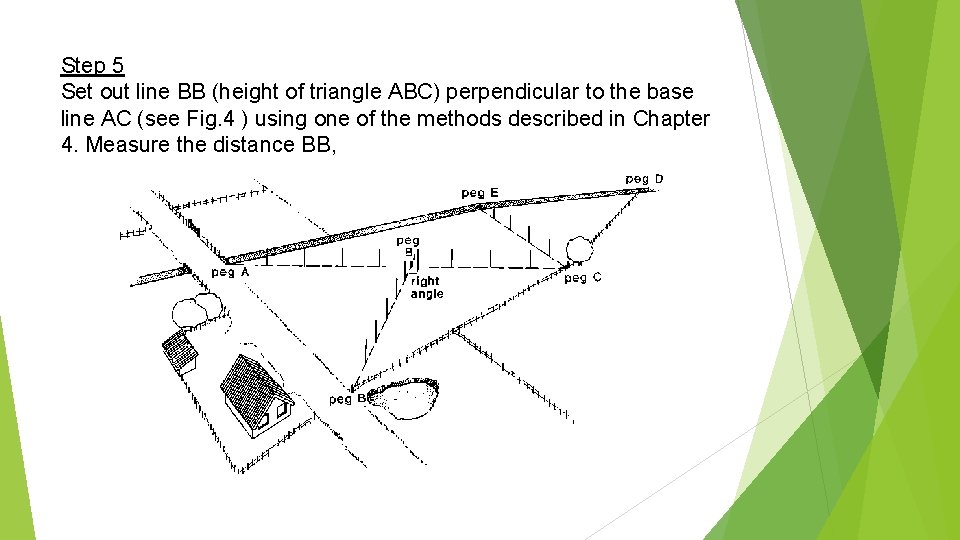
Step 5 Set out line BB (height of triangle ABC) perpendicular to the base line AC (see Fig. 4 ) using one of the methods described in Chapter 4. Measure the distance BB,
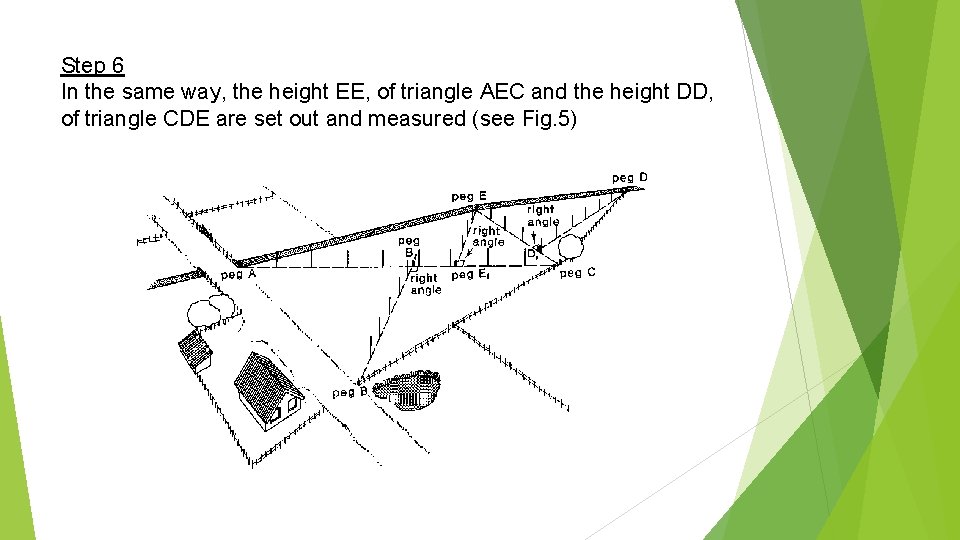
Step 6 In the same way, the height EE, of triangle AEC and the height DD, of triangle CDE are set out and measured (see Fig. 5)
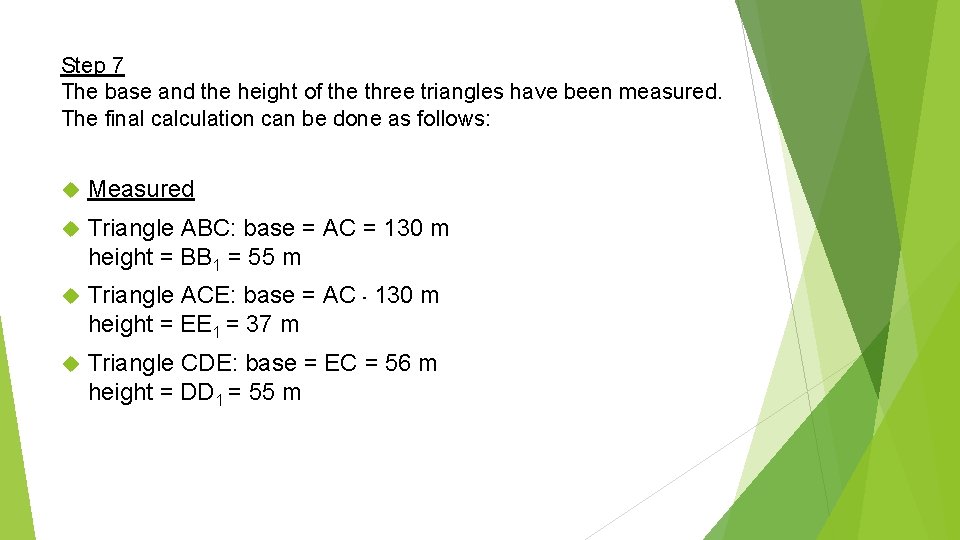
Step 7 The base and the height of the three triangles have been measured. The final calculation can be done as follows: Measured Triangle ABC: base = AC = 130 m height = BB 1 = 55 m Triangle ACE: base = AC 130 m height = EE 1 = 37 m Triangle CDE: base = EC = 56 m height = DD 1 = 55 m =
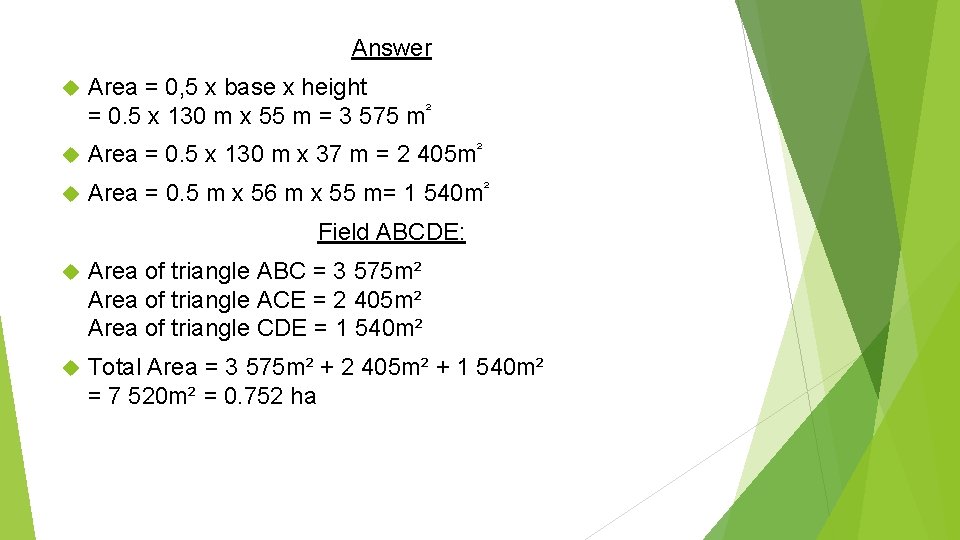
Answer Area = 0, 5 x base x height = 0. 5 x 130 m x 55 m = 3 575 m² Area = 0. 5 x 130 m x 37 m = 2 405 m² Area = 0. 5 m x 56 m x 55 m= 1 540 m² Field ABCDE: Area of triangle ABC = 3 575 m² Area of triangle ACE = 2 405 m² Area of triangle CDE = 1 540 m² Total Area = 3 575 m² + 2 405 m² + 1 540 m² = 7 520 m² = 0. 752 ha
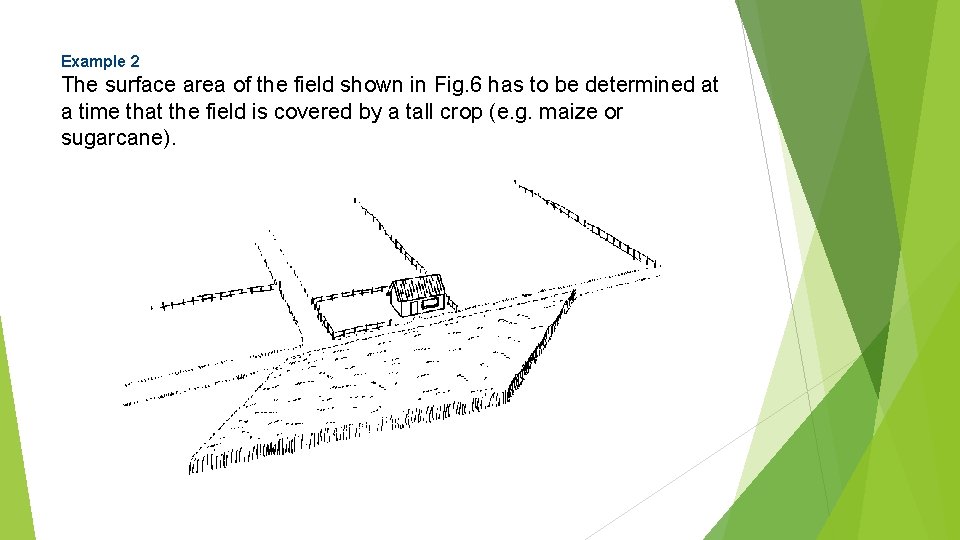
Example 2 The surface area of the field shown in Fig. 6 has to be determined at a time that the field is covered by a tall crop (e. g. maize or sugarcane).
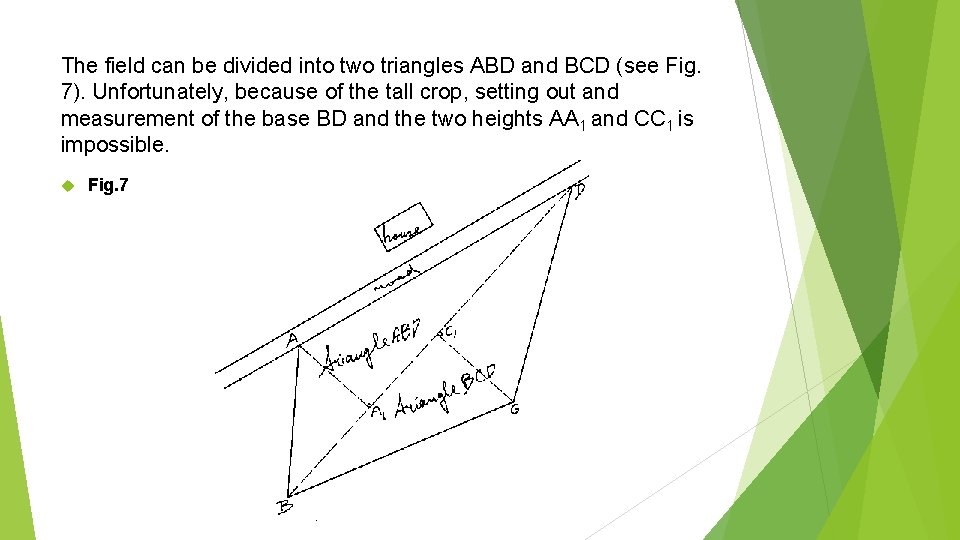
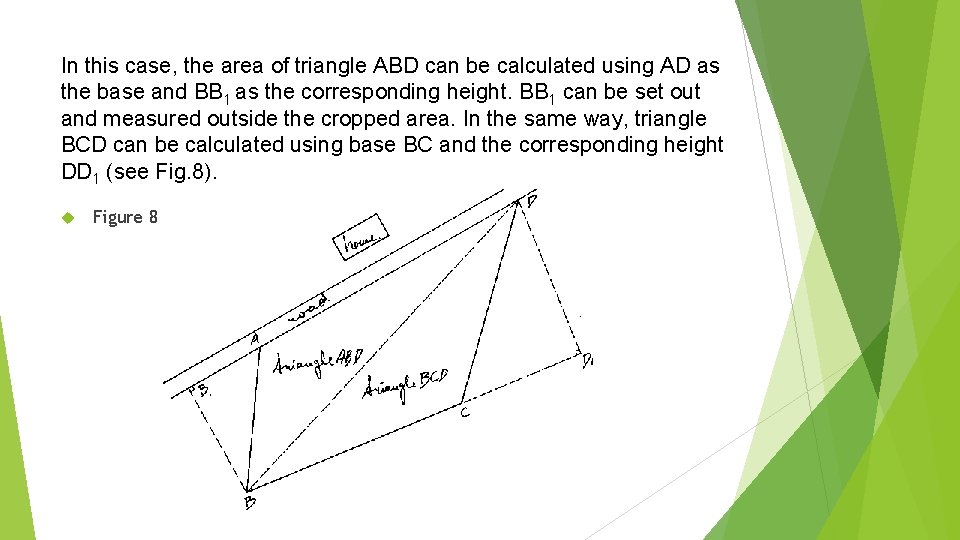
The field can be divided into two triangles ABD and BCD (see Fig. 7). Unfortunately, because of the tall crop, setting out and measurement of the base BD and the two heights AA 1 and CC 1 is impossible. Fig. 7
In this case, the area of triangle ABD can be calculated using AD as the base and BB 1 as the corresponding height. BB 1 can be set out and measured outside the cropped area. In the same way, triangle BCD can be calculated using base BC and the corresponding height DD 1 (see Fig. 8). Figure 8
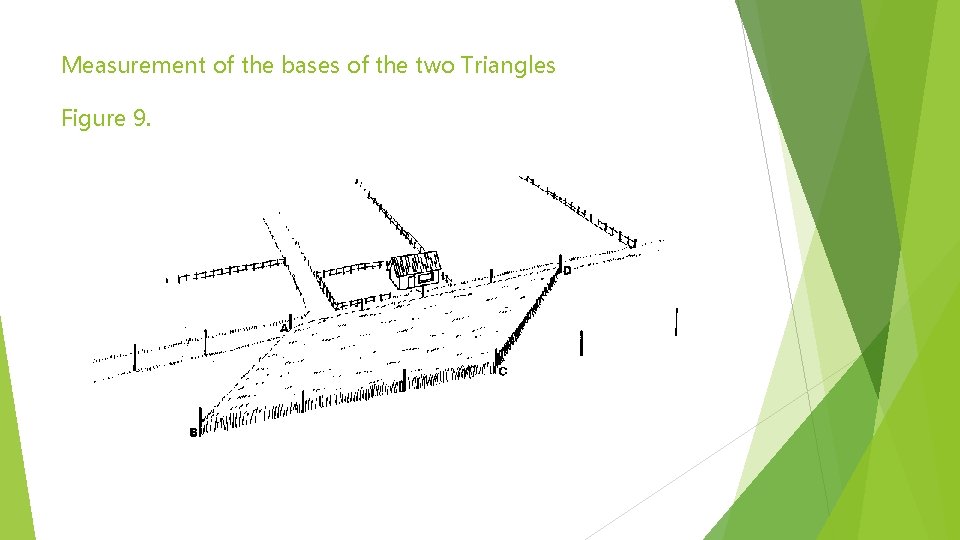
The procedure to follow on the field is: Step 1 Mark the 4 corners (A, B, C and D) with ranging poles. Step 2 Line AD is set out with ranging poles and extended behind A. Line BC is also set out and extended behind C (see Fig. 9). Measure the distances AD (base of triangle ADB) and BC (base of triangle BCD).
Measurement of the bases of the two Triangles Figure 9.
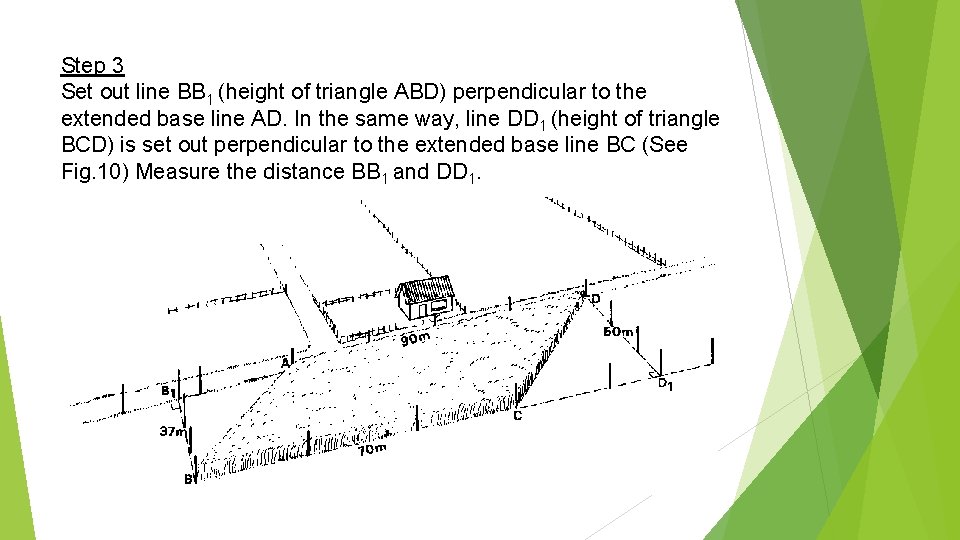
Step 3 Set out line BB 1 (height of triangle ABD) perpendicular to the extended base line AD. In the same way, line DD 1 (height of triangle BCD) is set out perpendicular to the extended base line BC (See Fig. 10) Measure the distance BB 1 and DD 1.
Step 4 The base and height of both triangles have been measured. The final calculations can be done as follows: Measured Triangle ABD: base = AD = 90 m height = BB 1 - 37 m Triangle BCD: base = BC = 70 m height = DD 1 - 50 m
Answer Area = 0. 5 x base x height = 0. 5 x 90 m x 37 m = 1 665 m² Area = 0. 5 x 70 m x 50 m = 1 750 m² Field ABDC: Area triangle ABD = 1 665 m² Area triangle BCD = 1 750 m² Total Area = 1 665 m² + 1 750 m² = 3 415 m² = 0. 3415 ha = approx. 0. 34 ha
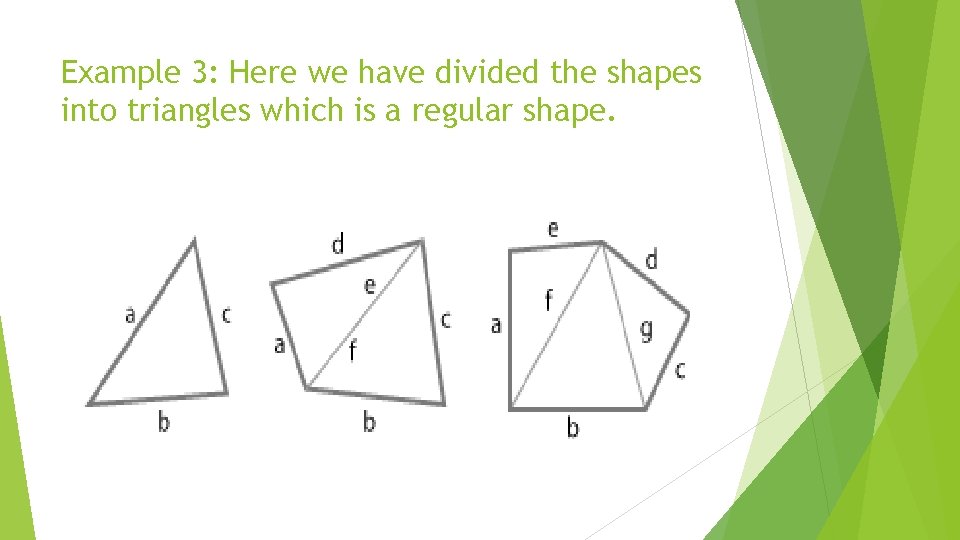
Example 3: Here we have divided the shapes into triangles which is a regular shape.
Example 3: Here we have divided the shapes into triangles which is a regular shape. Then, you can easily calculate the area of each triangle by using the Heron’s Formula. Heron's Formula: Area = √ s (s-a) x (s-b) x (s-c) Where: s = 0. 5 x ( a + b + c ) After calculating area of each triangle, simply add all of them to find the area of an irregular shape.