
Survey Statistics the past the present the future
- Slides: 55
Survey Statistics : the past, the present, the future Carl-Erik Särndal Statistics Sweden Örebro University Ba. No. Co. SS Höga Kusten, Sweden June 13 -17, 2011 -05 -12
Background of my talk : “The Canada Census Incident” The Government of Canada made Statistics Canada abandon “the long form” (systematic one-in-five households) for detailed 2011 census information, an d replace it with a voluntary National Household Survey (1/3 of all households) High degree of abstention (nonresponse) expected.
The Canada Census Incident The Government says : Respect the right of Canadians to refuse to divulge personal information. The Statisticians complain : Accuracy will suffer. The Users complain : Time series breaks; unreliable information about many groups in society.
The Canada Census Incident With the new design, Canada’s population will be shown as richer, better educated, more conservative than it is , at the expense of accurate information about small and disadvantaged groups.
The Canada Census Incident Question arising: Can non-statisticians tell professional statisticians how statistics of national importance should be produced ? Of similar kind : Can ordinary people tell surgeons how brain surgery, for example, should be carried out?
Questions arising • Could it be that official statistics production is so elementary, so lacking in established theory that questionable common sense can be allowed to take over ? • Information of unknown or doubtful accuracy, produced against better knowledge, is that nevertheless preferable to high quality information conforming to highest of standards? • Is official statistics production scientific ? If yes, to what extent ?
The Canada Census Incident it actually happened – regrettably
Outline of my talk Five brief comments : 1. Official statistics and scientific principles. 2. Statistical science vis-à-vis official statistics production. 3. Official statistics: a fragmented field 4. Survey methodology vis-à-vis survey theory 5. About the future
1. Official statistics and scientific principles. Main objective of an NSI : Deliver high quality statistics in high demand by users. The NSI: s – some at least - pride themselves in “scientific principles” Statistics Sweden : “The statistics produced rely on a scientific foundation”
1. Official statistics and scientific principles. There is not one unified (comprehensive) theory for official statistics. Article by Robert Groves (1987) titled: Survey research is a methodology without a unifying theory
1. Official statistics and scientific principles. No unifying theory for official statistics. If statistics production could point to a firm solid theory, enjoying the prestige of recent major scientific break-throughs, there would be no room for a Canada Census Incident.
1. Official statistics and scientific principles. Many observers (in high places) see official statistics production as a bundle of techniques with some theory here and there Statisticians are seen as technicians, “number-crunchers” Nevertheless they are very important people
1. Official statistics and scientific principles. NSI: s also recognize the absence of unifying theory. Statistics Canada (1998) : Survey Methodology is “a collection of practices, backed by some theory and empirical evaluation, among which practitioners have to make sensible choices in the context of a particular application”
1. Official statistics and scientific principles. The cited article by Groves (1987) about non-existence of unified theory: “A theory of surveys would unite social science concepts with the statistical properties of survey estimates” (i. e. , accuracy; bias and variance)
2. Statistical science vis-à-vis statistics production A central idea in statistical science, as taught in many universities : From a part (the sample), make probability statements about the whole (the population). This is statistical inference Statements - significant differences , confidence intervals - at specified level of probability
2. Statistical science vis-à-vis statistics production A central question in statistical science: “ How far from the truth ; “how close are we” The theory had its heyday in the 1930’s and 1940’s.
2. Statistical science vis-à-vis statistics production Official statistics production gives us “numbers about the population” as opposed to “inference about the population” as offered by Statistical science The usual concepts (confidence statements, etc. ) are not operational in official statistics. There they never say “we are this close to the truth”; they say instead “we do the best we can”
2. Statistical science vis-à-vis statistics production At this point of my presentation, some listeners start to feel uncomfortable : “What do you mean we don’t make inferences ? ” Reply: Statistics production does use statistical theory, in various bits and pieces also profits from theory from other sciences but it does not make inferences
2. Statistical science vis-à-vis statistics production Here, I am just asking myself some questions; sharing with you a perspective on values that we all hold as statisticians. A scientific view - from inside official statistics
2. Statistical science vis-à-vis statistics production Franchet and Nanopoulos (1997) article titled Statistical science and the European statistical system: expectations and perspectives “The methodology of official statistics is a notion that has to be distinctly understood from the notion of methodology in mathematical statistics” “The probabilistic formalism … of mathematical statistics has offered official statistics the necessary framework for its scientific foundation. ”
2. Statistical science vis-à-vis statistics production I see a wide gap between the principles of statistical science and the stark reality of today’s official statistics production
3. Official statistics production: a fragmented field Fragmentation (of a field of knowledge) is a concept in philosophy of science. Two of its aspects : (a) Competing theories within the field creates divisions (b) “Piecemeal theory” develops within a field that should be more unified Term Fragmentation not derogatory, just descriptive. Reference: Science, order, and creativity by D. Bohm and F. D. Peat (2000) David Bohm (1917 -1992), quantum physicist
3. Official statistics: a fragmented field There is fragmentation when divisions arise in a more or less arbitrary fashion without any regard for a wider context Ref: B&P p. 15
3. Official statistics: a fragmented field A sign of fragmentation is the emergence of separate groups of investigators, held together by common interest in a certain (limited) question. A group of people get together and work on the same problem, under a trademark name Official statistics has many examples : Imputation, Nonresponse weighting, Editing and data cleaning, Small area estimation, and so on
3. Official statistics: a fragmented field As time goes by, problem areas arise in a science, some become more and more “burning”, engender a phase of development. Theory develops within narrow sub-fields, pieces of theory, specializations inside the broader field, highly specific areas of knowledge, subcultures. So it is with statistics production: It has come to rely on “a collection of practices, backed by some theory here and there”
3. Official statistics: a fragmented field Some official statistics subcultures : In data treatment: Small area estimation Nonresponse weighting Imputation Editing and data cleaning In data delivery: Response burden Motivating respondents Confidentiality protection
3. Official statistics: a fragmented field Official statistics: Active groups, networks, exist a number of narrow specializations. Is this good, in the long run ? Where will it take us ? in
3. Official statistics: a fragmented field “Long range connections between the ideas is of crucial importance in the continued development of a field, and they cannot be dealt with in terms of narrow specializations” (Ref: B&P p. 71) Regrettable, but for official statistics production, is there an alternative ?
4. Survey theory versus Survey methodology In a history of science perspective, we need a distinction: Survey methodology – the collection of practices for (official) statistics production vis-à-vis Survey (statistics) theory - a mathematical field, rooted in a central idea of statistical science: From a part, make inference to the whole
Survey theory • is mathematical • the best of it has (over the years) had tremendous impact on practice • taught only in few universities Illustration: IASS jubilee commemorative volume 2001 (Landmark papers in Survey Statistics): 19 papers, almost all mathematical
Survey theory A division within Survey Theory is: • Design-based (probability sampling) theory, from 1930’s • Model–based theory, from 1970’s, as in Small area estimation.
Survey theory Classical (design-based) writers & pioneers : W. G. Cochran, W. E. Deming, M. H. Hansen, They were (applied) mathematicians with a keen understanding of the practical exigencies of surveys.
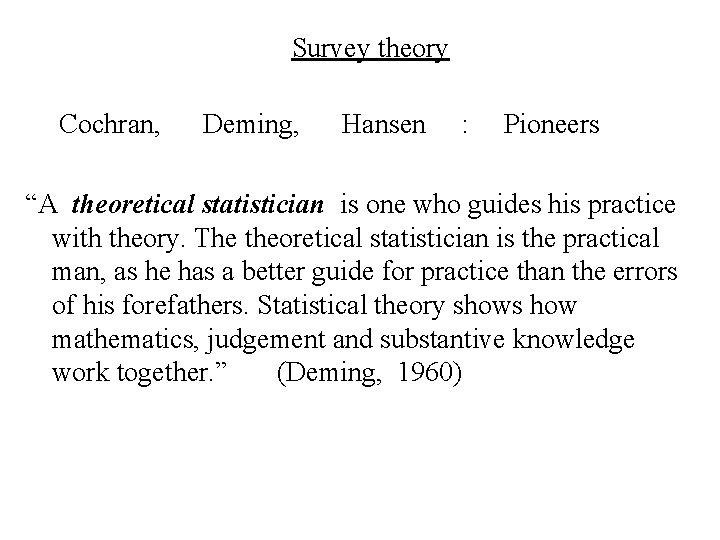
Survey theory Cochran, Deming, Hansen : Pioneers “A theoretical statistician is one who guides his practice with theory. The theoretical statistician is the practical man, as he has a better guide for practice than the errors of his forefathers. Statistical theory shows how mathematics, judgement and substantive knowledge work together. ” (Deming, 1960)
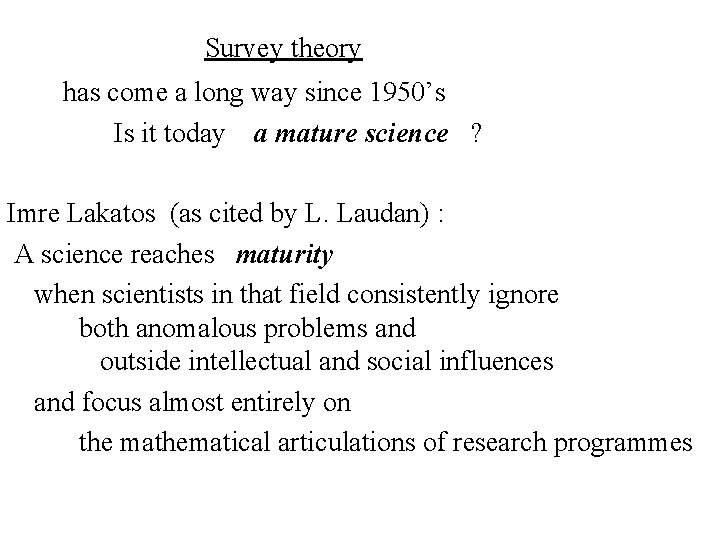
Survey theory has come a long way since 1950’s Is it today a mature science ? Imre Lakatos (as cited by L. Laudan) : A science reaches maturity when scientists in that field consistently ignore both anomalous problems and outside intellectual and social influences and focus almost entirely on the mathematical articulations of research programmes
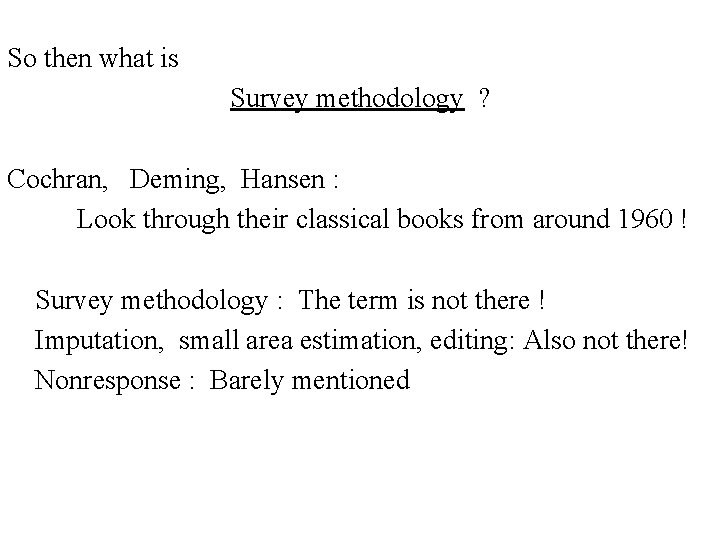
So then what is Survey methodology ? Cochran, Deming, Hansen : Look through their classical books from around 1960 ! Survey methodology : The term is not there ! Imputation, small area estimation, editing: Also not there! Nonresponse : Barely mentioned
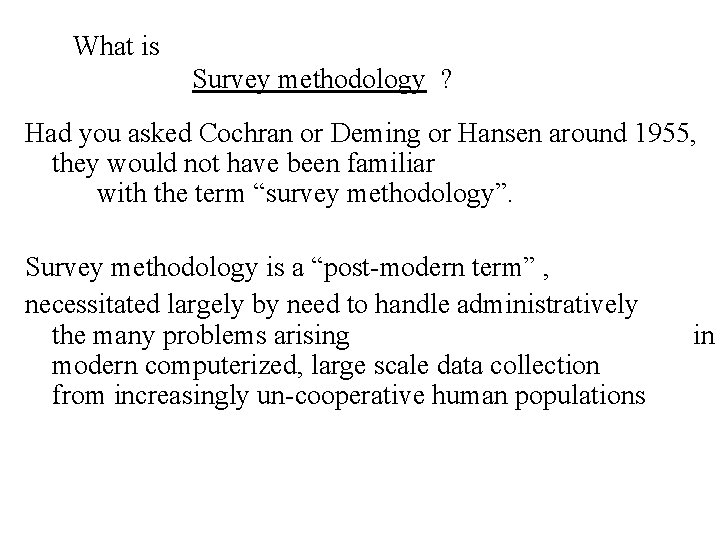
What is Survey methodology ? Had you asked Cochran or Deming or Hansen around 1955, they would not have been familiar with the term “survey methodology”. Survey methodology is a “post-modern term” , necessitated largely by need to handle administratively the many problems arising modern computerized, large scale data collection from increasingly un-cooperative human populations in
In the classical era, 1940’s to 60’s, Survey theory did exist. Survey methodology did not exist - as a term
Survey methodology Today, in the 2010’s , Survey methodology is: “A collection of practices, ” each piece lending a certain support to one of the steps in statistics production process (“the statistical value chain”) • Is nevertheless extremely valuable • Is systematically taught in very few places JPSM (USA) is a model; Europe lags behind
Survey methodology Composed of great variety of courses (e. g. , at JPSM) Data collection modes, Response behaviour, Interviewing, Pre-testing, Concern for data provider, Response burden, Confidentiality, and so on With more mathematical orientation : Imputation, Nonresponse weighting, Small area estimation, Editing, and so on
Survey methodology The scientific underpinnings for survey methodology stem not only from statistical science ; derive important elements also from : (Cognitive) Psychology Sociology (of interaction, of intergroup relations) Economics Political science and not in the least, Computer science
Survey theory vs. Survey methodology To summarize: To survey theory (as begun with Cochran, Deming, Hansen) has in modern times become attached a balloon of practices and techniques, necessitated by the complexity of modern times; This has given us modern survey methodology
The teaching of those fields : Statistical science taught in many universities Survey theory taught in very few universities Survey methodology and official statistics production taught systematically in very few places, but practiced in many
The statistician’s responsibility Can a statistician deliver ? is the title of an article in J. Official Statistics vol. 17 (2001), pp. 1 – 127 with 16 discussions and a rejoinder by the authors, R. Platek and C. E. Särndal Can a statistician fulfill his/her promise (to society) ? It is to deliver reliable statistics - isn’t it ?
Can a statistician deliver ? The 16 discussants : • Some say : Of course we cannot have a perfect theory for statistics production; the process is much too complex; they admit, if only reluctantly, that there is no objective measurement of accuracy in official statistics • Others say : “the glass is more than half full”
Can a statistician deliver ? Self-criticism: We, Platek and I, emphasized (perhaps too much) the statistical science view, its “idealistic obsession” with “valid inferences to the population” We did not point out that probability , the cornerstone of statistical science, is too limited a basis for official statistics
Can a statistician deliver ? Official statistics production has “outgrown” statistical science Probability, the basis of statistical science is “too narrow” an instrument for official statistics
Can we deliver ? Probability and probable error play little or no role when people look at “published numbers” ; they see them as “the truth” Franchet and Nanopoulos (1997), in : Statistical science and the European statistical system “Very often, almost always, statistical results are presented as the pure truth, expressed through exact figures. . No confidence intervals are given, no methods of estimation are presented and no tests of significance are operated”
5. The future ? Back to my “questions arising” : • Could it be that official statistics production is so elementary, so lacking in established theory that questionable common sense can take over ? • Information of unknown or doubtful accuracy produced against better knowledge, is it nevertheless preferable to high quality information, conforming to highest of standards?
5. The future ? The NSI needs a protective armour, a shield for its mission to “produce official statistics” for the nation In the past, this was not so necessary the NSI was the unchallenged supreme instance of statistical competence - there was trust Today, the NSI is vulnerable.
5. The future ? The NSI needs a shield for its ways of doing Why ? Because there is • competition, from sometimes less trustworthy competitors • pressures from “high places” • demands for more and more data on more and more things • scarcity of resources In the face of all this, the nation’s statistical high authority (the NSI) must demonstrate firm, competent delivery
5. The future ? Today, the NSI refers to : “A bundle of techniques” in “the statistical value chain” with “some theory here and there” (from statistical and other sciences) It is a weak protection. It is too easy to poke holes in that defence, by anyone who so chooses, e. g. , the government
5. The future ? Information of unknown or doubtful accuracy, perhaps produced against better knowledge, is that nevertheless preferable (for society) to quality information, conforming to the highest of standards? Not many have the opportunity (or the courage) to ask that difficult question It lies at the heart of the Canada Census Incident.
5. The future ? My hope for the future: That we be better able to show that sound, unifying, comprehensive theory can be brought in support of “accurate and useful information” for policy decisions in the nation’s interest A danger lies in a more or less uncontrolled growth, an expanding balloon of “a collection of practices” , a fuzzy constellation without sharp contours (that is, more and more fragmentation)
5. The future ? In particular, what can survey theory mathematically oriented survey science) contribute ? (the
References Bohm, D. and Peat, F. D. (2000). Science, Order, and Creativity, 2 nd edn. London: Routledge. Franchet, Y. and Nanopoulos, P. (1997). Statistical science and the European statistical system: Expectations and perspectives. In Proc. Conference in honour of S. Franscini. Basel: Birkhäuser. Groves, R. (1987). Survey research is a methodology without a unifying theory. Public Opinion Quarterly, 51, 156 -172. Lakatos, I. (1970). A chapter in: Criticism and the Growth of Knowledge. Cambridge Univ. Press. Laudan, L. (1977). Progress and its Problems. Toward a theory of scientific growth. LA: Univ. of California Press. Platek, R. and Särndal, C. E. (2001). Can a statistician deliver? J. Official Statistics, 17, 1 – 127 (with 16 discussions)