
Survey Research Examples of your survey questions People


- Slides: 12
Survey Research
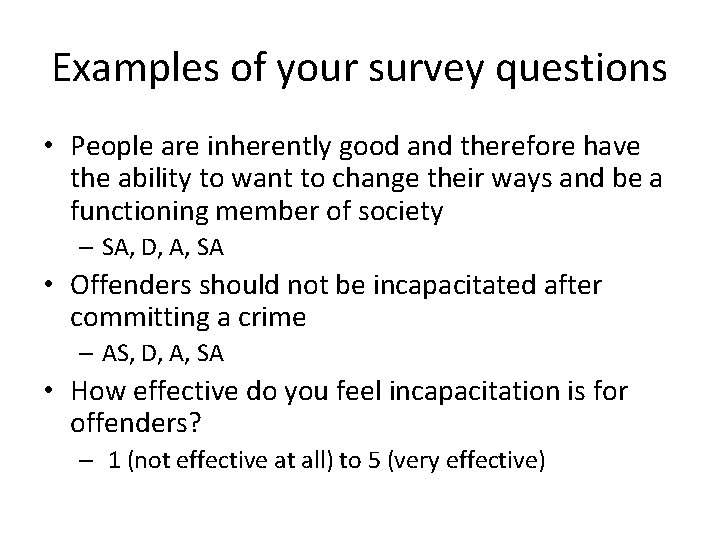
Examples of your survey questions • People are inherently good and therefore have the ability to want to change their ways and be a functioning member of society – SA, D, A, SA • Offenders should not be incapacitated after committing a crime – AS, D, A, SA • How effective do you feel incapacitation is for offenders? – 1 (not effective at all) to 5 (very effective)
Survey Basics • Definition of “survey” research • Types of survey research – Self-administered • Paper/pencil, internet (email)… – Interview • Phone, in-person
Rules of Engagement – statement vs. question – closed vs. open • Good closed-ended questions = mutually exclusive and exhaustive – Some exceptions here – Avoid “double-barreled questions” – Shorter is better – Avoid negative items – Avoid Bias – Global questions vs. specific – MUST BE CLEAR (meaning of “Native Americans”) – Should be relevant
Questionnaire construction • General Formatting – DON’T SQUISH! • • • Contingency questions (why use, how use) Matrix questions (upside/downside) Ordering items Instructions ALWAYS PRE-TEST (best way to find errors)
Self-administered surveys • Methods – Administer to group – Mail survey • How to increase response rates (why key issue? ) – Acceptable response rate? + Can you show whethere is bais? – Dillman “Total design method” – The devil is in the details » Bulk vs. stamps – FOLLOW UP MAILINGS
Interviews • In person – Upside • Response rates, fewer skipped questions, interviewers can observer and record other stuff… – Downside • Interviewer bias • Telephone – Upside • Efficient, most have phone, personal safety, control over data collection… – Downside? – The “CATI” system
The internet as a way to survey • Largest Objection? – Access – Bias • Still legitimate uses – Survey users of certain types of pages
Review of Survey Methods • Self-Administered – Mail, large groups, internet – Benefits? • Interview – Phone – In-Person – Benefits?
Surveys vs. Other Research Methods • Strengths – Large sample size – Flexibility – RELIABILITY • Weaknesses – Standardization (superficial? ) – Cannot usually change/adapt during study – Validity
Secondary Data Analysis • Definition • Capitalize on other people’s survey research – Some surveys started for the sole purpose of secondary research (NYS, NLSY, GSS) • Possible use for UROP and/or 3155 project • Examples – ICPSR – Other repositories • GSS data
Meta-analysis • • The analysis of others analyses Collect individual research studies A “Quantitative” review of literature Examples – Predictors of correctional officer attitudes and intentions to quit – Does rehabilitation reduce offending? What types of rehabilitation programs have the largest effect on crime?