
Survey Research Designs Outline of Todays Discussion 1



- Slides: 15
Survey Research Designs
Outline of Today’s Discussion 1. Survey Research Designs 2. In-Class Exercise on Survey Designs
Part 1 Survey Research Designs
Survey Research Designs 1. One of the most important decisions in survey research pertains to determining the overall design of the study. 2. Cross-Sectional Design - multiple samples are drawn from the population, at one time. 3. Examples? 4. What are some possible limitations of a crosssectional design?
Survey Research Designs 1. Successive Independent Samples Design - a series of cross-sectional studies are conducted over time (successively). 2. It is important that (a) the same questions are asked on each occasion, (b) the different samples (over time) should be drawn from the same population. 3. Examples? 4. What are some possible limitations of a successive independent samples design?
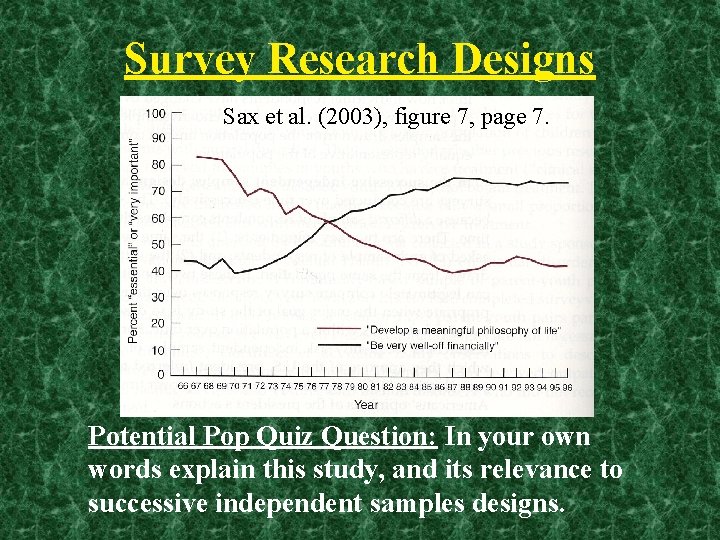
Survey Research Designs Sax et al. (2003), figure 7, page 7. Potential Pop Quiz Question: In your own words explain this study, and its relevance to successive independent samples designs.
Survey Research Designs 1. Longitudinal Design - The sample of respondents is surveyed more than once (mnemonic “longitudinal is a over a long time”). 2. What are some pros and cons associated with longitudinal designs?
Survey Research Designs 1. On the issue of longitudinal designs, what is meant by attrition (sometimes also called “mortality”)? 2. Potential Pop Quiz Question: Explain how the issue of respondent attrition is related to the issue of response bias. (Note: This requires a lot of critical thinking. You can do it!)
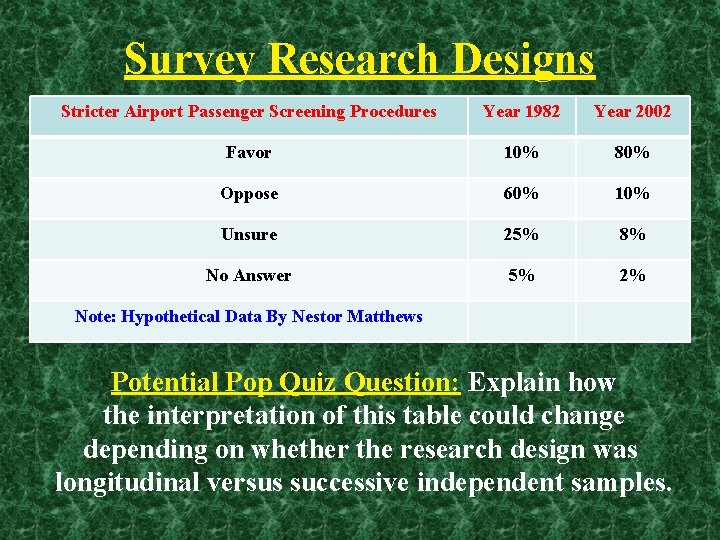
Survey Research Designs Stricter Airport Passenger Screening Procedures Year 1982 Year 2002 Favor 10% 80% Oppose 60% 10% Unsure 25% 8% No Answer 5% 2% Note: Hypothetical Data By Nestor Matthews Potential Pop Quiz Question: Explain how the interpretation of this table could change depending on whether the research design was longitudinal versus successive independent samples.
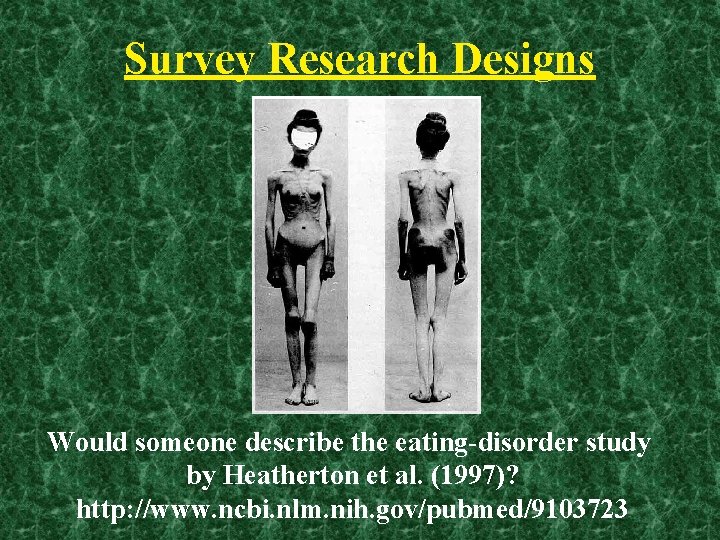
Survey Research Designs Would someone describe the eating-disorder study by Heatherton et al. (1997)? http: //www. ncbi. nlm. nih. gov/pubmed/9103723
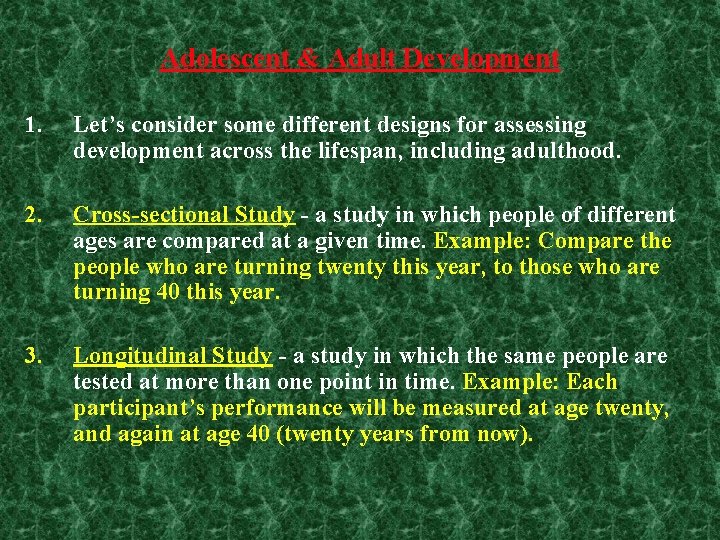
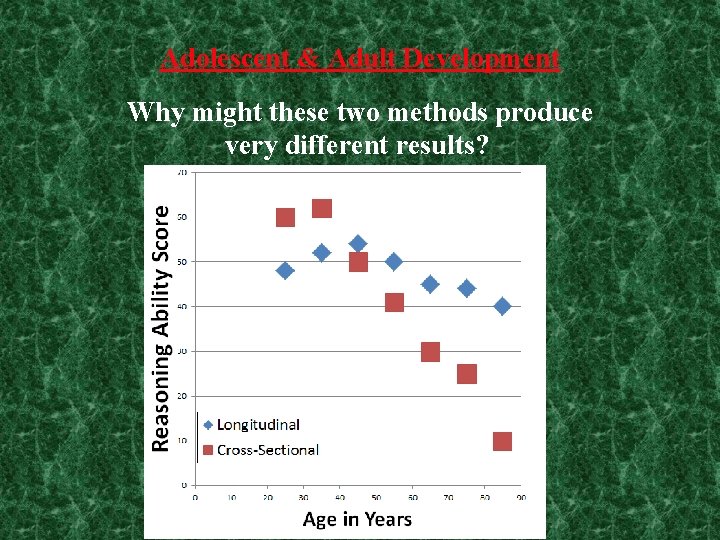
Adolescent & Adult Development 1. Let’s consider some different designs for assessing development across the lifespan, including adulthood. 2. Cross-sectional Study - a study in which people of different ages are compared at a given time. Example: Compare the people who are turning twenty this year, to those who are turning 40 this year. 3. Longitudinal Study - a study in which the same people are tested at more than one point in time. Example: Each participant’s performance will be measured at age twenty, and again at age 40 (twenty years from now).
Adolescent & Adult Development Why might these two methods produce very different results?
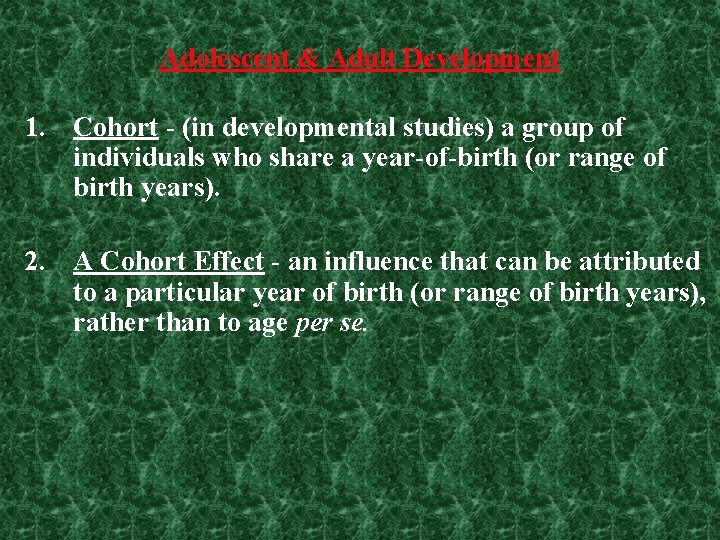
Adolescent & Adult Development 1. Cohort - (in developmental studies) a group of individuals who share a year-of-birth (or range of birth years). 2. A Cohort Effect - an influence that can be attributed to a particular year of birth (or range of birth years), rather than to age per se.
Part 2 In-class Exercise On Survey Designs
Acknowledgments Images used in this educational presentation were obtained from Wikimedia Commons, in accordance with regulations regarding copyright, use, and dissemination. http: //commons. wikimedia. org/wiki/Main_Page Sax, L. J. , Astin, A. W. , Lindholm, J. A. , Korn, W. S. , Saenz, V. B. , Mahoney, K. M. (2003). The American Freshman: National Norms for Fall 2003. Los Angeles, Higher Education Research Institute.