
Survey of Accounting Electronic Presentation by Douglas Cloud
Survey of Accounting Electronic Presentation by Douglas Cloud Pepperdine University Carl S. Warren

Task Force Clip Art included in this electronic presentation is used with the permission of New Vision Technology of Nepean Ontario, Canada.
Chapter 1 The Role of Accounting in Business
Learning Objectives 1. Describe the types and forms of businesses, business strategies, value. After chains, and stakeholders. studying this 2. Describe three business chapter, youactivities should of financing, investing, and operating. be able to: 3. Define accounting and explain its role in business. 4. Describe and illustrate the basic financial statements and how they interrelate. 5. Describe eight basic accounting concepts underlying financial reporting. 6. Describe and illustrate the use of horizontal analysis to analyze and evaluate a company’s performance.

Learning Objective 1 Describe the types and forms of businesses, business strategies, value chains, and stakeholders.
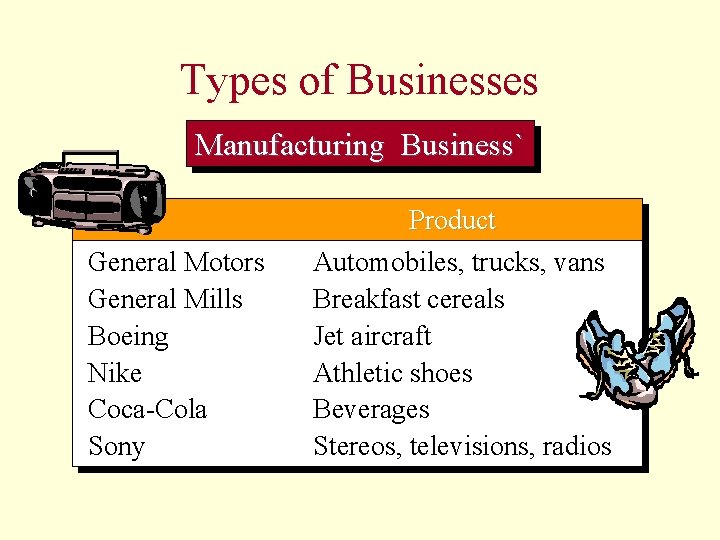
Types of Businesses Manufacturing Business` General Motors General Mills Boeing Nike Coca-Cola Sony Product Automobiles, trucks, vans Breakfast cereals Jet aircraft Athletic shoes Beverages Stereos, televisions, radios
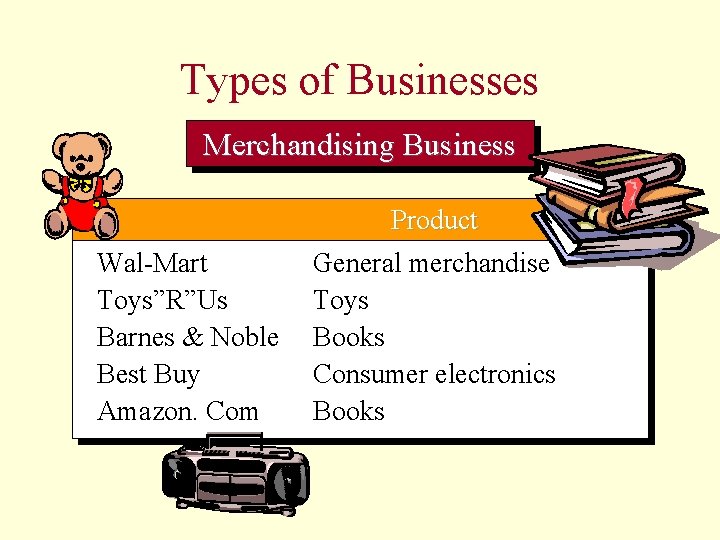
Types of Businesses Merchandising Business Wal-Mart Toys”R”Us Barnes & Noble Best Buy Amazon. Com Product General merchandise Toys Books Consumer electronics Books
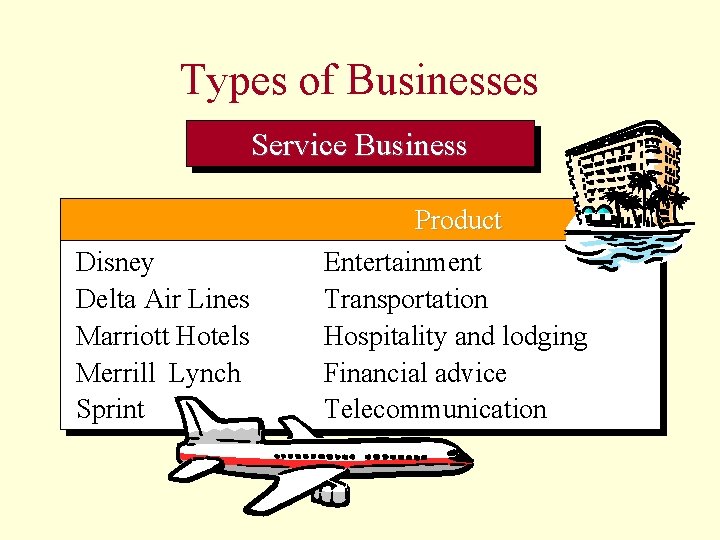
Types of Businesses Service Business Disney Delta Air Lines Marriott Hotels Merrill Lynch Sprint Product Entertainment Transportation Hospitality and lodging Financial advice Telecommunication
There are three forms of business organizations ü Proprietorship ü Partnership ü Corporation
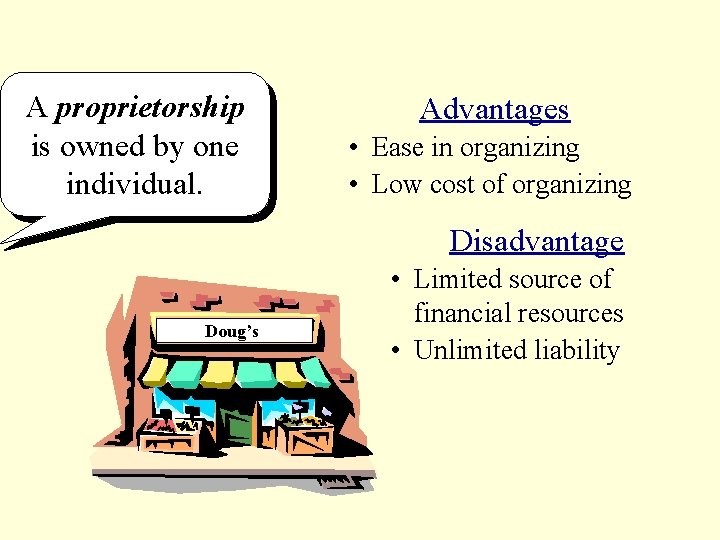
A proprietorship is owned by one individual. Advantages • Ease in organizing • Low cost of organizing Disadvantage Doug’s • Limited source of financial resources • Unlimited liability
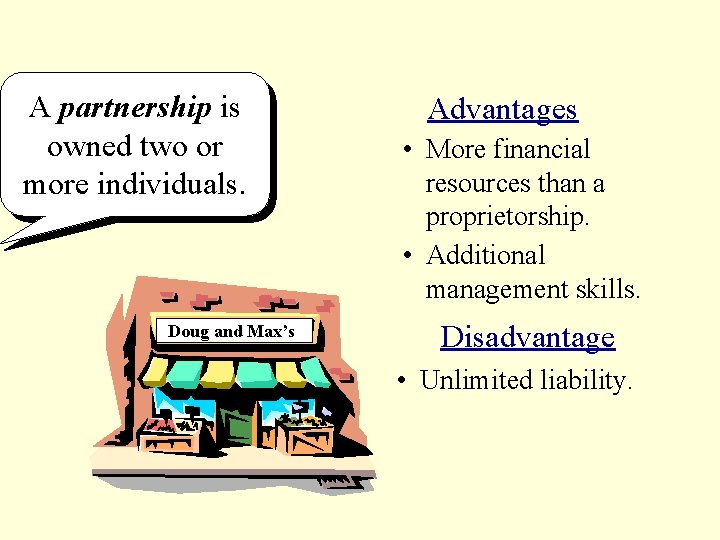
A partnership is owned two or more individuals. Doug and Max’s Advantages • More financial resources than a proprietorship. • Additional management skills. Disadvantage • Unlimited liability.
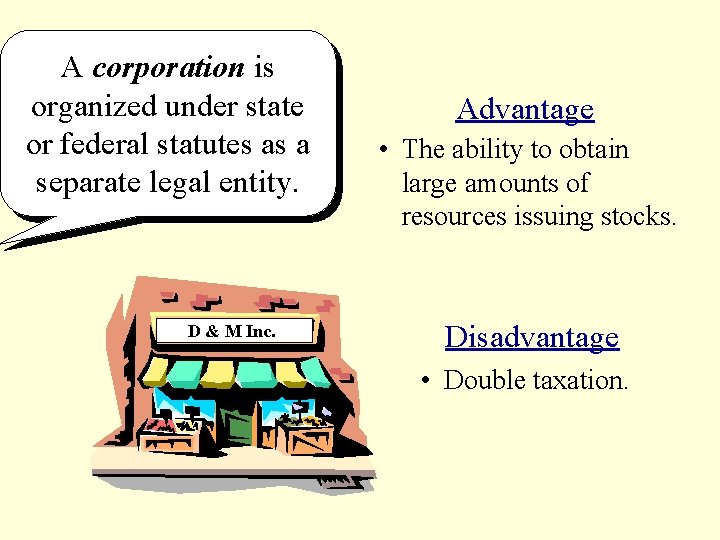
A corporation is organized under state or federal statutes as a separate legal entity. D & M Inc. Advantage • The ability to obtain large amounts of resources issuing stocks. Disadvantage • Double taxation.
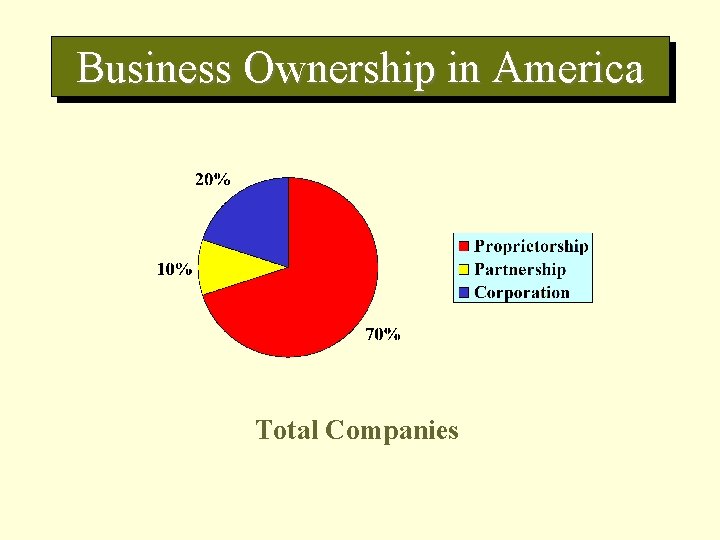
Business Ownership in America Total Companies
Business Strategy A business strategy is an integrated set of plans and actions designed to enable the business to gain an advantage over its competitors, and to maximize profits.
Differentiation Strategy Under a differentiation strategy, a business designs and produces a product or service that possess unique attributes or characteristics for which customers are willing to pay a premium price.
Business Stakeholders A business stakeholder is a person or entity that has an interest in the economic performance and wellbeing of a business.
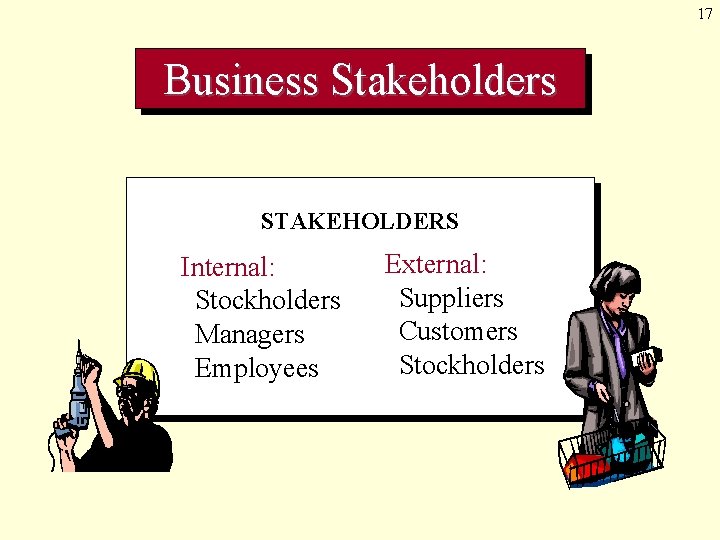
17 Business Stakeholders STAKEHOLDERS Internal: Stockholders Managers Employees External: Suppliers Customers Stockholders
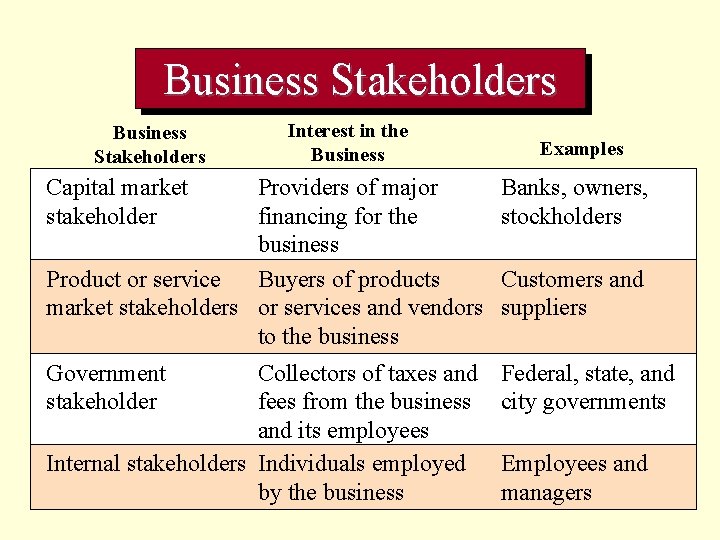
Business Stakeholders Interest in the Business Capital market stakeholder Examples Providers of major financing for the business Product or service Buyers of products market stakeholders or services and vendors to the business Banks, owners, stockholders Government stakeholder Federal, state, and city governments Collectors of taxes and fees from the business and its employees Internal stakeholders Individuals employed by the business Customers and suppliers Employees and managers
Learning Objective 2 Describe three business activities of financing, investing, and operating.
20 Financing Activities Financing activities involve obtaining funds to begin and operate a business.
Financing Activities Businesses seek financing by: üborrowing üissuing shares of ownership
Financing Activities A liability is a legal obligation to repay the amount borrowed according to the terms of the borrowing agreement.
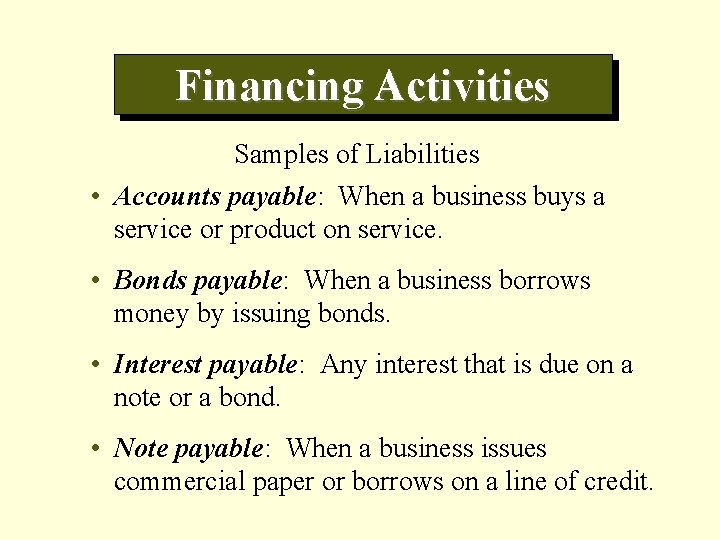
Financing Activities Samples of Liabilities • Accounts payable: When a business buys a service or product on service. • Bonds payable: When a business borrows money by issuing bonds. • Interest payable: Any interest that is due on a note or a bond. • Note payable: When a business issues commercial paper or borrows on a line of credit.
Financing Activities A business may also finance its operations by issuing shares of stock. The basic type of stock is called common stock.
Investing Activities Investing activities involve the selection and management of long-term resources that will be used to develop, produce, and sell goods and services.
Investing Activities Assets are resources that the business owns or are otherwise under its legal control and available for use in the future. What are assets?
Investing Activities When the business sells merchandise or services to a customer, the right to collect is an account receivable.
Operating Activities What is revenue? Revenue is the increase in assets from selling products or services. Revenue is often identified according to its source, such as Rent Revenue.
Operating Activities An expense is a decrease in assets or an increase in liabilities from producing and delivering goods or providing services that constitute the primary operating activities of an organization. What is an expense?
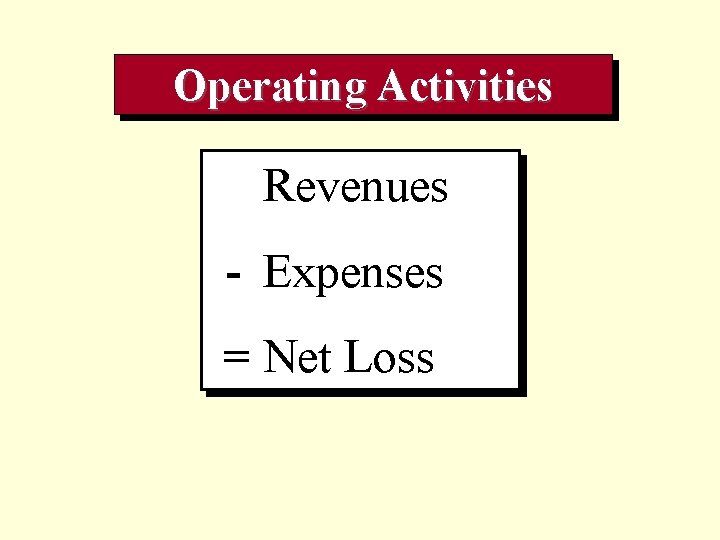
Operating Activities Revenues - Expenses = Net Loss Income
Learning Objective 3 Define accounting and its role in business.
What is accounting? Accounting is an information system that provides reports to stakeholders about the economic activities and condition of a business.
Major objectives of financial accounting 1. To report the financial condition of a business at a point in time. 2. To report changes in the financial condition of a business over a period of time.
Learning Objective 4 Describe and illustrate the basic financial statements and how they interrelate.
Income Statement An income statement is a summary of the revenue and the expenses for a specific period of time. Reports change in financial Objective: condition
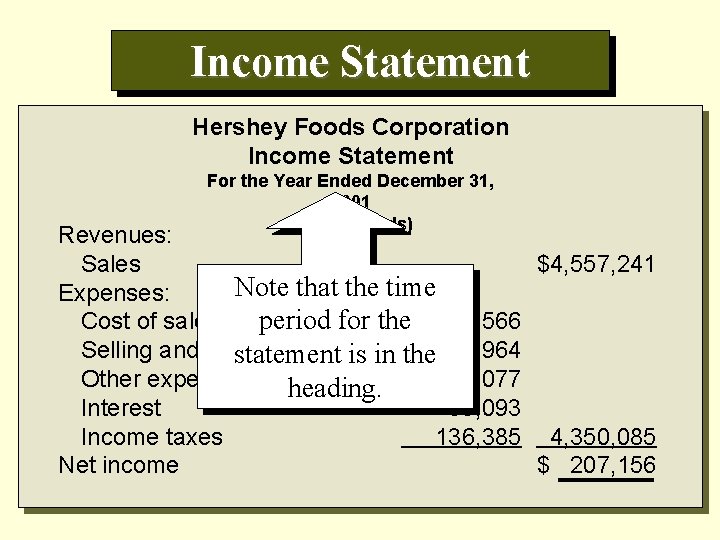
Income Statement Hershey Foods Corporation Income Statement For the Year Ended December 31, 2001 (in thousands) Revenues: Sales $4, 557, 241 Note that the time Expenses: Cost of sales period for the$2, 665, 566 Selling and administrative 1, 269, 964 statement is in the Other expenses 209, 077 heading. Interest 69, 093 Income taxes 136, 385 4, 350, 085 Net income $ 207, 156
Retained Earnings Statement The retained earnings statement reports changes in financial condition due to changes in retained earnings. Reports change in financial Objective: condition
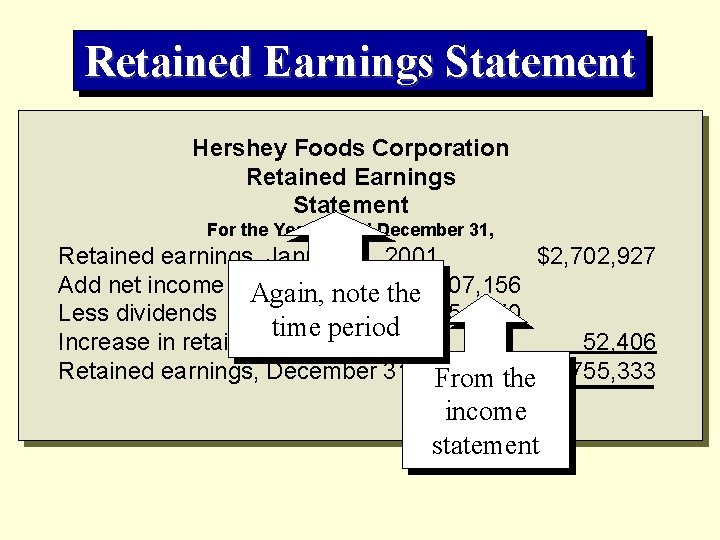
Retained Earnings Statement Hershey Foods Corporation Retained Earnings Statement For the Year Ended December 31, 2001 earnings, January 1, 2001 (in thousands) Retained $2, 702, 927 Add net income Again, note the$207, 156 Less dividends 154, 750 time period Increase in retained earnings 52, 406 Retained earnings, December 31, 2001 From the$2, 755, 333 income statement
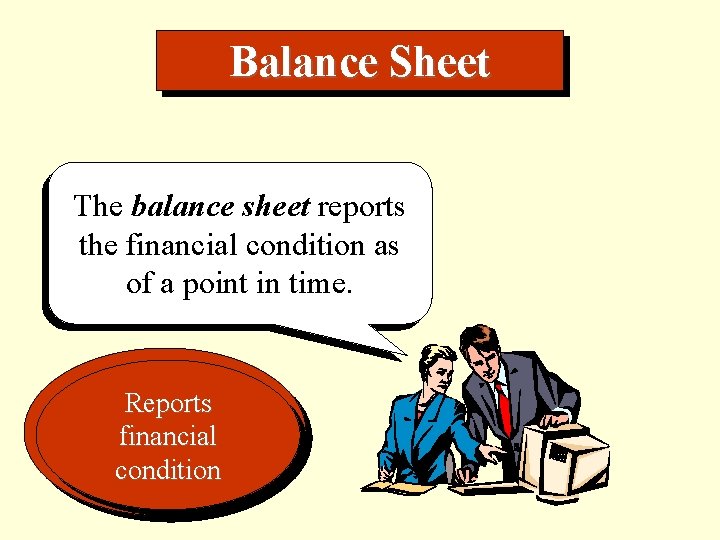
Balance Sheet The balance sheet reports the financial condition as of a point in time. Reports financial Objective: condition
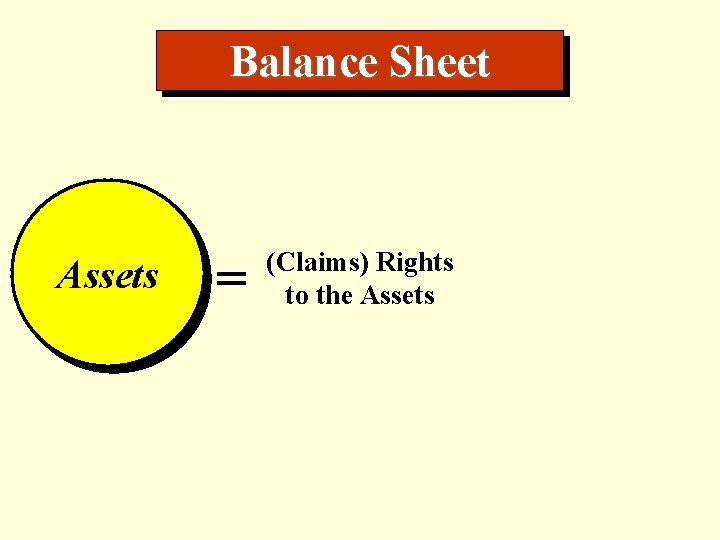
Balance Sheet Assets = (Claims) Rights to the Assets
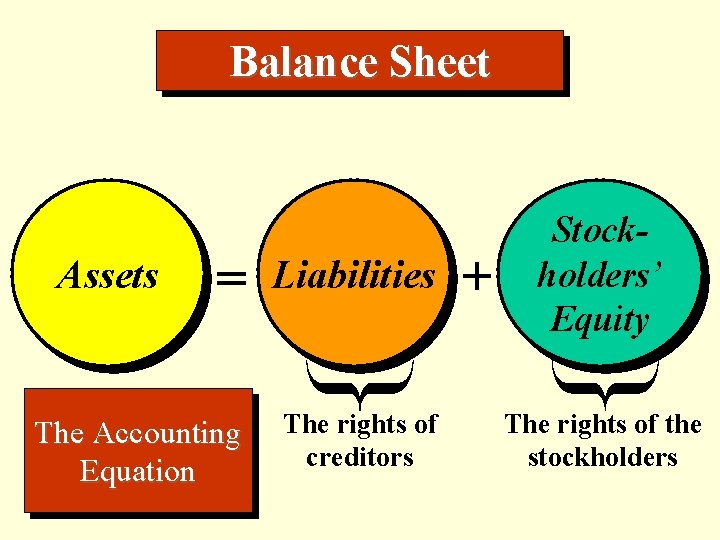
Balance Sheet = Liabilities The Accounting Equation The rights of creditors Assets + Stockholders’ Equity The rights of the stockholders
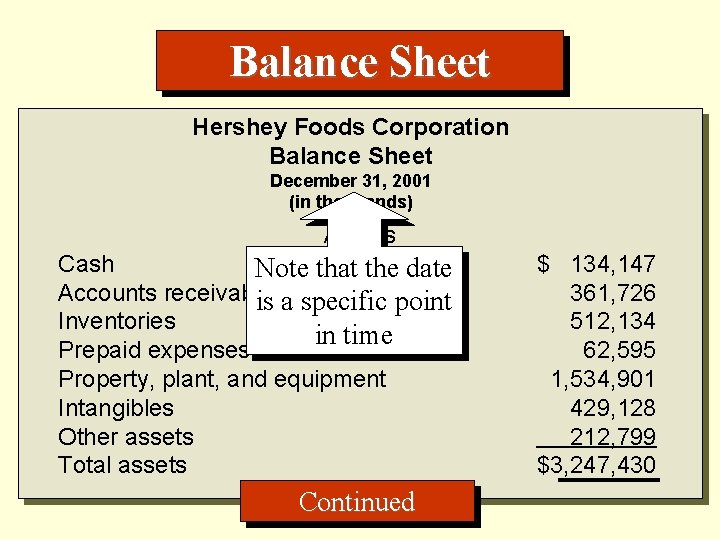
Balance Sheet Hershey Foods Corporation Balance Sheet December 31, 2001 (in thousands) Assets Cash Note that the date Accounts receivable is a specific point Inventories in time Prepaid expenses Property, plant, and equipment Intangibles Other assets Total assets Continued $ 134, 147 361, 726 512, 134 62, 595 1, 534, 901 429, 128 212, 799 $3, 247, 430
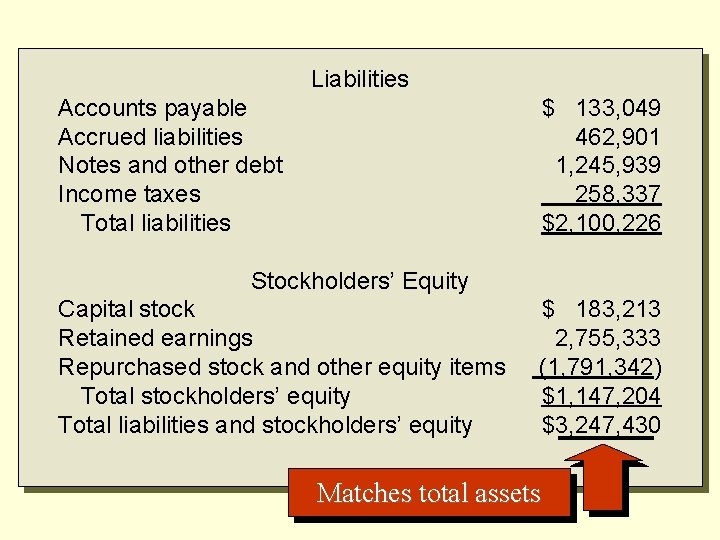
Liabilities Accounts payable Accrued liabilities Notes and other debt Income taxes Total liabilities $ 133, 049 462, 901 1, 245, 939 258, 337 $2, 100, 226 Stockholders’ Equity Capital stock Retained earnings Repurchased stock and other equity items Total stockholders’ equity Total liabilities and stockholders’ equity $ 183, 213 2, 755, 333 (1, 791, 342) $1, 147, 204 $3, 247, 430 Matches total assets
Statement of Cash Flows The statement of cash flows reports the changes in financial condition due to the changes in cash during a period. Reports change in financial Objective: condition
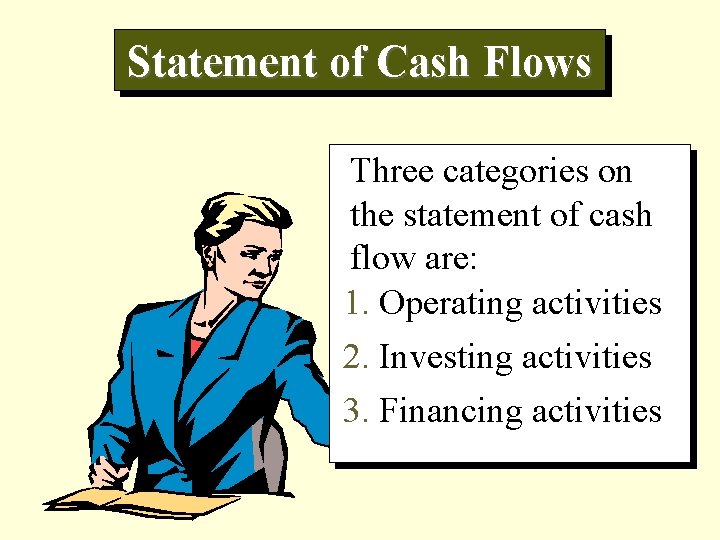
Statement of Cash Flows Three categories on the statement of cash flow are: 1. Operating activities 2. Investing activities 3. Financing activities
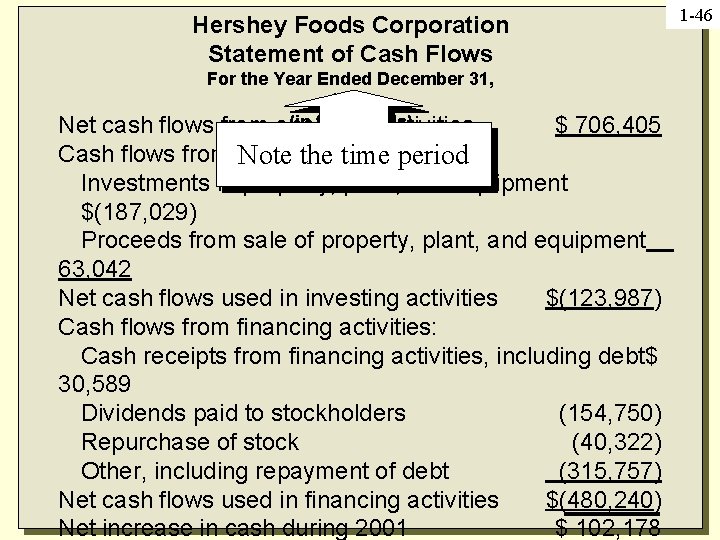
Hershey Foods Corporation Statement of Cash Flows For the Year Ended December 31, 2001 (in thousands) flows from operating activities Net cash $ 706, 405 Cash flows from investing Note the activities: time period Investments in property, plant, and equipment $(187, 029) Proceeds from sale of property, plant, and equipment 63, 042 Net cash flows used in investing activities $(123, 987) Cash flows from financing activities: Cash receipts from financing activities, including debt$ 30, 589 Dividends paid to stockholders (154, 750) Repurchase of stock (40, 322) Other, including repayment of debt (315, 757) Net cash flows used in financing activities $(480, 240) Net increase in cash during 2001 $ 102, 178 1 -46
Learning Objective 5 Describe eight basic accounting concepts underlying financial reporting.
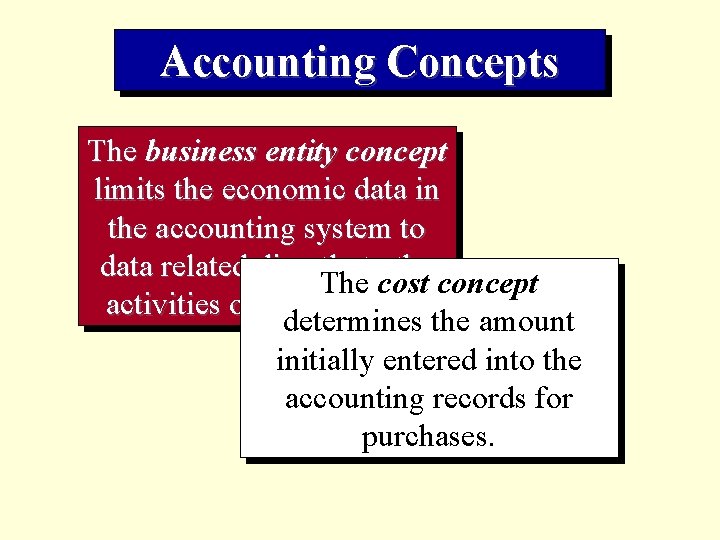
Accounting Concepts The business entity concept limits the economic data in the accounting system to data related directly to the The cost concept activities of the business. determines the amount initially entered into the accounting records for purchases.
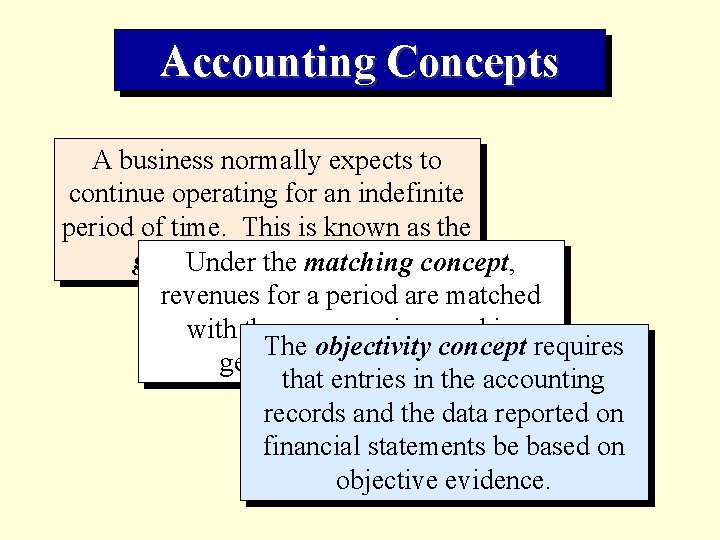
Accounting Concepts A business normally expects to continue operating for an indefinite period of time. This is known as the going. Under concern concept, the matching revenues for a period are matched with the expenses incurred in The objectivity concept requires generating the revenue. that entries in the accounting records and the data reported on financial statements be based on objective evidence.
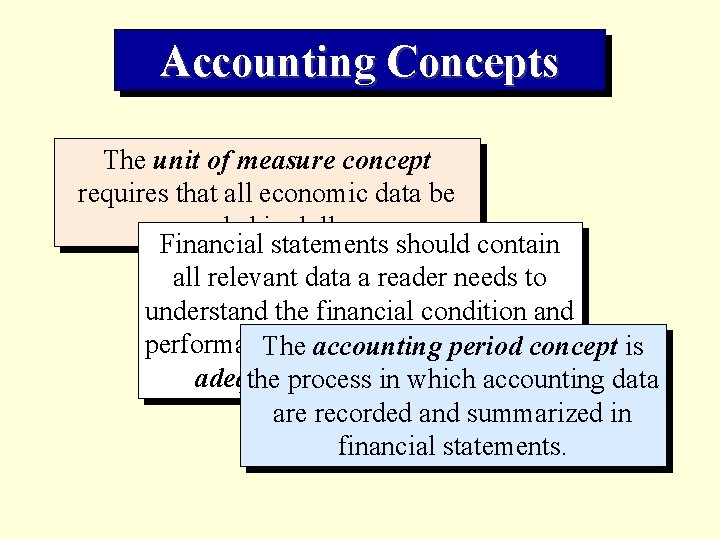
Accounting Concepts The unit of measure concept requires that all economic data be recorded in dollars. Financial statements should contain all relevant data a reader needs to understand the financial condition and performance a business. period This isconcept the Theofaccounting is adequate disclosure concept. the process in which accounting data are recorded and summarized in financial statements.
Financial History of a Business Income statement for the year ended December 31, 2003 1 3. C DE 003 2 Balance Sheet Dec. 31, 2003 Next slide
Financial History of a Business Income statement for the year ended December 31, 2004 1 3. C DE 004 2 Balance Sheet Dec. 31, 2004 Next slide
Financial History of a Business Income statement for the year ended December 31, 2005 1 3. C DE 005 2 Balance Sheet Dec. 31, 2005
Learning Objective 6 Describe and illustrate the use of horizontal analysis to analyze and evaluate a company’s performance.
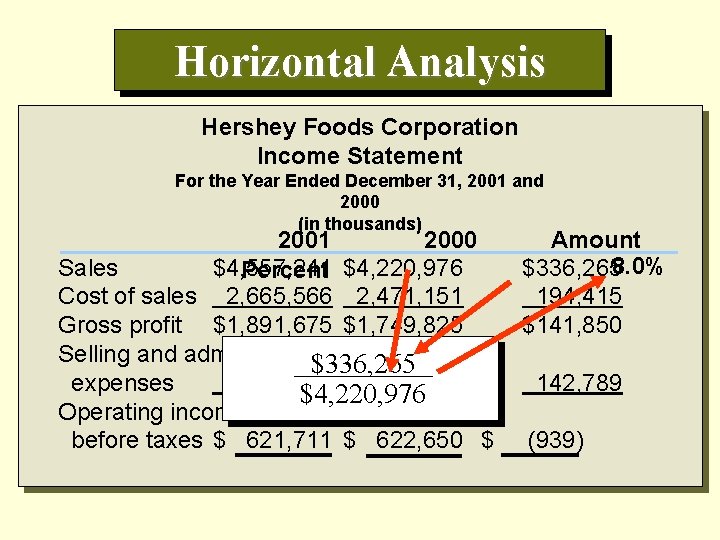
Horizontal Analysis Hershey Foods Corporation Income Statement For the Year Ended December 31, 2001 and 2000 (in thousands) 2001 2000 Sales $4, 557, 241 Percent $4, 220, 976 Cost of sales 2, 665, 566 2, 471, 151 Gross profit $1, 891, 675 $1, 749, 825 Selling and admin. $336, 265 expenses 1, 269, 964 1, 127, 175 $4, 220, 976 Operating income before taxes $ 621, 711 $ 622, 650 $ Amount $336, 2658. 0% 194, 415 $141, 850 142, 789 (939)
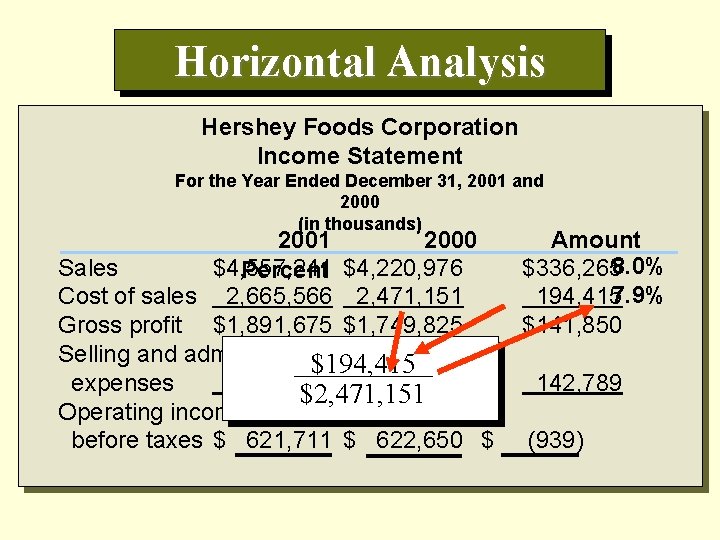
Horizontal Analysis Hershey Foods Corporation Income Statement For the Year Ended December 31, 2001 and 2000 (in thousands) 2001 2000 Sales $4, 557, 241 Percent $4, 220, 976 Cost of sales 2, 665, 566 2, 471, 151 Gross profit $1, 891, 675 $1, 749, 825 Selling and admin. $194, 415 expenses 1, 269, 964 1, 127, 175 $2, 471, 151 Operating income before taxes $ 621, 711 $ 622, 650 $ Amount $336, 2658. 0% 194, 4157. 9% $141, 850 142, 789 (939)
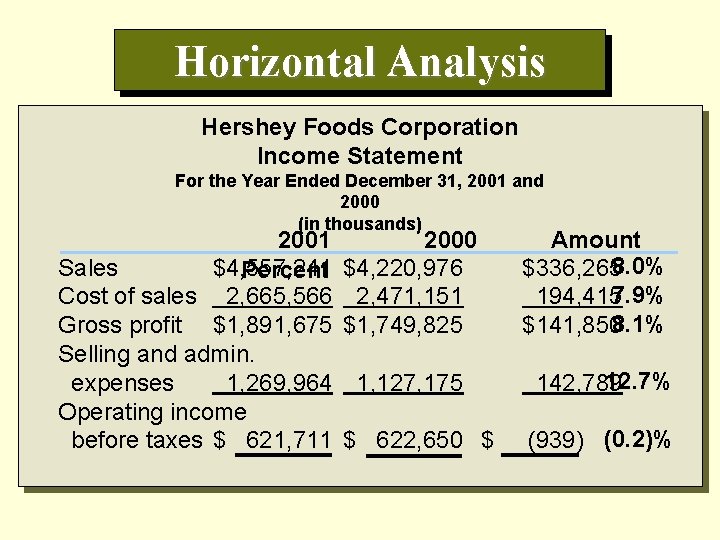
Horizontal Analysis Hershey Foods Corporation Income Statement For the Year Ended December 31, 2001 and 2000 (in thousands) 2001 Sales $4, 557, 241 Percent Cost of sales 2, 665, 566 Gross profit $1, 891, 675 Selling and admin. expenses 1, 269, 964 Operating income before taxes $ 621, 711 2000 $4, 220, 976 2, 471, 151 $1, 749, 825 1, 127, 175 $ 622, 650 $ Amount $336, 2658. 0% 194, 4157. 9% $141, 8508. 1% 12. 7% 142, 789 (939) (0. 2)%

Chapter 1 The End

- Slides: 59