
SURVEILLANCE OF COMMUNICABLE DISEASES by Prof Dr Mona
SURVEILLANCE OF COMMUNICABLE DISEASES by Prof. Dr. Mona Mortada modified by Prof. I Kharboush

Surveillance: definition q Ongoing and systematic collection, analysis and interpretation of health data in the process of describing and monitoring a health event. q The information is used for planning, implementing and evaluating public health interventions and programs.

Principles Of Surveillance An Effective Surveillance System 1. Addresses health events which causes substantial amount of morbidity and/or mortality. 2. Identifies and correctly classifies a large proportion of target health events. 3. Correctly reflects the distribution of events over time, place , and person. 4. Includes clear definitions of health events under surveillance.
Principles of Surveillance 5. Sets out appropriate methods for data collection, and for analysis, interpretation and feedback of information. 6. Leads to meaningful and effective public health action based on the data processed in the system. 7. Is uncomplicated and allocates resources efficiently and effectively.
Principles Of Surveillance 8. Is adaptive and responsive to new demand. 9. Encourages a high level of participation. 10. Provides information rapidly enough to allow effective action to be taken. 11. Requires minimal resources

Elements Of Surveillance (Types of Data Used) : 1 - Cases and Deaths Ø The total number of cases and/or deaths, Øthe date and the place of occurrence, Ødata on the characteristics of the patients and/or the deceased, for example, age, sex, and occupation are noted and recorded.
Types of Data Used (Cont. ): 2 - Laboratory Results They can be used to: Ø Confirm cases. Ø Detect bacterial resistance. Ø Determine levels of immunity in the population. Ø Determine the levels of environmental sanitation.
Types of Data Used (Cont. ) : 3 - Prevention and control measures: These are data obtained from the programs used for prevention and control, such as: Øthe number of patients treated, Ødwelling sprayed, Øvaccines applied. . . etc. q
Types of Data Used (Cont. ) : 4 - Environmental conditions: Such as: Ø The proportion of population supplied with water. Ø Quality of water Ø The coverage of services for excreta and garbage disposal Ø Levels of air pollution
Types of Data Used (Cont. ) : 5 - Vectors: The data on: qtypes of vectors existing in the area, qtheir geographical distribution, qtheir habits, qtheir level of resistance and susceptibility to insecticides.
Types of Data Used (Cont. ) : 6 - Reservoirs q. The data on types and distribution of both human and animal reservoirs.
Types of Data Used (Cont. ) : 7 - Population The data on: Øthe size of the population, Ø its distribution age, sex, Øgeographical distribution Øits migratory patterns; Øits susceptibility or resistance to diseases.
Types of Data Used (Cont. ) The data collected depends on the disease and its mode of transmission
Identifying Diseases For Surveillance: 1. It affects large number of people. 2. It causes substantial mortality or disability. 3. It is the target of a national, regional or international control program. 4. It is preventable and the surveillance will lead to an immunization campaign. 5. A limited outbreak of a severe disease in a few persons such as cholera or
LIMITATIONS OF SURVEILLANCE Labor Intensity Time Constraints Assessment Difficulties Reporting Inadequacies
LIMITATIONS OF SURVEILLANCE: 1 - Labor Intensity: ØSurveillance is a labor-intensive. ØIt requires much effort to collect the needed data, especially if it is not already being collected as part of the routine recording and reporting system; ØTabulation and analysis of data are also timeconsuming. For these reasons, most systems are limited to a few key indicators.
LIMITATIONS OF SURVEILLANCE: 2 - Time Constraints: q. It takes several years of data collection before trends are identified.
LIMITATIONS OF SURVEILLANCE: 3 - Assessment Difficulties: It can be difficult to assess the impact of disease: qif your target population is small, or qif you cannot set up control groups to compare disease patterns between program and non- program areas.
LIMITATIONS OF SURVEILLANCE: 4 - Reporting Inadequacies: ØReporting of surveillance data is often incomplete, especially from remote areas. ØThe data may be unrepresentative or wrongly collected or analyzed. ØIt needs to be carefully checked.
SURVEILLANCE PROCEDURES: q. The Surveillance procedures refer to steps that should be taken in designing and operating a surveillance system q. Nine steps are required:
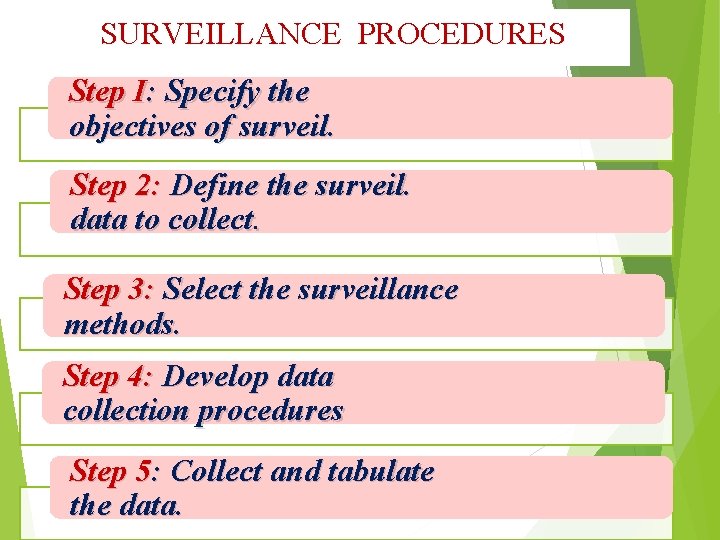
SURVEILLANCE PROCEDURES Step I: Specify the objectives of surveil. Step 2: Define the surveil. data to collect. Step 3: Select the surveillance methods. Step 4: Develop data collection procedures Step 5: Collect and tabulate the data.
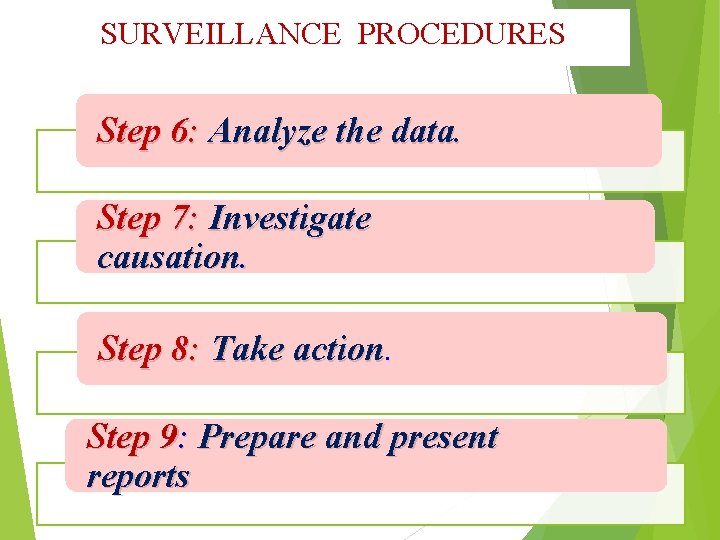
SURVEILLANCE PROCEDURES Step 6: Analyze the data. Step 7: Investigate causation. Step 8: Take action. Step 9: Prepare and present reports
Step 1: Specify objectives of surveillance The principle objectives of surveillance are: 1. To identify communicable diseases of public health importance. 2. To identify quickly any outbreak, epidemic or event to institute prevention and control activities early enough before further spread. 3. To identify risk factors involved in disease occurrence and explain cause of an illness or death.
Step 1: Specify objectives of surveillance 4. To identify specific population groups that are at high risk of illness and death. 5. To monitor disease trends. 6. To assess the current disease control activities and the effectiveness of specific interventions.
Step 2: Define the surveillance data to collect 1. The data to be collected should be indicated. The collection of surplus data should be avoided. 2. If you decide to investigate the causes of morbidity or mortality of a specific disease, indepth interviews to obtain the required data will need to be carried out. 3. Specify the indicator for each item to be monitored e. g. morbidity, mortality, case fatality, treatment success, immunization coverage.
Step 3 : Select the methods and procedures I. Routine Reporting System II. Sentinel reporting system III. Surveys and special studies IV. Case and outbreak investigations
Step 3 : Select the methods and procedures I. Routine Reporting System: q. Data are reported as a part of the routine screening and diagnosis process during visits to health facilities. q. Reports are based on direct contacts with the individual who is sick, dying, or has died.
Step 3 : Select the methods and procedures Advantages of routine reporting system: 1. Taking data from an ongoing system. Thus, they are inexpensive and efficient ways to collect information. 2. The data cover all health activities from routine well-baby clinic to surgery. 3. The same type of data is collected, and the same reporting periods are used. This is a great advantage for making comparisons among areas.
Step 3 : Select the methods and procedures Disadvantages of routine reporting system: 1) Incomplete reporting due to: Not all cases come to the health facility for treatment. Ø Distance, transportation costs, Ø Loss of income, Ø Cultural taboos
Step 3 : Select the methods and procedures 2) Not all cases are identified by outreach workers. 3) Complete and accurate reporting are always a problem in PHC. 4) Even when reporting is fairly regular and complete, there may be inconsistencies among health workers if they don't use the same procedures, definitions and guidelines.
Step 3 : Select the methods and procedures II. Sentinel reporting system: q A small number of health units is selected to report cases of diseases or deaths that are seen and diagnosed at their facility. q They may be also asked to report additional information, such as the immunization status of the children treated at the facility.
Step 3 : Select the methods and procedures q. The sites chosen are not necessarily selected because they are representative of the area. q. They may be chosen because they are likely to see cases of specific diseases, or because their caseloads are high enough that rare events are likely to be identified.
Step 3 : Select the methods and procedures Other criteria that are important are: Ø reliability of data collection, Ø timeliness of reporting, Ø willingness of staff to participate, Ø high quality laboratory or diagnostic capabilities. q. Hospitals are often included as sentinel sites, since: Ø likely to have much higher caseloads than centers Ø more likely to have staff trained in diagnosis and processing.
Step 3 : Select the methods and procedures Advantages of sentinel reporting : 1. Sentinel sites may provide a more consistent picture of illness in a given area than routine reporting. 2. Data collected from these sites may also show whether routine reporting is accurate or not. 3. Being chosen to participate in surveillance tends to motivate the staff to do the best they can to report accurately and on time.
Step 3 : Select the methods and procedures 4. They are also relatively inexpensive to set up and operate, especially in contrast to a "universal" system where all potential facilities would be required to report. Disadvantages of sentinel reporting : 1. 2. They are not representative of the entire population at risk. The data they generate may not be of sufficient volume to generates and ratios that are important for assessing changes in health status.
Step 3 : Select the methods and procedures III. Surveys and special studies: Sample surveys are often used for surveillance q. They usually provide broad estimate of the incidence or prevalence of a disease, q. They can also be used to estimate mortality rates, although the sample sizes required to do this are very large. q. Can be used to evaluate the reliability of the routine or sentinel systems. q
Step 3 : Select the methods and procedures IV. Case and outbreak investigations: q These investigations are attempts to identify the causes of a death or a disease, q They are not alternatives to routine and sentinel systems, but are used as a next step in epidemiological investigations.
Step 3 : Select the methods and procedures q. In general a "case" investigation is an investigation of a single case; q. An "outbreak" investigation is an investigation of many cases. q. When the occurrence of a particular disease is very low, polio for example, even one case can be considered an outbreak.
Step 3 : Select the methods and procedures Advantages of case or outbreak investigation : q The investigations have a programmatic as well as medical objective. They can identify Ø Errors that should be corrected, Ø Procedures that could be changed to prevent problems from occurring in the first place.
Step 3 : Select the methods and procedures q The investigations can provide staff with a: Ø Chance to learn more about the conditions and causes of diseases and deaths, Ø Can use information to improve internal procedures.
Step 4: Develop the data collection and reporting procedures Data collection and reporting procedures consists of three sub -steps: 1) Develop operational definitions of cases. 2) Develop or revise the collection/recording instruments. 3) Pretest the instruments. 1
Step 4. 1: Develop an operational definition of a case q. A case definition is necessary to ensure that all health workers use the same definition and criteria to diagnose a specific disease. Otherwise, the surveillance system will be of no use. q. WHO definitions can be used.
Step 4. 1: Develop an operational definition of a case q. When developing your own case definition, make sure it is: clear, consistent throughout the surveillance system, highly sensitive and specific. q. It should also include appropriate criteria for confirmation.
Step 4. 1: Develop an operational definition of a case Types of case definitions for purposes of surveillance: 1. The lay case: A non-clinical definition using clear terms to identify the symptoms. 2. The suspected or clinical case: Based on clinical diagnosis by health professionals only with no laboratory tests.
Step 4. 1: Develop an operational definition of a case 3. The probable case: Based on clinical diagnosis. Laboratory test is suggestive but not confirmatory. 4. The confirmed case: Based on clinical diagnosis and confirmed laboratory investigation.
Step 4. 1: Develop an operational definition of a case An Example of Standard Case Definition : Meningococcal Meningitis: 1. Suspected case of acute meningitis: Sudden onset of fever ( > 38. 5 ºC rectal or 38. 0 ºC axillary) with stiff neck. Ø In infants less than one year of age, meningitis is suspected when fever is accompanied by a bulging fontanels.
Step 4. 1: Develop an operational definition of a case 2 - Probable case of Meningococcal meningitis: 1. A suspected case of acute meningitis as defined above, with turbid cerebrospinal fluid (CSF). Gram stain showing Gramnegative diplococcic; or 2. Ongoing epidemic; or 3. Petechial or purpural rash.
Step 4. 1: Develop an operational definition of a case 3 - Confirmed case of Meningococcal meningitis: q. A suspected case or probable one of acute meningitis as defined above, with either: Øpositive culture of cerebrospinal fluid or, Øblood with identification of Neisseria meningitides.
Step 4. 2: Develop/revise data collection/recording instruments 1) Registers: A. Clinic registers B. Individual clinic treatment records C. Outreach registers D. Death registers. 2) Survey questionnaires 3) Case investigation form
Step 4. 2: Develop/revise data collection/recording instruments Rules which should be considered when identifying and recording cases: Avoid double-counting. 2) Only count those cases that have been diagnosed by a health worker 3) Count and tabulate separately cases diagnosed through lay reporting 4) Count current cases only 1)
Step 4. 3: Pretest the instruments q. After selection of instruments they should be tested under real conditions. q. They should be tried to see: Øif they are understandable to staff, Øeasy to use, and produce the type of data needed.
PROCEDURES Step 5: Collect, Tabulate and Report the Data q. Health centers and district offices use the following forms to report data: 1. Weekly, monthly or quarterly surveillance reports. 2. Disease case investigation forms. 3. Disease maps. 4. Disease charts.
Step 5: Collect, Tabulate and Report the Data Training, supervision and quality control: Good training and supervision of the staff is crucial to the success of the system. 1) Training: Training should cover the following topics: 1. The purpose and utility of surveillance. 2. How to recognize and classify specified diseases using standard or lay case definitions.

Step 5: Collect, Tabulate and Report the Data 3. How to record data on the clinic and outreach registers. 4. How to summarize and report data on weekly or monthly basis. 5. How to determine if further investigation is needed.
Step 5: Collect, Tabulate and Report the Data Ways to deal with problems of investigators: 1. Make sure that the interviewers are well trained to begin with. 2. Watch them during practice session to see if they have the insistence to go after the needed information. 3. Make sure that there is enough time allocated to allow the interviewer to get to and from the site, establish empathy, and search for answers.
Step 5: Collect, Tabulate and Report the Data 4. Encourage the investigators to express their concern and feelings, and help them to deal with them. 5. Teach them culturally appropriate ways to obtain the information. 6. Accompany them periodically on investigations to observe their technique and provide constructive feedback.
Step 5: Collect, Tabulate and Report the Data 2) Supervision : 1. The supervisor should make sure that the interviewers follow up on all designated cases and deaths. 2. He should not let them skip some because they are inconvenient. 3. He should make sure that they follow up on answers that are not complete, or questions which are not answered.
Step 5: Collect, Tabulate and Report the Data 3) Quality control: The best way to ensure quality is to introduce the desire for it in the interviewer. Ø The interviewers should be encouraged to examine their own procedures, and to identify ways to improve them. Ø The interviewers should be brought together as a group to share experiences and to seek solutions to common problems. Ø
Step 5: Collect, Tabulate and Report the Data ØA sure indicator of problems of quality is a high "unknown" ratio, if more than 10 to 20 % of the causes of a disease or death are unknown, then it is likely that something is wrong. ØIt could be that the instrument, interview technique, or timing of the interview is causing the bias.
Step 5: Collect, Tabulate and Report the Data Indicators of quality of reporting ØProportion of centers reporting ØProportion of reports submitted within x days of the mandatory reporting date ØProportion submitting “zero reporting” ØThe main indicators of quality of reporting is timeliness/completeness of reporting
Step 6: Analyze the Data ØAnalysis should be encouraged at each level of the surveillance system. ØHealth facility staff should also be encouraged to analyze their data. ØEven at the peripheral level they should learn to interpret the data they are collecting to have a better understanding of the needs of their communities.
Step 6: Analyze the Data presentation: Summary tables Ø Most tables will be made out of simple counts of the number of cases. ØSome tables may include Percentage distributions, and a few might include averages.
Step 6: Analyze the Data Disease charts q Summary disease charts are usually made for a 12 -month period for one health center, and then prepared for all health centers combined. q. Disease charts are usually in the form: line graph Ø histogram Ø bar chart Ø pie chart. Ø
Step 6: Analyze the Data Maps q. The advantage of a visual presentation of the geographical distribution of cases is that it is easier to identify the location of cases that can often give a quick picture of how communicable diseases are spreading.
Step 6: Analyze the Data Computing rates and ratios: q Rates and ratios should be calculated if the target population is large enough to produce reasonably accurate figures, especially when computing mortality rates.

Step 6: Analyze the Data Incidence rate Attack rate Ø An attack rate is an incidence rate, usually expressed as a percent and applied to narrowly defined populations observed for limited periods of time, as in an outbreak or epidemic. ØThe formula is the same as for the incidence rate.
Step 6: Analyze the Data Prevalence rates measures the frequency of all current cases of the disease, i. e. , the old and new cases and are of two types: 1 -Point prevalence rate: This measures the frequency of the current illness at a given point of time 2 - Period prevalence
Step 6: Analyze the Data Analysis: The purpose of analysis is to: (1) Identify patterns, and (2) Identify causes of diseases or deaths. Look for the following patterns in your data: 1 - Spikes: Unusual or sharp increases or decreases in the number of cases. This can indicate an outbreak of a disease
Step 6: Analyze the Data 2 -Clusters: Ø Groupings of cases by time period, area, age group, etc. ØThis can indicate an outbreak that is limited to a certain part of the population, such as an outbreak of cholera in a specific part of the city.
Step 6: Analyze the Data 3 -Trends: Gradual increases or decreases in cases over a long time. Trends should be watched carefully, since they may occur so gradually that change is not observed. 4 -Seasonal variations: Regular changes according to the time of the year.
Step 7 : Investigate Causation 7. 1 Case and outbreak investigations: The primary objective of a case or outbreak investigation usually is to identify ways of preventing further transmission of the disease-causing agent.
Step 7 : Investigate Causation The general guidelines for conducting the investigation are as follows: 1. 2. 3. 4. Observe or examine the patient, if possible; Interview the mother or other relative who has first-hand knowledge of the case; Interview the health worker who observed, examined or treated the case; Collect basic descriptive information about the case
Step 7 : Investigate Causation 5. Confirm the diagnosis; 6. Identify symptoms the patient had before and during the illness; 7. Determine whether the patient had received appropriate preventive care; 8. Identify treatment the patient received during the illness; 9. Identify the outcome of the treatment and illness.
Step 7 : Investigate Causation The information collected will then be analyzed to identify: (1) the main cause of the disease; (2) action that could be taken in the future to prevent a recurrence of the disease
Step 7 : Investigate Causation 7. 2 Verbal autopsies: 1. Observe or examine the body, if possible; 2. Interview the mother or other relative who has first-hand knowledge of the death; 3. Interview the health worker who observed, examined or treated the deceased prior to, during, or after death;
Step 7 : Investigate Causation 4. Collect basic descriptive information about the death: A. circumstances of the death; B. symptoms and condition of the patient at time of death; C. suspected causes. 5. Identify the main (most probable) cause of death; 6. Identify associated causes;
Step 7 : Investigate Causation 7. Determine whether the patient had received appropriate preventive care; 8. Identify the treatment the patient received during the illness. As with case or outbreak investigations, the analysis should identify: the main cause of the death; and II. action that could be taken in the future to prevent this type of death. I.
Step 8 : Develop an action plan ØObviously, the whole purpose of surveillance is to find ways to prevent unnecessary disease and death. ØThe data collected through the surveillance system will help to do that. ØOnce the problems have been identified, and their causes determined, the next step is take action to eliminate those problems.
Step 8 : Develop an action plan 1 - What: The action (s) to be taken should be specified. 2 - Who: The specific people who will be responsible for each action should be identified, by name or position. 3 - When: The date for starting and/or completing the action. 4 - Where: The sites or locations where actions will take place. 5 - How: Outline of procedures that will be followed. 6 - Resources: Outline of resources that will be made available to carry out the actions.
Step 9: Prepare and present reports Ø Most surveillance systems are designed at the central level and requires reports to be sent to that level for analysis and interpretation. ØOther levels will be interested as well. Ø If formal reports are to be sent to the central level and to other levels, organizations, agencies or concerned authorities then the following guidelines may be of some help:
Step 9: Prepare and present reports 1 - Review original objectives to make sure that you know the user's most important objectives, questions, issues, and indicators. Make sure that your report addressed them. 2 - Review tables, charts, and maps. Decide which ones will provide the users with the information that most interest them.
Step 9: Prepare and present reports Ø Add a short narrative (sequence of events) to explain each one. Ø Order them in some logical sequence, such as the following: a- The number of cases of each disease; b- The number of deaths, by cause; c- An analysis of trends, what they mean; d- Major issues that need to be addressed; e- A summary of the actions that you have (or plan) to take.
Surveillance Communicable diseases: WHO Anthrax. Avian influenza. Crimean-Congo hemorrhagic fever. Dengue hemorrhagic fever. Ebola virus disease. Hepatitis. Influenza. Maternal deaths surveillance NCDs surveillance e. g. injuries
Surveillance There are two types of public health surveillance – event-based surveillance and indicator-based surveillance – complement one another. Both types of surveillance include collecting, monitoring, assessing, and interpreting data. However, the types of data used and the situations in which we use them can be different. https: //www. cdc. gov/globalhealth/healthprotection/gddopscenter/ho w. html
Event-based surveillance Event-based public health surveillance looks at reports, stories, rumors, and other information about health events that could be a serious risk to public health. Such information may be described as unstructured information because the information obtained is nonstandardized or subjective.
Event-based surveillance The goal of EBS is to detect unusual events that might signal an outbreak. Information obtained through EBS can come from sources like reports in the media or rumors on an internet blog. EBS can also be community-based, meaning that information about a possible public health event is reported by people in the community through a hotline or other messaging system. For example, if a teacher notices an unusually high number of children absent from school with similar symptoms and reports it to a local health official, the teacher can be considered a participant in community EBS.
Indicator-based surveillance Indicator-based public health surveillance is a more traditional way of reporting diseases to public health officials. Indicator-based surveillance involves reports of specific diseases from health care providers to public health officials.
Indicator-based surveillance Such information may be described as structured information because the information obtained is standardized. An example of information obtained through indicator-based surveillance might be reports received on a regular basis and entered routinely into a diseasereporting database on the number of laboratory-confirmed cases of influenza identified at a hospital laboratory.
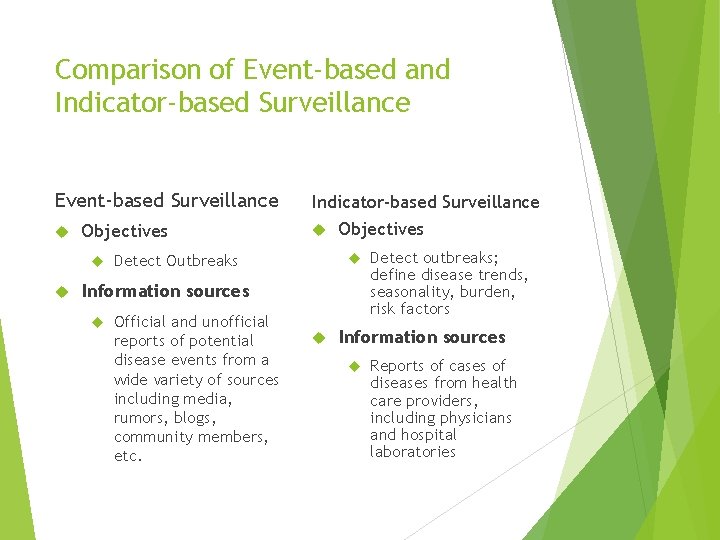
Comparison of Event-based and Indicator-based Surveillance Event-based Surveillance Objectives Indicator-based Surveillance Objectives Detect Outbreaks Information sources Official and unofficial reports of potential disease events from a wide variety of sources including media, rumors, blogs, community members, etc. Detect outbreaks; define disease trends, seasonality, burden, risk factors Information sources Reports of cases of diseases from health care providers, including physicians and hospital laboratories
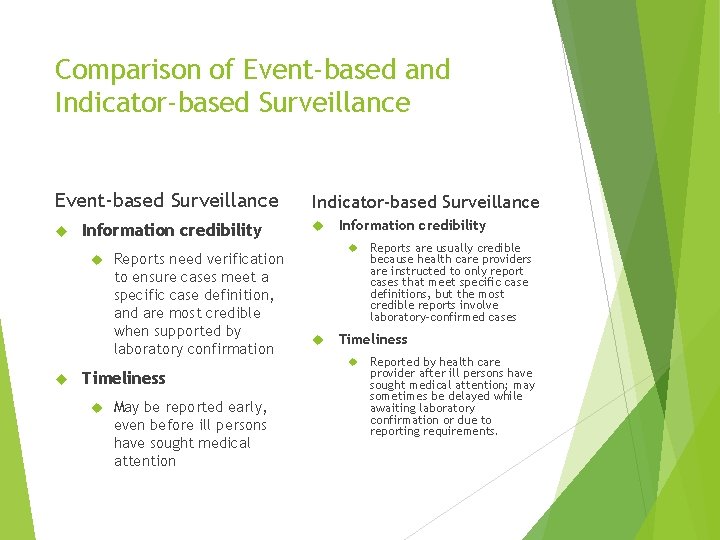
Comparison of Event-based and Indicator-based Surveillance Event-based Surveillance Information credibility Reports need verification to ensure cases meet a specific case definition, and are most credible when supported by laboratory confirmation Timeliness May be reported early, even before ill persons have sought medical attention Indicator-based Surveillance Information credibility Reports are usually credible because health care providers are instructed to only report cases that meet specific case definitions, but the most credible reports involve laboratory-confirmed cases Timeliness Reported by health care provider after ill persons have sought medical attention; may sometimes be delayed while awaiting laboratory confirmation or due to reporting requirements.

Comparison of Event-based and Indicator-based Surveillance Event-based Surveillance Where is it used? Indicator-based Surveillance Can be used anywhere Where is it used? What diseases is it used for? All public health events involving potential disease, including events caused by unknown disease Where health infrastructure exists and health care providers and laboratories are willing to participate in public health surveillance What diseases is it used for? Usually known diseases

- Slides: 92