
Surveillance During Animal Disease Emergencies Overview Surveillance Ongoing
- Slides: 17
Surveillance During Animal Disease Emergencies Overview
Surveillance ● Ongoing, systematic collection, analysis, and interpretation of health -related data ● Essential for planning, implementation, and evaluation ● Disease prevention and control measures Just In Time Training Surveillance: Overview
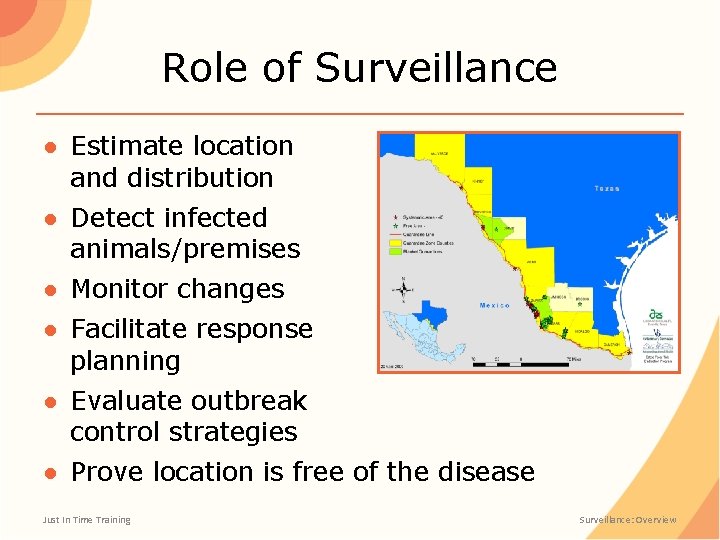
Role of Surveillance ● Estimate location and distribution ● Detect infected animals/premises ● Monitor changes ● Facilitate response planning ● Evaluate outbreak control strategies ● Prove location is free of the disease Just In Time Training Surveillance: Overview
What You Will Need To Know ● Target disease – Organism § Animal only § Zoonotic § Level of PPE § Biosecurity – Incubation period § Trace back § Trace forward Just In Time Training – Transmission route § Trace additional cases § How pathogen spreads – Animals – Fomites – Vectors Surveillance: Overview
What You Will Need To Know ● Type of data needed – Visual Inspection – Diagnostic testing – Survey - Review records § Vaccination status § Environmental exposure § History Just In Time Training Surveillance: Overview
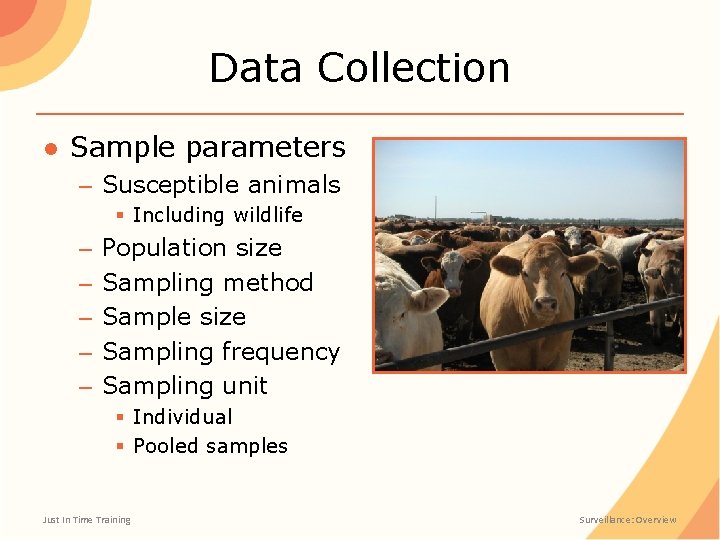
Data Collection ● Sample parameters – Susceptible animals § Including wildlife – – – Population size Sampling method Sample size Sampling frequency Sampling unit § Individual § Pooled samples Just In Time Training Surveillance: Overview
Case Definition ● Clinical criteria – Clinical signs in individuals ● Epidemiological criteria ● Definition should include – Species – Location – Time – Mortality rates – Morbidity rates ● Laboratory criteria – Screening test – Confirmatory test Just In Time Training Surveillance: Overview
Case Classification ● Negative Case – No clinical signs – No positive lab results ● Suspect Case – Has clinical signs – No confirmed lab result Just In Time Training ● Presumptive Positive Case – Has clinical signs – Has a positive lab result ● Confirmed Positive Case – Agent has been isolated and identified Surveillance: Overview
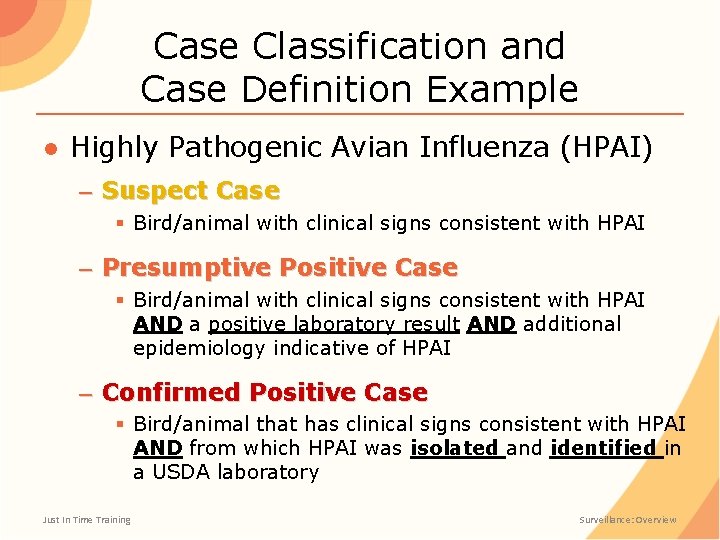
Case Classification and Case Definition Example ● Highly Pathogenic Avian Influenza (HPAI) – Suspect Case § Bird/animal with clinical signs consistent with HPAI – Presumptive Positive Case § Bird/animal with clinical signs consistent with HPAI AND a positive laboratory result AND additional epidemiology indicative of HPAI – Confirmed Positive Case § Bird/animal that has clinical signs consistent with HPAI AND from which HPAI was isolated and identified in a USDA laboratory Just In Time Training Surveillance: Overview
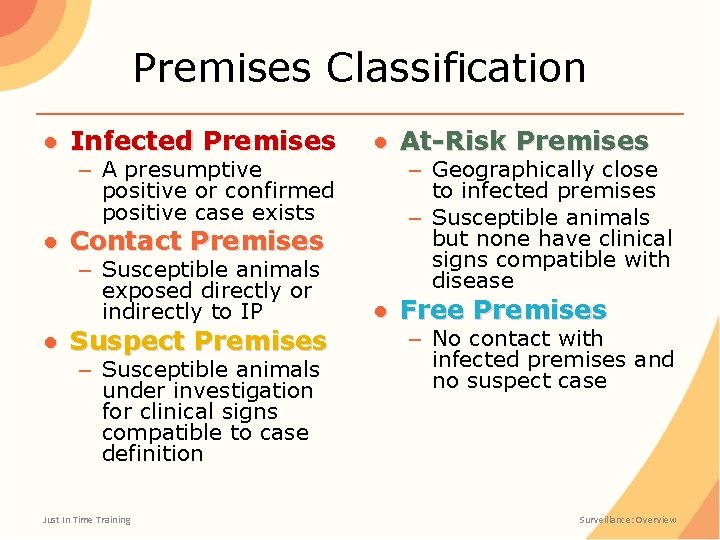
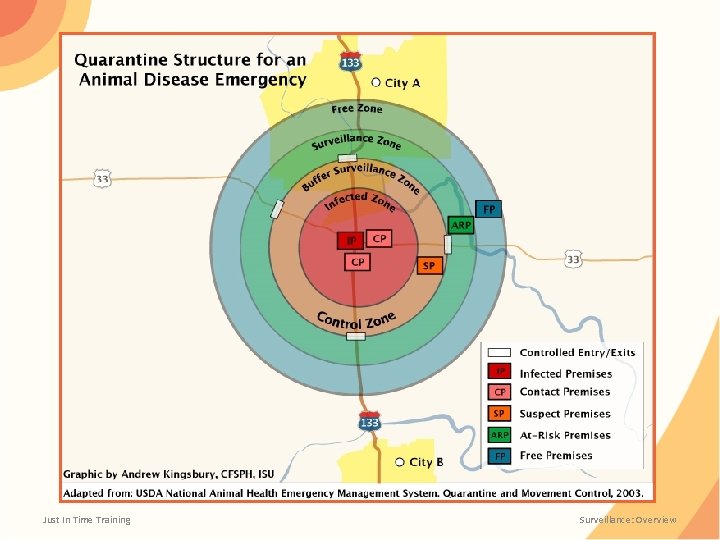
Premises Classification ● Infected Premises – A presumptive positive or confirmed positive case exists ● Contact Premises – Susceptible animals exposed directly or indirectly to IP ● Suspect Premises – Susceptible animals under investigation for clinical signs compatible to case definition Just In Time Training ● At-Risk Premises – Geographically close to infected premises – Susceptible animals but none have clinical signs compatible with disease ● Free Premises – No contact with infected premises and no suspect case Surveillance: Overview
Just In Time Training Surveillance: Overview
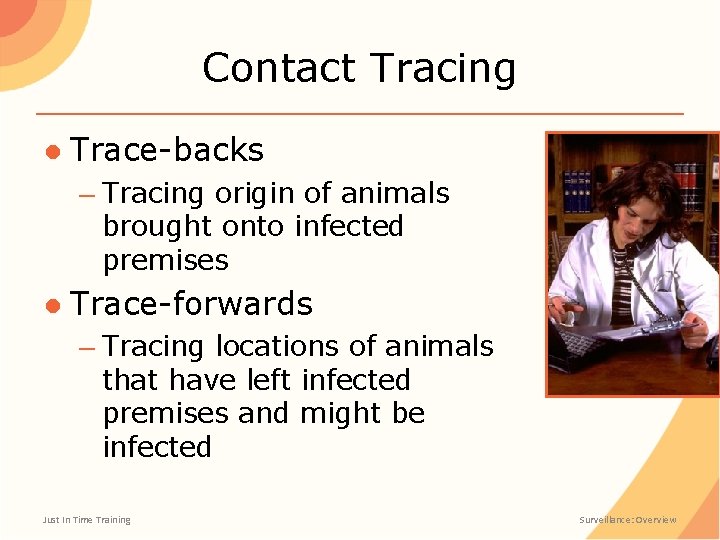
Contact Tracing ● Trace-backs – Tracing origin of animals brought onto infected premises ● Trace-forwards – Tracing locations of animals that have left infected premises and might be infected Just In Time Training Surveillance: Overview
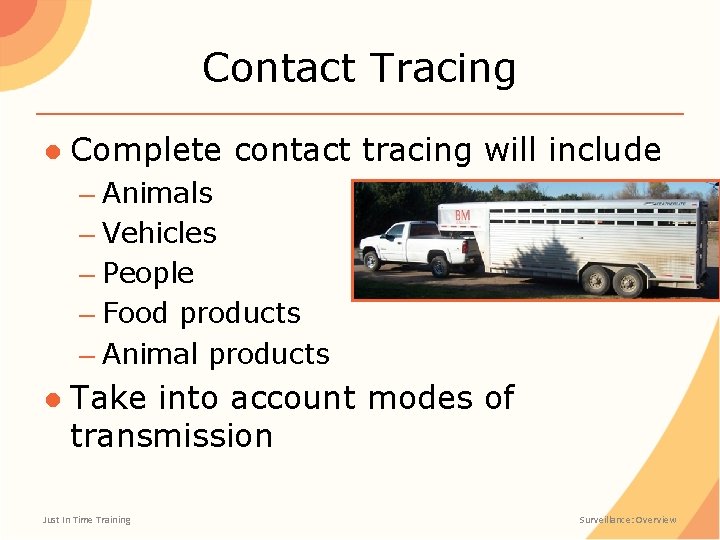
Contact Tracing ● Complete contact tracing will include – Animals – Vehicles – People – Food products – Animal products ● Take into account modes of transmission Just In Time Training Surveillance: Overview
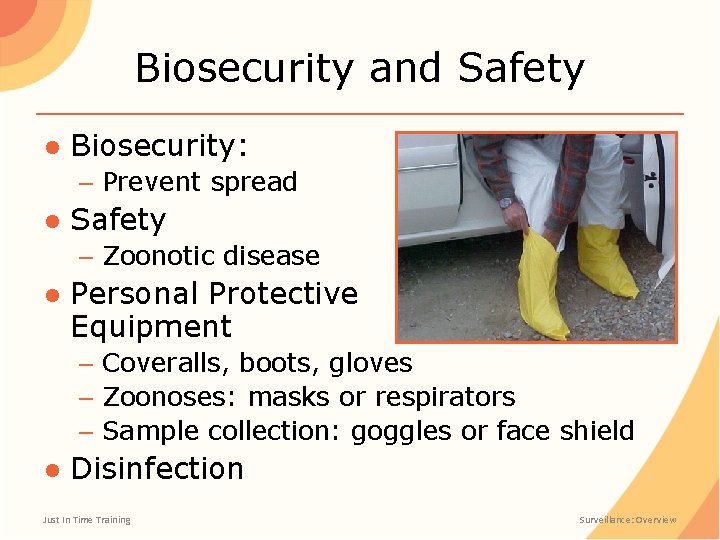
Biosecurity and Safety ● Biosecurity: – Prevent spread ● Safety – Zoonotic disease ● Personal Protective Equipment – Coveralls, boots, gloves – Zoonoses: masks or respirators – Sample collection: goggles or face shield ● Disinfection Just In Time Training Surveillance: Overview
Public Interaction ● Access to private premises – Owners may react differently ● Guidelines – Travel in teams – Cell phones are necessary – Introduce yourself and purpose – Avoid confrontation – Leave if safety concerns exist Just In Time Training Surveillance: Overview
References ● USDA Resources for Conducting Animal Health Surveillance – Surveillance and Data Standards – Guidelines for Developing Animal Health Surveillance Plans – http: //www. aphis. usda. gov/vs/nahss/resources. htm ● Animal Disease Surveillance Survey Systems, MD Salman Editor. 2003. Blackwell Publishing, Ames Just In Time Training Surveillance: Overview
Acknowledgments Development of this presentation was by the Center for Food Security and Public Health at Iowa State University through funding from the Multi-State Partnership for Security in Agriculture Authors: Sarah Viera, MPH, Glenda Dvorak, DVM, MPH, DACVPM